
Life, 1885-01-22 · page 10 of 16
Life — January 22, 1885 — page 10: what you’re looking at
What you’re looking at
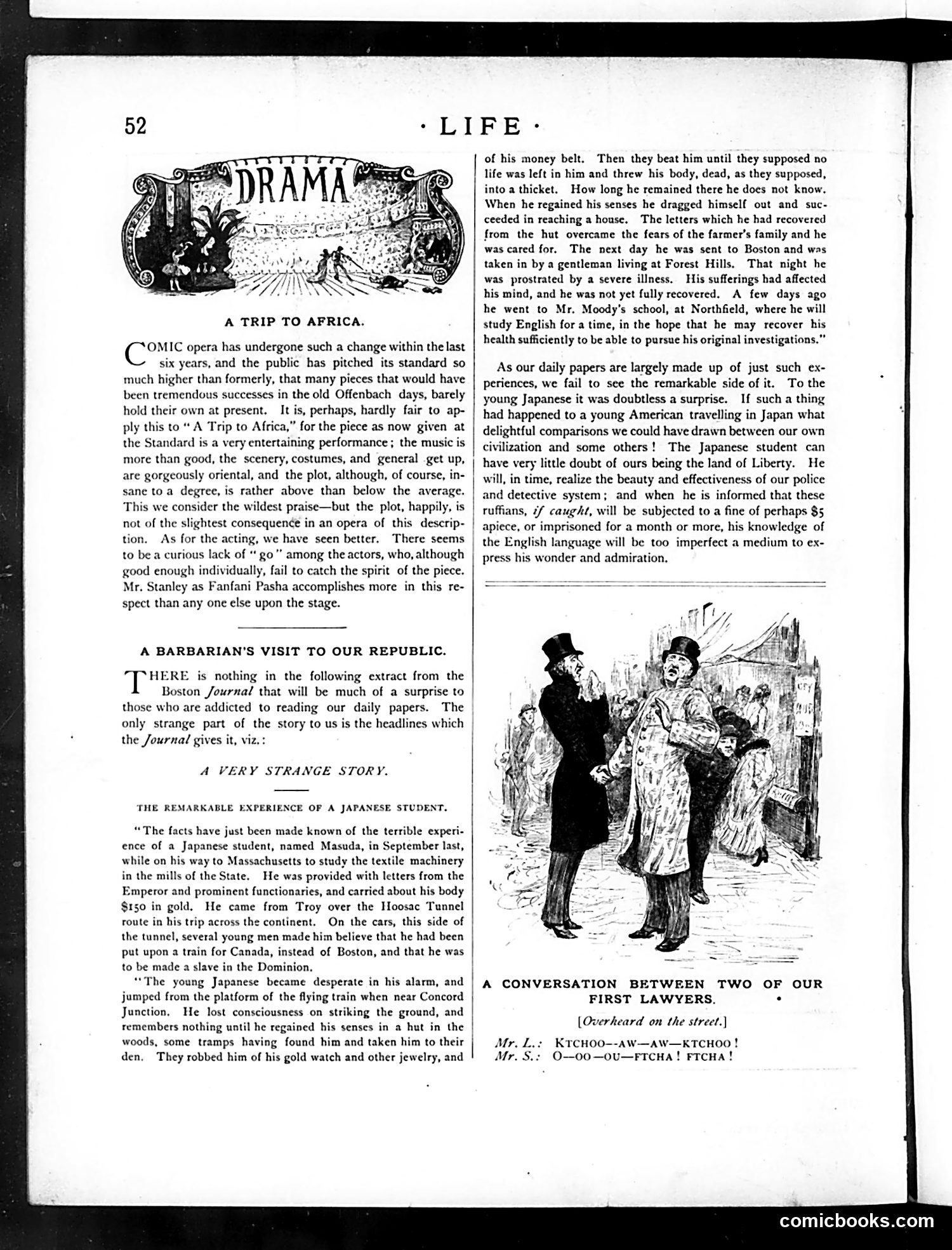
This page contains two distinct pieces of social satire: **"A Trip to Africa"** reviews a comic opera at the Standard Theatre, criticizing the production's weak acting despite adequate music and scenery. The reviewer praises only Mr. Stanley's performance as "Fanfani Pasha." **"A Barbarian's Visit to Our Republic"** is the more pointed satire. It reprints a Boston Journal account of a Japanese student (Masuda) who was robbed, beaten, and nearly killed by American con men and tramps during his 1882 journey to Massachusetts. The satire's bite lies in Life's observation that Americans would be outraged if a young American faced such treatment in Japan—yet consider this "not remarkable" when happening to a foreigner in America. The article sardonically notes that while the Japanese student learned "the beauty and effectiveness of our police and detective system," he also experienced American lawlessness firsthand. The piece critiques American hypocrisy: the nation prides itself on civilization while its actual treatment of foreigners reveals otherwise.
📄 Transcribed text from this page (OCR, searchable)
Machine-transcribed from the original scan — historical spelling and the odd misread are preserved.
- LIFE: A TRIP TO AFRICA. OMIC opera has undergone such a change within the last six years, and the public has pitched its standard so much higher than formerly, that many pieces that would have been tremendous successes in the old Offenbach days, barely hold their own at present. It is, perhaps, hardly fair to ap- ply this to “ A Trip to Africa,” for the piece as now given at the Standard is a very entertaining performance ; the music i: more than good, the scenery, costumes, and general get up, are gorgeously oriental, and the plot, although, of course, in- sane toa degree, is rather above than below the average. This we consider the wildest praise—but the plot, happil not of the slightest consequence in an opera of this descrip- tion. As for the acting, we have seen better. There seems to bea curious lack of “ go" among the actors, who, although good enough individually, fail to catch the spirit of the piece. Mr. Stanley as Fanfani Pasha accomplishes more in this re- spect than any one else upon the stage. A BARBARIAN'S VISIT TO OUR REPUBLIC. HERE is nothing in the following extract from the Boston Journal that will be much of a surprise to those who are addicted to reading our daily papers. The only strange part of the story to us is the headlines which the Journal gives it, viz.: A VERY STRANGE STORY. THE REMARKABLE EXPERIENCE OF A JAPANESE STUDENT. “The facts have just been made known of the terrible experi- ence of a Japanese student, named Masuda, in September last, while on his way to Massachusetts to study the textile machinery in the mills of the State. He was provided with letters from the Emperor and prominent functionaries, and carried about his body $150 in gold. He came from Troy over the Hoosac Tunnel route in his trip across the continent. On the cars, this side of the tunnel, several young men made him believe that he had been put upon a train for Canada, instead of Boston, and that he was to be made a slave in the Dominion, “The young Japanese became desperate in his alarm, and jumped from the platform of the flying train when near Concord Junction, He lost consciousness on striking the ground, and remembers nothing until he regained his senses in a hut in the woods, some tramps having found him and taken him to their den, They robbed him of his gold watch and other jewelry, and of his money belt. Then they beat him until they supposed no life was left in him and threw his body, dead, as they supposed, into a thicket. How long he remained there he does not know. When he regained his senses he dragged himself out and suc- ceeded in reaching a house, The letters which he had recovered from the hut overcame the fears of the farmer’s family and he was cared for. The next day he was sent to Boston and was taken in by a gentleman living at Forest Hills. That night he was prostrated by a severe illness. His sufferings had affected his mind, and he was not yet fully recovered. A few days ago he went to Mr. Moody’s school, at Northfield, where he will study English for a time, in the hope that he may recover his health sufficiently to be able to pursue his original investigations.” As our daily papers are largely made up of just such ex- periences, we fail to see the remarkable side of it. To the young Japanese it was doubtless a surprise. If such a thing had happened to a young American travelling in Japan what delightful comparisons we could have drawn between our own civilization and some others! The Japanese student can have very little doubt of ours being the land of Liberty. He will, in time, realize the beauty and effectiveness of our police and detective system; and when he is informed that these tuffians, ¢f caught, will be subjected to a fine of perhaps $5 apiece, or imprisoned for a month or more, his knowledge of the English language will be too imperfect a medium to ex- press his wonder and admiration, A CONVERSATION BETWEEN TWO OF FIRST LAWYERS. g (Overheard on the street. KTCHOO--AW—AW—KTCHOO ! O—00—ou—FTCHA! FTCHA! OUR comicbooks.com