
Life, 1885-01-22 · page 6 of 16
Life — January 22, 1885 — page 6: what you’re looking at
What you’re looking at
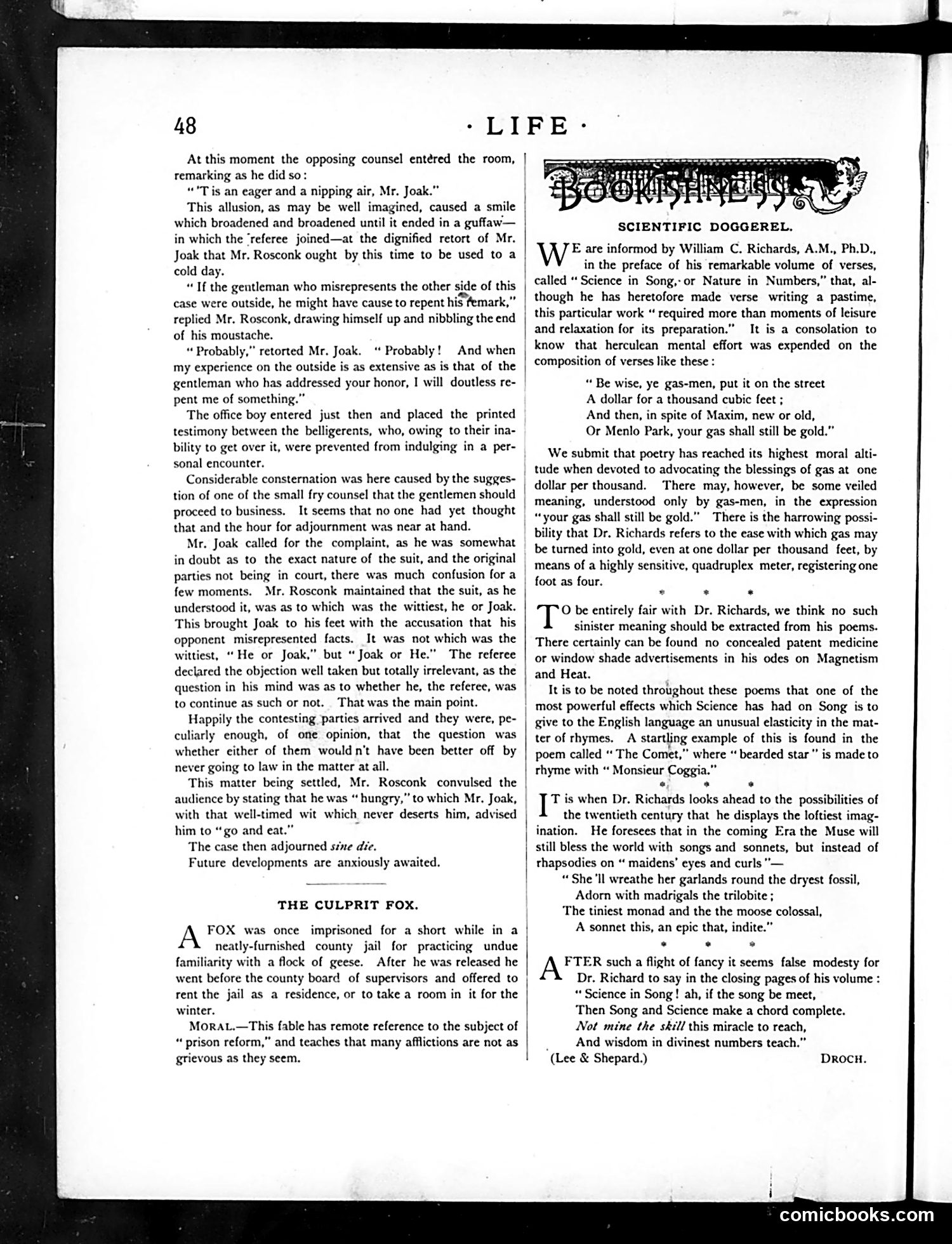
This page contains two distinct sections: a legal anecdote and a book review. **The Legal Anecdote** describes a courtroom dispute between opposing counsel—Mr. Joak and Mr. Roscovck—over proper procedure. Mr. Joak makes a quip about "a tiger and a nipping air," which the referee finds irrelevant but humorous. The satire targets courtroom pomposity: lawyers debating procedural minutiae while the actual case's merit gets lost in legal formalism. **"The Culprit Fox"** is a brief moral tale about a fox imprisoned for disturbing poultry, then released. The moral notes that imprisonment doesn't reform all afflictions, satirizing contemporary assumptions about prison reform effectiveness. **"Scientific Doggerel"** reviews William C. Richards' poetry collection, mocking verses that advocate impractical solutions (storing gas in dollars). The satire ridicules pseudo-scientific poetry as pretentious hokum.
📄 Transcribed text from this page (OCR, searchable)
Machine-transcribed from the original scan — historical spelling and the odd misread are preserved.
48 At this moment the opposing counsel entered the room, | remarking as he did so: “Tis an eager and a nipping air, Mr. Joak.” This allusion, as may be well imagined, caused a smile | which broadened and broadened until it ended in a guffaw— in which the ‘referee joined—at the dignified retort of Mr. Joak that Mr. Rosconk ought by this time to be used to a cold day. “If the gentleman who misrepresents the other side of this case were outside, he might have cause to repent his femark,” replied Mr. Rosconk, drawing himself up and nibbling the end of his moustache. “Probably,” retorted Mr. Joak. “ Probably! And when my experience on the outside is as extensive as is that of the gentleman who has addressed your honor, I will doutless re- pent me of something.” The office boy entered just then and placed the printed testimony between the belligerents, who, owing to their ina- bility to get over it, were prevented from indulging in a per- sonal encounter, Considerable consternation was here caused by the sugges- tion of one of the small fry counsel that the gentlemen should proceed to business. It seems that no one had yet thought that and the hour for adjournment was near at hand. Mr. Joak called for the complaint, as he was somewhat in doubt as to the exact nature of the suit, and the original parties not being in court, there was much confusion for a few moments. Mr. Rosconk maintained that the suit, as he understood it, was as to which was the wittiest, he or Joak. This brought Joak to his feet with the accusation that his opponent misrepresented facts. It was not which was the wittiest, “He or Joak,” but “Joak or He.” The referee declared the objection well taken but totally irrelevant, as the question in his mind was as to whether he, the referee, was | to continue as such or not. That was the main point. | Happily the contesting parties arrived and they were, pe- culiarly enough, of one opinion, that the question was whether either of them wouldn't have been better off by never going to law in the matter at all. This matter being settled, Mr. Rosconk convulsed the | audience by stating that he was “ hungry,” to which Mr. Joak, with that well-timed wit which never deserts him, advised him to “go and eat.” The case then adjourned sine die. Future developments are anxiously awaited. THE CULPRIT FOX. FOX was once imprisoned for a short while in a neatly-furnished county jail for practicing undue familiarity with a flock of geese. After he was released he went before the county board of supervisors and offered to rent the jail as a residence, or to take a room in it for the winter. MorRAL.—This fable has remote reference to the subject of “ prison reform,” and teaches that many afflictions are not as grievous as they seem. ! * LIFE: SCIENTIFIC DOGGEREL, E are informod by William C. Richards, A.M., Ph.D., in the preface of his remarkable volume of verses, called “ Science in Song,-or Nature in Numbers,” that, al- though he has heretofore made verse writing a pastime, | this particular work “ required more than moments of leisure and relaxation for its preparation.” It is a consolation to know that herculean mental effort was expended on the composition of verses like these : “ Be wise, ye gas-men, put it on the street A dollar for a thousand cubic feet ; And then, in spite of Maxim, new or old, Or Menlo Park, your gas shall still be gold.” We submit that poetry has reached its highest moral alti- tude when devoted to advocating the blessings of gas at one dollar per thousand. There may, however, be some veiled meaning, understood only by gas-men, in the expression “your gas shall still be gold.” There is the harrowing possi- bility that Dr. Richards refers to the ease with which gas may be turned into gold, even at one dollar per thousand feet, by means of a highly sensitive, quadruplex meter, registering one | foot as four. * * * O be entirely fair with Dr. Richards, we think no such sinister meaning should be extracted from his poems. There certainly can be found no concealed patent medicine or window shade advertisements in his odes on Magnetism and Heat. It is to be noted throughout these poems that one of the | most powerful effects which Science has had on Song is to give to the English language an unusual elasticity in the mat- ter of rhymes. A startling example of this is found in the poem called “ The Comet,” where “ bearded star" is made to rhyme with “ Monsieur Coggia.” . . T is when Dr. Richards looks ahead to the possibilities of the twentieth century that he displays the loftiest imag- ination. He foresees that in the coming Era the Muse will still bless the world with songs and sonnets, but instead of thapsodies on “ maidens’ eyes and curls "— “ She'll wreathe her garlands round the dryest fossil, Adorn with madrigals the trilobite ; The tiniest monad and the the moose colossal, A sonnet this, an epic that, indite.” . . ° FTER such a flight of fancy it seems false modesty for Dr. Richard to say in the closing pages of his volume : “Science in Song! ah, if the song be meet, Then Song and Science make a chord complete. Not mine the skill this miracle to reach, And wisdom in divinest numbers teach.” “(Lee & Shepard.) Drocu. comicbooks.com