
A complete issue · 28 pages · 1884
Life — December 11, 1884
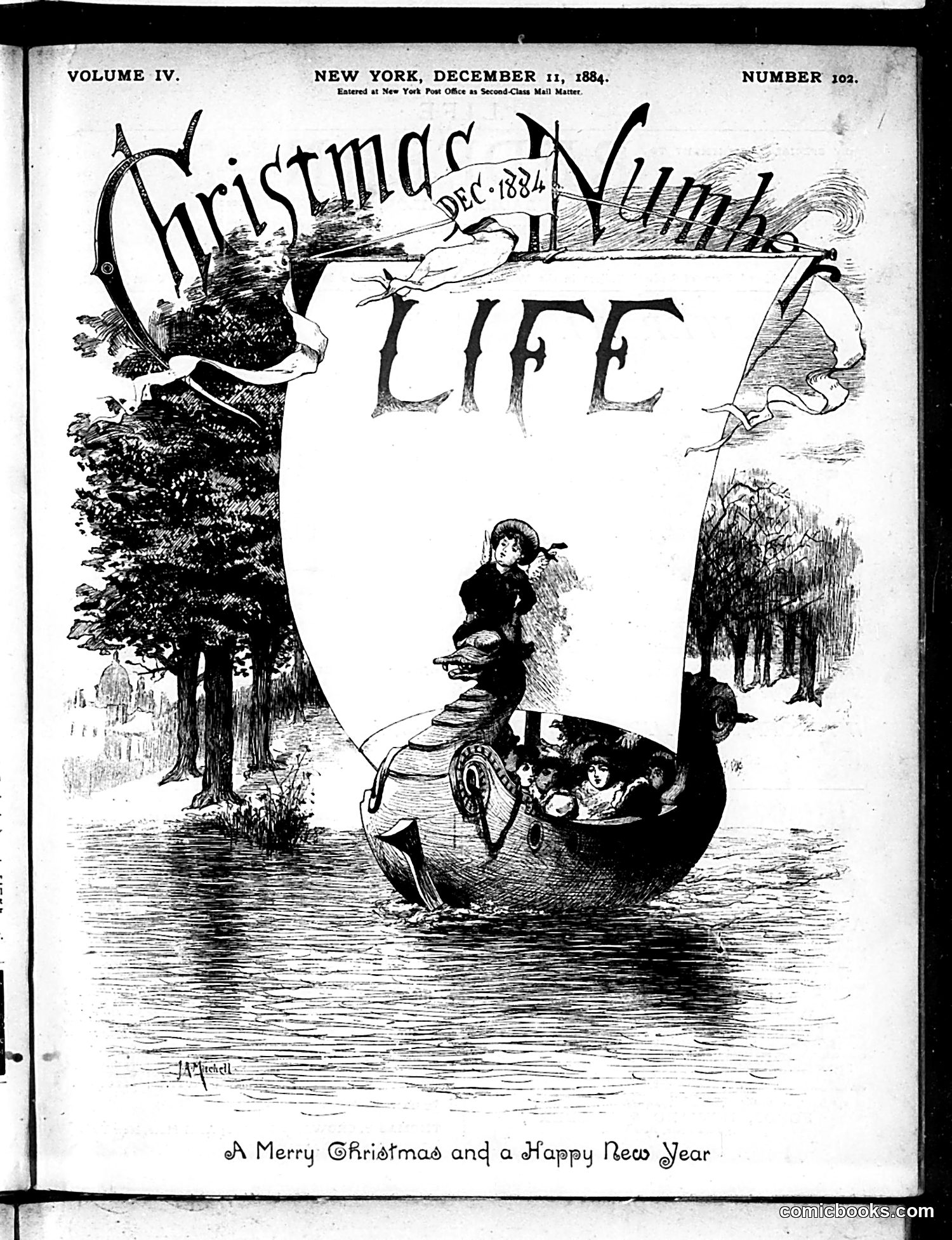
This is the December 11, 1884 Christmas issue of *Life* magazine. The cover depicts a whimsical holiday scene: a child in a boat on water, surrounded by forest scenery, with decorative winter imagery including holly branches and what appears to be a deer or stag at the top. The design is primarily festive rather than overtly political. The illustration by J.A. Weidel emphasizes seasonal themes—childhood wonder, nature, and Christmas celebration—rather than satirizing specific contemporary figures or events. The greeting "A Merry Christmas and a Happy New Year" confirms this is holiday-themed editorial content meant to celebrate the season with readers rather than critique politics or society through satire.
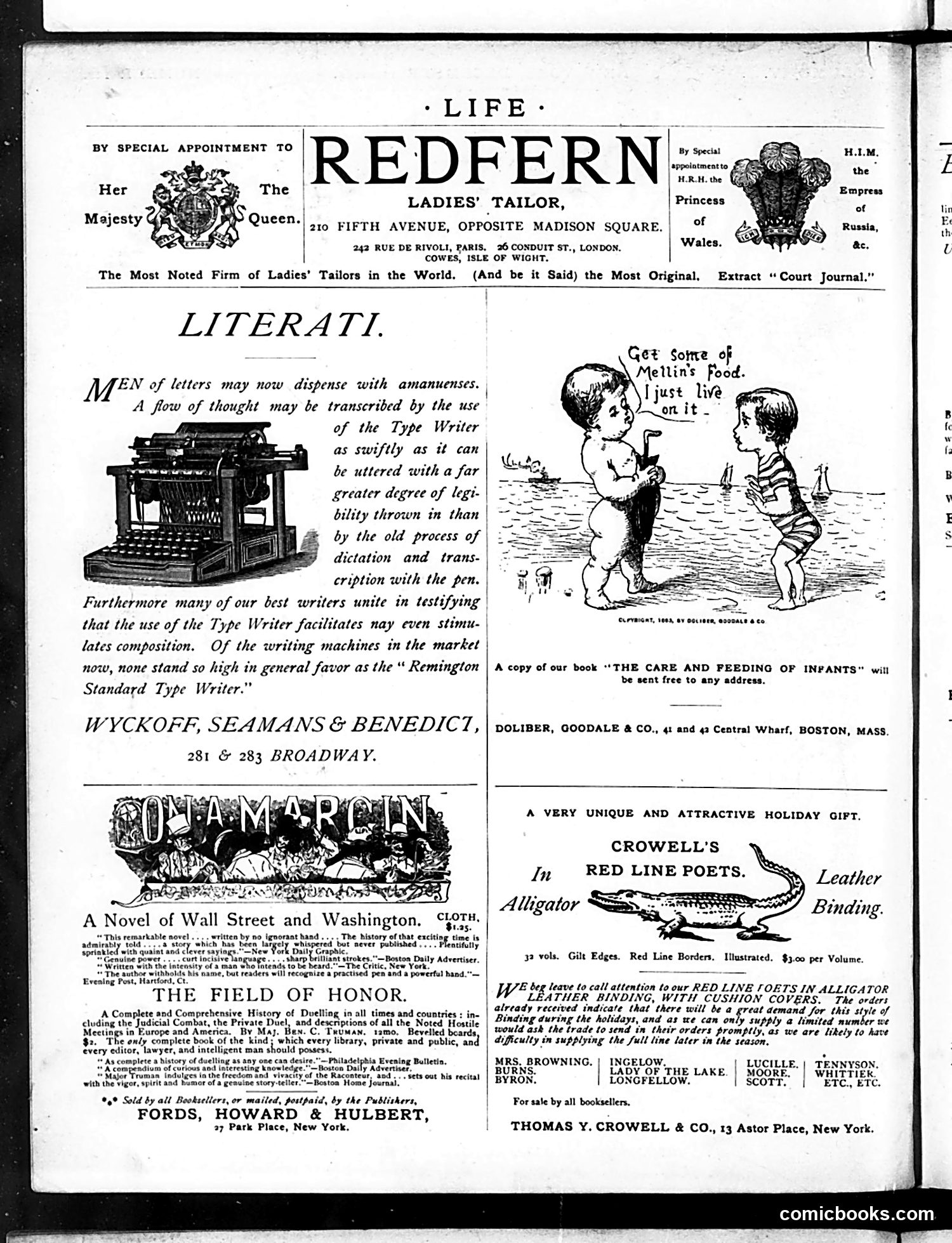
This page is primarily **advertising**, not political satire. The main content includes: 1. **Redfern Ladies' Tailor** (top) - luxury fashion advertisement with royal warrants 2. **Literati section** - promotes Remington typewriters to writers, emphasizing speed and legibility versus handwriting 3. **A small cartoon** (center-right) shows two babies at a beach; one says "Get some of Mellin's Food. I just live on it" - this is a **product advertisement** for infant formula, using child characters as endorsers 4. **Crowell's Red Line Poets** - book advertisement featuring alligator leather binding 5. **The Field of Honor** - novel advertisement The babies cartoon is typical early-1900s advertising strategy: using cute children to sell baby products. It's not political commentary, merely commercial marketing dressed in humorous form.
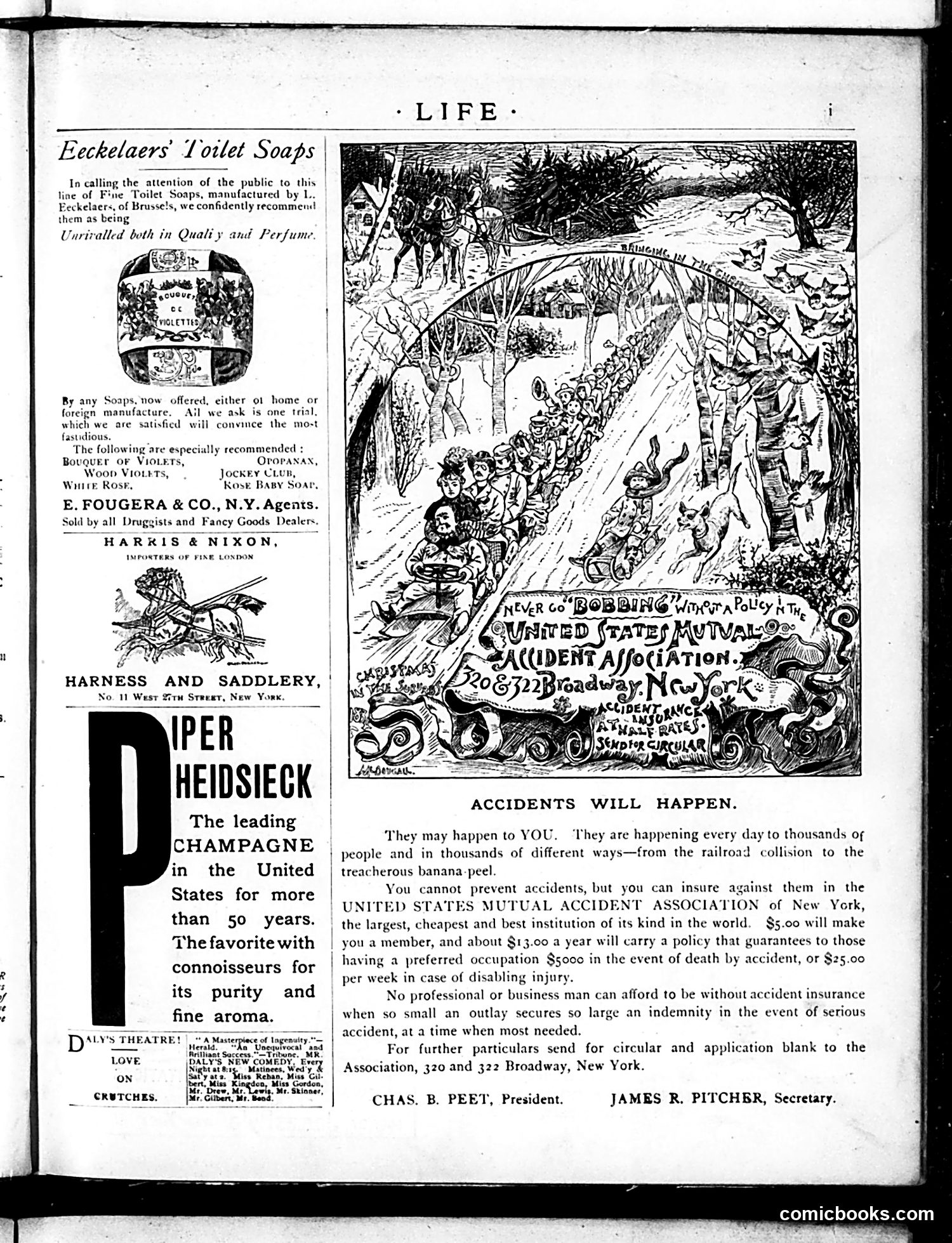
This page contains primarily **advertisements** rather than political satire. The large central illustration advertises the **United States Mutual Accident Association** (New York), using a winter sledding scene with people enjoying recreational activities. The caption "ACCIDENTS WILL HAPPEN" introduces the insurance pitch below, which emphasizes that accidents occur daily and promotes their affordable accident insurance policies ($5.00 membership, with death benefits up to $5,000). Other advertisements include: Eeckelaers' Toilet Soaps, Harris & Nixon Harness and Saddlery, Piper Heidsieck Champagne, and what appears to be a theatre advertisement. The page demonstrates how **insurance companies used optimistic, recreational imagery** to market safety products to middle-class readers during this period.
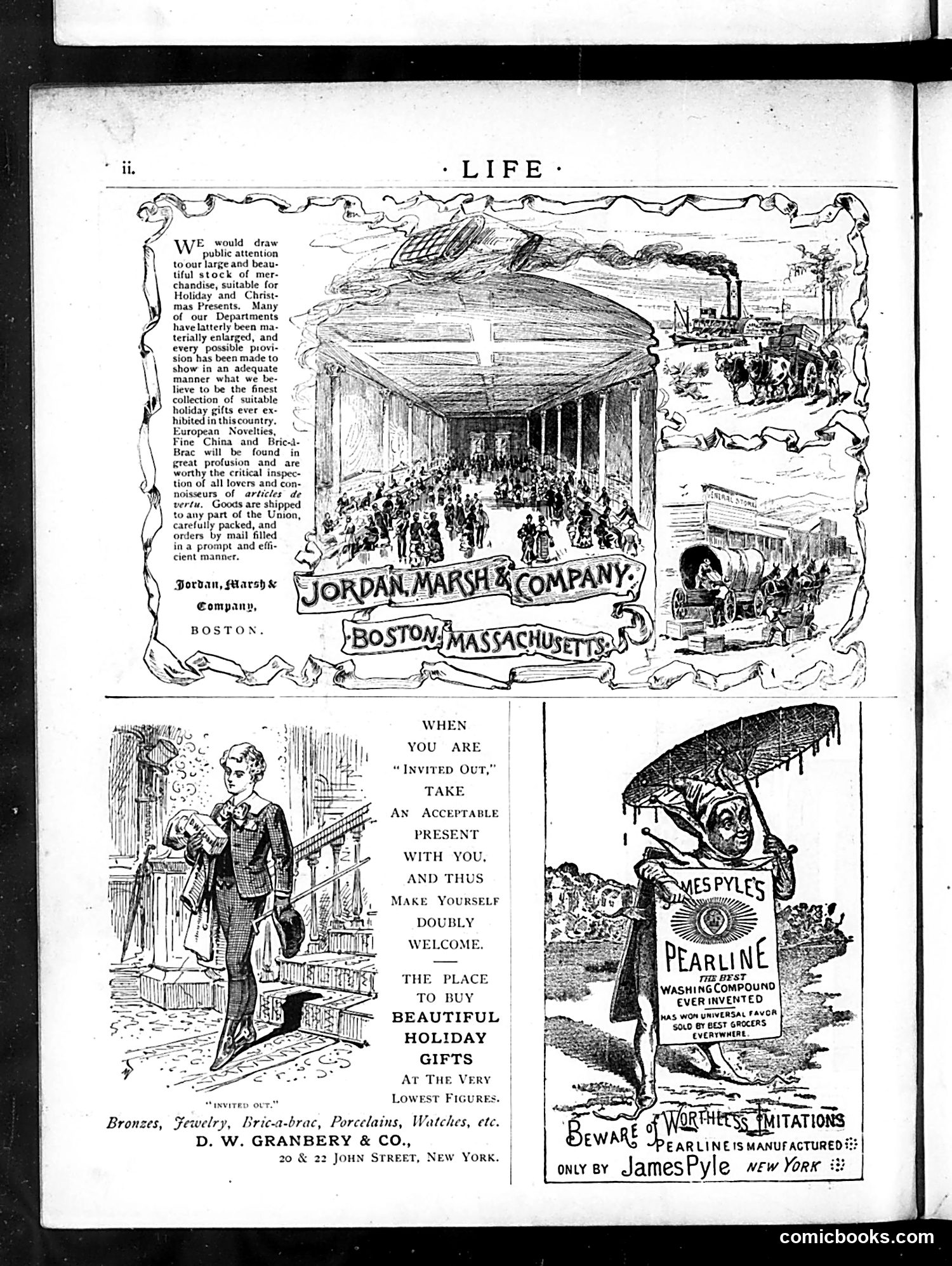
This Life magazine page is primarily **advertising rather than satire or political commentary**. The top advertisement promotes **Jordan, Marsh & Company**, a Boston department store, highlighting their holiday merchandise with an illustrated warehouse interior crowded with shoppers. Below that, **D.W. Granbery & Co.** (New York jewelry retailer) advertises holiday gifts—bronzes, jewelry, porcelains, watches—as appropriate presents to bring when "invited out." The right side features an advertisement for **James Pyle's Pearline**, a washing compound. The illustration shows a witch-like figure warning against counterfeit imitations, emphasizing that genuine Pearline is "manufactured only by James Pyle, New York." The page reflects late 19th-century consumer culture, using product advertising with decorative borders and illustrated figures typical of the era's commercial messaging.
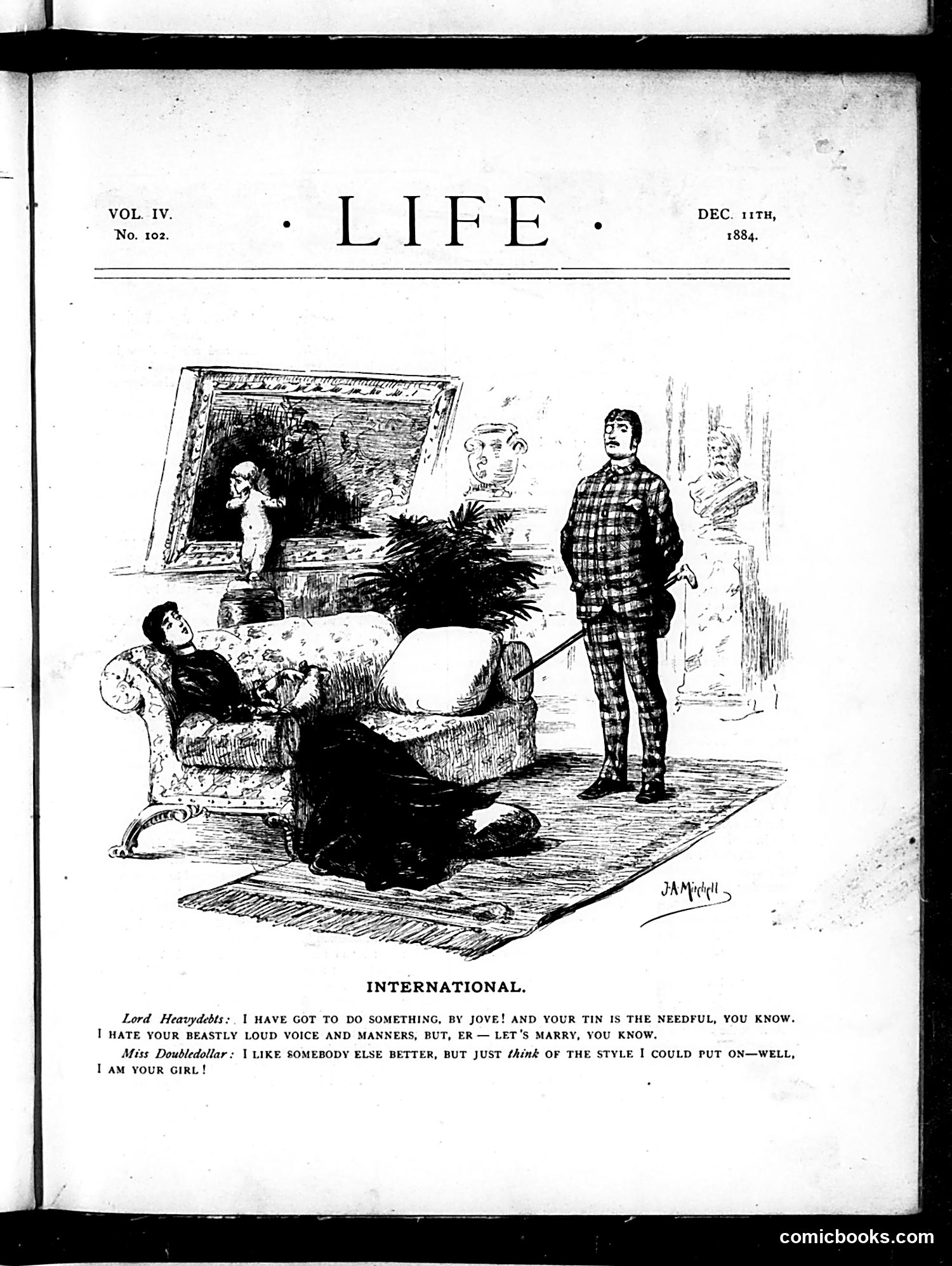
This satirical cartoon depicts a romantic/marital conflict between an English aristocrat ("Lord Heavydidds") and an American woman ("Miss Doubledollar"). The humor centers on **transatlantic class differences**: Lord Heavydidds wants to marry Miss Doubledollar for her wealth (her "tin" or money), but she rejects him because, despite his superior manners and social standing, she prefers someone of better "style"—implying an American suitor offers more fashionable appeal. The cartoon mocks both the English obsession with aristocratic status and Americans' fixation on style and wealth. It satirizes the common phenomenon of wealthy American heiresses marrying (or rejecting) impoverished European nobility during the Gilded Age. The "International" title emphasizes this cross-cultural romantic competition.
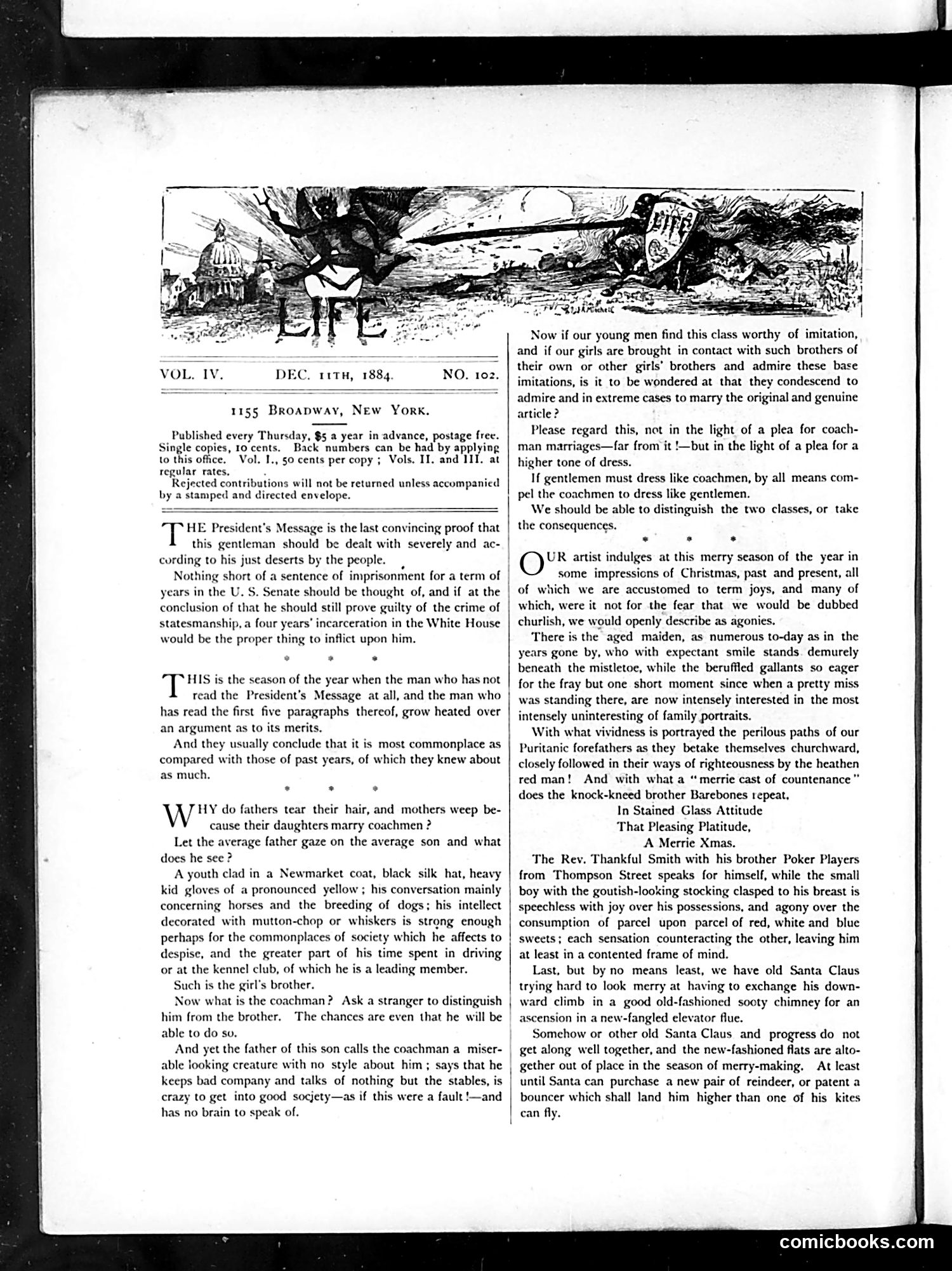
The page contains editorial commentary rather than a cartoon. The main text criticizes fathers who object to their daughters marrying coachmen while dressing their own sons as coachmen—essentially wearing the same uniform as servants. The satire targets class hypocrisy: wealthy families adopt the fashionable "coachman look" (Newmarket coat, silk hat, gloves) as stylish dress, yet consider actual coachmen unsuitable marriage prospects for their daughters. The piece argues this distinction is absurd and hypocritical. If the coachman's appearance and manner are admirable enough to imitate, why are they deemed unworthy as sons-in-law? The satire highlights Victorian-era class pretensions and the arbitrary nature of social status based on appearance rather than substance.
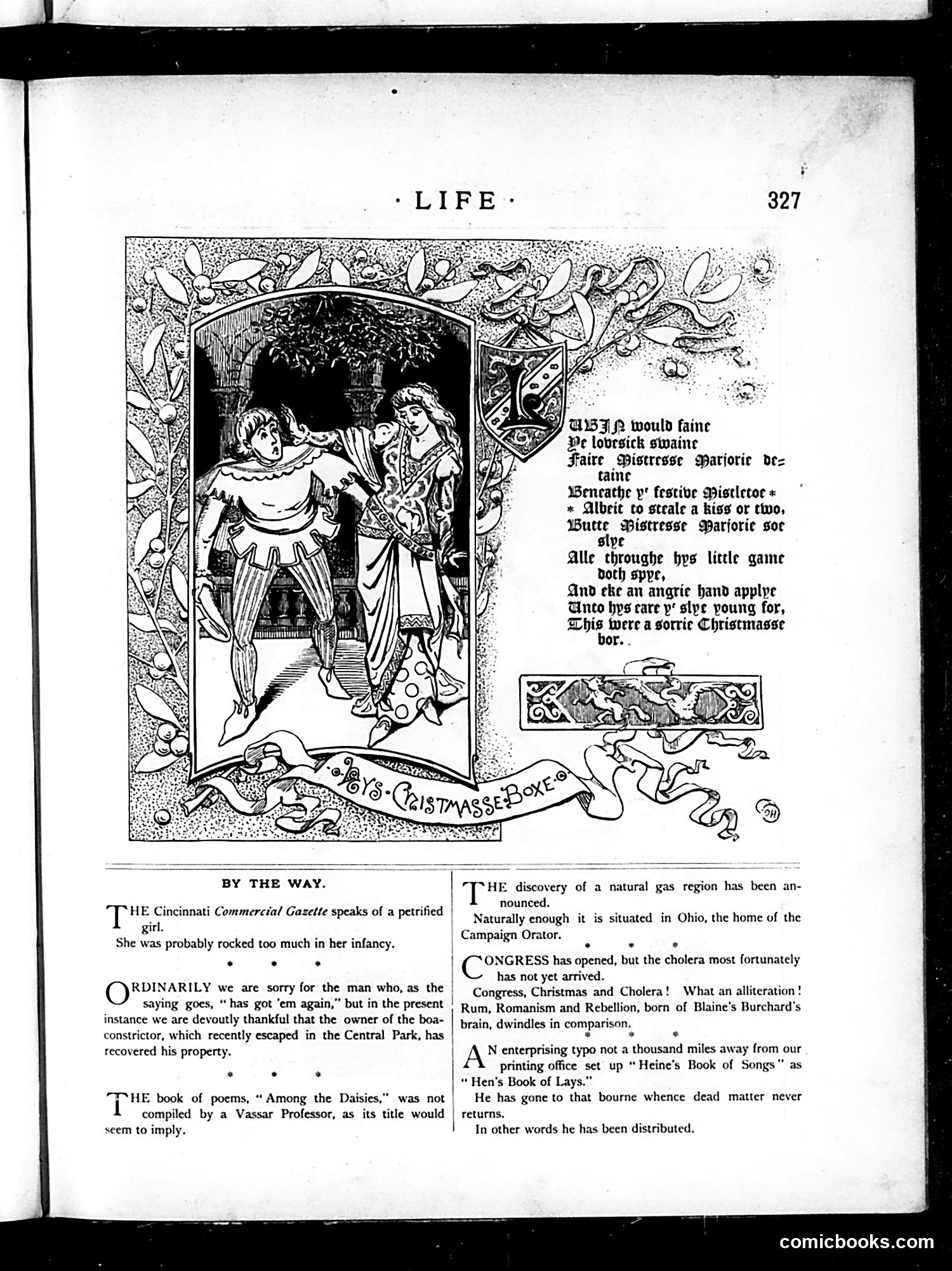
The main illustration is a decorative "Christmas Box" featuring figures in Elizabethan costume engaged in flirtation or romantic interaction—likely a historical literary reference, though the specific work isn't clearly indicated here. The "By the Way" section contains four brief satirical notes: 1. A joke about a petrified girl from Cincinnati being over-rocked in infancy 2. Commentary praising recovery of a boat owner's property from Central Park 3. A jab at "Among the Daisies," a poetry collection, suggesting its Vassar Professor compiler failed at her job 4. Political satire mentioning cholera, Congress, and "Blaine's Burchard's brain"—likely referencing 1884 election-year politics The overall tone is lighthearted gossip and topical humor typical of Life's satirical style.
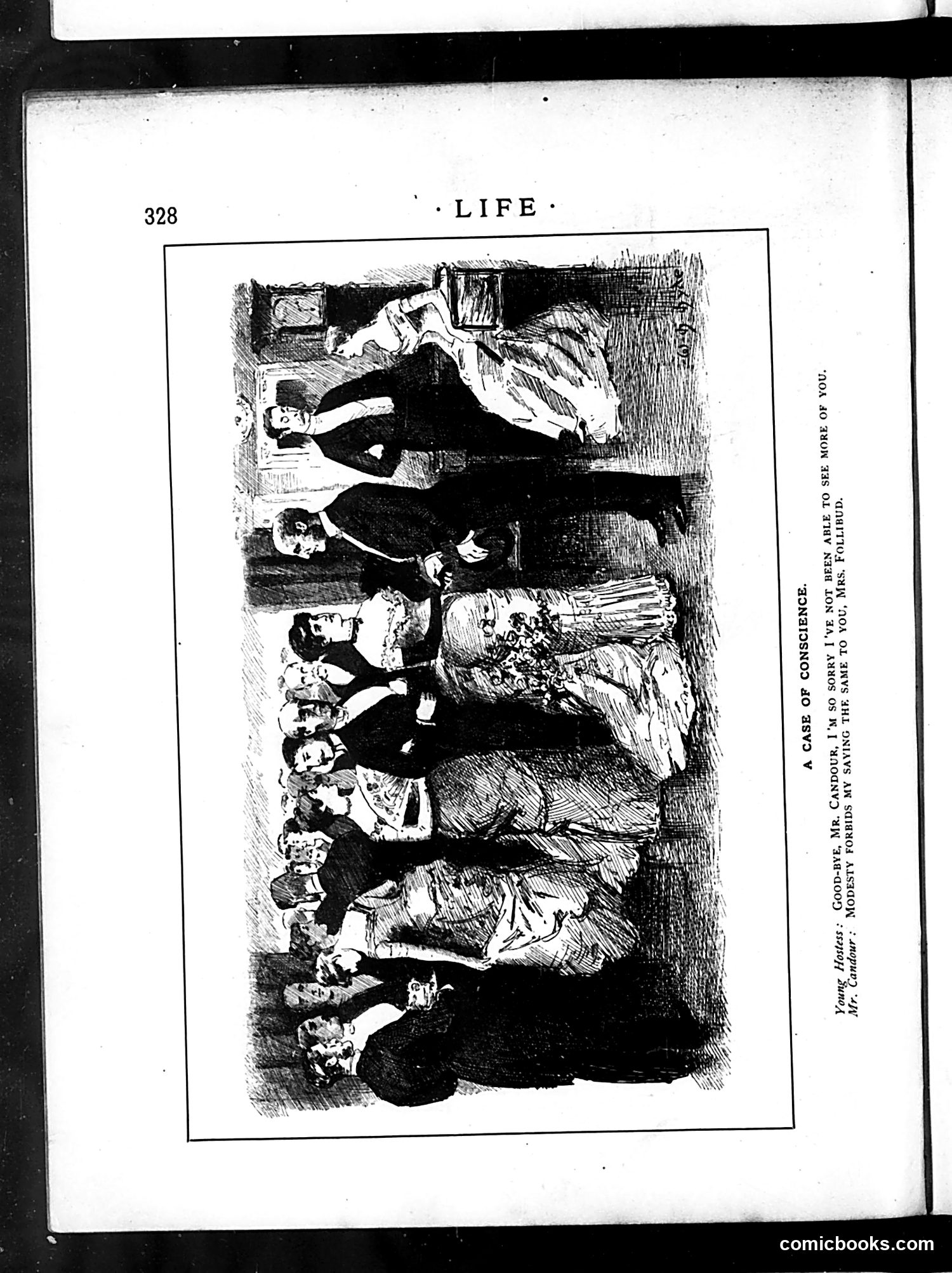
This cartoon depicts Young Haskins Goodspeed, Mr. Carneaider (a character name), in what appears to be a moral dilemma. The caption reads: "I'M SO SORRY I'VE NOT BEEN HERE TO SEE MORE OF YOU. MODESTY FORBIDS MY SAYING THE SAME TO YOU, MRS. CARNEAIDER." The image shows multiple figures in what appears to be a social setting. The satire appears to target hypocrisy—specifically a man expressing regret about not visiting while simultaneously insulting his host's wife through backhanded "modesty." The cartoon mocks false politeness and the contradictions between stated courtesy and actual contempt in social interactions. It's a commentary on insincerity in upper-class social conventions of the era.
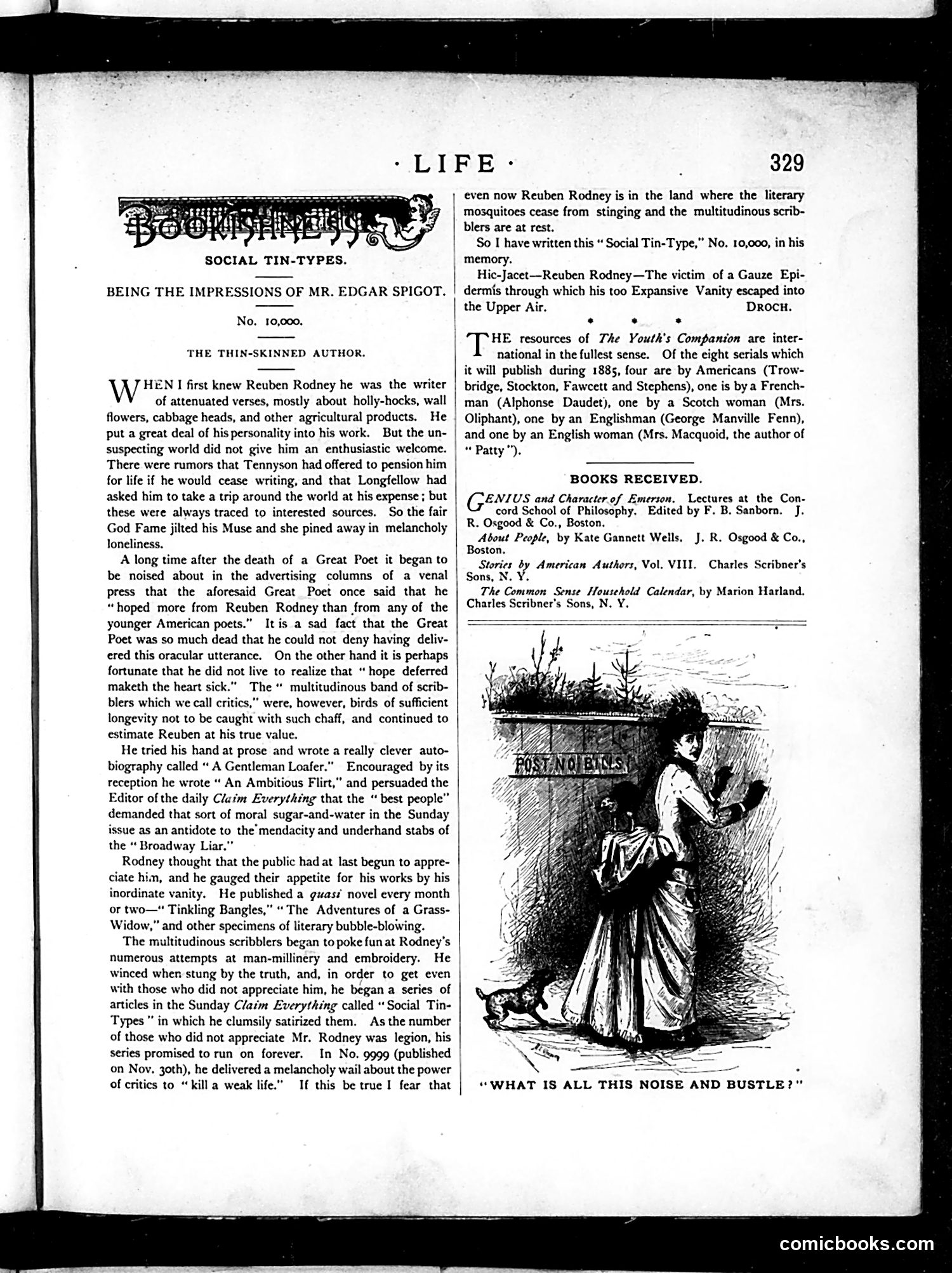
This page features a satirical essay titled "Social Tin-Types" by Edgar Spigot, critiquing writer Reuben Rodney. The text mockingly describes Rodney as a minor poet who wrote about "holly-hocks, wall flowers, cabbage heads, and other agricultural products" — deliberately trivial subjects. The satire attacks Rodney's vanity and prolific output of mediocre work, noting he published a "quasi novel every month or two" with titles like "Fishing Bangles" and "The Adventures of a Grass-Widow." Life's editors satirize his thin-skinned response to criticism through his "Social Tin-Types" series in the *Claim Everything* publication, where he caricatured detractors. The accompanying illustration shows a postal worker, visually representing the "noise and bustle" of Rodney's constant literary output flooding the public.
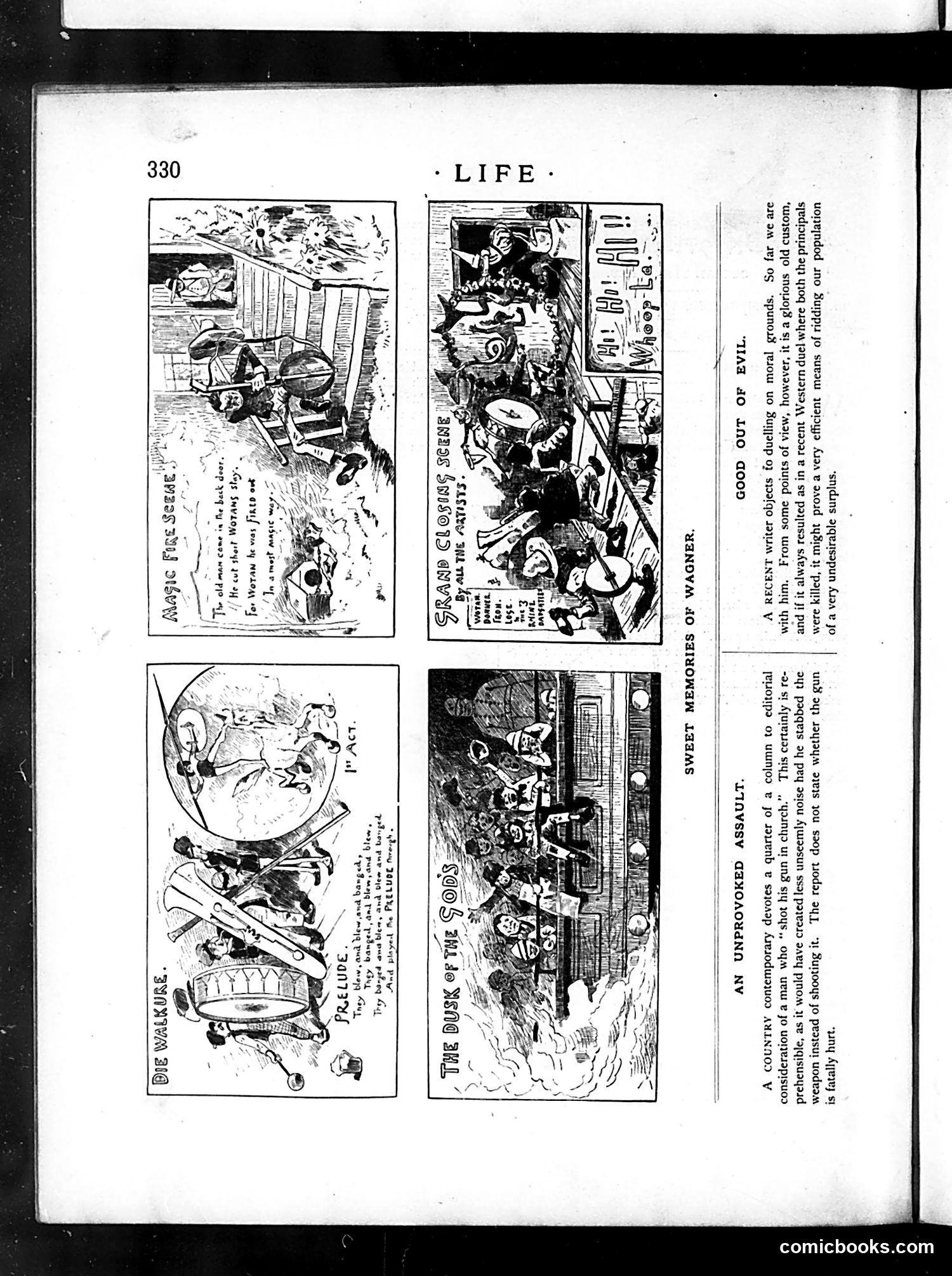
This page contains four satirical cartoons mocking what appears to be contemporary political or social figures, labeled with titles like "Good Out of Evil," "Sweet Memories of Wagner," "An Unproved Assault," and "Big Weasels." The cartoons use exaggerated caricature and chaotic visual imagery typical of early 20th-century American satirical humor. The "Wagner" reference suggests commentary on political figures of that era, though the specific identities and incidents are unclear from the degraded OCR text and image quality. The editorial text on the right discusses "eventual" matters and references "Verruckt" (German for "crazy"), suggesting possible commentary on German affairs or German-American relations, which was common during WWI-era Life magazine content. Without clearer source context, the precise satirical targets and political meanings remain uncertain.
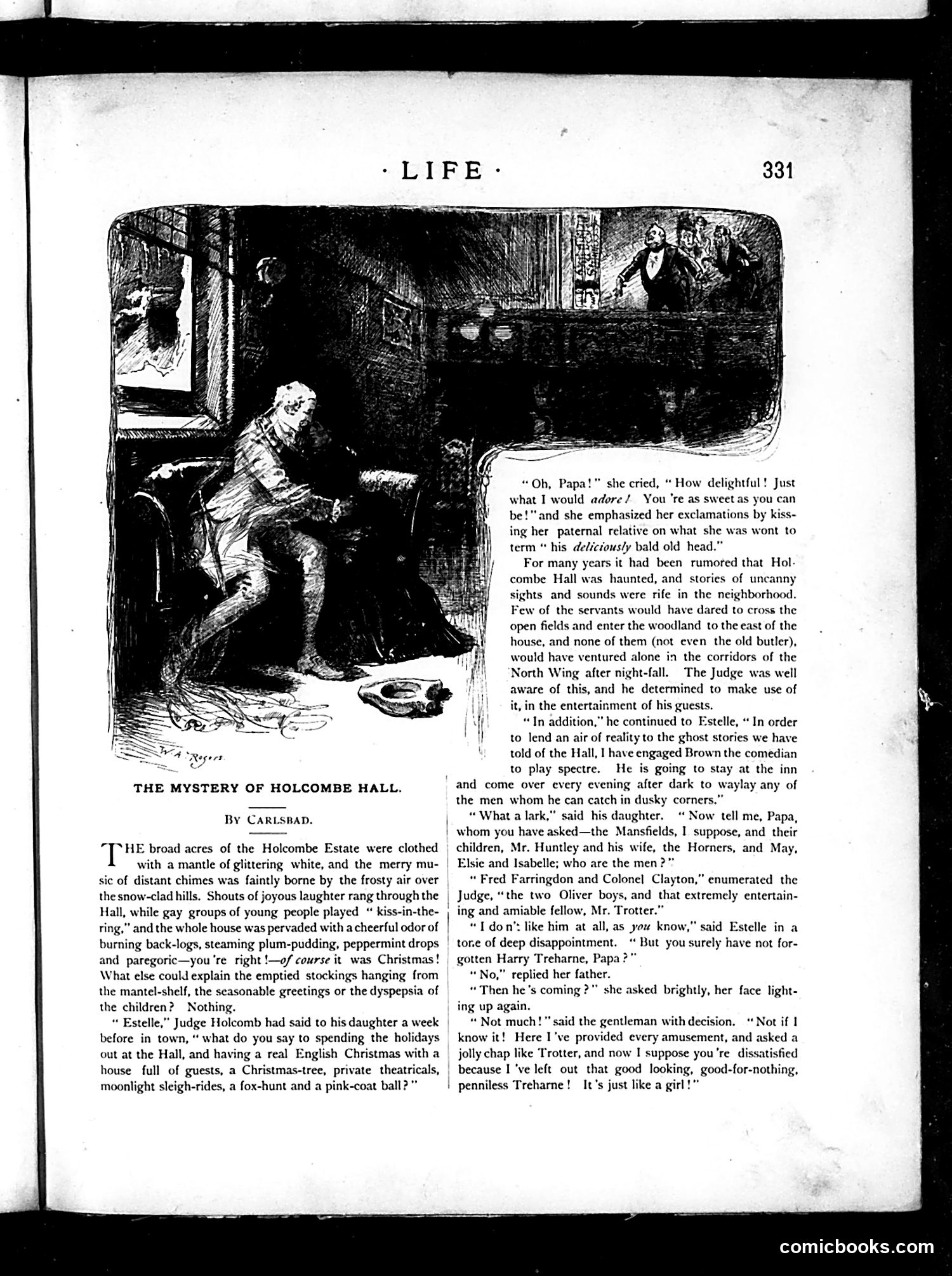
This page presents the opening of a serialized short story by Carlsbad in *Life* magazine, not a political cartoon. The illustration depicts a Victorian Christmas scene at a country estate. The narrative setup involves Judge Holcomb planning an elaborate holiday entertainment, including hiring a comedian to pose as a ghost to frighten guests—exploiting the hall's reputation as haunted. His daughter Estelle is delighted with the arrangements until learning that Harry Treharne, a handsome but penniless young man she favors, has been deliberately excluded. The humor is genteel Victorian comedy-of-manners: the contrast between the judge's elaborate schemes and his daughter's romantic disappointment, plus his exasperation at her preference for an unsuitable suitor. The "dyspepsia of the children" and mention of paregoric (a mild opiate) reflect period-typical attitudes toward holiday excess. This appears designed as light entertainment for *Life*'s middle-class readership.
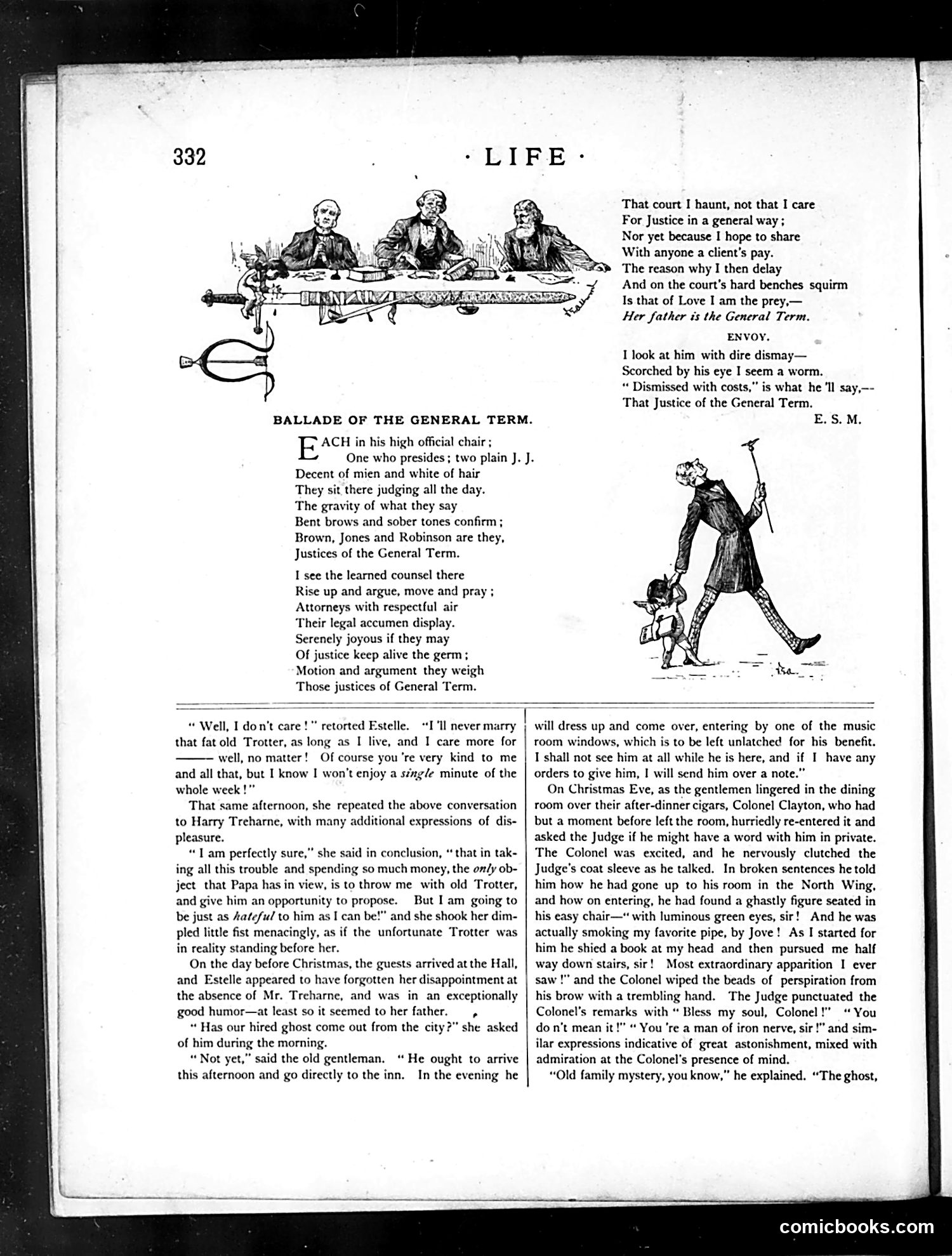
This page satirizes the legal system and judicial pomposity through verse and narrative fiction. The illustrated "Ballade of the General Term" mocks three judges (Brown, Jones, and Robinson) of New York's General Term court, depicted as grave, solemn figures presiding over endless cases. The poem's romantic subplot—a suitor whose prospects depend on impressing the judge (the "General Term")—suggests that justice is subordinate to personal connections and patronage. The satirical point: these supposedly impartial arbiters of law are merely stern authority figures whose real power lies in social manipulation rather than principled judgment. The prose narrative below appears unrelated, concerning a Christmas house-party ghost story, suggesting this is a typical issue mixing satirical commentary with serialized fiction.
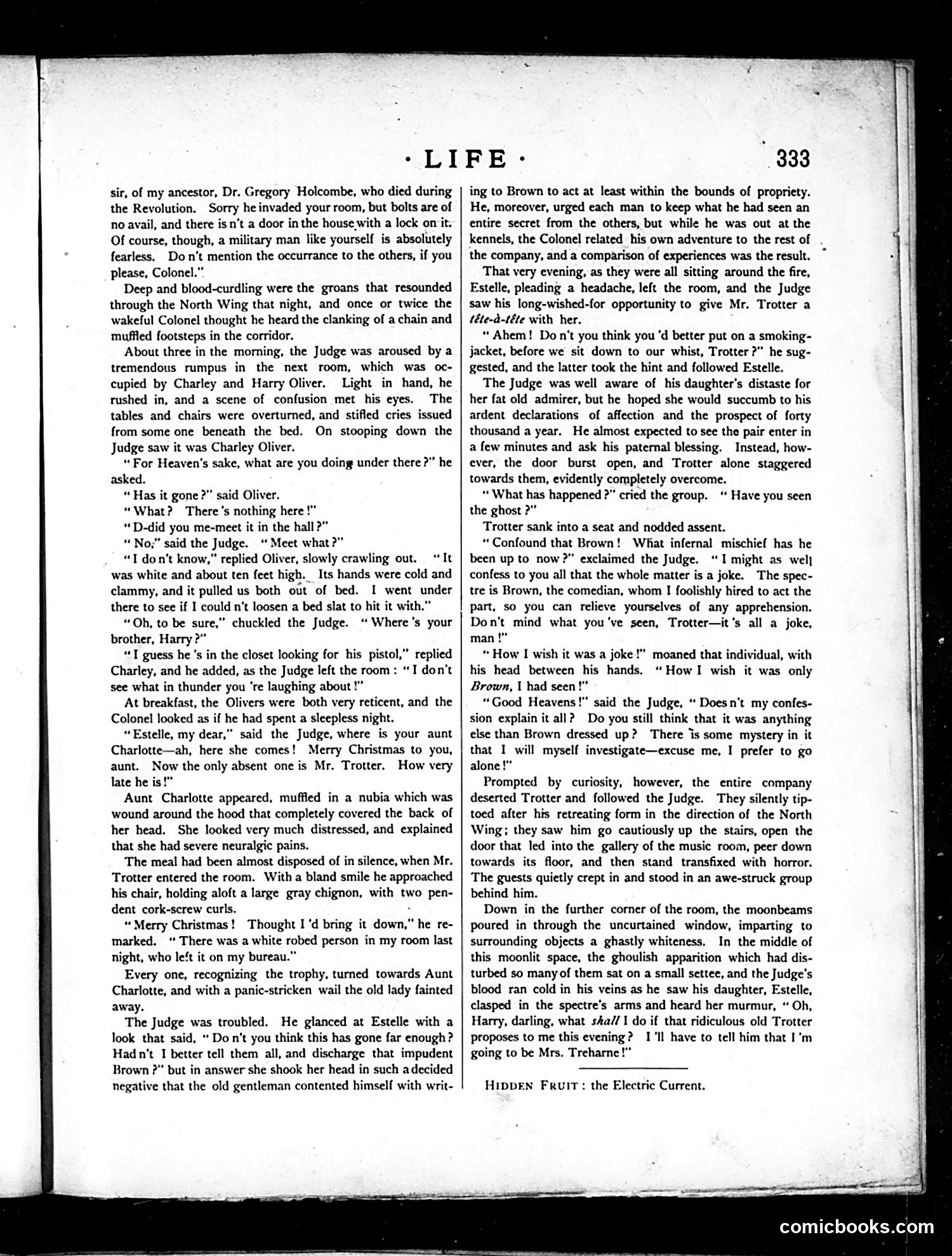
This page contains a serialized comedic story (titled "Hidden Fruit: The Electric Current" at bottom) about a household prank involving a fake ghost. **The Setup:** A Judge hosts guests including Aunt Charlotte and a man named Trotter. Someone—revealed to be a servant named Brown—is deliberately impersonating a ghost to scare the household. **The Satire/Joke:** The humor targets credulous, superstitious people and servants' mischief-making. Brown, acting "within bounds of propriety," stages elaborate hauntings: appearing as a "white robed" specter, terrorizing guests in their bedrooms. The punchline exposes Aunt Charlotte when Trotter produces her gray hairpiece (chignon) left behind during the ghost act—she'd been the "ghost" herself. **Social Context:** This reflects Victorian-era entertainment involving pranks, servants' capacity for deception, and the gullibility of supposedly refined household members. The story mocks both the supernatural-believing tendency of the era and the pretense of household authority when servants successfully manipulate their employers. The narrative humor relies on physical comedy, revealed identities, and social embarrassment rather than political commentary.
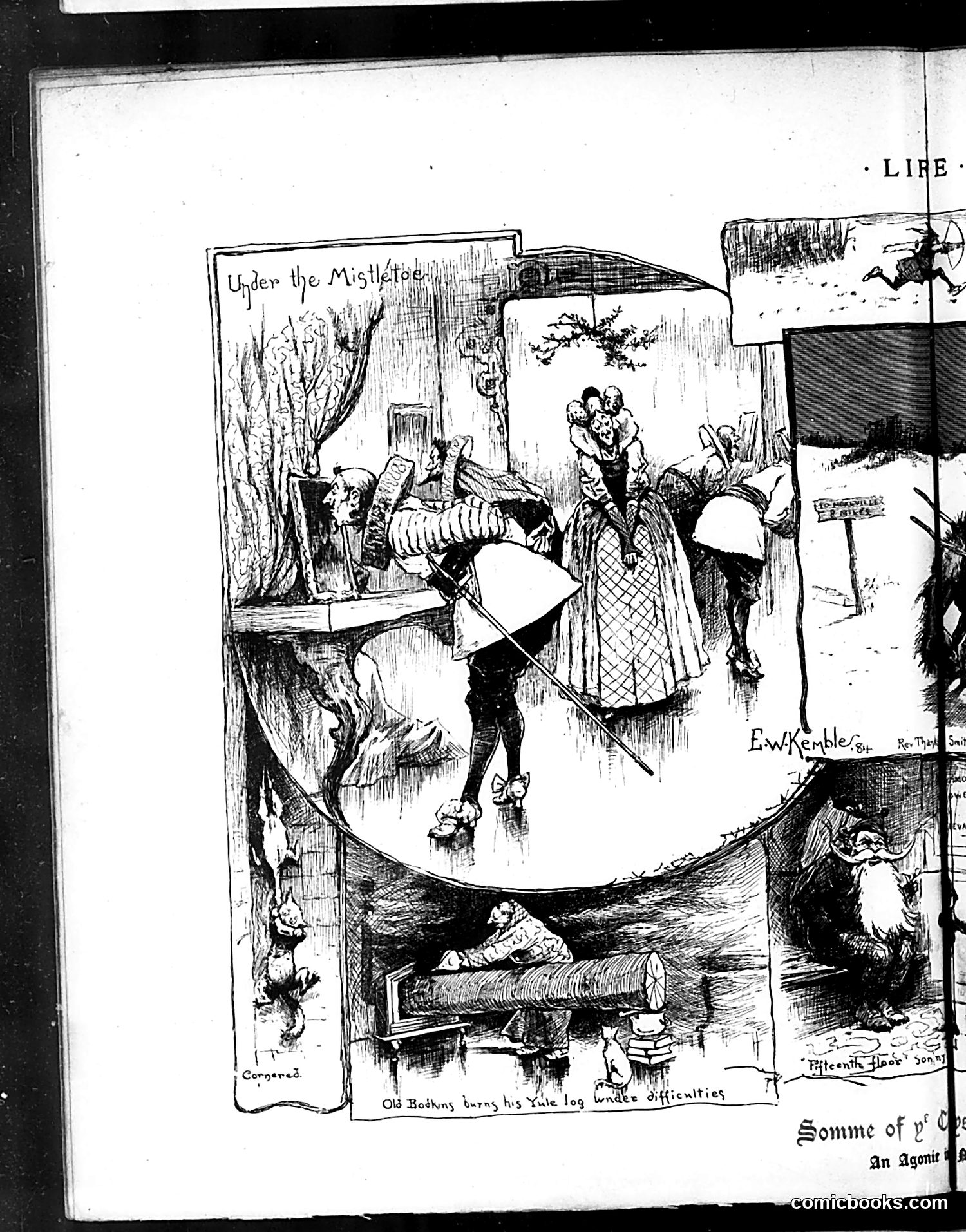
This page from *Life* magazine contains an illustration titled "Under the Mistletoe" by E.W. Kemble, depicting a holiday scene. The cartoon shows figures in what appears to be a domestic interior during Christmas season, with a large circular opening (possibly a fireplace or window) as the central focus. The caption references "Old Botkins burn[ing] his Yule log" with "difficulties," suggesting the humor concerns holiday mishaps—likely a servant or character struggling with the traditional Christmas task of burning a large log in the fireplace. The specific satirical point is unclear without additional context about who "Old Botkins" represents, but the joke appears to rest on physical comedy involving holiday traditions and domestic trouble. The mistletoe reference in the title suggests romantic or social awkwardness typical of Victorian-era holiday humor.
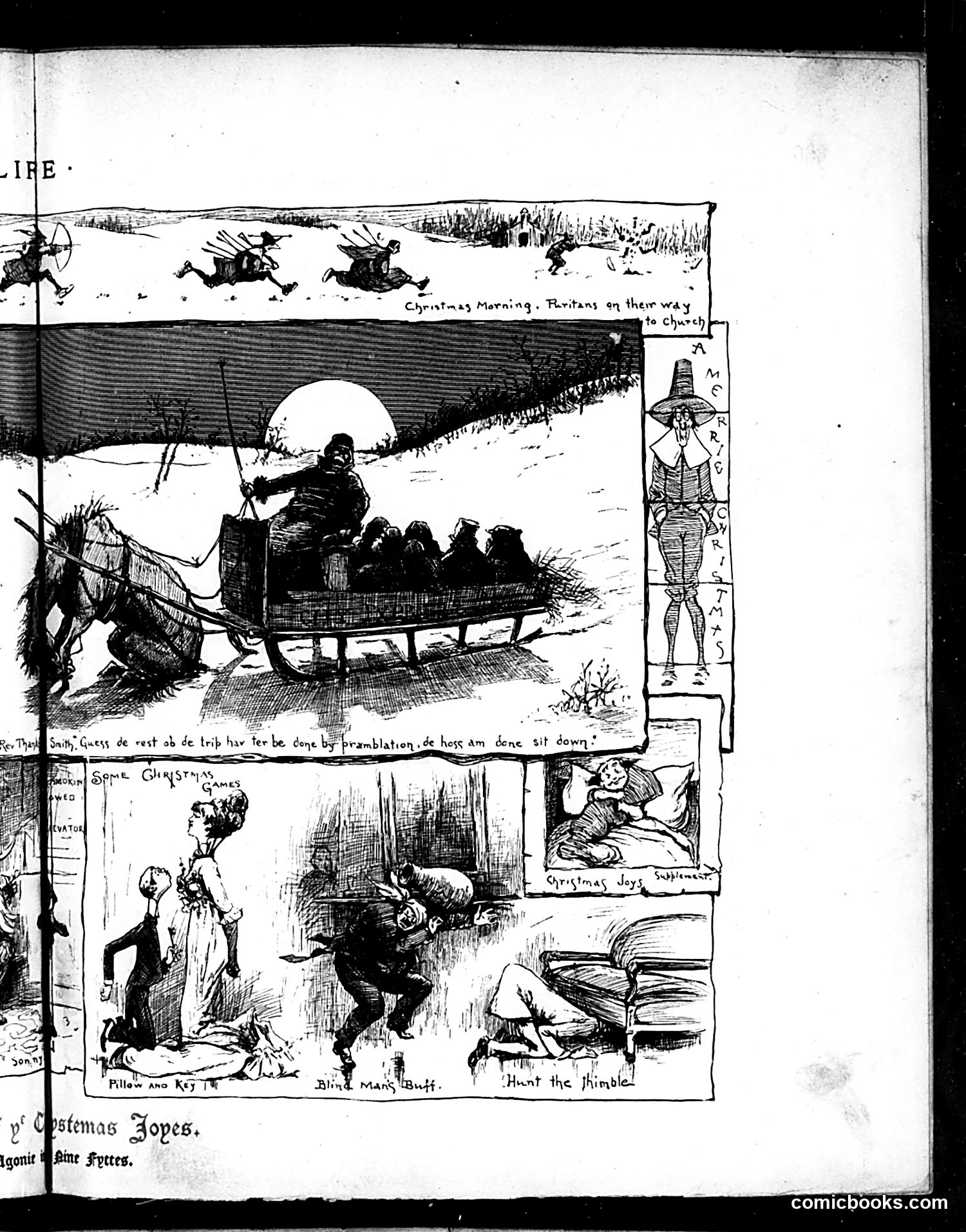
This page from *Life* magazine depicts Christmas-themed satirical cartoons. The top strip shows a snowy scene with the caption "Christmas Morning. Revelers on their way to church," featuring figures trudging through snow, with a sleigh and what appears to be Native American imagery on the right side. The lower panel contains four smaller cartoons labeled "Some Christmas Games," illustrating holiday activities: "Pillow and Key," "Blind Man's Buff," "Hunt the Thimble," and another game. These represent traditional parlor games played during Victorian Christmas celebrations. The crude dialect and caricatures typical of 19th-century *Life* satire appear throughout. The overall page humorously contrasts the difficulty of traveling to church in winter conditions with the frivolous indoor amusements of the holiday season—poking fun at both religious observance and leisure activities among middle and upper-class Americans.
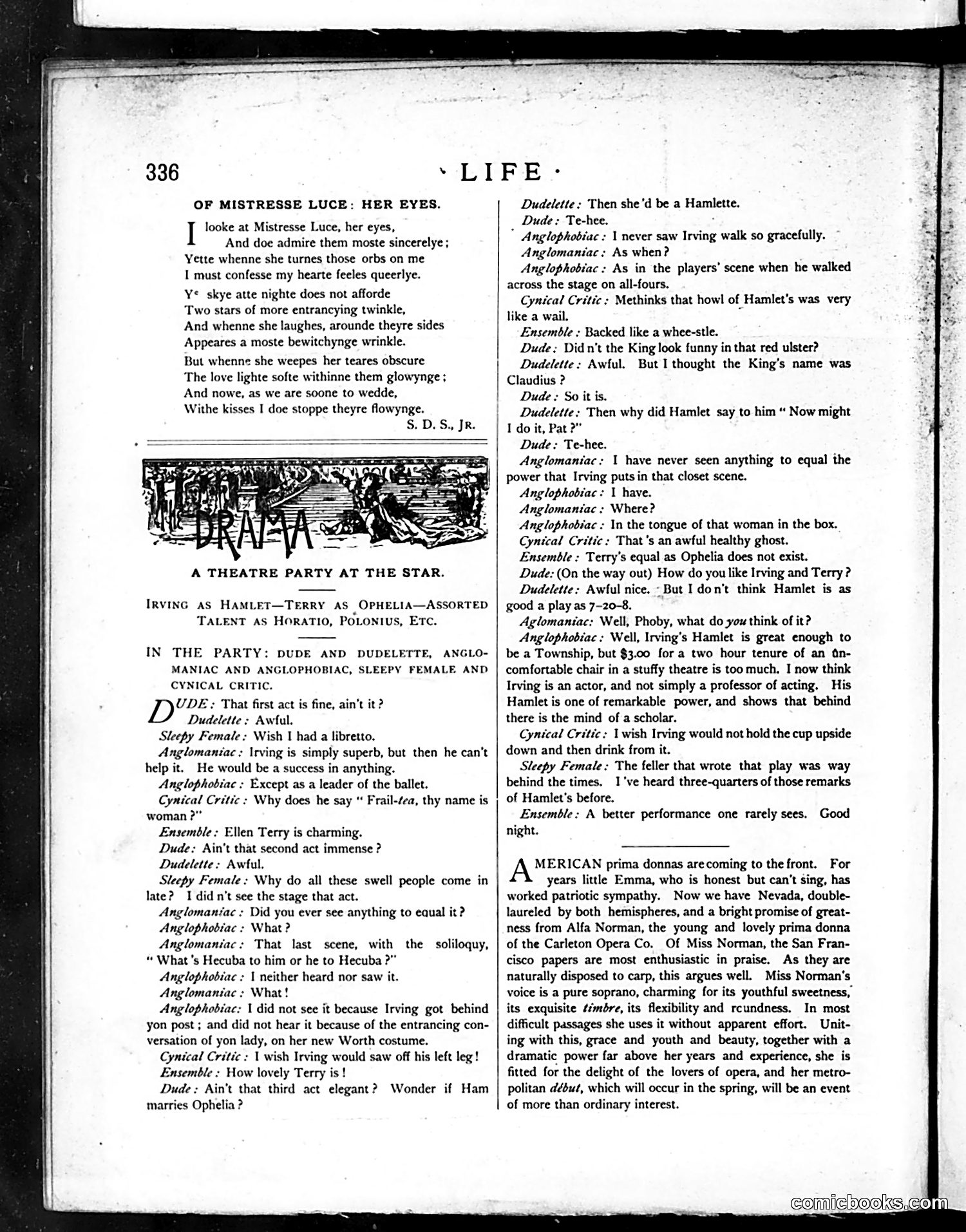
This satirical piece mocks theatergoers attending a performance of *Hamlet* featuring celebrated British actors Henry Irving and Ellen Terry. The cartoon (visible as a woodcut illustration) depicts audience members during the play. The satire targets various audience stereotypes through dialogue: - **The "Dude" and "Dudelette"**: Fashionable but vapid attendees with opposite reactions to everything - **The "Anglomaniac" and "Anglophobiac"**: Comically polarized British-opinion devotees—one praising Irving excessively, the other finding fault with everything - **The "Cynical Critic"**: Makes absurdist complaints (wishing Irving would saw off his leg) - **The "Sleepy Female"**: Distracted, wishing for a libretto instead of watching The humor lies in their missing the actual play—one woman doesn't see acts because she's absorbed in conversation about fashion; another misses Irving because he stands behind a post. They make nonsensical observations and contradict themselves constantly. The piece satirizes superficial theatergoing culture: pretentious posturing, fashionable attendance over genuine appreciation, and the absurdity of polite society's theatrical conventions.
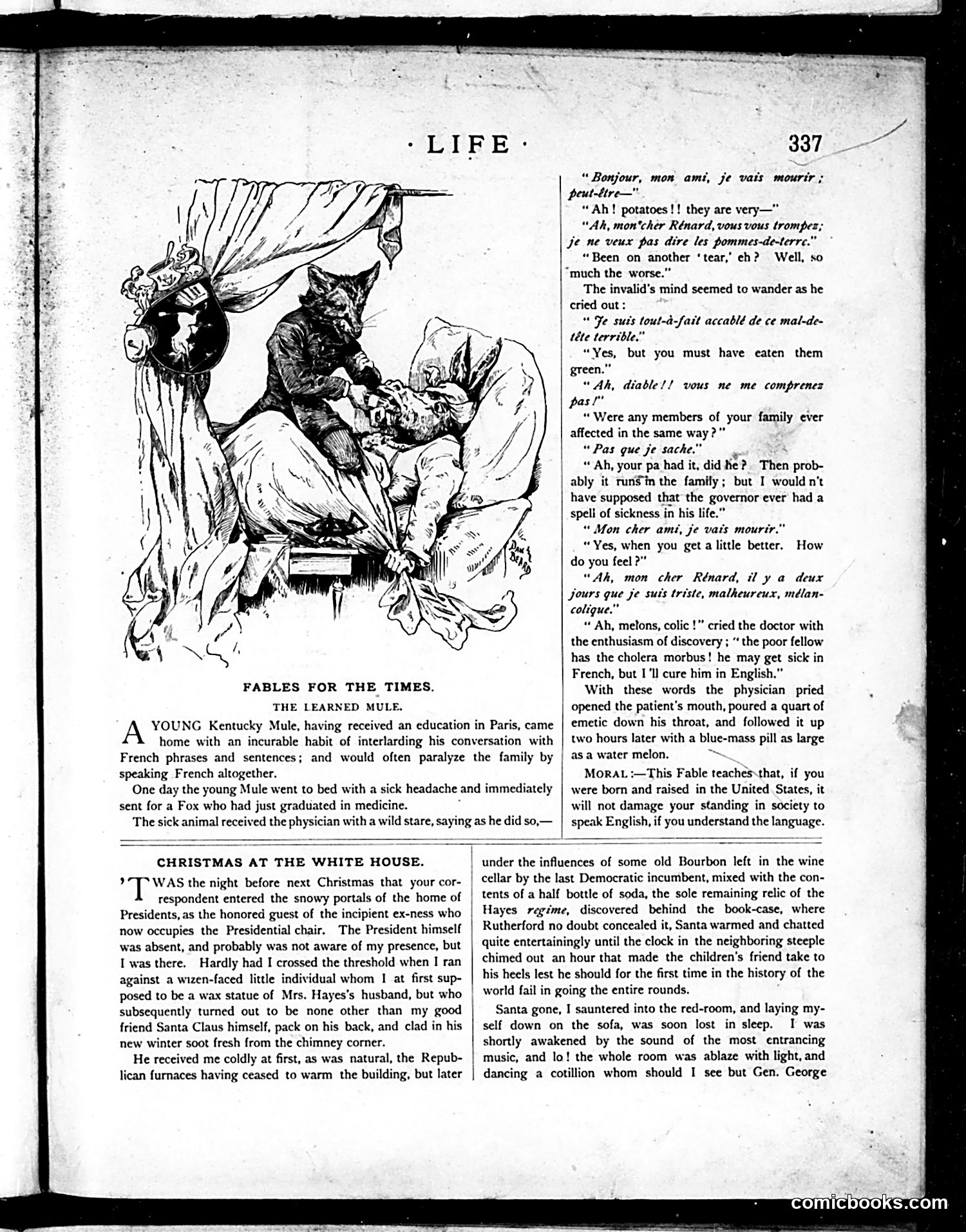
This fable mocks an American (represented as a Kentucky mule) who returned from Paris and constantly sprinkles French phrases into his speech, annoying his family. When he falls ill, a newly graduated doctor (a fox) misinterprets his French complaints about a headache ("mal-de-tête") as references to potatoes and melons, diagnosing cholera and treating him aggressively in English. **The satire targets**: pretentious Americans who adopted foreign mannerisms after European travel, seeming ridiculous to practical compatriots. The moral explicitly states that being American-born and English-speaking poses no social disadvantage—an anti-affectation message. The second piece, "Christmas at the White House," appears to satirize the Hayes administration (references to Mrs. Hayes's husband, Republican furnaces, the temperance-minded Hayes regime versus Democratic wine stocks).
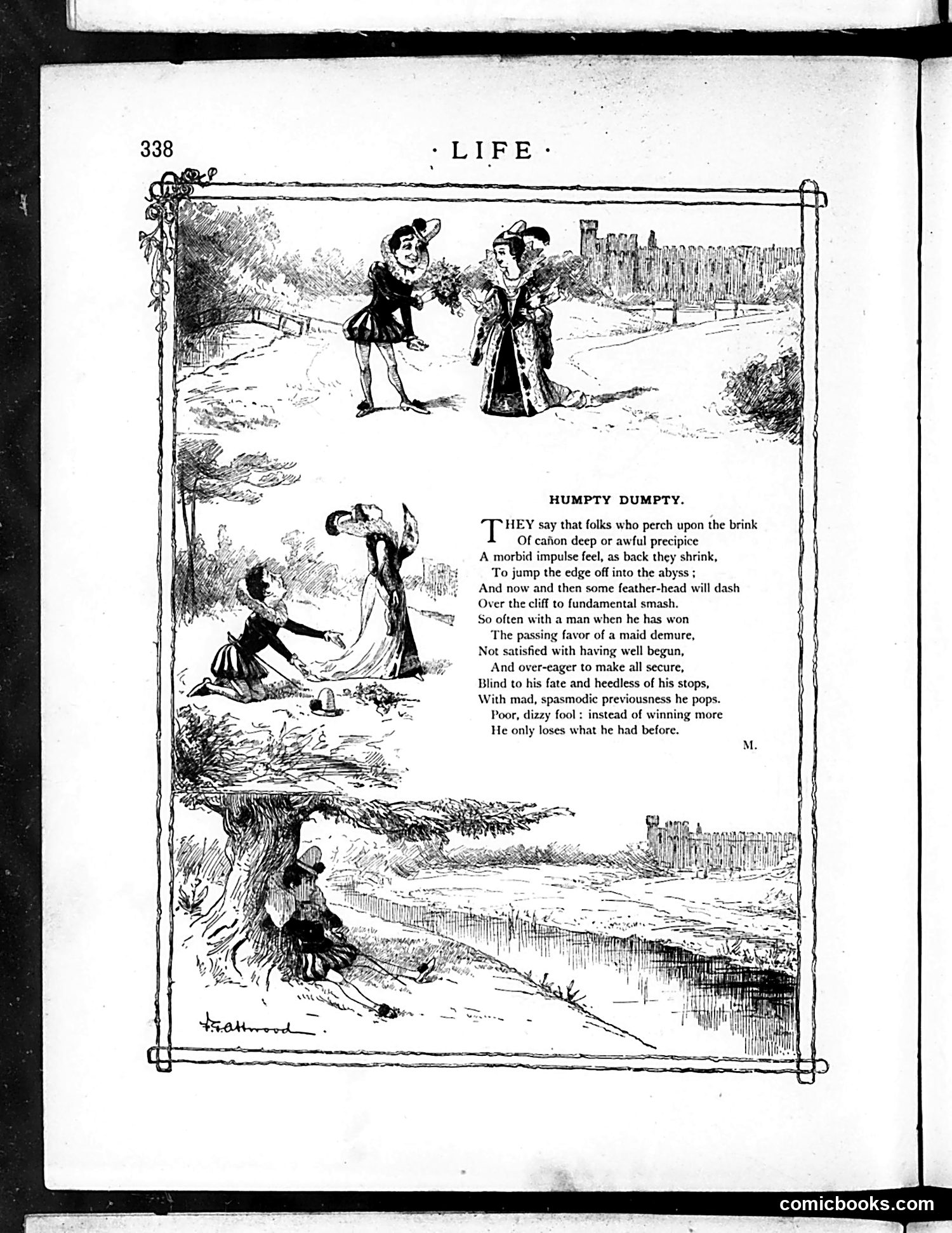
This satirical poem uses the "Humpty Dumpty" metaphor to mock male overconfidence in romance. The verses compare a man who's won a woman's affection to someone standing on a precipice—driven by an irrational impulse toward self-destruction. The poem's central joke: a man, satisfied with initial romantic success, grows impatient and "over-eager to make all secure." Instead of consolidating his advantage, he acts rashly ("pops the question," likely), destroying what he'd already gained. The "fundamental smash" is his romantic downfall. The accompanying illustrations show couples in courtship scenarios, emphasizing the tension between restraint and reckless pursuit. The satire targets male presumption—the assumption that winning favor guarantees continued success, and that hasty action secures romantic gains. The moral: desperation and impatience inevitably backfire.
This is a satirical story-cartoon featuring deceased U.S. Presidents as ghosts visiting the current administration under President Chester Arthur. The piece mocks Arthur's pretensions and various political figures. **Key figures and jokes:** - **Washington, Jefferson, Adams, Jackson, Grant, Hayes**: Historical presidents appearing as ghosts, ranking Arthur's character - **Millard Fillmore**: embarrassed because his coat is inferior to Arthur's fancy attire - **Andrew Jackson**: ironically approves of Arthur despite calling him a "dudish" dandy - **James G. Blaine**: appears at the window repeatedly making excuses ("the rain kept me away"), likely referencing his controversial political career - **Lincoln's joke about Blaine**: a pun on the letter "R" (perhaps referencing Blaine's reputation or scandals) - **Horace Greeley and Samuel Tilden**: discuss how Greeley's newspaper falsely reported Tilden's election in 1876, a reference to post-election confusion The satire critiques Arthur's vanity, questions politician reliability, and mocks Gilded Age political corruption and incompetence.
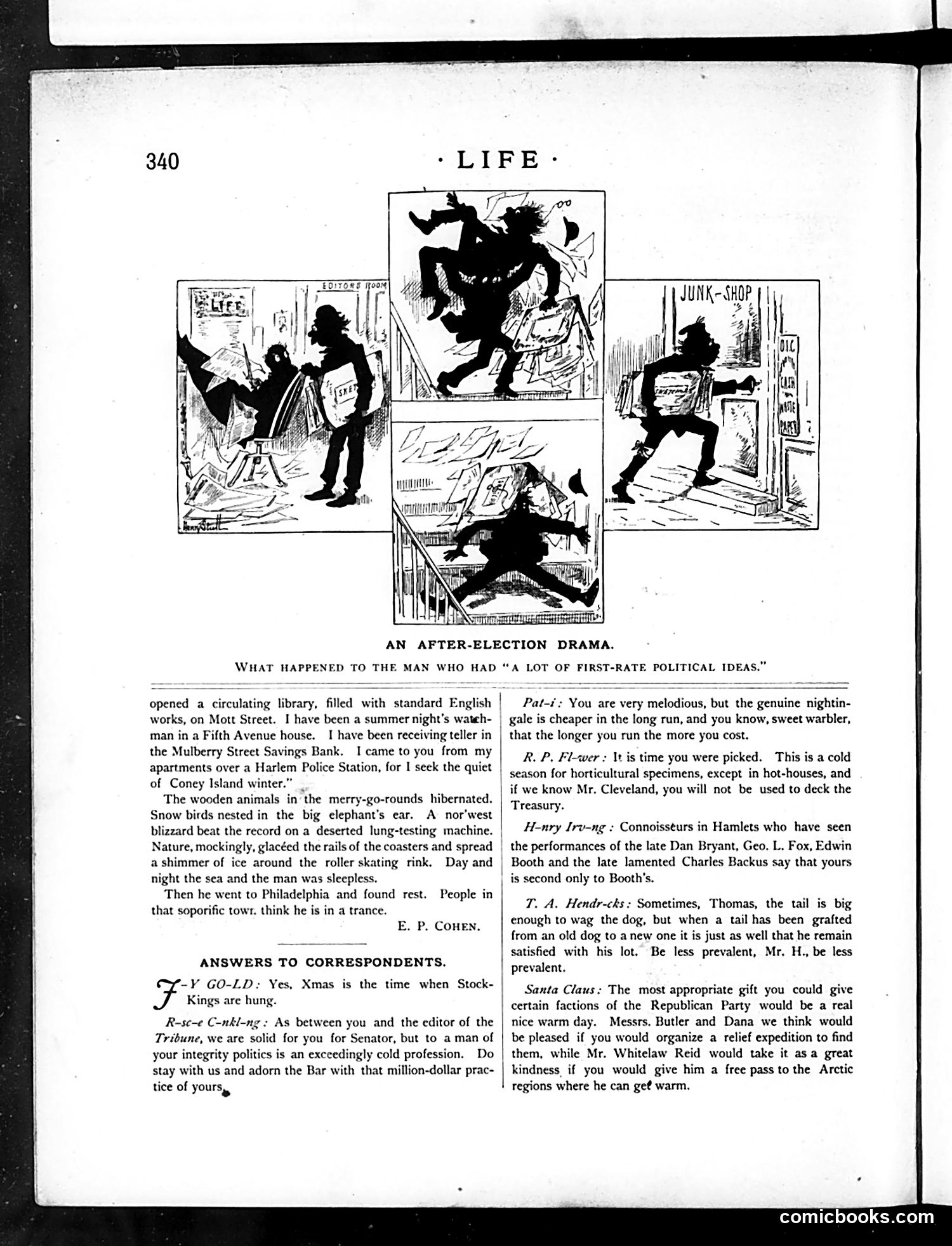
This satirical cartoon depicts a man with "first-rate political ideas" experiencing a dramatic comedown after an election. The four-panel sequence shows him descending from political ambition to destitution: from editing at Life magazine offices, to working various menial jobs (nightwatchman, bank teller, Harlem Police Station resident), finally ending unemployed and sleepless at Coney Island before finding "rest" in Philadelphia. The joke targets idealistic politicians who promised great things during campaigns but faced failure or irrelevance after elections ended. The exaggerated silhouettes emphasize his physical and psychological deterioration. The "Answers to Correspondents" section below contains pointed jabs at contemporary public figures (R.P. Flower, Henry Irving, T.A. Hendricks, and Republican politicians Butler, Dana, and Whitelaw Reid), mocking their political failures, theatrical pretensions, or inadequacies—typical of Life magazine's satirical commentary on 1880s politics and public life.
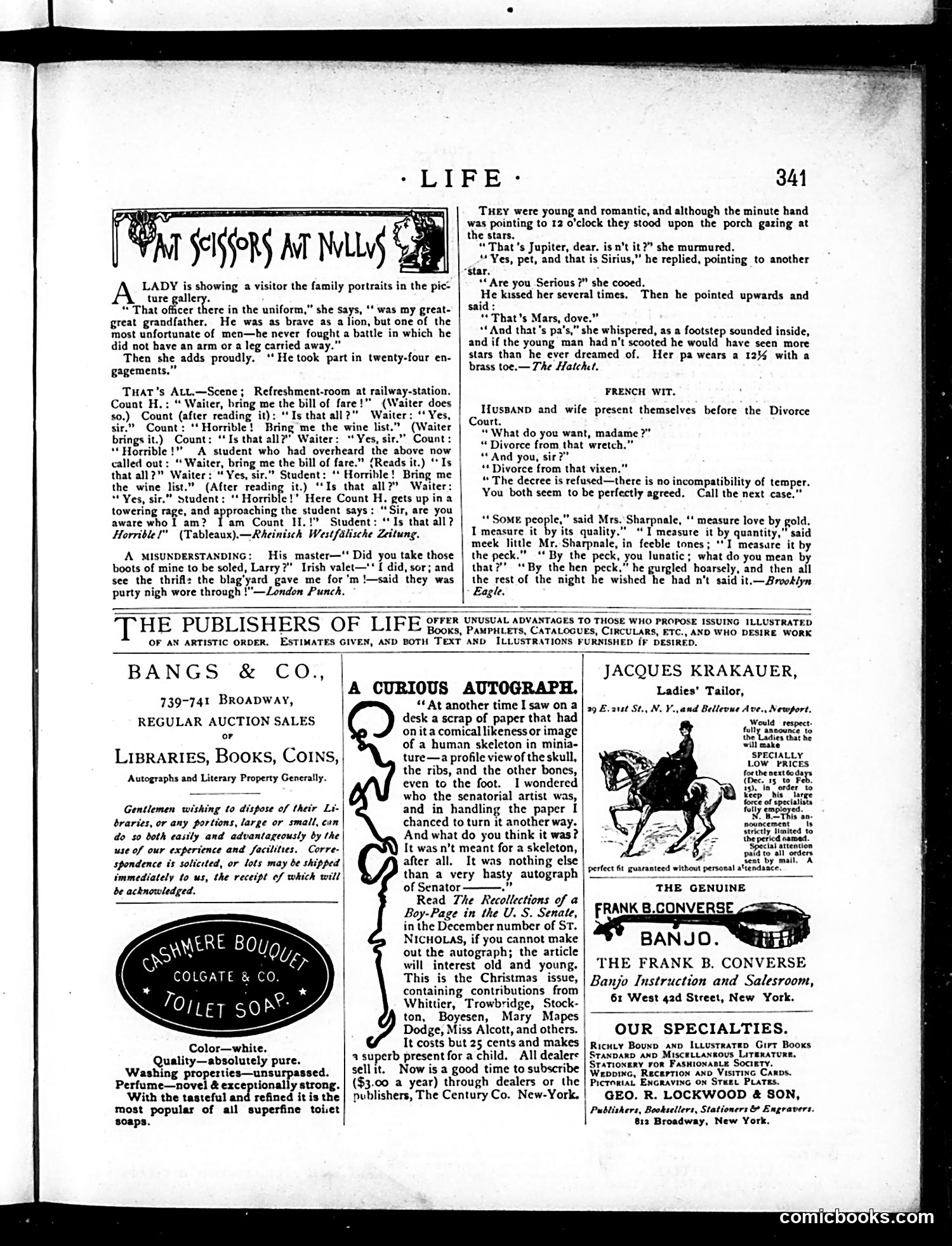
This page contains multiple brief humorous sketches typical of Life's satirical format: **"At Scissors at Nullus"** (top): A lady recounts her great-grandfather's military history—he participated in twenty-four engagements but lost limbs in each one. The joke: she presents this catastrophic record with pride, inverting normal expectations about military service. **"That's All"**: A count repeatedly asks a waiter "Is that all?" regarding menu and wine list options. A student overhears and mockingly mimics him. The count explodes in rage at being imitated, but the student's final "Is that all?" suggests the count's pretentious indignation is itself ridiculous. **The Romantic Stars scene**: A couple gazes at constellations; he identifies Mars, she makes a pun ("Are you Serious?"). When she references "that's pa's," implying her father is watching, the young man flees—the joke being he sees "stars" from the father's literal brass-toed shoe. **French Wit section**: Two brief jokes about divorce and marriage—the first playing on mutual spousal complaints; the second a "hen-pecked husband" pun. The page is primarily **advertising** for publishers and retailers below these sketches.
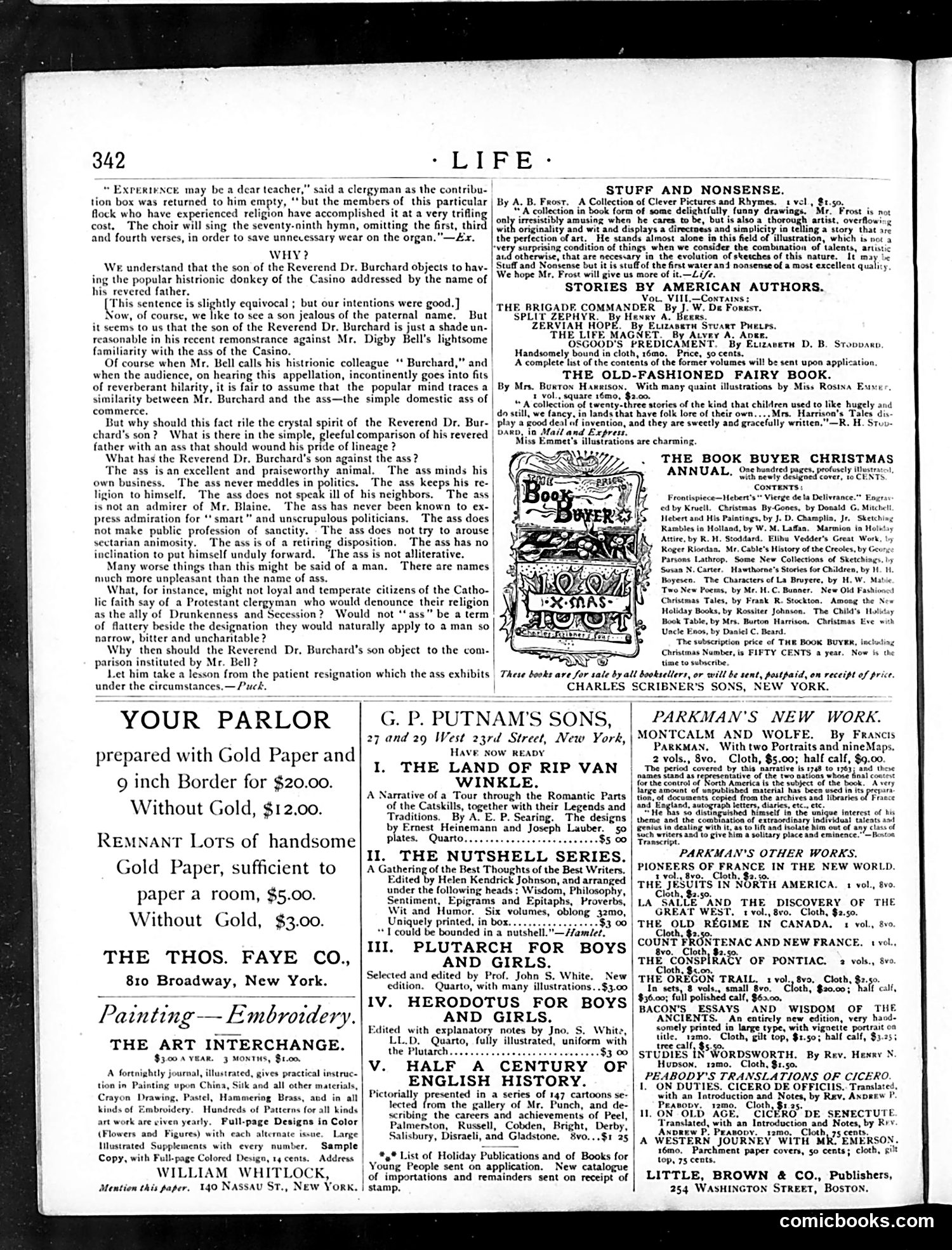
This page is primarily advertising and literary announcements, not political cartoons. The main editorial content at the top addresses a controversy: Reverend Dr. Burchard's son objected to comedian Digby Bell calling a stage donkey at the Casino theater "Burchard"—which made the audience laugh by implying a resemblance between the reverend and an ass. Life's satire defends the donkey and mocks the reverend. The editorial argues that the ass is actually a virtuous animal: it minds its own business, keeps religion private, doesn't meddle in politics, and "is not an admirer of Mr. Blaine" (likely referring to political corruption). This contrasts implicitly with a Protestant clergyman (Burchard) who publicly denounced Catholicism as connected to "Drunkenness and Secession." The joke: the supposedly sanctimonious reverend is worse than the humble ass. The satire attacks clerical hypocrisy and sectarian bigotry during America's Gilded Age.
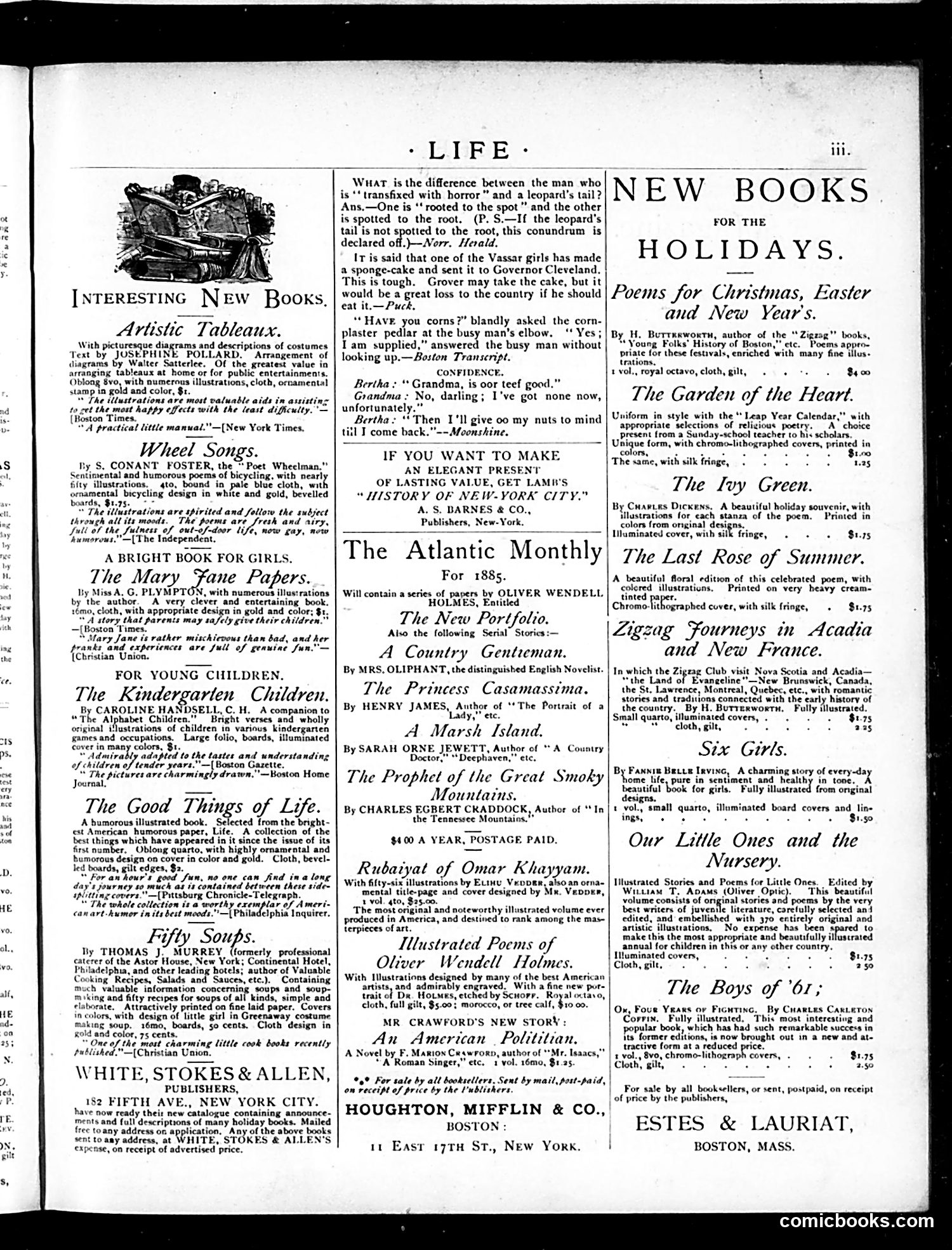
This page is primarily a **book advertisement section** rather than a satirical cartoon page. However, it opens with a **visual joke** in the top left corner. The cartoon shows an illustrated figure in what appears to be a dramatic pose, accompanying a **pun-based riddle** about the difference between a man "transfixed with horror" and a leopard's tail. The joke plays on the double meaning of "rooted to the spot" (frozen in fear) versus "spotted to the root" (the leopard's markings). This type of wordplay and visual gag was typical of Life's satirical humor. The remainder of the page consists of **advertisements for holiday books** published by White, Stokes & Allen, targeting various audiences (children, girls, cyclists). Book titles like "Wheel Songs" reflect the era's cultural interests—bicycling was a fashionable leisure activity in the 1880s. The marketing emphasizes illustrated, decorative editions suitable as gifts, reflecting Victorian-era holiday shopping practices.
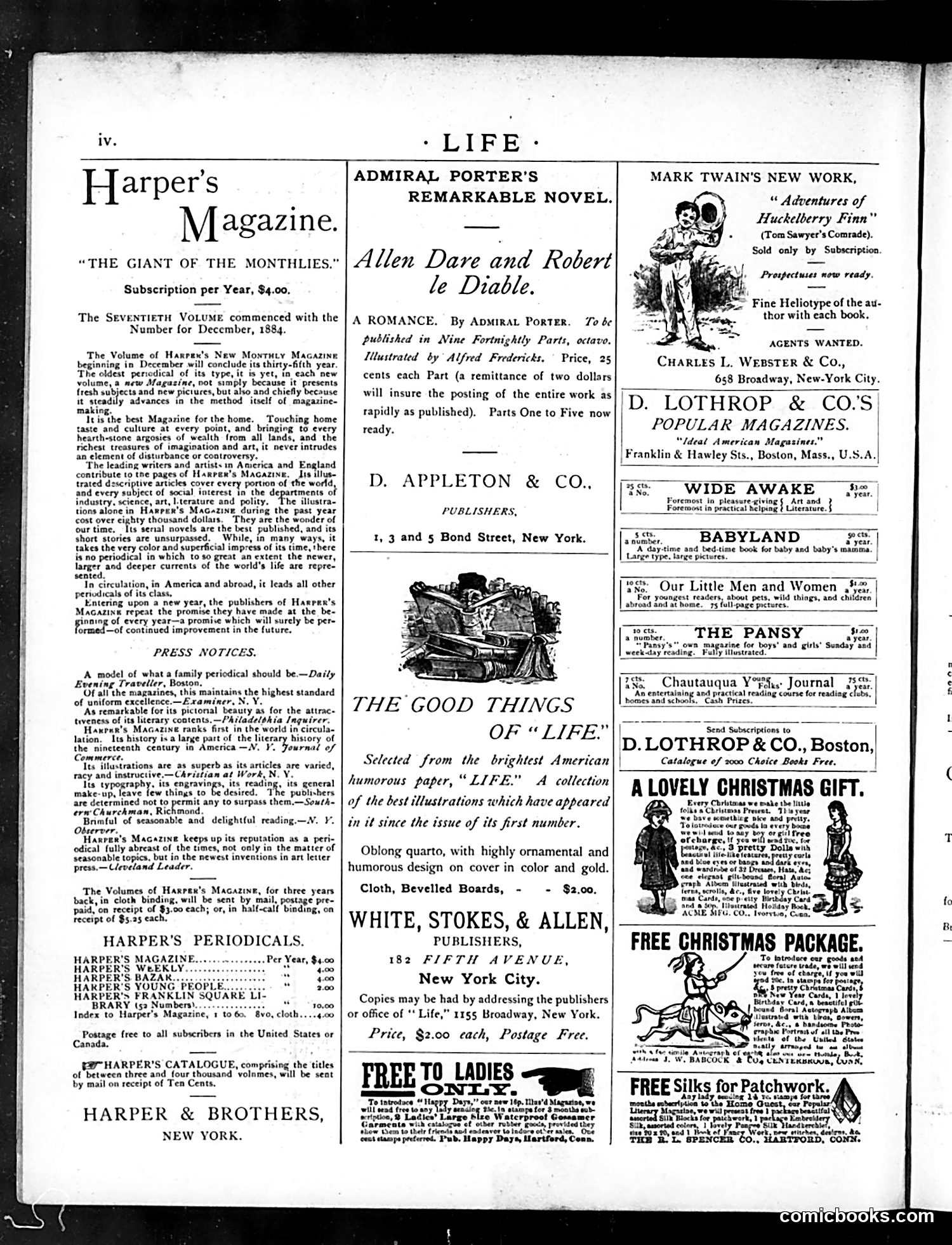
This is primarily **an advertising and marketing page** from *Life* magazine, not a political cartoon or satirical content page. It's essentially early advertisement for competing publications and products. The page promotes **Harper's Magazine** and related Harper & Brothers publications through testimonials and subscription information, emphasizing it as "the giant of the monthlies"—America's leading family magazine. The right side advertises other publications and Christmas gift items: Mark Twain's *Adventures of Huckleberry Finn* (notably "sold only by subscription"), Admiral Porter's serialized novel *Allen Dave and Robert le Diable*, various children's magazines (*Babyland*, *Our Little Men and Women*), and gift merchandise like dolls and silk for patchwork. There appear to be small illustrative vignettes of children and dolls accompanying product advertisements, typical Victorian-era marketing imagery. **No satire or political commentary is evident here**—this is straightforward commercial promotion reflecting 1880s publishing industry competition and holiday shopping culture.
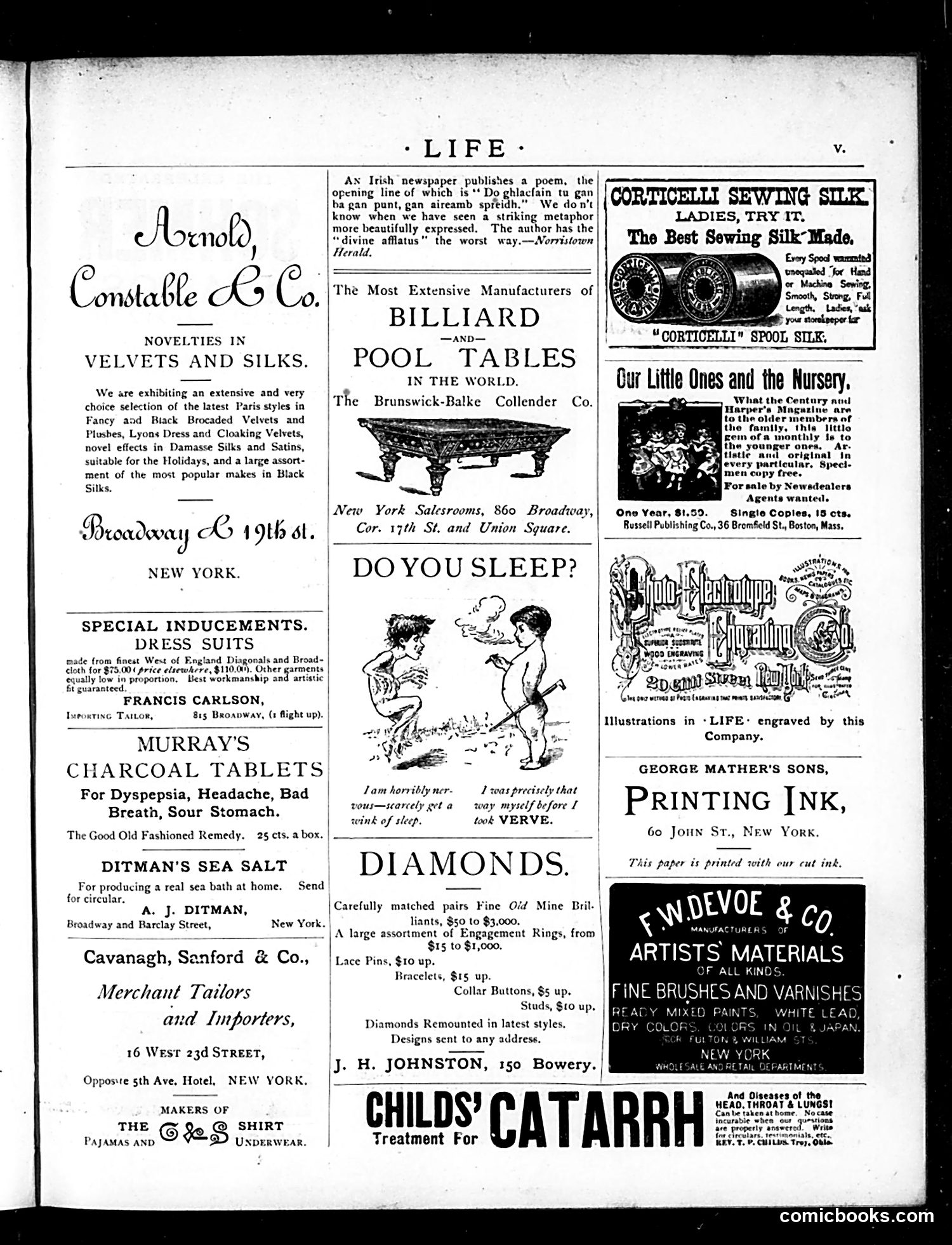
This page is primarily **advertisements** with one notable satirical cartoon. The "DO YOU SLEEP?" illustration depicts two cherub-like figures—likely infants or putti—discussing insomnia. One complains of being "horribly nervous" and unable to sleep; the other responds that he had the same problem "before I took VERVE," promoting a patent medicine cure. The satire targets **the era's ubiquitous quack remedies**. By depicting babies as insomniacs needing medicinal intervention, the cartoon mocks both the absurdity of such products and consumers' desperation for solutions to modern ailments. The implication is that people will believe anything—even that infants need nerve tonics—if marketed persuasively enough. The broader page reinforces this: surrounded by ads for digestive tablets, sea salt baths, and diamond rings, the cartoon reflects Gilded Age consumer culture's embrace of commercial "solutions" to everyday problems.
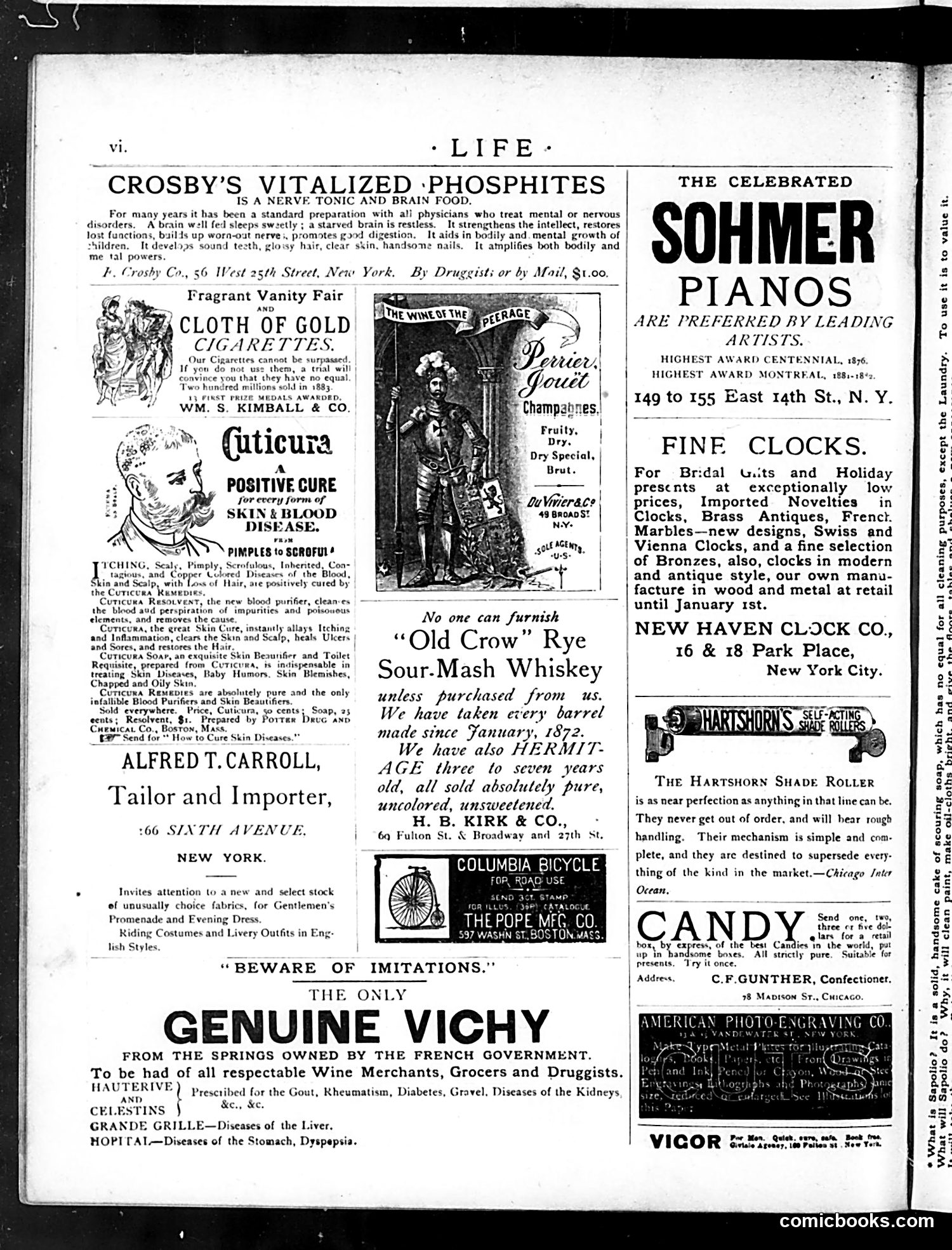
This is primarily a advertisements page from *Life* magazine. There are no political cartoons or satirical content to analyze. The page showcases late 19th-century patent medicines and consumer goods: Crosby's Vitalized Phosphites (a nerve tonic), Cuticura (a skin treatment), Cloth of Gold cigarettes, Old Crow whiskey, and various other products including pianos, clocks, and bicycles. The only illustration is a small portrait head used to advertise Cuticura—likely a before/after demonstration showing the product's purported effects on skin conditions. These were common marketing tactics of the era, when unregulated patent medicines made extravagant health claims. The page reflects the commercial nature of *Life* during this period, relying on advertising revenue rather than satirical content.
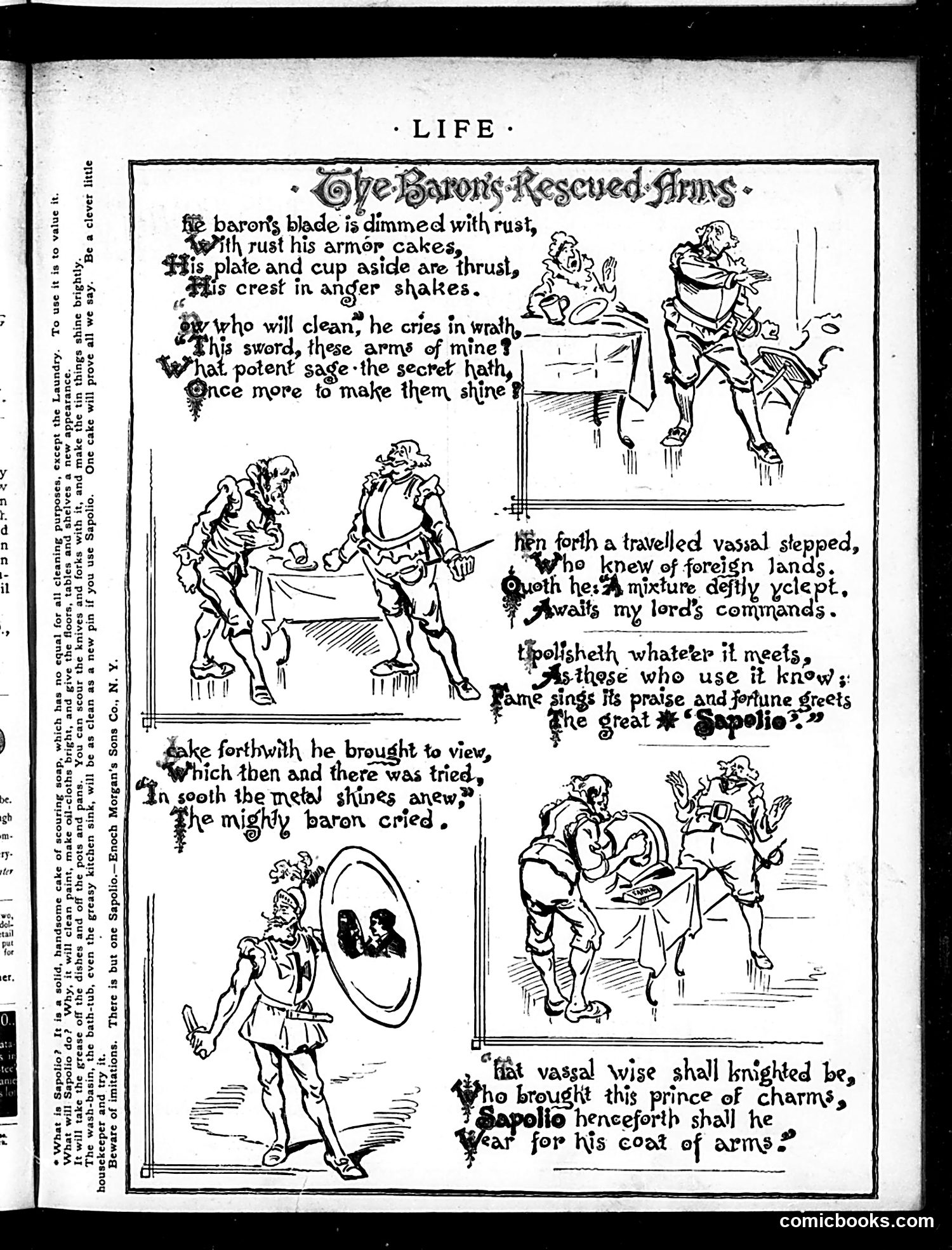
This is a humorous narrative poem illustrated with woodcuts, functioning as an advertisement for Sapolio cleaning product. The story depicts a medieval baron whose armor and weapons have fallen into rust and disrepair. He desperately seeks someone who can restore them to shine. A clever "travelled vassal" (servant) appears and offers a mysterious substance—clearly meant to be Sapolio—which miraculously polishes the metal. The baron is so impressed he knights the vassal and grants him a coat of arms. The satire gently mocks both medieval romance conventions and contemporary advertising by treating a household cleaning product with mock-heroic grandeur. The joke is that something as mundane as a scouring powder is presented with the drama and formality of a knightly quest, making the product memorable through whimsical storytelling rather than direct sales pitch.
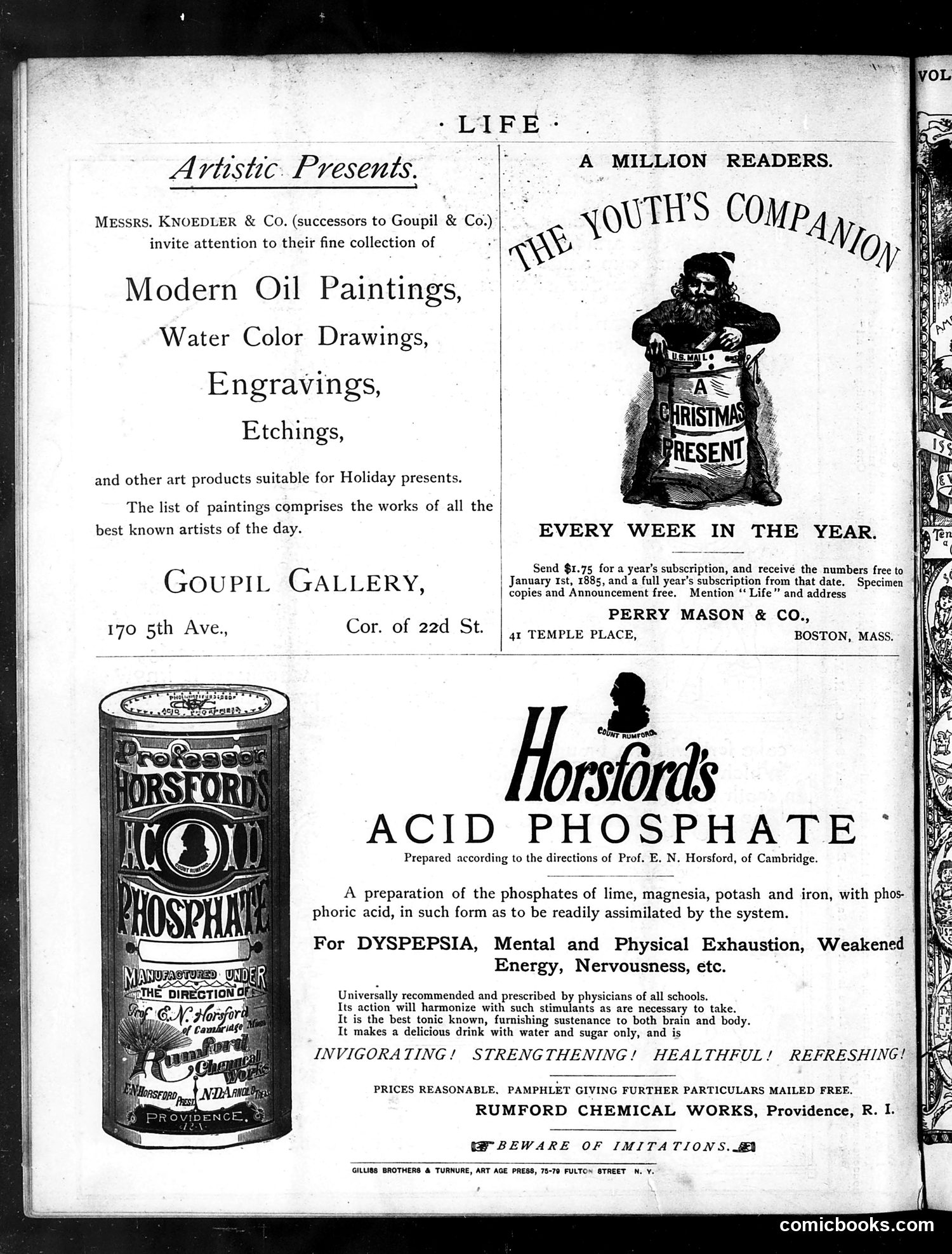
This page is primarily **advertising**, not satire or political commentary. It contains three distinct ads: 1. **Goupil Gallery** (top left): announces fine art for holiday gift-giving—oil paintings, watercolors, engravings, etchings. 2. **The Youth's Companion** (top right): a subscription magazine featuring Santa Claus imagery, promoting $1.75 yearly subscriptions starting January 1885. 3. **Horsford's Acid Phosphate** (bottom): a patent medicine advertisement claiming to treat "dyspepsia, mental and physical exhaustion, weakened energy, nervousness." It's presented as a scientifically-formulated tonic (prepared by Prof. E.N. Horsford of Cambridge) universally recommended by physicians—typical late-19th-century medical marketing that would be considered fraudulent today. No political cartoon or satire is present. The page simply reflects Life magazine's revenue model: selling advertising space to holiday retailers and patent medicine companies.