
Life, 1884-12-11 · page 6 of 28
Life — December 11, 1884 — page 6: what you’re looking at
What you’re looking at
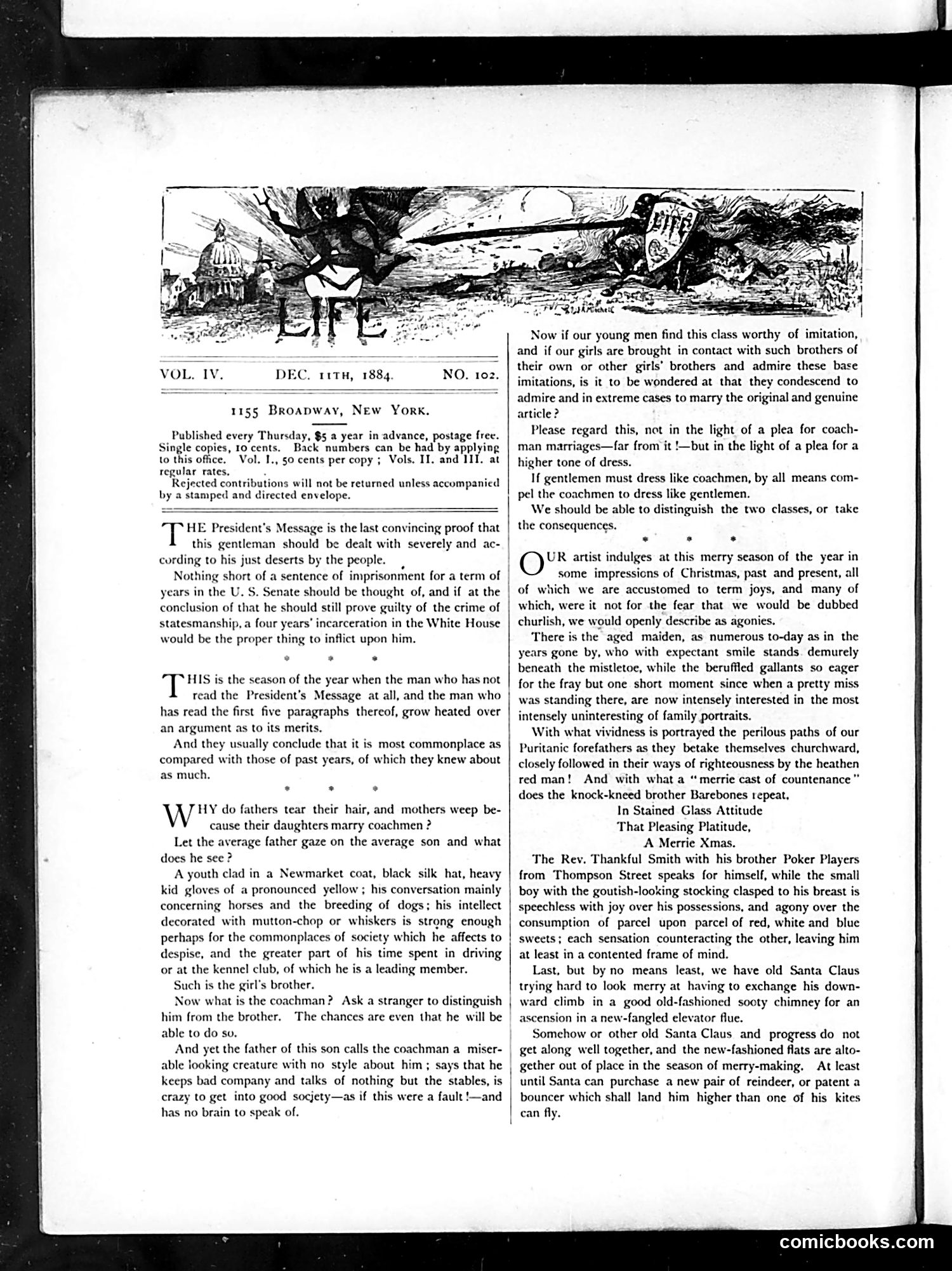
The page contains editorial commentary rather than a cartoon. The main text criticizes fathers who object to their daughters marrying coachmen while dressing their own sons as coachmen—essentially wearing the same uniform as servants. The satire targets class hypocrisy: wealthy families adopt the fashionable "coachman look" (Newmarket coat, silk hat, gloves) as stylish dress, yet consider actual coachmen unsuitable marriage prospects for their daughters. The piece argues this distinction is absurd and hypocritical. If the coachman's appearance and manner are admirable enough to imitate, why are they deemed unworthy as sons-in-law? The satire highlights Victorian-era class pretensions and the arbitrary nature of social status based on appearance rather than substance.
📄 Transcribed text from this page (OCR, searchable)
Machine-transcribed from the original scan — historical spelling and the odd misread are preserved.
VOL. IV. 1155 Broapway, New York. Published every Thursday, $5 a year in advance, postage free. Single copies, to cents. Back numbers can be had by applying to this office.” Vol. 1., 50 cents per copy ; Vols. II, and III. at regular rates, Rejected contributions will not be returned unless accompanied by a stamped and directed envelope. HE President's Message is the last convincing proof that this gentleman should be dealt with severely and ac- | cording to his just deserts by the people. Nothing short of a sentence of imprisonment for a term of years in the U. S. Senate should be thought of, and if at the conclusion of that he should still prove guilty of the crime of | statesmanship, a four years’ incarceration in the White House would be the proper thing to inflict upon him. ° . . HIS is the season of the year when the man who has not read the President’s Message at all, and the man who | has read the first five paragraphs thereof, grow heated over an argument as to its merits, And they usually conclude that it is most commonplace as compared with those of past years, of which they knew about as much, . . . HY do fathers tear their hair, and mothers weep be- cause their daughters marry coachmen ? Let the average father gaze on the average son and what does he see ? A youth clad in a Newmarket coat, black silk hat, heavy kid gloves of a pronounced yellow ; his conversation mainly concerning horses and the breeding of dogs; his intellect decorated with mutton-chop or whiskers is strong enough perhaps for the commonplaces of society which he affects to despise, and the greater part of his time spent in driving or at the kennel club, of which he is a leading member. Such is the girl's brother. Now what is the coachman? Ask a stranger to distinguish him from the brother. The chances are even that he will be able to do so. And yet the father of this son calls the coachman a _miser- able looking creature with no style about him ; says that he keeps bad company and talks of nothing but the stables, is | crazy to get into good socjety—as if this were a fault !—and has no brain to speak of. Now if our young men find this class worthy of imitation, and if our girls are brought in contact with such brothers of their own or other girls’ brothers and admire these base imitations, is it to be wondered at that they condescend to admire and in extreme cases to marry the original and genuine article ? Please regard this, not in the light of a plea for coach- man marriages—far from it !—but in the light of a plea for a higher tone of dress. If gentlemen must dress like coachmen, by all means com- pel the coachmen to dress like gentlemen. We should be able to distinguish the two classes, or take the consequences. . * . UR artist indulges at this merry season of the year in some impressions of Christmas, past and present, all of which we are accustomed to term joys, and many of which, were it not for the fear that we would be dubbed churlish, we would openly describe as agonies. ‘There is the aged maiden, as numerous to-day as in the years gone by, who with expectant smile stands. demurely beneath the mistletoe, while the beruffled gallants so eager for the fray but one short moment since when a pretty miss was standing there, are now intensely interested in the most intensely uninteresting of family portraits. With what vividness is portrayed the perilous paths of our Puritanic forefathers as they betake themselves churchward, closely followed in their ways of righteousness by the heathen red man! And with what a “ merrie cast of countenance" does the knock-kneed brother Barebones repeat, In Stained Glass Attitude That Pleasing Platitude, A Merrie Xmas. The Rev. Thankful Smith with his brother Poker Players from Thompson Street speaks for himself, while the small boy with the goutish-looking stocking clasped to his breast is speechless with joy over his possessions, and agony over the consumption of parcel upon parcel of red, white and blue sweets; each sensation counteracting the other, leaving him at least in a contented frame of mind. Last, but by no means least, we have old Santa Claus trying hard to look merry at having to exchange his down- ward climb in a good old-fashioned sooty chimney for an ascension in a new-fangled elevator flue. Somchow or other old Santa Claus and progress do not get along well together, and the new-fashioned flats are alto- gether out of place in the season of merry-making. At least until Santa can purchase a new pair of reindeer, or patent a bouncer which shall land him higher than one of his kites | can fly. comicbooks.com