
Life, 1884-12-11 · page 9 of 28
Life — December 11, 1884 — page 9: what you’re looking at
What you’re looking at
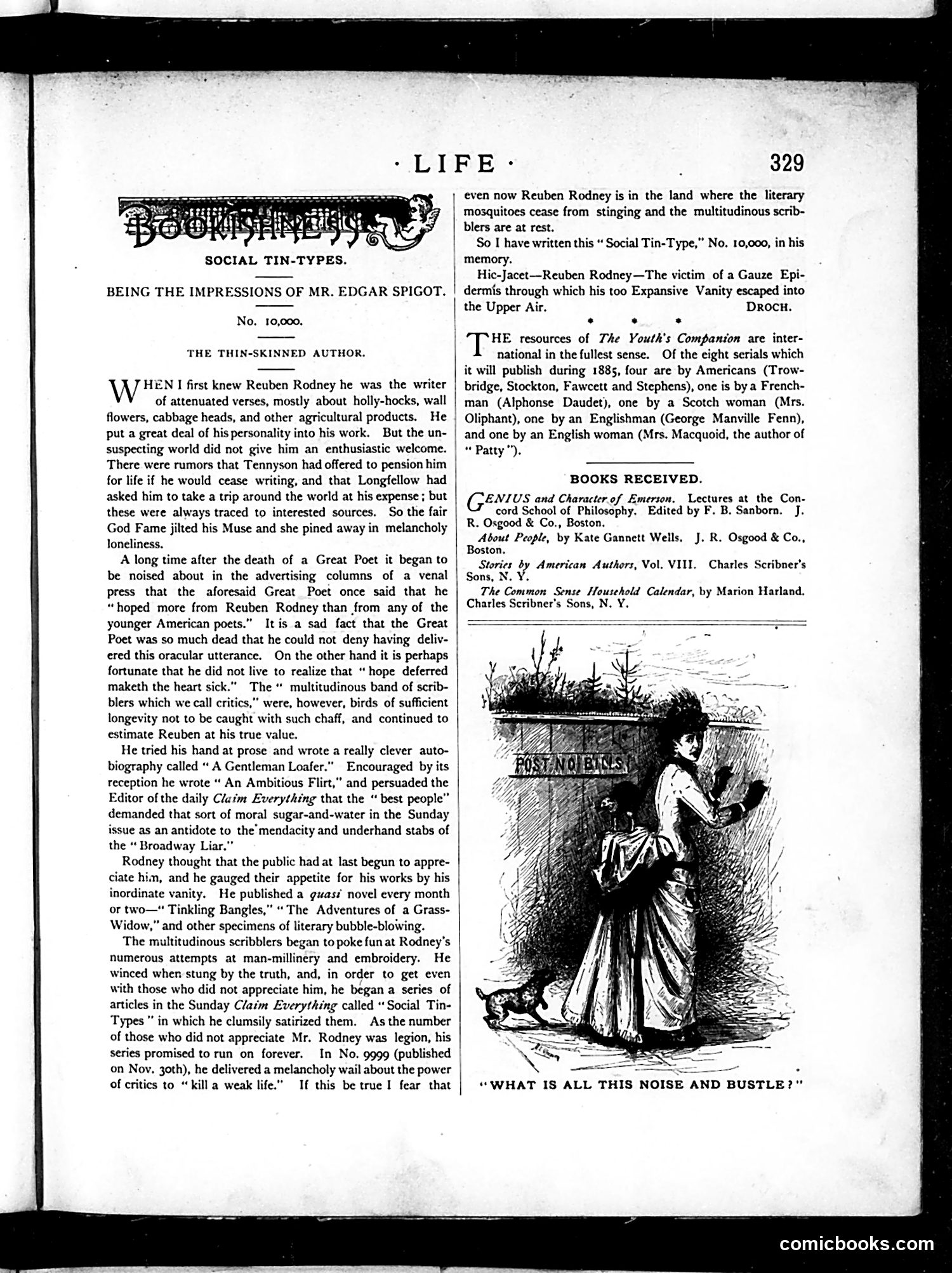
This page features a satirical essay titled "Social Tin-Types" by Edgar Spigot, critiquing writer Reuben Rodney. The text mockingly describes Rodney as a minor poet who wrote about "holly-hocks, wall flowers, cabbage heads, and other agricultural products" — deliberately trivial subjects. The satire attacks Rodney's vanity and prolific output of mediocre work, noting he published a "quasi novel every month or two" with titles like "Fishing Bangles" and "The Adventures of a Grass-Widow." Life's editors satirize his thin-skinned response to criticism through his "Social Tin-Types" series in the *Claim Everything* publication, where he caricatured detractors. The accompanying illustration shows a postal worker, visually representing the "noise and bustle" of Rodney's constant literary output flooding the public.
📄 Transcribed text from this page (OCR, searchable)
Machine-transcribed from the original scan — historical spelling and the odd misread are preserved.
> LIFE: SOCIAL TIN-TYPES. BEING THE IMPRESSIONS OF MR. EDGAR SPIGOT. No, 10,000, THE THIN-SKINNED AUTHOR. HEN | first knew Reuben Rodney he was the writer of attenuated verses, mostly about holly-hocks, wall flowers, cabbage heads, and other agricultural products. He | put a great deal of his personality into his work. But the un- suspecting world did not give him an enthusiastic welcome. | There were rumors that Tennyson had offered to pension him for life if he would cease writing, and that Longfellow had asked him to take a trip around the world at his expense ; but these were always traced to interested sources. So the fair | God Fame jilted his Muse and she pined away in melancholy loneliness. A long time after the death of a Great Poet it began to be noised about in the advertising columns of a venal press that the aforesaid Great Poet once said that he “hoped more from Reuben Rodney than from any of the younger American poets.” It is a sad fact that the Great Poet was so much dead that he could not deny having deliv- ered this oracular utterance. On the other hand it is perhaps fortunate that he did not live to realize that “hope deferred maketh the heart sick.” The “ multitudinous band of scrib- blers which we call critics,” were, however, birds of sufficient longevity not to be caught with such chaff, and continued to estimate Reuben at his true value. He tried his hand at prose and wrote a really clever auto- biography called “ A Gentleman Loafer.” Encouraged by its reception he wrote “ An Ambitious Flirt,” and persuaded the Editor of the daily Clatm Everything that the “ best people” demanded that sort of moral sugar-and-water in the Sunday issue as an antidote to the’mendacity and underhand stabs of the “ Broadway Liar.” Rodney thought that the public had at last begun to appre- ciate him, and he gauged their appetite for his works by his | inordinate vanity. He published a guasi novel every month or two— Tinkling Bangles,” “The Adventures of a Grass- Widow,” and other specimens of literary bubble-blowing. The multitudinous scribblers began to poke fun at Rodney's numerous attempts at man-millinery and embroidery. He winced when stung by the truth, and, in order to get even with those who did not appreciate him, he began a series of articles in the Sunday Claim Everything called “Social Tin- Types” in which he clumsily satirized them. As the number of those who did not appreciate Mr. Rodney was legion, his series promised to run on forever. In No. 9999 (published on Nov. 30th), he delivered a melancholy wail about the power of critics to “killa weak life.” If this be true I fear that 329 even now Reuben Rodney is in the land where the literary mosquitoes cease from stinging and the multitudinous scrib- blers are at rest. So I have written this “ Social Tin-Type,” No. 10,000, in his memory. Hic-Jacet—Reuben Rodney—The victim of a Gauze Epi- dermis through which his too Expansive Vanity escaped into the Upper Air. Drocu. . . . HE resources of The Youth's Companion are inter- national in the fullest sense. Of the eight serials which it will publish during 1885, four are by Americans (Trow- bridge, Stockton, Fawcett and Stephens), one is bya French- man (Alphonse Daudet), one by a Scotch woman (Mrs. Oliphant), one by an Englishman (George Manville Fenn), and one by an English woman (Mrs. Macquoid, the author of “ Patty"). BOOKS RECEIVED. Gearus and Character.of Emerton. Lectures at the Con- cord School of Philosophy. Edited by F. B. Sanborn. J. R. Osgood & Co., Boston. About People, by Kate Gannett Wells. Boston. Stories by American Authors, Vol. VIII. Charles Scribner's Sons, N. Y. The Common Sense Household Calendar, by Marion Harland. Charles Scribner's Sons, N. Y. J. R. Osgood & Co., “WHAT IS ALL THIS NOISE AND BUSTLE?" comicbooks.com