
A complete issue · 16 pages · 1884
Life — September 11, 1884
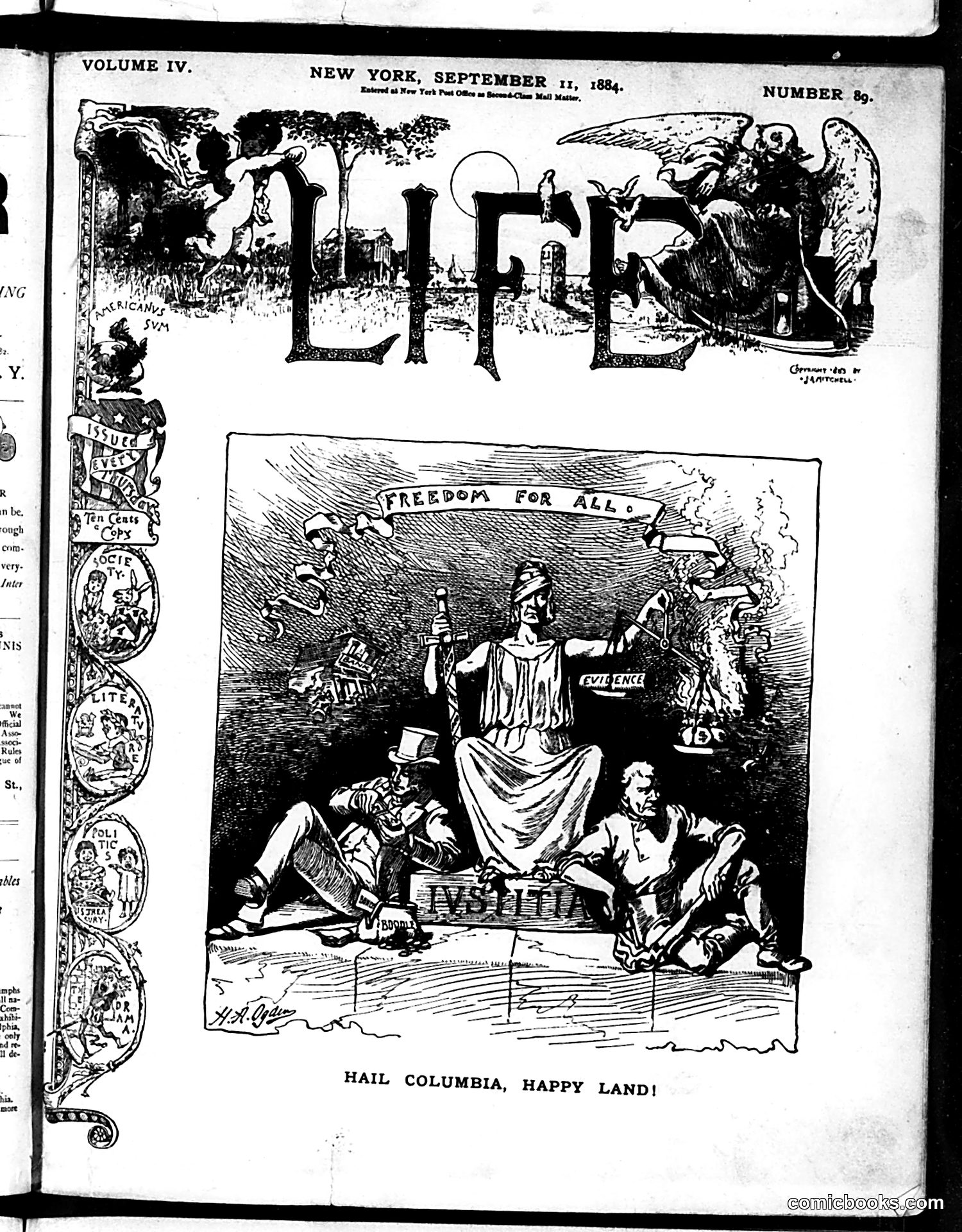
This political cartoon titled "Hail Columbia, Happy Land!" depicts Lady Liberty (Columbia) seated centrally with a banner reading "Freedom for All." She's surrounded by figures representing different American constituencies or interests. The allegorical scene appears to comment on the 1884 presidential election—a major contest between James G. Blaine (Republican) and Grover Cleveland (Democrat). The figures at Liberty's feet likely represent competing political factions or voter groups seeking her favor and attention. The phrase "Freedom for All" suggests ironic commentary on whether American democracy truly delivers on its promise. The cartoon's satirical tone questions which candidate or party genuinely serves the nation's ideals versus mere self-interest. The ornate left border contains classical medallions, typical of Life's design aesthetic.
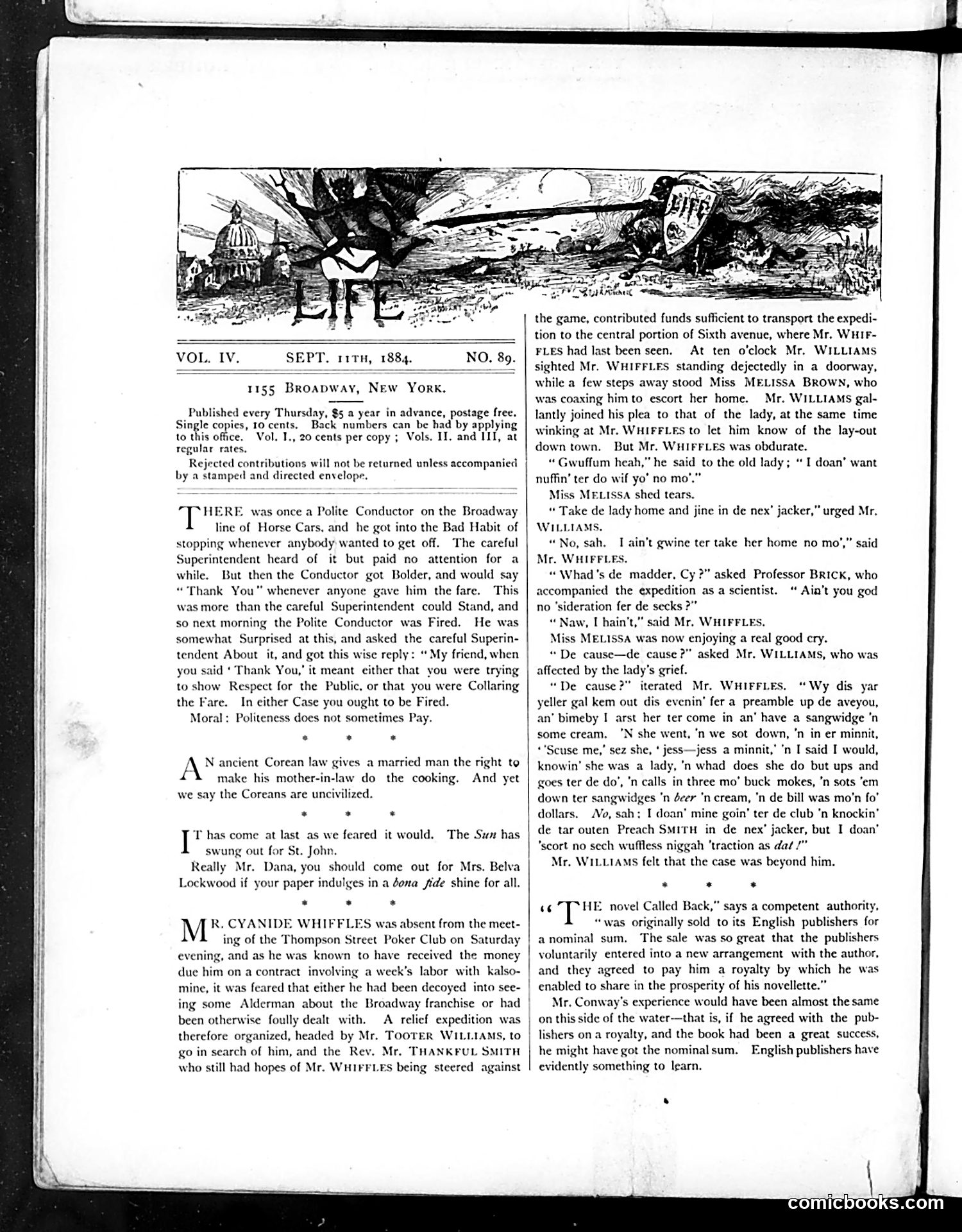
This page contains satirical short stories rather than political cartoons. The main pieces mock: 1. **"The Polite Conductor"** — A brief anecdote satirizing excessive politeness in service work. A Broadway streetcar conductor was fired for being *too* courteous to passengers, illustrating how even virtues can be taken to absurd extremes in professional settings. 2. **Korean marriage law commentary** — A dismissive note suggesting Koreans are "uncivilized" because their law grants husbands authority over domestic cooking—reflecting Victorian-era Western attitudes toward non-European cultures. 3. **"Called Back" book review** — Discusses a novel's English publishing success and royalty arrangements, with no apparent satirical intent; appears to be straightforward literary commentary. The humor targets social pretension and professional absurdity rather than specific political figures.
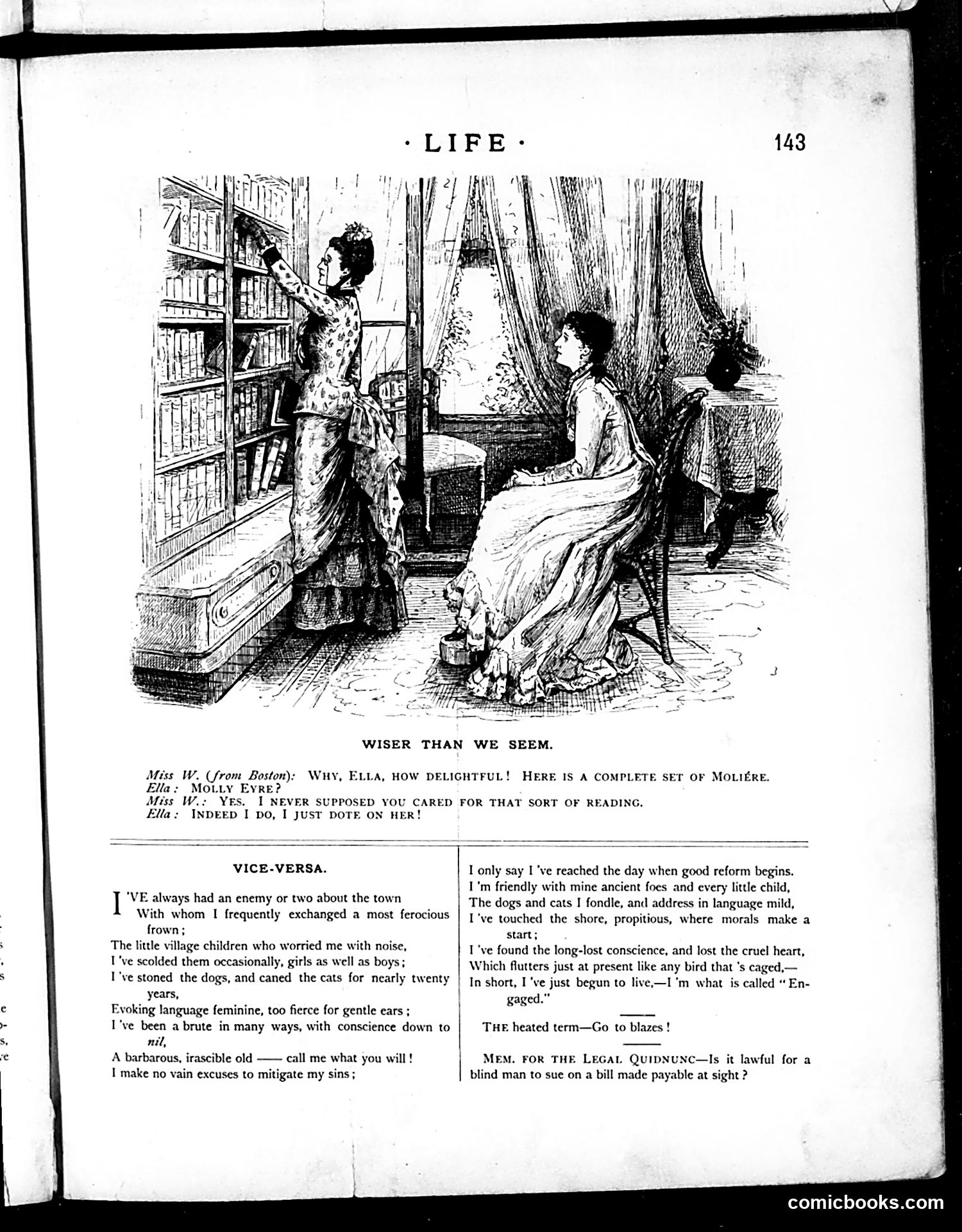
The top cartoon, titled "Wiser Than We Seem," depicts a social comedy about class and literary taste. A woman from Boston (Miss W.) presents Molière's complete works to her friend Ella, expecting praise. Ella responds with surprise that the Boston woman reads such sophisticated French literature, having assumed she lacked such refined interests. The joke satirizes regional stereotypes and superficial social assumptions—people misjudge others' intellectual capacity based on appearance or origin. Below, "Vice Versa" is a confessional poem where the speaker admits to past brutishness (scolding children, cursing) but claims recent moral reformation and "engagement" with life's better aspects. It's a humorous meditation on personal improvement and redemption, mocking self-righteous claims of moral awakening.
This page consists entirely of satirical text commentary ("Boomlets" section) with no visible cartoons. The satire targets 1880s-1890s political figures: - **Mrs. Belva Lockwood**: Mocked for her "Presidential boom" (she ran for president in 1884 and 1888) - **James G. Blaine**: Criticized for his failed presidential ambitions - **Governors Bunn and Rusk**: Satirized as unlikely presidential candidates - **Gen. Butler**: Referenced regarding a campaign medal The right column reviews Charles Egbert Craddock's novel "Where the Battle Was Fought," praising its romantic Southern setting and Civil War themes. The satire's point: mock the proliferation of marginal political figures seeking the presidency and the media attention given to their "booms." The dismissive tone suggests Life viewed these candidacies as absurd.
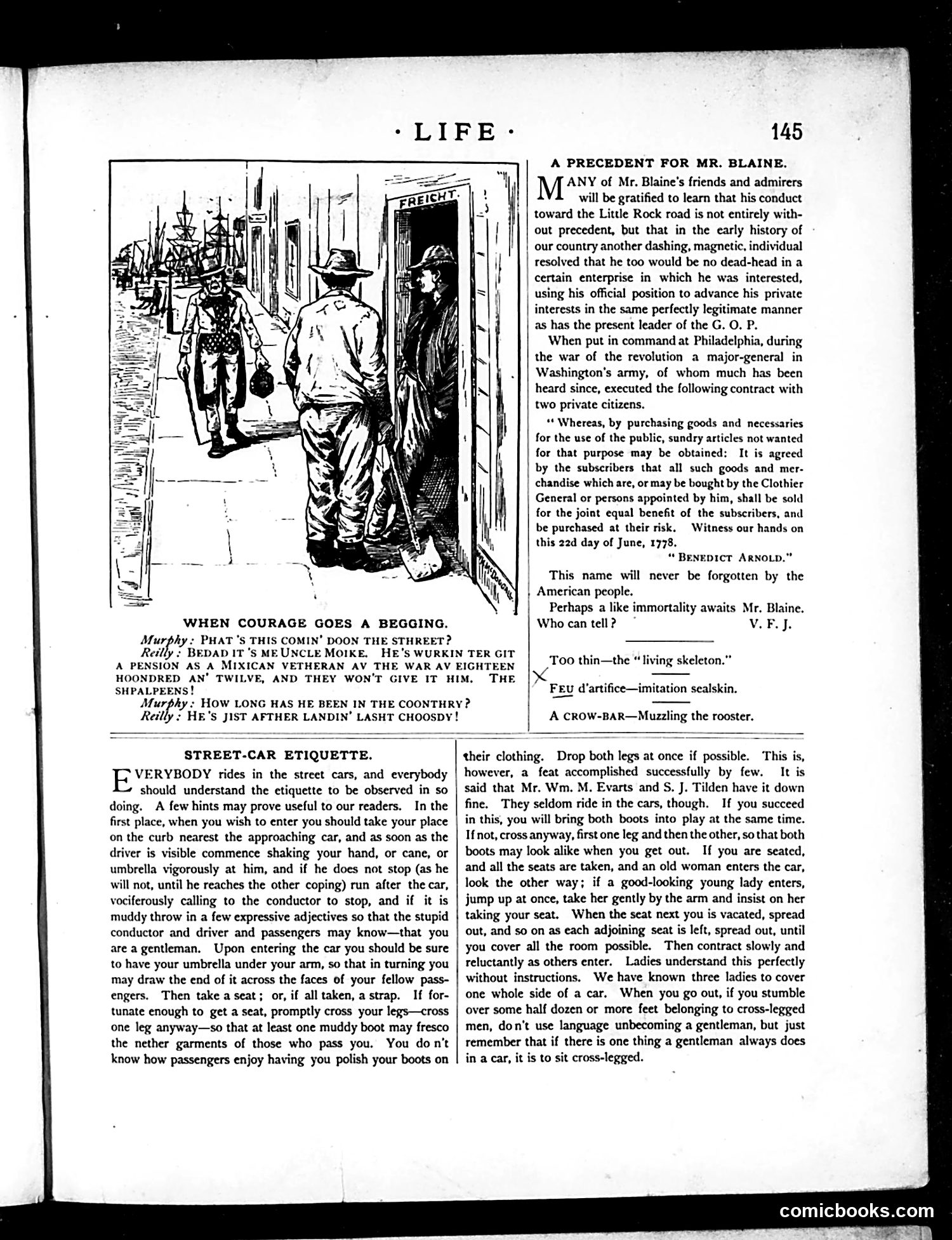
**Main Cartoon: "When Courage Goes a Begging"** This depicts a street scene with soldiers and civilians. The dialogue references a Mexican War veteran seeking a pension, with an Uncle Moke character. The joke satirizes the government's reluctance to provide pensions to war veterans—suggesting their "courage" isn't valued when it comes time to pay them. This reflects common 19th-century complaints about inadequate veteran benefits. **"Street-Car Etiquette" Section** This satirical advice column mocks poor manners on public transit—specifically muddy boots, aggressive seat-taking, and blocking aisles. The detailed instructions about crossing one's legs and letting women sit first suggest passengers frequently violated these norms, making the etiquette guide necessary social commentary on declining public decorum.
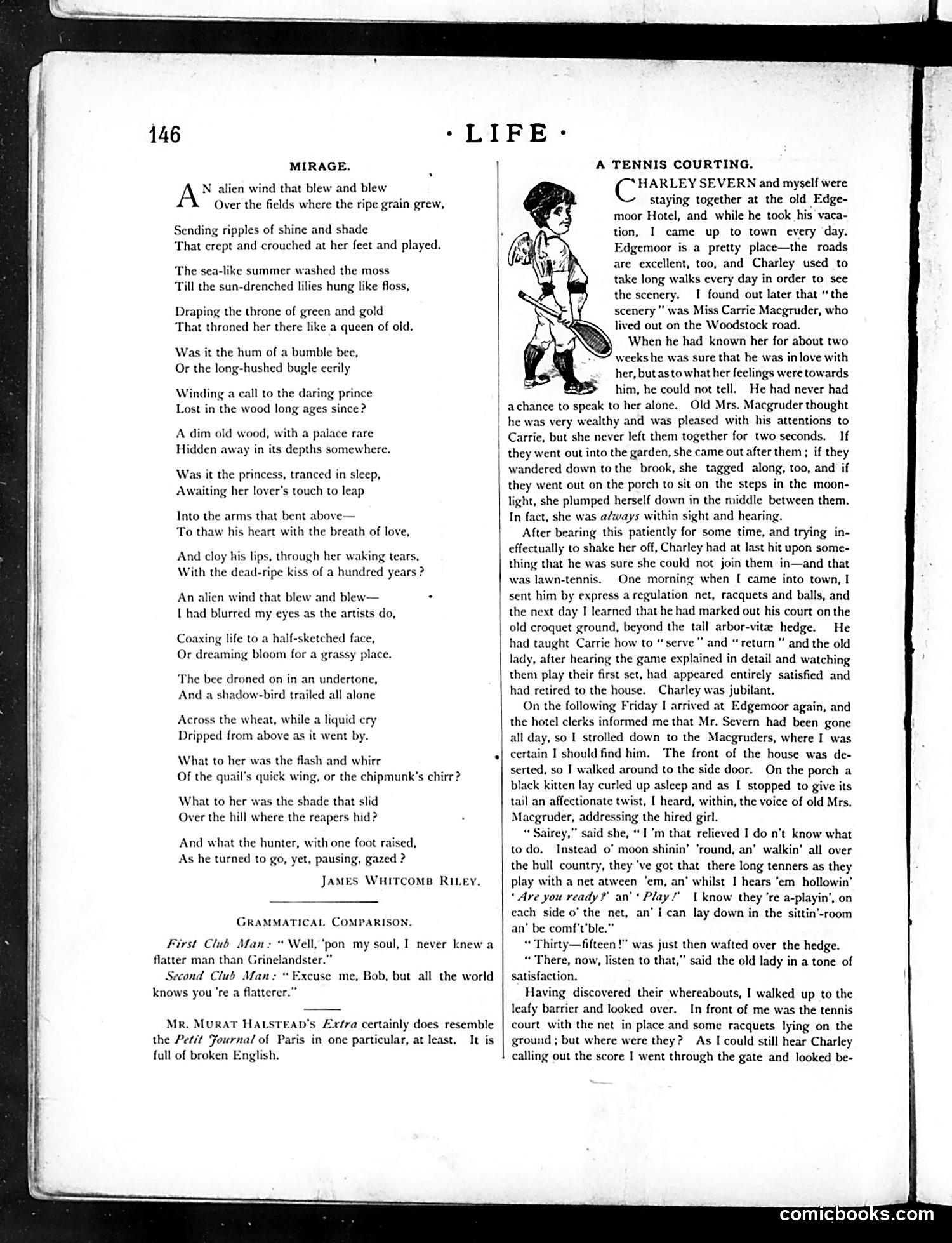
This page contains two distinct sections: **Left side:** A poem titled "Mirage" by James Whitcomb Riley, with an illustration of a young woman in tennis attire holding a racket. The poem uses romantic, allegorical language about nature and longing. **Right side:** A prose piece titled "A Tennis Courting" describing a romantic encounter between the narrator and a man named Charley Severn at a hotel, mediated through tennis and a young woman named Carrie Macgruder. The narrative is lighthearted social commentary about courtship customs among the leisure class. **Bottom:** A brief "Grammatical Comparison" section mocking public figures' speech patterns—Grinelander, Bob the flatterer, and Mr. Murat Halstead's broken English. The page reflects early 20th-century *Life* magazine's mix of sentimental poetry, humorous social fiction, and gentle satirical jabs at contemporary public figures and social conventions.
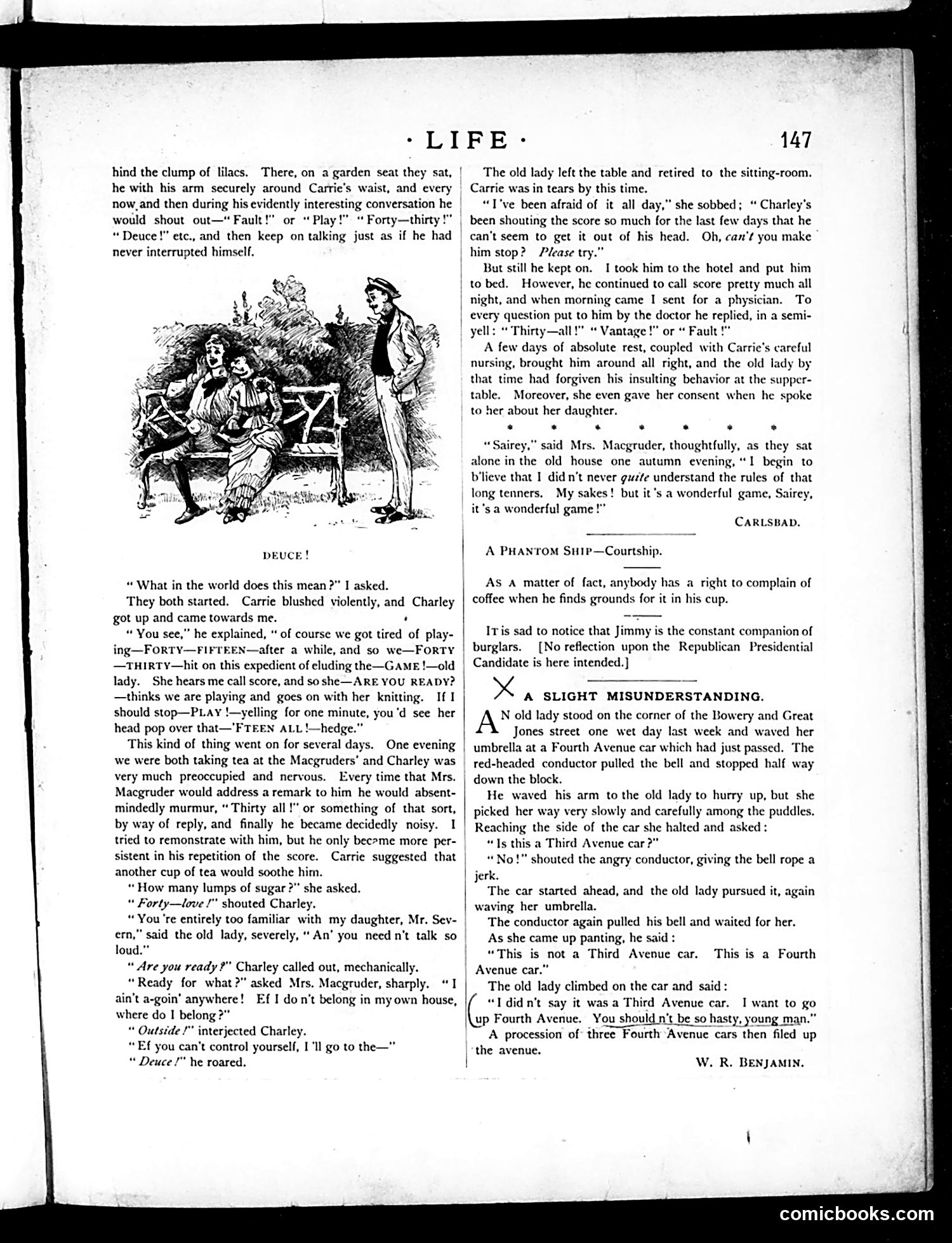
This page contains three separate literary pieces rather than political cartoons. The main illustrated story shows a gentleman and woman in period dress engaged in a domestic dispute about card games—likely depicting social satire about leisure activities and marital dynamics among the upper classes. Below are two short humorous pieces: "A Phantom Ship—Courtship" contains a one-liner joke about coffee grounds, and "A Slight Misunderstanding" by W.R. Benjamin satirizes urban life, depicting a confused elderly woman boarding the wrong Fourth Avenue streetcar in New York City, creating comedy from the conductor's impatience and her bewilderment. The content reflects early 20th-century American urban humor and domestic comedies typical of Life magazine's satirical offerings.
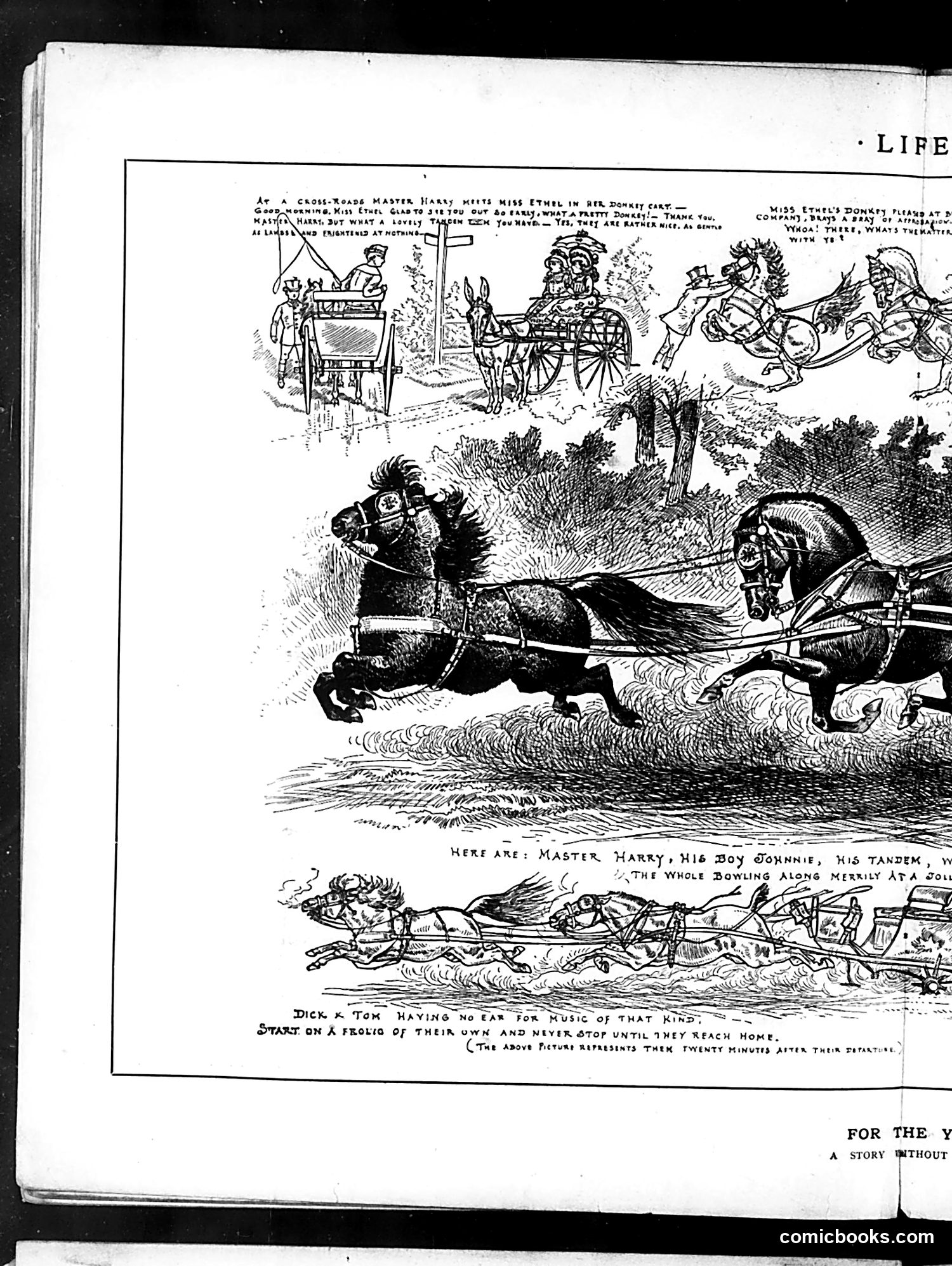
This page contains a humorous illustrated narrative about a character named **Master Harry** and his boy **Johnnie**, depicting them on a wild "bowling" expedition with horses and carriages. The top panels show various characters in Victorian-era dress observing or participating in chaotic carriage scenes. The middle section depicts horses at full gallop pulling what appears to be an out-of-control conveyance. The bottom panel mentions **"Dick" and "Tom"** having "no ear for music" while on "a frolic of their own," never stopping "until they reach home." The satire appears to mock reckless driving or transportation behavior of the era—the "bowling along merrily" suggests wild, uncontrolled movement. The joke relies on visual chaos and the contrast between genteel Victorian society and unruly behavior, typical of Life magazine's satirical humor targeting contemporary social follies.
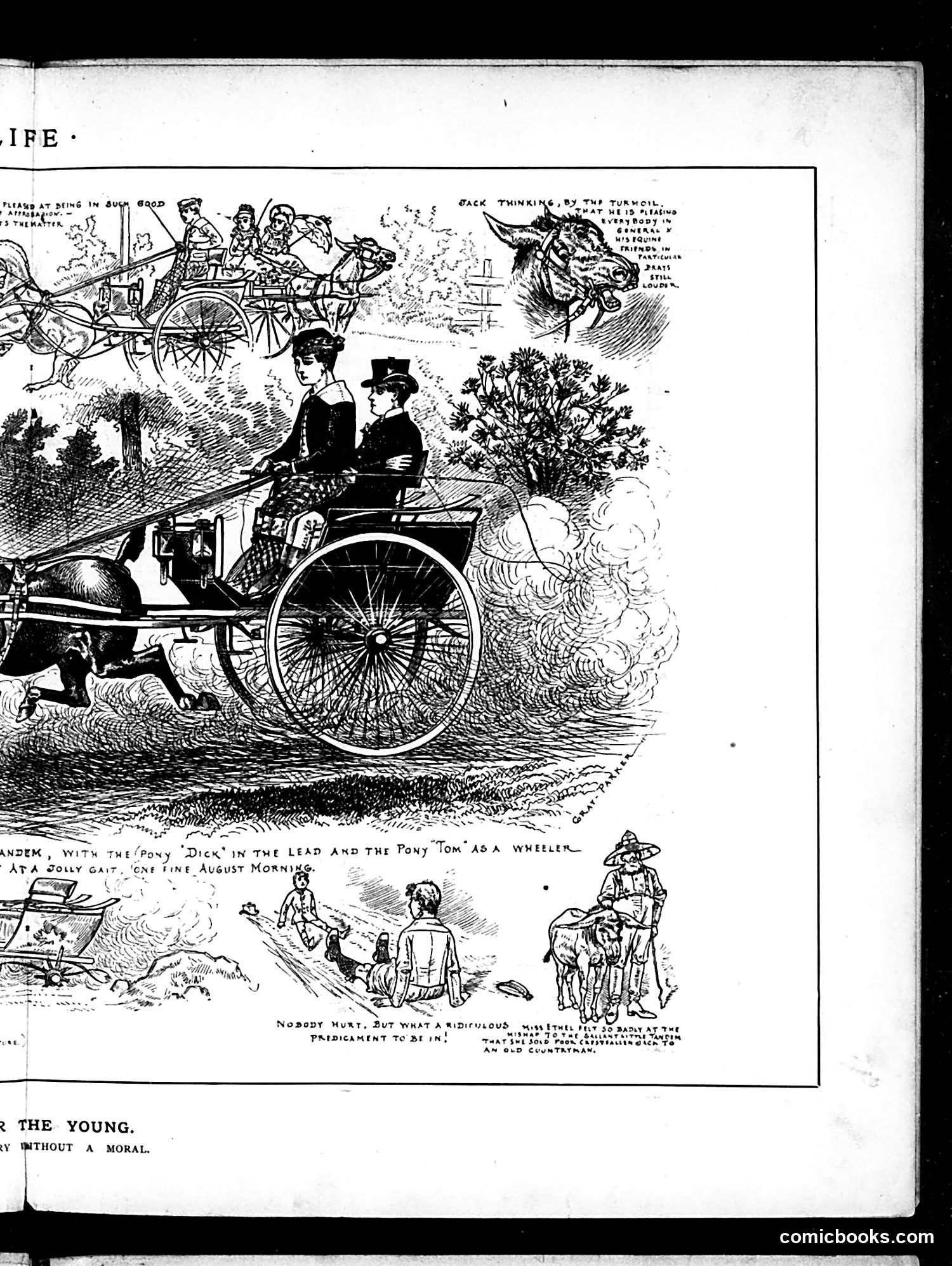
This appears to be a multi-panel satirical cartoon about fashionable society and transportation. The central image depicts a well-dressed couple in a pony cart—a leisure vehicle popular among the wealthy—with text referencing "Pony Dick" and "Pony Tom as a wheeler" during "a jolly gait one fine August morning." The upper panels mock aristocratic pretension, with references to "back thinking by the turmoil" and hunting scenes. The lower panel depicts a "Nursery Hunt," appearing to satirize how even children mimicked upper-class recreational activities and transportation fashions. The satire seems directed at Victorian-era wealthy society's obsession with fashionable carriages, horses, and country leisure activities as status symbols—mocking both the expense and the affected mannerisms involved.
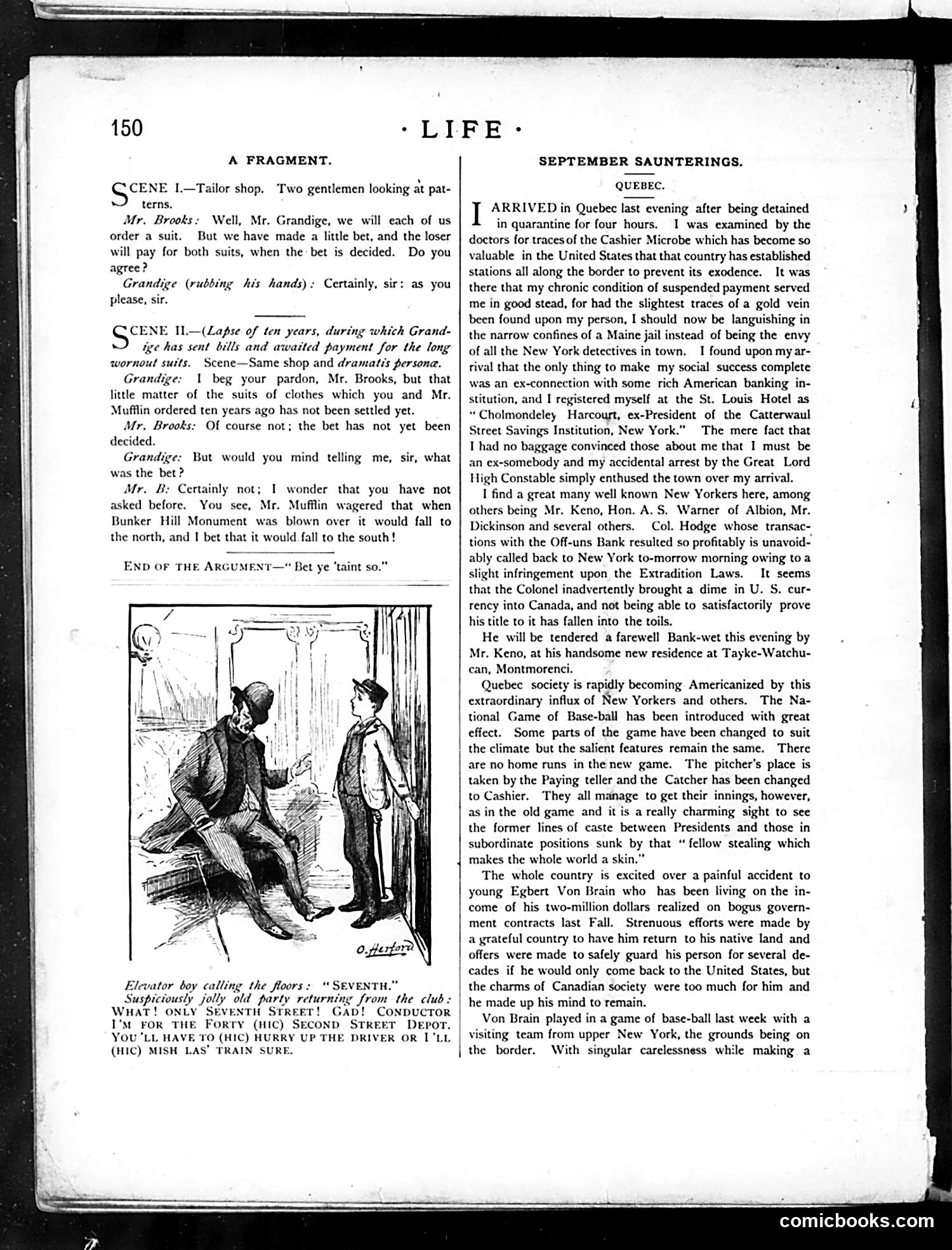
This page contains two satirical pieces from *Life* magazine: **"A Fragment"** (top): A comedic sketch about a tailor's unpaid bill. Two men order suits with a bet: one wagered the Bunker Hill Monument would fall north in a collapse; the other bet south. Ten years later, the tailor still hasn't been paid because the bet remains undecided—a absurdist joke about an endless, pointless dispute used as an excuse for non-payment. **"September Saunterings"** (right): A satirical travel essay mocking wealthy Americans in Quebec. The narrator poses as a fake banking executive ("ex-President of the Catterwaul Street Savings Institution") and gains social status through this fraudulent claim. The piece ridicules American financial corruption and pretension, mentioning real figures involved in scandals (Colonel Hodge, the "Off-uns Bank"). It also jokes that Quebec society is being "Americanized" by introducing baseball with positions renamed after bank jobs (cashier, paying teller)—mocking how American financial crime and commercialism infiltrate Canadian society.
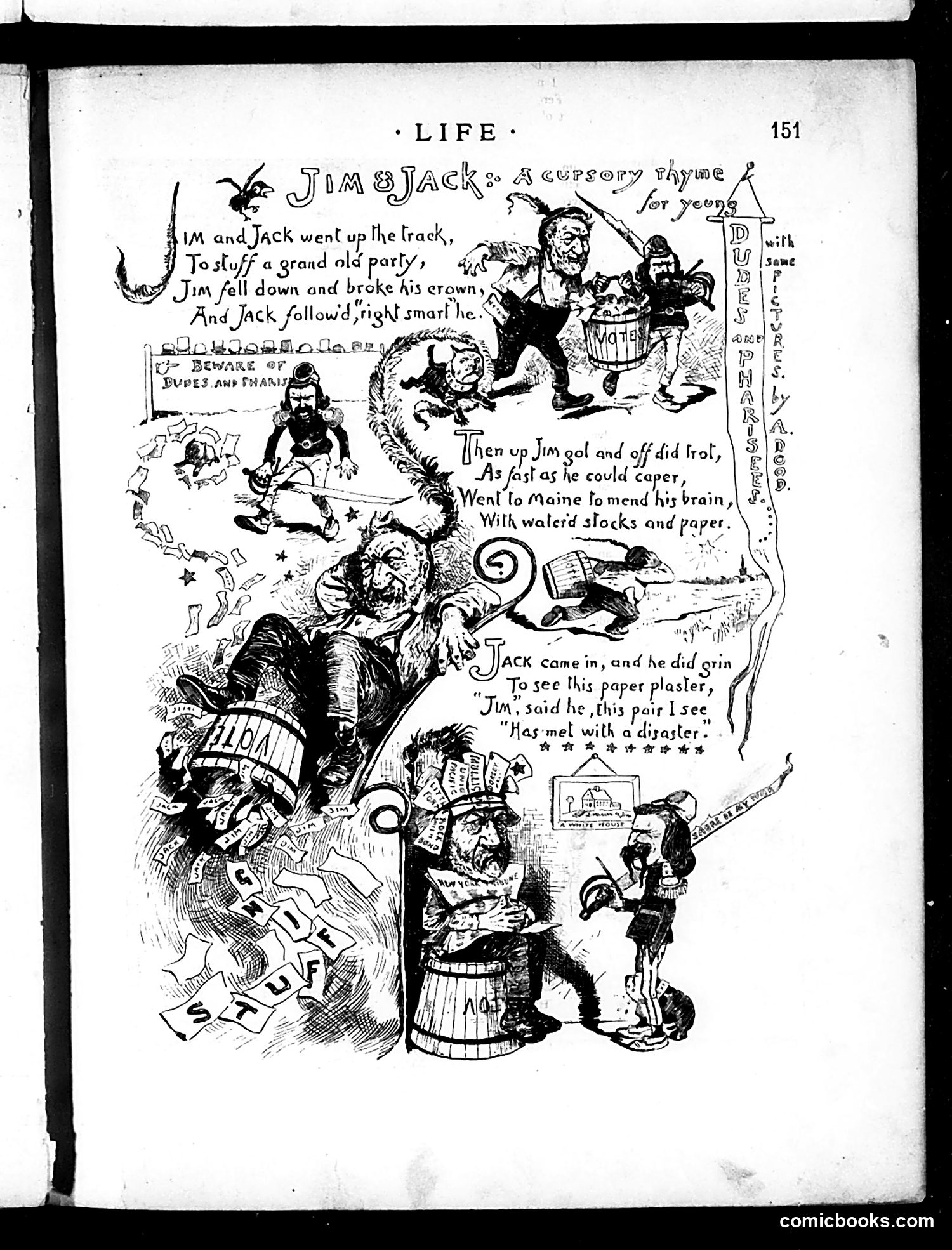
This is a satirical nursery rhyme parody (based on "Jack and Jill") mocking political figures through exaggerated caricature and slapstick humor. The illustrations depict two men in what appears to be 19th-century political dress engaging in clownish behavior—falling, getting injured, and requiring medical care. The rhyme's humor centers on incompetence: Jim falls and breaks his crown; Jack follows foolishly. Jim then travels to Maine seeking medical treatment ("to mend his brain, with watered stocks and paper"), suggesting mental deficiency. Jack's final grin at seeing Jim's "disaster" implies mockery of a rival's misfortune. Without clearer identifying labels visible in the image, the specific political figures cannot be definitively identified. However, the style and format are typical of Life magazine's political satire attacking contemporary politicians or public figures through crude humor and visual ridicule. The "Maine" reference and period costume suggest late 19th-century American politics.
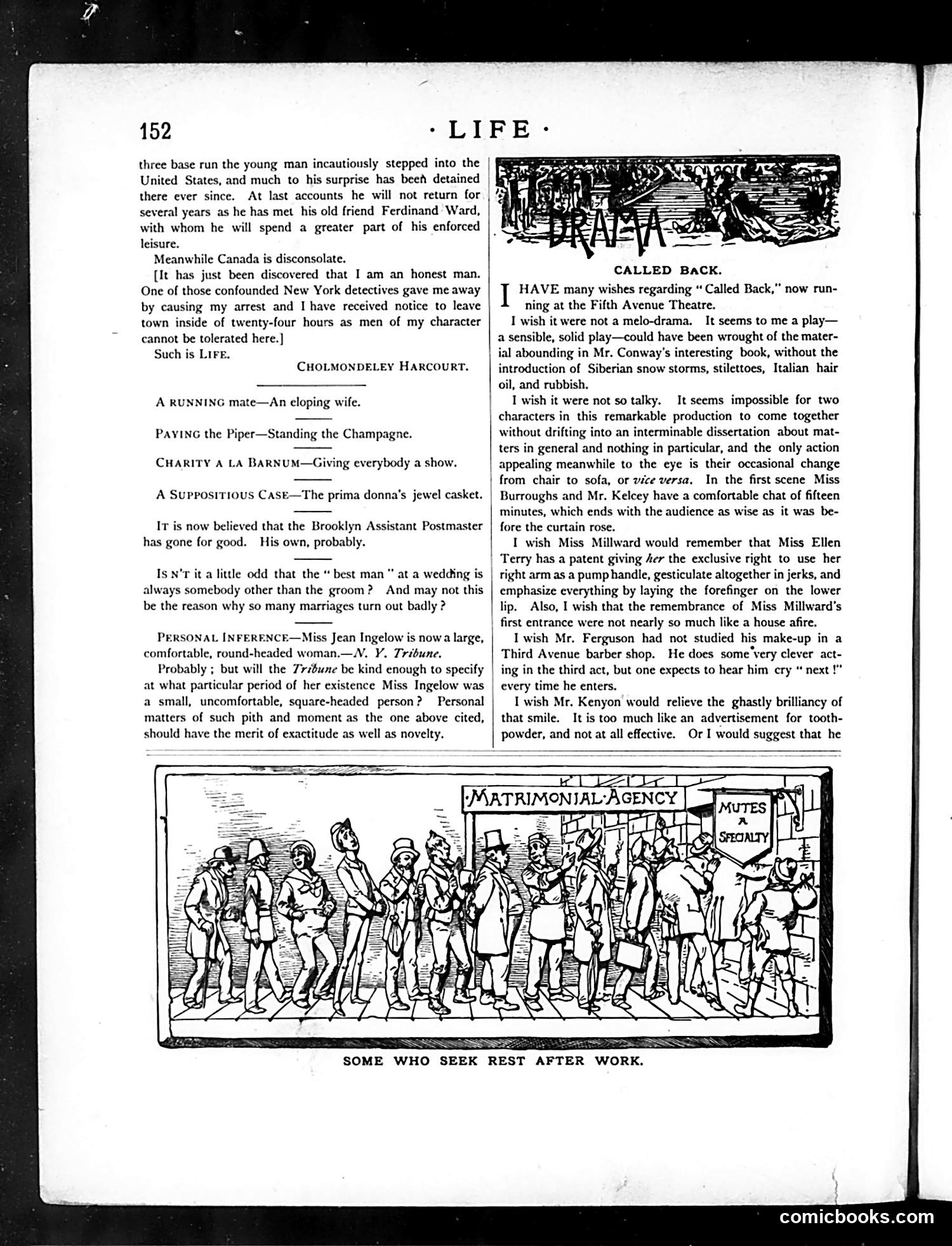
This page contains theater criticism and satirical brief items typical of Life magazine's humor section. The main cartoon depicts a "Matrimonial Agency" storefront crowded with men seeking wives—captioned "Some Who Seek Rest After Work." The joke satirizes marriage as a refuge from labor, playing on the ironic expectation that matrimony provides relaxation rather than obligations. The text section reviews the play "Called Back" at the Fifth Avenue Theatre, critiquing its melodramatic elements, excessive dialogue, and actors' affected mannerisms. The reviewer wishes the production were a "sensible, solid play" rather than relying on Siberian storms and Italian hair oil for dramatic effect. Other brief items mock contemporary figures: a Canadian official detained in the U.S., a Brooklyn postmaster's disappearance, and newspaper commentary on actress Jean Ingelow. The humor relies on wordplay and absurdist logic typical of 1880s-90s satirical journalism.
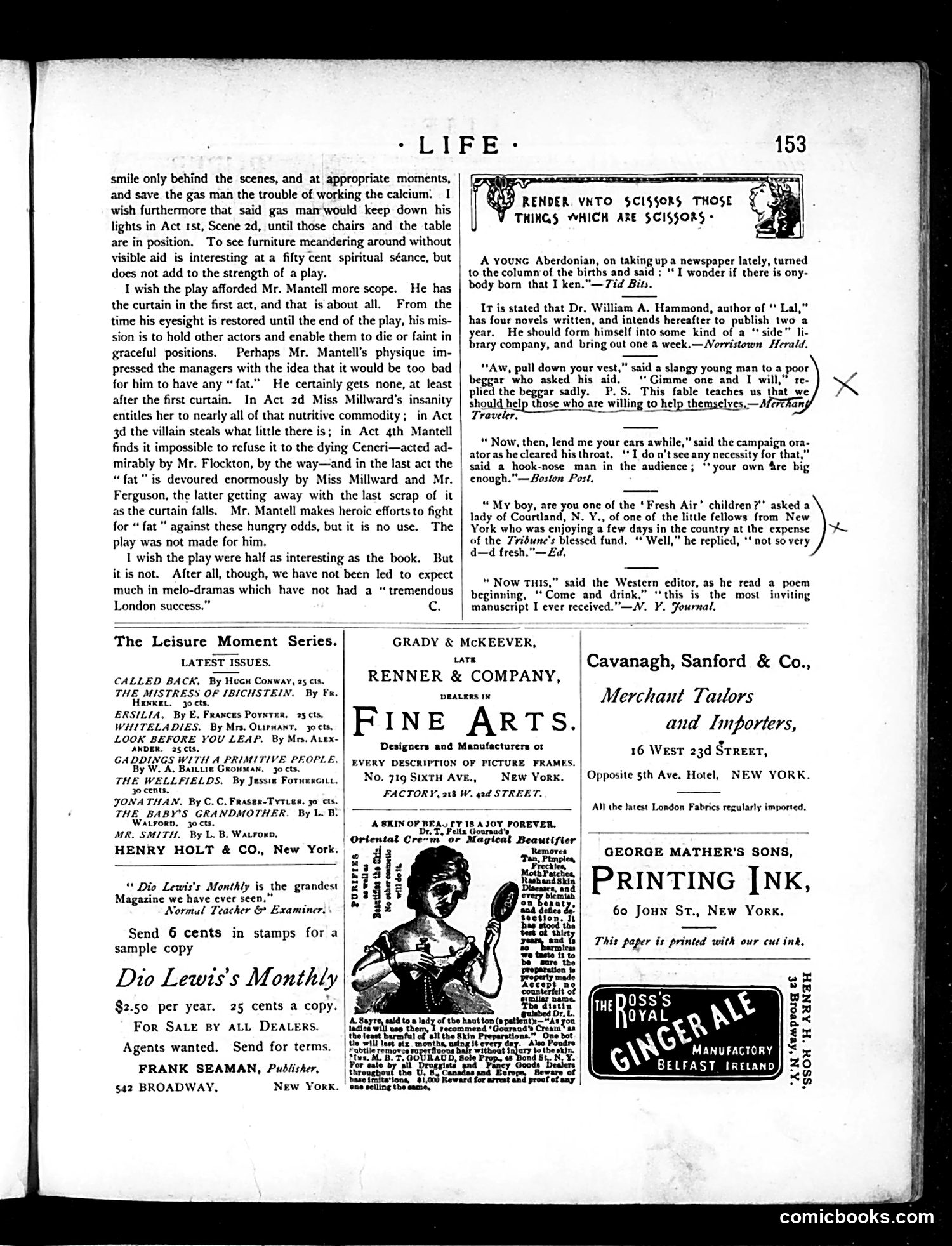
This page is primarily **advertising and literary notices**, typical of a 19th-century periodical's back matter. The substantive content consists of brief comic anecdotes and newspaper column excerpts—not original satire or cartoons. The featured vignette box at top—"Render Unto Scissors Those Things Which Are Scissors"—is reprinted from *Tid Bits*. It's a light ethnic joke: a Scotsman ("Aberdonian") asks if anyone born was "a ken" (known to him). This plays on the Scottish accent for mild humor. The remaining jokes are reprinted exchanges: a beggar's witty comeback, a heckler's quip at a politician, and jabs at authors' productivity and manuscript quality. They're generic period humor without specific political targets. The page is otherwise dominated by book advertisements (*The Leisure Moment Series*), commercial ads (printing ink, tailors), and publisher notices—standard 1880s magazine filler serving no satirical purpose beyond mild comedic relief through reprinted newspaper squibs.
This page is primarily **advertisements and humor pieces**, not political cartoons. The main text items are: 1. **"Mrs. Lockwood Accepts"** (bottom left)—A brief quote from someone named Lockwood accepting a political nomination from "the only political party" representing all Americans. This likely refers to **Belva Lockwood**, a women's rights activist who ran for U.S. President in 1884 on the Equal Rights Party ticket—a notable but minor candidacy. The satire appears gentle, focusing on her acceptance speech's grandiose language. 2. **Two brief humorous anecdotes** about a Methodist minister abandoning his congregation and a tramp deceiving a woman—standard joke filler. 3. **"Piper Heidsieck"** advertisement (right side)—promoting champagne as "perfectly pure." The rest consists of product advertisements for toilet soaps, charcoal tablets, sea salt, and resort information. There are no visible political cartoons or caricatures on this page.
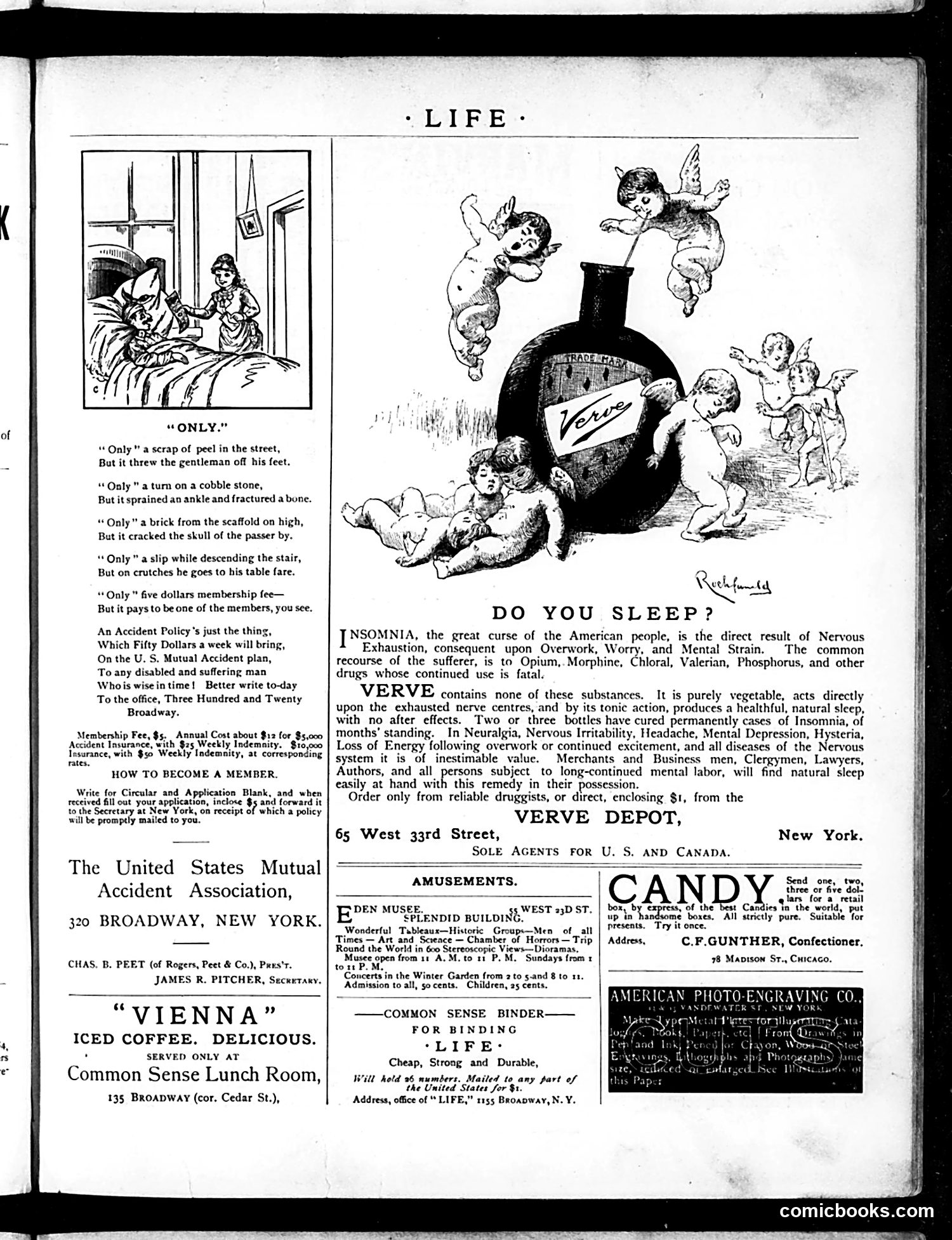
This page combines satirical editorial content with period advertisements. The main cartoon, titled "Only," uses repetitive irony to mock complacency about minor accidents—a "scrap of peel," a "turn on cobble stone," a "brick from scaffold"—each supposedly trivial but causing serious injury. The joke builds toward selling accident insurance: a five-dollar membership fee seems small until one realizes accidents are common and unpredictable. This satirizes both human negligence and the emerging insurance industry's marketing tactics. The page also advertises "Verve," a vegetable-based sleep tonic marketed to overworked professionals (merchants, lawyers, clergymen) as an alternative to dangerous opium and morphine—reflecting late-19th-century anxiety about both insomnia and drug addiction. Additional ads promote candy, the Eden Musee (a wax museum), and iced coffee, representing typical consumer goods of the era.
This page is almost entirely **advertisements**—there are no political cartoons or satirical content visible. It consists of Victorian-era product ads for whiskey, corsets, patent medicines, pianos, bicycles, safes, and sporting goods. The one notable element is the **Cuticura skin remedy ad**, which claims to cure everything from pimples to scrofula (a tuberculous infection). This reflects the era's **patent medicine culture**: unregulated products made extravagant medical claims without scientific backing. Modern readers should recognize this as quackery—Cuticura was marketed as a universal cure-all despite lacking any real medicinal efficacy. The ads collectively illustrate **late 19th-century consumer culture** and the kinds of products marketed to middle/upper-class Americans. The emphasis on "purity," "genuine" goods (note the Vichy water warning against imitations), and imported European products reflects period anxieties about product authenticity and quality control.