
Life, 1884-09-11 · page 2 of 16
Life — September 11, 1884 — page 2: what you’re looking at
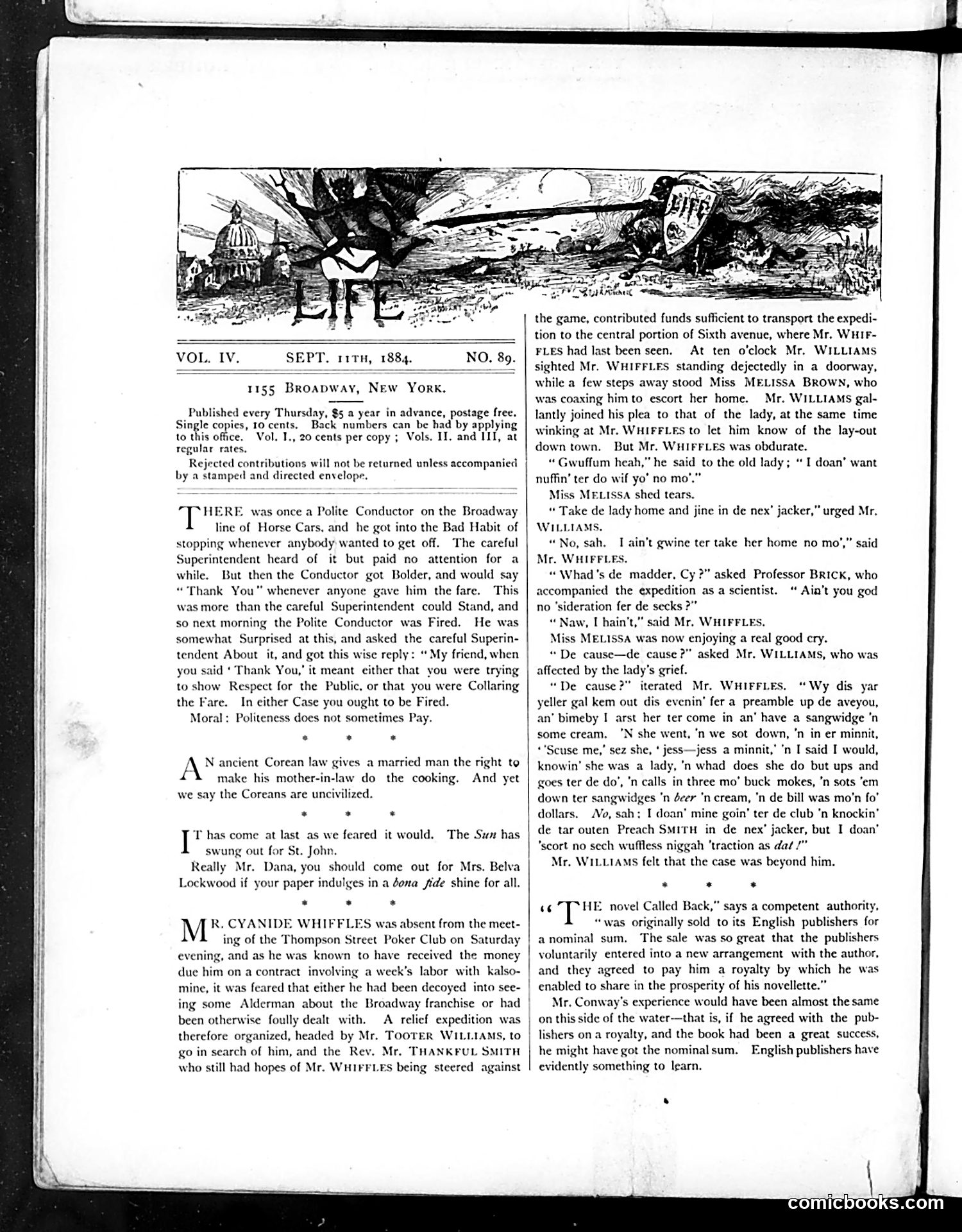
What you’re looking at
This page contains satirical short stories rather than political cartoons. The main pieces mock: 1. **"The Polite Conductor"** — A brief anecdote satirizing excessive politeness in service work. A Broadway streetcar conductor was fired for being *too* courteous to passengers, illustrating how even virtues can be taken to absurd extremes in professional settings. 2. **Korean marriage law commentary** — A dismissive note suggesting Koreans are "uncivilized" because their law grants husbands authority over domestic cooking—reflecting Victorian-era Western attitudes toward non-European cultures. 3. **"Called Back" book review** — Discusses a novel's English publishing success and royalty arrangements, with no apparent satirical intent; appears to be straightforward literary commentary. The humor targets social pretension and professional absurdity rather than specific political figures.
📄 Transcribed text from this page (OCR, searchable)
Machine-transcribed from the original scan — historical spelling and the odd misread are preserved.
1155 Broapway, New York. Published every Thursday, $5 a year in advance, postage free. Single copies, 10 cents. Back numbers can be had by applying to this office.’ Vol. I., 20 cents per copy ; Vols. IT. and HI, at regular rates. Rejected contributions will not be returned unless accompanied by a stamped and directed envelope. HERE. was once a Polite Conductor on the Broadway line of Horse Cars, and he got into the Bad Habit of stopping whenever anybody wanted to get off. The careful | Superintendent heard of it but paid no attention for a while. But then the Conductor got Bolder, and would say “Thank You" whenever anyone gave him the fare. This was more than the careful Superintendent could Stand, and so next morning the Polite Conductor was Fired. He was somewhat Surprised at this, and asked the careful Superin- tendent About it, and got this wise reply: “ My friend, when you said ‘ Thank You,’ it meant either that you were trying to show Respect for the Public, or that you were Collaring the Fare. In either Case you ought to be Fired. Moral: Politeness does not sometimes Pay. N N ancient Corean law gives a married man the right to ifr make his mother-in-law do the cooking. And yet we say the Coreans are uncivilized. . * * * . * T has come at last as we feared it would. The Sw has swung out for St. John. Really Mr. Dana, you should come out for Mrs. Belva Lockwood if your paper indulges in a dona fide shine for all. * * * R, CYANIDE WHIFFLES was absent from the meet- ing of the Thompson Street Poker Club on Saturday evening, and as he was known to have received the money due him on a contract involving a week's labor with kalso- mine, it was feared that either he had been decoyed into see- ing some Alderman about the Broadway franchise or had been otherwise foully dealt with. A relief expedition was therefore organized, headed by Mr. TOOTER WILLIAMS, to | go in search of him, and the Rev. Mr. THANKFUL S. who still had hopes of Mr. WHIFFLES being steered against the game, contributed funds sufficient to transport the expedi- tion to the central portion of Sixth avenue, where Mr. WHIF- FLES had last been seen. At ten o'clock Mr. WILLIAMS sighted Mr. WHIFFLES standing dejectedly in a doorway, while a few steps away stood Miss MELISSA BROWN, who was coaxing him to escort her home. Mr. WILLIAMS gal- lantly joined his plea to that of the lady, at the same time winking at Mr. WHIFFLES to let him know of the lay-out down town. But Mr. WHIFFLES was obdurate. “ Gwuffum heah,” he said to the old lady; “ I doan’ want nuffin’ ter do wif yo’ no mo’.” Miss MELISSA shed tears. “ Take de lady home and jine in de nex’ jacker," urged Mr. WILLIAMS. “No, sah, [ain't gwine ter take her home no mo’,” said Mr. WHIFFLES. “Whad's de madder, Cy ?” asked Professor BRICK, who accompanied the expedition as a scientist. “ Ain’t you god no ‘sideration fer de secks ?” “Naw, I hain’t,” said Mr, WHIFFLES. Miss MELISSA was now enjoying a real good cry. “De cause—de cause ?” asked Mr. WILLIAMS, who was affected by the lady's grief. “De cause?” iterated Mr. WHIFFLES. “Wy dis yar yeller gal kem out dis evenin’ fer a preamble up de aveyou, an’ bimeby I arst her ter come in an’ have a sangwidge 'n some cream. she went, ‘n we sot down, ‘n in er minnit, sez she, ‘ jess—jess a minnit,’ 'n I said I would, knowin’ she was a lady, 'n whad does she do but ups and goes ter de do’, 'n calls in three mo’ buck mokes, ’n sots ‘em down ter sangwidges 'n écer 'n cream, 'n de bill was mo’n fo’ dollars. No, sah; I doan’ mine goin’ ter de club ‘n knockin’ de tar outen Preach SMITH in de nex’ jacker, but I doan’ | 'scort no sech wuffless niggah ‘traction as dad /” Mr. WILLIAMS felt that the case was beyond him. “ HE novel Called Back,” says a competent authority, “was originally sold to its English publishers for anominal sum. The sale was so great that the publishers voluntarily entered into a new arrangement with the author, and they agreed to pay him a royalty by which he was | enabled to share in the prosperity of his novellette.” Mr. Conway's experience would have been almost the same on this side of the water—that is, if he agreed with the pub- lishers on a royalty, and the book had been a great success, he might have got the nominalsum. English publishers have evidently something to learn.