
Life, 1884-09-11 · page 6 of 16
Life — September 11, 1884 — page 6: what you’re looking at
What you’re looking at
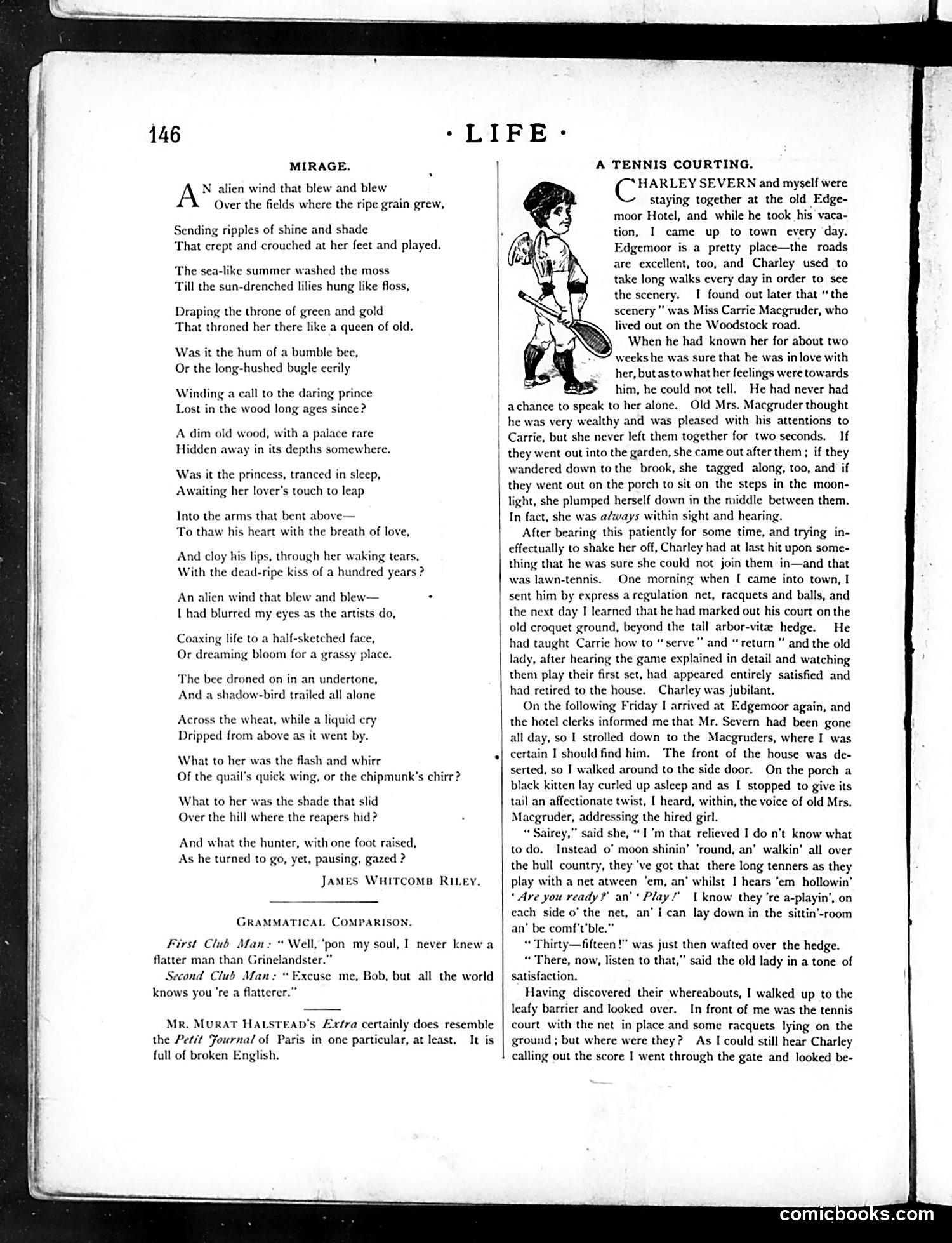
This page contains two distinct sections: **Left side:** A poem titled "Mirage" by James Whitcomb Riley, with an illustration of a young woman in tennis attire holding a racket. The poem uses romantic, allegorical language about nature and longing. **Right side:** A prose piece titled "A Tennis Courting" describing a romantic encounter between the narrator and a man named Charley Severn at a hotel, mediated through tennis and a young woman named Carrie Macgruder. The narrative is lighthearted social commentary about courtship customs among the leisure class. **Bottom:** A brief "Grammatical Comparison" section mocking public figures' speech patterns—Grinelander, Bob the flatterer, and Mr. Murat Halstead's broken English. The page reflects early 20th-century *Life* magazine's mix of sentimental poetry, humorous social fiction, and gentle satirical jabs at contemporary public figures and social conventions.
📄 Transcribed text from this page (OCR, searchable)
Machine-transcribed from the original scan — historical spelling and the odd misread are preserved.
MIRAGE. N alien wind that blew and blew Over the fields where the ripe grain grew, Sending ripples of shine and shade That crept and crouched at her feet and played. The sea-like summer washed the moss Till the sun-drenched lilies hung like floss, Draping the throne of green and gold That throned her there like a queen of old. Was it the hum of a bumble bee, Or the long-hushed bugle eerily Winding a call to the daring prince Lost in the wood long ages since? A dim old wood, with a palace rare Hidden away in its depths somewhere. Was it the princess, tranced in sleep, Awaiting her lover’s touch to leap Into the arms that bent above— To thaw his heart with the breath of love, And cloy his lips, through her waking tears, With the dead-ripe kiss of a hundred year: An alien wind that blew and blew— I had blurred my eyes as the artists do, Coaxing life to a half-sketched face, Or dreaming bloom for a grassy place. ‘The bee droned on in an undertone, And a shadow-bird trailed all alone Across the wheat, while a liquid cry Dripped from above as it went by. flash and whirr quick wing, or the chipmunk’s chi What to her was t Of the quail’s What to her was the shade that slid Over the hill where the reapers hid? And what the hunter, with one foot raised, As he turned to go, yet, pausing, gazed ? James WHITCOMB RILEY. GRAMMATICAL COMPARISON. First Club Man; Second Club Man knows you 're a flatte’ =xcuse me, Bob, but all the world Mr. MuRAT HALsTEAD’s £x¢ra certainly does resemble the Petit Fourna/ of Paris in one particular, at least. It is full of broken English. | had retired to the house. “Well, ‘pon my soul, I never knew a | flatter man than Grinelandster.” TENNIS COURTING. HARLEY SEVERN and myself were staying together at the old Edge- moor Hotel, and while he took his vaca- tion, I came up to town every day. Edgemoor is a pretty place—the roads are excellent, too, and Charley used to take long walks every day in order to see the scenery. I found out later that “the scenery” was Miss Carrie Macgruder, who lived out on the Woodstock road. When he had known her for about two weeks he was sure that he was in love with her, but as to what her feelings were towards him, he could not tell. He had never had achance to speak to her alone. Old Mrs. Macgruder thought he was very wealthy and was pleased with his attentions to Carrie, but she never left them together for two seconds. If they went out into the garden, she came out after them ; if they wandered down tothe brook, she tagged along, too, and if they went out on the porch to sit on the steps in the moon- light, she plumped herself down in the middle between them. In fact, she was a/ways within sight and hearing. After bearing this patiently for some time, and trying in- | effectually to shake her off, Charley had at last hit upon some- thing that he was sure she could not join them in—and that was lawn-tennis. One morning when [ came into town, I sent him by express a regulation net, racquets and balls, and the next day I learned that he had marked out his court on the old croquet ground, beyond the tall arbor-vita hedge. He had taught Carrie how to “serve” and “return” and the old lady, after hearing the game explained in detail and watching them play their first set, had appeared entirely satisfied and Charley was jubilant. On the following Friday I arrived at Edgemoor again, and the hotel clerks informed me that Mr. Severn had been gone all day, so I strolled down to the Macgruders, where I was certain I should find him. The front of the house was de- serted, so I walked around to the side door. On the porch a lack kitten lay curled up asleep and as I stopped to give its tail an affectionate twist, I heard, within, the voice of old Mrs. Macgruder, addressing the hired girl. “ Sairey,” said she, “I'm that relieved I do n't know what todo. Instead 0’ moon shinin’ ‘round, an’ walkin’ all over the hull country, they ‘ve got that there long tenners as they play with a net atween ‘em, an’ whilst I hears ‘em hollowin’ ‘ Are you ready? an‘ Play!’ 1 know they ‘re a-playin’, on each side o’ the net, an’ I can lay down in the sittin’-room an’ be comf't’ble.” “ Thirty—fifteen !"" was just then wafted over the hedge. “ There, now, listen to that,” said the old lady in a tone of satisfaction. Having discovered their whereabouts, I walked up to the leafy barrier and looked over. In front of me was the tennis court with the net in place and some racquets lying on the ground ; but where were they? As I could still hear Charley calling out the score I went through the gate and looked be- comicbooks.com