
Life, 1884-09-11 · page 4 of 16
Life — September 11, 1884 — page 4: what you’re looking at
What you’re looking at
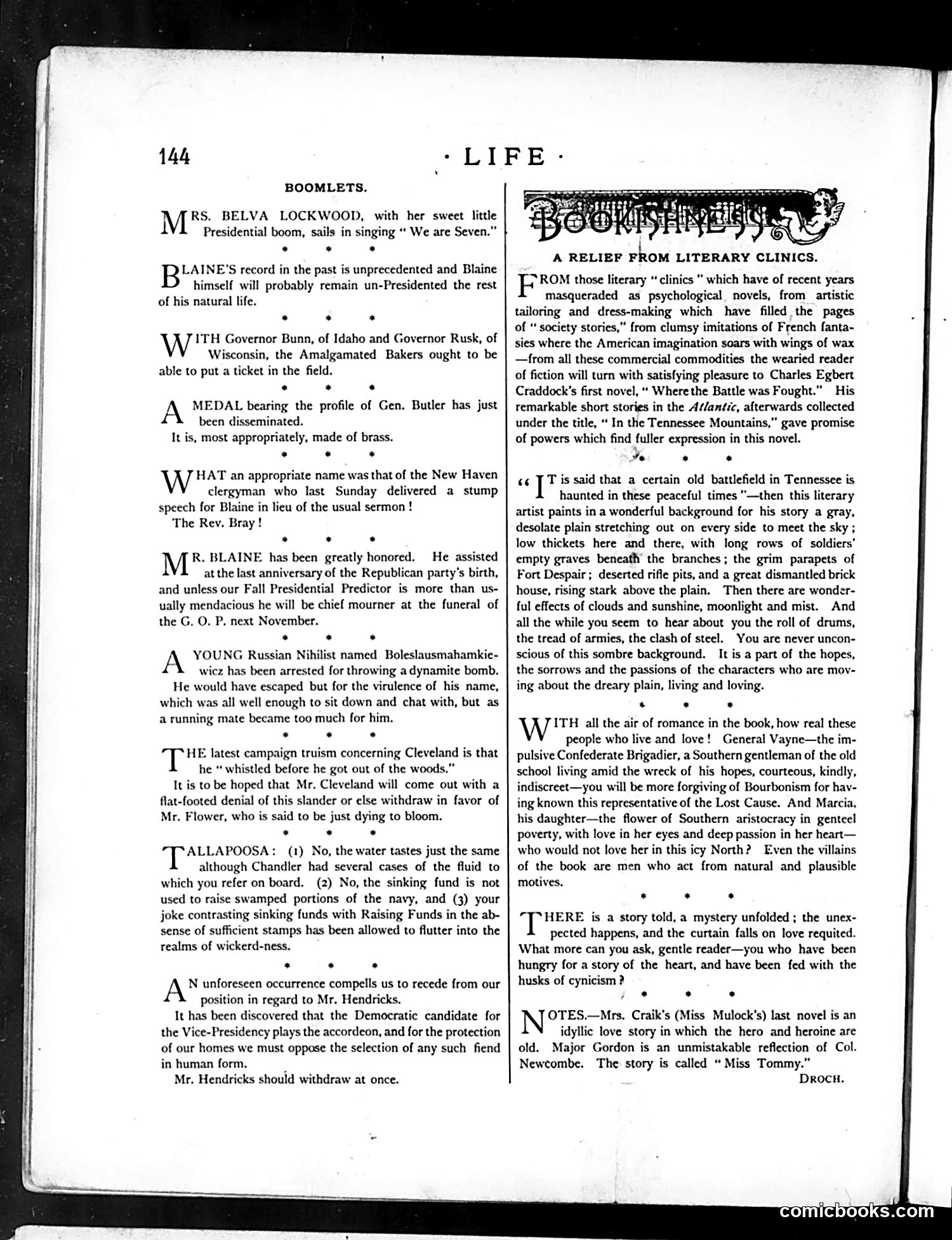
This page consists entirely of satirical text commentary ("Boomlets" section) with no visible cartoons. The satire targets 1880s-1890s political figures: - **Mrs. Belva Lockwood**: Mocked for her "Presidential boom" (she ran for president in 1884 and 1888) - **James G. Blaine**: Criticized for his failed presidential ambitions - **Governors Bunn and Rusk**: Satirized as unlikely presidential candidates - **Gen. Butler**: Referenced regarding a campaign medal The right column reviews Charles Egbert Craddock's novel "Where the Battle Was Fought," praising its romantic Southern setting and Civil War themes. The satire's point: mock the proliferation of marginal political figures seeking the presidency and the media attention given to their "booms." The dismissive tone suggests Life viewed these candidacies as absurd.
📄 Transcribed text from this page (OCR, searchable)
Machine-transcribed from the original scan — historical spelling and the odd misread are preserved.
144 BOOMLETS. RS. BELVA LOCKWOOD, with her sweet little Presidential boom, sails in singing “‘ We are Seven.” . * . LAINE'S record in the past is unprecedented and Blaine himself will probably remain un-Presidented the rest of his natural life. . . . ITH Governor Bunn, of Idaho and Governor Rusk, of Wisconsin, the Amalgamated Bakers ought to be able to put a ticket in the field. . . . MEDAL bearing the profile of Gen. Butler has just been disseminated. It is, most appropriately, made of brass. . . * HAT an appropriate name was that of the New Haven clergyman who last Sunday delivered a stump speech for Blaine in lieu of the usual sermon ! ‘The Rev. Bray! . . . R. BLAINE has been greatly honored. He assisted atthe last anniversary of the Republican party's birth, and unless our Fall Presidential Predictor is more than us- ually mendacious he will be chief mourner at the funeral of the G. O. P. next November. . . . YOUNG Russian Nihilist named Boleslausmahamkie- wicz has been arrested for throwing a dynamite bomb. He would have escaped but for the virulence of his name, which was all well enough to sit down and chat with, but as a running mate became too much for him. . . . HE latest campaign truism concerning Cleveland is that he “whistled before he got out of the woods.” It is to be hoped that Mr. Cleveland will come out with a flat-footed denial of this slander or else withdraw in favor of Mr. Flower, who is said to be just dying to bloom. . . . ALLAPOOSA: (1) No, the water tastes just the same although Chandler had several cases of the fluid to which you refer on board. (2) No, the sinking fund is not used to raise swamped portions of the navy, and (3) your joke contrasting sinking funds with Raising Funds in the ab- sense of sufficient stamps has been allowed to flutter into the realms of wickerd-ness. . . . N unforeseen occurrence compells us to recede from our position in regard to Mr. Hendricks, It has been discovered that the Democratic candidate for the Vice-Presidency plays the accordeon, and for the protection of our homes we must oppose the selection of any such fiend in human form. . Mr. Hendricks should withdraw at once. A RELIEF FROM LITERARY CLINICS. { ROM those literary “clinics ” which have of recent years masqueraded as psychological novels, from artistic tailoring and dress-making which have filled the pages of “society stories,” from clumsy imitations of French fanta- sies where the American imagination soars with wings of wax —from all these commercial commodities the wearied reader of fiction will turn with satisfying pleasure to Charles Egbert Craddock's first novel, “ Where the Battle was Fought.” His remarkable short stories in the Aé/antic, afterwards collected under the title, “ In the Tennessee Mountains,” gave promise of powers which find fuller expression in this novel. ve * * «¢ JT is said that a certain old battlefield in Tennessee is haunted in these peaceful times "—then this literary artist paints in a wonderful background for his story a gray, desolate plain stretching out on every side to meet the sky ; low thickets here and there, with long rows of soldiers’ empty graves beneath’ the branches ; the grim parapets of Fort Despair ; deserted rifle pits, and a great dismantled brick house, rising stark above the plain. Then there are wonder- ful effects of clouds and sunshine, moonlight and mist. And all the while you seem to hear about you the roll of drums, the tread of armies, the clash of steel. You are never uncon- scious of this sombre background. It is a part of the hopes, the sorrows and the passions of the characters who are mov- ing about the dreary plain, living and loving. * . . ITH all the air of romance in the book, how real these people who live and love! General Vayne—the im- pulsive Confederate Brigadier, a Southern gentleman of the old school living amid the wreck of his hopes, courteous, kindly, indiscreet—you will be more forgiving of Bourbonism for hav- ing known this representative of the Lost Cause. And Marcia, his daughter—the flower of Southern aristocracy in genteel poverty, with love in her eyes and deep passion in her heart— who would not love her in this icy North? Even the villains of the book are men who act from natural and plausible motives. * * . HERE is a story told, a mystery unfolded ; the unex- pected happens, and the curtain falls on love requited. What more can you ask, gentle reader—you who have been hungry for a story of the heart, and have been fed with the husks of cynicism ? ,* . . OTES.—Mrs. Craik’s (Miss Mulock’s) last novel is an idyllic love story in which the hero and heroine are old. Major Gordon is an unmistakable reflection of Col. Newcombe, The story is called “ Miss Tommy.” Drocu.