
A complete issue · 16 pages · 1884
Life — August 28, 1884
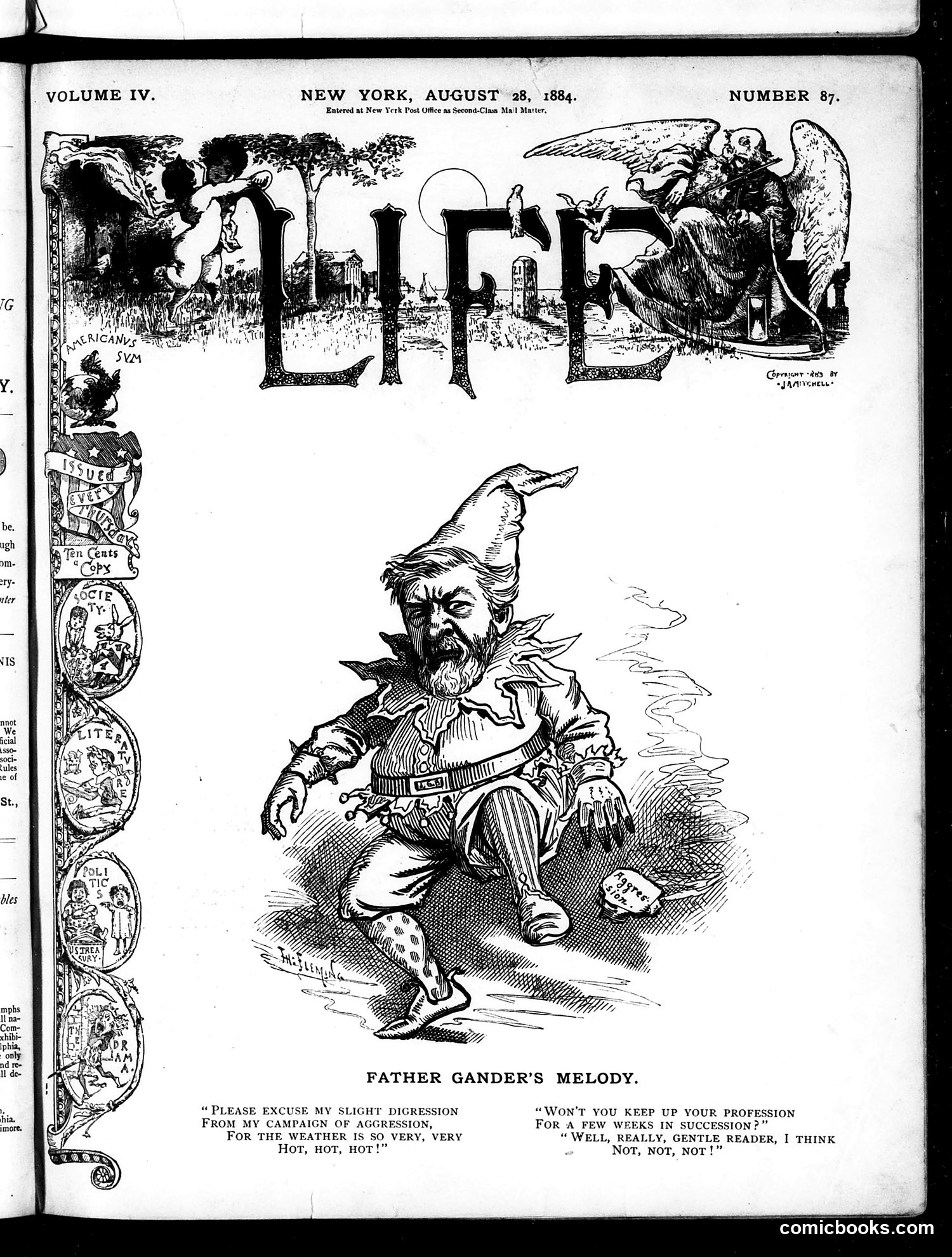
This political cartoon satirizes a military or political figure (depicted as a bearded gnome-like character in military dress with a pointed hat) who is making excuses about weather being "very, very hot, hot, hot!" while allegedly neglecting his professional duties. The figure's interlocutor demands he maintain his profession "for a few weeks in succession," to which he protests "Not, not, not!" The satire appears to mock someone's excuse-making during a military campaign or political responsibility, suggesting he's shirking duties due to trivial complaints about weather. The whimsical "Father Gander" framing treats the subject mockingly, as if he were a nursery-rhyme character rather than a serious leader.
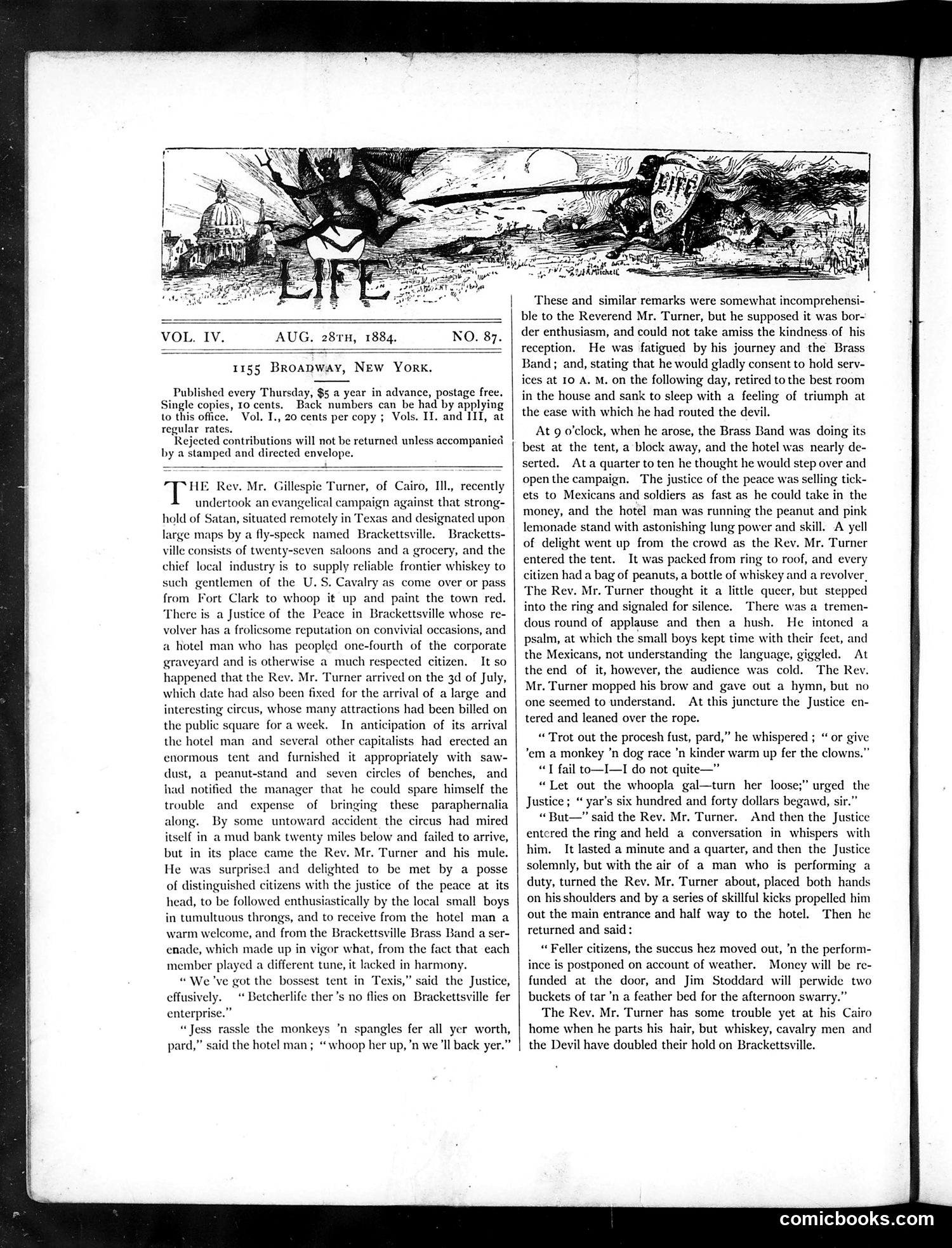
This page contains a satirical story about Reverend Mr. Gillespie Turner of Cairo, Illinois, who conducted an evangelical campaign in Texas. The narrative mocks his misadventures during a circus visit in Bracketsville—particularly his awkward attempts to lead hymn-singing and prayer among rowdy circus crowds who didn't understand his intentions. The satire targets religious enthusiasm clashing with frontier irreverence. Turner's earnest evangelicism proves ineffectual and somewhat ridiculous when confronted with the rough, secular world of circus tents and whiskey-soaked cattle towns. The joke centers on his naïveté and the gap between his moral ambitions and harsh frontier reality—a common 19th-century American theme mocking pious reformers encountering rougher American culture.
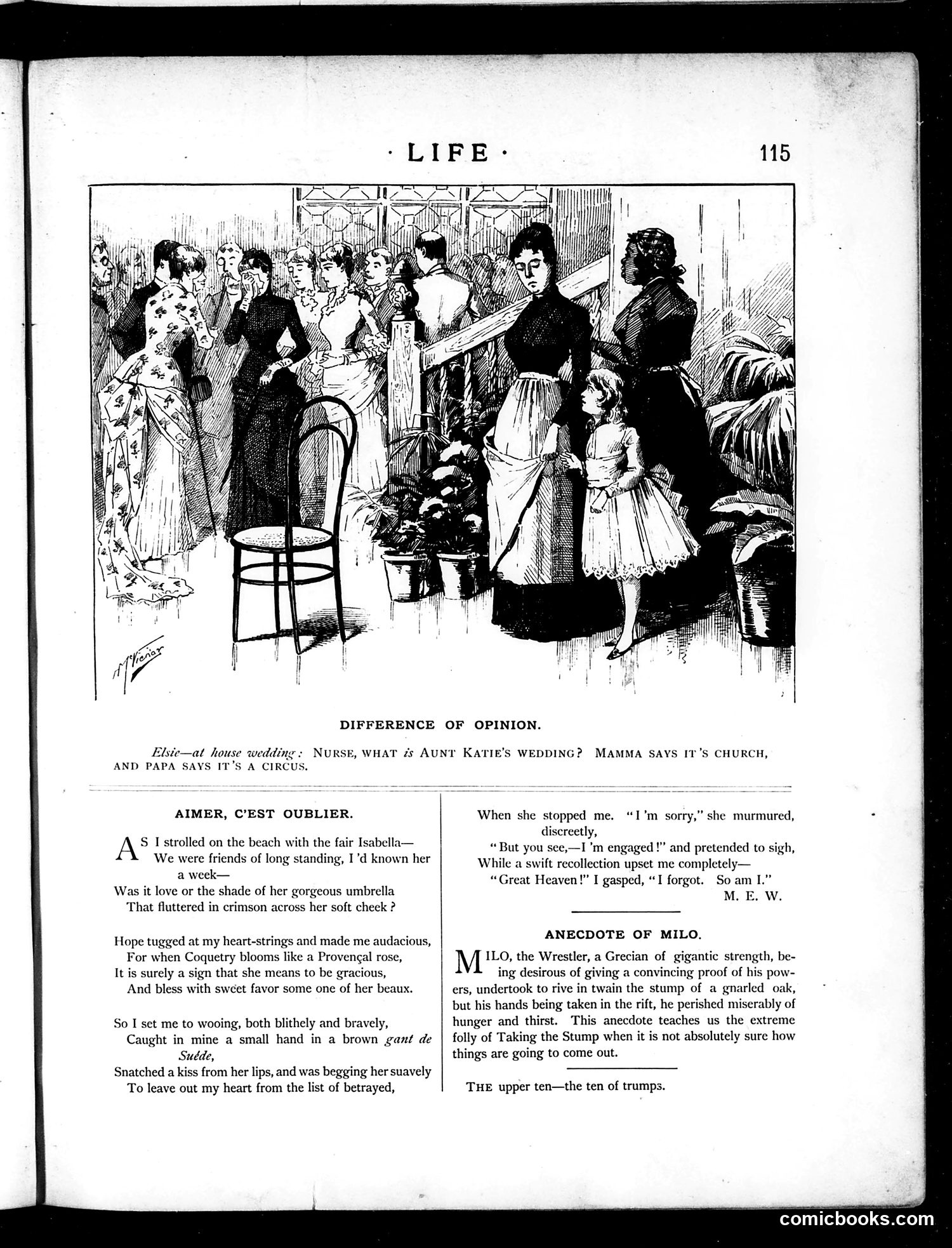
**The Cartoon:** This satirical illustration depicts a Victorian-era social gathering, likely a wedding reception. The caption jokes about conflicting opinions: "Nurse, what is Aunt Katie's wedding? Mamma says it's church, and Papa says it's a circus." The humor relies on visual contradiction—the scene appears chaotic and crowded with numerous guests in formal dress, children running about, and general social disorder. This visual "circus-like" atmosphere supports Papa's skeptical assessment against Mamma's more respectable characterization. **The Satire:** The joke mocks pretentious Victorian social conventions by suggesting that elaborate, crowded society weddings—despite their religious or formal framing—often devolve into spectacles rather than dignified ceremonies. It's gentle social commentary on wedding excess and the gap between aspirational appearances and actual reality.
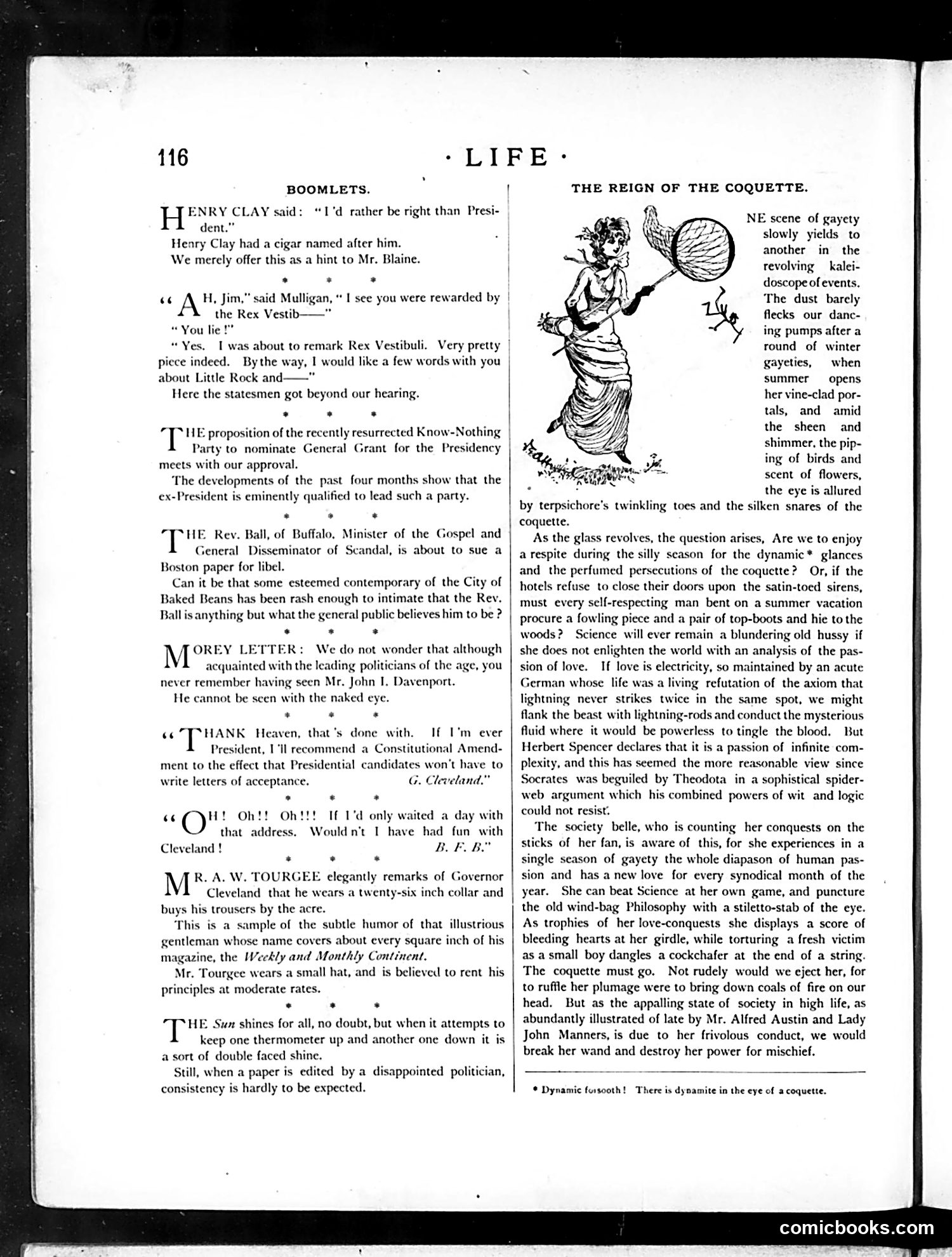
This page contains political commentary and social satire rather than a cartoon. The "Boomlets" section mocks various political figures and movements of the era, including: - **Henry Clay**: A jab at his presidential ambitions - **General Grant**: Commentary on a "Know-Nothing Party" effort to nominate him - **Rev. Ball of Buffalo**: Criticized for alleged scandal involvement - **Governor Cleveland**: Mocked for his appearance (a "twenty-six inch collar") The right column's illustration shows a **coquette** (flirtatious woman) with a fan, accompanying text satirizing her social influence and romantic conquests. The satire suggests society women wield considerable power through charm and manipulation. The overall page reflects 19th-century American political humor, targeting ambitious politicians and critiquing social pretension.
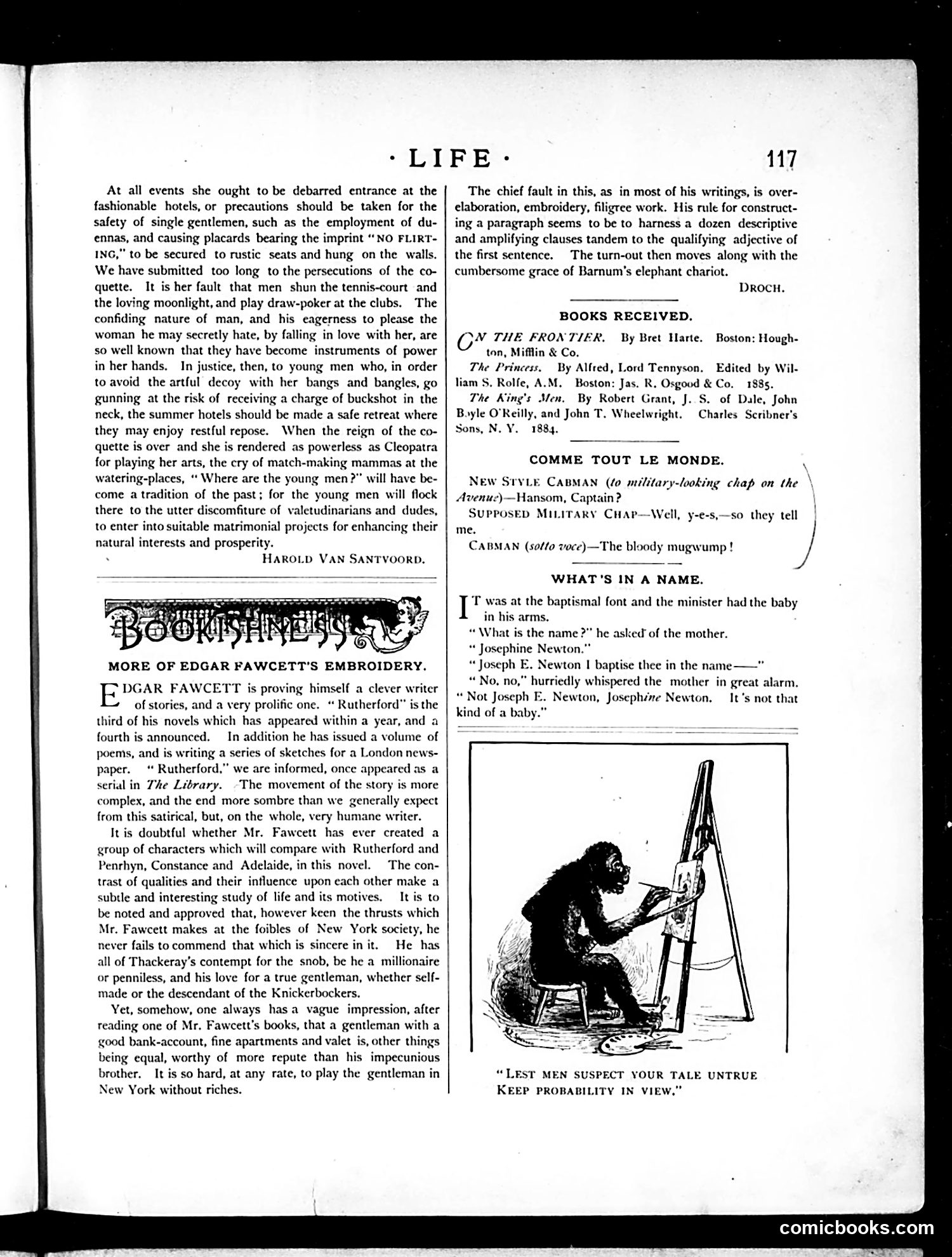
The main illustration depicts a chimpanzee painting at an easel, captioned "LEST MEN SUSPECT YOUR TALE UNTRUE / KEEP PROBABILITY IN VIEW." This appears to be satirical commentary on artistic authenticity and credibility. The cartoon suggests that even a monkey's artwork would seem more believable if it maintained some connection to reality or probability. The joke likely critiques artists or writers of the period who created implausible or fantastical works presented as serious art. The accompanying text discusses Edgar Fawcett's literary output, praising his writing while noting his tendency toward elaborate embellishment. The monkey-painting image serves as ironic visual commentary on Fawcett's ornate style—suggesting that even absurd subjects become more credible when grounded in realistic probability rather than pure extravagance.
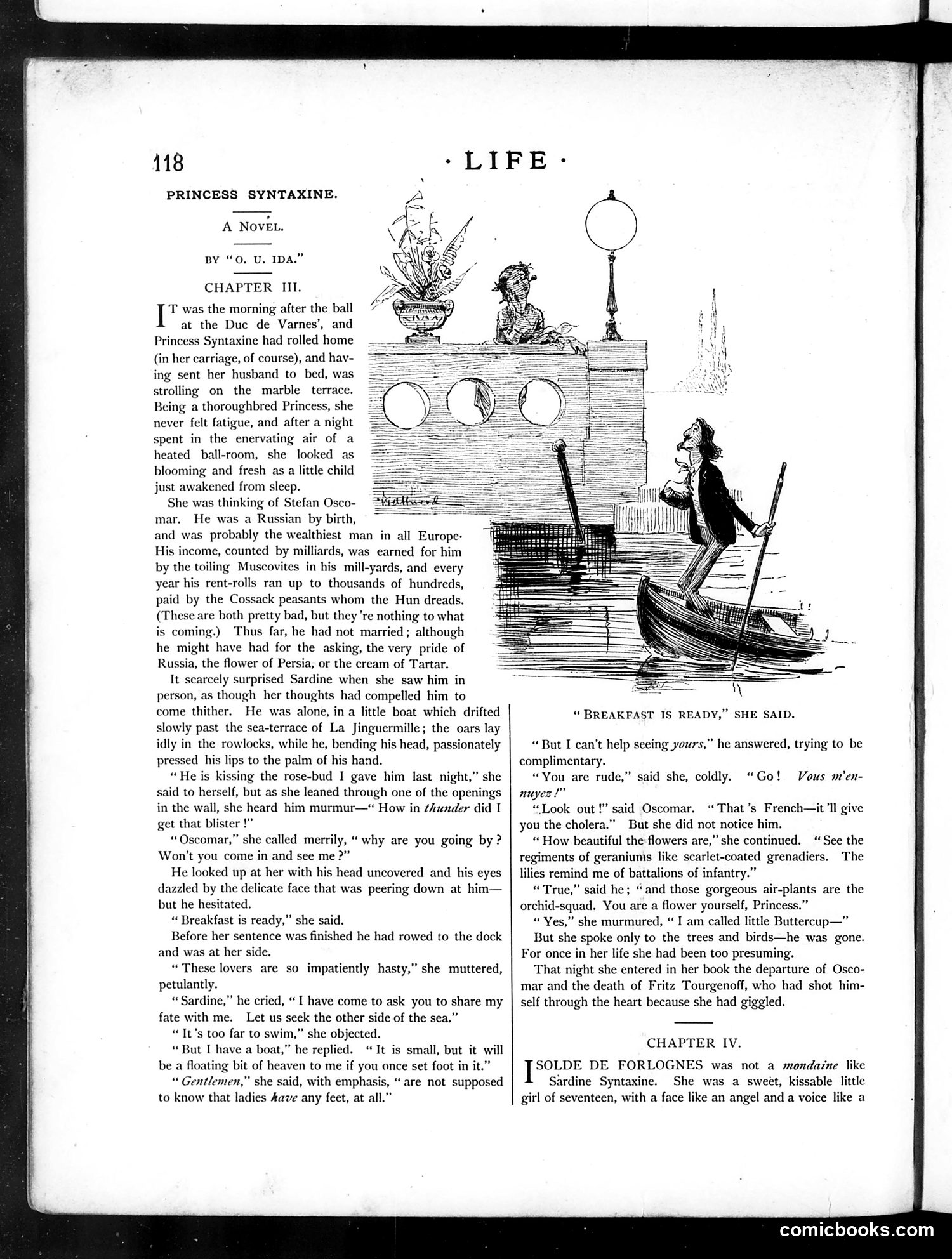
This page contains a serialized novel titled "Princess Syntaxine" by "O. U. IDA." (likely a pseudonym). The illustrations show a domestic scene at a waterside terrace where Princess Syntaxine encounters a man named Oscomar in a small boat. The content is satirical fiction rather than political commentary. The humor appears to derive from wordplay and romantic complications—Oscomar is described as a wealthy Russian nobleman, and the dialogue includes French phrases and flirtation. The scene depicts the Princess contemplating Oscomar while on her terrace, with servants preparing breakfast. This represents *Life* magazine's literary satire tradition: mocking aristocratic pretension and romantic melodrama through serialized fiction rather than editorial cartoons. The specific satirical target is unclear without additional context about the novel's broader narrative.
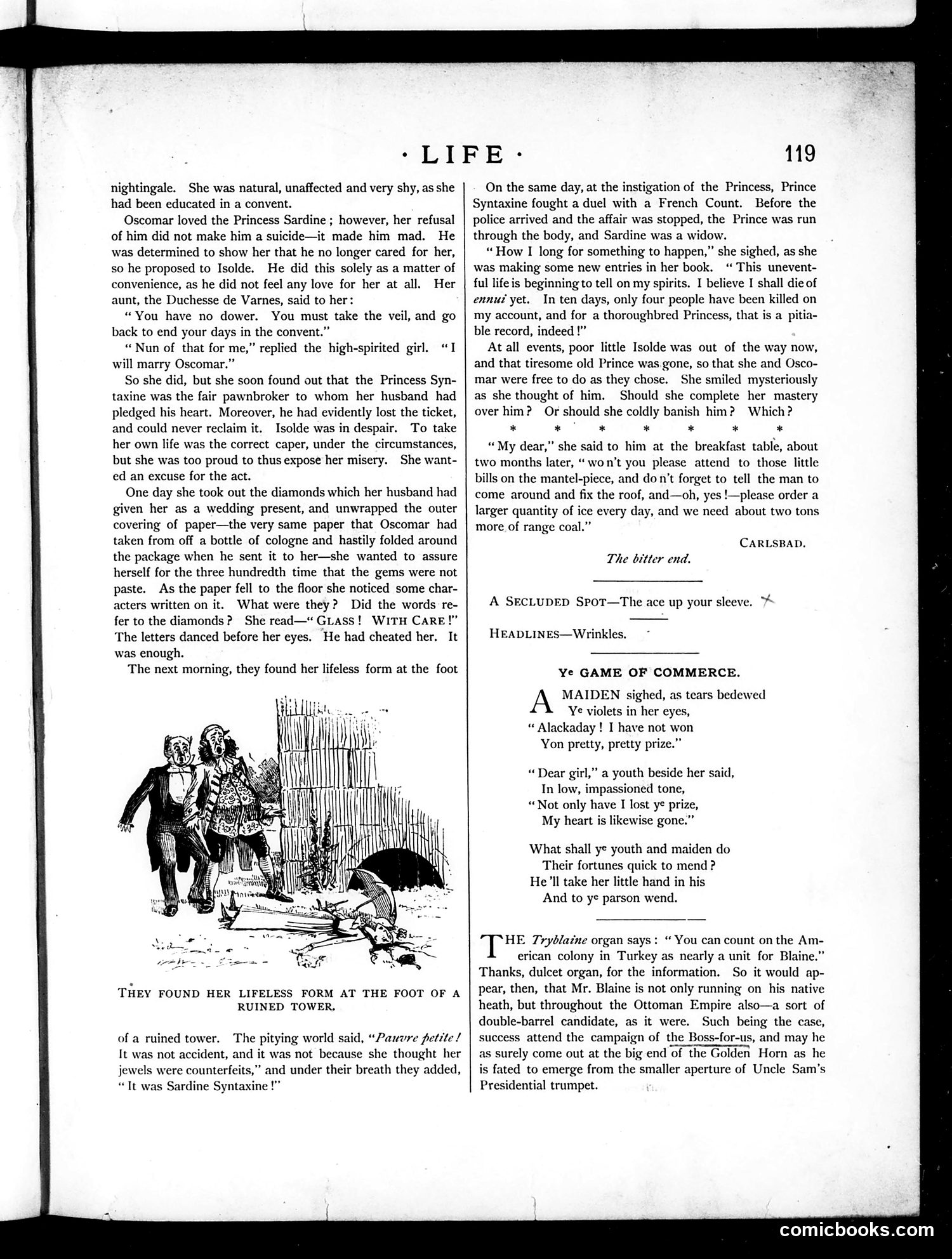
This page contains a serialized fiction story about Princess Sardine (likely satirical royalty), concluding with her death. The narrative describes marital infidelity and financial deception—her husband pawned her diamonds and cheated her—themes mocking aristocratic excess and moral corruption. The accompanying illustration shows two figures discovering a dead woman at a ruined tower's base, captioned "They found her lifeless form at the foot of a ruined tower"—a melodramatic ending typical of Victorian serialized fiction. Below are separate satirical sections: "A Secluded Spot," "Headlines—Wrinkles," and "Ye Game of Commerce" (a poem about lost love and heartbreak). The final section discusses American political involvement in Turkey regarding James G. Blaine, mixing satire with contemporary political commentary about U.S. imperial ambitions.
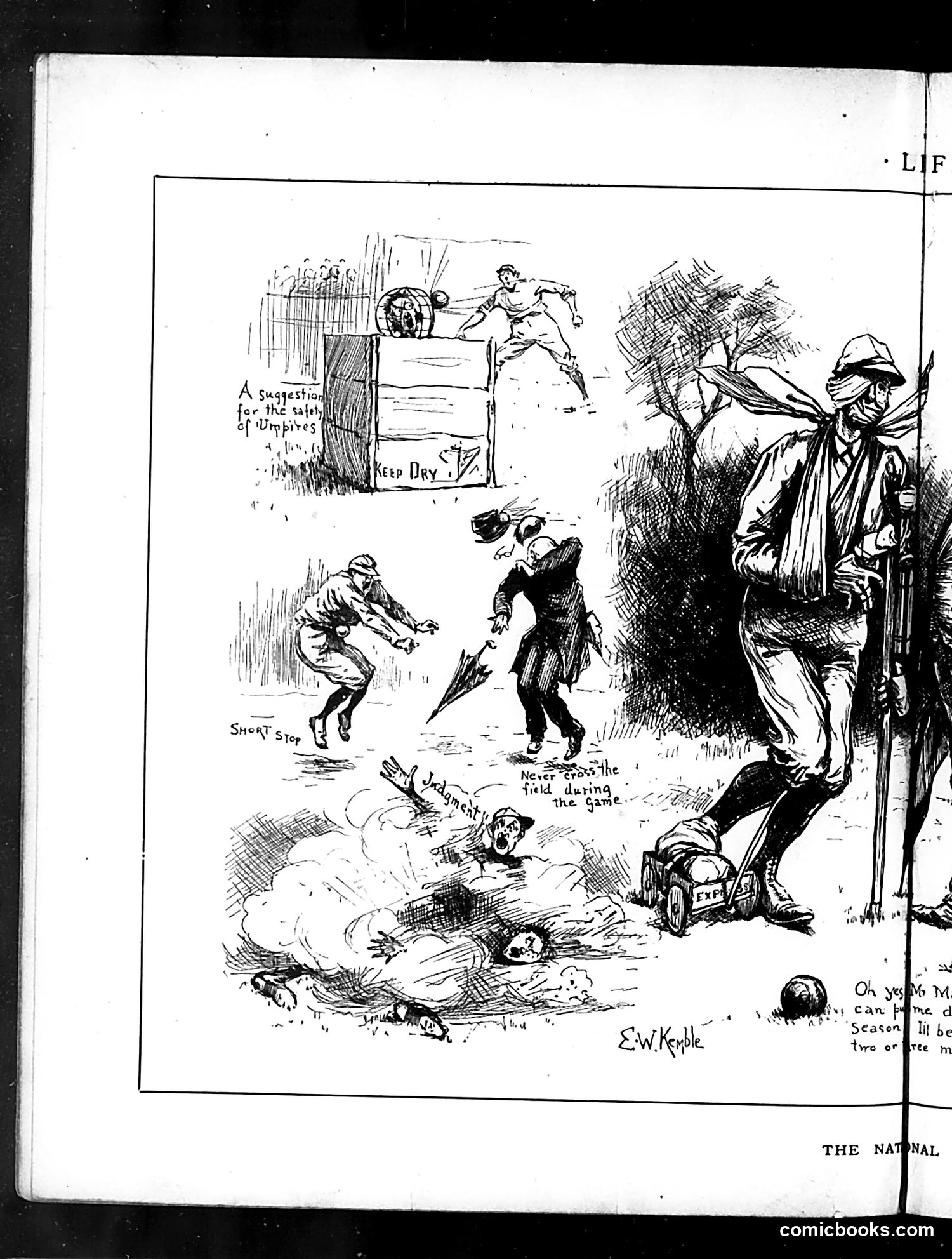
This satirical cartoon by E.W. Kemble depicts cricket game rules through humorous scenarios. The labeled vignettes illustrate specific regulations: - **"A suggestion for the establishment of Umpires"**: Shows an umpire in a protective box labeled "KEEP DRY" - **"Short Stop"**: Depicts a fielder's positioning - **"Never cross the field during the game"**: Shows a player violating this rule The cartoon mocks cricket's formal regulations by exaggerating their consequences and presenting absurd enforcement methods. The humor derives from depicting cricket—a genteel sport—with slapstick consequences for rule violations, appealing to American readers less familiar with cricket's complex regulations. The style and subject suggest this aimed to educate readers about cricket rules through comedic illustration rather than straightforward instruction.
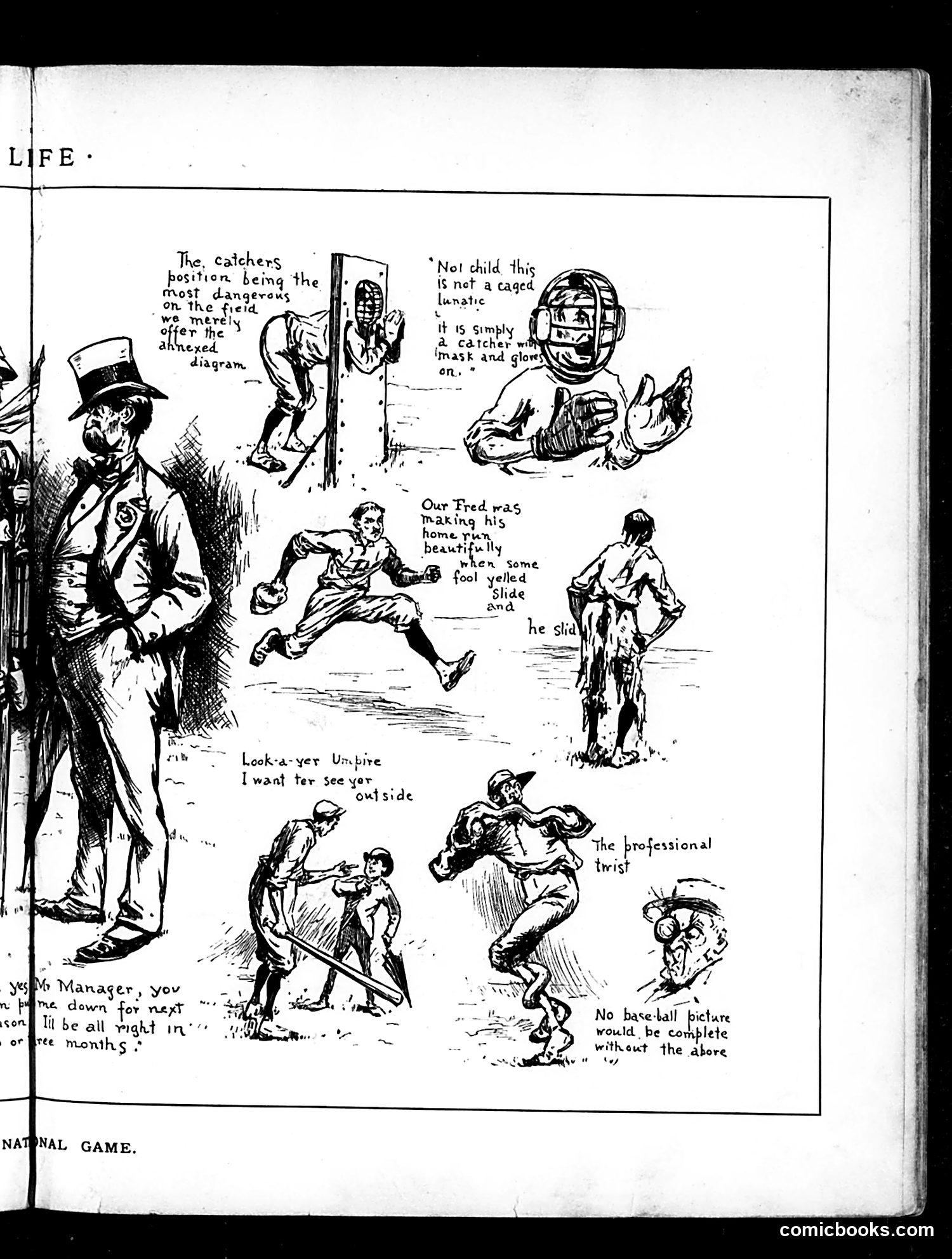
This is an instructional baseball diagram and commentary page from *Life* magazine's "National Game" section. Rather than political satire, it's educational sports journalism using humor. The page illustrates various baseball techniques and positions through sketched figures: the catcher's dangerous position, proper fielding form, sliding technique, and "the professional twist" (likely an advanced batting or pitching motion). A figure on the left—appearing to be a team manager or official in formal dress—observes and comments on the plays. The captions use dry humor to explain baseball fundamentals. References to "Fred," the umpire, and the manager suggest this depicts typical game situations. The overall purpose is teaching readers baseball rules and techniques through entertaining cartoon illustrations, not political commentary.
This is a satirical travel narrative mocking Newport society and American social climbing. The unnamed correspondent fabricates an aristocratic identity—claiming to be a "younger son of a childless Earl" with £50,000 income—and is immediately showered with invitations. The satire targets: **Social pretension**: Wealthy Newport residents eagerly host someone based solely on fabricated wealth and British title, revealing their obsession with status. **Name ridiculing**: The invented characters have absurd names (Madame Gudeclose, Count Marrons Glacé, Fee-Jee Yisland) mocking nouveau-riche affectation. **The cholera subplot**: A yacht in quarantine for cholera doesn't deter guests—they attend anyway—suggesting both recklessness and the triviality of social obligation over actual danger. **The "substitute" trick**: The correspondent sends a dressed-up stand-in to one dinner, yet creates a "furore" through mere pleasant conversation, exposing how superficial these circles are. The piece ridicules Gilded Age wealth obsession and the pretentiousness of summer resort culture among the American rich.
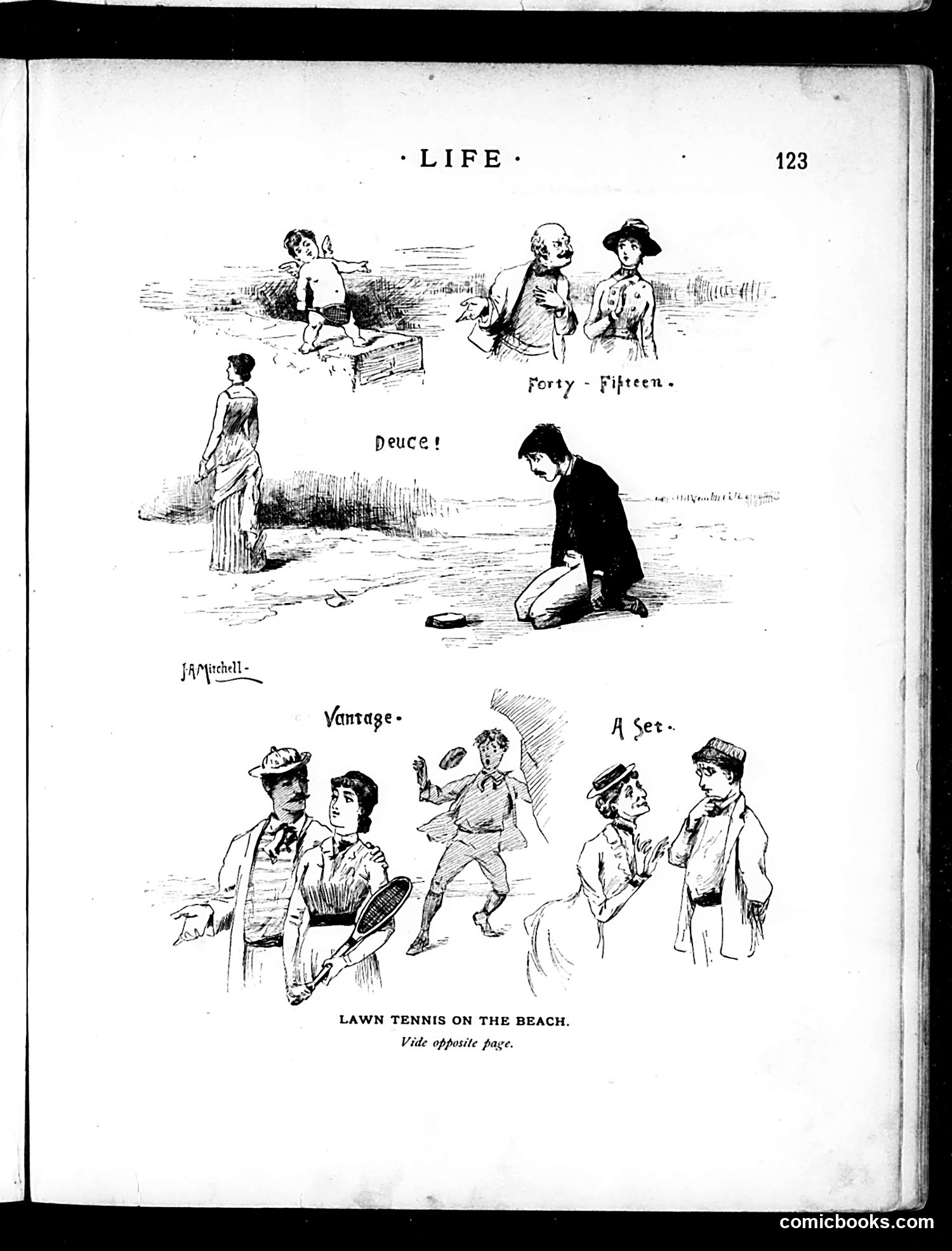
This page from *Life* magazine illustrates scenes of beach lawn tennis, a leisure activity popular among the upper and middle classes in the late 19th/early 20th century. The sketches depict various moments: scoring ("Forty-Fifteen," "Deuce"), victory ("A Set"), and social interaction ("Vantage"). The humor appears gentle and observational rather than sharp political satire. The cartoons capture the pretensions and awkwardness of fashionably dressed players attempting this genteel sport on sand—an inherently unsuitable surface for the game. The clothing (formal jackets, hats) contrasts amusingly with the athletic activity, satirizing how the upper classes maintained social propriety even during recreation. The reference to "vide opposite page" suggests accompanying text or additional illustrations elsewhere in the magazine providing context about this fashionable pastime.
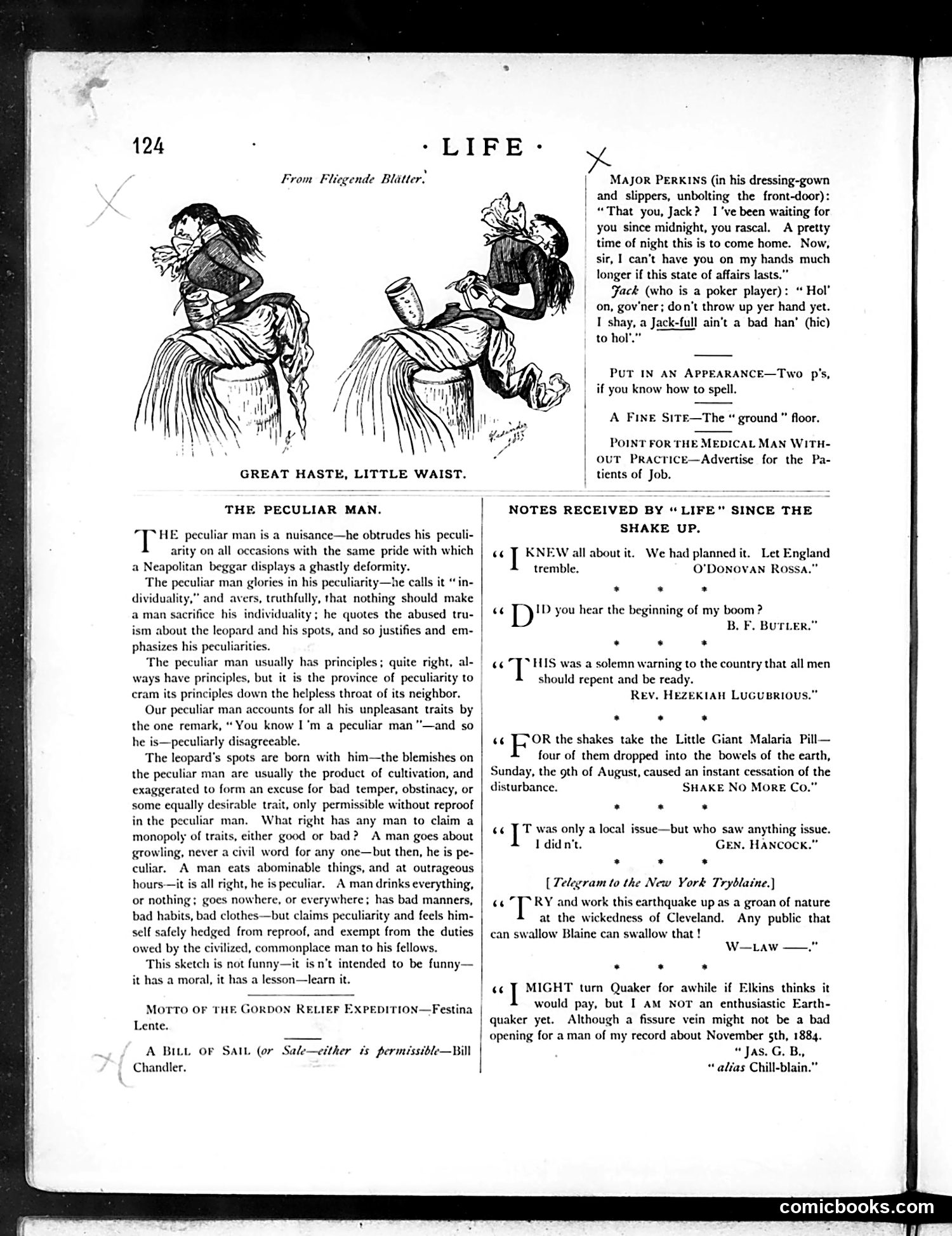
**The Cartoon:** The top illustration (from German publication *Fliegende Blätter*) depicts women with exaggerated tiny waists, likely mocking Victorian corsetry fashion. The title "Great Haste, Little Waist" suggests the absurd contradiction between rushing about modern life and maintaining the constrictive, impractical silhouettes fashionable women endured. **The Essay:** "The Peculiar Man" satirizes individuals who use eccentricity as an excuse for antisocial behavior—people who justify rudeness, slovenliness, or boorishness by claiming "I'm a peculiar man." The piece criticizes how such people invoke their "individuality" (sarcastically) while actually just annoying their neighbors, comparing their self-cultivated flaws unfavorably to natural leopard spots. **The Notes Section:** Brief satirical responses to recent news, including political jabs at O'Donovan Rossa (Irish nationalist), James Blaine (presidential candidate), and references to an earthquake and Cleveland politics—typical of *Life* magazine's topical humor mixing politics, advertising mockery, and social commentary.
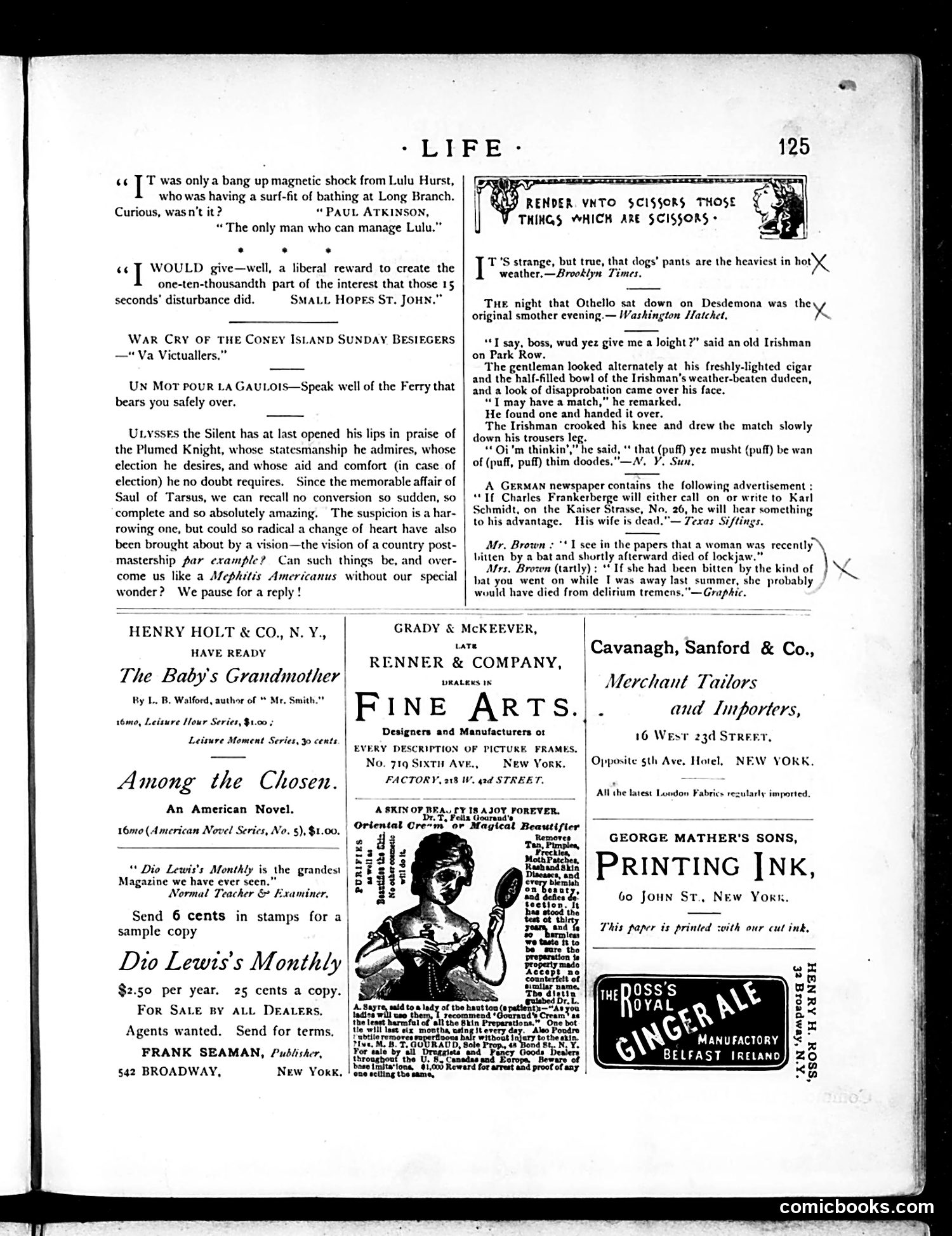
This page is primarily **advertisements and satirical short humor bits** rather than a coherent political cartoon. Here's what's visible: The central content features brief jokes and social commentary, likely referencing contemporary figures or situations. One mentions "Lulu Hurst," apparently a famous woman of the 1880s known for unusual abilities. Another discusses "Ulysses the Silent" praising "the Plumed Knight"—likely political commentary on General James Garfield (the "Plumed Knight"). There's humor about Irish dialects, German classified ads, and trivial social observations ("dogs' pants are the heaviest in hot weather"). The jokes rely on wordplay and period-specific scandals familiar to *Life* magazine's readers. The bulk of the page comprises **advertisements** for books, merchant tailors, printing ink, and ginger ale—typical of a magazine from the 1880s. Without additional context on contemporary events, many specific satirical targets remain unclear to modern readers.
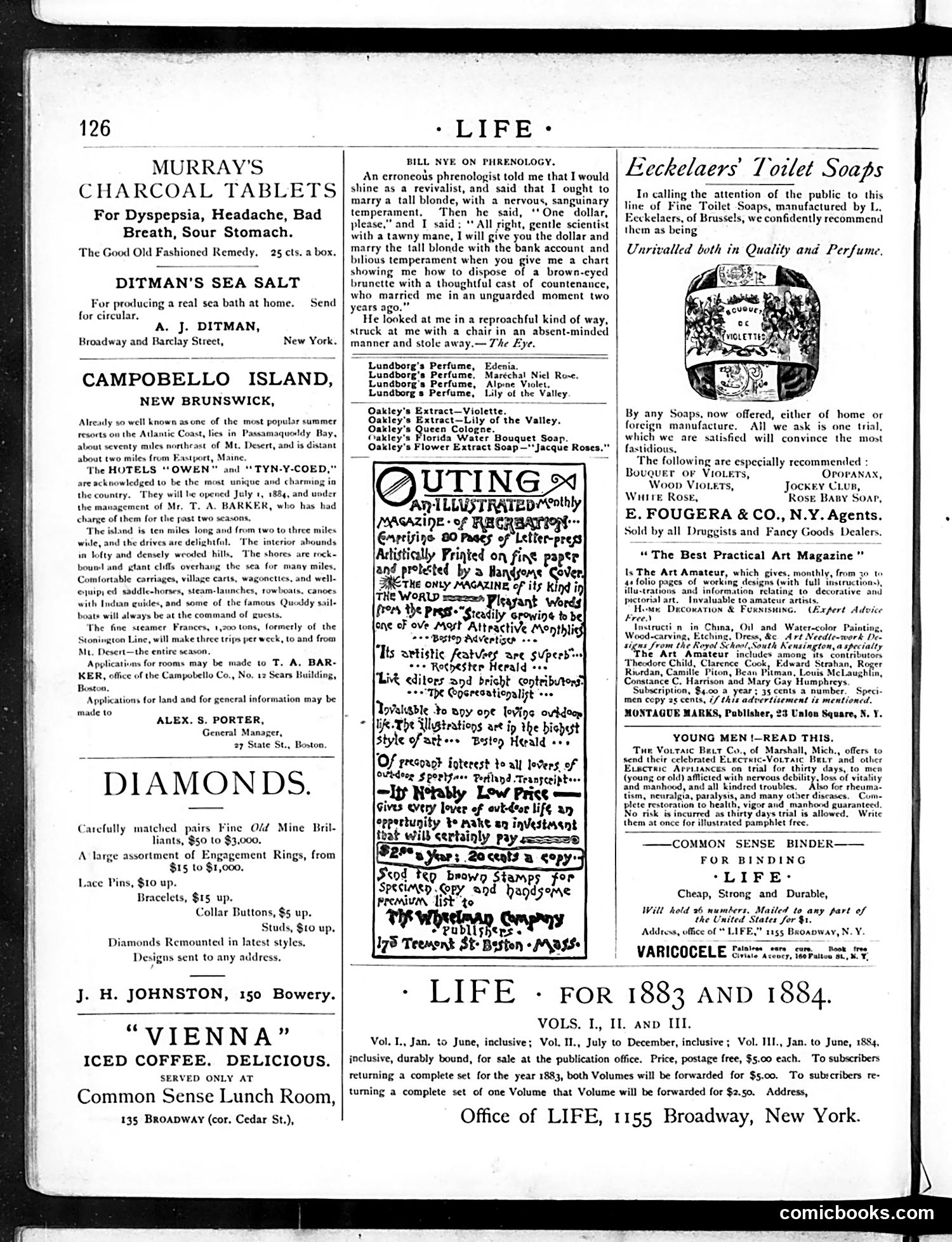
This is primarily an **advertising page** from Life magazine (page 126), featuring commercial notices for products like charcoal tablets, sea salt, resort accommodations at Campobello Island, diamonds, and perfumes. The only satirical content is a brief humor piece titled "ON PHRENOLOGY"—a joke mocking pseudoscientific phrenology (reading skull bumps to predict character). A man consults a phrenologist who, after examining his head, inexplicably advises him to marry a tall blonde instead of his current wife. When the man sarcastically agrees but asks how to "dispose of" his existing brown-eyed wife, the phrenologist becomes offended and attacks him with a chair before fleeing. The satire targets the absurdity of phrenology as a false science and the charlatan practitioners who peddled it.
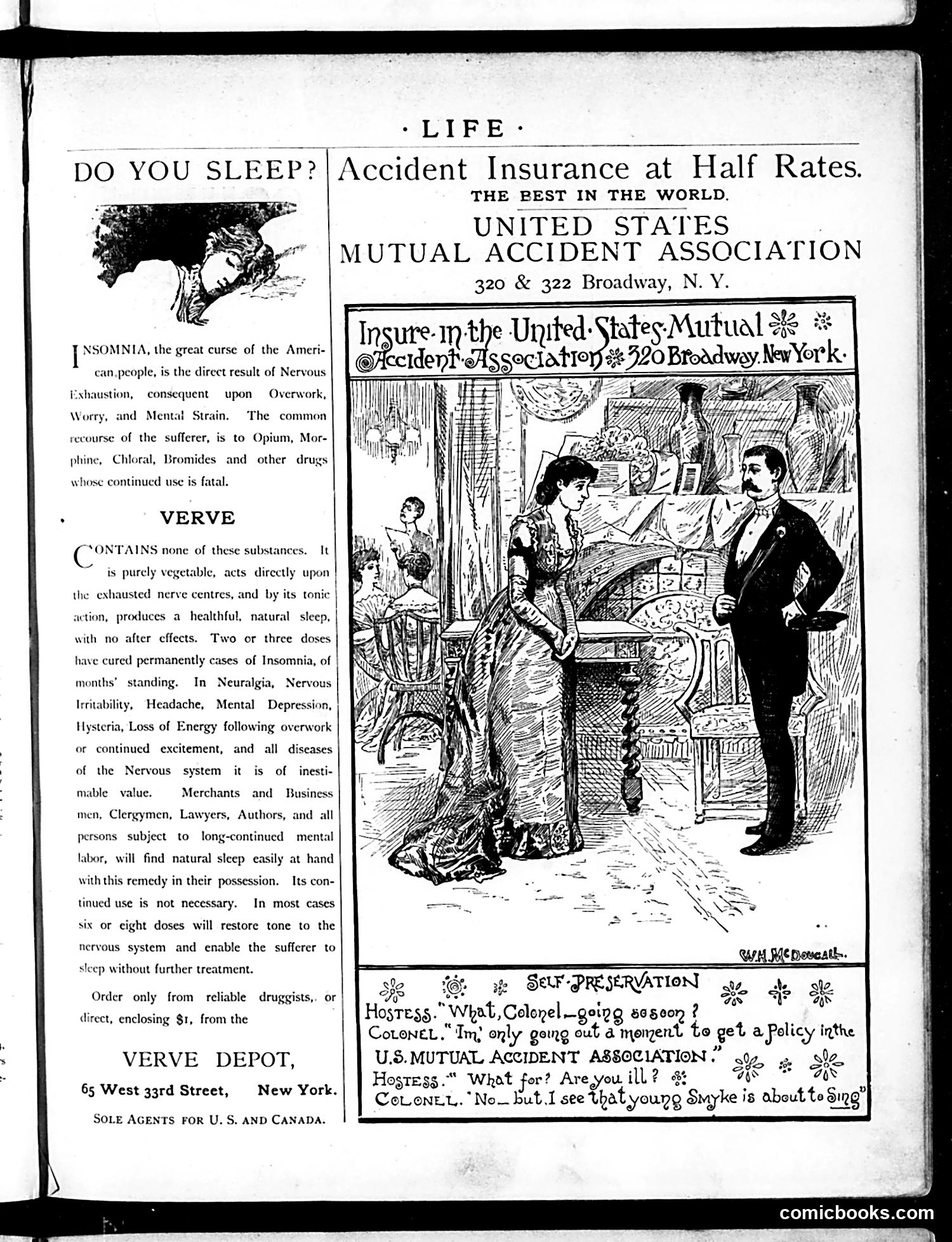
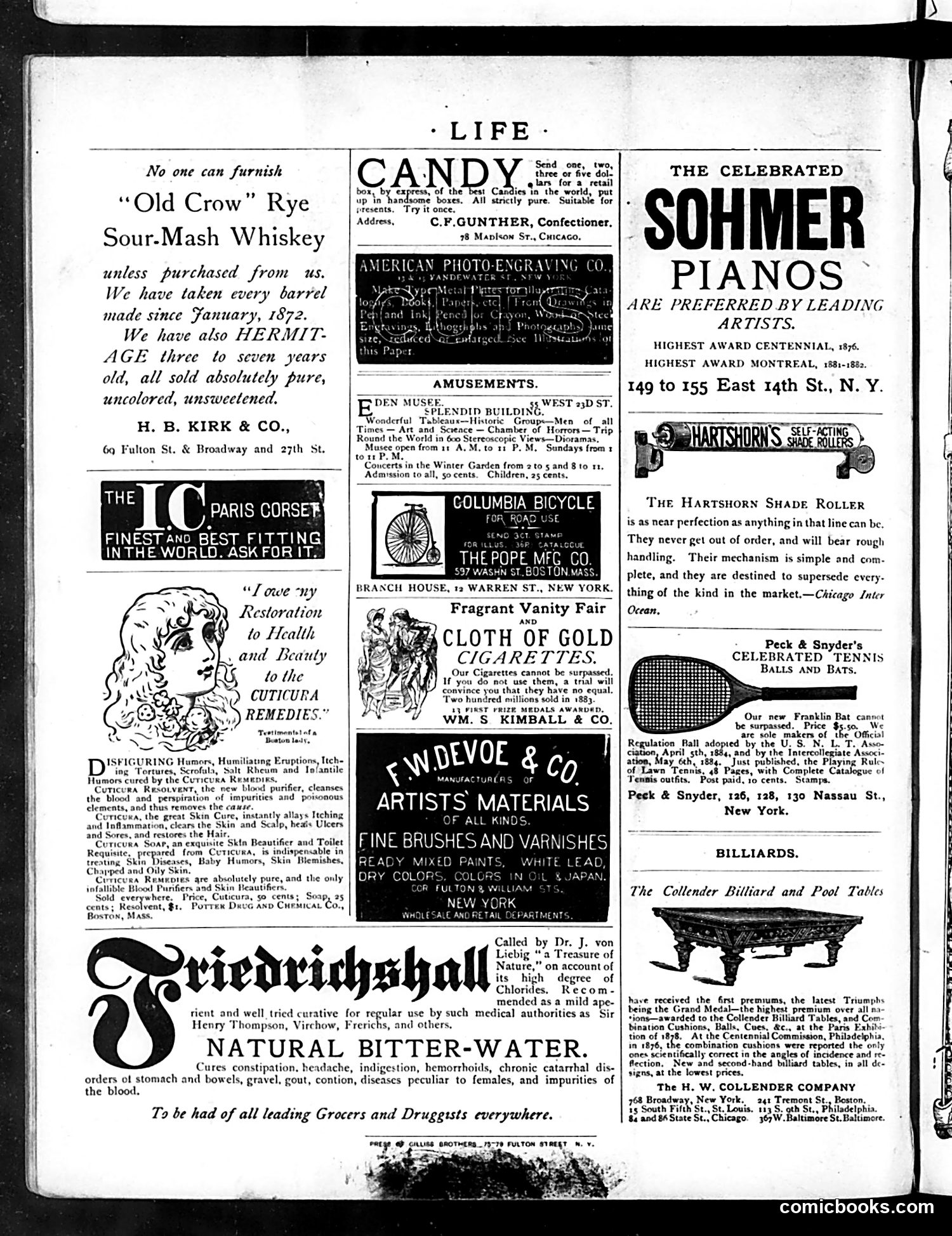
This is primarily an **advertising page**, not a political cartoon or satirical content. The page consists entirely of commercial advertisements typical of late 19th-century American magazines. Notable ads include: - **Whiskey and patent medicines** (Old Crow Rye, Cuticura remedies, Friedrichshall Natural Bitter-Water) — reflecting the era's unregulated pharmaceutical market where alcohol and dubious tonics were marketed as medical cures - **Consumer goods** (Sohmer Pianos, Columbia Bicycles, Paris Corsets) — aspirational products for middle-class readers - **Entertainment** (Eden Musee, a wax museum with "Chamber of Horrors") - **Sporting equipment** (Peck & Snyder tennis balls and bats) The page reflects Gilded Age consumer culture and the lack of FDA regulation—products made unsubstantiated health claims freely. There is **no visible political satire or cartoon commentary** on this particular page.