
Life, 1884-08-28 · page 6 of 16
Life — August 28, 1884 — page 6: what you’re looking at
What you’re looking at
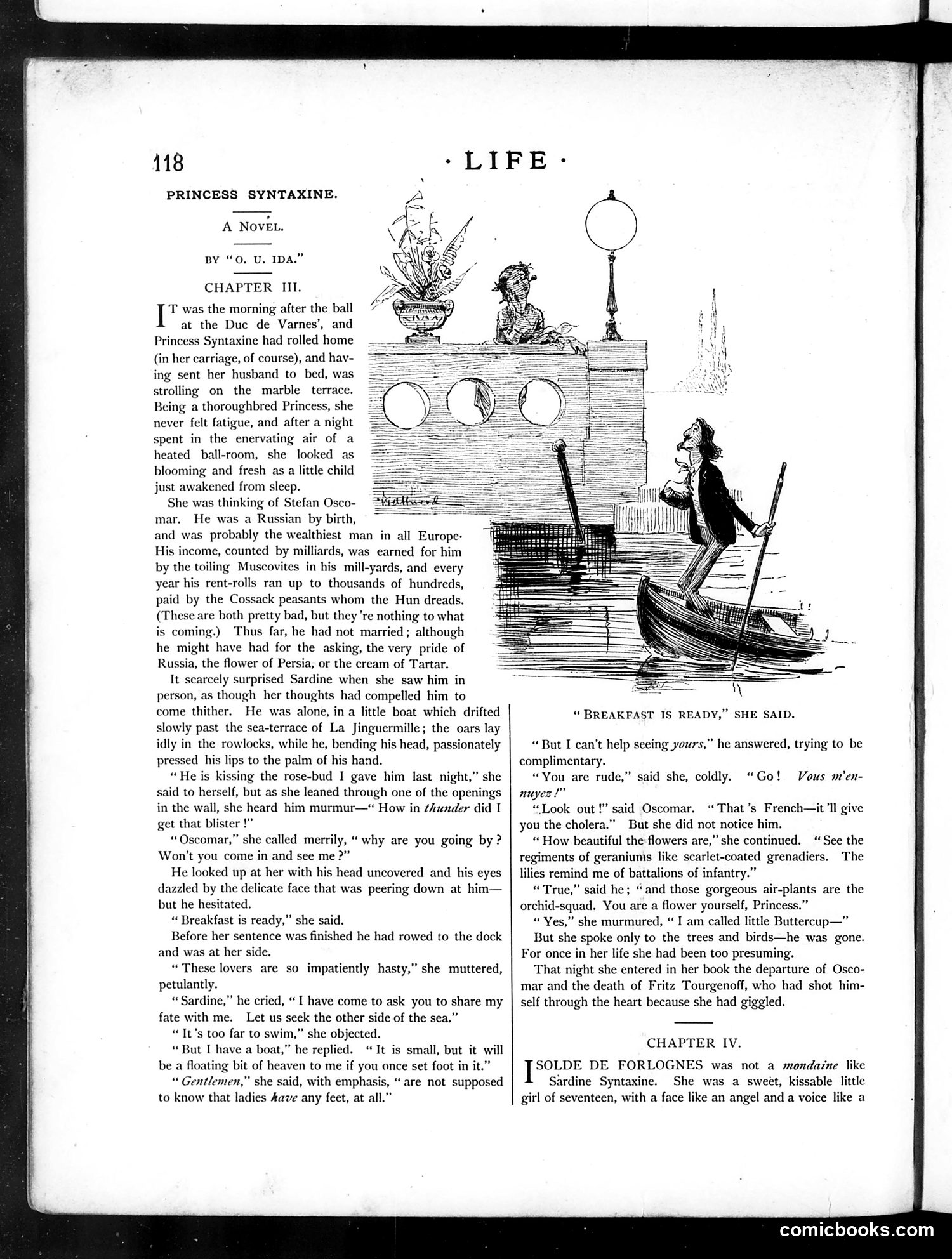
This page contains a serialized novel titled "Princess Syntaxine" by "O. U. IDA." (likely a pseudonym). The illustrations show a domestic scene at a waterside terrace where Princess Syntaxine encounters a man named Oscomar in a small boat. The content is satirical fiction rather than political commentary. The humor appears to derive from wordplay and romantic complications—Oscomar is described as a wealthy Russian nobleman, and the dialogue includes French phrases and flirtation. The scene depicts the Princess contemplating Oscomar while on her terrace, with servants preparing breakfast. This represents *Life* magazine's literary satire tradition: mocking aristocratic pretension and romantic melodrama through serialized fiction rather than editorial cartoons. The specific satirical target is unclear without additional context about the novel's broader narrative.
📄 Transcribed text from this page (OCR, searchable)
Machine-transcribed from the original scan — historical spelling and the odd misread are preserved.
118 PRINCESS SYNTAXINE. A NovEL. BY “O, U. IDA.” CHAPTER III. ii was the morning after the ball at the Duc de Varnes’, and Princess Syntaxine had rolled home (in her carriage, of course), and hav- ing sent her husband to bed, was strolling on the marble terrace. Being a thoroughbred Princess, she never felt fatigue, and after a night spent in the enervating air of a heated ball-room, she looked as blooming and fresh as a little child just awakened from sleep. She was thinking of Stefan Osco- mar. He was a Russian by birth, and was probably the wealthiest man in all Europe: His income, counted by milliards, was earned for him by the toiling Muscovites in his mill-yards, and every year his rent-rolls ran up to thousands of hundreds, paid by the Cossack peasants whom the Hun dreads. (These are both pretty bad, but they 're nothing to what is coming.) Thus far, he had not married; although he might have had for the asking, the very pride of Russia, the flower of Persia, or the cream of Tartar. It scarcely surprised Sardine when she saw him in person, as though her thoughts had compelled him to come thither. He was alone, in a little boat which drifted slowly past the sea-terrace of La Jinguermille; the oars lay idly in the rowlocks, while he, bending his head, passionately pressed his lips to the palm of his hand. “He is kissing the rose-bud I gave him last night,” she said to herself, but as she leaned through one of the openings in the wall, she heard him murmur—“ How in ¢hunder did I get that blister !” “Oscomar,” she called merrily, “ why are you going by ? Won't you come in and see me ?” He looked up at her with his head uncovered and his eyes dazzled by the delicate face that was peering down at him— but he hesitated. “ Breakfast is ready,” she said. Before her sentence was finished he had rowed to the dock and was at her side. “These lovers are so impatiently hasty,” she muttered, petulantly. “Sardine,” he cried, “I have come to ask you to share my fate with me. Let us seek the other side of the sea.” “It's too far to swim,” she objected. “But I have a boat,” he replied. “It is small, but it will be a floating bit of heaven to me if you once set foot in it.” “Gentlemen,” she said, with emphasis, “ are not supposed to know that ladies Aave any feet, at all.” “ BREAKFAST IS READY,” SHE SAID. “But I can’t help seeing yours,” he answered, trying to be complimentary. “You are rude,” said she, coldly. nuyez !” “Look out!” said Oscomar. “That’s French—it 'll give you the cholera.” But she did not notice him. “ How beautiful the flowers are,” she continued. “See the regiments of geraniums like scarlet-coated grenadiers. The lilies remind me of battalions of infantry.” “True,” said he; “and those gorgeous air-plants are the orchid-squad. You are a flower yourself, Princess.” “Yes,” she murmured, “I am called little Buttercup—” But she spoke only to the trees and birds—he was gone. For once in her life she had been too presuming. That night she entered in her book the departure of Osco- mar and the death of Fritz Tourgenoff, who had shot him- self through the heart because she had giggled. “Go! Vous m'en- CHAPTER IV. SOLDE DE FORLOGNES was not a mondaine like Sardine Syntaxine. She was a sweet, kissable little girl of seventeen, with a face like an angel and a voice like a comicbooks.com