
Life, 1884-08-28 · page 5 of 16
Life — August 28, 1884 — page 5: what you’re looking at
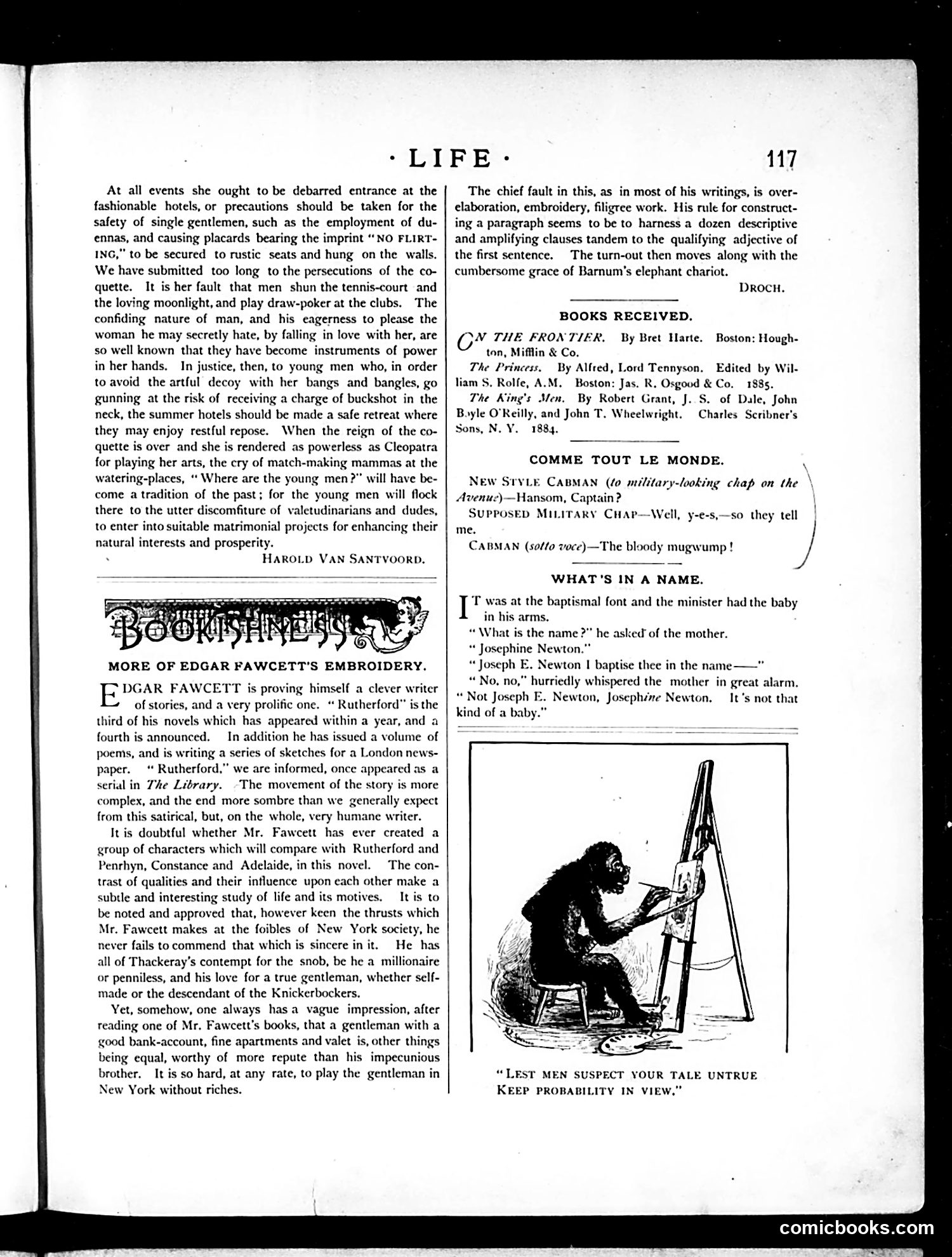
What you’re looking at
The main illustration depicts a chimpanzee painting at an easel, captioned "LEST MEN SUSPECT YOUR TALE UNTRUE / KEEP PROBABILITY IN VIEW." This appears to be satirical commentary on artistic authenticity and credibility. The cartoon suggests that even a monkey's artwork would seem more believable if it maintained some connection to reality or probability. The joke likely critiques artists or writers of the period who created implausible or fantastical works presented as serious art. The accompanying text discusses Edgar Fawcett's literary output, praising his writing while noting his tendency toward elaborate embellishment. The monkey-painting image serves as ironic visual commentary on Fawcett's ornate style—suggesting that even absurd subjects become more credible when grounded in realistic probability rather than pure extravagance.
📄 Transcribed text from this page (OCR, searchable)
Machine-transcribed from the original scan — historical spelling and the odd misread are preserved.
-> LIFE: 117 At all events she ought to be debarred entrance at the fashionable hotels, or precautions should be taken for the safety of single gentlemen, such as the employment of du- ennas, and causing placards bearing the imprint “NO FLIRT- ING,” to be secured to rustic seats and hung on the walls. We have submitted too long to the persecutions of the co- quette. It is her fault that men shun the tennis-court and the loving moonlight, and play draw-poker at the clubs. The confiding nature of man, and his eagerness to please the woman he may secretly hate, by falling in love with her, are so well known that they have become instruments of power in her hands. In justice, then, to young men who, in order to avoid the artful decoy with her bangs and bangles, go gunning at the risk of receiving a charge of buckshot in the neck, the summer hotels should be made a safe retreat where they may enjoy restful repose. When the reign of the co- quette is over and she is rendered as powerless as Cleopatra for playing her arts, the cry of match-making mammas at the watering-places, ‘ Where are the young men ?” will have be- come a tradition of the past; for the young men will flock there to the utter discomfiture of valetudinarians and dudes, to enter into suitable matrimonial projects for enhancing their natural interests and prosperity. . HAROLD VAN SANTVOORD. MORE OF EDGAR FAWCETT'S EMBROIDERY. [~ DGAR FAWCETT is proving himself a clever writer of stories, and a very prolific one. “ Rutherford” is the third of his novels which has appeared within a year, and a fourth is announced. —_In addition he has issued a volume of poems, and is writing a series of sketches for a London news- paper. “ Rutherford,” we are informed, once appeared as a serial in The Library. ~The movement of the story is more complex, and the end more sombre than we generally expect from this satirical, but, on the whole, very humane writer. It is doubtful whether Mr. Fawcett has ever created a group of characters which will compare with Rutherford and Penrhyn, Constance and Adelaide, in this novel. The con- trast of qualities and their influence upon cach other make a subtle and interesting study of life and its motives. It is to be noted and approved that, however keen the thrusts which Mr. Fawcett makes at the foibles of New York society, he never fails tocommend that which is sincere in it. He has all of Thackeray’s contempt for the snob, be he a millionaire or penniless, and his love for a true gentleman, whether self- made or the descendant of the Knickerbockers. Yet, somehow, one always has a vague impression, after reading one of Mr. Fawcett’s books, that a gentleman with a good bank-account, fine apartments and valet is, other things being equal, worthy of more repute than his impecunious brother. It is so hard, at any rate, to play the gentleman in New York without riches. The chief fault in this, as in most of his writings, is over- elaboration, embroidery, filigree work. His rule for construct- ing a paragraph seems to be to harness a dozen descriptive and amplifying clauses tandem to the qualifying adjective of the first sentence. The turn-out then moves along with the cumbersome grace of Barnum’s elephant chariot. DRocu. BOOKS RECEIVED. C% THE FRONTIER, By Bret Marte. Boston: Hough- ton, Mifflin & Co, The Princess. By Allred, Lord Tennyson. Edited by Wil- liam S. Rolfe, A.M. Boston: Jas. R. Osgood & Co. 1885. The King's Men. By Robert Grant, J. S. of Dale, John Bayle O'Reilly, and John T, Wheelwright. Charles Scribner's Sons, N.Y. 1884. COMME TOUT LE MONDE. CABMAN (lo military-looking chap on the \ Avenu:)—Hansom, Captain? SUPPOSED MILITARY CHAP—Well, y-e-s,—so they tell me. CABMAN (soffo voce)—The bloody mugwump ! WHAT'S IN A NAME. ie was at the baptismal font and the minister had the baby in is the name ?” he asked of the mother. ephine Newton.” “Joseph E. Newton I baptise thee in the name—”" “No, no,” hurriedly whispered the mother in great alarm. “Not Joseph E. Newton, Josephée Newton, — It's not that kind of a baby.” “LEST MEN SUSPECT YOUR TALE UNTRUE KEEP PROBABILITY IN VIEW.” comicbooks.com