
A complete issue · 16 pages · 1884
Life — August 21, 1884
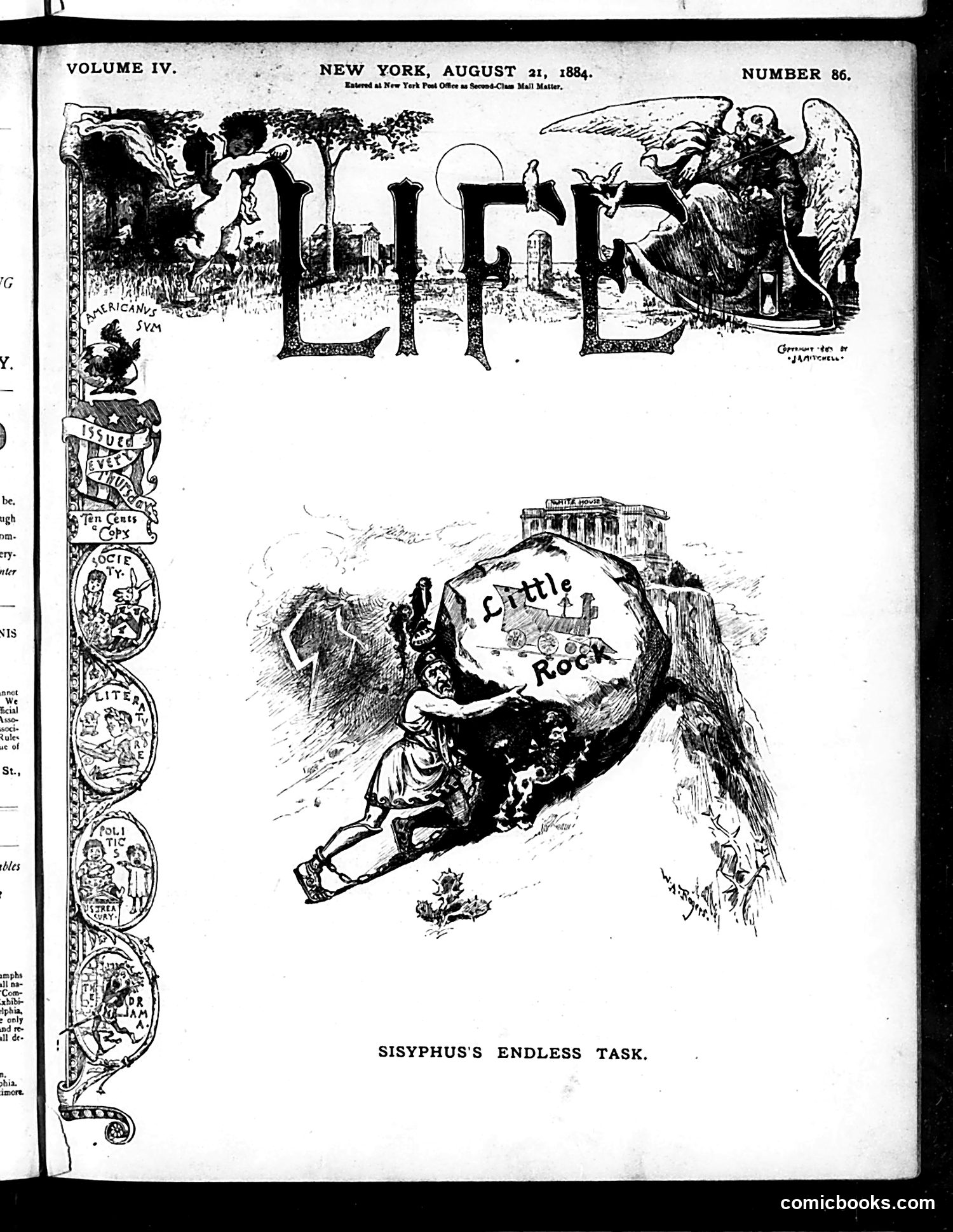
This page features a political cartoon titled "Sisyphus's Endless Task," referencing the Greek mythological figure condemned to eternally roll a boulder uphill. The cartoon depicts a figure pushing a large boulder labeled "Little Rock" up a steep incline toward a classical building (likely representing government or political authority). The caption invokes Sisyphus to suggest that whoever is associated with "Little Rock" faces an impossible, repetitive task. Given the 1884 date, this likely comments on Reconstruction-era politics or disputes involving Arkansas (Little Rock is its capital). The satire suggests that some political objective or reform effort is futile and endlessly frustrating—a task destined to fail repeatedly, much like Sisyphus's eternal punishment. The decorative left border contains Life magazine's typical ornamental design with classical motifs.
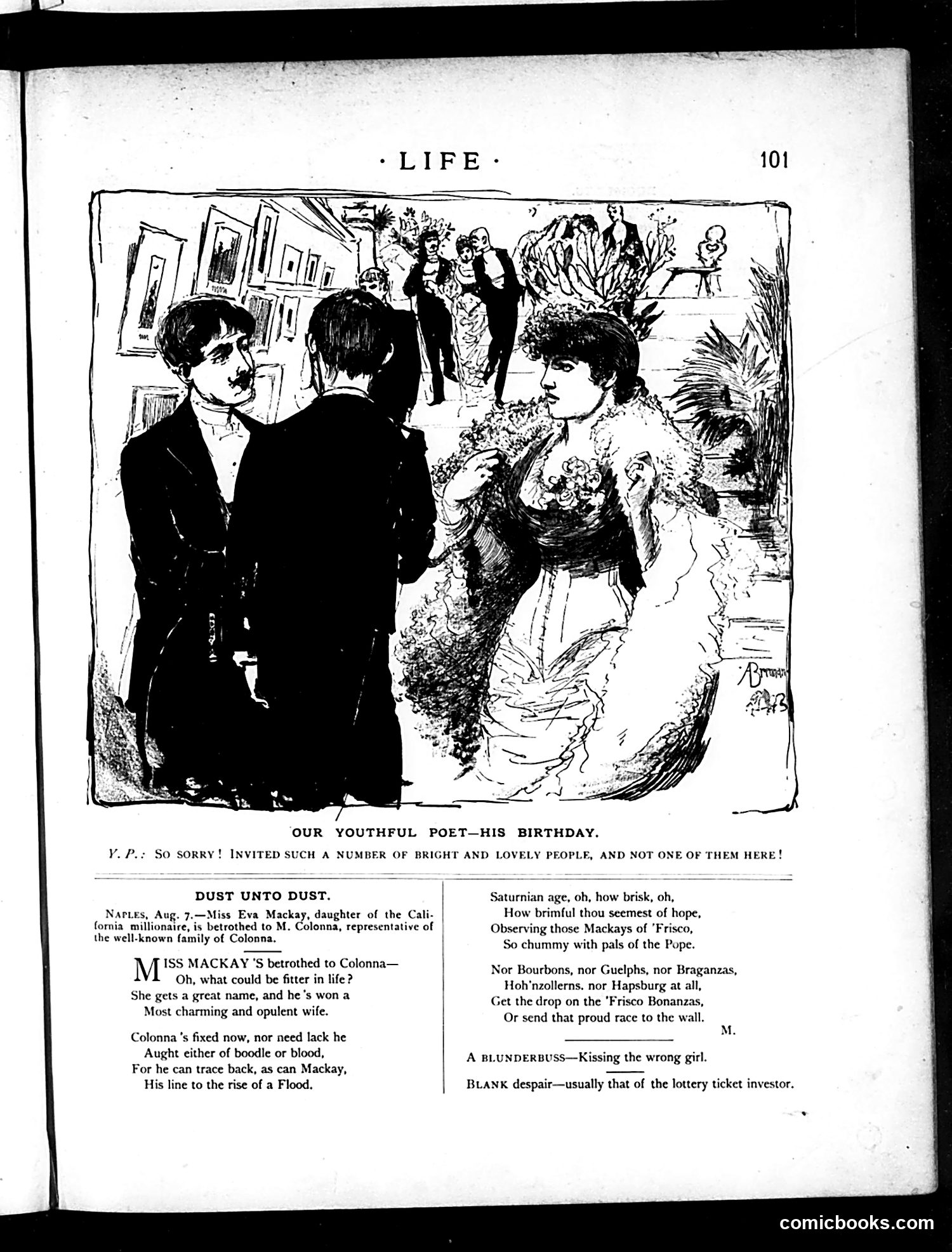
The main cartoon titled "OUR YOUTHFUL POET—HIS BIRTHDAY" depicts a social gathering where a young poet's birthday party has gone awry. The caption reveals the joke: the host (labeled "Y.P." for "Youthful Poet") laments inviting "such a number of bright and lovely people, and not one of them here!"—suggesting his guests have failed to arrive or are disappointing. The accompanying verse sections mock the poet's pretensions and social aspirations. "DUST UNTO DUST" satirizes Miss Mackay's betrothal to Colonna, a wealthy California representative, commenting on her advantageous marriage. Other brief items like "A BLUNDERBUSS" and "BLANK DESPAIR" appear to be social gossip—standard satirical fare mocking high society's romantic misadventures and financial follies, typical of Life's society-page humor from this era.
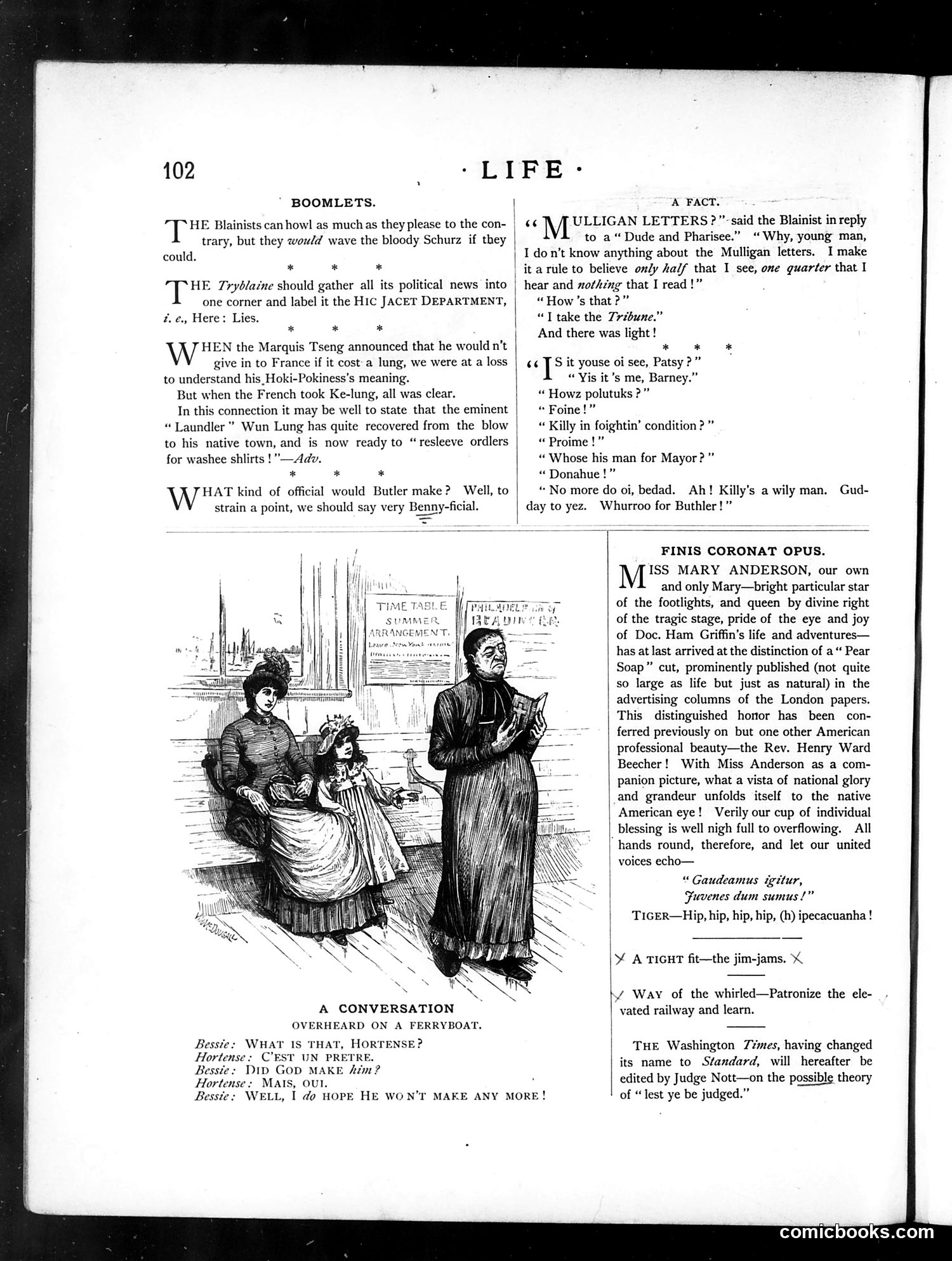
This page contains political satire and humor columns rather than a single unified cartoon. The **"Boomlets"** section mocks political incompetence: the Blainists (supporters of James G. Blaine) are criticized for spreading false rumors; The *Tribune* is accused of mislabeling opinion as news; and there's mockery of French diplomatic weakness regarding colonial disputes. The **main illustration** shows a ferryboat conversation where passengers debate whether God created Butler (likely General Benjamin Butler, a controversial political figure). The joke ridicules Butler's prominent role in politics through absurdist theological questioning. **"Finis Coronat Opus"** celebrates actress Mary Anderson's success in London theater, comparing her favorably to Henry Ward Beecher and claiming American cultural distinction. The satire targets 1880s political figures and media credibility through humor.
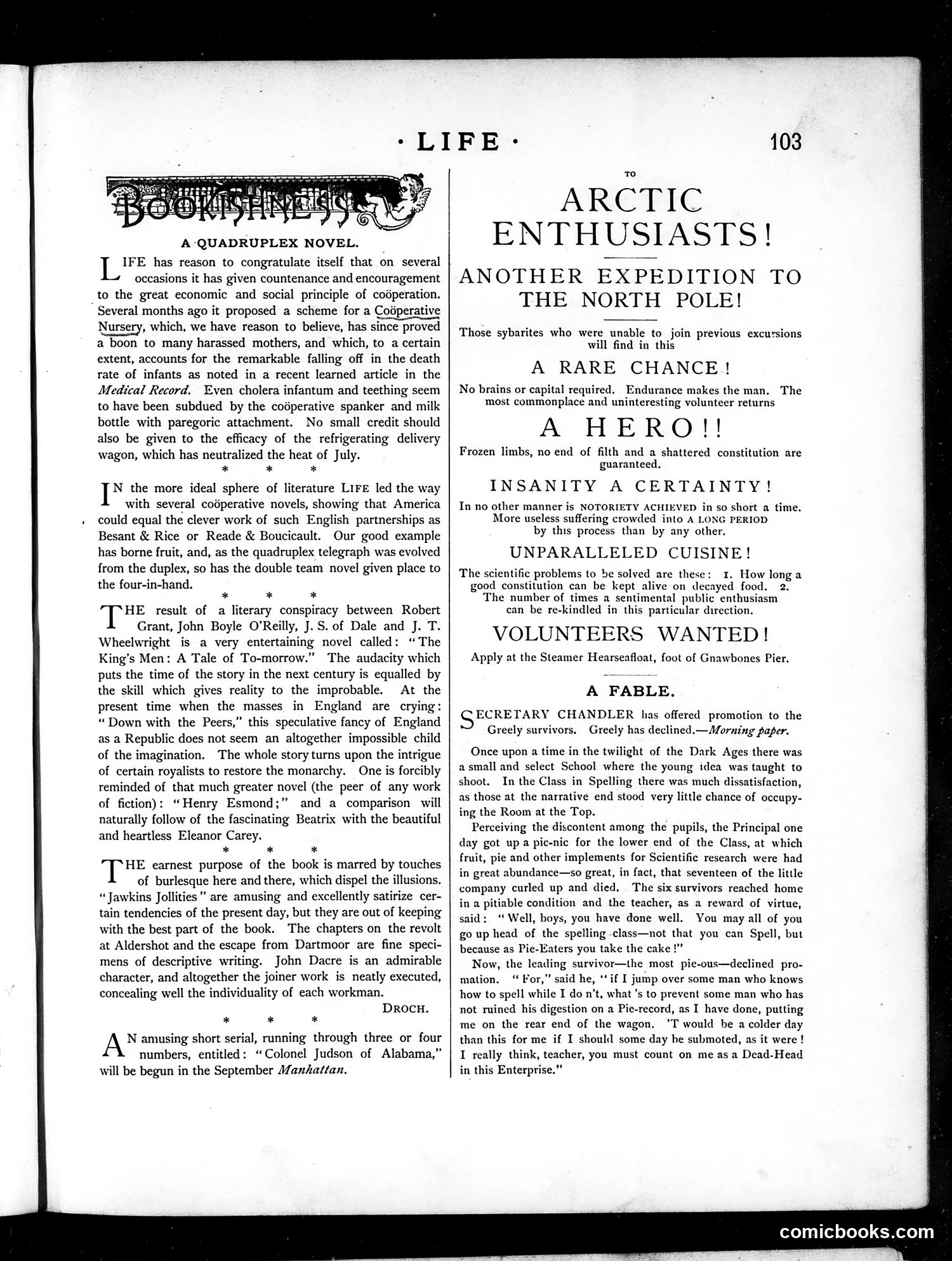
This page contains satirical advertisements and short fiction rather than political cartoons. The main content includes: **"To Arctic Enthusiasts!"** - A mock recruitment advertisement parodying polar expeditions, offering "A RARE CHANCE" to join an Arctic voyage with promises of "Frozen limbs, no end of filth and a shattered constitution" and "INSANITY A CERTAINTY!" The satire targets the era's romanticization of dangerous polar exploration, suggesting such ventures are actually suicidal rather than heroic. **"A Fable"** - A brief story mocking a schoolmaster who offers students promotion for enduring a painful picnic, satirizing educational corruption and the abuse of authority over vulnerable students. Both pieces use exaggeration and irony to critique contemporary social institutions and dangerous trends in society.
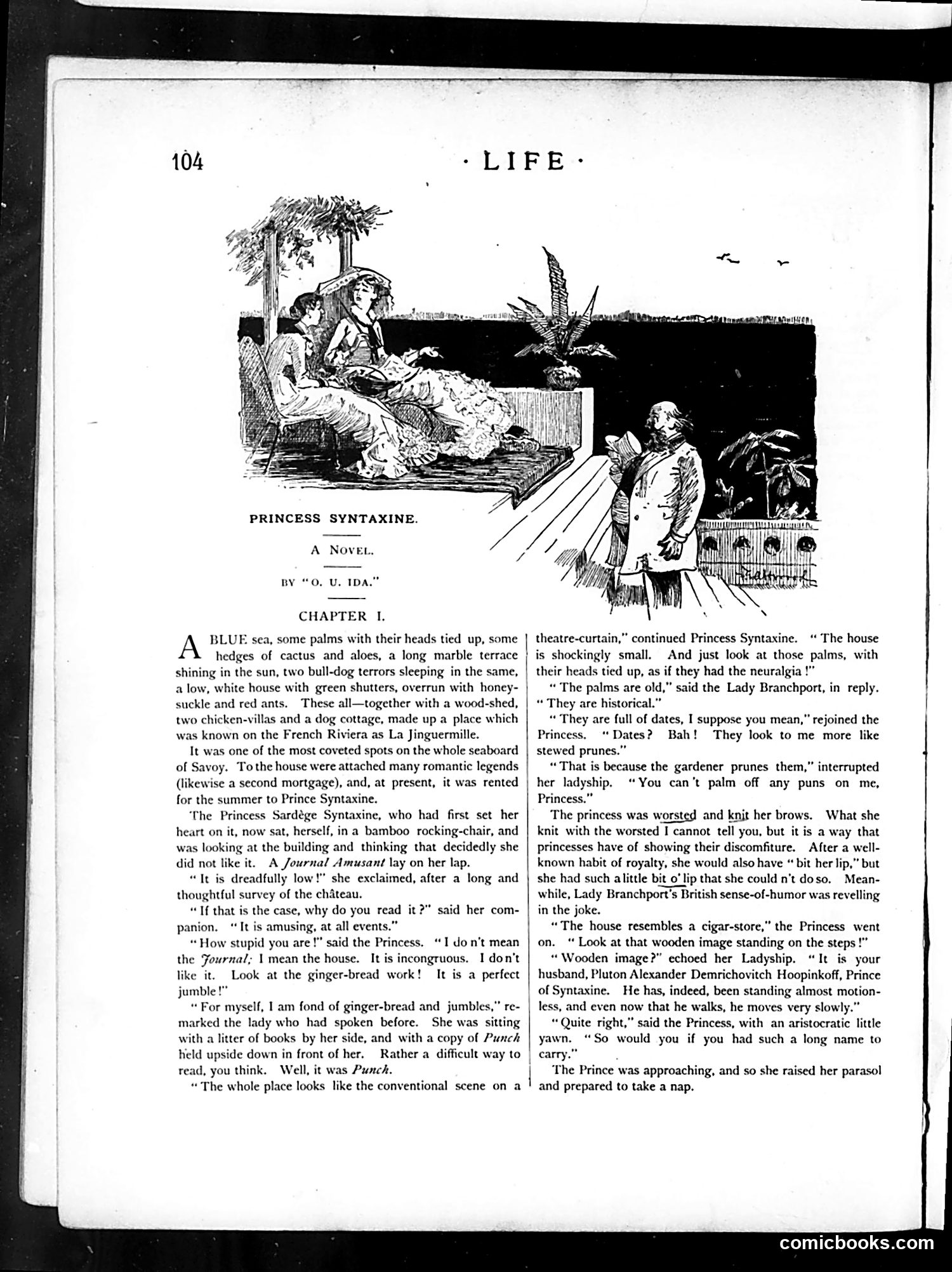
This page presents the opening of a serialized satirical novel titled "Princess Syntaxine" by "O. U. IDA." (likely a pseudonym). The illustration depicts a princess on a terrace overlooking a garden, conversing with a companion about the house's décor and the approaching Prince. The satire targets pretentious upper-class aesthetics and social conventions. The princess criticizes the "ginger-bread" architecture and the "historical" potted palms, while her companion defends them as fashionable. References to "Lady Branckport's British sense-of-humor" and the Prince's slow, aristocratic gait mock aristocratic affectations and social vanity. The novel appears to be satirizing wealthy society's obsession with status symbols and performative sophistication during the Gilded Age or early 20th century.
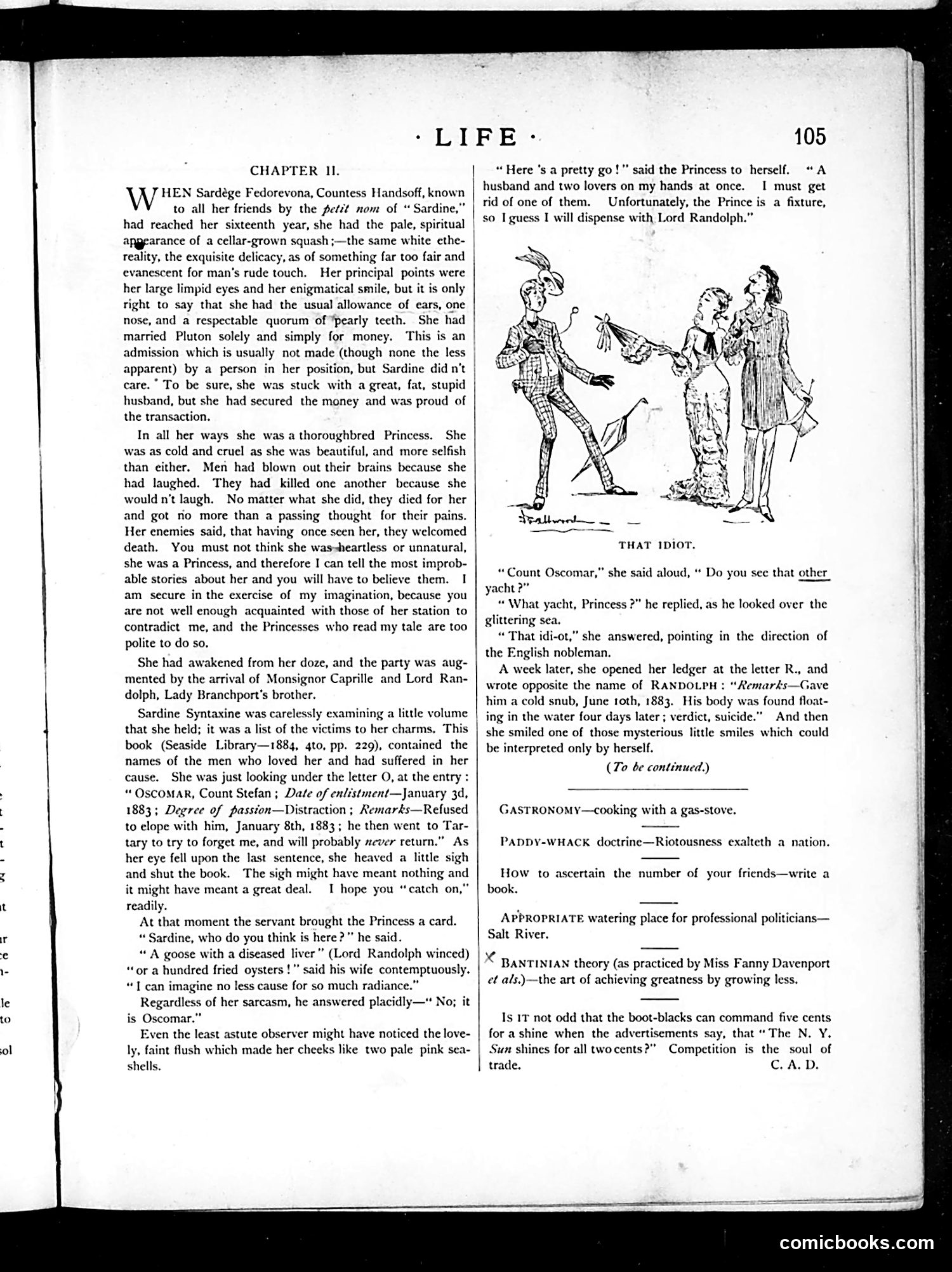
The main illustration titled "THAT IDIOT" depicts a social scene where a woman in an elaborate dress gestures dismissively at a man while speaking to two other gentlemen. Based on the surrounding text about Princess Sardine and her romantic entanglements, this cartoon satirizes the aristocratic social world—likely mocking a foolish suitor or social climber being rejected or ridiculed by a woman of higher status. The satirical column text below includes various quips about contemporary society: political figures ("Salt River" as exile for failed politicians), fashion/grooming (boot-blacks demanding payment), and social pretension. The humor targets pomposity and social absurdity among the upper classes. Without identifying specific individuals, the cartoon captures typical Life magazine satire of Gilded Age social dynamics and romantic folly.
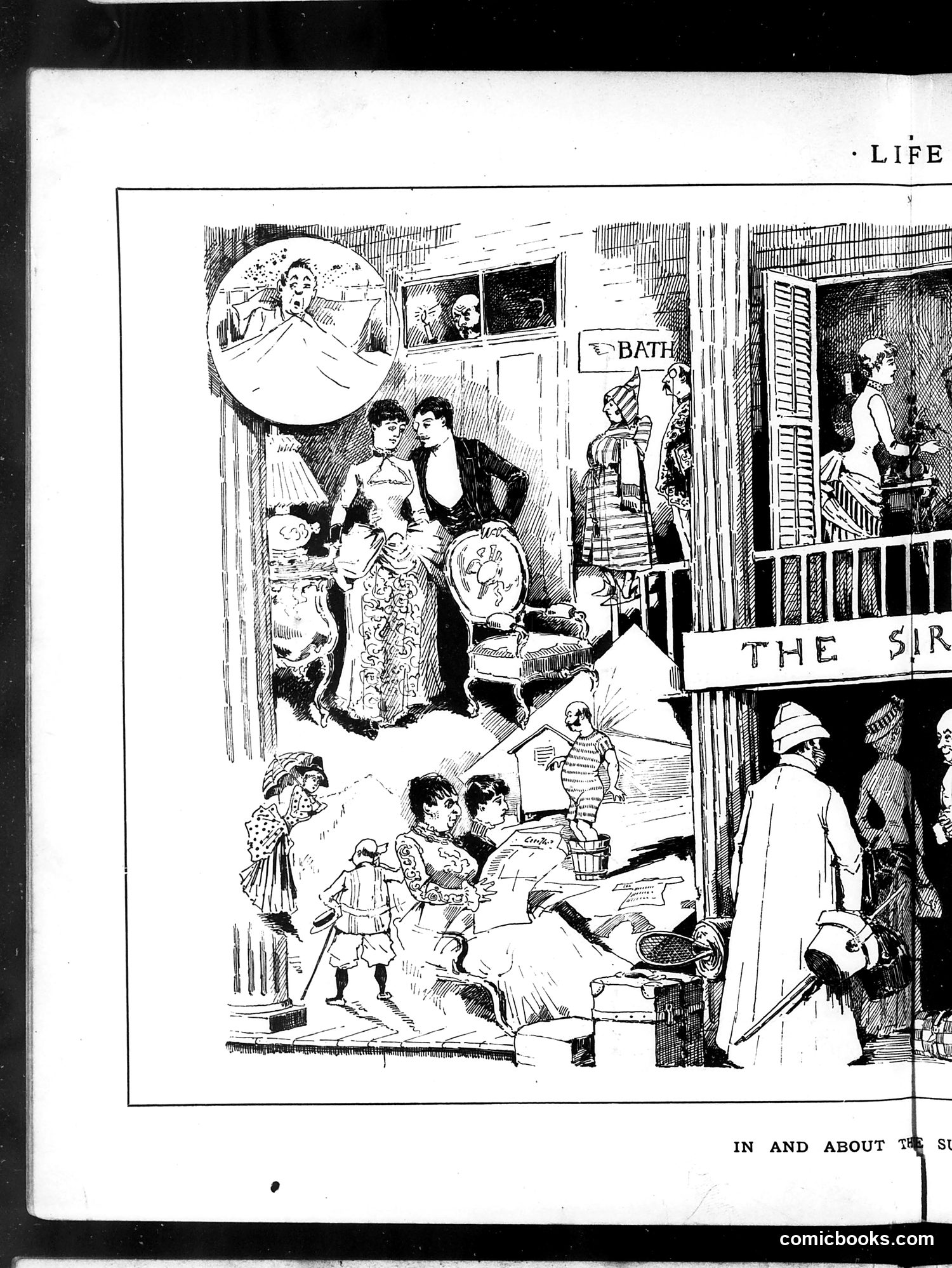
This appears to be a satirical illustration from *Life* magazine depicting social chaos around a bathing establishment (marked "BATH"). The cartoon shows multiple scenes of domestic disorder: a woman in a mirror at top left appears distressed; a couple embraces amid confusion in an upper room; children play unsupervised in the street below; and working-class men in hats navigate the crowded scene with apparent bewilderment. The satire likely critiques early 20th-century urban life and changing social norms—perhaps mocking the disruption of traditional domestic order as public bathing facilities became more common, or poking fun at the chaos of tenement living. The juxtaposition of private (the couple) and public (street activity) spheres suggests commentary on eroding social boundaries and propriety in modern city life.
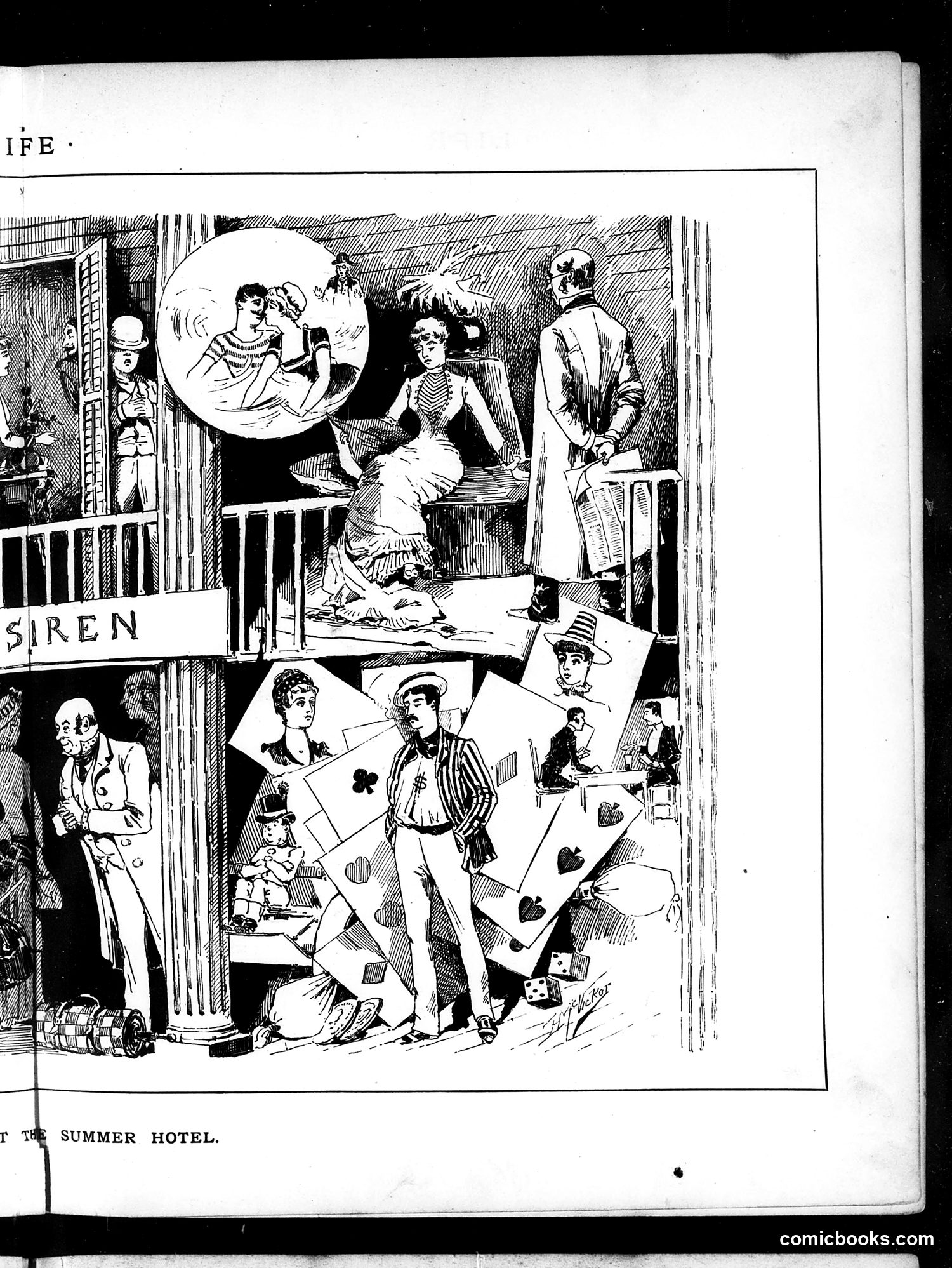
This satirical cartoon depicts social life at a summer resort hotel. The upper panel shows flirtation and romance on a balcony, with a woman admiring herself in a mirror while men gather around. The lower panel parodies this with playing cards featuring portrait heads—a visual joke suggesting the romantic "games" at such hotels are as artificial as card games. The cartoon satirizes the superficiality and theatrical nature of summer hotel society: guests performing romance and courtship as casual entertainment. The mix of gentlemen, women in fashionable dress, and the emphasis on appearance and distraction (card games, mirrors) mocks the leisure class's preoccupation with flirtation and social posturing rather than genuine connection.
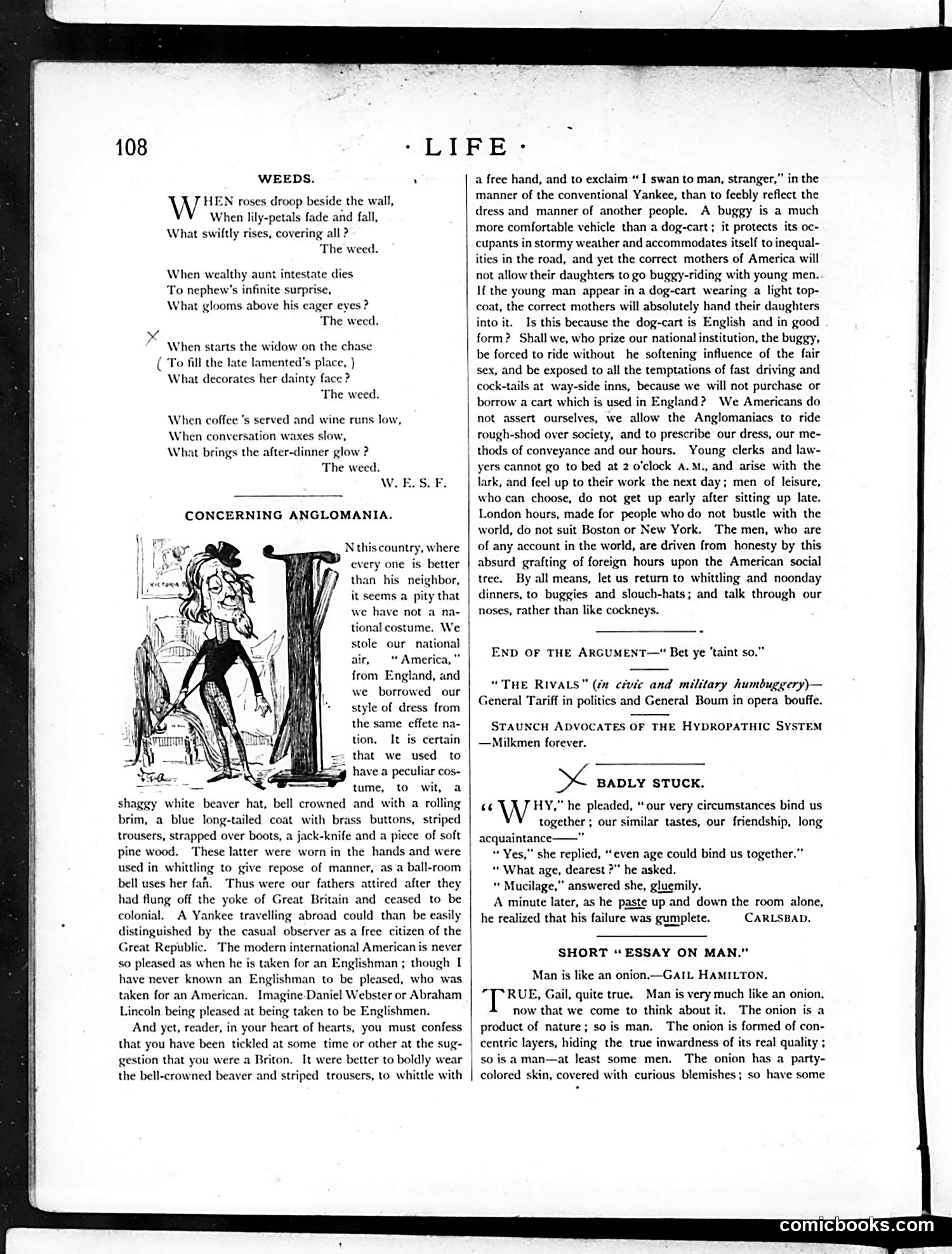
This article mocks American social pretension and excessive British imitation. The accompanying caricature depicts an exaggerated "Yankee" figure in the old-fashioned national costume—a bell-crowned beaver hat, blue coat with brass buttons, and striped trousers—the authentic American dress from the Revolutionary era. The satire's point: Americans have abandoned their distinctive identity to ape English fashion and customs, viewing British manners as superior. The author argues this is absurd—Americans should proudly maintain their original style (whittling, buggies, casual speech) rather than adopting English affectations. Specific examples of "Anglomania": mothers forbid daughters from riding in buggies but permit dog-carts (English), and fashionable society adopts London's late hours despite being impractical for working Americans. The satire suggests this social climbing damages American character and honesty, urging readers to reclaim authentic Yankee identity.
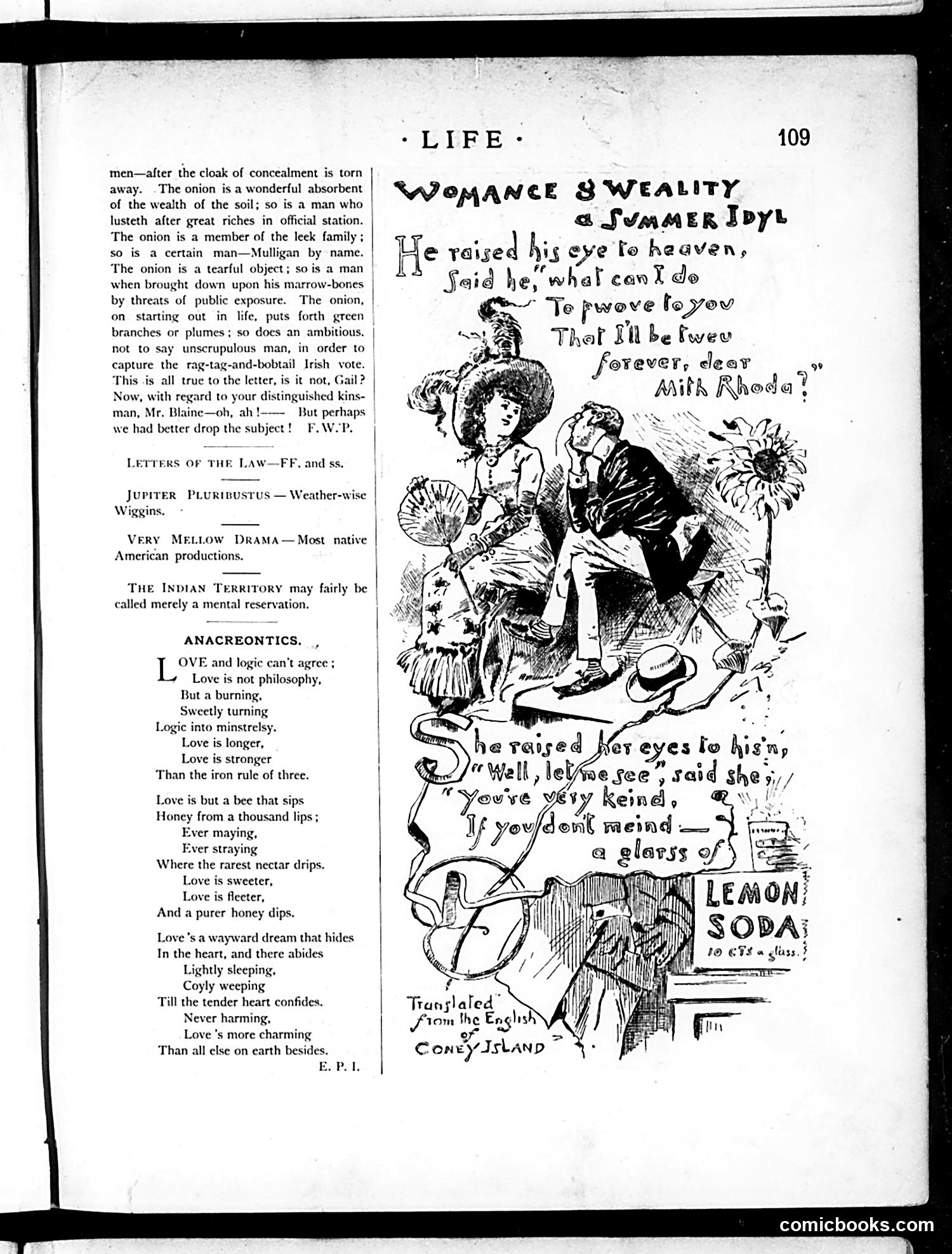
This illustrated comic depicts a flirtation between a wealthy man and a woman, likely titled to satirize sentimental romance fiction. The man asks what he can do to "prove" his love and remain "forever, dear." The woman, appearing coy, responds she'll let him see—but only if he doesn't mind "a glass of LEMON SODA." The joke appears to be modest and deflating: rather than romantic declarations or expensive gifts, the woman's affection is humorously contingent on something trivial and inexpensive. The advertisement for lemon soda embedded in the cartoon suggests this is **advertising satire**—mocking both overwrought sentimental stories and commercialism. The subtitle notes it's "translated from the English of Coney Island," likely mocking cheaply-produced popular entertainment of the era.
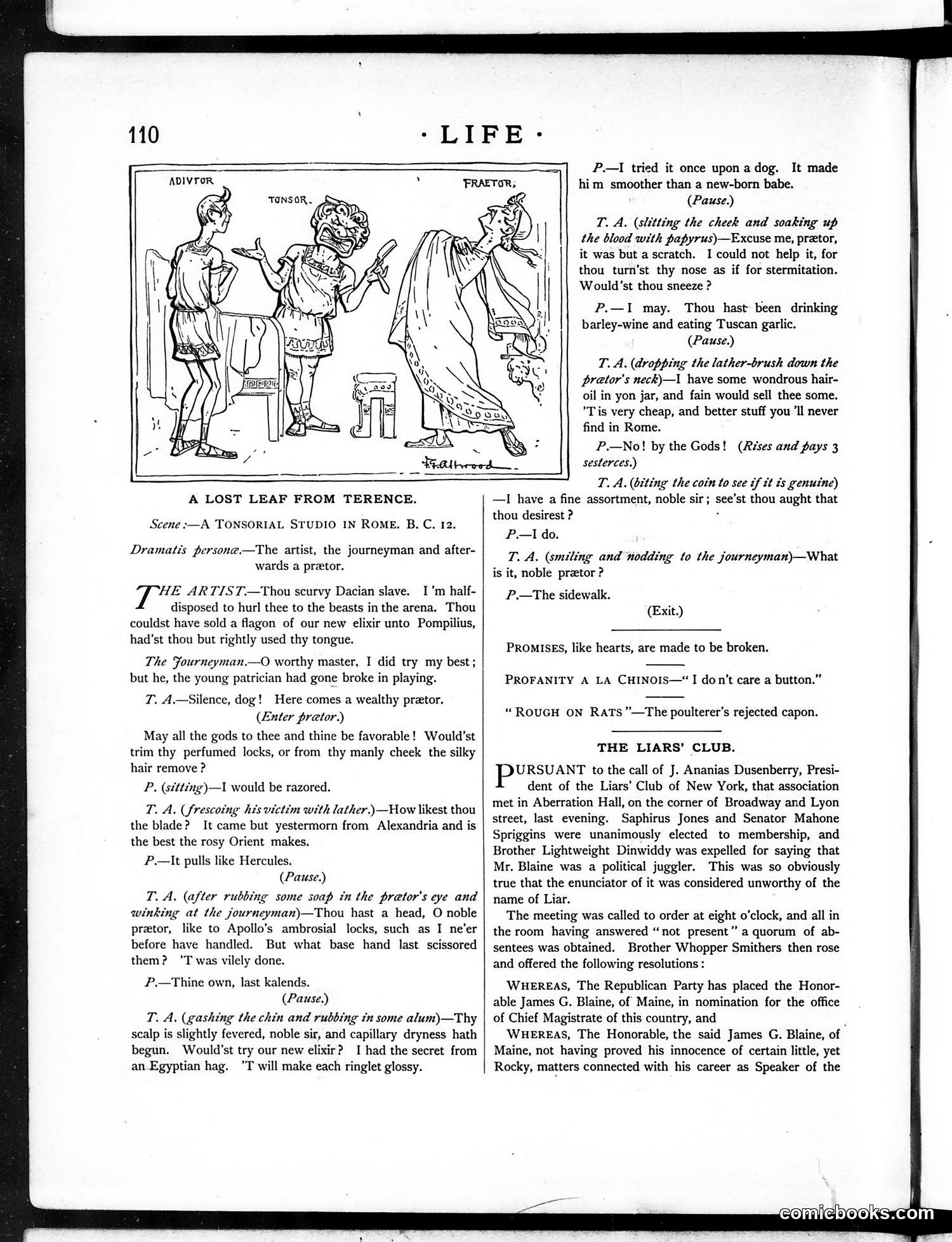
This is a mock-classical satire set in ancient Rome that satirizes contemporary con-artists and barber-shop salesmanship. A shady barber (the "Artist") and his journeyman attempt to fleece a wealthy customer (a "praetor") through flattery, physical harm disguised as service (pulling hair, cutting his chin), and aggressive upselling of bogus remedies. When the praetor finally escapes, he demands payment in the form of the sidewalk itself—suggesting the barber has already swindled him completely. The Latin setting allows Life magazine to critique modern urban hustlers while maintaining comedic distance. The barber's incompetence and violence mirror real period grooming establishments known for overcharging and poor service. Below appears unrelated political content mocking James G. Blaine's nomination and the "Liars' Club"—contemporary political satire.
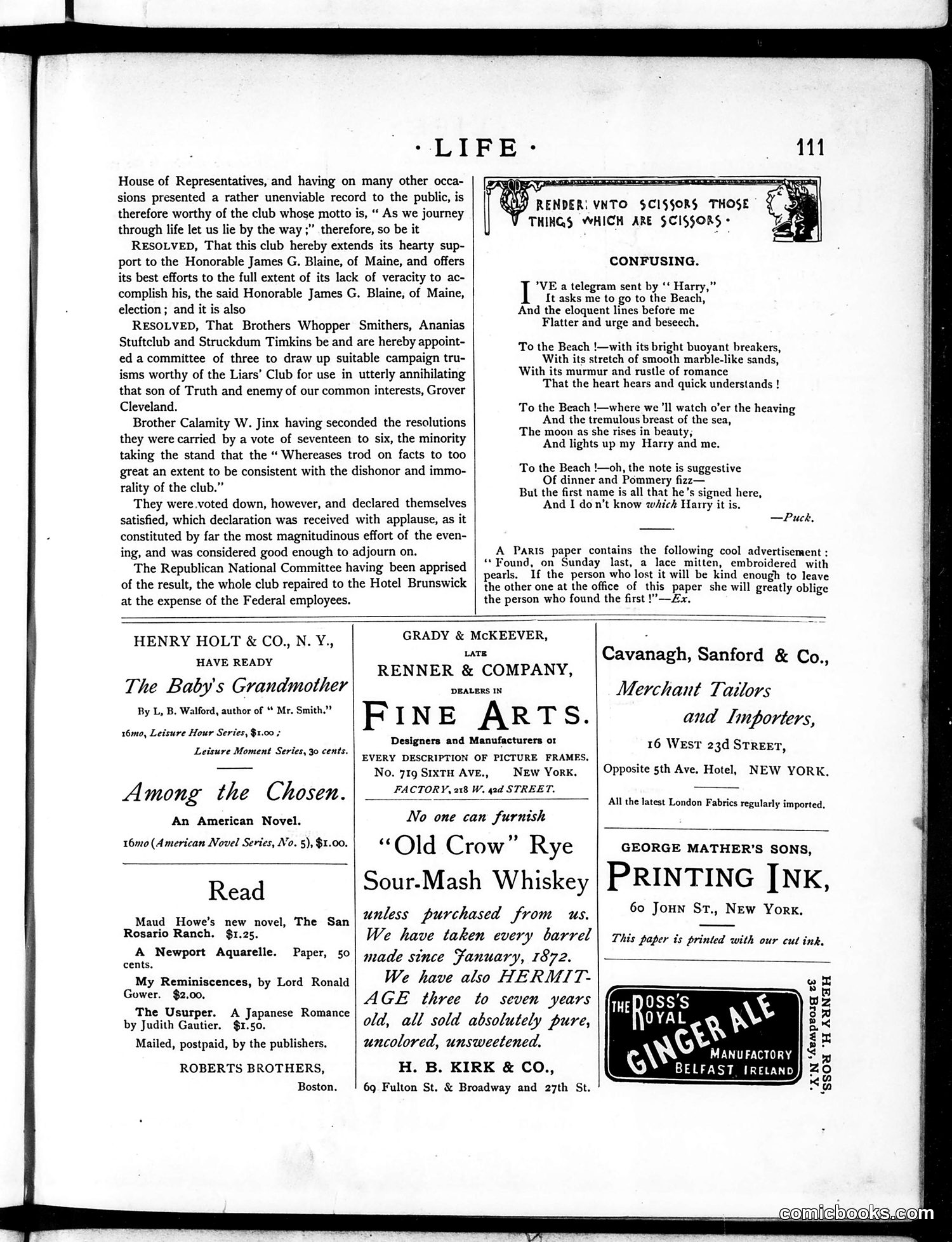
This page satirizes the 1884 U.S. presidential race between Republican James G. Blaine of Maine and Democrat Grover Cleveland. The main text mocks a fictional "Liars' Club" that endorses Blaine while appointing members with absurd names—"Whopper Smithers," "Ananias Stuftclub," "Struckdum Timkins"—to run his campaign using "suitable campaign truisms." The satire suggests Blaine's supporters rely on dishonesty rather than facts. The cartoon at top ("Render: Unto Scissors Those Things Which Are Scissors") appears to be visual wordplay, though its specific reference is unclear from the image alone. The other items are humorous classified ads, including a found lace mitten ad requiring the finder's matching pair—satirizing absurd or incomplete notices. The rest of the page comprises period book and product advertisements.
This page is primarily **advertising and book announcements** with embedded humor pieces rather than political cartoons. The notable content includes: **"Gaining Information"** — a brief satirical joke about a young woman who asks her mother if kissing unmarried men is wrong. When mother says "certainly," the girl reveals she's already told multiple boys (Dick, Jack, Tom, Charlie, Arthur, Will, Bob, Al, and Sam) that their mother forbids it. The humor mocks both the girl's manipulation and Victorian courtship propriety. **"Close Observation"** — a child refuses bedtime, noting the old hen went to bed WITH her chicks—implying children shouldn't sleep alone, subverting parental logic. The remainder consists of **advertisements** for *The King's Men* (a speculative fiction novel about King George the Fifth's reign), *The Critic* literary magazine, perfumes, soaps, and hotels. This reflects 1880s magazine structure where advertising subsidized content. No prominent political cartoons appear on this page.
This page combines satirical content with period advertisements typical of late 19th-century publications. ## The Cartoons/Humor: The "Do You Sleep?" section features two brief jokes. The first mocks a vain young man with large ears who asks a woman if he'd make an attractive angel; she replies his ears stick up too high for wings—simple physical mockery. The second satirizes wealthy but emotionally distant husbands: a busy man barely remembers his own infant son (born during a railway expansion), and when asked about the child, learns the baby was kidnapped weeks prior—yet the father's indifference to the news somehow spoils the family's evening. The satire targets masculine neglect and wealth's failure to bring happiness. ## Advertisements: The page is largely ads: "Verve," a vegetable-based sleep remedy (contrast to dangerous opium/morphine); Oakley's toiletries; and *Outing Illustrated*, a recreation magazine. These reflect Gilded Age concerns: insomnia from overwork, grooming products, and leisure activities for the expanding middle class.
This is primarily an **advertising page** from Life magazine, not a satirical cartoon. It showcases late-19th century consumer products typical of the era. The advertisements reveal period concerns: Cuticura's emphatic claims to cure "every form of skin & blood disease" and "scrofula" reflect anxieties about contagious illness and dermatological conditions. The repeated warnings against "imitations" (particularly for Vichy water and the Paris Corset) suggest widespread product counterfeiting was a recognized consumer problem. Notable products include: champagne, corsets, safes, bicycles, cigarettes, pianos, medical waters, billiard tables, and tennis equipment. The emphasis on "highest awards" and "medals" indicates manufacturers competed heavily on international recognition to establish credibility. The page demonstrates how Life functioned not just as satire but as a commercial vehicle, mixing advertising with editorial content—a common 19th-century magazine practice.