
Life, 1884-08-21 · page 10 of 16
Life — August 21, 1884 — page 10: what you’re looking at
What you’re looking at
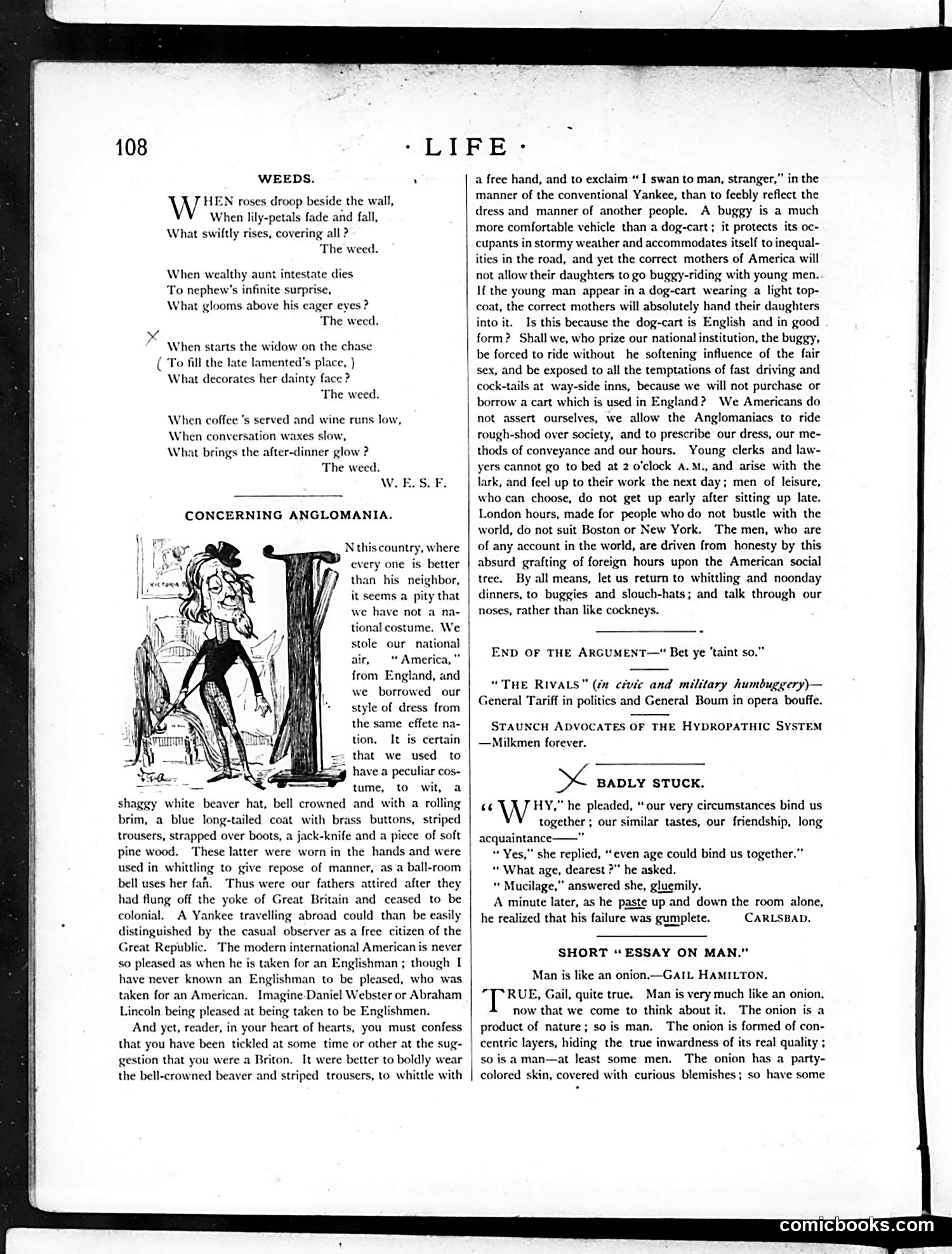
This article mocks American social pretension and excessive British imitation. The accompanying caricature depicts an exaggerated "Yankee" figure in the old-fashioned national costume—a bell-crowned beaver hat, blue coat with brass buttons, and striped trousers—the authentic American dress from the Revolutionary era. The satire's point: Americans have abandoned their distinctive identity to ape English fashion and customs, viewing British manners as superior. The author argues this is absurd—Americans should proudly maintain their original style (whittling, buggies, casual speech) rather than adopting English affectations. Specific examples of "Anglomania": mothers forbid daughters from riding in buggies but permit dog-carts (English), and fashionable society adopts London's late hours despite being impractical for working Americans. The satire suggests this social climbing damages American character and honesty, urging readers to reclaim authentic Yankee identity.
📄 Transcribed text from this page (OCR, searchable)
Machine-transcribed from the original scan — historical spelling and the odd misread are preserved.
> LIFE: WEEDS. HEN roses droop beside the wall, When lily-petals fade and fall, What swiftly rises, covering all ? The weed. When wealthy aunt intestate dies To nephew's infinite surprise, What glooms above his eager ey: The we When starts the widow on the chase ( To fill the late lamented’s place, } What decorates her dainty face ? The weed. When coffee 's served and wine runs low, When conversation waxes slow, What brings the after-dinner glow ? The weed. W.E. CONCERNING ANGLOMANIA. Nthiscountry, where every one is better than his neighbor, it seems a pity that we have not a na- tional costume. We | stole our national | air, “America,” from England, and we borrowed our style of dress from the same effete na- tion. It is certain that we used to have a peculiar cos- tume, to wit, a shaggy white beaver hat, bell crowned and with a rolling brim, a blue long-tailed coat with brass buttons, striped trousers, strapped over boots, a jack-knife and a piece of soft pine wood. These latter were worn in the hands and were used in whittling to give repose of manner, bell uses her fai. Thus were our fathers attired after they had flung off the yoke of Great Britain and ceased to be colonial. A Yankee travelling abroad could than be easily distinguished by the casual observer as a free citizen of the Great Republic. The modern international American is never so pleased as when he is taken for an Englishman ; though I have never known an Englishman to be pleased, who was taken for an American. Imagine Daniel Webster or Abraham Lincoln being pleased at being taken to be Englishmen. And yet, reader, in your heart of hearts, you must confess that you have been tickled at some time or other at the sug- gestion that you were a Briton. It were better to boldly wear the bell-crowned beaver and striped trousers, to whittle with asa ball-room | | so is a man—at least some men. a free hand, and to exclaim “I swan to man, stranger,” in the manner of the conventional Yankee, than to feebly reflect the dress and manner of another people. A buggy is a much more comfortable vehicle than a dog-cart ; it protects its oc- cupants in stormy weather and accommodates itself to inequal- ities in the road, and yet the correct mothers of America will not allow their daughters to go buggy-riding with young men. If the young man appear in a dog-cart wearing a light top- coat, the correct mothers will absolutely hand their daughters into it. Is this because the dog-cart is English and in good form? Shall we, who prize our national institution, the buggy, be forced to ride without he softening influence of the fair sex, and be exposed to all the temptations of fast driving and cock-tails at way-side inns, because we will not purchase or borrow a cart which is used in England? We Americans do not assert ourselves, we allow the Anglomaniacs to ride rough-shod over society, and to prescribe our dress, our me- thods of conveyance and our hours. Young clerks and law- yers cannot go to bed at 2 o'clock A.M., and arise with the lark, and feel up to their work the next day; men of leisure, who can choose, do not get up early after sitting up late. London hours, made for people who do not bustle with the world, do not suit Boston or New York. The men, who are of any account in the world, are driven from honesty by this absurd grafting of foreign hours upon the American social tree. By all means, let us return to whittling and noonday dinners, to buggies and slouch-hats; and talk through our noses, rather than like cockneys. END OF THE ARGUMENT—“ Bet ye ‘taint so.” “THE RIVALS" (2 civic and military humbuggery)— General Tariff in politics and General Boum in opera bouffe. STAUNCH ADVOCATES OF THE HYDROPATHIC SYSTEM —Milkmen forever. A BADLY STUCK. “cc W HY,” he pleaded, “ our very circumstances bind us together ; our similar tastes, our friendship, long acquaintance——" “Yes,” she replied, “even age could bind us together.” “ What age, dearest ?” he asked. “ Mucilage,” answered she, gluemily. A minute later, as he paste up and down the room alone, he realized that his failure was gumplete. CARLSBAD. SHORT “ ESSAY ON MAN.” Man is like an onion —GAIL HAMILTON, RUE, Gail, quite true. Man is very much like an onion, now that we come to think about it. The onion is a product of nature; so is man. The onion is formed of con- centric layers, hiding the true inwardness of its real quality ; The onion has a party- colored skin, covered with curious blemishes; so have some comicbooks.com