
A complete issue · 16 pages · 1884
Life — August 14, 1884
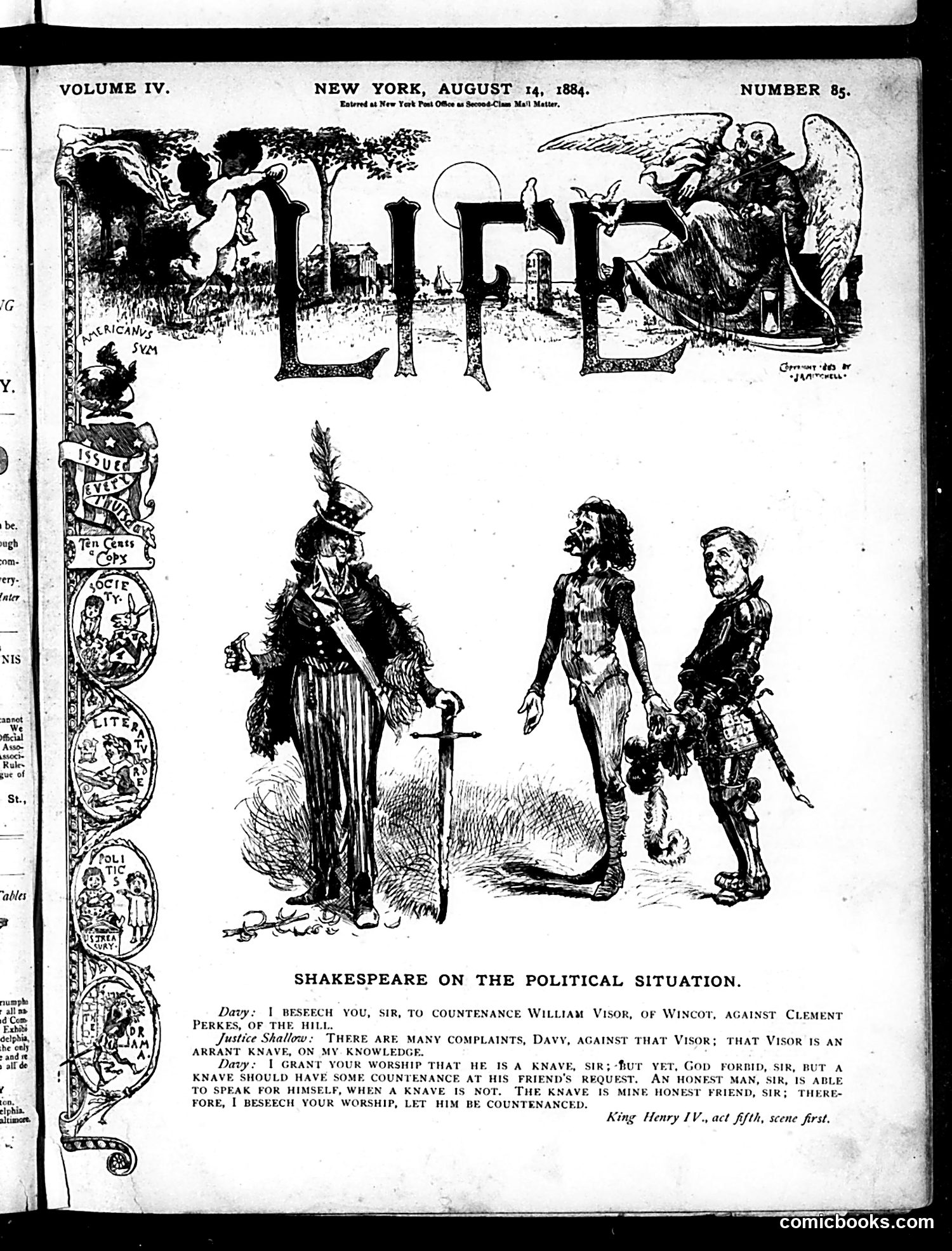
This is a political cartoon titled "Shakespeare on the Political Situation" from Life magazine, August 14, 1884. The cartoon uses a Shakespeare quote (King Henry IV, act 3, scene 1) as political commentary. The dialogue involves Davy (likely representing a political figure) discussing William Visor of Wincot and Clement Perkes—names from Shakespeare's play. The satire appears to critique political disputes of the 1884 election period, using the Shakespeare passage to comment on contemporary political figures and their conflicts. The three caricatured figures represent participants in these political disputes. By framing modern politics through Shakespeare, the cartoonist suggests that current political squabbles mirror timeless human follies—implying that 1884's political arguments are as petty and absurd as Shakespeare's minor characters' complaints.
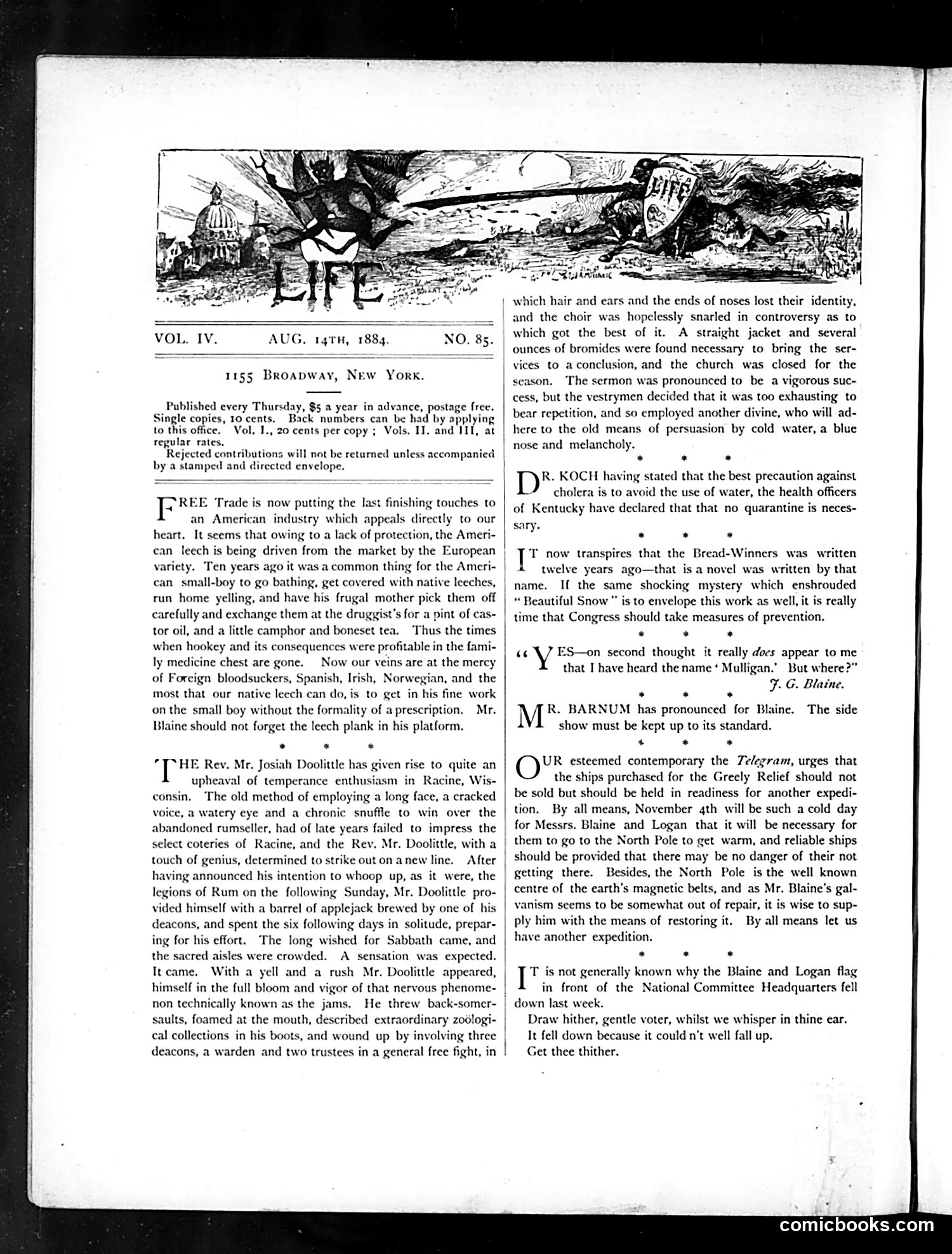
The page contains several short satirical items rather than a single cartoon. The masthead shows "LIFE" with an allegorical figure. The articles mock various 1884 topics: American industry lacking tariff protection; temperance enthusiasm in Racine, Wisconsin (where Reverend Josiah Doolittle apparently staged a dramatic anti-alcohol protest); and a novel called *The Bread-Winners* (written anonymously twelve years prior, now revealed, regarding labor unrest). One piece jabs at someone named Blaine and the "side show" he's maintaining. Another criticizes the *Telegram* newspaper for suggesting ships be held for Arctic expeditions rather than sold. The final item jokes about a flag falling at National Committee Headquarters, using a crude pun: "It fell down because it couldn't well fall up." The satire targets politics, morality crusaders, and contemporary newspaper absurdities.
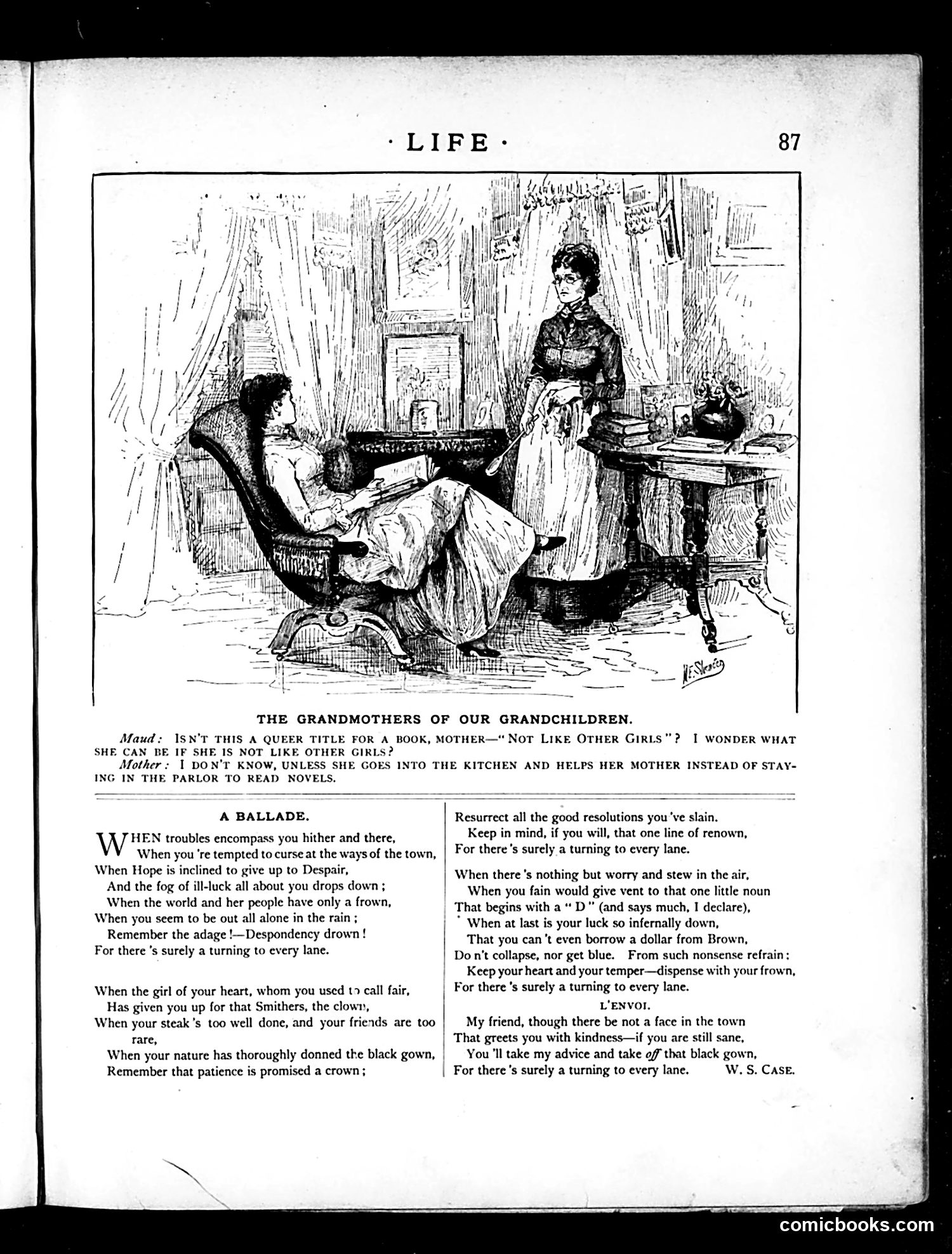
**The Cartoon:** "The Grandmothers of Our Grandchildren" depicts three women in a domestic interior. The dialogue satirizes evolving gender roles: a daughter reads novels in a parlor while her mother suggests she should instead help in the kitchen. The mother character represents traditional domestic expectations. **The Satire:** This appears to critique emerging debates about women's education and leisure activities in the late 19th/early 20th century. The joke targets tension between older generations who valued household labor and younger women pursuing intellectual pursuits through reading. **"A Ballade":** The accompanying poem reinforces consolation themes—"there's surely a turning to every lane"—offering optimistic verse about perseverance through difficulties, unrelated to the cartoon's gender commentary. The page reflects period anxieties about changing women's roles and social expectations.
This page contains two distinct sections: **Left column ("Concerning Our Sentiments"):** Editorial commentary on the 1884 presidential campaign. Life declares support for the Republican Party while opposing the Democratic nomination of James G. Blaine for President. The piece criticizes those who claim Life is "Democratic" simply because it disagrees with a Republican choice. The editors argue they support honest governance over partisan loyalty, referencing Governor Cleveland favorably while opposing Hendricks and Kelly's "Democracy." **Right column ("Pulled Back"):** A serialized story excerpt by Hugo Goneaway, Chapter III, featuring characters in Geneva and Siberia. This appears to be fictional narrative content rather than political satire. The page reflects Life's role as a satirical publication engaged in campaign-season political commentary rather than presenting visual cartoons.
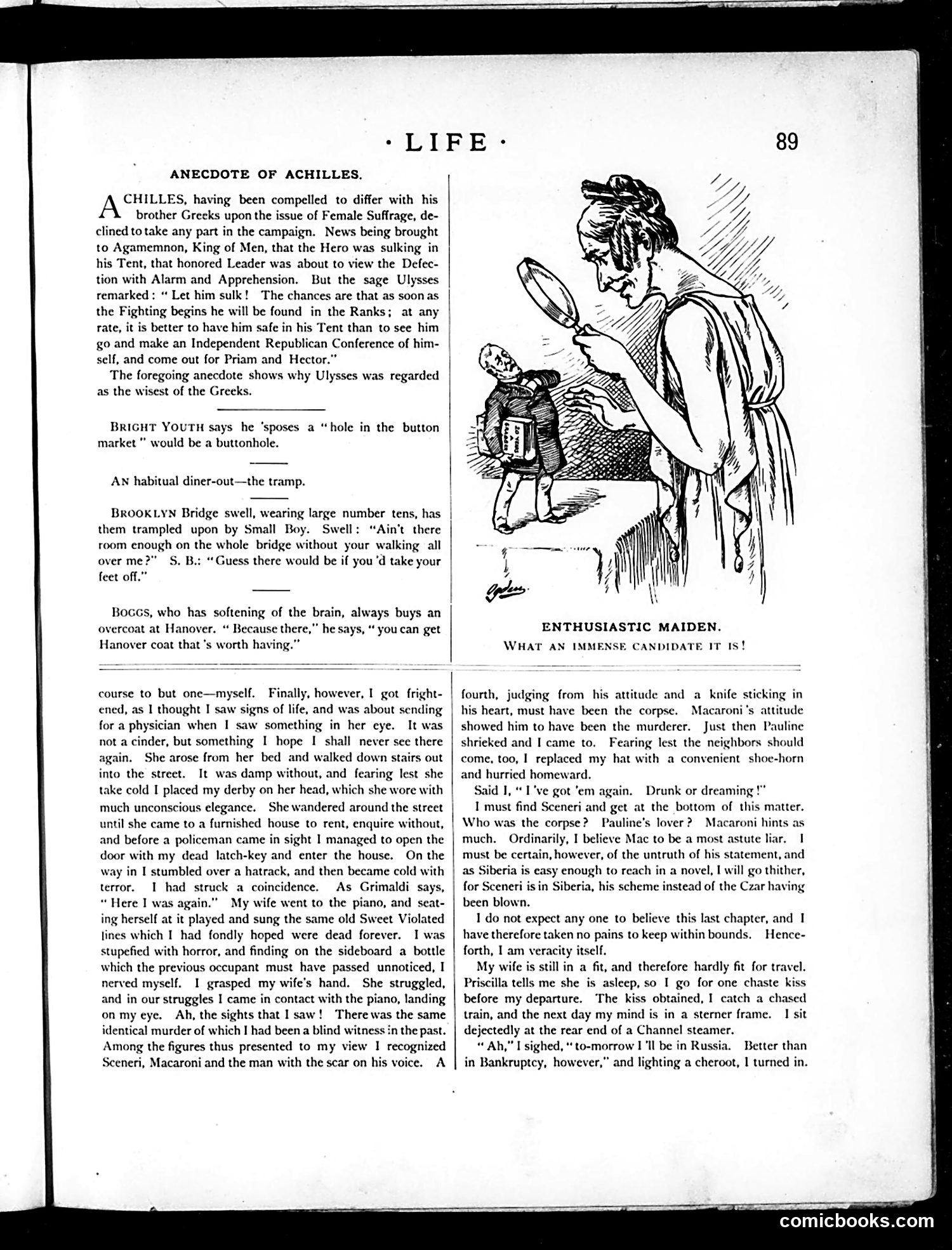
The main cartoon, titled "ENTHUSIASTIC MAIDEN: What an Immense Candidate it is!", shows a woman presenting a tiny man to another figure, apparently satirizing a political candidate's inflated reputation versus actual stature. The page also contains brief humorous anecdotes and quips: - "ANECDOTE OF ACHILLES" compares the Greek hero Achilles to Ulysses's wisdom - "BRIGHT YOUTH" offers a joke about market inefficiency - "BROOKLYN BRIDGE" contains a witty exchange about crowding - "BOGGS" jokes about buying an overcoat at Hanover for its label value The longer narrative passage discusses murders and personal drama, appearing unrelated to the political cartoon. The overall page mixes classical references with contemporary urban humor typical of Life's satirical approach.
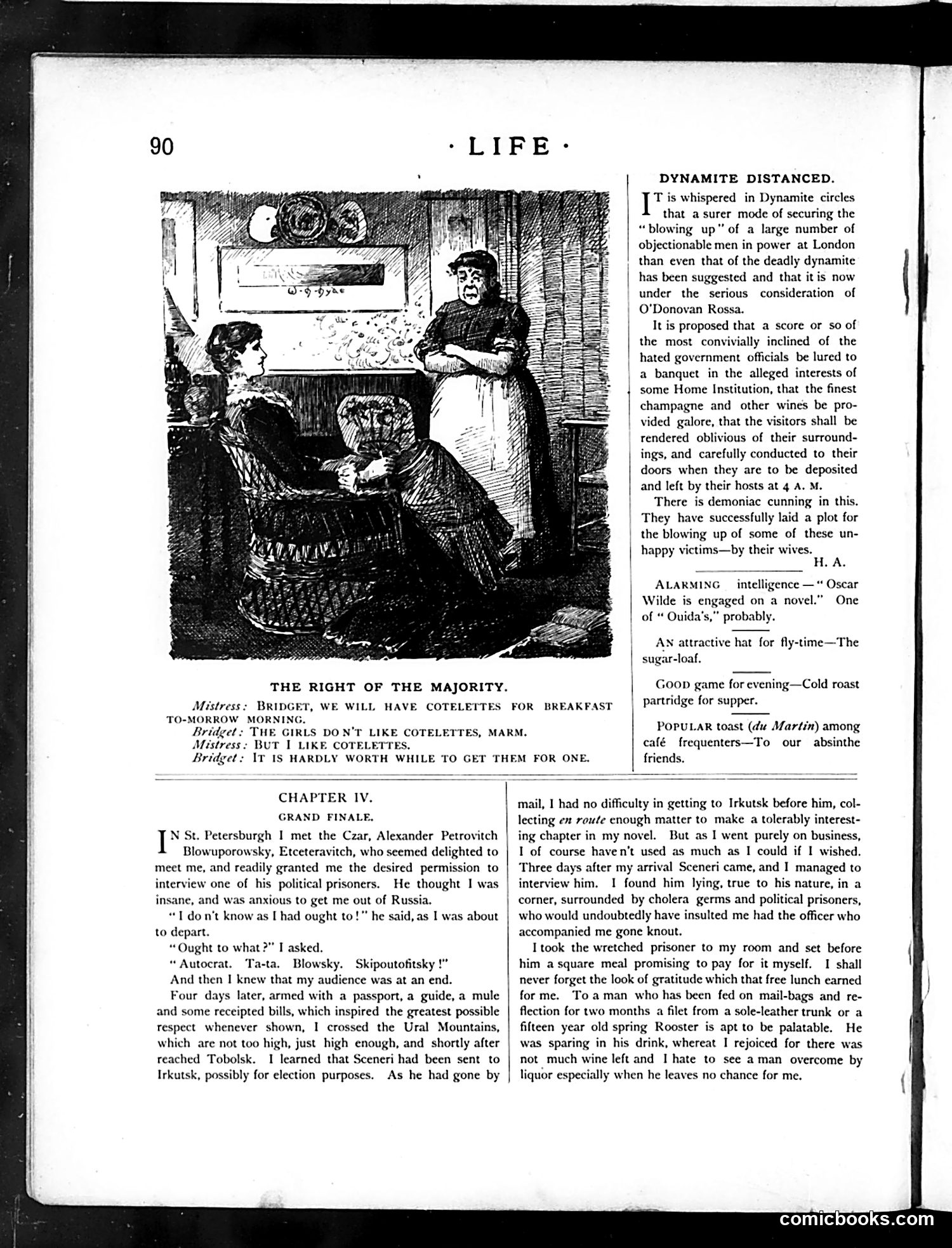
This cartoon satirizes a domestic dispute about breakfast plans, using it as political commentary. The mistress proposes cotelettes (cutlets) for tomorrow's breakfast; the servant Bridget objects, saying "the girls don't like cotelettes." The mistress insists on serving them anyway, declaring "it is hardly worth while to get them for one"—meaning she'll cook them regardless of household preference. The satire likely comments on **authoritarian governance and disregard for public opinion**. The title "The Right of the Majority" is ironic: though a majority (the servants/household) opposes the decision, the authority figure imposes her will anyway. This reflects late-19th-century debates about democratic representation versus elite rule. The domestic setting makes the political critique indirect but pointed.
This page contains the conclusion of a serialized story ("The End" by J.K. Bangs) followed by a section titled "Boomlets" — satirical commentary on contemporary political figures and issues. The "Boomlets" section mocks several targets: 1. **Miss Susan B. Anthony** — criticized for her advocacy, with a verse suggesting she's pursuing causes the author deems misguided 2. **Collector John A. Tibbetts** — ridiculed for his speech against Blaine and Logan nominees, with sarcastic questioning of his relevance 3. **The New York Sun** — attacked for aggressively promoting political candidates 4. **Ben Butler** — characterized as a weak candidate being pushed into prominence 5. **Reid-Law White's "Trylaine"** — accused of reprinting "Mulligan letters" while falsely attributing them to Cleveland to damage his reputation The satire targets both political machinations and journalistic dishonesty of the era.
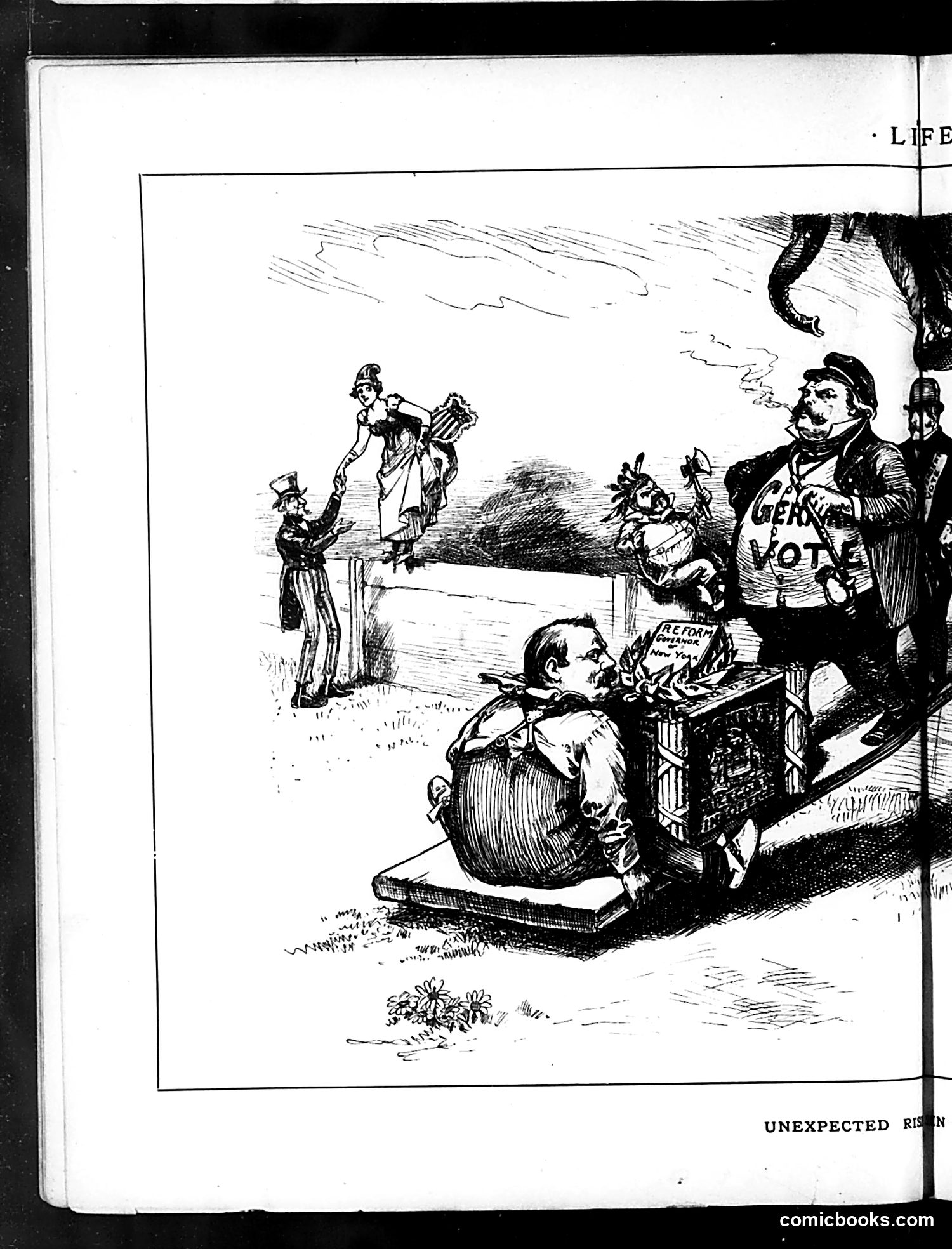
This satirical cartoon appears to depict an "unexpected rise" (per the caption). The image shows a rotund figure seated prominently in the foreground, wearing what appears to be political regalia. Standing figures surround him, including one labeled "GREAT NOT" and references to New York politics visible on papers/documents he holds. The cartoon likely satirizes the sudden political ascendancy of a specific politician—possibly a mayor, governor, or other New York official—mocking their unexpected elevation to prominence. The exaggerated physical proportions (especially the rotund seated figure) and caricatured expressions suggest ridicule of the subject's character or qualifications. Without clearer text identification or dating, the specific political figure and event remain unclear, though the style suggests late 19th or early 20th-century American political satire.
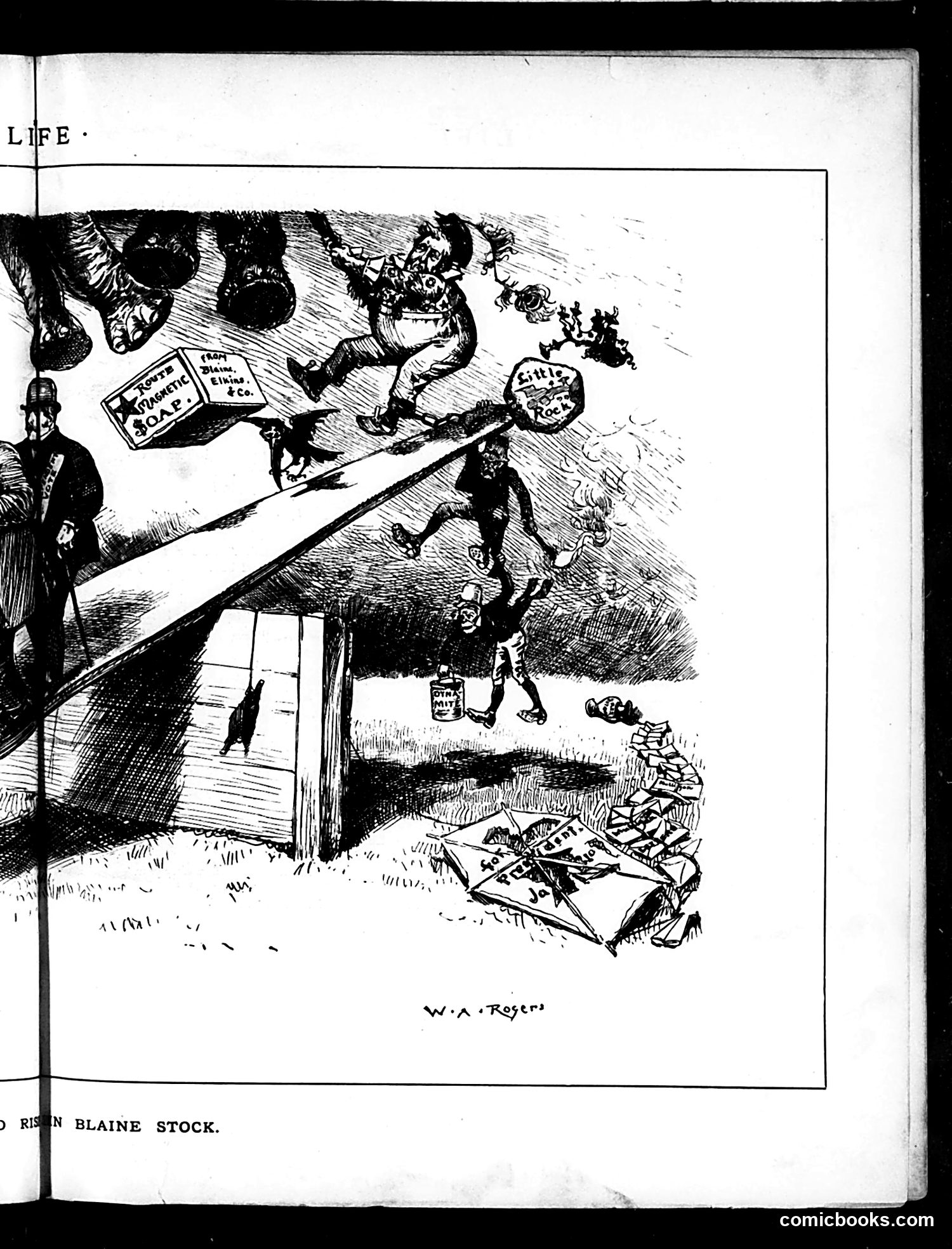
This is a satirical cartoon by W.A. Rogers titled "RISEN BLAINE STOCK," appearing in *Life* magazine. The cartoon depicts a man on the left (likely a politician or financier) wielding what appears to be a large lever or pole, manipulating demonic or chaotic figures above labeled with what seems to be stock-related references. Papers scatter on the ground below. The satire appears to critique stock market manipulation or financial scheming involving someone named Blaine—likely James G. Blaine, a prominent 19th-century politician. The demons represent market volatility or fraudulent activity being orchestrated from above, suggesting corruption in financial markets or political interference in economic affairs. The overall message condemns behind-the-scenes manipulation of stocks for personal gain.
This satirical dialogue mocks immigrant Jewish merchants and their social pretensions through ethnic stereotyping. The story concerns Levi Sulzbacher's engagement to Rebecca Rosenheimer. When Levi visits her father Herman Rosenheimer to discuss the engagement, he finds the father "airing his shirt-front"—sitting outside half-dressed in shabby clothes. The humor (as Life intended it) derives from the contrast: Levi arrives impeccably groomed ("attired faultlessly, with a clean shave"), while Rebecca's father appears slovenly. The dialogue, rendered in exaggerated Yiddish-inflected English, centers on a running joke about priorities: Rosenheimer dismisses Levi's fine appearance, sarcastically suggesting that expensive cigars matter more to him than proper clothing—implying Levi wastes money on luxuries rather than respectability. The piece reflects period attitudes toward newly arrived or working-class Jewish immigrants as uncouth and materialistic, using comedic caricature that would be considered offensive today.
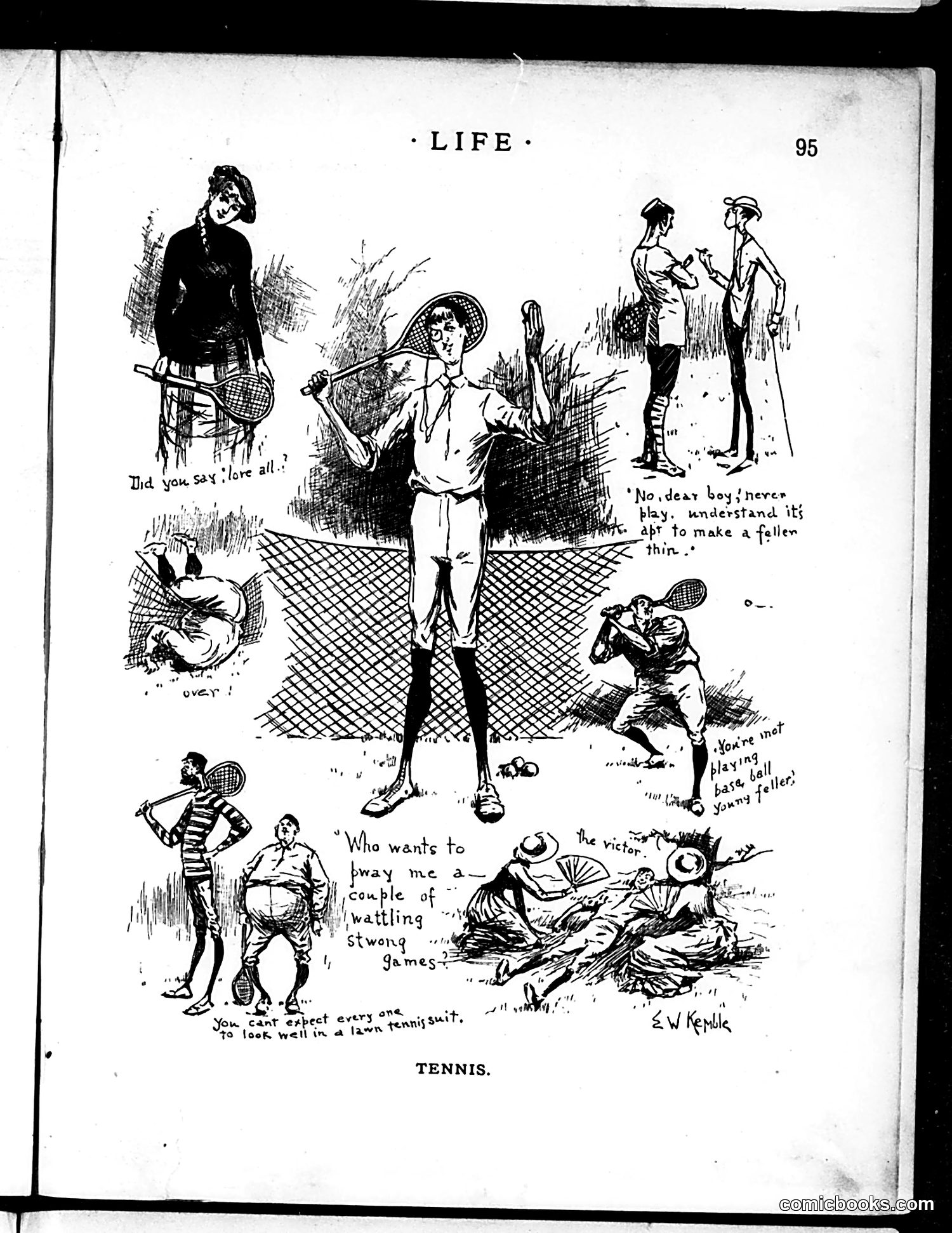
This satirical cartoon page mocks tennis culture and player appearance. The central figure is an awkwardly thin male tennis player surrounded by commentary about the sport. The repeated jokes focus on how poorly some people look in tennis attire—specifically that "you can't expect every one to look well in a lawn tennis suit." The various vignettes show different tennis scenarios with social commentary: women spectators, players of varying athleticism, and references to "wasting strong games" and players "not playing bare ball" well. The satire targets both the affectation of lawn tennis as a fashionable pastime and the physical inadequacy of amateur players who attempt it. The cartoonist appears to be critiquing tennis as an aspirational sport where participants often fail to meet expectations—both athletically and sartorially.
This Life magazine page contains three separate satirical pieces: **"Good Advice"** (top left): A domestic scene where Mother counsels Johnny not to fight, but his brother Tommy points out that counting to forty before striking works—a joke about the ineffectiveness of anger-management advice. **"Dowery Negotiation"** (center/bottom left): A lengthy dialogue in exaggerated Yiddish-inflected English between two Jewish immigrant men haggling over a dowry. The satire mocks both the mercenary nature of dowry negotiations and Jewish immigrant stereotypes of the era. One man eventually admits he'll lie about the amount, suggesting dishonesty in marriage dealings. **"Strategy"** (right): A domestic humor sketch where a burglar breaks into a bedroom but is so offended by being called "nasty" that he destroys the occupant's umbrella as punishment—absurdist humor about wounded pride overriding criminal intent. The page reflects late 19th/early 20th-century American satirical humor, heavy on ethnic stereotyping and domestic/courtship themes considered humorous at the time.
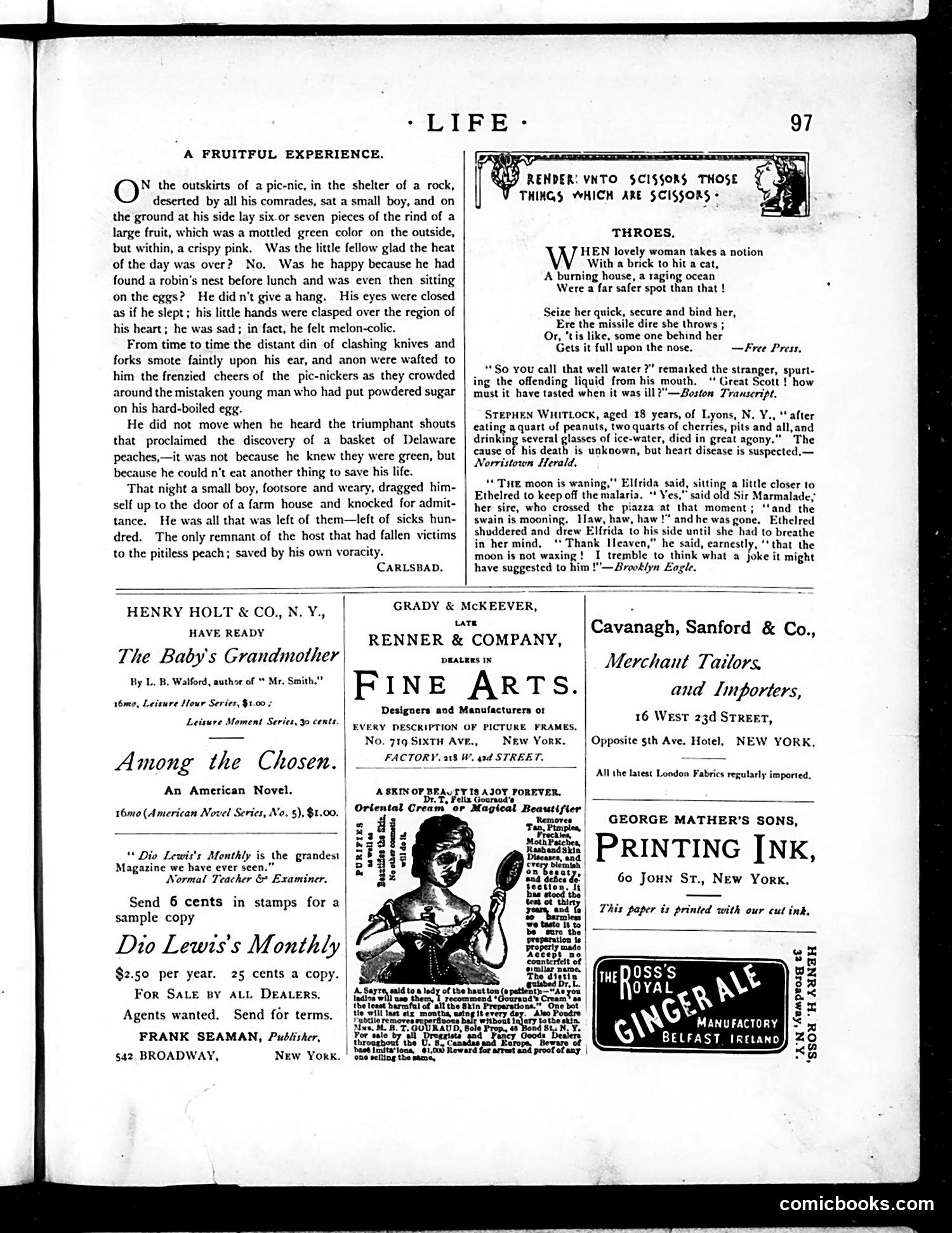
This page from the satirical magazine *Life* contains three humorous short pieces: **"A Fruitful Experience"** mocks a boy's gluttony at a picnic. The joke plays on "melon-colic" (melancholy + colic)—the boy has eaten so much fruit he's sick, while others around him celebrate discoveries like peaches and someone's mistake with powdered sugar on eggs. The punchline: he survives by pure overstuffed voracity while "sicks hundred" presumably die from the same excess. It's gentle humor about overindulgence. **"Throes"** is a short verse joke about women losing their temper—a "lovely woman" armed with a brick is more dangerous than a fire or ocean. The humor derives from period gender stereotypes about female hysteria and emotional volatility. **The brief anecdotes** (about well water, Stephen Whitlock, and the moon) are simple one-liners exploiting wordplay and puns rather than satirizing current events. The rest is advertising for books, art supplies, and patent medicines—typical of *Life*'s revenue model. No major political satire appears on this particular page.
This page is primarily **advertising**, not political satire. The main content is a full-page advertisement for "VERVE," a patent medicine claiming to cure insomnia without dangerous drugs like opium or morphine. The ad targets anxious professionals—merchants, lawyers, clergy, authors—blaming their sleeplessness on "Nervous Exhaustion" from overwork. It promises natural, vegetable-based relief in "six or eight doses." The cartoon at top-left simply illustrates a sleeping person, reinforcing the product's appeal. The page includes supplementary ads for other products (Vienna iced coffee, Parker House hotel) and several humorous anecdotes about lost items and a child's innocent misunderstanding at Sunday school—typical filler content for the era. **Context for modern readers**: This reflects the 1880s patent medicine boom, when unregulated tonics and remedies made extravagant health claims. VERVE's emphasis on avoiding "fatal" drugs was marketing strategy, though we now know such tonics were often ineffective or contained their own dangerous ingredients.
This is primarily an **advertising page** from Life magazine (circa 1884, based on the Bellevue Hospital letterhead date). The bulk of the content consists of commercial advertisements for disinfectants, soaps, and consumer goods—not political satire. The main feature is a lengthy endorsement from Prof. R. Ogden Doremus of Bellevue Hospital promoting "Bellevue Disinfectants" as cholera prevention products. This reflects genuine **late-19th-century public health concerns**: cholera epidemics were recurring threats, and germ theory was newly validated by scientists like Pasteur and Koch (mentioned here). The marketing emphasizes scientific credentials to build consumer confidence in these chemical disinfectants. The page also includes ads for Eeckelaers' Toilet Soaps, Murray's Charcoal Tablets, diamonds, and other period products. There is no visible political cartoon or satirical commentary on this particular page—it's a straightforward (if densely packed) commercial section typical of 1880s magazines.
This is **primarily an advertisement page**, not a satirical cartoon page. It contains various commercial ads from the 1880s for consumer goods and services. The only illustrated element with potential satirical content is the **"Cuticura" advertisement** featuring a cherub-like figure in a bowl labeled "Cuticura." This appears to be a straightforward (if whimsical) product advertisement for a skin remedy, not political satire. The text promises to cure various skin conditions—eczema, scrofulous diseases, and inherited skin afflictions. The page otherwise showcases period products: whiskey, safes, pianos, bicycles, corsets, cigarettes, champagne, billiard tables, and medical remedies. These ads reflect late 19th-century consumer culture and manufacturing claims typical of the era. **No clear political cartoon or satirical commentary is present** on this particular page. It functions as a revenue-generating advertisement section rather than editorial content.