
A complete issue · 16 pages · 1884
Life — August 7, 1884
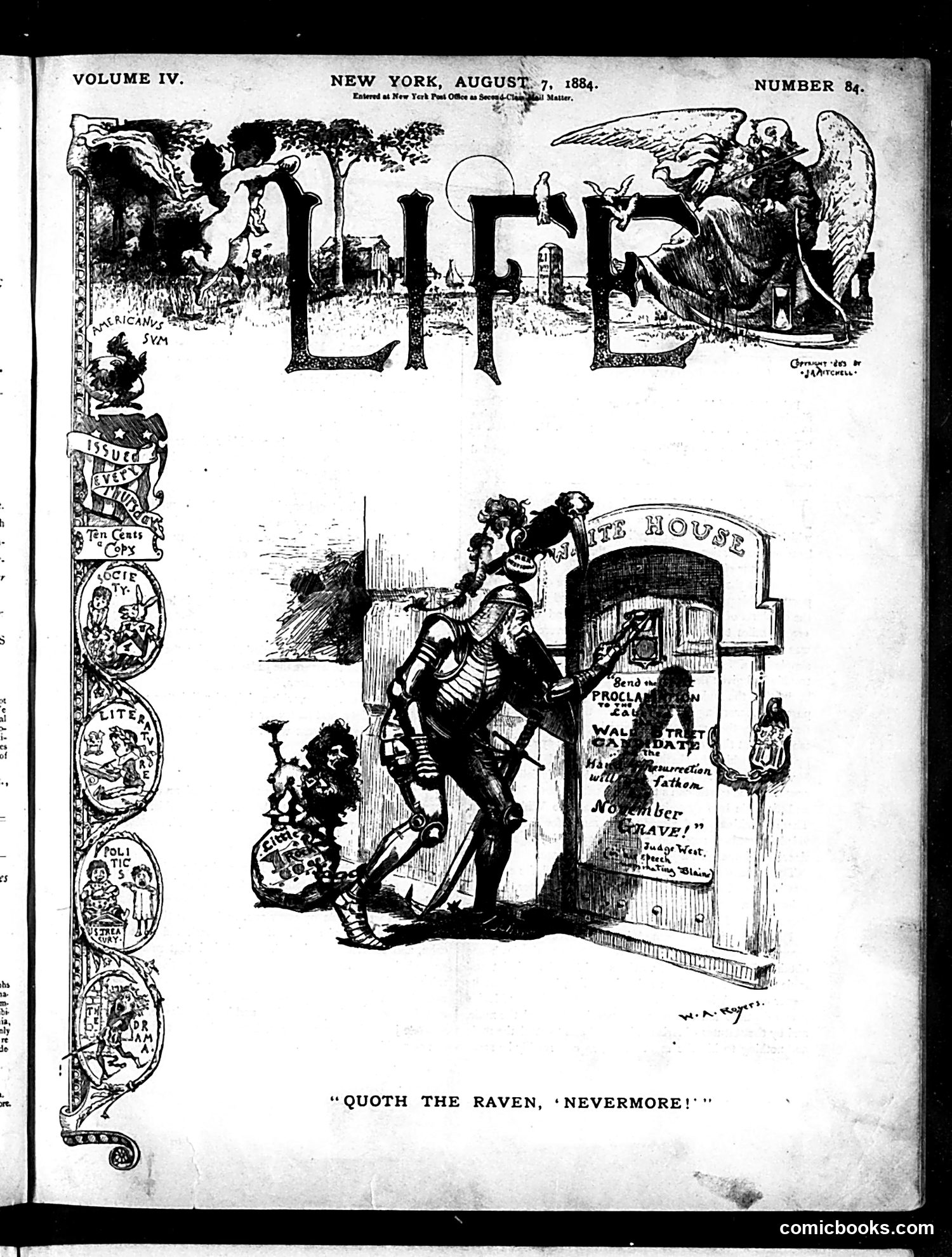
This page features a literary parody titled "Quoth the Raven, 'Nevermore!'" The central illustration shows a skeleton figure at a doorway labeled "White House," with various political references written on the door. The skeleton appears to be death or political defeat personified, knocking at the presidential residence. This is satirizing American politics during the 1884 election year. The "raven" reference alludes to Edgar Allan Poe's famous poem about inevitable doom. The skeleton at the White House door suggests that death or political ruin awaits someone—likely either the incumbent administration or a particular candidate. The ornamental border on the left contains small emblematic vignettes, typical of Life's design aesthetic of the era.
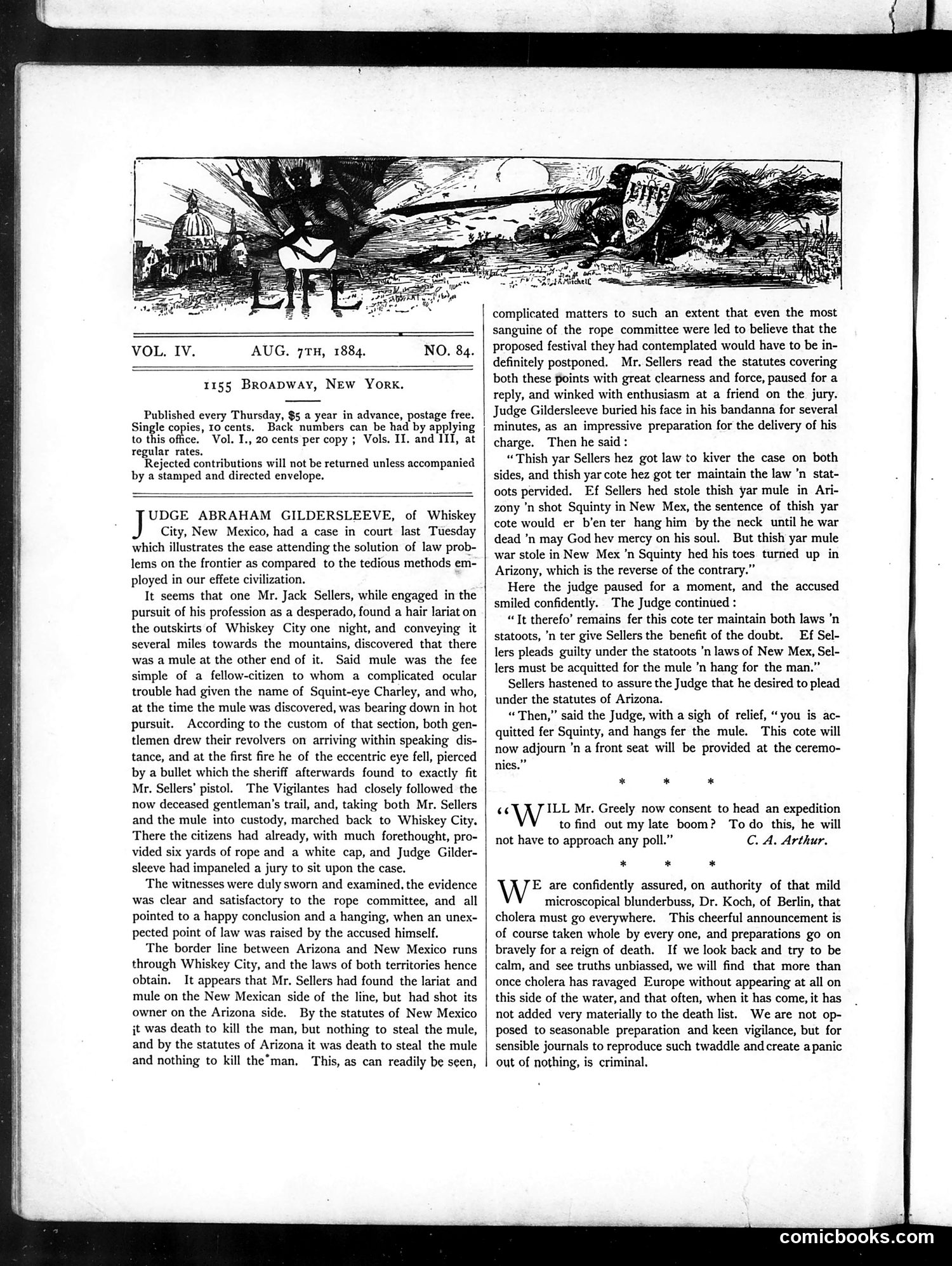
The page contains a satirical story about Judge Abraham Gildersleeve of Whiskey City, New Mexico, addressing a legal dispute over a mule. The narrative satirizes frontier justice and conflicting territorial laws—specifically the tension between New Mexico and Arizona statutes regarding property and capital punishment. The humor lies in the absurdist legal problem: the mule was found dead, so neither jurisdiction can execute appropriate punishment (New Mexico law requires killing the man; Arizona requires killing the mule). The judge's solution—hanging the mule symbolically anyway—mocks both the rigidity of frontier law and the desperation of underdeveloped legal systems trying to maintain order. The additional commentary about cholera appears unrelated editorial content.
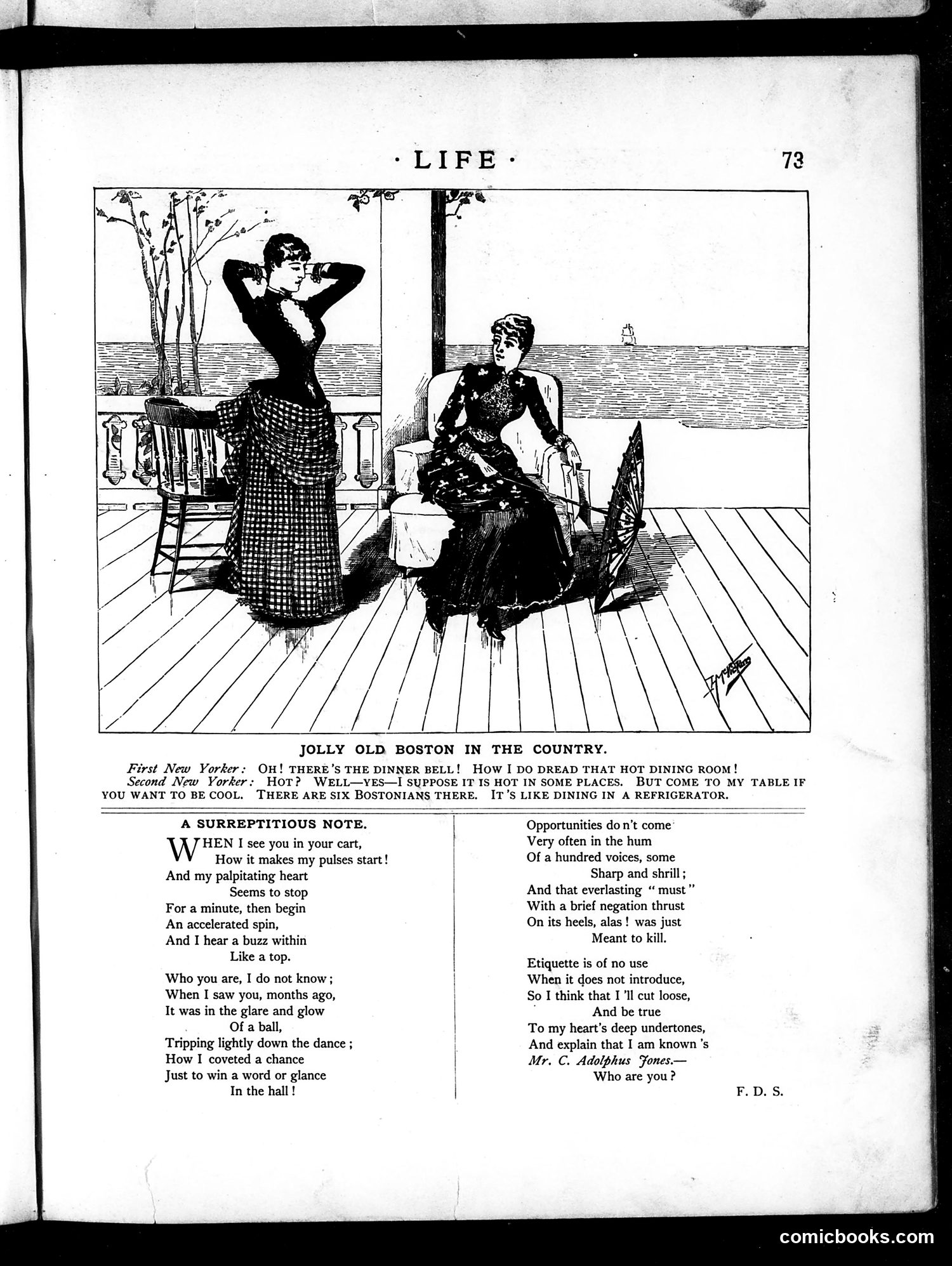
This cartoon satirizes the social pretensions of wealthy Bostonians visiting the countryside. Two fashionably dressed women are depicted on a seaside porch; one stands adjusting her hair while the other sits. The dialogue mocks their complaints about heat and discomfort despite being in a supposedly cooler location. The joke targets Boston's reputation for cultural snobbery. The women expect country life to provide relief from city heat, but one suggests Boston's "six Bostonians" would make any place feel hot—a dig at Bostonians' self-importance and presumed arrogance. The accompanying poem "A Superstitious Note" is unrelated satirical verse about romantic attraction, signed F.D.S. The satire reflects turn-of-century American attitudes toward East Coast elite pretension.
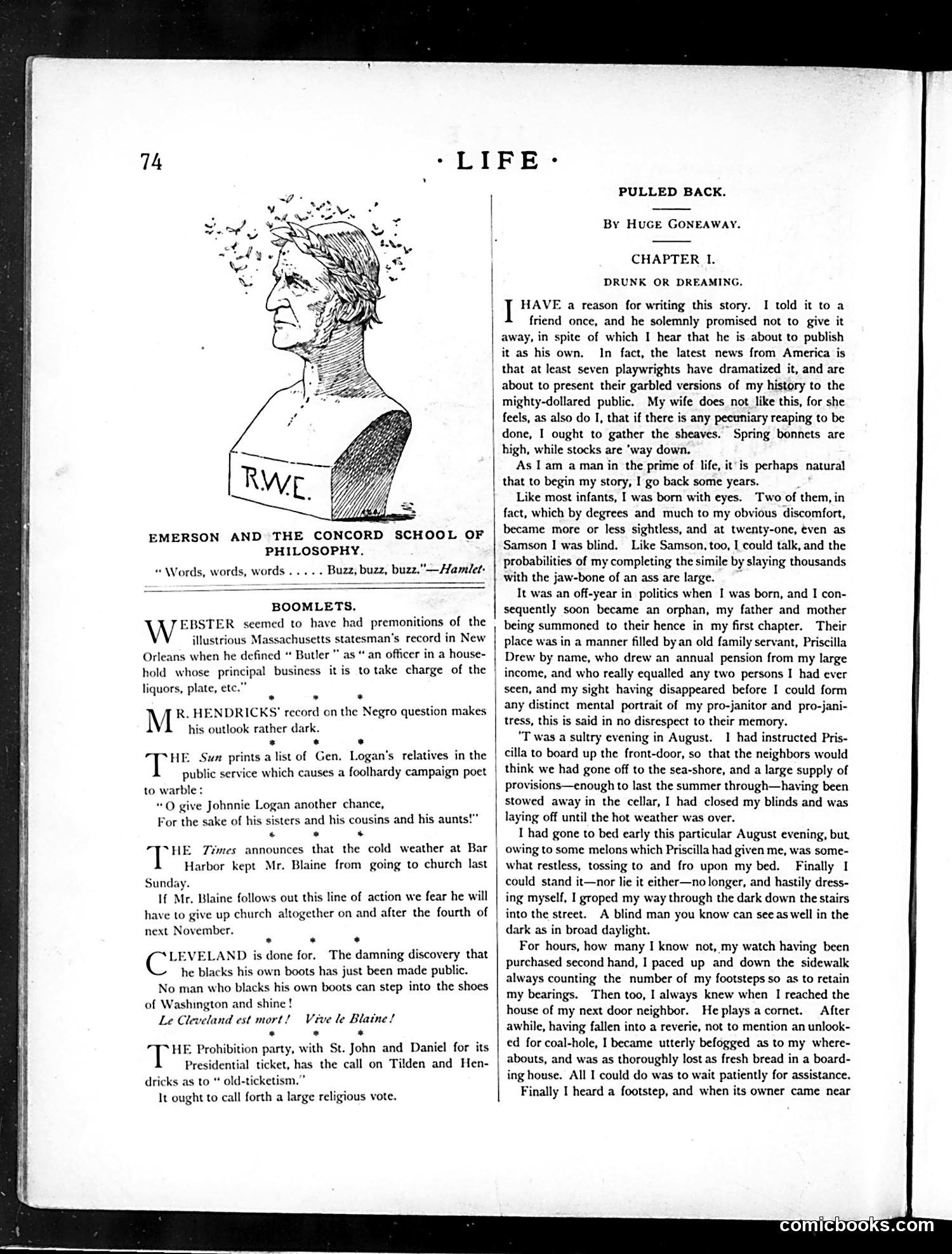
The main cartoon depicts a bust labeled "RWE" (Ralph Waldo Emerson) with the caption "EMERSON AND THE CONCORD SCHOOL OF PHILOSOPHY," quoting Hamlet: "Words, words, words... Buzz, buzz, buzz." This satirizes the Concord School of Philosophy, Emerson's intellectual circle. The "buzz, buzz, buzz" mocking suggests the satire ridicules the school's abstract theorizing as empty verbosity—all talk with little practical substance. The repetition emphasizes this critique of philosophical discourse disconnected from real-world application. The "Boomlets" section below contains brief political jabs at various public figures and contemporary events, typical of Life's satirical commentary style. The page also begins serialization of "Pulled Back" by Hugh Goneaway, a memoir-style piece unrelated to the political satire above.
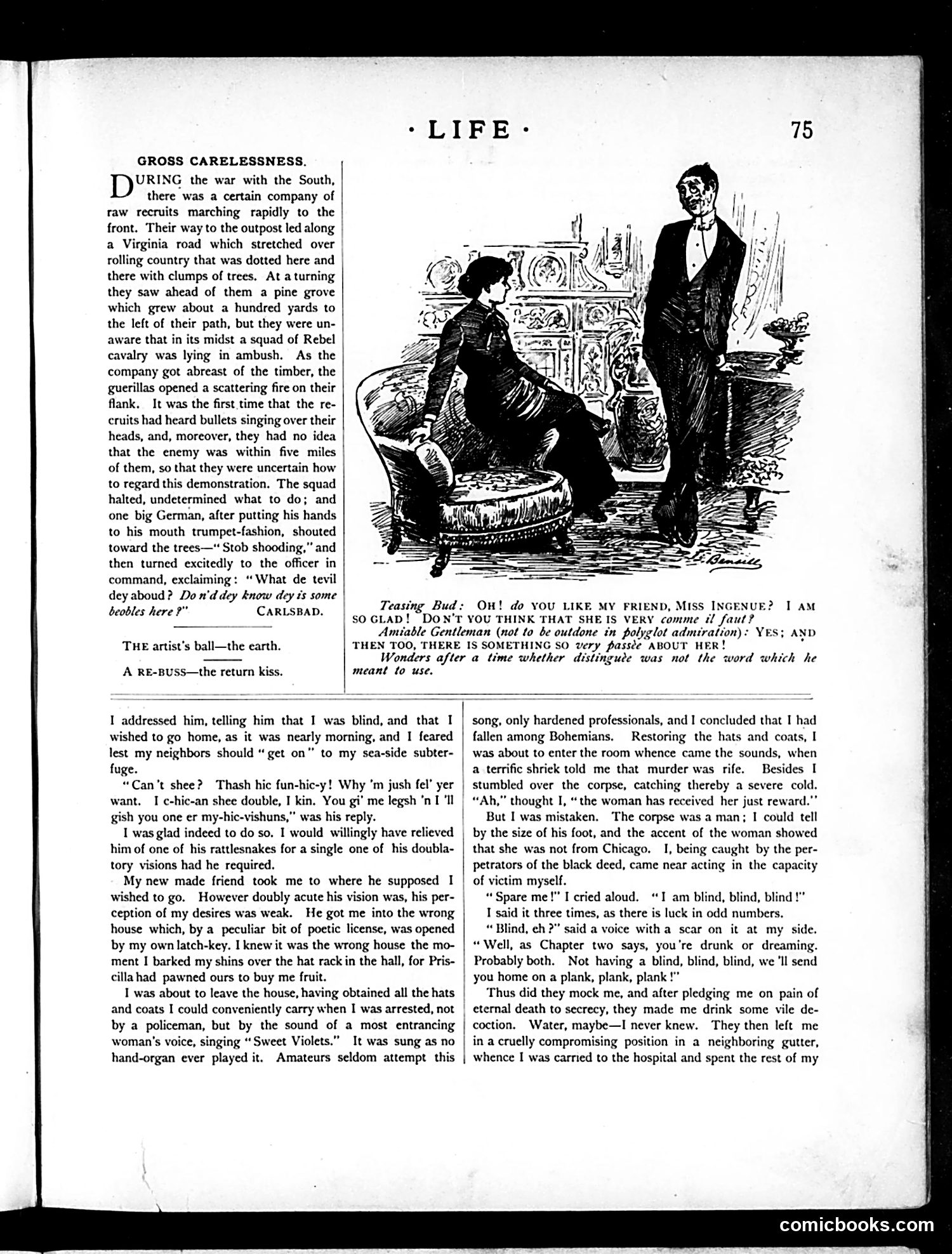
The cartoon depicts a social scene where a gentleman is introducing a woman ("Miss Ingenue") to another man, praising her as "very comme il faut" (proper/fashionable) and noting "something so very passive about her." The joke appears to satirize upper-class dating rituals and male attitudes toward women during this era. The suitor's emphasis on her passivity suggests mockery of the ideal of submissive femininity that wealthy men supposedly sought in potential wives. The ornate interior setting emphasizes the artificiality of these social conventions. The accompanying story "Gross Carelessness" describes Civil War soldiers' carelessness during combat—unaware enemy cavalry operated nearby. It's likely satirizing military incompetence rather than making a direct political statement.
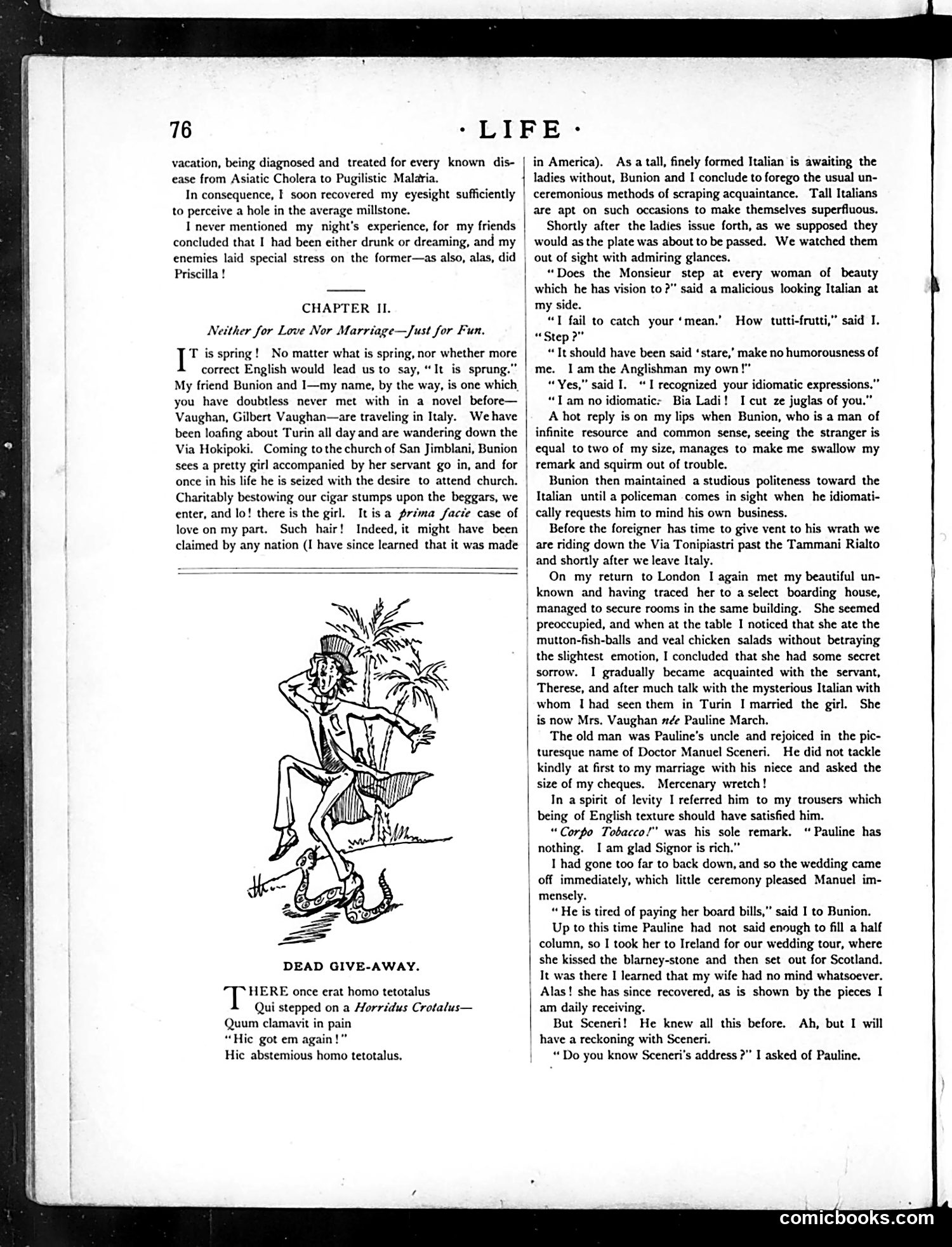
This cartoon illustrates a Latin phrase about a man stepping on a *Horridus Crotatus* (a "horrible rattle"—likely a rattlesnake). The four-line Latin verse jokes that the man "got 'em again" and his "abstemious homo totatus" (austere/sober self) is in pain. The accompanying illustration shows a thin man in formal dress who has stepped on a coiled snake with a human head, creating a darkly comic visual pun. The cartoon appears to satirize someone's repeated misfortune or foolishness—stepping on danger despite knowing better. Without additional context about which specific person or event this references, the exact satirical target remains unclear, though it likely mocked a contemporary public figure's recurrent blunders or moral failings.
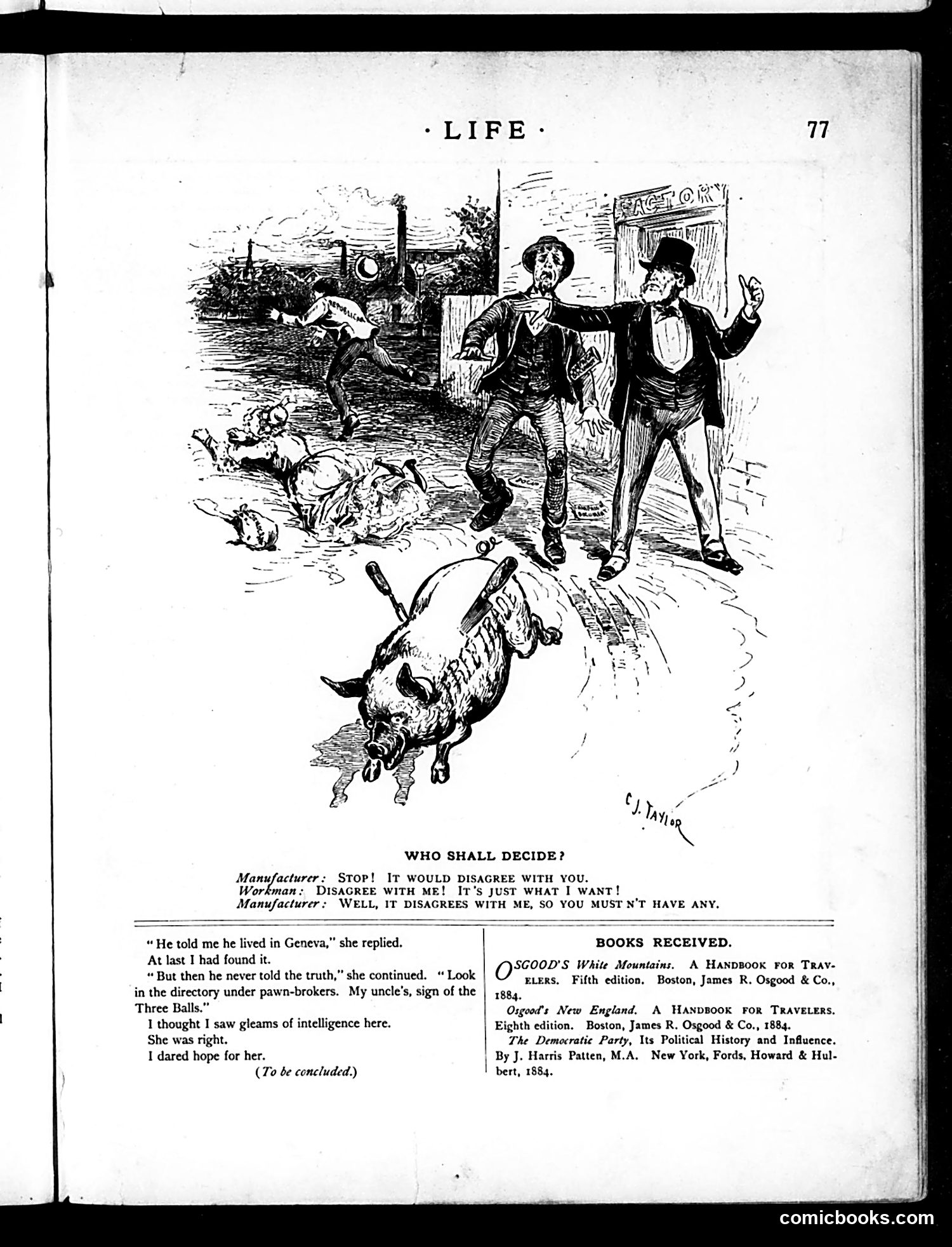
This cartoon depicts a labor dispute between a manufacturer and workman, with a pig being pulled in opposite directions as the metaphorical stakes. The manufacturer claims the pig (representing wages or goods) belongs to him; the workman disagrees, insisting it's what he wants. The manufacturer's final retort—"Well, it disagrees with me, so you mustn't have any"—satirizes capitalist logic: if labor won't accept management's terms, production stops and nobody benefits. The drawing by C.J. Taylor critiques how industrial conflicts harm all parties, particularly workers. The factory, smoke, and period clothing suggest this reflects late-19th-century American labor tensions, when disputes over wages and working conditions were intense and often resulted in worker deprivation rather than compromise.
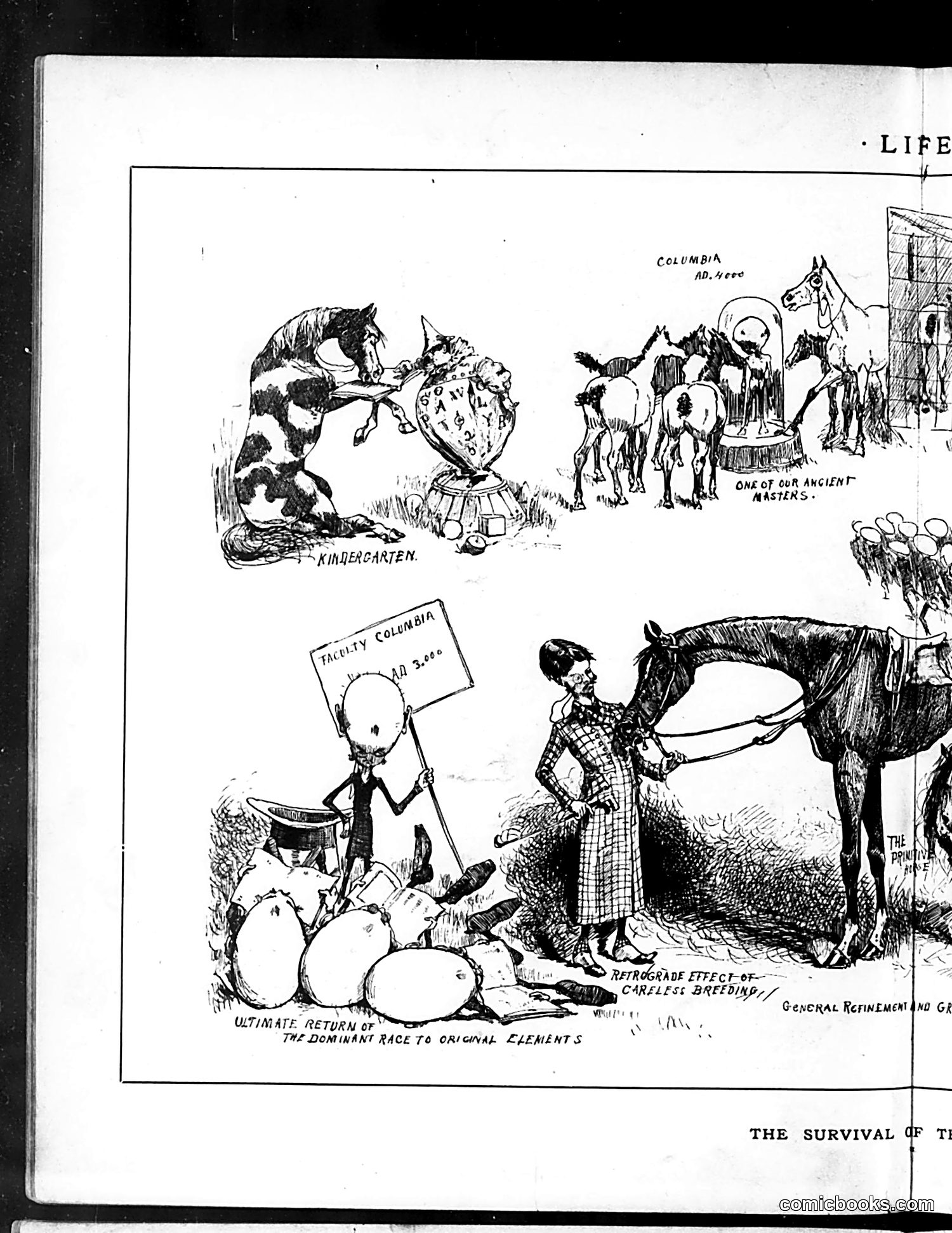
This page contains three satirical cartoon panels critiquing turn-of-the-century educational and social issues: 1. **"Kindergarten"** (top left): A horse and donkey appear to represent Columbia (America) and an unidentified institution, suggesting concerns about early education quality. 2. **"Ultimate Return of the Dominant Race to Original Elements"** (bottom left): A figure labeled "Faculty Columbia" holds a sign while crude egg-shaped forms lie scattered, satirizing what appears to be concerns about educational degeneration or decline in academic standards. 3. **"Retrograde Effects of Careless Breeding"** (right): A woman with a horse illustrates concerns about heredity and breeding practices, likely commenting on eugenics debates or animal husbandry issues of that era. The overall theme suggests anxiety about American institutional decline and hereditary concerns popular in early 20th-century discourse.
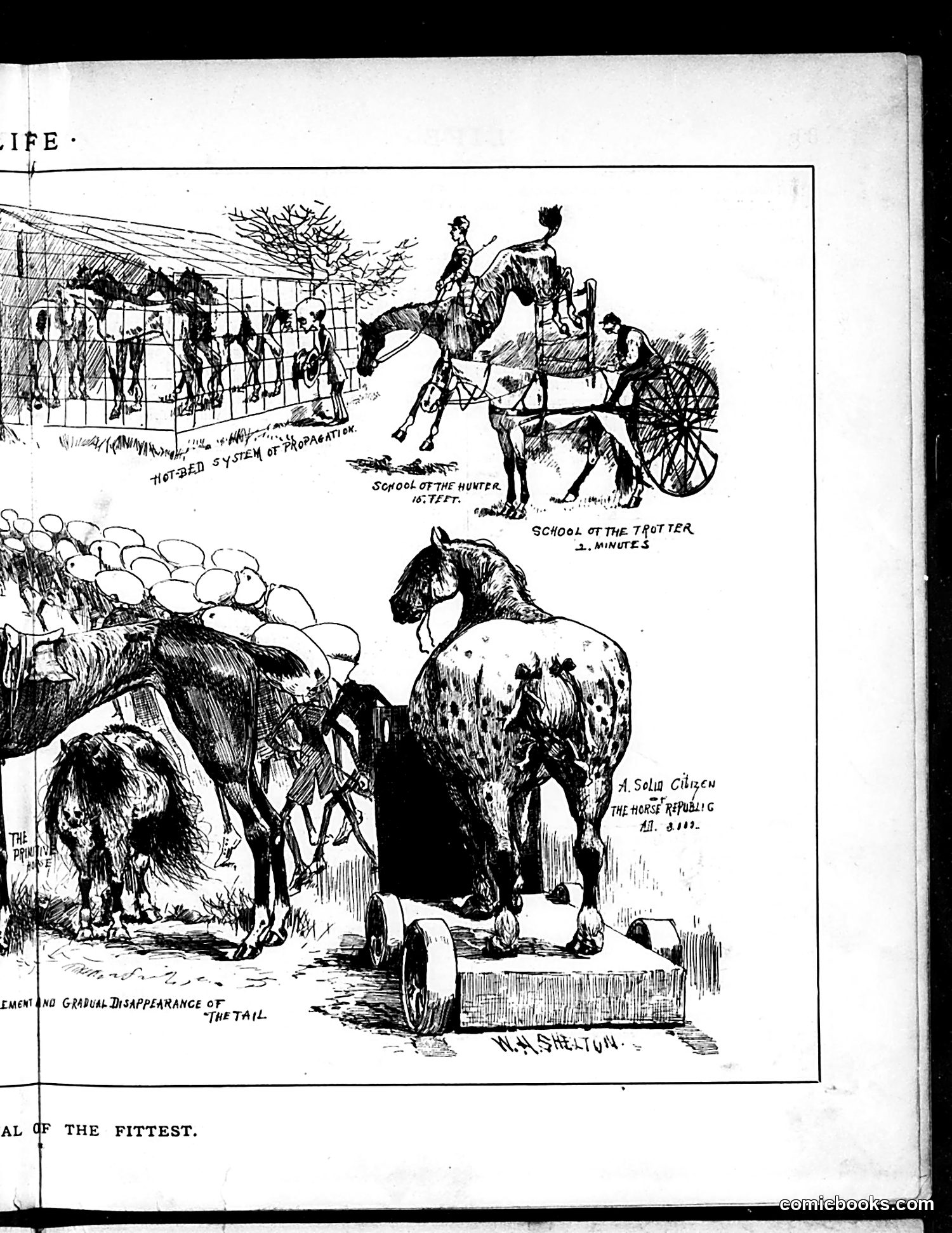
This page shows satirical sketches about horses and horsemanship, labeled as "School of the Hunter" and "School of the Trotter." The cartoons mock equestrian training methods and horse breeding standards of the era. The top panels ridicule "the System of Preparation"—showing exaggerated, awkward horse training techniques. The bottom illustration, credited to W.A. Shelton, depicts "A Solid Citizen" (labeled "The Horse Republic All 8,000") positioned on a cart, sarcastically presenting an ordinary horse as an exemplary citizen. The overall satire appears to critique both pretentious horse-breeding culture and possibly political absurdity—treating horses as serious civic subjects. The "Republic" reference suggests mockery of democratic institutions or civic pride being applied to trivial matters like horse shows.
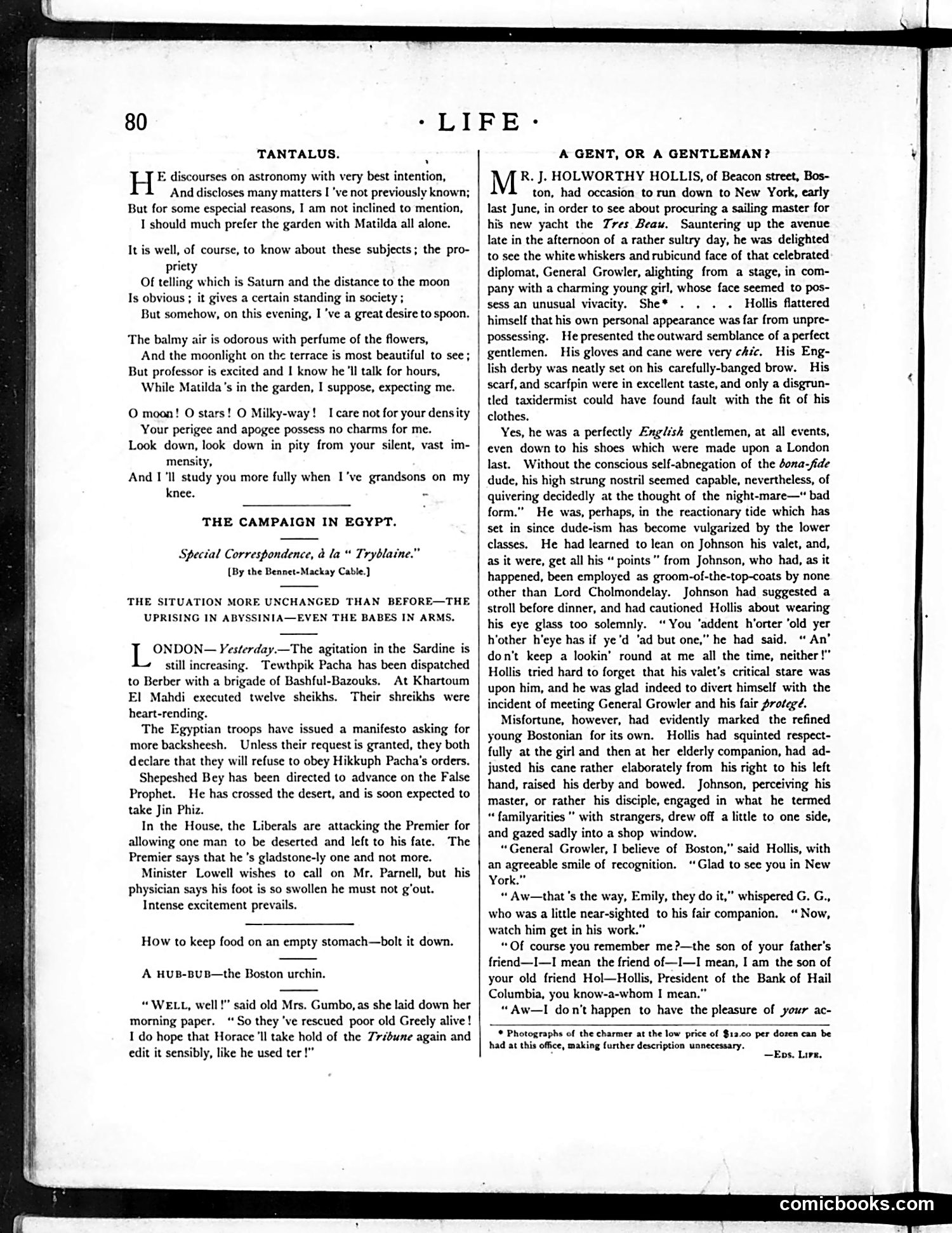
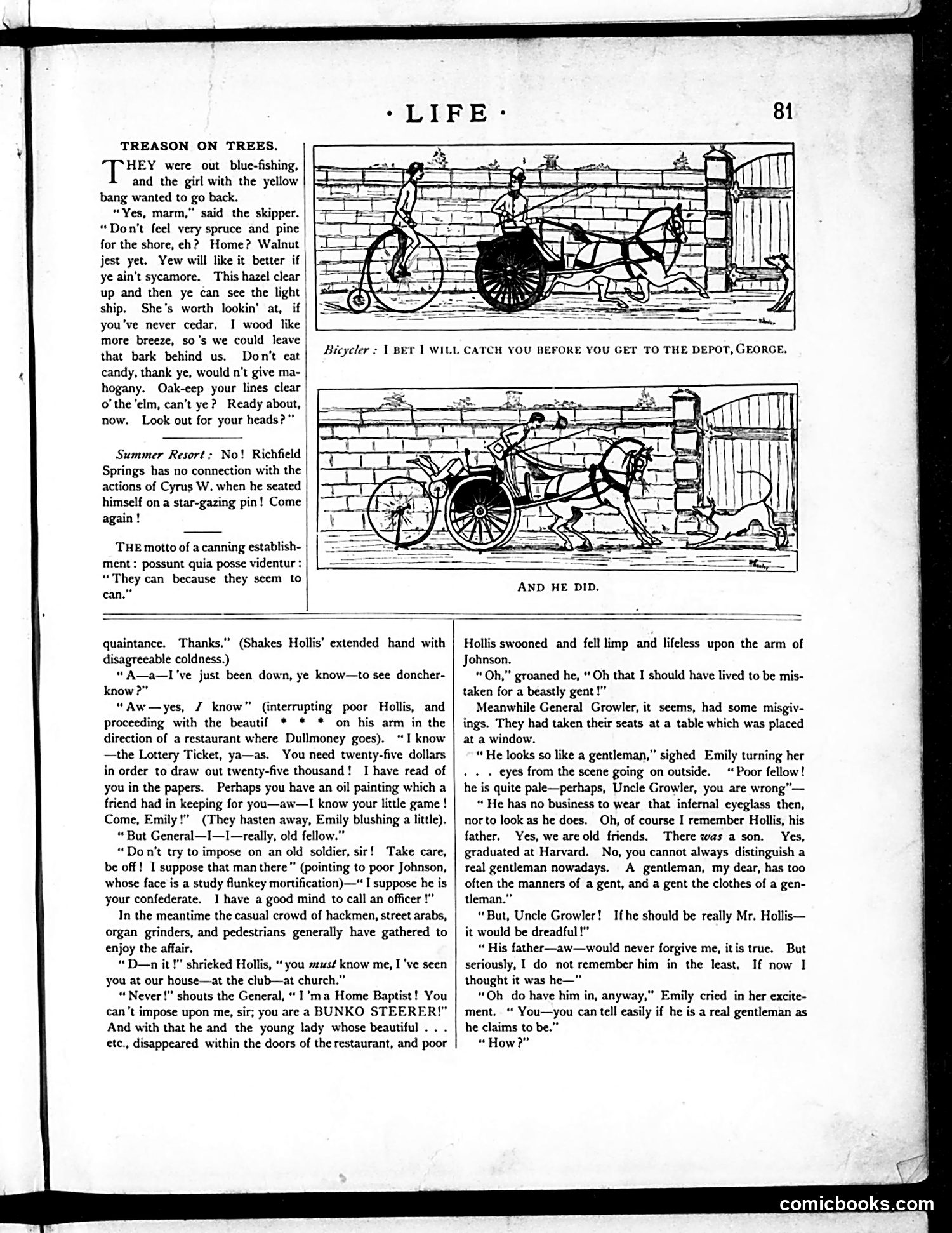
This page contains two unrelated satirical pieces: **"Treason on Trees"** is a pun-heavy dialogue where a boat skipper speaks entirely in tree-related wordplay ("Don't feel very spruce and pine," "Walnut jest yet," "Yew will like it better"). The humor relies on audience groaning at forced botanical puns—typical turn-of-century wordplay humor. **"And He Did"** depicts a social comedy about class pretension. General Growler, a curmudgeonly old soldier, encounters a well-dressed man (Hollis) he refuses to recognize, suspecting him of being a "bunko steerer" (con artist). Despite Hollis's protests that they know each other from social circles, Growler publicly humiliates him and leaves with a young woman. The satire mocks both: Growler's suspicious rudeness and class anxiety, and the broader Gilded Age concern that gentlemen can be distinguished only by clothes and manner, not character. Growler's final uncertainty ("I do not remember him in the least") exposes his bluff.
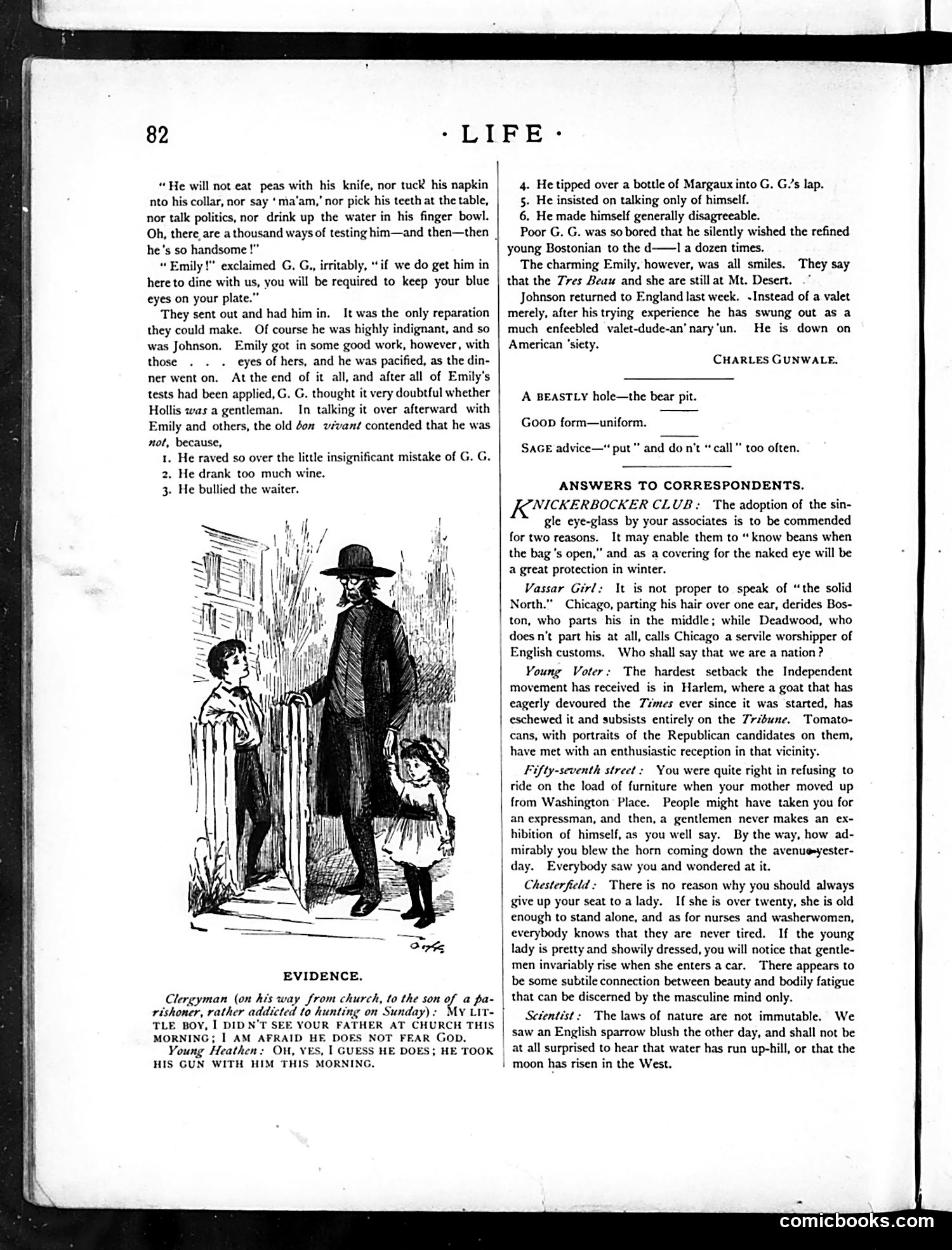
This *Life* magazine page contains two satirical pieces about gentlemanly conduct and social hypocrisy. **The main cartoon** depicts a clergyman encountering a parishioner's son heading out with a gun on Sunday (hunting day). The son cheerfully explains his father isn't at church because he took his gun—implying the father fears God enough to prepare for the afterlife, but not enough to skip hunting. The satire mocks selective religiosity: prioritizing Sunday recreation over worship while claiming piety. **The narrative above** concerns a man named Johnson (appears to be English or a visitor) tested by socialites for gentlemanly behavior. Despite passing superficial etiquette tests, he fails by: getting angry over spilled wine, drinking excessively, bullying waiters, and being self-absorbed. The satire suggests true gentlemanliness isn't about knife-and-fork rules but character—Johnson has none. His subsequent reinvention as a snobby "dude" criticizing American society ironically proves his shallowness. Both pieces satirize the gap between surface propriety and actual moral substance.
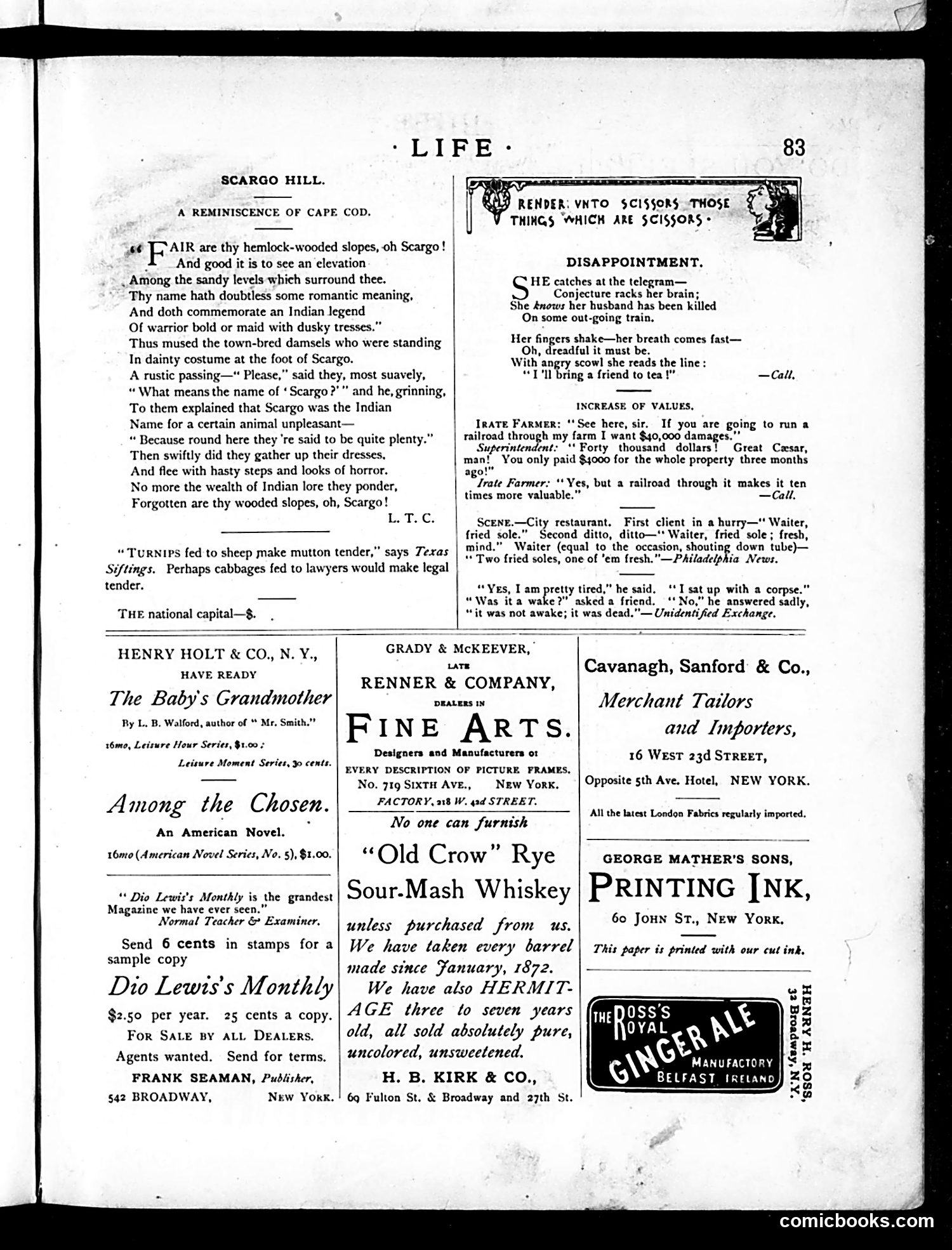
This page primarily contains **advertisements and light satirical humor** rather than political cartooning. **Main Content:** The page features several brief humorous pieces: 1. **"Scargo Hill"** — A poem mocking naive city visitors to Cape Cod who romanticize Indian place names, only to learn from a local that "Scargo" refers to an unpleasant animal. The joke targets sentimental tourists deflated by mundane reality. 2. **Three short comic scenarios** satirizing everyday absurdities: a farmer negotiating railroad compensation, a widow's false alarm about her husband, and a waiter's creative interpretation of "fresh" fried sole. 3. **A one-liner** joking that turnips make mutton tender, so perhaps cabbages would make lawyers' legal arguments more tender (edible/palatable). **Advertising dominates the lower half**, promoting books, whiskey, art frames, tailoring services, and printing ink—typical of Life's revenue model. The humor is gentle, domestic satire reflecting late 19th-century American life rather than sharp political commentary.
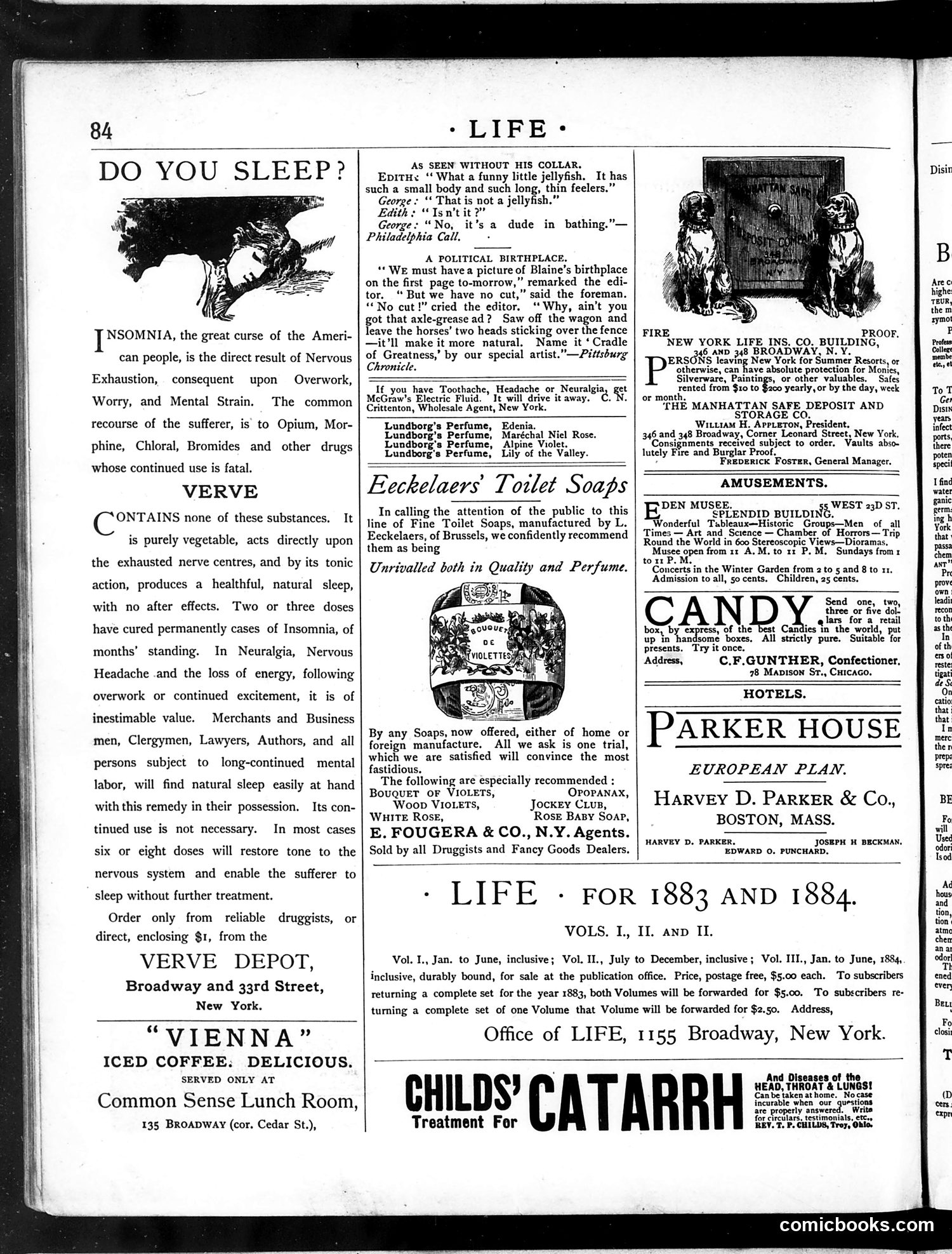
This page is primarily **advertisements** with one small satirical cartoon titled "As Seen Without His Collar." The cartoon depicts what appears to be a thin, lanky man in a bathing suit. The joke plays on the "dude"—a contemporary figure of fun in 1880s America: an excessively fashionable, vain young man. The humor suggests that without his elaborate collar (a key fashion statement), the dude is revealed as physically unimpressive—his body as thin and insubstantial as a jellyfish's. The satire mocks the artificiality of fashionable dress, implying the dude relies entirely on clothing and accessories to project status or attractiveness. Stripped to basics, he's exposed as ridiculous. This reflects period anxieties about masculine authenticity and the contempt many held for fashion-obsessed urbanites. The page also includes a brief satirical note about James G. Blaine's birthplace being used as a newspaper advertisement (the "axle-grease ad" joke), but the cartoon is the primary visual satire here.
This page is primarily **advertising**, not satire or political commentary. It contains product advertisements for disinfectants and other goods, mixed with book notices. The main content focuses on **Bellevue Disinfectants**, marketed as cholera prevention during what appears to be a late 19th-century health crisis (the page is dated 1884). The ads feature endorsements from Professor R. Ogden Doremus, a real chemist at Bellevue Hospital, lending scientific credibility to claims about killing disease germs. The "Outing" magazine advertisement uses decorative typography but contains no clear satirical intent—it's simply promoting the publication. There is **no identifiable political cartoon on this page**. The content reflects genuine Victorian-era anxieties about contagious disease and the emerging germ theory of illness, presented through earnest advertising rather than humorous commentary.
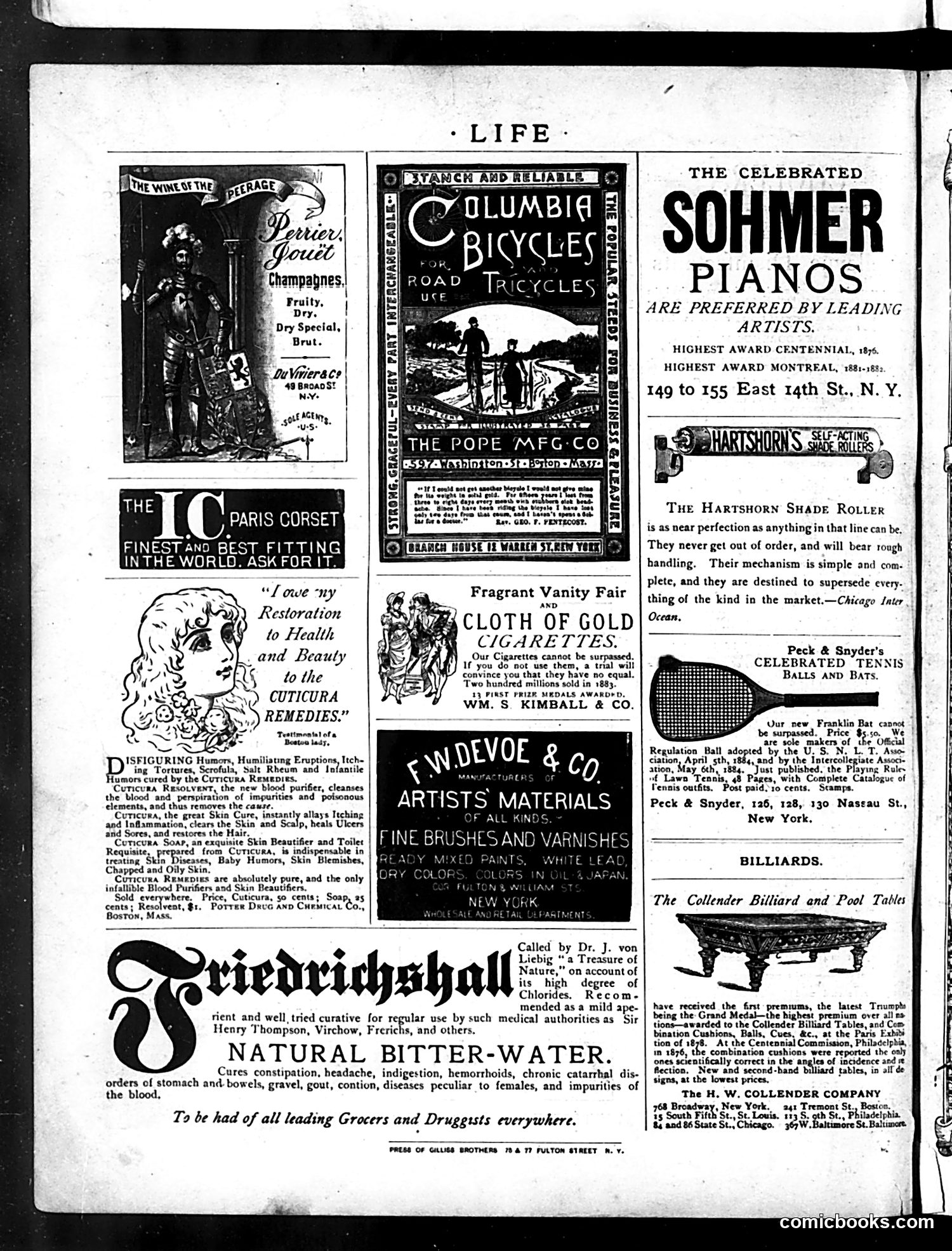
This is primarily an **advertising page** from an undated issue of Life magazine (likely 1880s based on product references and typography). There are no political cartoons or satirical content to analyze. The page consists entirely of period advertisements for consumer goods and services: champagne, corsets, bicycles, pianos, cigars, skin remedies (Cuticura), art supplies, sporting equipment (tennis balls and bats), billiard tables, and a digestive tonic called "Sprudelsaal." The ads employ common Victorian marketing strategies—celebrity endorsements ("preferred by leading artists"), medical claims ("cures constipation, headache, indigestion"), and awards ("Highest Award Centennial, 1876"). The Cuticura remedy ad is notably lengthy, using testimonial format to promote its blood-purifying and skin-healing properties. **No satirical content is present.** This reflects Life's dual nature as both a humor magazine and advertising vehicle during this era.