
Life, 1884-08-07 · page 2 of 16
Life — August 7, 1884 — page 2: what you’re looking at
What you’re looking at
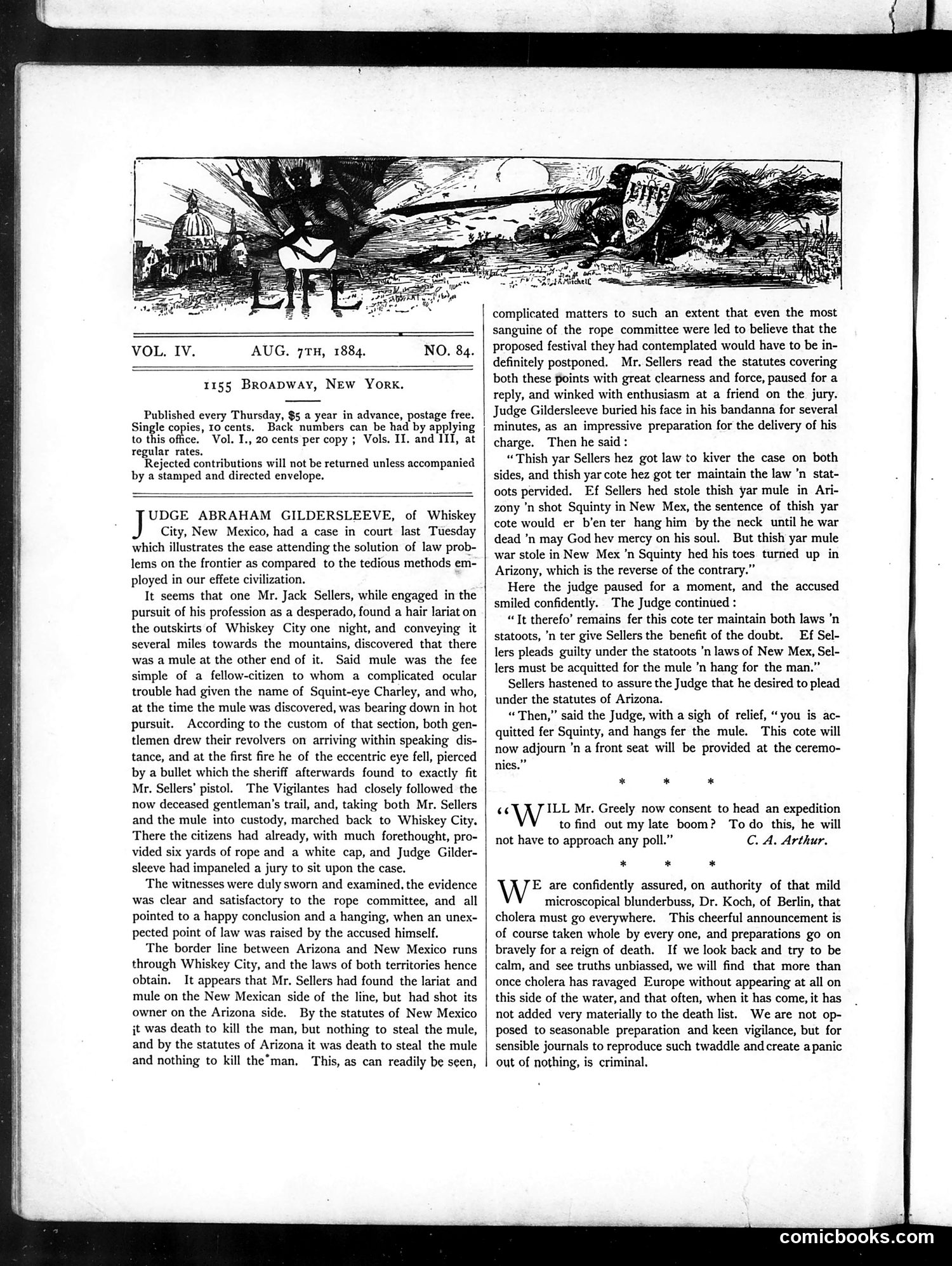
The page contains a satirical story about Judge Abraham Gildersleeve of Whiskey City, New Mexico, addressing a legal dispute over a mule. The narrative satirizes frontier justice and conflicting territorial laws—specifically the tension between New Mexico and Arizona statutes regarding property and capital punishment. The humor lies in the absurdist legal problem: the mule was found dead, so neither jurisdiction can execute appropriate punishment (New Mexico law requires killing the man; Arizona requires killing the mule). The judge's solution—hanging the mule symbolically anyway—mocks both the rigidity of frontier law and the desperation of underdeveloped legal systems trying to maintain order. The additional commentary about cholera appears unrelated editorial content.
📄 Transcribed text from this page (OCR, searchable)
Machine-transcribed from the original scan — historical spelling and the odd misread are preserved.
VOL. IV. AUG. 7TH, 1884. NO. 84. 1155 Broapway, NEw York. Published every Thursday, $5 a year in advance, postage free. Single copies, 10 cents. Back numbers can be had by applying to this office.’ Vol. I., 20 cents per copy ; Vols. I. and III, at regular rates. Rejected contributions will not be returned unless accompanied by a stamped and directed envelope. UDGE ABRAHAM GILDERSLEEVE, of Whiskey City, New Mexico, had a case in court last Tuesday which illustrates the ease attending the solution of law prob- lems on the frontier as compared to the tedious methods em- ployed in our effete civilization. It seems that one Mr. Jack Sellers, while engaged in the pursuit of his profession as a desperado, found a hair lariat on the outskirts of Whiskey City one night, and conveying it several miles towards the mountains, discovered that there was a mule at the other end of it. Said mule was the fee simple of a fellow-citizen to whom a complicated ocular trouble had given the name of Squint-eye Charley, and who, at the time the mule was discovered, was bearing down in hot pursuit. According to the custom of that section, both gen- tlemen drew their revolvers on arriving within speaking dis- tance, and at the first fire he of the eccentric eye fell, pierced by a bullet which the sheriff afterwards found to exactly fit Mr. Sellers’ pistol. The Vigilantes had closely followed the now deceased gentleman’s trail, and, taking both Mr. Sellers and the mule into custody, marched back to Whiskey City. There the citizens had already, with much forethought, pro- vided six yards of rope and a white cap, and Judge Gilder- sleeve had impaneled a jury to sit upon the case. The witnesses were duly sworn and examined, the evidence was clear and satisfactory to the rope committee, and all pointed to a happy conclusion and a hanging, when an unex- pected point of law was raised by the accused himself. The border line between Arizona and New Mexico runs through Whiskey City, and the laws of both territories hence obtain. It appears that Mr. Sellers had found the lariat and mule on the New Mexican side of the line, but had shot its owner on the Arizona side. By the statutes of New Mexico it was death to kill the man, but nothing to steal the mule, and by the statutes of Arizona it was death to steal the mule and nothing to kill the’man, This, as can readily be seen, complicated matters to such an extent that even the most sanguine of the rope committee were led to believe that the proposed festival they had contemplated would have to be in- definitely postponed. Mr. Sellers read the statutes covering both these points with great clearness and force, paused for a reply, and winked with enthusiasm at a friend on the jury. Judge Gildersleeve buried his face in his bandanna for several minutes, as an impressive preparation for the delivery of his charge. Then he said : “Thish yar Sellers hez got law to kiver the case on both sides, and thish yar cote hez got ter maintain the law 'n stat- cots pervided. Ef Sellers hed stole thish yar mule in Ari- zony ’n shot Squinty in New Mex, the sentence of thish yar cote would er b’en ter hang him by the neck until he war dead ’n may God hev mercy on his soul. But thish yar mule war stole in New Mex ’n Squinty hed his toes turned up in Arizony, which is the reverse of the contrary.” Here the judge paused for a moment, and the accused smiled confidently. The Judge continued : “Tt therefo’ remains fer this cote ter maintain both laws 'n statoots, 'n ter give Sellers the benefit of the doubt. Ef Sel- lers pleads guilty under the statoots ’n laws of New Mex, Sel- lers must be acquitted for the mule ’n hang for the man.” Sellers hastened to assure the Judge that he desired to plead under the statutes of Arizona. “Then,” said the Judge, with a sigh of relief, “you is ac- quitted fer Squinty, and hangs fer the mule. This cote will now adjourn ’n a front seat will be provided at the ceremo- nies.” * * * “VJ ILL Mr. Greely now consent to head an expedition to find out my late boom? To do this, he will C. A. Arthur. not have to approach any poll.” * * * E are confidently assured, on authority of that mild microscopical blunderbuss, Dr. Koch, of Berlin, that cholera must go everywhere. This cheerful announcement is of course taken whole by every one, and preparations go on bravely for a reign of death. If we look back and try to be calm, and see truths unbiassed, we will find that more than once cholera has ravaged Europe without appearing at all on this side of the water, and that often, when it has come, it has not added very materially to the death list. We are not op- posed to seasonable preparation and keen vigilance, but for sensible journals to reproduce such twaddle and create a panic out of nothing, is criminal. comicbooks.com