
Life, 1884-08-07 · page 11 of 16
Life — August 7, 1884 — page 11: what you’re looking at
What you’re looking at
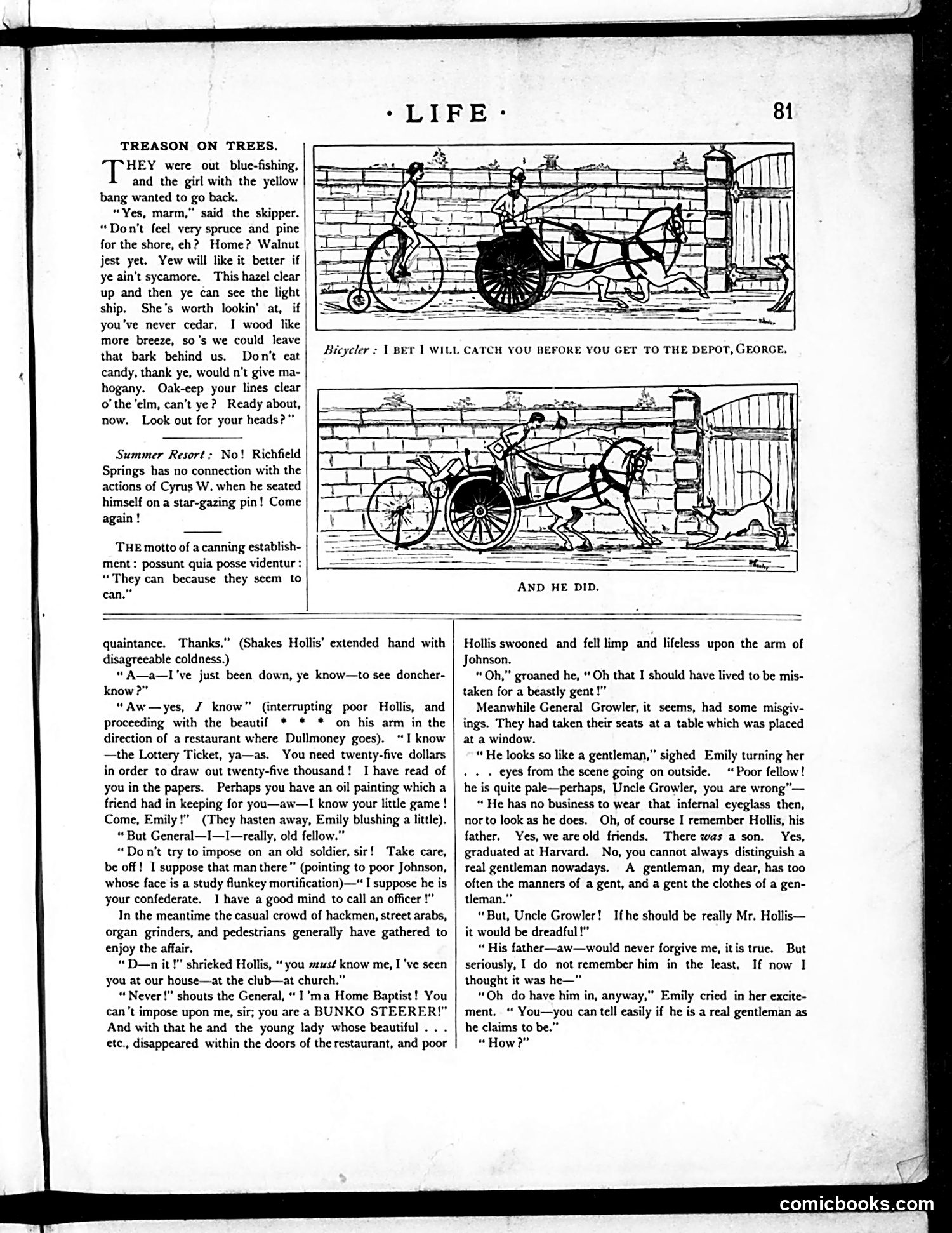
This page contains two unrelated satirical pieces: **"Treason on Trees"** is a pun-heavy dialogue where a boat skipper speaks entirely in tree-related wordplay ("Don't feel very spruce and pine," "Walnut jest yet," "Yew will like it better"). The humor relies on audience groaning at forced botanical puns—typical turn-of-century wordplay humor. **"And He Did"** depicts a social comedy about class pretension. General Growler, a curmudgeonly old soldier, encounters a well-dressed man (Hollis) he refuses to recognize, suspecting him of being a "bunko steerer" (con artist). Despite Hollis's protests that they know each other from social circles, Growler publicly humiliates him and leaves with a young woman. The satire mocks both: Growler's suspicious rudeness and class anxiety, and the broader Gilded Age concern that gentlemen can be distinguished only by clothes and manner, not character. Growler's final uncertainty ("I do not remember him in the least") exposes his bluff.
📄 Transcribed text from this page (OCR, searchable)
Machine-transcribed from the original scan — historical spelling and the odd misread are preserved.
TREASON ON TREES. HEY were out blue-fishing, and the girl with the yellow bang wanted to go back. “Yes, marm,” said the skipper. “Don’t feel very spruce and pine for the shore, eh? Home? Walnut | jest yet. Yew will like it better if ye ain’t sycamore. This hazel clear up and then ye can see the light ship. She's worth lookin’ at, if | you've never cedar. I wood like | more breeze, so's we could leave | that bark behind us. Don't eat candy, thank ye, would n't give ma- hogany. Oak-eep your lines clear | o’the'elm, can't ye? Ready about, now. Look out for your heads?” Summer Resort; No! Richfield Springs has no connection with the actions of Cyrus W. when he seated | himself on a star-gazing pin! Come again ! THE motto of a canning establish- | ment: possunt quia posse videntur : “They can because they seem to can,” AND HE DID. quaintance. Thanks.” (Shakes Hollis’ extended hand with disagreeable coldness.) “A—a—lI've just been down, ye know—to see doncher- know ?” “Aw—yes, J know” (interrupting poor Hollis, and proceeding with the beautif * * * on his arm in the direction of a restaurant where Dullmoney goes). “1 know —the Lottery Ticket, ya—as. You need twenty-five dollars in order to draw out twenty-five thousand! I have read of you in the papers. Perhaps you have an oil painting which a friend had in keeping for you—aw—lI know your little game ! Come, Emily!" (They hasten away, Emily blushing a little). “ But General—I—I—really, old fellow.” “Don’t try to impose on an old soldier, sir! Take care, be off! I suppose that man there” (pointing to poor Johnson, whose face is a study flunkey mortification) —“ I suppose he is your confederate. 1 have a good mind to call an officer !” In the meantime the casual crowd of hackmen, street arabs, organ grinders, and pedestrians generally have gathered to enjoy the affair. “D—n it!" shrieked Hollis, “ you mus# know me, I 've seen you at our house—at the club—at church.” “Never!” shouts the General, “1 ‘ma Home Baptist! You can’t impose upon me, sir; you are a BUNKO STEERER!” And with that he and the young lady whose beautiful . . . etc., disappeared within the doors of the restaurant, and poor Hollis swooned and fell limp and lifeless upon the arm of Johnson. “Oh,” groaned he, “Oh that I should have lived to be mis- taken for a beastly gent!” Meanwhile General Growler, it seems, had some misgiv- ings. They had taken their seats at a table which was placed at a window. “ He looks so like a gentleman,” sighed Emily turning her « eyes from the scene going on outside. “‘ Poor fellow! he is quite pale—perhaps, Uncle Growler, you are wrong”— “ He has no business to wear that infernal eyeglass then, nor to look as he does. Oh, of course I remember Hollis, his father. Yes, we are old friends. There was a son. Yes, graduated at Harvard. No, you cannot always distinguish a real gentleman nowadays. A gentleman, my dear, has too often the manners of a gent, and a gent the clothes of a gen- tleman.” “But, Uncle Growler! Ifhe should be really Mr. Hollis— it would be dreadful!” “ His father—aw—would never forgive me, itis true. seriously, 1 do not remember him in the least. thought it was he—” “Oh do have him in, anyway,” Emily cried in her excite- ment. “ You—you can tell easily if he is a real gentleman as he claims to be.” “How?” But If now I comicbooks.com