
A complete issue · 16 pages · 1884
Life — July 17, 1884
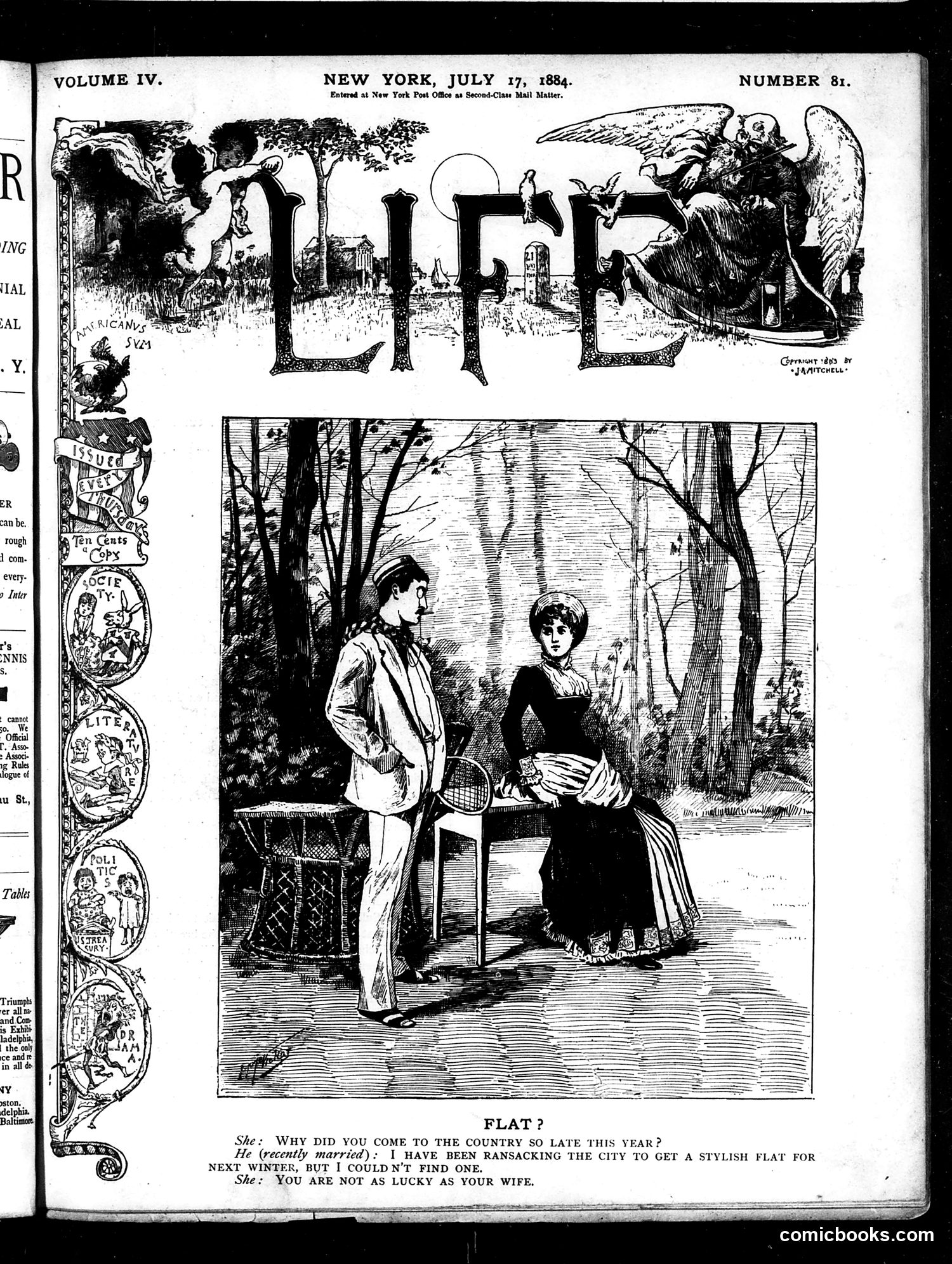
This satirical cartoon jokes about a newly married couple's housing troubles. The husband, recently wed, complains that he's been "ransacking the city to get a stylish flat for next winter, but I couldn't find one." His wife replies tartly: "You are not as lucky as your wife." The humor pivots on the word "flat"—slang for an apartment. The wife's retort implies her "luck" was finding him as a husband, the ultimate "flat" (meaning an unsatisfactory or disappointing thing). The satire reflects late-19th-century American anxieties about urban housing shortages and the social expectations placed on husbands to provide suitable accommodations. The punchline delivers a cutting commentary on marriage itself as a questionable bargain for women.
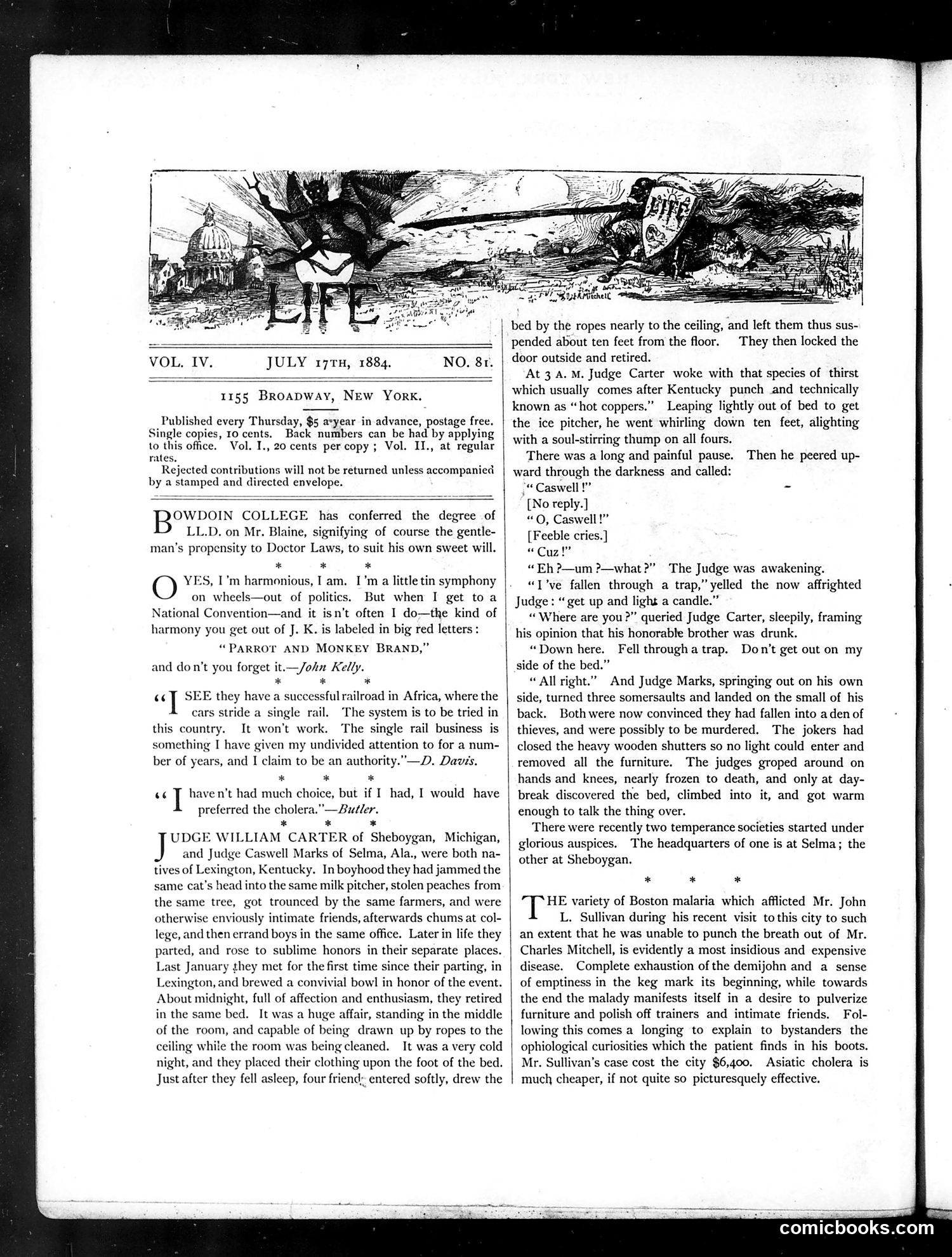
The header illustration depicts "Life" as a dynamic force—a winged figure emerging from or transforming a landscape, with what appears to be a classical dome (likely the Capitol) visible on the left. This symbolizes the magazine's role as social commentary on American institutions. The page's text contains satirical anecdotes and observations rather than explicit political cartoons. One notable piece mocks the single-rail railroad system proposed for Africa, suggesting American skepticism toward such schemes. Another anecdote humorously recounts Judge William Carter's mishap when judges fell through a trap bed during a nighttime incident in Kentucky—satirizing judicial dignity through physical comedy. The overall tone reflects 1884's satirical journalism style: mocking institutions, social pretensions, and contemporary absurdities through witty prose rather than direct caricature.
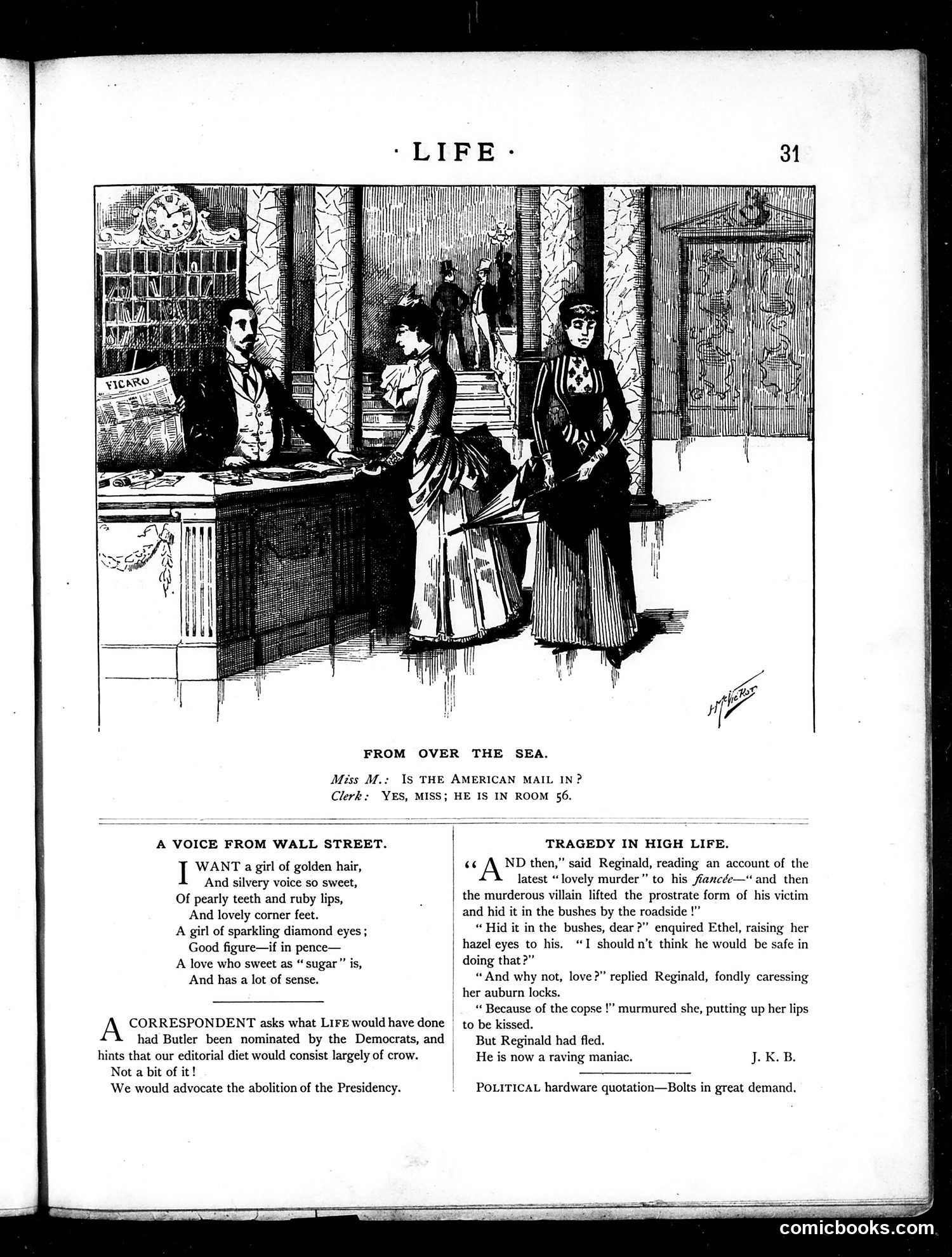
**Top Cartoon ("From Over the Sea"):** A hotel clerk scene depicting international tensions. The caption's exchange about an "American mail" being in "room 56" likely references espionage or diplomatic intrigue concerns of the early 20th century, suggesting anxieties about foreign correspondence or secret communications. **"A Voice From Wall Street":** A satirical poem praising an idealized woman with conventional beauty standards ("golden hair," "pearly teeth," "sparkling diamond eyes") and noting she has "sense"—mocking how wealthy men valued both attractiveness and financial acumen in potential wives. **Political Commentary:** A correspondent questions whether Life would endorse Butler (unclear which candidate) as president, suggesting the magazine typically advocated abolishing the presidency itself—satirizing Life's radical editorial stance.
This page contains satirical "Boomlets"—short political commentary pieces—rather than visual cartoons. The content critiques several contemporary figures: **Mr. Logan** defended Mickey Doo, whose character has been damaged by association with "Lindley Murray." **Mr. Blaine** is called a "guilt-edged statesman," implying moral compromise despite avoiding outright criminality. **The Norristown Herald** is mocked for calling Maine's electric light advocate a gentleman unwilling to "steal red-hot stoves"—ironic criticism of someone actually honest. **Sir Lepel's American tour** receives particular scrutiny: the English writer argues America is a country of disillusionment and disappointment, with only the Black population possessing humor. The piece sarcastically disputes his claims about American cities and character, defending American dignity against foreign criticism. The overall tone mocks political hypocrisy and defends American reputation against European condescension.
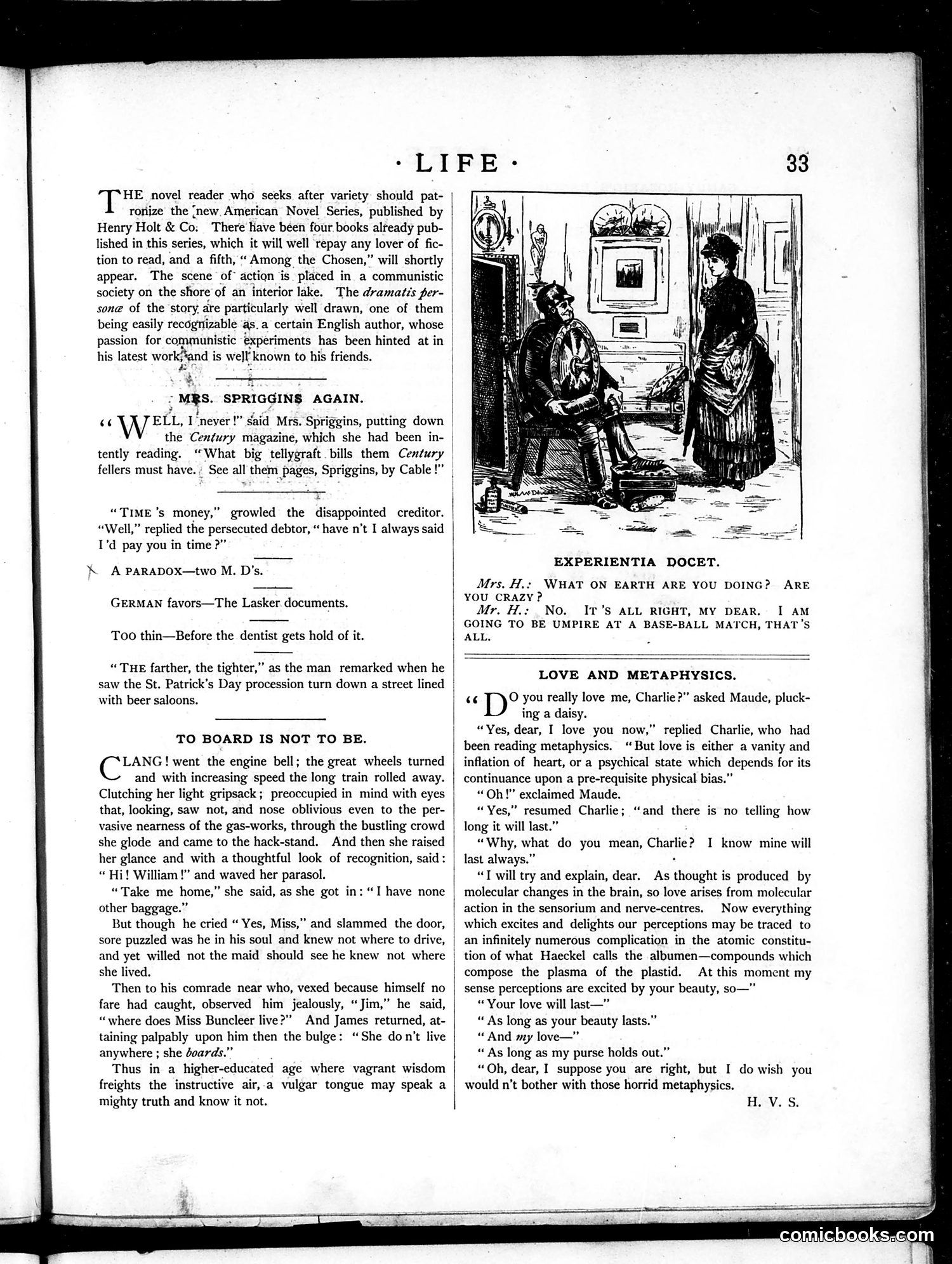
This page contains several short humorous pieces and one illustration rather than a political cartoon. The main illustration shows "Experientia Docet" (Experience Teaches) - depicting what appears to be a domestic scene where a man seated with a newspaper and a standing woman are in conversation, likely about a mundane domestic matter (he mentions umpiring at a baseball match). The page's humor derives from witty, brief satirical pieces about everyday life: Mrs. Spriggins complaining about magazine bills, observations about dentists and St. Patrick's Day celebrations, and a romantic dialogue between Charlie and Maude about love versus metaphysics. The satire targets middle-class concerns and the pretentiousness of intellectual romanticism rather than political issues. It's gentle, domestic humor typical of Life magazine's style.
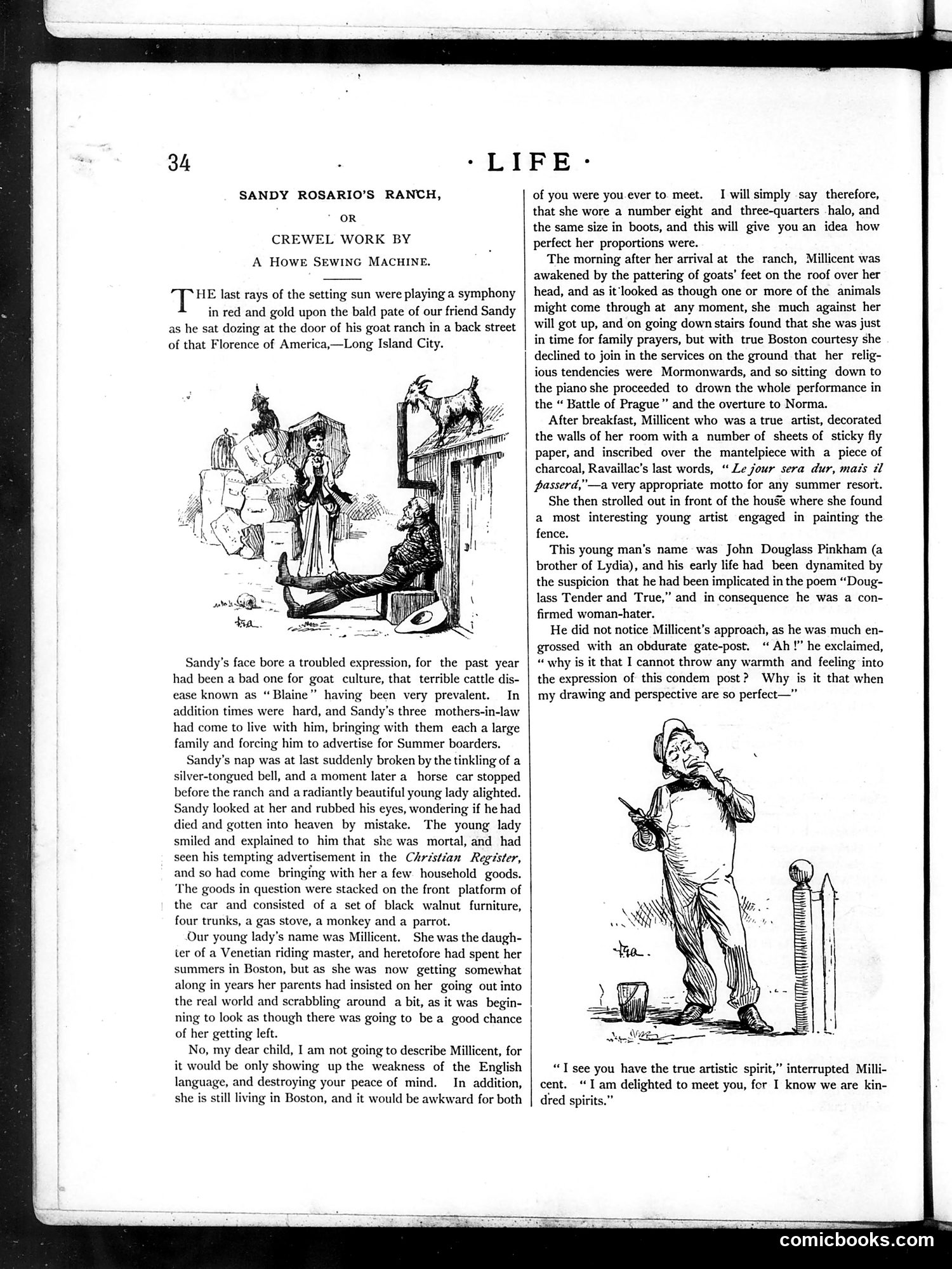
This page contains a short story titled "Sandy Rosario's Ranch" with illustrations rather than political satire. The narrative describes Sandy, a rancher dealing with cattle disease ("Blaine") and difficult times, whose troubles are interrupted by the arrival of a beautiful young woman named Millicent. The two illustrations show: (1) Millicent's arrival by horse-car with her belongings, and (2) John Douglass Pinkham, a young artist whom Millicent encounters painting a fence. The story satirizes Pinkham as a "woman-hater" who complains about artistic criticism, while Millicent represents an independent, cultured woman from Boston. This appears to be serialized fiction rather than editorial commentary or political cartooning.
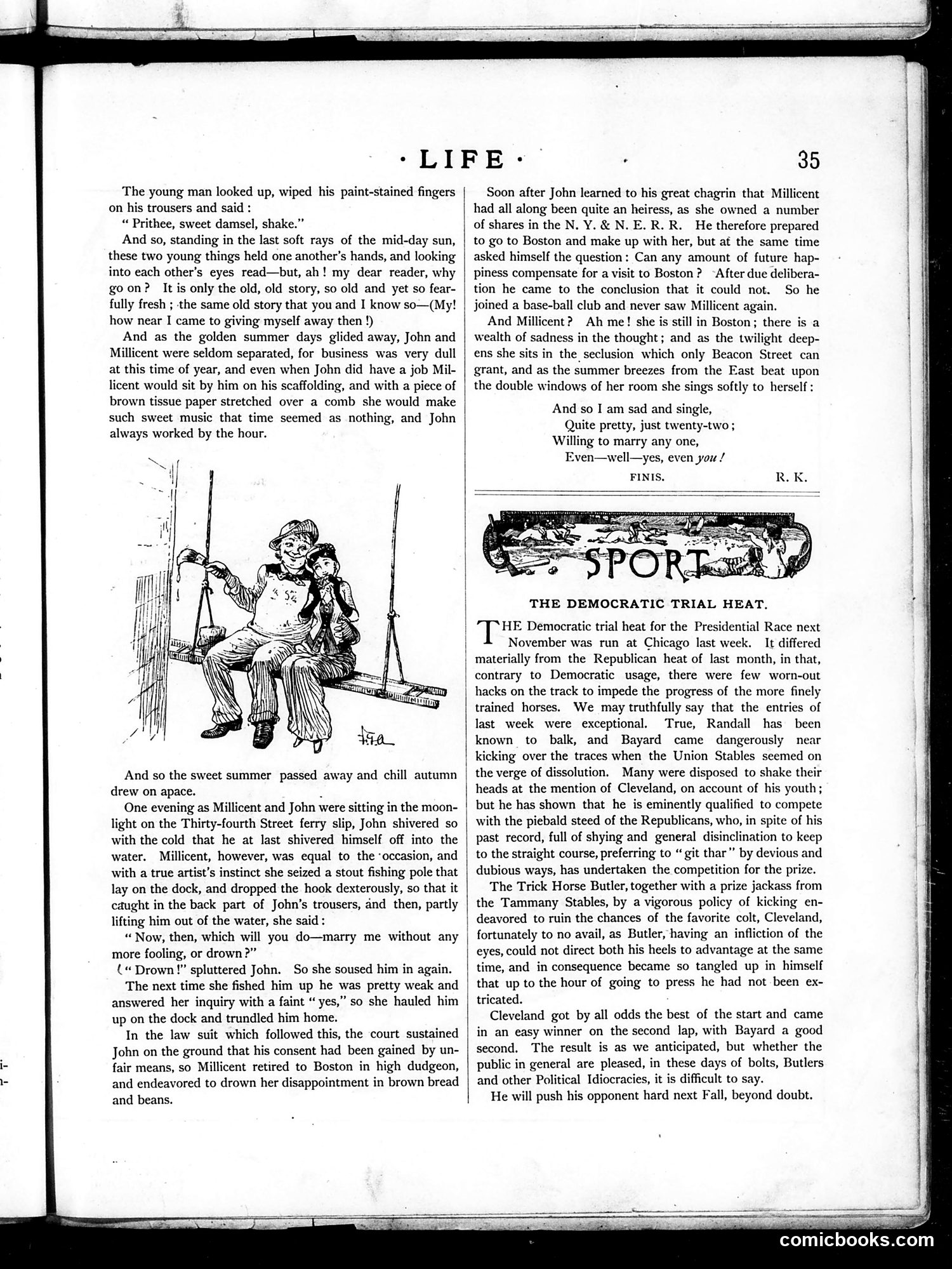
The page contains two distinct sections: **Left side:** A serialized story about young John and Millicent, illustrated with a sketch showing a man on a swing. The narrative describes their romance and separation—John eventually moves to Boston to pursue business rather than follow Millicent into marriage. The story's tone is sentimental and wryly humorous about romantic disappointment. **Right side:** A sports column titled "The Democratic Trial Heat" discussing the 1884 Presidential race. It reports on a Democratic primary at Chicago, critiquing candidates like Cleveland and Bayard. The commentary suggests the Republican candidates (referenced as horses being trained) pose a strong challenge, using horse-racing metaphors to describe the political competition. Both sections employ satirical, light humor typical of Life magazine's editorial voice.
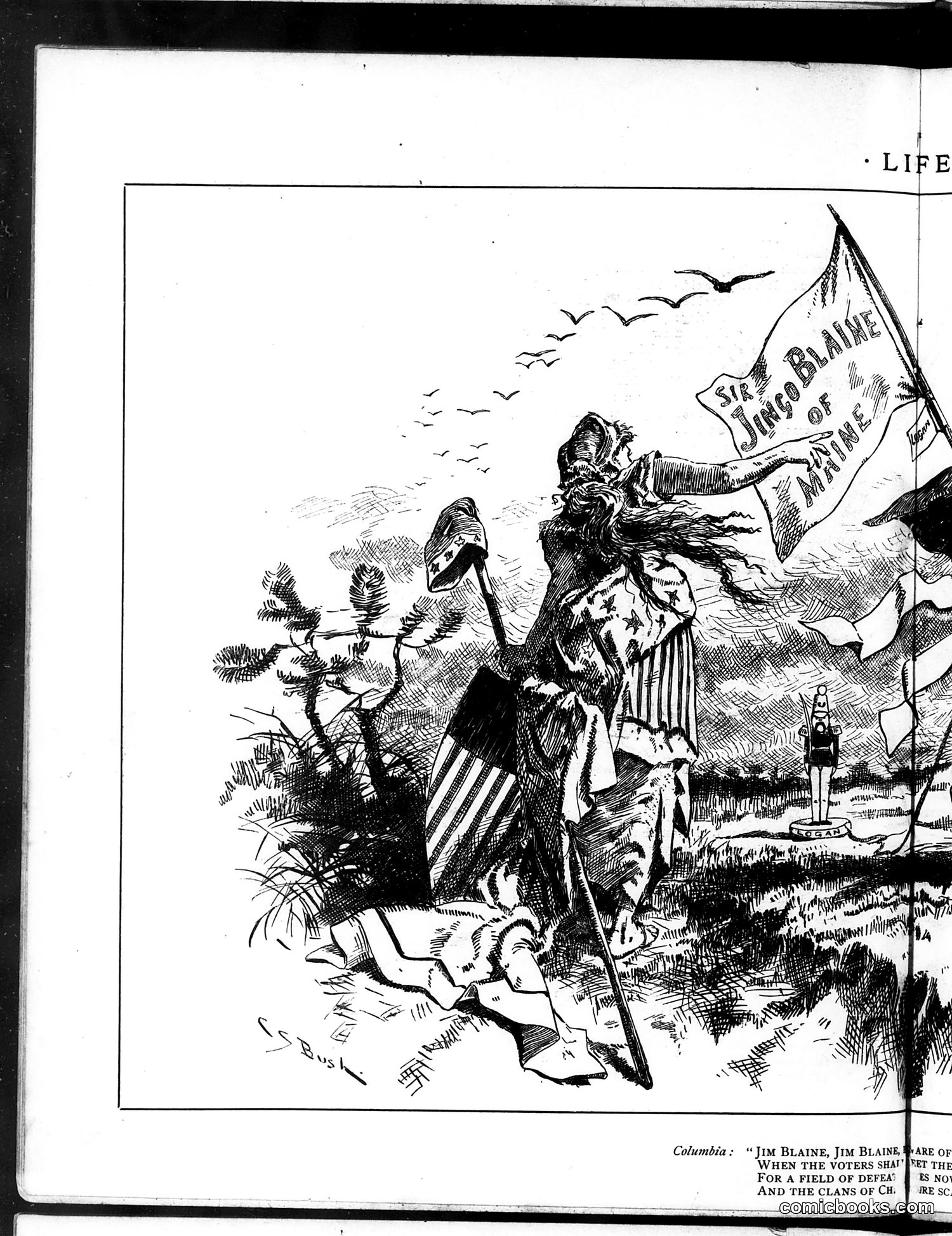
This Life magazine cartoon depicts a skeletal, death-like figure holding a flag reading "Sea Blaine, Lord of Maritime" while standing in a desolate landscape. The caption references "Jim Blaine" and mentions voters choosing "a field of defeat" and "clans of ch[aos]." The skeleton personifies political death or defeat, likely satirizing James G. Blaine's 1884 presidential campaign. The flag parodies his political slogan or platform related to maritime/naval policy. The desolate setting with dead vegetation suggests electoral ruin or political devastation. The cartoon mocks either Blaine's campaign promises or his actual electoral loss, using death imagery as satire. Without the complete caption text, the specific policy or event being ridiculed remains partially unclear, but the overall message condemns Blaine's political ambitions as leading to failure.
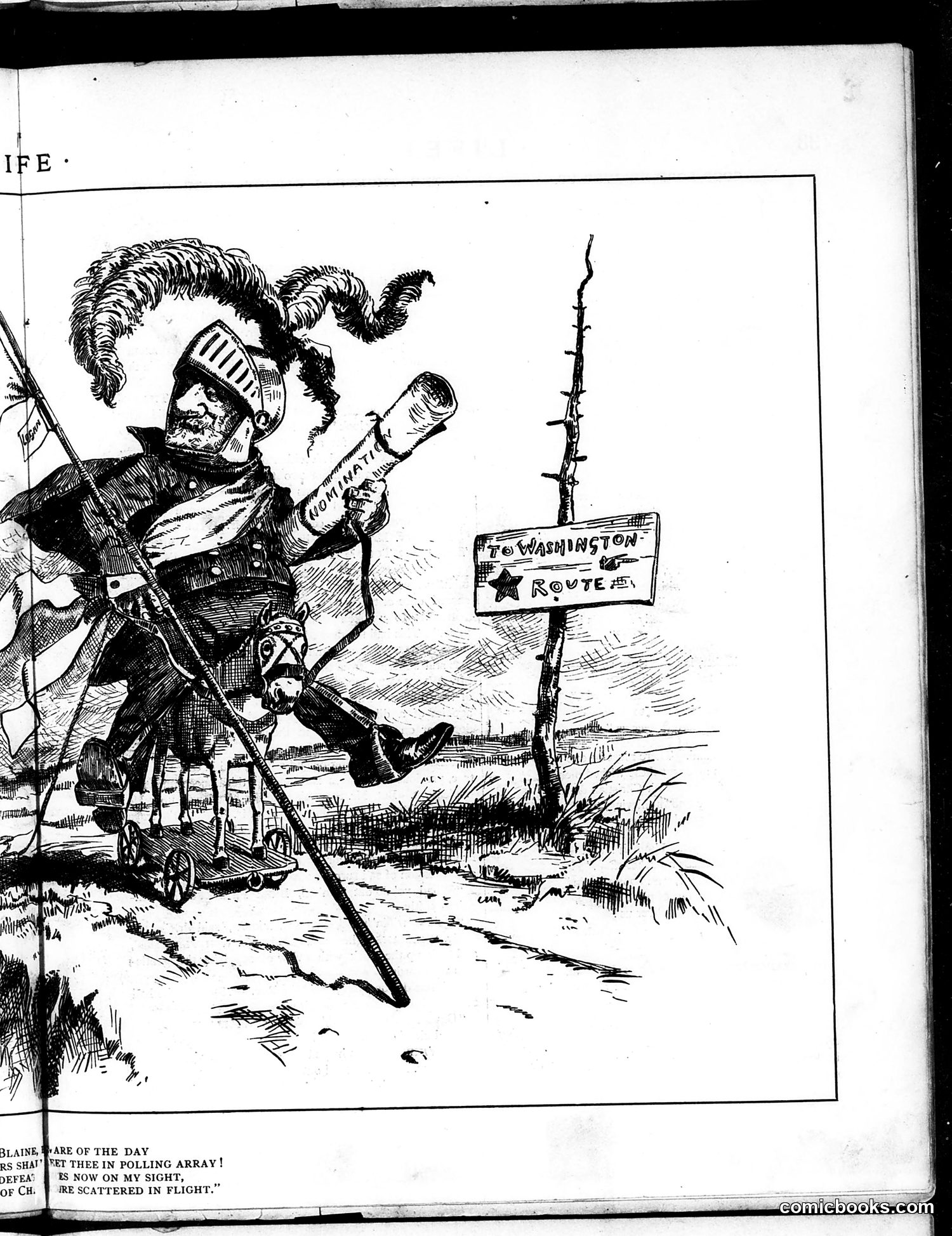
This appears to be a WWI-era satirical cartoon from *Life* magazine. A caricatured military figure—likely representing a German general or Kaiser-associated officer, identifiable by the distinctive spiked helmet (*Pickelhaube*)—stands on a signpost marked "TO WASHINGTON" with a star emblem, suggesting he's plotting a route toward the American capital. The figure holds what appears to be a telescope or viewing instrument and carries military equipment, depicting him as an aggressive aggressor. The caption references "polling array" and enemies being "scattered in flight," suggesting the cartoon ridicules German military ambitions or invasion fantasies. This likely satirizes American anxieties about German military intentions before or during U.S. involvement in World War I, mocking the implausibility of such threats while playing on contemporary fears.
This page contains two pieces of satirical social commentary typical of 19th-century Life magazine: **"Good Lord Deliver Us"** (left): A poem mocking hypocrisy in wealthy churches. A country visitor discovers that the respectable, devout-looking wealthy parishioners are actually financial criminals—a bank director who defaulted on funds, a stock-broker who embezzled, a bucket-shop operator. The repeated refrain ironically invokes divine protection from these "wicked men" hiding behind pious appearances in their lavish church setting. **"The Thompson Street Poker Club"** (right): A humorous story about a poker game among working-class men with comical names (Cyanide Whiffles, Tooter Williams, Reverend Thankful Smith). It satirizes petty gamblers and their dramatic posturing over small stakes, with dialect-heavy dialogue suggesting working-class characters. The story pokes fun at their exaggerated self-importance during a trivial card game. Both pieces satirize American society by exposing the gap between appearance and reality—whether wealthy respectability masking fraud or ordinary men inflating their importance.
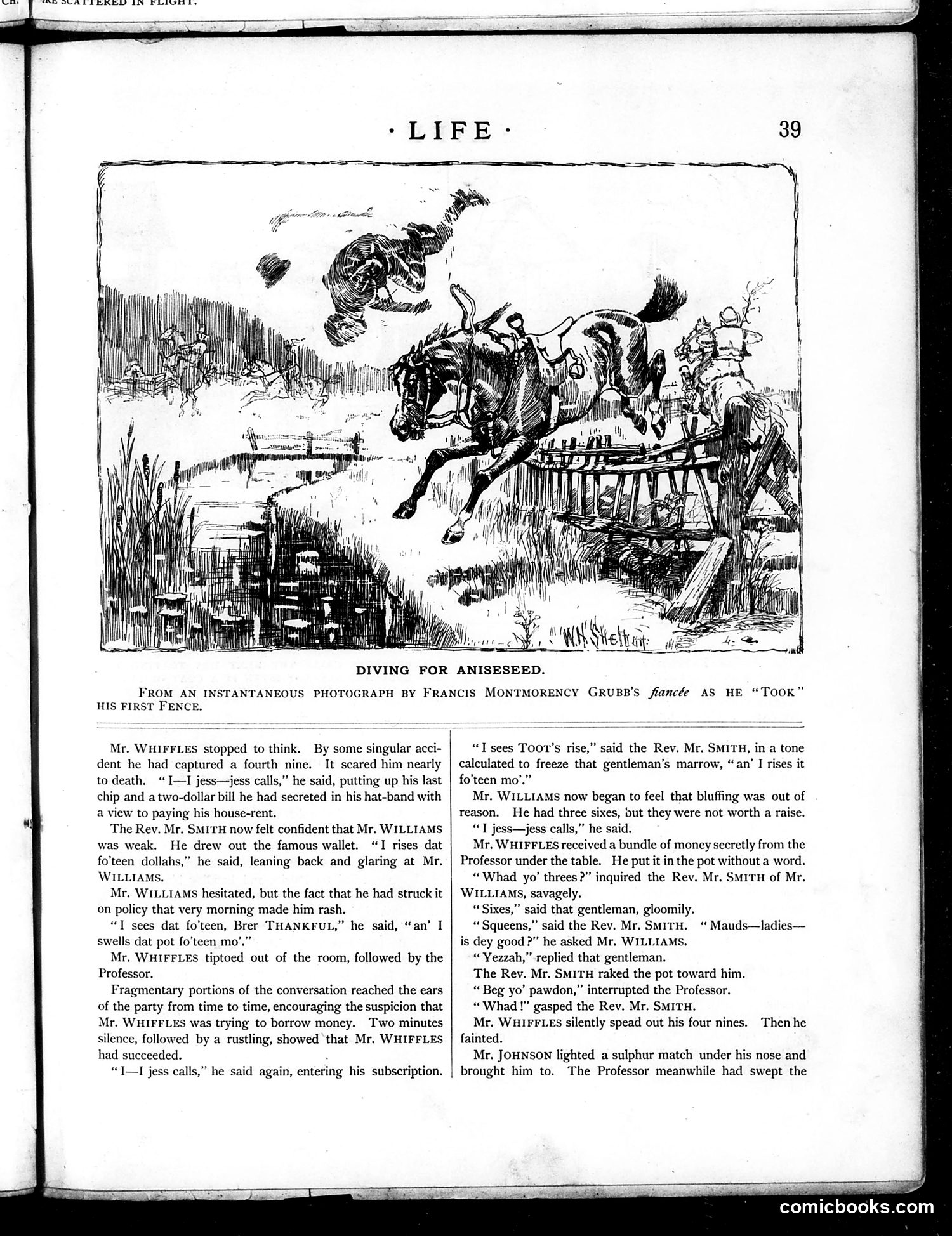
This page contains a poker game narrative satirizing racial stereotypes of the era. The text depicts three Black men—Mr. Whiffles, Reverend Mr. Smith, and Mr. Williams—playing cards with exaggerated dialect ("fo'teen dollahs," "jess calls"). The cartoon illustration shows a horse-and-rider taking a fence, captioned as related to "Francis Montmorency Grubb's fiancée" and his "first fence"—likely a separate, unrelated humorous item about equestrian mishaps. The poker narrative's humor derives from period racial caricature: depicting the players as superstitious, poor, and prone to reckless gambling. The climax—Whiffles winning with four nines after borrowing money from "the Professor"—plays on stereotypes of financial irresponsibility and trickery. The title "Diving for Aniseseed" remains contextually unclear but likely contains additional period-specific slang or reference.
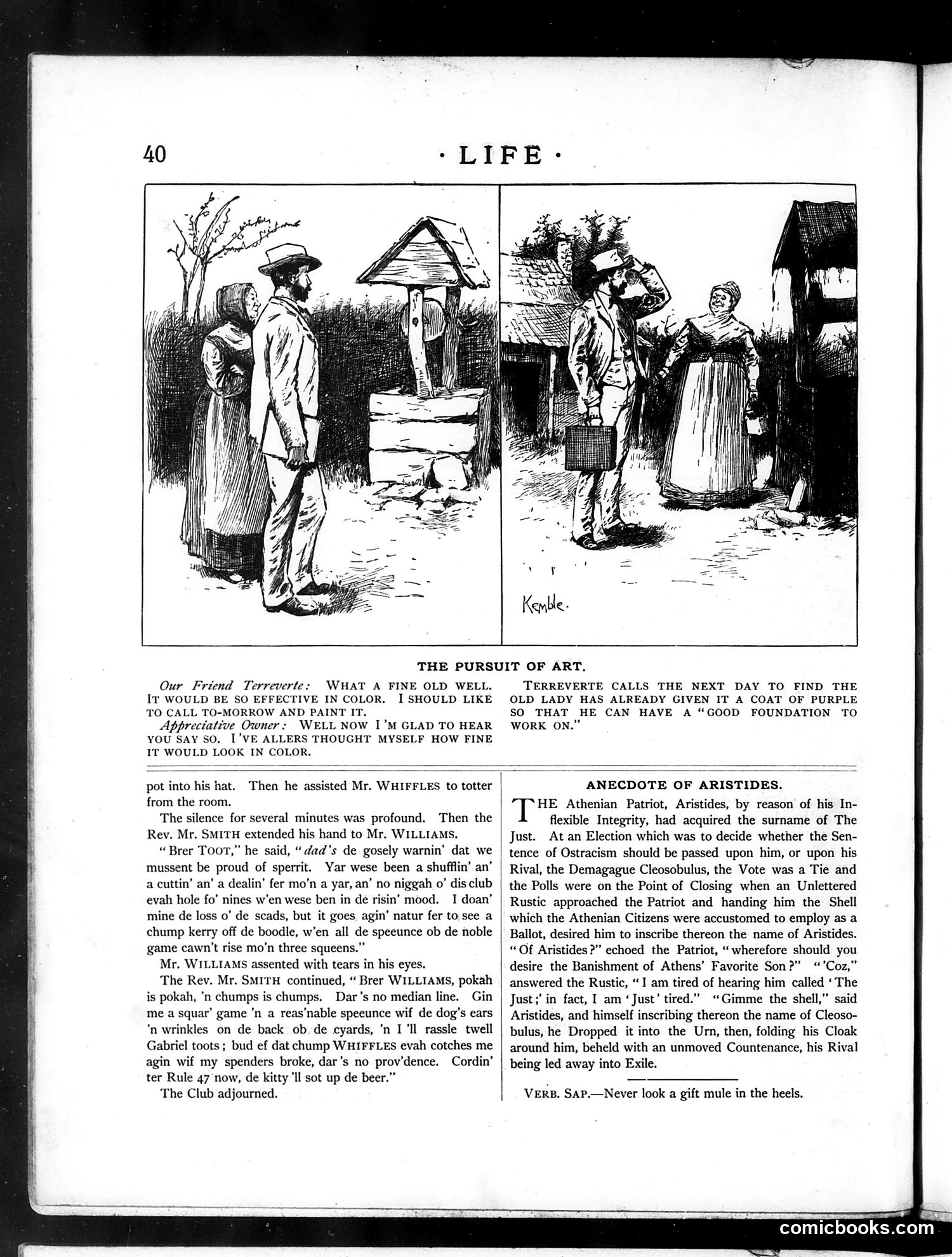
The top cartoon mocks artistic pretension. A man named Terreverte, presenting himself as an artist, flatters a rural property owner about painting his old well "in color." The owner, equally unsophisticated, agrees it would look fine—neither understands art. The joke is revealed when Terreverte returns the next day to find the owner has already painted the well purple, destroying any artistic opportunity. The satire targets both fake artists seeking easy subjects and the clueless wealthy who patronize them without understanding aesthetics. The lower section provides classical context through Aristides, the "Just" Athenian patriot. A peasant, tired of hearing him called "The Just," asks him to write his own name on a ballot for exile—unaware of the irony. Aristides, proving his integrity, writes his rival's name instead, accepting exile with dignity. This contrasts sharply with the contemporary satire above: ancient virtue versus modern fraud.
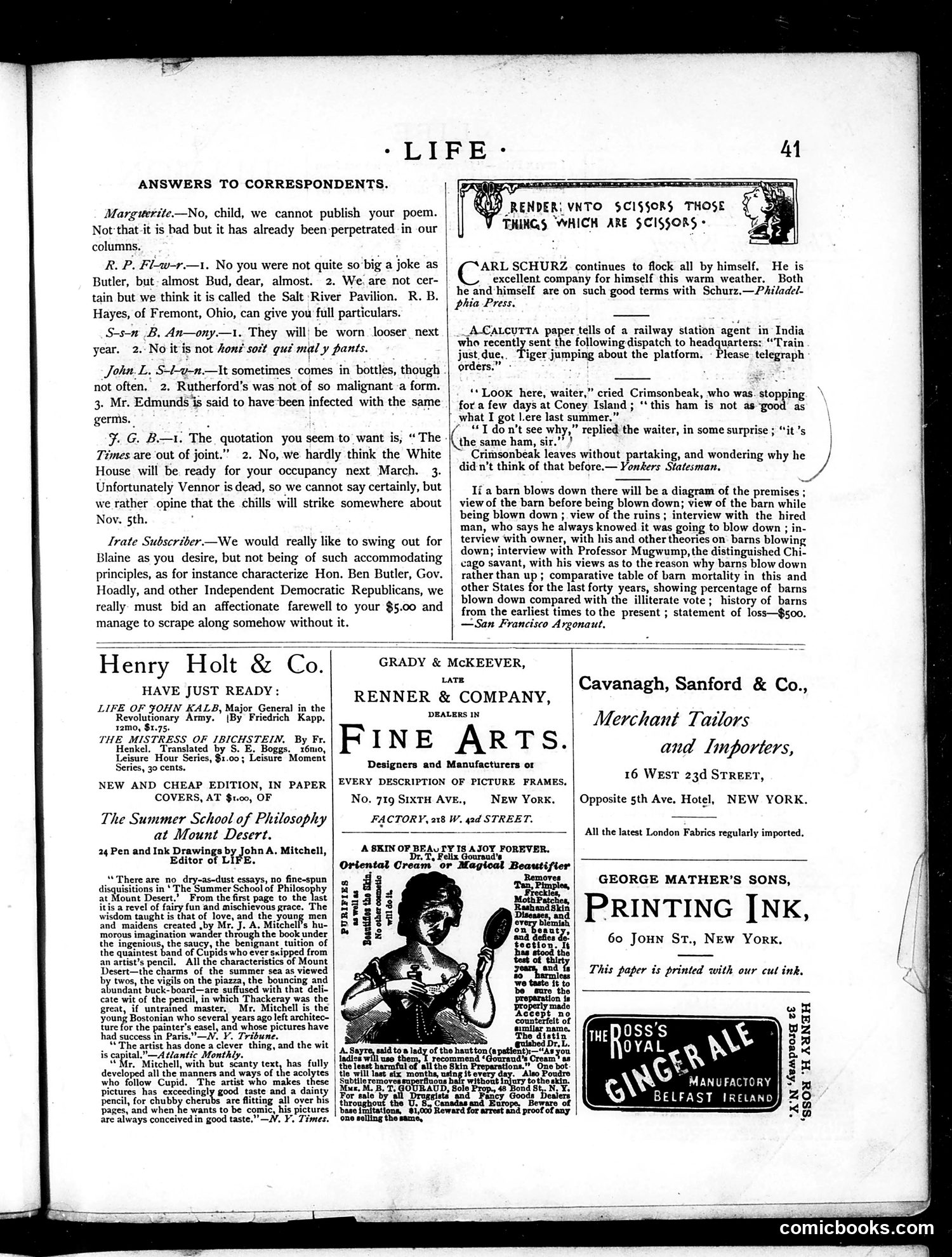
This page is primarily a **humor advice column** with satirical responses to reader letters, reflecting 1870s American politics: **Key References:** - **Ben Butler & Gov. Hoadly**: Criticized as unprincipled "Independent Democratic Republicans"—politicians seen as party-switchers - **Carl Schurz**: Mocked for "continuing to flock all by himself"—likely referencing his political isolation or independent stance - **Rutherford Hayes/Vennor**: References to figures of the era; Vennor's death is noted - **Blaine**: Mentioned as a candidate the magazine won't support, despite reader pressure **The Humor:** The "answers" mock readers about fashion, political candidates, and historical figures. The tone suggests *Life* was a satirical publication pushing back against reader influence, particularly regarding coverage of various political figures and movements. Most jokes are era-specific and require knowledge of 1870s politics and personalities to fully appreciate. The page is otherwise filled with book advertisements and printing company notices.
This is primarily an **advertisements and announcements page** from Life magazine (circa 1883, based on the footer). While it contains some editorial content, the page is dominated by commercial notices. The **editorial content** consists of brief humorous anecdotes typical of Life's satirical style: - "Little Fritz" jokes about a child's naive logic - A banker's wife learns he's embezzling and must flee the country - An overheated man scalds himself on hot food, then ice - "Little Mary and the Bishop" presents a child outwitting a condescending authority figure with an unanswerable theological question These sketches reflect **Victorian-era humor**: wordplay, domestic embarrassment, and children innocently exposing adult pretension or hypocrisy. The **advertisements** hawk luxury items (diamonds, perfume), hotels, candy, and dubious medical remedies (McGraw's "Electric Fluid" for toothaches). The page also promotes Life's own book collections and competitor magazines like *Dio Lewis's Monthly*. This appears to be a **back-of-magazine section** mixing filler content with revenue-generating ads.
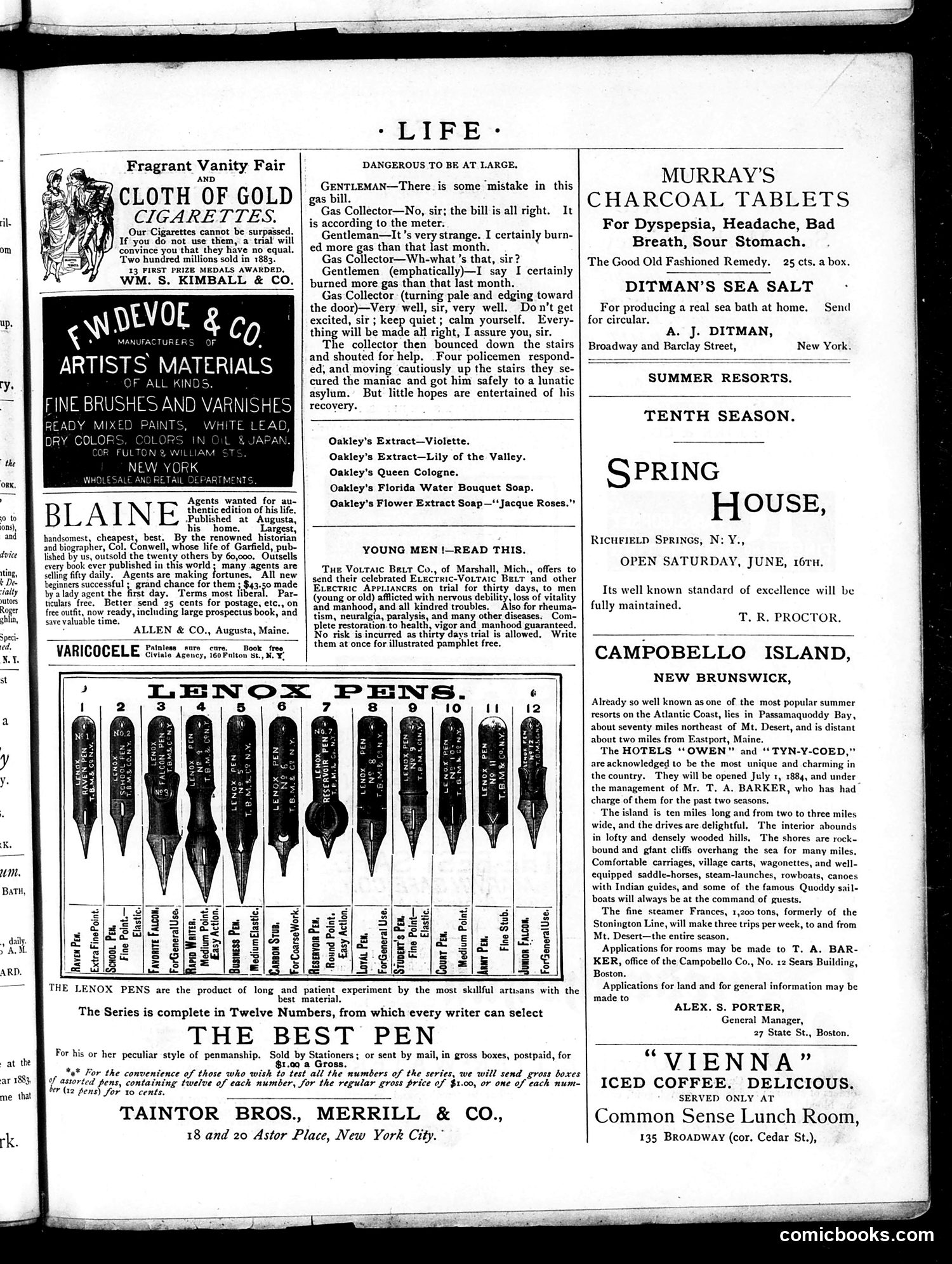
This cartoon satirizes a gas company customer's complaint about an inflated bill. A gentleman disputes his gas charges, insisting he burned more gas the previous month. The gas collector interprets the customer's raised voice and emphasis as a sign of violent insanity, treating him as a dangerous maniac. He flees, summons four policemen, and they forcibly remove the customer to a lunatic asylum. The satire targets both gas companies' allegedly fraudulent billing practices and the era's casual willingness to institutionalize people for minor emotional outbursts. By showing the collector's absurd overreaction to a reasonable complaint, the cartoon implies that gas companies deliberately overcharge customers—and that objecting loudly enough gets you labeled insane. It's dark humor about corporate malfeasance and the period's loose standards for committing people to asylums.
This is primarily an **advertising page** from Life magazine, containing no political cartoons or satirical commentary. Instead, it features period product advertisements typical of the 1880s. The page includes ads for: - **Whiskey, safes, bicycles, corsets, and pianos**—representing typical consumer goods of the era - **Medical/beauty products** like Cuticura soap (for skin conditions) and patent medicines like "Natural Bitter-Water" - **Sporting goods** (tennis equipment, billiards) The only visual element with any illustrative character is a **classical female profile** accompanying the Cuticura ad, depicting idealized beauty—a common marketing approach of the period. **Context for modern readers:** This page reflects the magazine's business model: Life subsidized its satirical content through extensive advertising. The ads reveal what products and health concerns dominated 1880s consumer culture—many of these "patent medicines" made dubious therapeutic claims that would be illegal today. There is no satire or political commentary present on this page.