
Life, 1884-07-17 · page 5 of 16
Life — July 17, 1884 — page 5: what you’re looking at
What you’re looking at
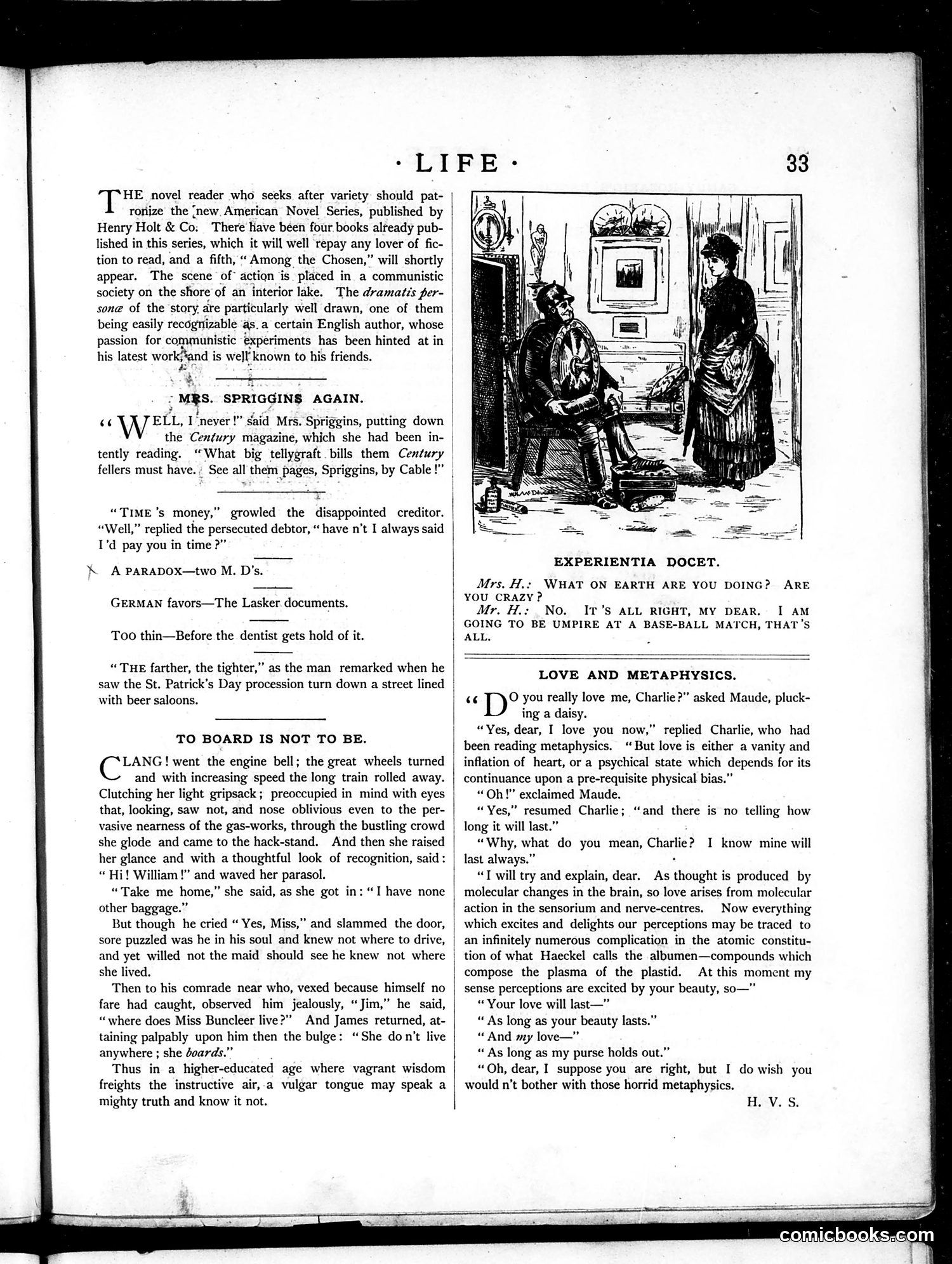
This page contains several short humorous pieces and one illustration rather than a political cartoon. The main illustration shows "Experientia Docet" (Experience Teaches) - depicting what appears to be a domestic scene where a man seated with a newspaper and a standing woman are in conversation, likely about a mundane domestic matter (he mentions umpiring at a baseball match). The page's humor derives from witty, brief satirical pieces about everyday life: Mrs. Spriggins complaining about magazine bills, observations about dentists and St. Patrick's Day celebrations, and a romantic dialogue between Charlie and Maude about love versus metaphysics. The satire targets middle-class concerns and the pretentiousness of intellectual romanticism rather than political issues. It's gentle, domestic humor typical of Life magazine's style.
📄 Transcribed text from this page (OCR, searchable)
Machine-transcribed from the original scan — historical spelling and the odd misread are preserved.
- LIFE HE novel reader who seeks after variety should pat- roriize the (new. American Novel Series, published by Henry Holt & Co: There liave béen four books already pub- lished in this series, which it will well repay any lover of fic- | tion to read, and a fifth, “ Among the Chosen,” will shortly | The scene of* action is. placed in a communistic | appear. society on the shore of an interior lake. The dramates per- sone of the story. are particularly well drawn, one of them being easily recognizable ‘as.a certain English author, whose passion for communistic experiments has been hinted at in his latest workand is well’known to his friends. % : MRS. SPRIGGINS AGAIN. “cc ELL, I inever !" said Mrs. Spriggins, putting down the Century magazine, which she had been in- tently reading. “What big tellygraft bills them Century fellers must have. : See all them pages, Spriggins, by Cable!” | “TIME 's money,” growled the disappointed creditor. “Well,” replied the persecuted debtor, “ have n’t I always said I'd pay you in time ?” A PARADOX—two M. D's. GERMAN favors—The Lasker. documents. Too thin—Before the dentist gets hold of it. “ THE farther, the tighter,” as the man remarked when he saw the St. Patrick's Day procession turn down a street lined | | 6 O you really love me, Charlie?” asked Maude, pluck- with beer saloons. TO BOARD IS NOT TO BE. LANG! went the engine bell; the great wheels turned | and with increasing speed the long train rolled away. Clutching her light gripsack; preoccupied in mind with eyes that, looking, saw not, and nose oblivious even to the per- vasive nearness of the gas-works, through the bustling crowd | she glode and came to the hack-stand. And then she raised her glance and with a thoughtful look of recognition, said: “Hi! William!” and waved her parasol. “Take me home,” she said, as she got in: “I have none other baggage.” But though he cried “ Yes, Miss,” and slammed the door, sore puzzled was he in his soul and knew not where to drive, | and yet willed not the maid should see he knew not where she lived. Then to his comrade near who, vexed because himself no fare had caught, observed him jealously, “Jim,” he said, “where does Miss Buncleer live?” And James returned, at- taining palpably upon him then the bulge: “She don’t live anywhere ; she doards.”” Thus in a higher-educated age where vagrant wisdom freights the instructive air,.a vulgar tongue may speak a mighty truth and know it not. EXPERIENTIA DOCET. Mrs. H.: WHAT ON EARTH ARE YOU DOING? YOU CRAZY? Mr. H.: No. IT’S ALL RIGHT, MY DEAR, I AM GOING TO BE UMPIRE AT A BASE-BALL MATCH, THAT'S ALL, ARE LOVE AND METAPHYSICS. ing a daisy. “Yes, dear, I love you now,” replied Charlie, who had been reading metaphysics. ‘But love is either a vanity and inflation of heart, or a psychical state which depends for its continuance upon a pre-requisite physical bias.” “Oh!” exclaimed Maude. “Yes,” resumed Charlie; “and there is no telling how long it will last.” “Why, what do you mean, Charlie? last always.” “T will try and explain, dear. I know mine will As thought is produced by molecular changes in the brain, so love arises from molecular action in the sensorium and nerve-centres. Now everything which excites and delights our perceptions may be traced to an infinitely numerous complication in the atomic constitu- tion of what Haeckel calls the albumen—compounds which compose the plasma of the plastid. At this moment my sense perceptions are excited by your beauty, so—” “Your love will last—” “As long as your beauty lasts.” “And my love—” “As long as my purse holds out.”” “Oh, dear, I suppose you are right, but I do wish you would n’t bother with those horrid metaphysics. H. V. S.