
Life, 1884-07-17 · page 4 of 16
Life — July 17, 1884 — page 4: what you’re looking at
What you’re looking at
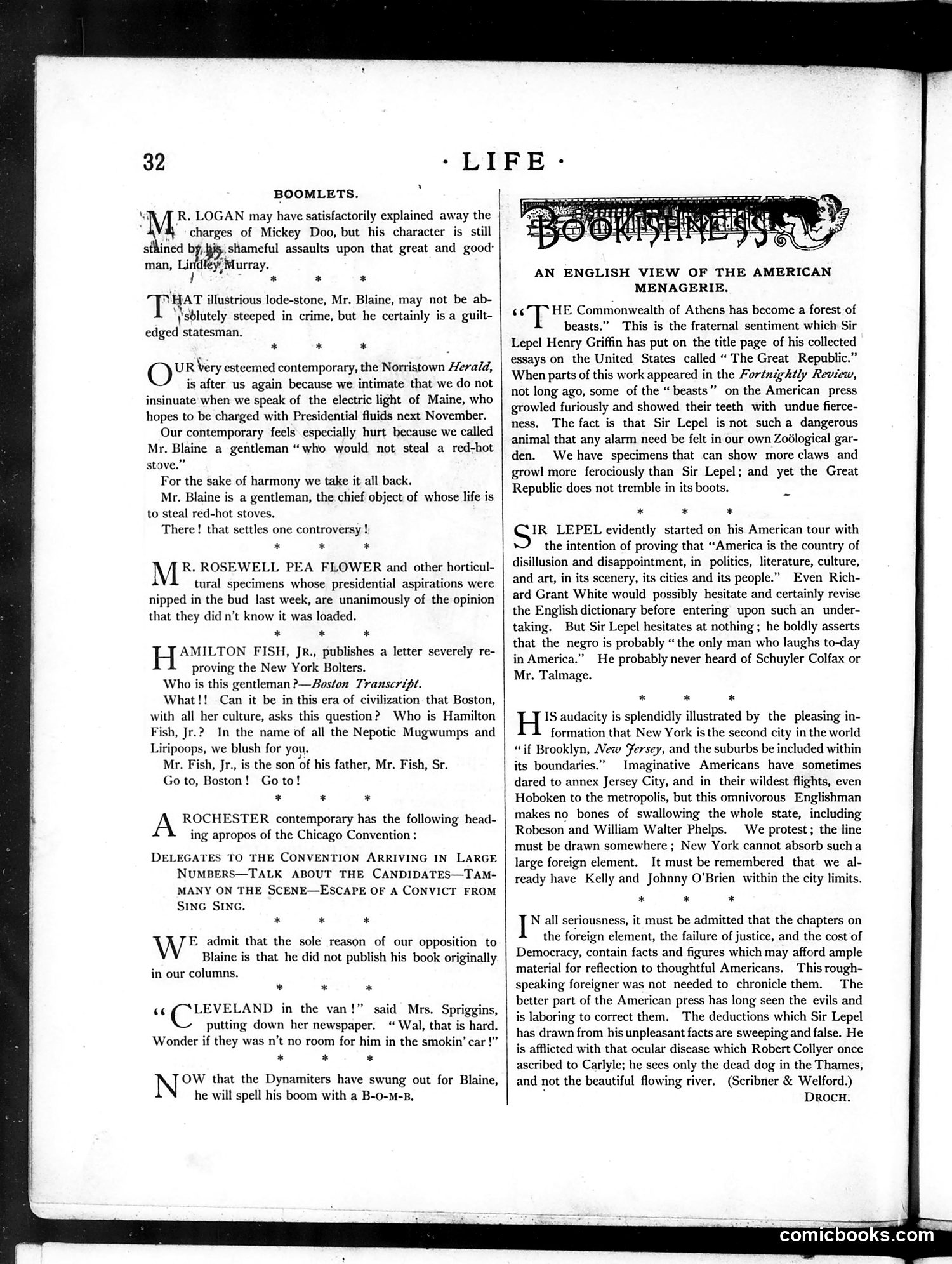
This page contains satirical "Boomlets"—short political commentary pieces—rather than visual cartoons. The content critiques several contemporary figures: **Mr. Logan** defended Mickey Doo, whose character has been damaged by association with "Lindley Murray." **Mr. Blaine** is called a "guilt-edged statesman," implying moral compromise despite avoiding outright criminality. **The Norristown Herald** is mocked for calling Maine's electric light advocate a gentleman unwilling to "steal red-hot stoves"—ironic criticism of someone actually honest. **Sir Lepel's American tour** receives particular scrutiny: the English writer argues America is a country of disillusionment and disappointment, with only the Black population possessing humor. The piece sarcastically disputes his claims about American cities and character, defending American dignity against foreign criticism. The overall tone mocks political hypocrisy and defends American reputation against European condescension.
📄 Transcribed text from this page (OCR, searchable)
Machine-transcribed from the original scan — historical spelling and the odd misread are preserved.
32 BOOMLETS. R. LOGAN may have satisfactorily explained away the 4} charges of Mickey Doo, but his character is still sthined b ne assaults upon that great and good: i ey Murray. * man, Li * * Tet illustrious lode-stone, Mr. Blaine, may not be ab- ‘}sblutely steeped in crime, but he certainly is a guilt- edged statesman. * * * O UR Very esteemed contemporary, the Norristown Hera/d, is after us again because we intimate that we do not insinuate when we speak of the electric light of Maine, who hopes to be charged with Presidential fluids next November. Our contemporary feels especially hurt because we called Mr. Blaine a gentleman “who would not steal a red-hot stove.” For the sake of harmony we take it all back. Mr. Blaine is a gentleman, the chief object of whose life is to steal red-hot stoves. There! that settles one controversy ! \ R. ROSEWELL PEA FLOWER and other horticul- tural specimens whose presidential aspirations were nipped in the bud last week, are unanimously of the opinion that they did n’t know it was loaded. * * * AMILTON FISH, Jr., publishes a letter severely re- proving the New York Bolters. Who is this gentleman ?—Boston Transcript. What!! Can it be in this era of civilization that Boston, with all her culture, asks this question? Who is Hamilton Fish, Jr.? In the name of all the Nepotic Mugwumps and Liripoops, we blush for you, Mr. Fish, Jr., is the son of his father, Mr. Fish, Sr. Go to, Boston! Go to! * * * * * * ROCHESTER contemporary has the following head- ing apropos of the Chicago Convention : DELEGATES TO THE CONVENTION ARRIVING IN LARGE NUMBERS—TALK ABOUT THE CANDIDATES—TAM- MANY ON THE SCENE—ESCAPE OF A CONVICT FROM SING SING. * * * E admit that the sole reason of our opposition to Blaine is that he did not publish his book originally in our columns. * * * «¢ (ALEVELAND in the van!” said Mrs. Spriggins, putting down her newspaper. “ Wal, that is hard. Wonder if they was n’t no room for him in the smokin’ car !” * * * OW that the Dynamiters have swung out for Blaine, he will spell his boom with a B-0-M-B. AN ENGLISH VIEW OF THE AMERICAN MENAGERIE. ““ HE Commonwealth of Athens has become a forest of beasts.” This is the fraternal sentiment which Sir Lepel Henry Griffin has put on the title page of his collected essays on the United States called “ The Great Republic.” When parts of this work appeared in the Fortnightly Review, not long ago, some of the “ beasts” on the American press growled furiously and showed their teeth with undue fierce- ness. The fact is that Sir Lepel is not sucha dangerous animal that any alarm need be felt in our own Zodlogical gar- den. We have specimens that can show more claws and growl more ferociously than Sir Lepel; and yet the Great Republic does not tremble in its boots. * * * IR LEPEL evidently started on his American tour with the intention of proving that “America is the country of disillusion and disappointment, in politics, literature, culture, and art, in its scenery, its cities and its people.” Even Rich- ard Grant White would possibly hesitate and certainly revise the English dictionary before entering upon such an under- taking. But Sir Lepel hesitates at nothing ; he boldly asserts that the negro is probably “the only man who laughs to-day in America.” He probably never heard of Schuyler Colfax or Mr. Talmage. * * * IS audacity is splendidly illustrated by the pleasing in- formation that New York isthe second city in the world “if Brooklyn, Mew Fersey, and the suburbs be included within its boundaries.” Imaginative Americans have sometimes dared to annex Jersey City, and in their wildest flights, even Hoboken to the metropolis, but this omnivorous Englishman makes no bones of swallowing the whole state, including Robeson and William Walter Phelps. We protest ; the line must be drawn somewhere ; New York cannot absorb sucha large foreign element. It must be remembered that we al- ready have Kelly and Johnny O’Brien within the city limits. * * * N all seriousness, it must be admitted that the chapters on the foreign element, the failure of justice, and the cost of Democracy, contain facts and figures which may afford ample material for reflection to thoughtful Americans. This rough- speaking foreigner was not needed to chronicle them. The better part of the American press has long seen the evils and is laboring to correct them. The deductions which Sir Lepel has drawn from his unpleasant facts are sweeping and false. He is afflicted with that ocular disease which Robert Collyer once ascribed to Carlyle; he sees only the dead dog in the Thames, and not the beautiful flowing river. (Scribner & Welford.) , Drocu. comicbooks.com