
Life, 1884-07-17 · page 6 of 16
Life — July 17, 1884 — page 6: what you’re looking at
What you’re looking at
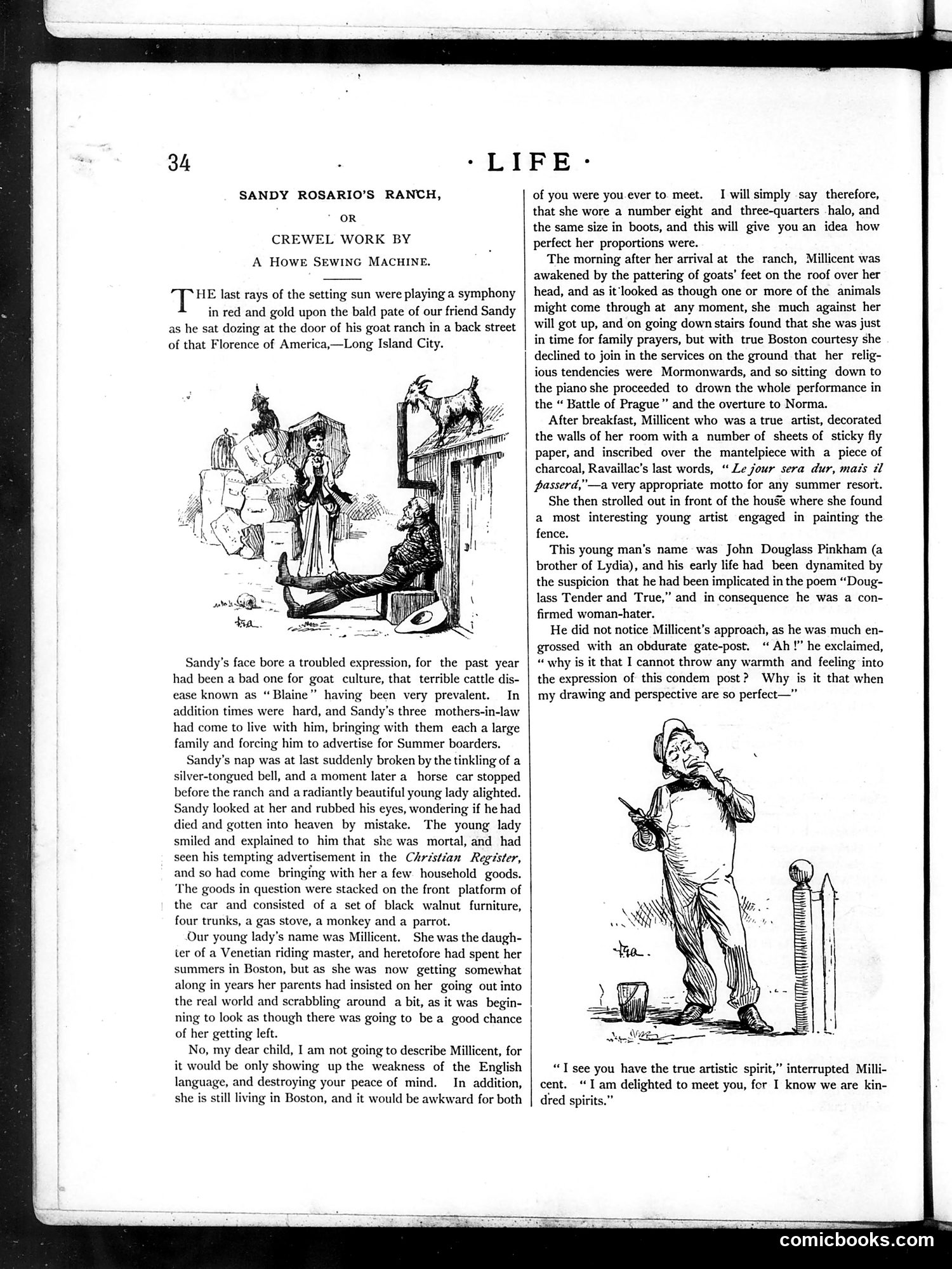
This page contains a short story titled "Sandy Rosario's Ranch" with illustrations rather than political satire. The narrative describes Sandy, a rancher dealing with cattle disease ("Blaine") and difficult times, whose troubles are interrupted by the arrival of a beautiful young woman named Millicent. The two illustrations show: (1) Millicent's arrival by horse-car with her belongings, and (2) John Douglass Pinkham, a young artist whom Millicent encounters painting a fence. The story satirizes Pinkham as a "woman-hater" who complains about artistic criticism, while Millicent represents an independent, cultured woman from Boston. This appears to be serialized fiction rather than editorial commentary or political cartooning.
📄 Transcribed text from this page (OCR, searchable)
Machine-transcribed from the original scan — historical spelling and the odd misread are preserved.
- LIFE: SANDY ROSARIO’S RANCH, OR CREWEL WORK BY A HOWE SEWING MACHINE. HE last rays of the setting sun were playing a symphony in red and gold upon the bald pate of our friend Sandy as he sat dozing at the door of his goat ranch in a back street of that Florence of America,—Long Island City. a SS as! (7) tes Sandy’s face bore a troubled expression, for the past year had been a bad one for goat culture, that terrible cattle dis- ease known as “Blaine” having been very prevalent. In addition times were hard, and Sandy’s three mothers-in-law had come to live with him, bringing with them each a large family and forcing him to advertise for Summer boarders. Sandy's nap was at last suddenly broken by the tinkling of a silver-tongued bell, and a moment later a horse car stopped before the ranch and a radiantly beautiful young lady alighted. Sandy looked at her and rubbed his eyes, wondering if he had died and gotten into heaven by mistake. The young lady smiled and explained to him that she was mortal, and had seen his tempting advertisement in the Christian Register, and so had come bringing with her a few household goods. ‘The goods in question were stacked on the front platform of the car and consisted of a set of black walnut furniture, four trunks, a gas stove, a monkey and a parrot. Our young lady's name was Millicent. She was the daugh- ter of a Venetian riding master, and heretofore had spent her summers in Boston, but as she was now getting somewhat along in years her parents had insisted on her going out into the real world and scrabbling around a bit, as it was begin- ning to look as though there was going to be a good chance of her getting left. No, my dear child, I am not going to describe Millicent, for it would be only showing up the weakness of the English language, and destroying your peace of mind. In addition, she is still living in Boston, and it would be awkward for both of you were you.ever to meet. I will simply say therefore, that she wore a number eight and three-quarters -halo, and the same size in boots, and this will give you an idea how perfect her proportions were. The morning after her arrival at the ranch, Millicent was awakened by the pattering of goats’ feet on the roof over her head, and as it‘looked as though one or more of the animals might come through at any moment, she much against her will got up, and on going down stairs found that she was just in time for family prayers, but with true Boston courtesy she declined to join in the services on the ground that her relig- ious tendencies were Mormonwards, and so sitting down to the piano she proceeded to drown the whole performance in the “ Battle of Prague” and the overture to Norma. After breakfast, Millicent who was a true artist, decorated the walls of her room with a number of sheets of sticky fly paper, and inscribed over the mantelpiece with a piece of charcoal, Ravaillac’s last words, “ Le jour sera dur, mais il passerd,"—a very appropriate motto for any summer resort. She then strolled out in front of the house where she found a most interesting young artist engaged in painting the fence. This young man’s name was John Douglass Pinkham (a brother of Lydia), and his early life had been dynamited by the suspicion that he had been implicated in the poem “Doug- lass Tender and True,” and in consequence he was a con- firmed woman-hater. He did not notice Millicent’s approach, as he was much en- grossed with an obdurate gate-post. “ Ah!” he exclaimed, “why is it that I cannot throw any warmth and feeling into the expression of this condem post? Why is it that when my drawing and perspective are so perfect—” “T see you have the true artistic spirit,” interrupted Milli- cent. “Iam delighted to meet you, for I know we are kin- dred spirits.” comicbooks.com