
A complete issue · 16 pages · 1884
Life — July 10, 1884
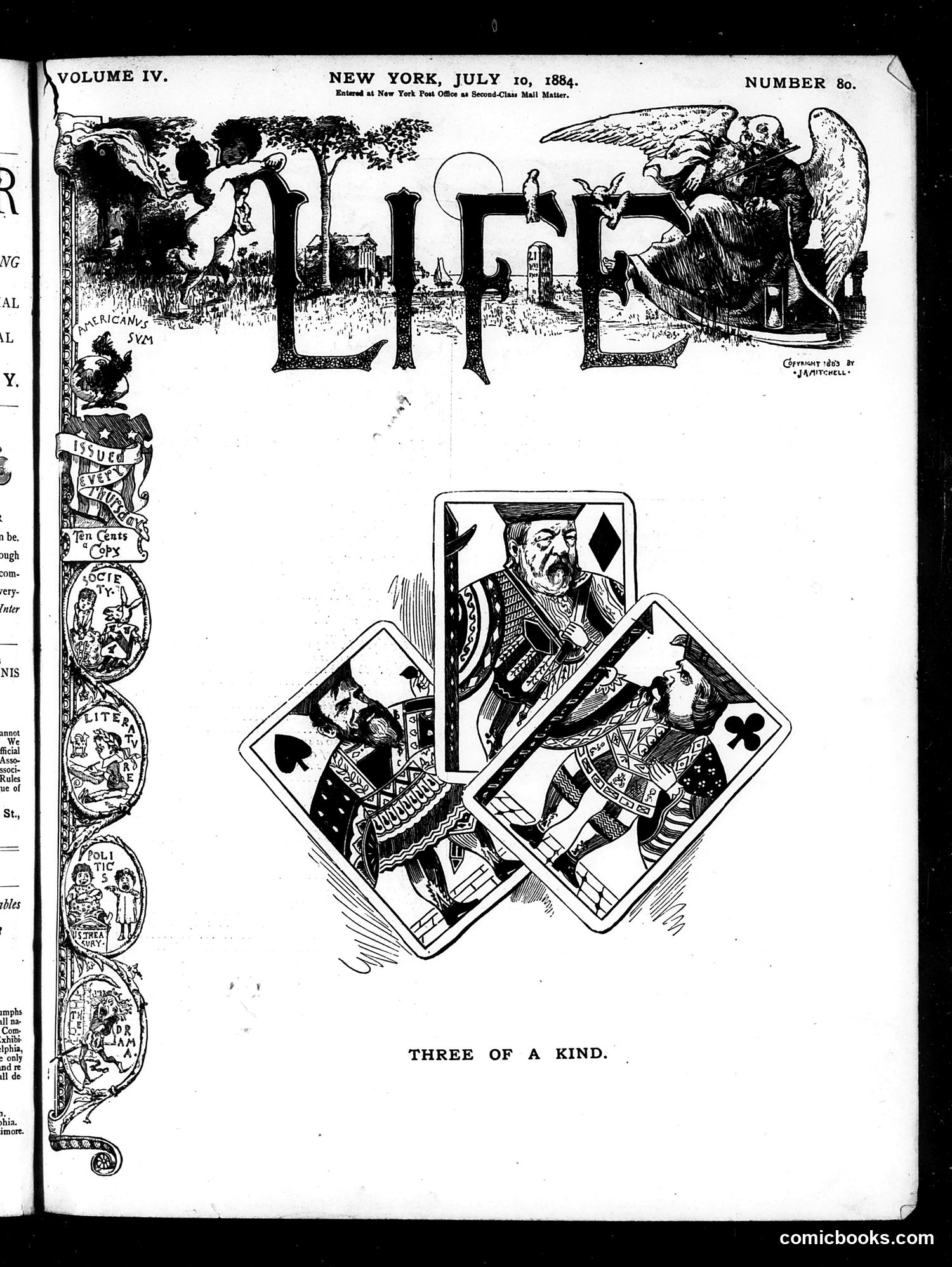
This cartoon shows three playing cards—a King of Diamonds, Queen of Spades, and Jack of Clubs—arranged as if discarded during a card game. The title "Three of a Kind" is a poker reference, though three different suits cannot form a winning hand, making the title ironic. The imagery likely satirizes contemporary political or social figures as "three of a kind"—suggesting they're alike despite appearing different, or that they're fraudulent/worthless like a bad hand. Without identifying specific faces clearly, the cartoon appears to comment on hypocrisy or deception among prominent figures of 1884, using the card metaphor to suggest they're all equally unsuitable or corrupt. The exact targets remain unclear from the image alone.
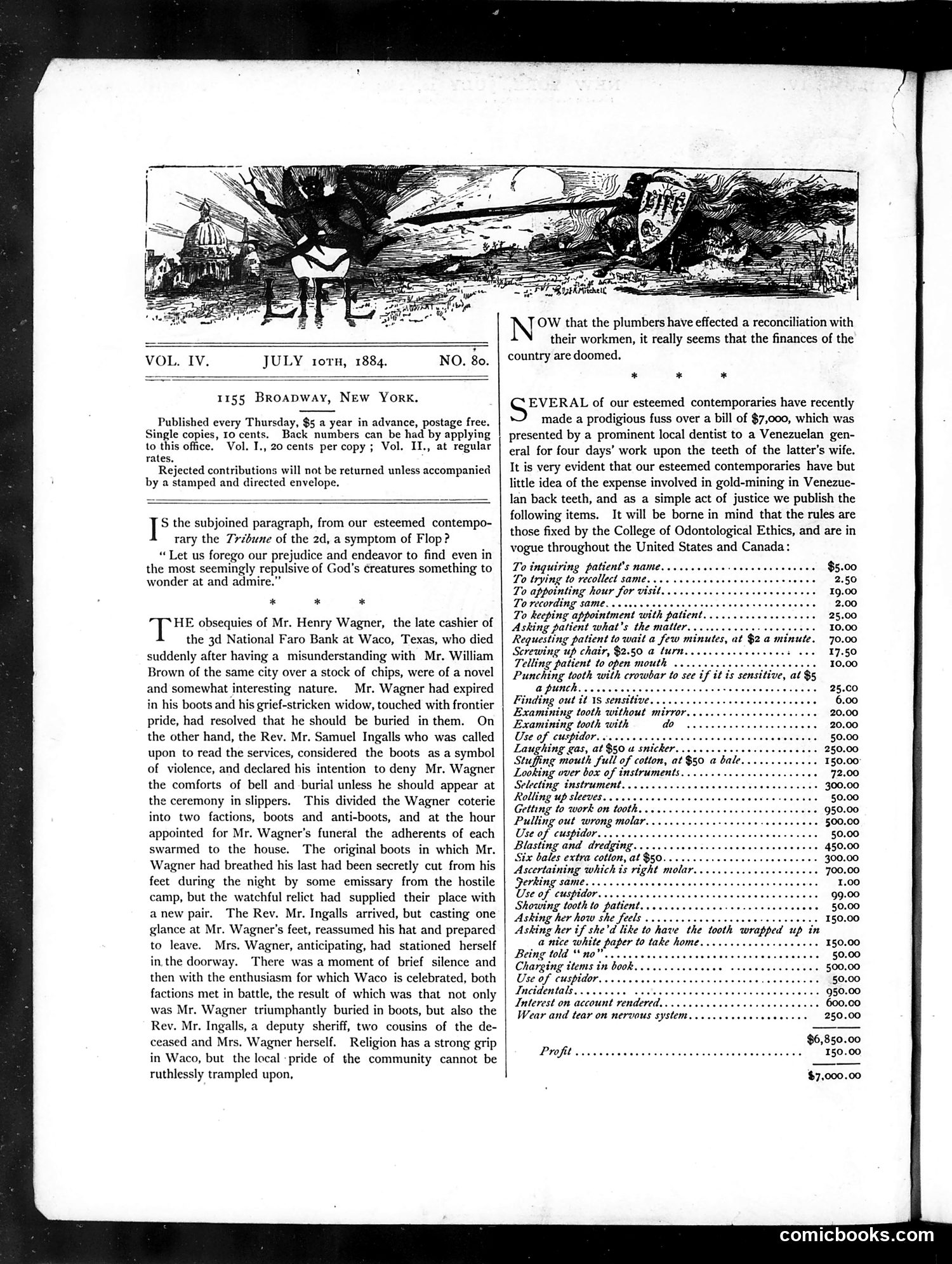
The page header cartoon depicts a figure labeled "Life" - likely the magazine's mascot or personification - in a dramatic scene with what appears to be destruction or chaos in the background. The main text satirizes a Venezuelan general's bill for $7,000 dental work on his wife's teeth, presented to a Venetian general. The satire mocks the absurdly inflated costs itemized line-by-line (inquiring patient's name: $5.00; "Screaming up chair": $7.50; "Stuffing mouth full of cotton": $150.00, etc.). The piece also recounts an anecdote about Henry Wagner, a cashier in Waco, Texas, whose boots became a symbol of frontier dispute between religious factions—mocking both frontier violence and religious hypocrisy. The satirical intent targets both medical price-gouging and absurd social conflicts of the era.
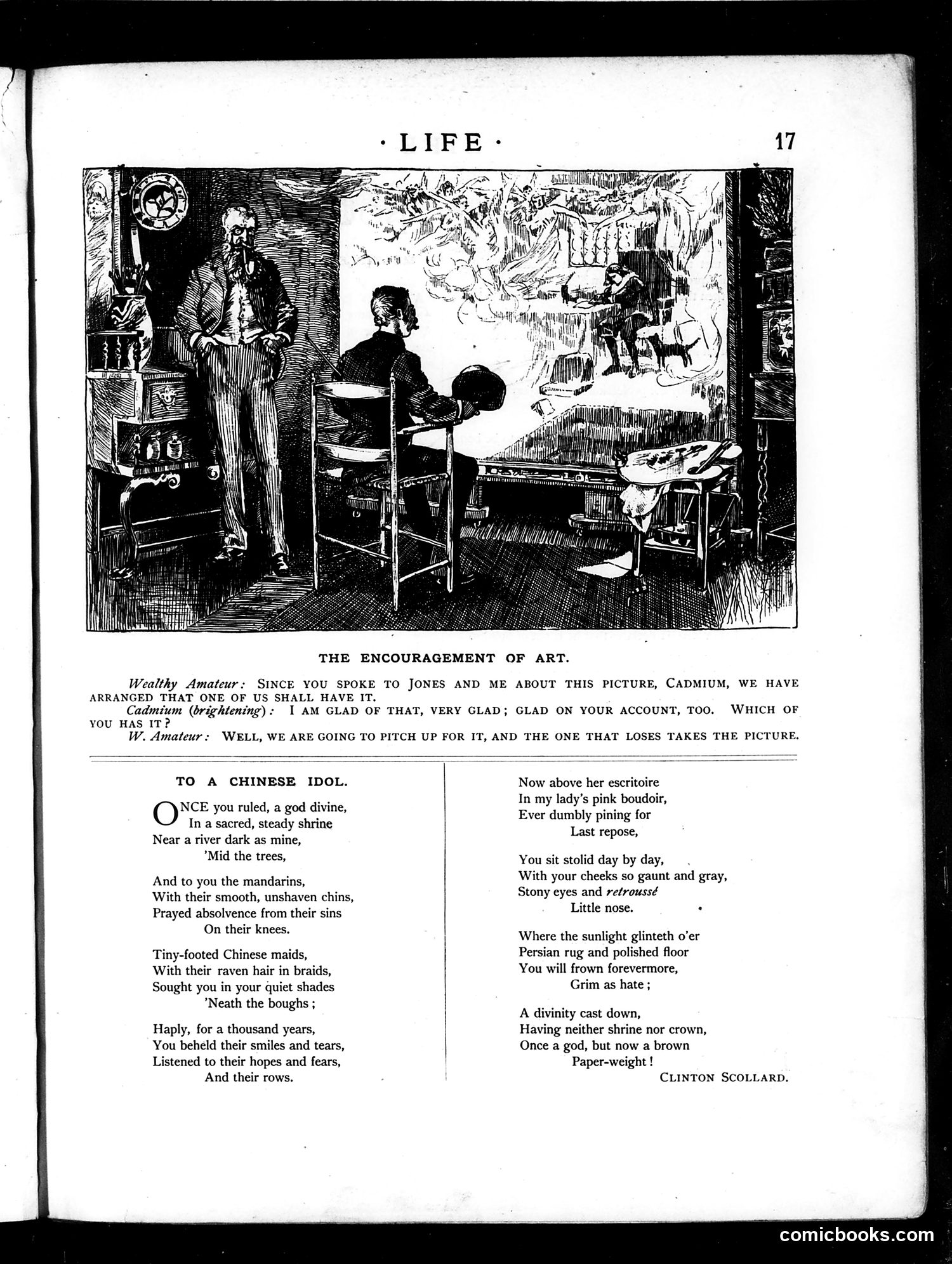
The top cartoon satirizes wealthy amateur art collectors. Two wealthy men discuss purchasing a painting from "Cadmium," a struggling artist. One proposes they gamble for it—"the one that loses takes the picture"—revealing their actual disinterest in art itself. The joke exposes how wealthy dilettantes treat art acquisitions as casual wagers rather than genuine patronage or appreciation. Below, Clinton Scollard's poem "To a Chinese Idol" laments the decline of a once-revered religious statue, now reduced to a decorative "paper-weight" in a wealthy person's home. The verses contrast the idol's former spiritual significance with its current status as mere ornament, criticizing the commodification and trivialization of sacred objects by affluent collectors indifferent to their cultural meaning.
This page contains satirical commentary rather than a political cartoon. The "Boomlets" section mocks contemporary political and social figures through brief written quips: - The Boston *Post* is criticized for claiming Logan and Slogan don't rhyme - French threats to bombard Ha-noi are ridiculed - Republican political maneuvering is sarcastically noted - MacVeagh is praised for withdrawing from politics The right column discusses Edward Bellamy's novel *"Miss Ludington's Sister: A Romance of Immortality,"* arguing it presents an ingenious theory of spiritual immortality that could be weaponized for political campaigns—particularly the Republican National Committee's efforts to "materialize the dead" voters in Pennsylvania and Connecticut. The humor targets both political absurdity and the exploitation of spiritualism for electoral purposes during the Gilded Age.
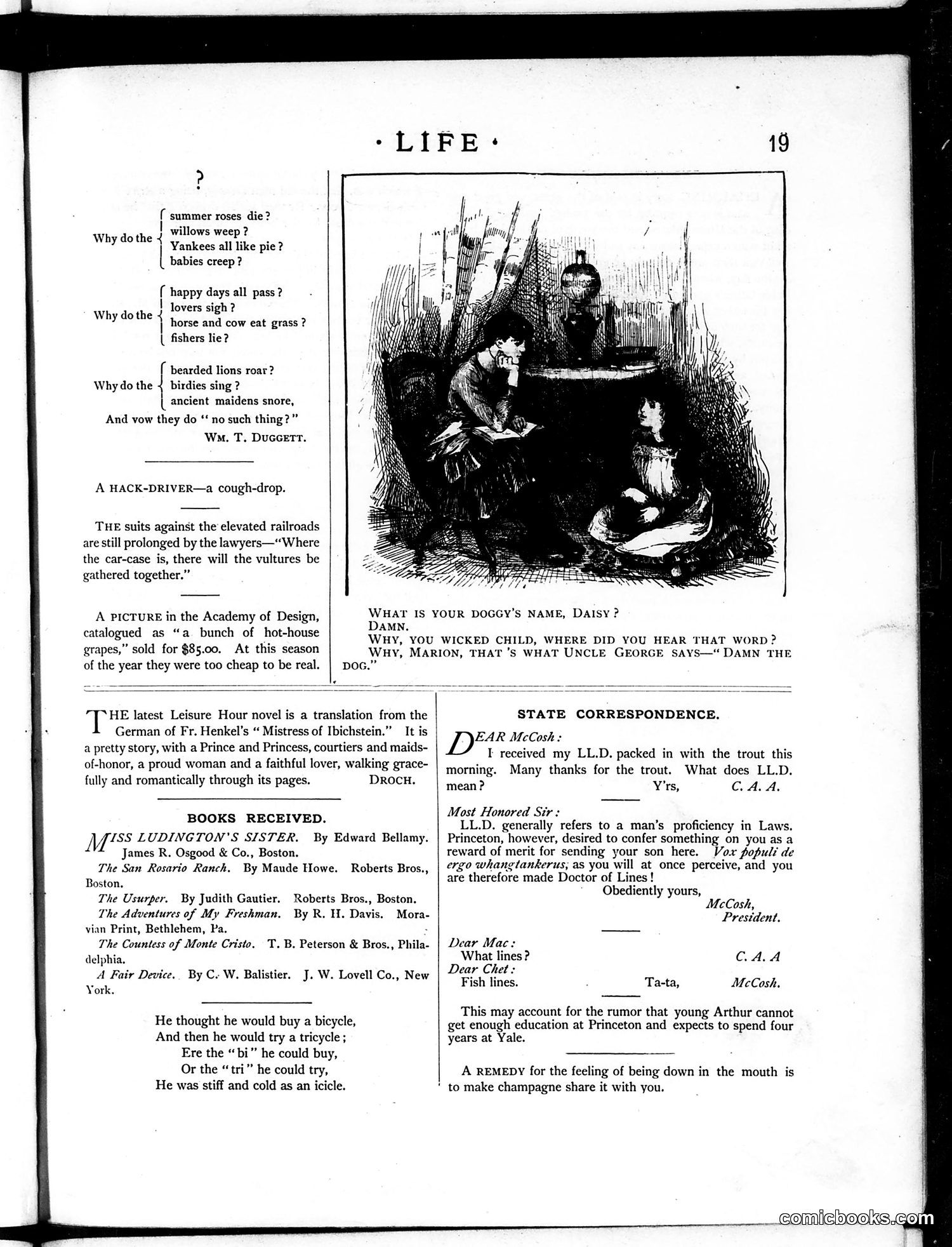
The main illustration depicts a domestic scene where an adult scolds a child about the word "damn." The child has named their dog "Daisy" but calls it by an oath, claiming to have heard Uncle George use the term. The adult responds with mock horror, suggesting the child learned this language from an elder male relative. This is a gentle satirical commentary on Victorian-era hypocrisy regarding profanity—adults, particularly men, used such language freely but feigned shock when children repeated it. The joke exploits the contradiction between proper public manners and private behavior, with "Uncle George" serving as the typical scapegoat for corrupting youth. It reflects period anxieties about childhood innocence and adult moral responsibility.
This page contains no political cartoon. Instead, it's a literary piece titled "Judith Rooney, or Skim-Milk and Daisies," a novel serialized in Life magazine. The content includes a "Campaign Anecdote" about a young boy named James whose father was turning soil in a garden—a story illustrating lessons about hard work and honesty for aspiring politicians. Below that begins Chapter II of the Judith Rooney novel, describing a heroine living on Rhode Island who tends a lighthouse while reading Harper's Bazaar and pining for romance. This is serialized fiction, not satire or political commentary. Life magazine during this era mixed humor, advertisements, and serialized stories for its readers.
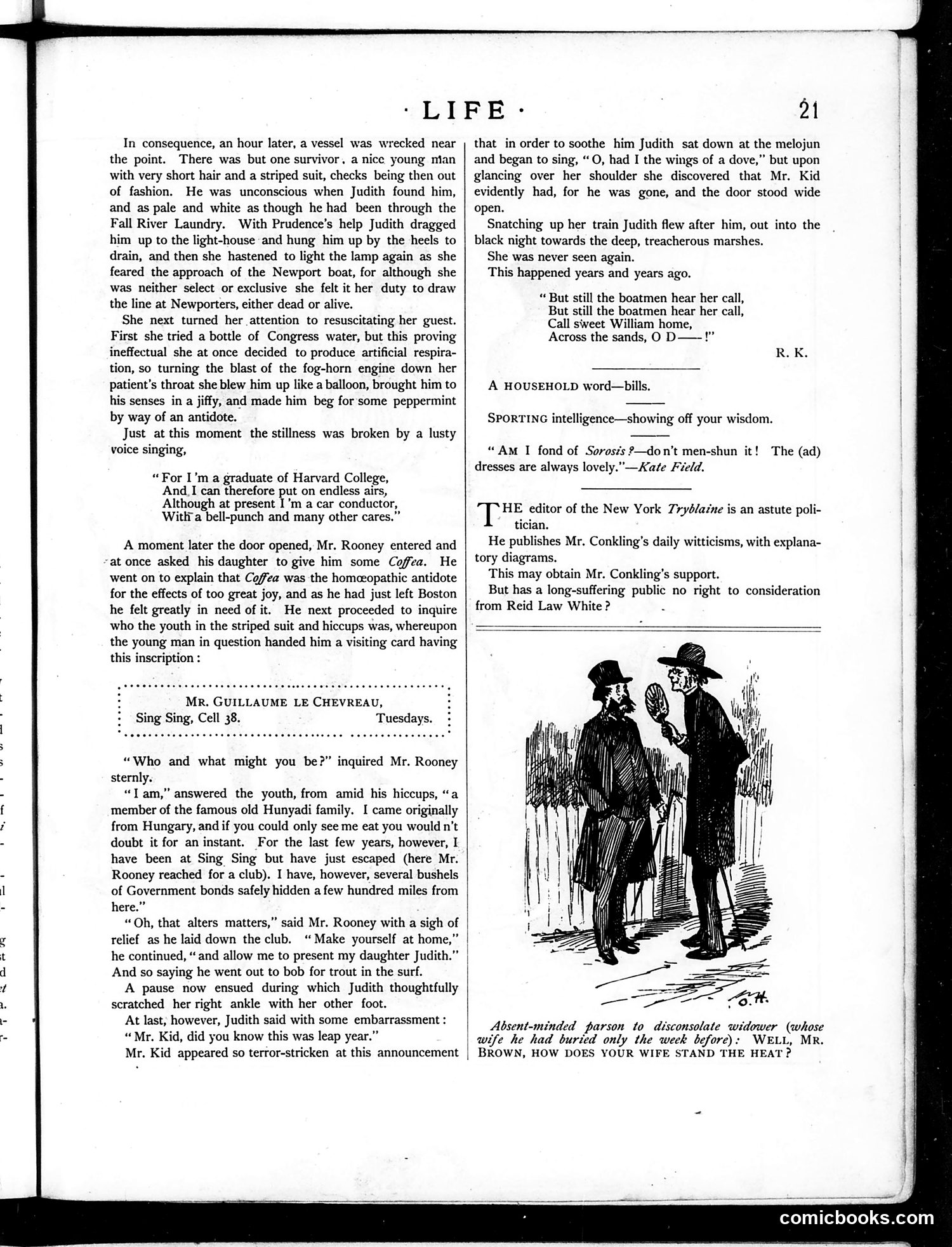
The page contains a short story excerpt and editorial commentary, with one political cartoon at the bottom. **The Cartoon:** Depicts two men in conversation outdoors. The caption identifies one as an "absent-minded parson" whose wife he recently buried, and asks "Well, Mr. Brown, how does your wife stand the heat?" This is dark humor playing on the man's forgetfulness—he's forgotten his wife is dead, suggesting his absent-mindedness is so severe he's lost track of major life events. **Editorial Section:** References "Reid Law White" and discusses the New York *Trybune* editor's publishing of "Mr. Conkling's daily witticisms with explanatory diagrams," suggesting satire of newspaper politics and editorial practices of the era. The overall tone is satirical commentary on contemporary social and political figures, typical of Life magazine's humor.
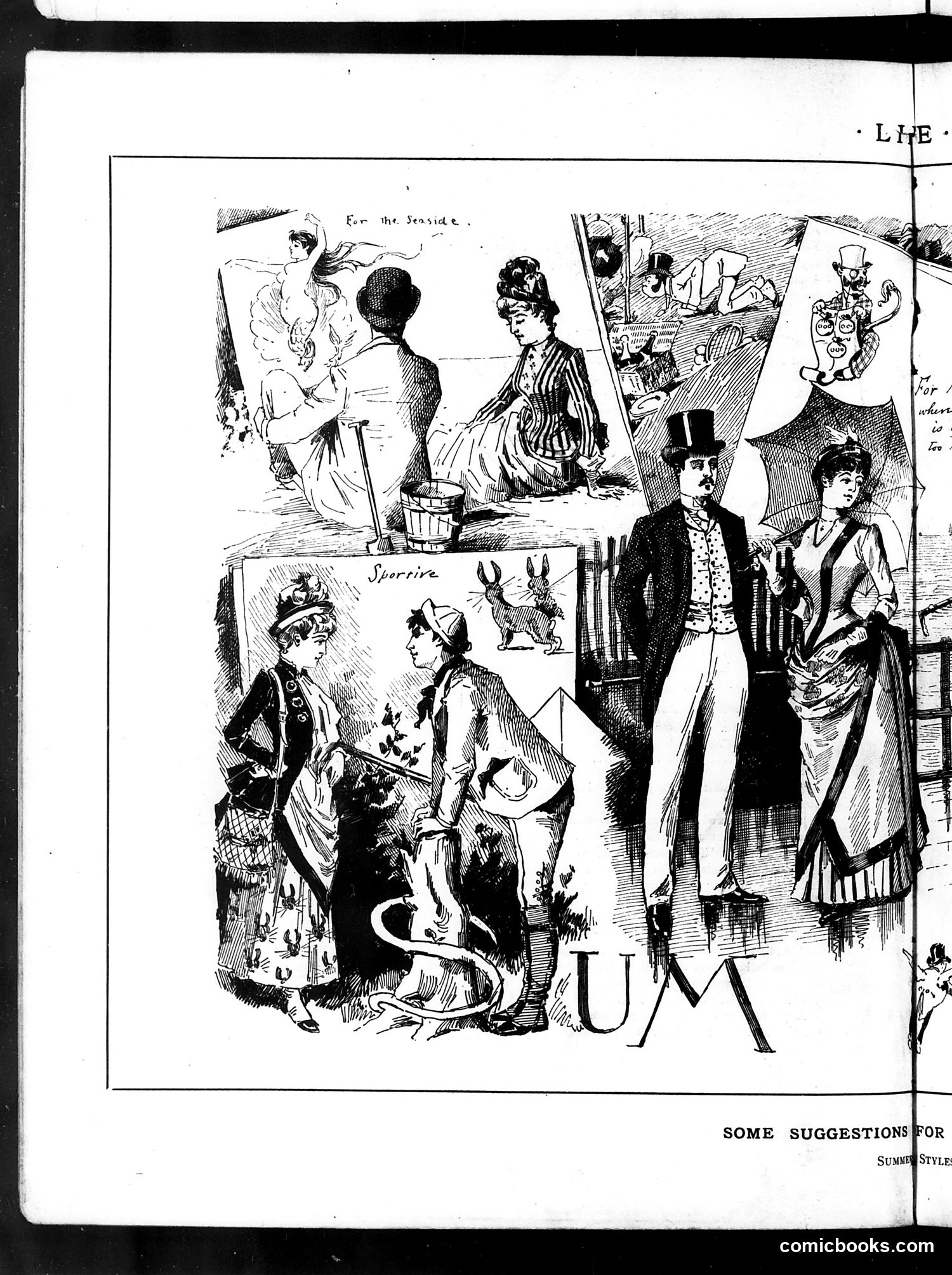
This is a satirical fashion illustration page showing various summer clothing and social scenarios from what appears to be the Edwardian era (early 1900s). The page presents exaggerated depictions of fashionable society figures in summer attire and activities. The cartoon mocks upper-class leisure pursuits and fashion pretensions through several vignettes: formal summer outings, theatrical displays, and social gatherings. The sketches satirize the elaborate, restrictive clothing women wore during this period—including corseted silhouettes and impractical accessories—while men display equally formal attire with top hats for casual daytime events. The title and layout suggest Life magazine is gently ridiculing contemporary fashion conventions and the absurdity of maintaining formal dress codes even during relaxed summer months.
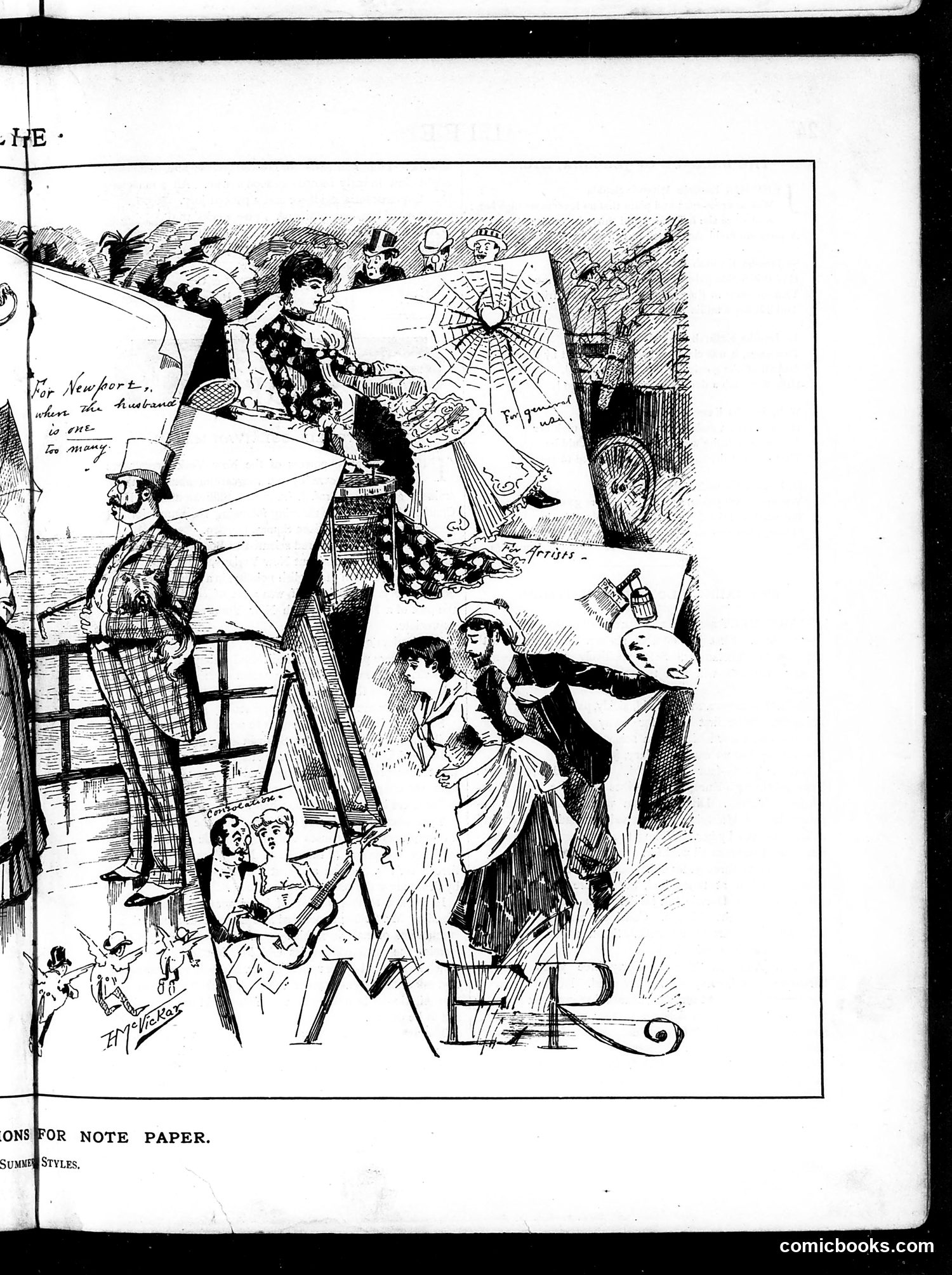
This appears to be a satirical illustration about New York society and fashion, likely from the late 19th or early 20th century based on the artistic style. The central figure is an elegantly dressed woman in an elaborate patterned gown, positioned prominently. She's surrounded by various vignettes showing fashionable people, carnival/theatrical imagery (including what appears to be a clown or jester figure), and social scenes. The text references "For New York—for the husband is one too many" and mentions "Summer Styles," suggesting commentary on women's fashion, social climbing, or marital dynamics among wealthy New Yorkers. The carnival imagery may mock the artificiality or spectacle of high society. Without clearer OCR text, the specific satirical target remains somewhat unclear, though it definitely critiques fashionable society.
This page contains three distinct satirical pieces: **"The Ballade of Jerusha"** mocks a homely spinster who fabricates wealth (inheriting a million pounds) to attract a husband. The satire targets both her deception and the suitor's mercenary motives—he only pursues her upon hearing of the inheritance, abandoning interest when he discovers there's "no tin" (money). **"For Sale—A Lot of Clergymen"** is a bitter catalog satirizing corrupt or hypocritical clergy. Each numbered entry exposes clerical vices: theological rigidity, divorce, Darwin-denial, mercenary matchmaking, class snobbery, and Catholic ritualism. The ad format mock-treats ministers as commodities to be bought, highlighting their disposability and moral compromises. **"The Mitchell-Sullivan Match"** reports on a boxing exhibition between "Prof." John L. Sullivan and English nobleman Charles Mitchell at Madison Square Garden. The piece ironically frames this "refined exhibition of fisticuffery" as a cultural event, while mocking press coverage and audience behavior—crowds demanded refunds and threw money back, displaying boorishness Life attributed to working-class spectators. All three pieces employ satirical exaggeration to critique social hypocrisy, greed, and moral decay.
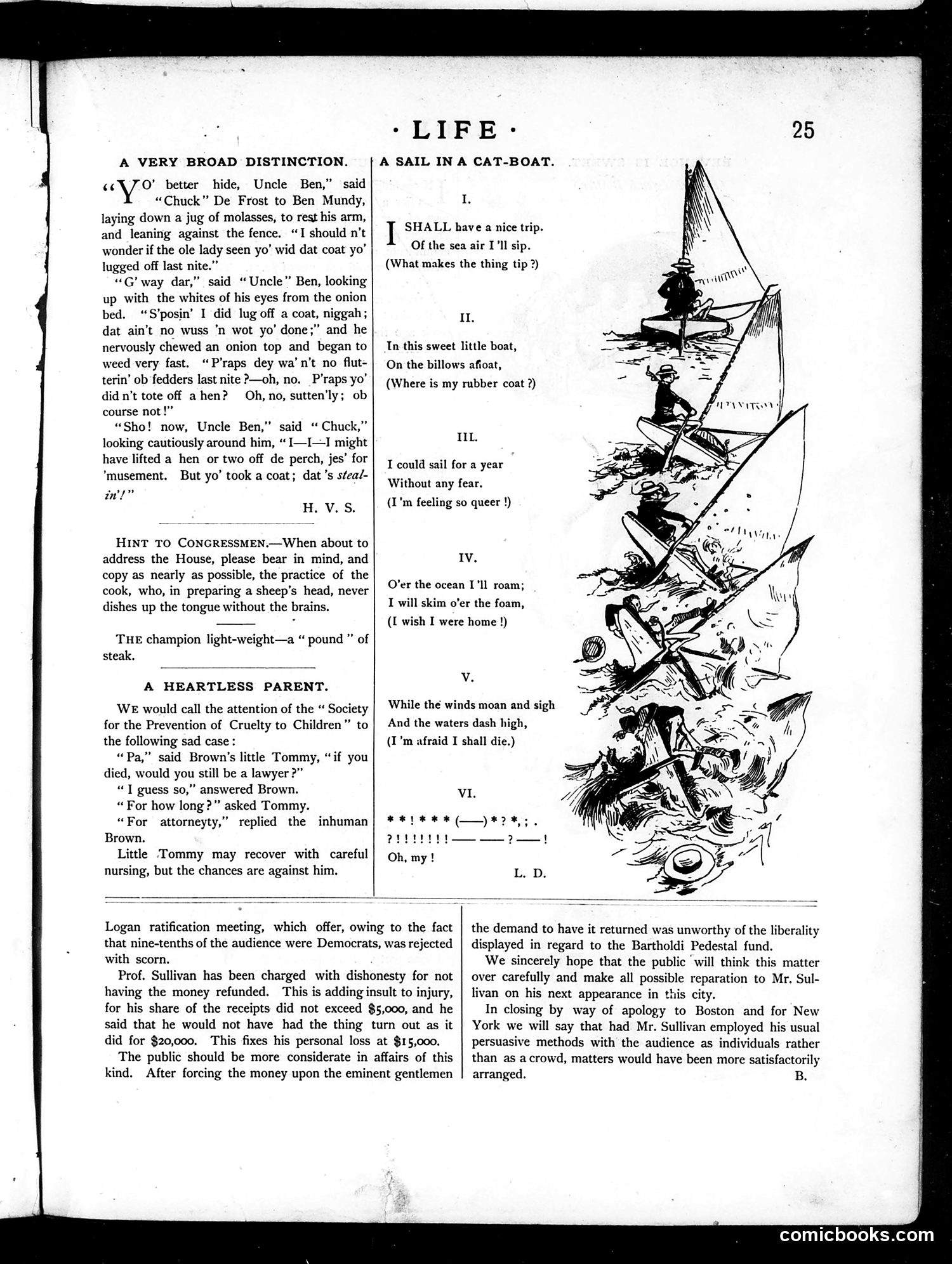
This page contains three separate satirical pieces: **"A Very Broad Distinction"**: A dialect humor piece featuring two African American workers debating petty theft. One accuses the other of stealing a coat; the accused responds that his accuser stole a hen. The "broad distinction" of the title is the satirical point—both are thieves, yet each tries to claim moral superiority. This reflects the crude racial stereotyping common in late 19th-century American humor. **"A Sail in a Cat-Boat"**: A six-stanza poem with accompanying illustrations showing a sailboat passenger's shifting emotions. Each stanza presents brave declarations (I'll have a nice trip, sail fearlessly) immediately contradicted by parenthetical admissions of seasickness and homesickness. The humor lies in this contrast between bold aspirations and reality. **"A Heartless Parent"**: A brief joke where a lawyer father answers his son's question about whether he'd still be a lawyer after death with "For attorneyty" (playing on "eternity"). The satire mocks lawyers as inherently permanent fixtures, suggesting their profession defines them eternally. The page also includes miscellaneous editorial commentary on political and social matters.
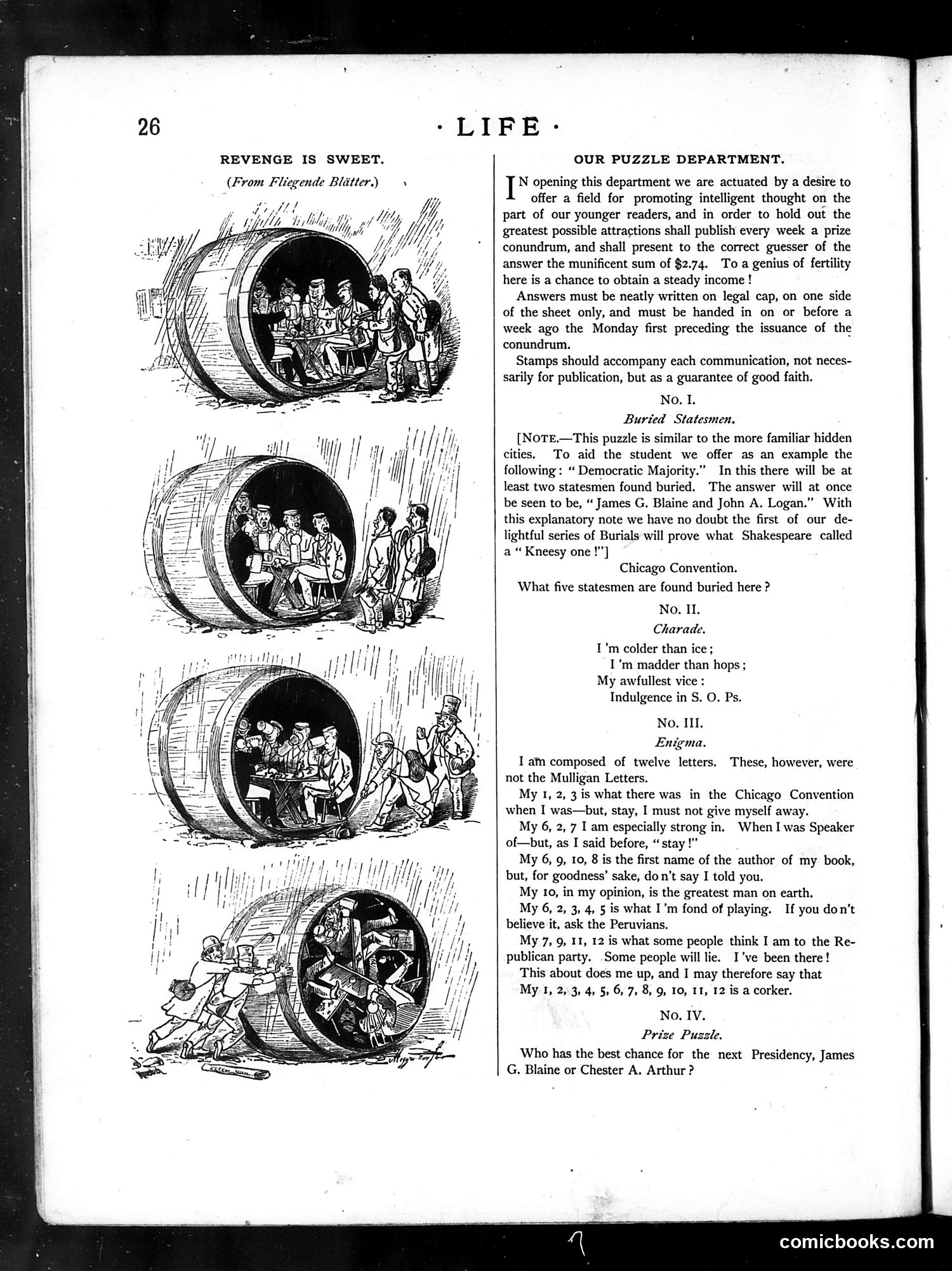
This is Life's inaugural "Puzzle Department," offering $2.74 prizes for correct answers—a modest but notable incentive for the era. The cartoons (from German publication Fliegende Blätter) show people hiding in large barrels, illustrating the "hidden cities" puzzle concept. The puzzles themselves are heavily political, referencing the 1884 Chicago Convention and prominent Republican figures: - **Puzzle I** asks which five statesmen are "buried" in "Chicago Convention"—likely referring to delegates or candidates from that recent convention. - **Puzzle III's enigma** is a self-referential riddle from a mysterious speaker who: was present at Chicago, was a Speaker (of the House), wrote a book, knows famous figures, and has Peruvian connections. The clues suggest **James G. Blaine**, the 1884 Republican nominee. - **Puzzle IV** directly asks readers to predict whether Blaine or Chester Arthur has better presidential prospects—topical political speculation. The page uses wordplay and coded references to engage readers in contemporary political discourse while providing entertainment.
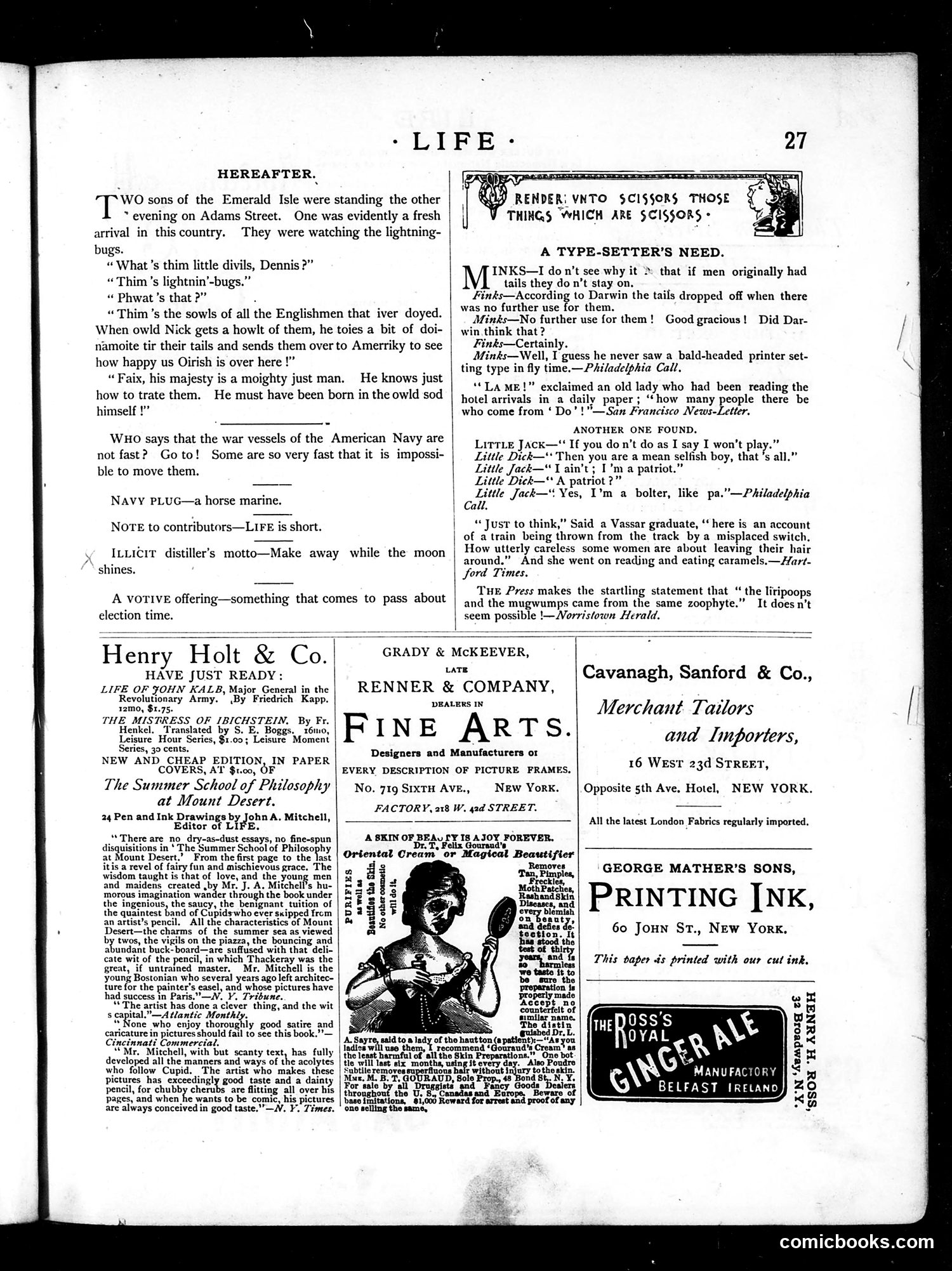
This page contains several brief humorous sketches typical of Life's satirical style: **"Hereafter"** depicts Irish immigrants observing fireflies, with one explaining they're souls of dead Englishmen that the Devil torments by attaching dynamite to their tails and sending them to America—a joke playing on Irish-English antagonism and immigrant perspectives. **"A Type-Setter's Need"** is a pun-based joke among printers about "Inks," "Finks," and "Minks," culminating in a quip about bald printers losing their hair in summer—poking fun at occupational hazards. **Other brief jokes** mock specific groups: Vassar women for carelessness, a child claiming to be a "bolter" (political independent) like his father, and newspaper absurdities. The page is primarily **advertising** for books and commercial services (tailors, printers, art dealers), with humor interspersed. The content reflects late 19th-century American stereotypes about immigrants and class humor typical of the era.
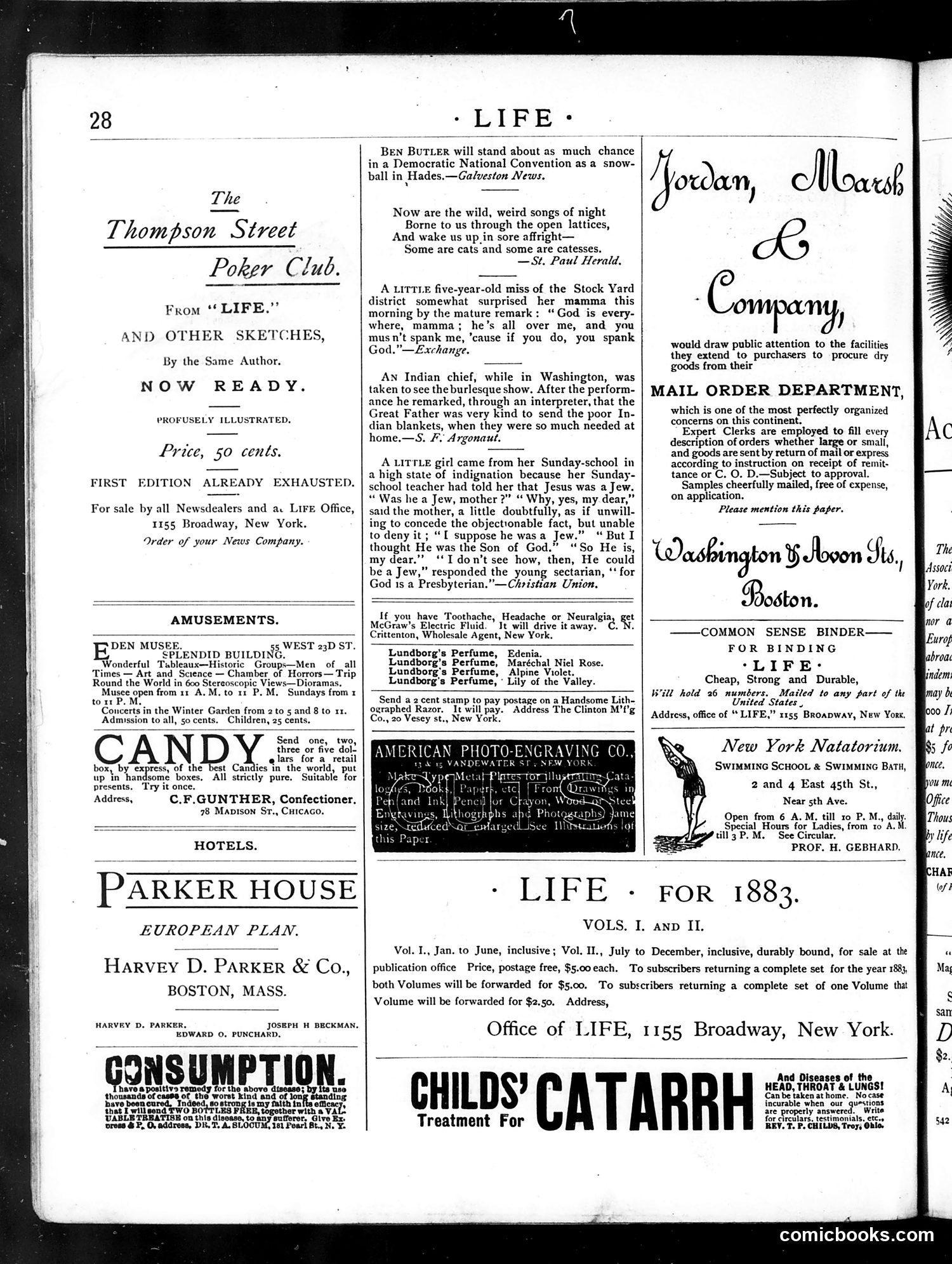
This page is primarily **advertisements and short humorous anecdotes** rather than political cartoons. The content includes: **Key Items:** 1. **Book Advertisement**: "The Thompson Street Poker Club" - a collection of sketches, now sold out 2. **Humor Pieces**: Short, satirical anecdotes mocking religious hypocrisy and cultural attitudes, including: - A child's logic about Jesus being both Jewish and the "Son of God" while her Presbyterian mother struggles with the contradiction - An Native American chief's naive interpretation of U.S. government "kindness" - A child's theological reasoning about divine omnipresence 3. **Period Advertisements**: Perfumes, confectionery, swimming schools, hotels, and medical nostrums (McGraw's Electric Fluid for headaches) **The satire targets** American Protestantism's discomfort with Jesus's Jewish identity and the gaps between religious teaching and logic. The overall tone is lighthearted social commentary typical of 1880s American humor magazines, poking fun at middle-class pretension and intellectual inconsistency rather than partisan politics.
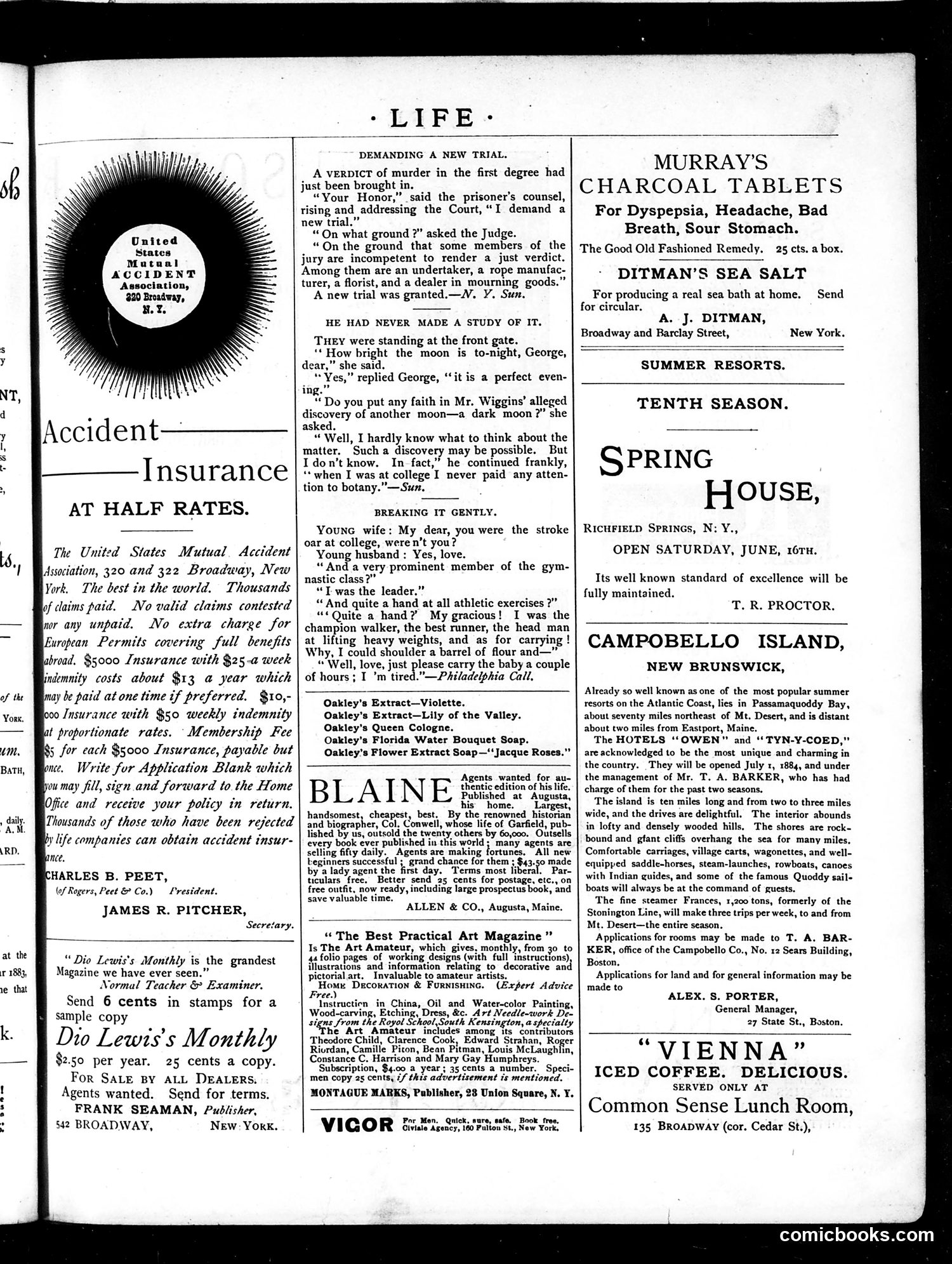
This page contains two satirical jokes typical of 1880s Life magazine: **"Demanding a New Trial"**: A murder defendant's lawyer argues for a new trial because jurors are "incompetent"—listing an undertaker, rope manufacturer, florist, and dealer in mourning goods. The joke's dark humor lies in the obvious conflict of interest: these tradespeople would all profit financially from the defendant's conviction and execution. The satire critiques both the justice system's blindness to such bias and, implicitly, the commercialization of death in Victorian America. **"He Had Never Made a Study of It"**: George confuses "botany" (plant science) with "astronomy" (the study of celestial bodies), pretending ignorance about the moon rather than admitting his college education was superficial. The humor mocks educated men who bluff their way through conversations despite lacking actual knowledge. Both jokes reflect Life's satirical focus on American social pretense, professional corruption, and masculine incompetence—common themes in this era's humor magazine.
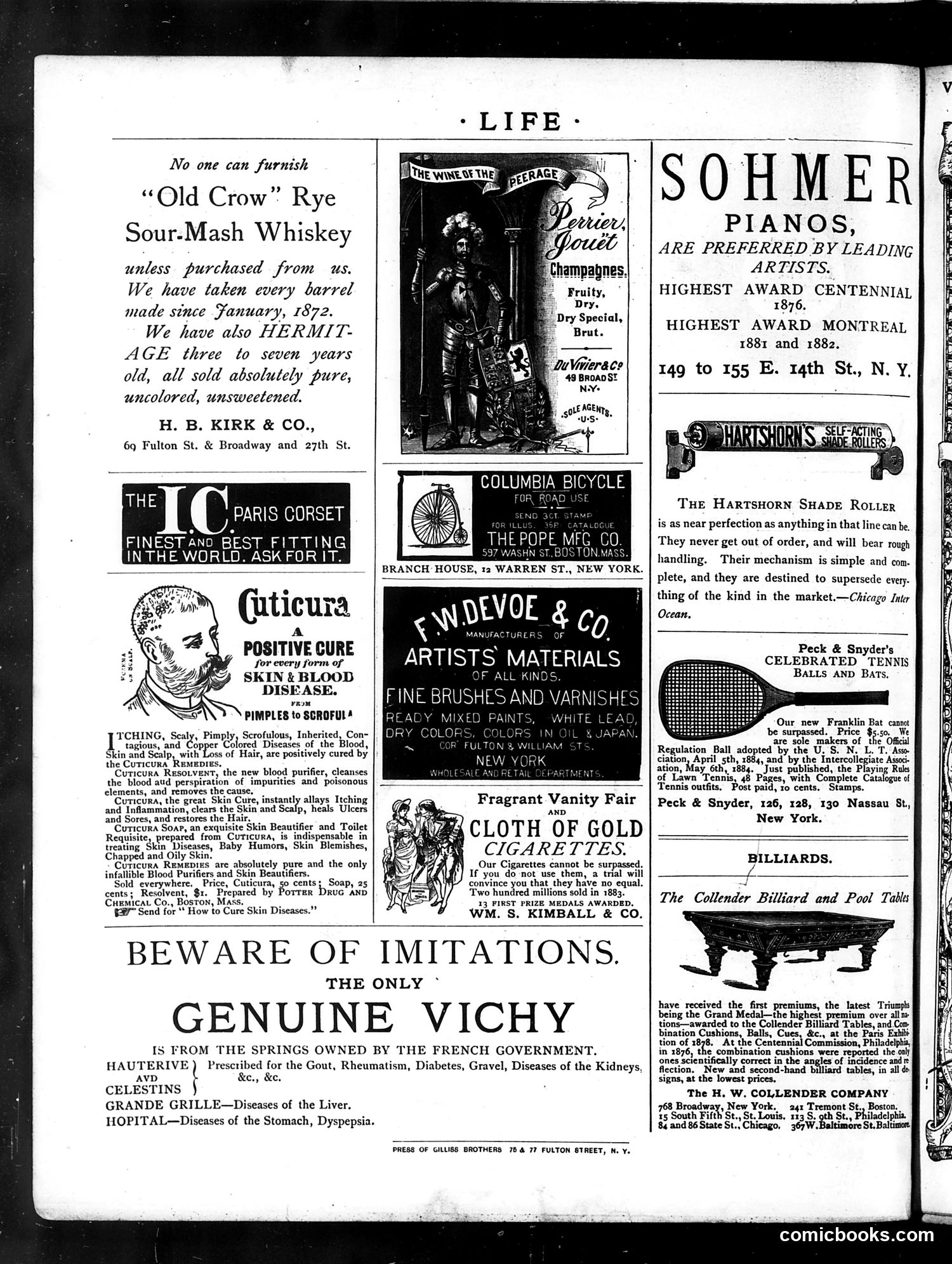
This is primarily an **advertising page** from Life magazine, not a satirical cartoon. The page showcases various consumer products and services from the 1880s, including: **Key advertisements:** - **H.B. Kirk & Co.** whiskey ("Old Crow" Rye), emphasizing authenticity since 1872 - **Sohmer Pianos**, promoted as preferred by leading artists with awards from 1876-1882 - **Cuticura Remedies** for skin diseases, with detailed medical claims - **Paris Corset**, claiming to be "finest and best fitting in the world" - **Columbia Bicycle**, **Hartshorn Shade Roller**, and sporting goods by Peck & Snyder - **Vichy water** (bottom), emphasized as genuine only from French government springs, prescribed for gout and kidney diseases **Historical context:** These ads reflect late-Victorian consumer culture and the era's aggressive marketing claims (particularly medical products), before modern FDA regulations. The emphasis on "genuine" and "beware of imitations" suggests widespread counterfeiting was common.