
Life, 1884-07-10 · page 6 of 16
Life — July 10, 1884 — page 6: what you’re looking at
What you’re looking at
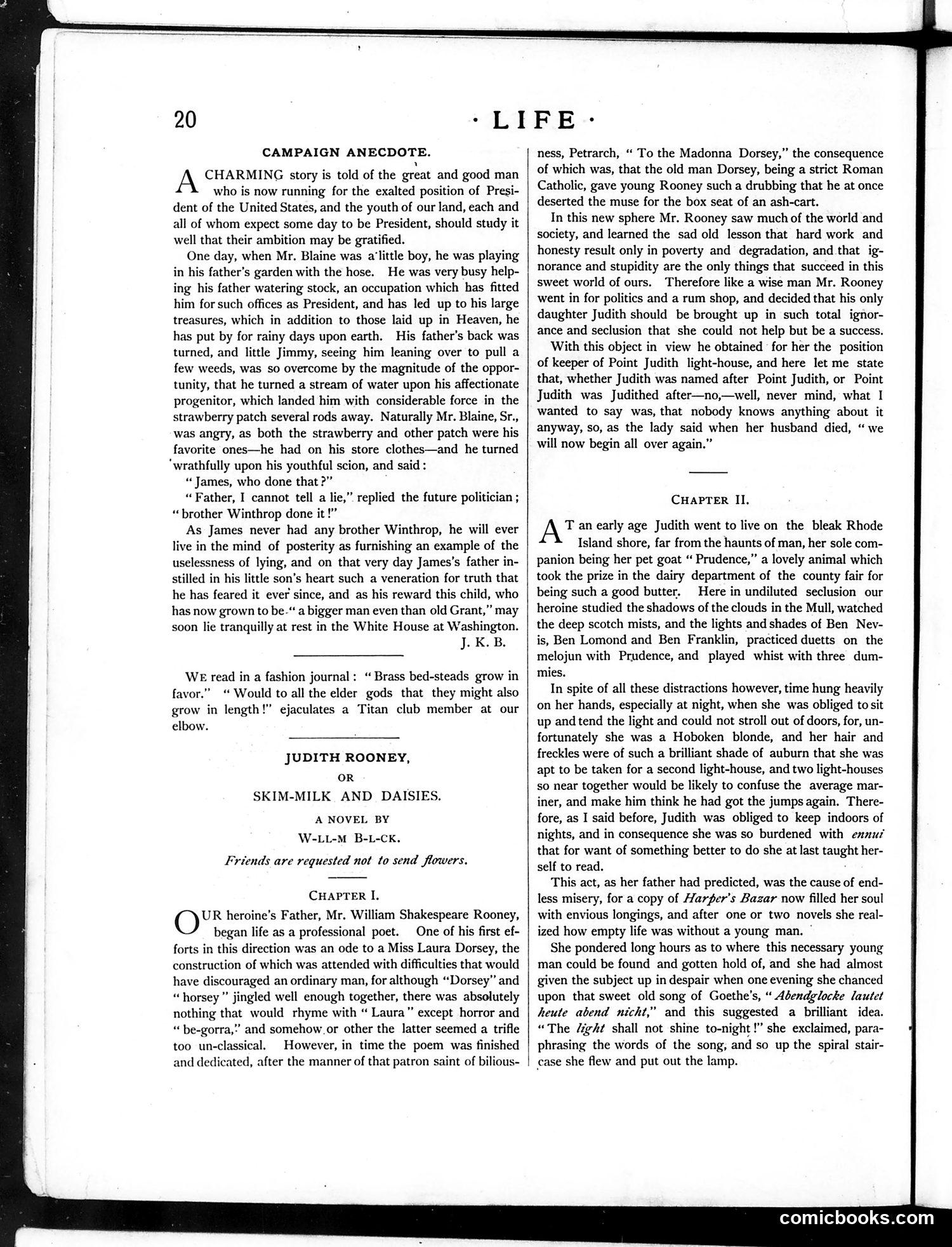
This page contains no political cartoon. Instead, it's a literary piece titled "Judith Rooney, or Skim-Milk and Daisies," a novel serialized in Life magazine. The content includes a "Campaign Anecdote" about a young boy named James whose father was turning soil in a garden—a story illustrating lessons about hard work and honesty for aspiring politicians. Below that begins Chapter II of the Judith Rooney novel, describing a heroine living on Rhode Island who tends a lighthouse while reading Harper's Bazaar and pining for romance. This is serialized fiction, not satire or political commentary. Life magazine during this era mixed humor, advertisements, and serialized stories for its readers.
📄 Transcribed text from this page (OCR, searchable)
Machine-transcribed from the original scan — historical spelling and the odd misread are preserved.
CAMPAIGN ANECDOTE. y A CHARMING story is told of the great and good man who is now running for the exalted position of Presi- dent of the United States, and the youth of our land, each and all of whom expect some day to be President, should study it well that their ambition may be gratified. One day, when Mr. Blaine was alittle boy, he was playing in his father’s garden with the hose. He was very busy help- ing his father watering stock, an occupation which has fitted him for such offices as President, and has led up to his large treasures, which in addition to those laid up in Heaven, he has put by for rainy days upon earth. His father’s back was turned, and little Jimmy, seeing him leaning over to pull a few weeds, was so overcome by the magnitude of the oppor- tunity, that he turned a stream of water upon his affectionate progenitor, which landed him with considerable force in the strawberry patch several rods away. Naturally Mr. Blaine, Sr., was angry, as both the strawberry and other patch were his favorite ones—he had on his store clothes—and he turned “wrathfully upon his youthful scion, and said : “James, who done that ?” “Father, I cannot tell a lie,” replied the future politician ; “brother Winthrop done it!” As James never had any brother Winthrop, he will ever live in the mind of posterity as furnishing an example of the uselessness of lying, and on that very day James’s father in- stilled in his little son’s heart such a veneration for truth that he has feared it ever since, and as his reward this child, who has now grown to be.“ a bigger man even than old Grant,” may soon lie tranquilly at rest in the White House at Washington. j. K. B. WE read in a fashion journal : “Brass bed-steads grow in favor.” ‘“ Would to all the elder gods that they might also grow in length!” ejaculates a Titan club member at our elbow. JUDITH ROONEY, OR SKIM-MILK AND DAISIES. A NOVEL BY W-LL-M B-L-CK. Friends are requested not to send flowers. CHAPTER I. UR heroine's Father, Mr. William Shakespeare Rooney, began life as a professional poet. One of his first ef- forts in this direction was an ode to a Miss Laura Dorsey, the construction of which was attended with difficulties that would have discouraged an ordinary man, for although “Dorsey” and “horsey” jingled well enough together, there was absolutely nothing that would rhyme with “ Laura” except horror and “ be-gorra,:’ and somehow. or other the latter seemed a trifle too un-classical. However, in time the poem was finished and dedicated, after the manner of that patron saint of bilious- ness, Petrarch, ‘ To the Madonna Dorsey,” the consequence of which was, that the old man Dorsey, being a strict Roman Catholic, gave young Rooney such a drubbing that he at once deserted the muse for the box seat of an ash-cart. In this new sphere Mr. Rooney saw much of the world and society, and learned the sad old lesson that hard work and honesty result only in poverty and degradation, and that ig- norance and stupidity are the only things that succeed in this sweet world of ours. Therefore like a wise man Mr. Rooney went in for politics and a rum shop, and decided that his only daughter Judith should be brought up in such total ignor- ance and seclusion that she could not help but be a success. With this object in view he obtained for her the position of keeper of Point Judith light-house, and here let me state that, whether Judith was named after Point Judith, or Point Judith was Judithed after—no,—well, never mind, what I wanted to say was, that nobody knows anything about it anyway, so, as the lady said when her husband died, “ we will now begin all over again.” CHAPTER II. T an early age Judith went to live on the bleak Rhode Island shore, far from the haunts of man, her sole com- panion being her pet goat “ Prudence,” a lovely animal which took the prize in the dairy department of the county fair for being such a good butter. Here in undiluted seclusion our heroine studied the shadows of the clouds in the Mull, watched the deep scotch mists, and the lights and shades of Ben Nev- is, Ben Lomond and Ben Franklin, practiced duetts on the melojun with Prudence, and played whist with three dum- mies. In spite of all these distractions however, time hung heavily on her hands, especially at night, when she was obliged to sit up and tend the light and could not stroll out of doors, for, un- fortunately she was a Hoboken blonde, and her hair and freckles were of such a brilliant shade of auburn that she was apt to be taken for a second light-house, and two light-houses so near together would be likely to confuse the average mar- iner, and make him think he had got the jumps again. There- fore, as I said before, Judith was obliged to keep indoors of nights, and in consequence she was so burdened with ennui that for want of something better to do she at last taught her- self to read. This act, as her father had predicted, was the cause of end- less misery, for a copy of Harper's Bazar now filled her soul with envious longings, and after one or two novels she real- ized how empty life was without a young man. ° She pondered long hours as to where this necessary young man could be found and gotten hold of, and she had almost given the subject up in despair when one evening she chanced upon that sweet old song of Goethe's, “ Abendglocke lautet heute abend nicht,” and this suggested a brilliant idea. “The /ight shall not shine to-night!” she exclaimed, para- phrasing the words of the song, and so up the spiral stair- case she flew and put out the lamp. comicbooks.com