
A complete issue · 16 pages · 1884
Life — June 12, 1884
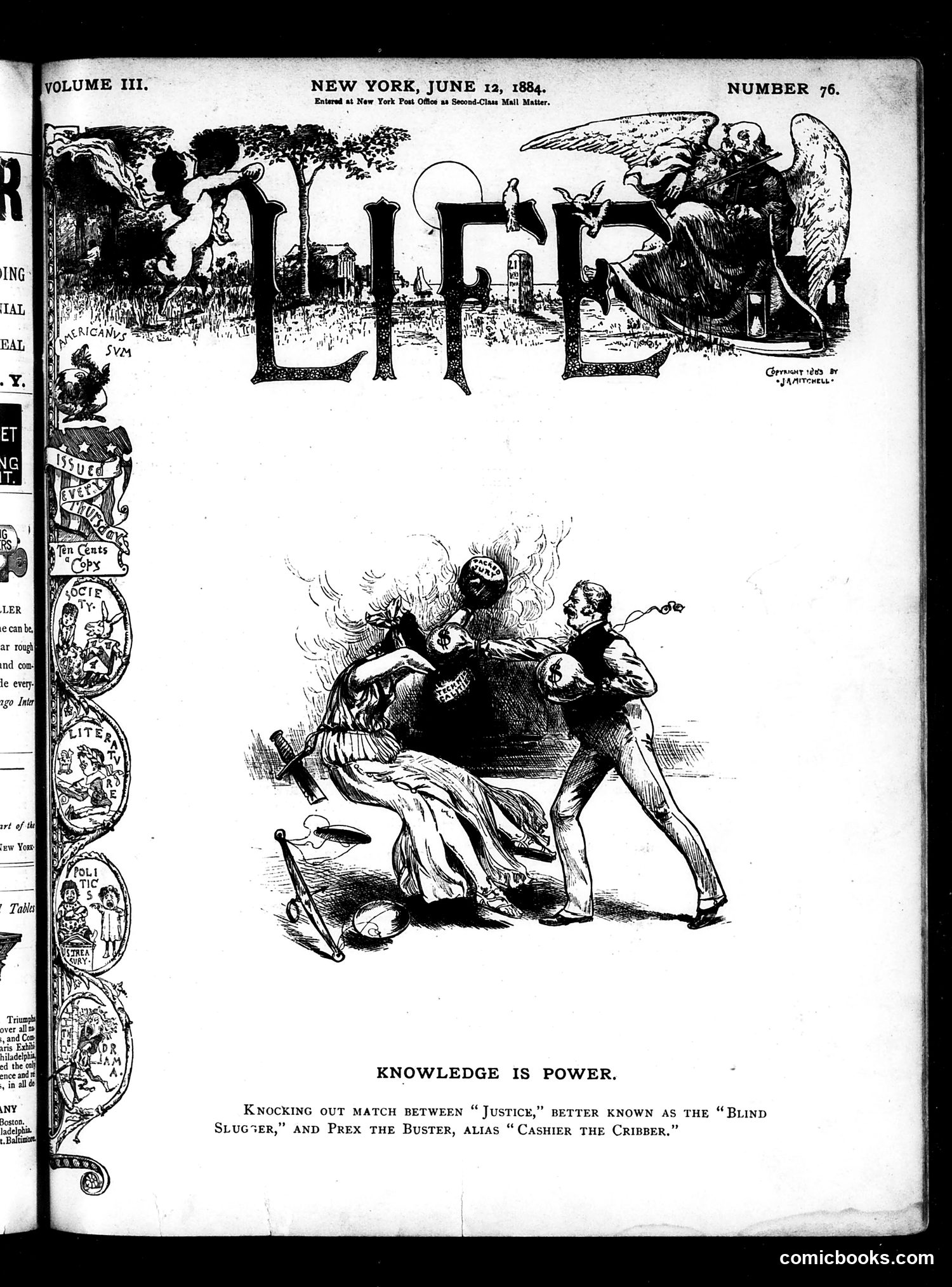
The main illustration depicts a violent confrontation titled "Knowledge is Power," showing a boxing match between personified abstractions: "Justice" (the "Blind Slugger") and "Prex the Buster" (alias "Cashier the Cribber"). This appears to be political satire referencing a specific scandal or legal dispute from 1884, likely involving accusations of embezzlement or financial misconduct by someone nicknamed "the Cribber" (a thief). The imagery of blind justice fighting corruption suggests critique of either judicial incompetence or criminal malfeasance. Without additional context about 1884 events, the specific figures remain unclear, though the allegorical framework—justice versus criminality—is evident. The decorative border contains various satirical vignettes typical of Life's style.
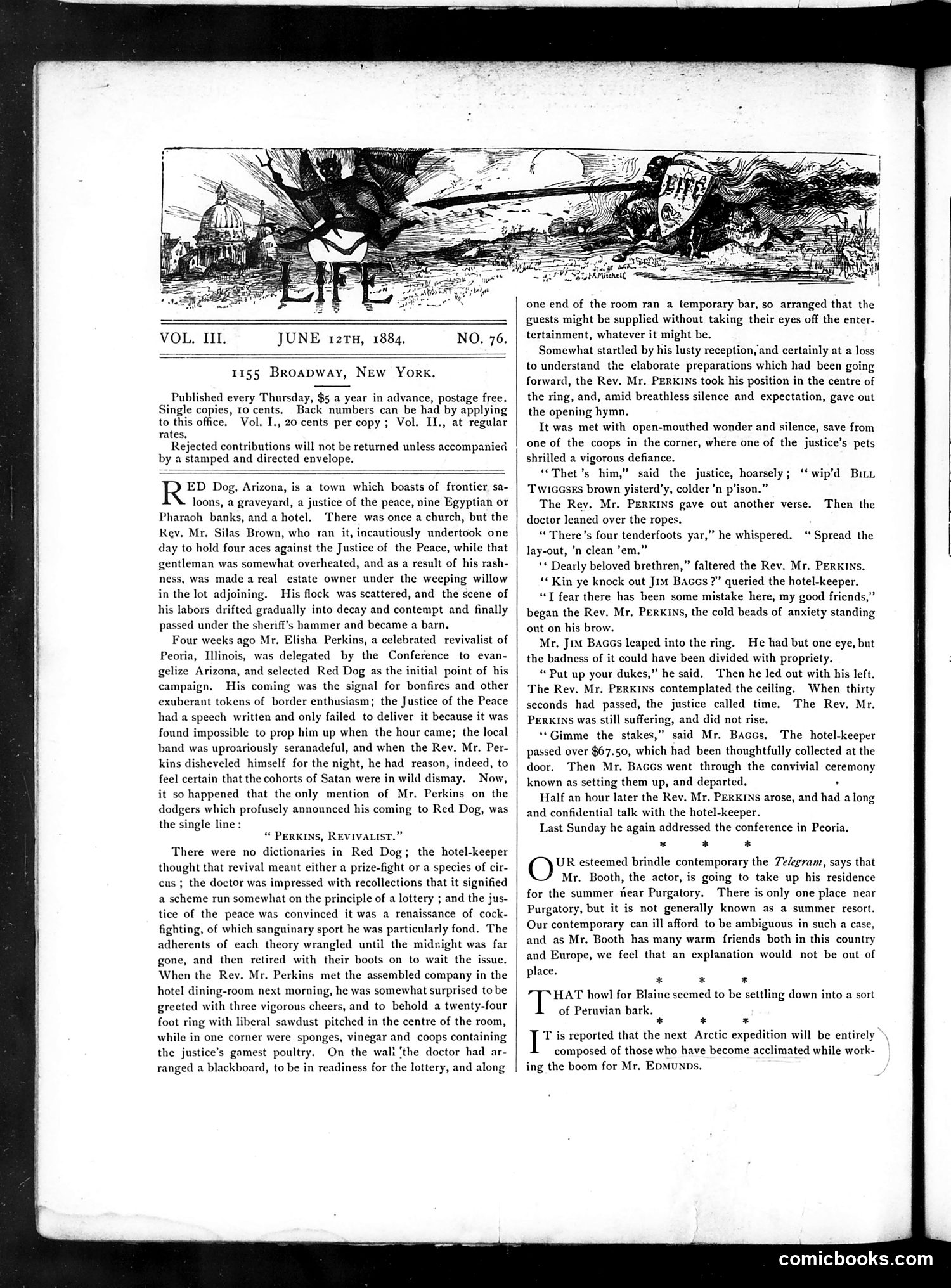
The main article describes a revival meeting in Red Dog, Arizona, where a traveling evangelist (Rev. Mr. Perkins) attempts to hold a religious service. A local justice of the peace and other townsfolk, apparently unaccustomed to such activities, react with confusion and disruption. The piece satirizes frontier irreverence toward organized religion—when the preacher tries to lead hymns and scripture, the participants misunderstand instructions ("spread the lay-out, 'a clean 'em") and the justice demands money ("gimme the stakes"). The satire mocks both the earnest evangelist's efforts and the frontier town's complete lack of religious decorum, suggesting a clash between civilized Eastern Christianity and rough Western indifference or incomprehension.
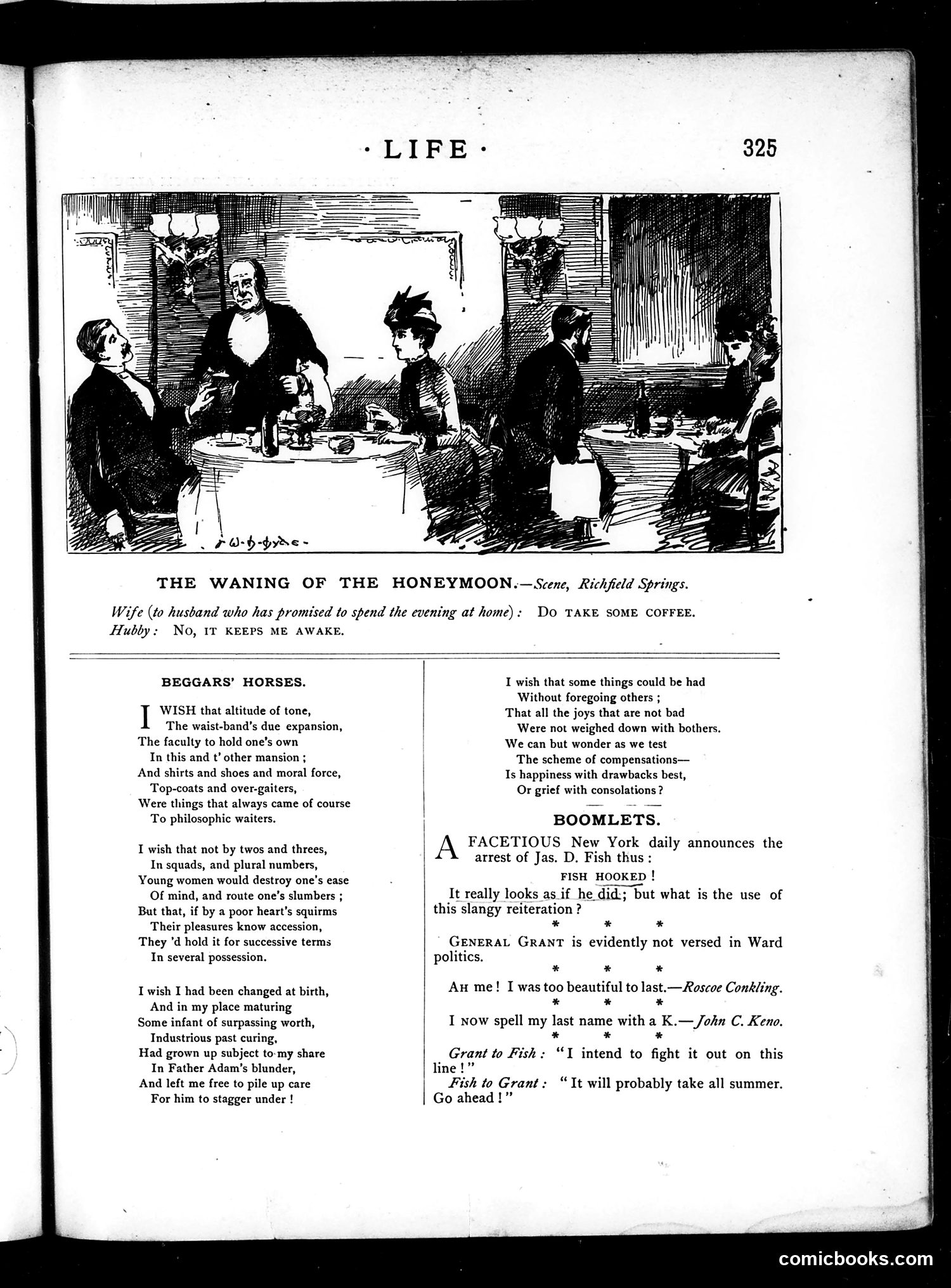
This cartoon satirizes early marriage dynamics. A wife urges her husband to stay home for coffee after dinner, but he refuses—"NO, IT KEEPS ME AWAKE." The joke contrasts romantic courtship with mundane married life: the husband prioritizes sleep over companionship, suggesting the "honeymoon period" (initial marital bliss) has ended and been replaced by domestic routine and the husband's indifference. The accompanying poem "Beggars' Horses" expresses nostalgia for a simpler life without society's material pressures and social obligations—critiquing the burdens of maintaining upper-class status through possessions and fashion ("Top-coats and over-gaiters"). The "Boomlets" section contains brief satirical quips about contemporary figures and politics, including references to General Grant and various social figures.
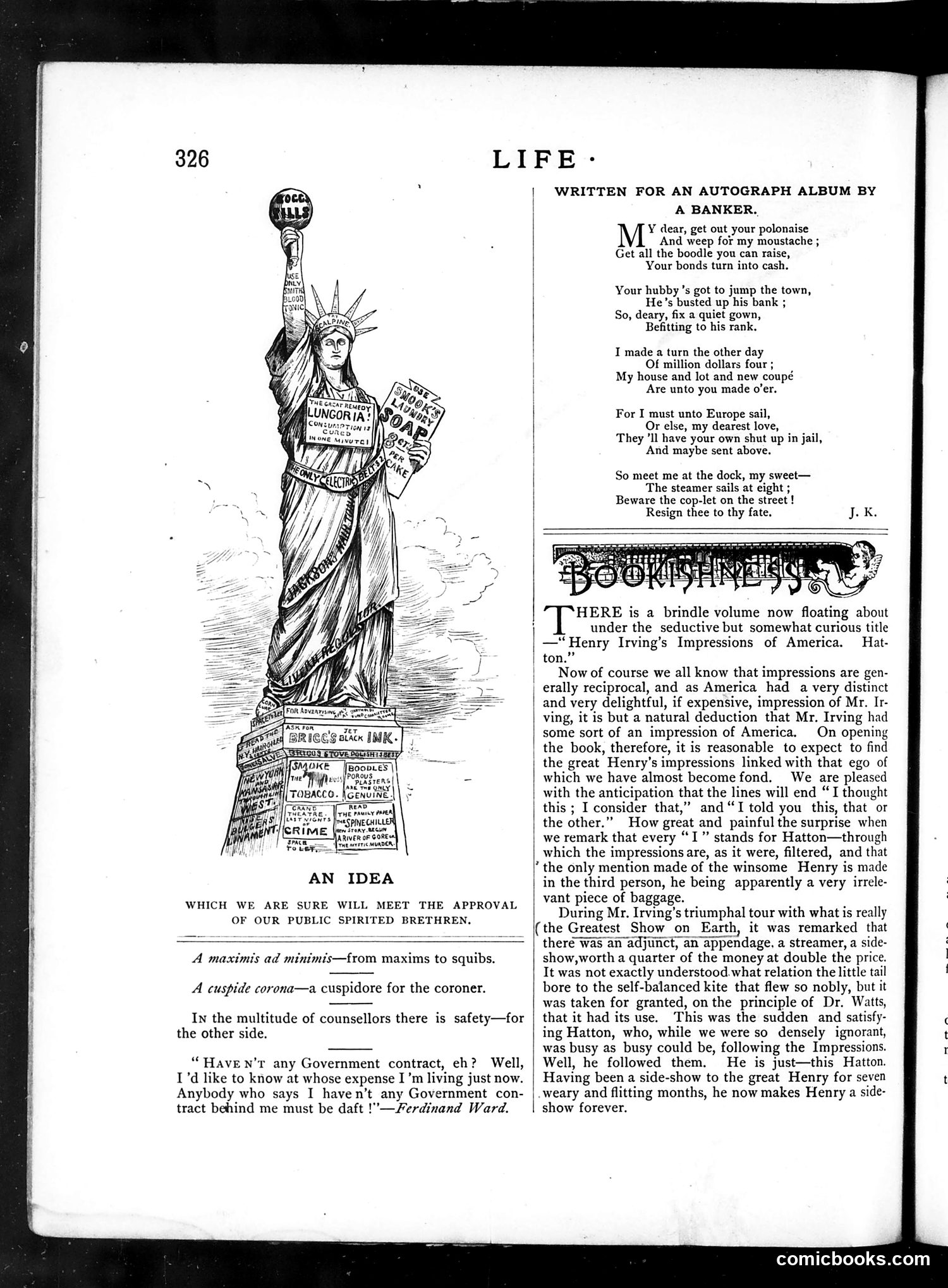
This cartoon satirizes American consumerism and commercialism by transforming the Statue of Liberty into a billboard. Lady Liberty clutches not a torch but a product advertisement, while her pedestal is plastered with advertisements for various consumer goods: ink, tobacco, soap, and other commodities. The satire targets how American capitalism has commodified the nation's most iconic symbol of freedom and democracy. Rather than representing ideals, Liberty now promotes commercial products—suggesting that by the early 20th century, American values had become inseparable from consumer culture and advertising. The accompanying text's Latin phrases ("maximus ad minimis") reinforce the joke about degrading something grand into something trivial for profit.
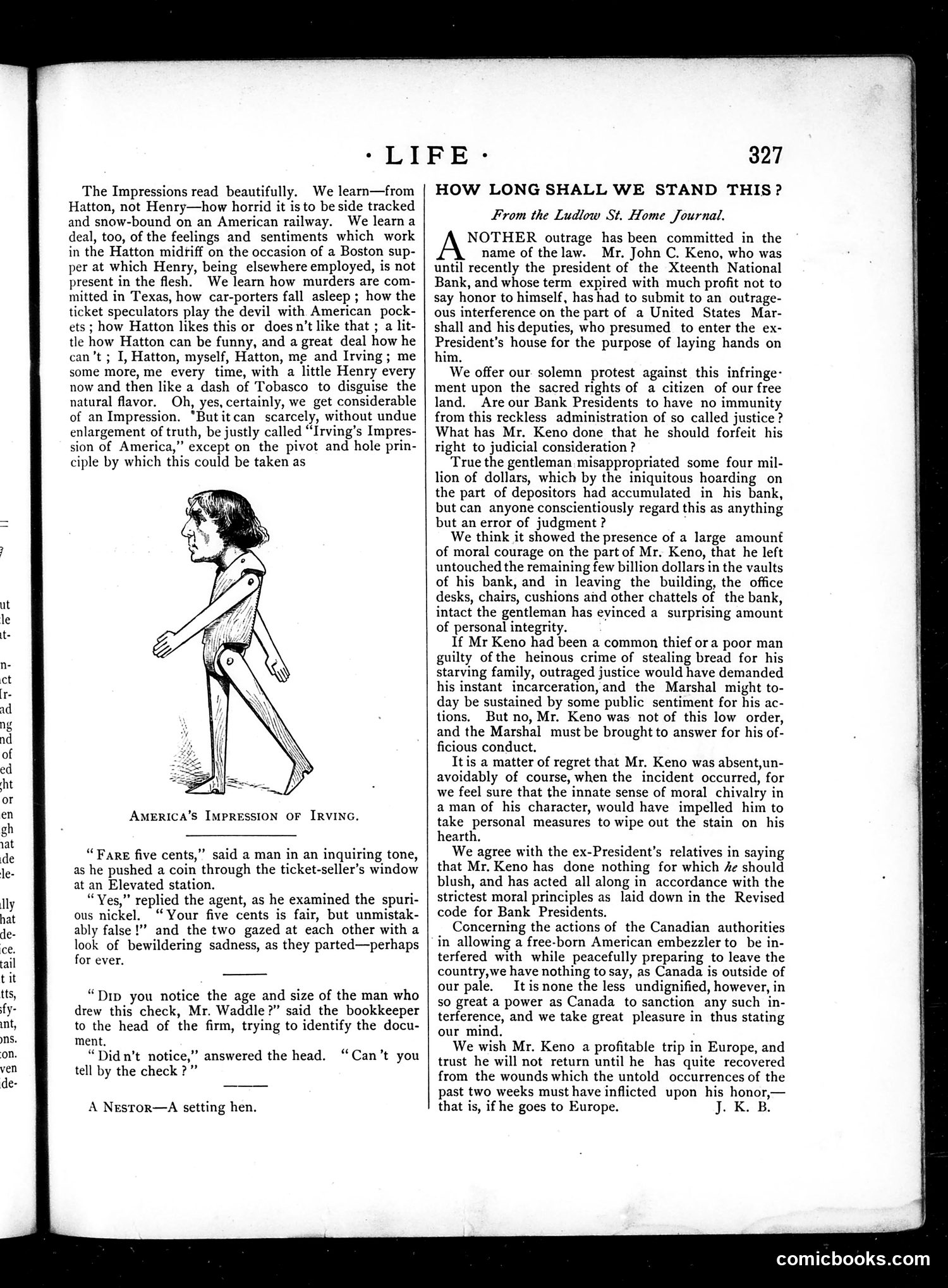
This cartoon satirizes Washington Irving, the famous American author, depicted as an exaggerated, skeletal figure in a contorted pose. The accompanying text describes Irving's impressions of America—specifically his travels on a snowy, isolated Hatton railroad journey and observations of American life and manners. The satire suggests Irving's own grotesque distortions when describing American society back to European audiences. By showing him as an absurdly twisted caricature, the cartoonist mocks how Irving's literary "impressions" of America may have been equally distorted or unflattering representations of American character to foreign readers. The visual exaggeration mirrors the supposed exaggeration in his written accounts.
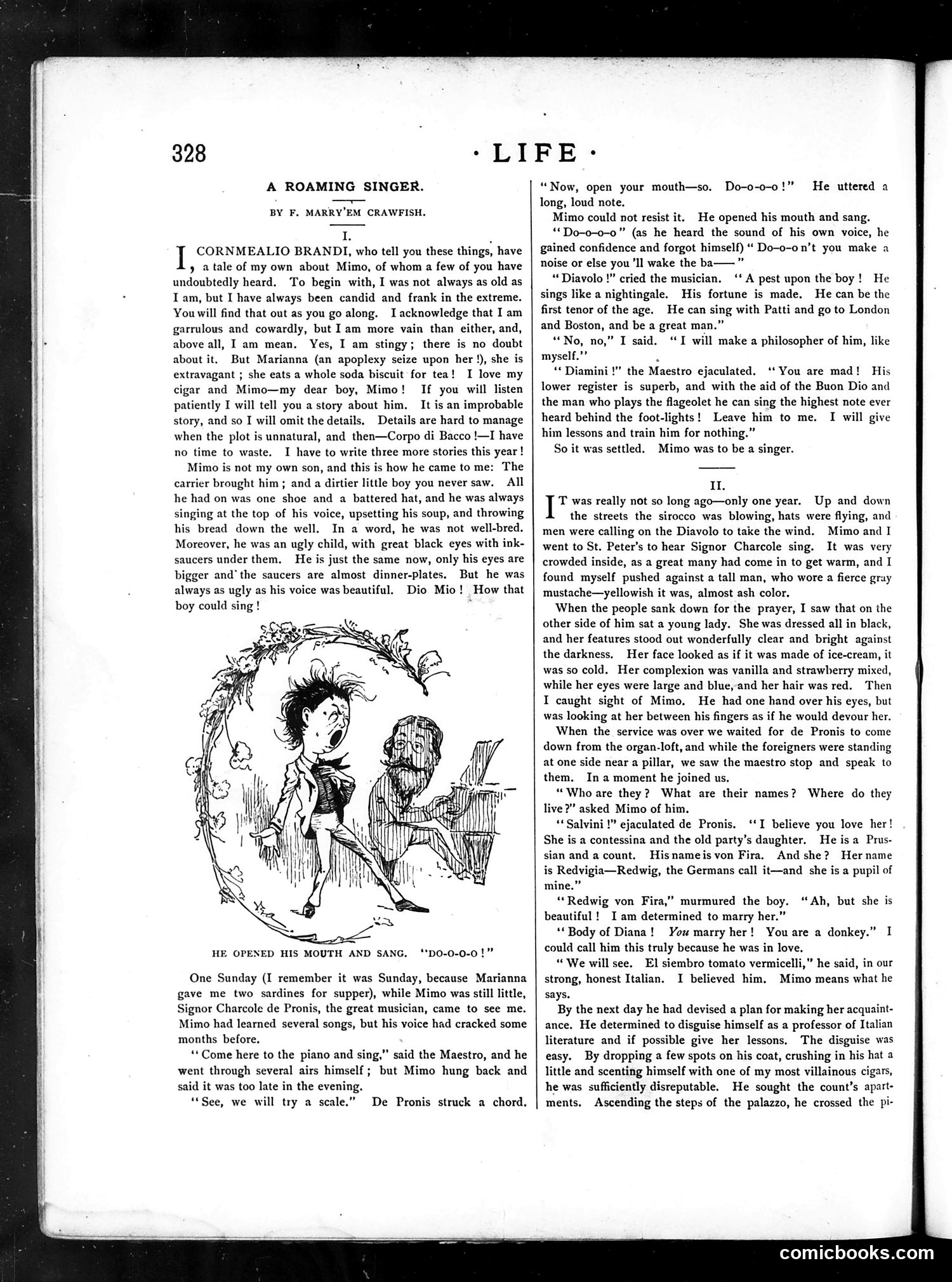
This page contains a short story by F. Marry'em Crawfish about Mimo, a young Italian boy with an exceptional singing voice. The accompanying illustration depicts a theatrical scene: a young boy singing with his mouth wide open (captioned "HE OPENED HIS MOUTH AND SANG. 'DO-O-O-O!'"), surrounded by what appear to be music-related figures. The story describes how a music master (De Pronis) discovers Mimo's talent and attempts to train him as a professional singer. The narrative is a sentimental tale about a talented street urchin being groomed for operatic success, reflecting 19th-century fascination with discovering raw musical talent among poor Italian youth. The illustration's exaggerated style emphasizes Mimo's earnest singing performance.
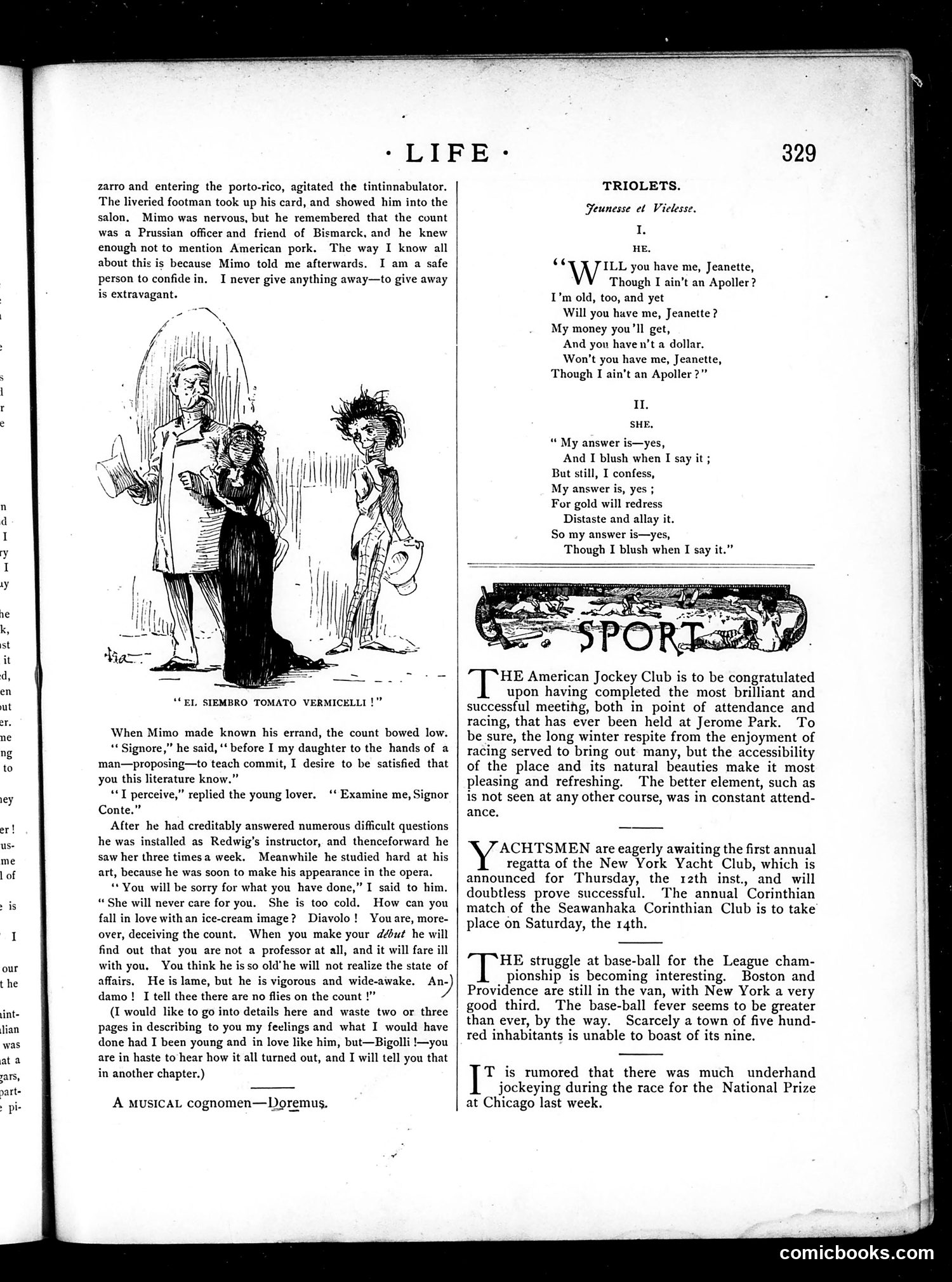
The main cartoon labeled "EL SIEMBRO TOMATO VERMICELLI" depicts what appears to be a Prussian or German military officer (identifiable by uniform details) with two younger figures, likely referencing a diplomatic or social scenario involving a European aristocrat. The accompanying text describes the officer as a "Prussian officer and friend of Bismarck," suggesting this satirizes European military elites or diplomatic relations. The narrative involves deception regarding the officer's actual status—he's apparently not genuinely aristocratic. The satire likely mocks either European pretension, or the gullibility of Americans toward aristocratic claims. The specific historical context of Prussian-American relations is unclear without additional dating information, but the cartoon appears to ridicule European social posturing and deceptive status claims.
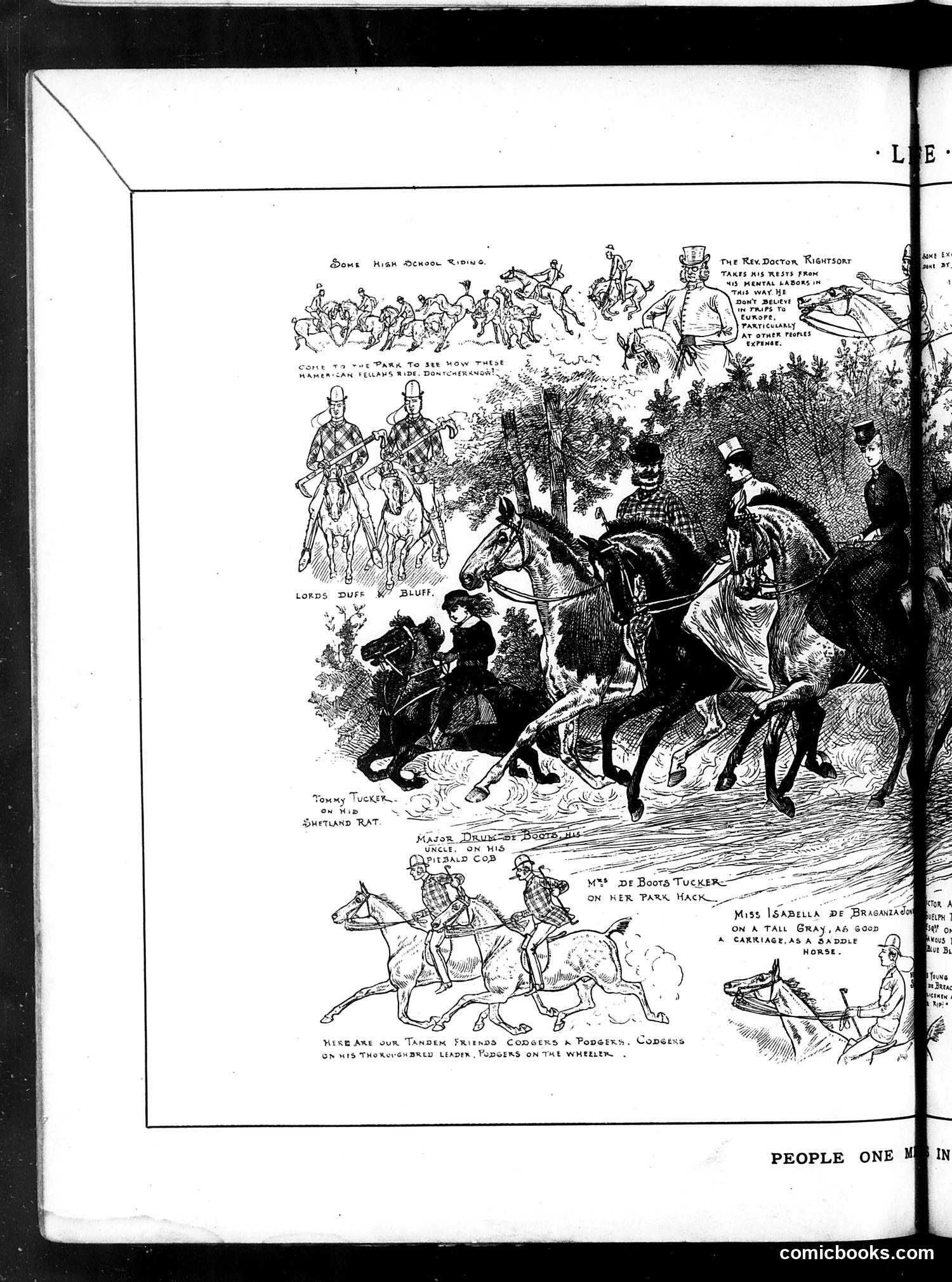
This appears to be a satirical illustration about British high society and fox hunting. The page depicts various upper-class figures engaged in or discussing a hunt, labeled with names like "Lords Duff & Bluff," "Tommy Tucker," and references to "Mrs. de Boots Tucker" and "Miss Isabella de Braganzá." The satire targets the pretensions and absurdities of British aristocracy, particularly their obsession with fox hunting as a status symbol. The visual humor comes from exaggerated caricatures showing these lords and ladies in ridiculous hunting scenarios—some riding poorly, others in undignified positions. The text labels appear to mock both the hunters' names and their pretentious behavior, suggesting that despite their noble titles and fancy horses, these figures are fundamentally ridiculous.
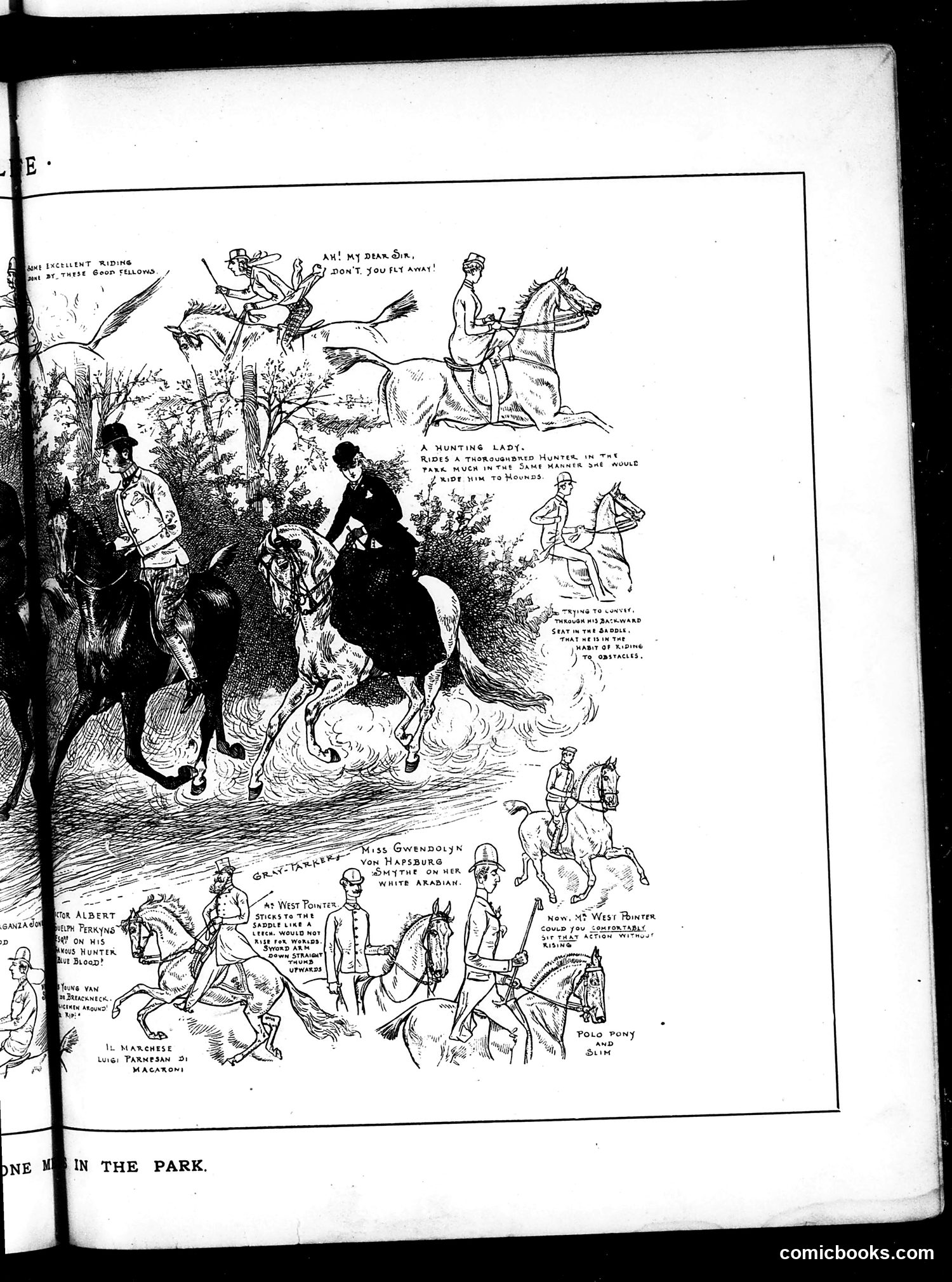
This illustration satirizes high society's equestrian culture, likely from the Gilded Age. The page depicts various wealthy riders and their mounts, with labeled figures including "Miss Gwendolyn von Hapsburg" on a white Arabian horse and references to "West Pointer" military riders. The satire appears to mock the pretensions and social hierarchies of fashionable horseback riding in urban parks—a leisure activity that demonstrated wealth and status. The various captions and character types suggest commentary on social climbing, military affectation, and the absurdities of aristocratic display. The phrase "One Man in the Park" suggests ironic contrast between the single central figure and the crowded cast of characters surrounding him, likely commenting on individualism versus social conformity among the elite.
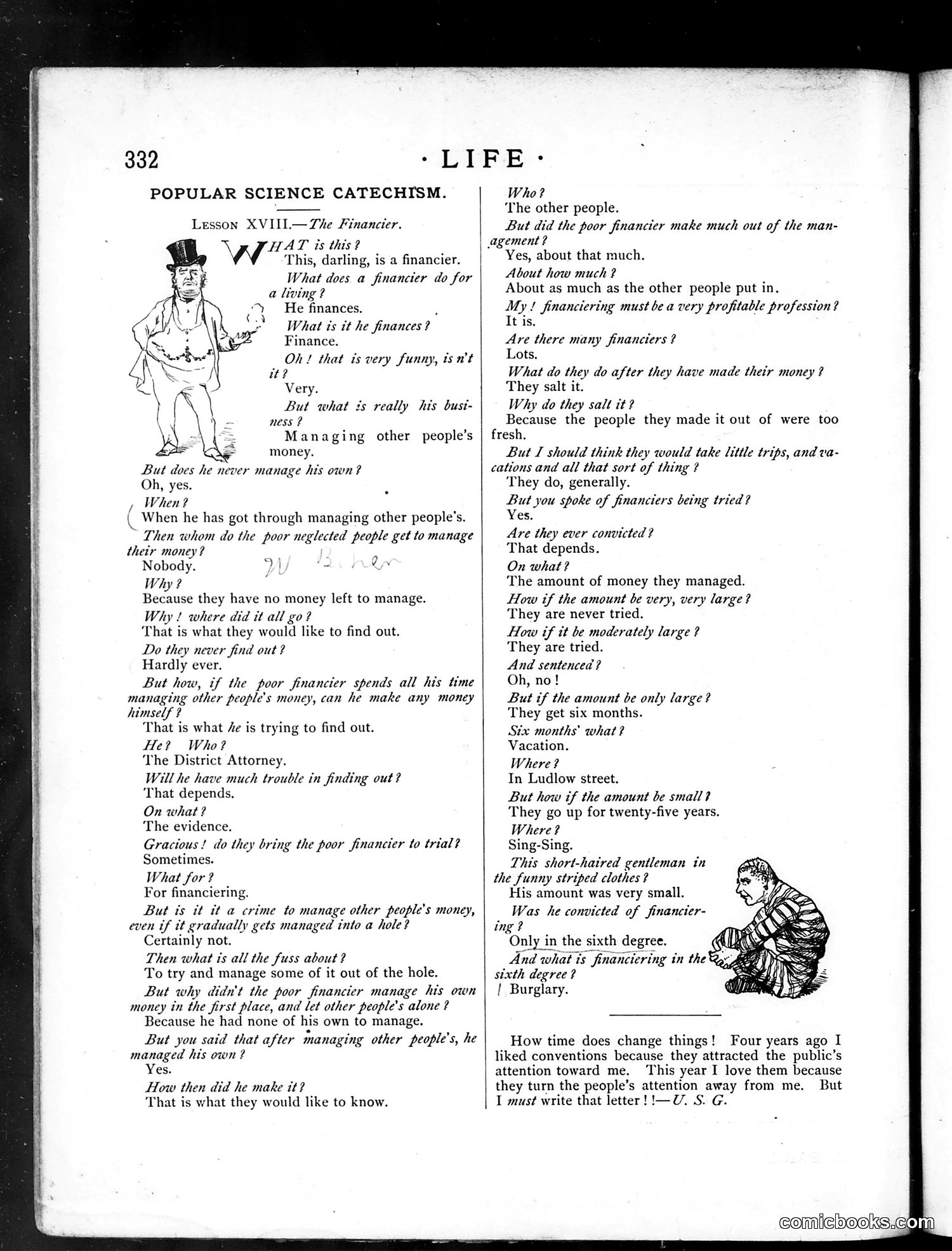
This is a satirical "catechism" (Q&A lesson) mocking financiers and the justice system's treatment of them. The humor relies on absurdist logic to expose hypocrisy: **The Core Satire:** A financier's job is managing other people's money—which he then loses or embezzles. Poor people end up with nothing to manage. When caught, wealthy financiers face no real consequences, while small-time criminals get 25-year sentences. **The Key Joke:** The punchline reveals a "short-haired gentleman in striped clothes" (a convict at Sing-Sing prison) was convicted of "financiering in the sixth degree"—which turns out to be burglary. The satire suggests that embezzling millions goes unpunished while stealing small amounts gets harsh prison time, exposing class-based legal inequality. **Historical Context:** This reflects Gilded Age anxieties about wealthy financiers escaping justice while poor criminals faced severe punishment—a critique of systemic inequality and corporate malfeasance in early 20th-century America.
This page satirizes the 1884 Republican National Convention in Chicago, mocking the candidates and their campaigns through exaggerated anecdotes. **Key Figures:** - **James G. Blaine**: frontrunner, criticized for lavish hospitality ("carte blanche") to delegates - **Chester A. Arthur**: incumbent president, portrayed as financially strapped - **William Chandler**: Secretary of Navy, ridiculed for avoiding the convention due to supposed foot/eye ailments and financial troubles **The Satire:** The Indiana delegation's soap wagon bearing "BEFORE USING" and "AFTER USING" portraits of Arthur mocks his transformation from Port Collector to President, implying he's been "cleaned up" like a product. The soap platform jokes that cleanliness appeals to Arthur supporters but not Italian voters. Blaine's hospitality is sarcastically praised as generous, while Arthur's inability to pay fines for arrested campaign workers undermines his boom. The overall tone ridicules the candidates' desperation, corruption, and absurdity of convention politics.
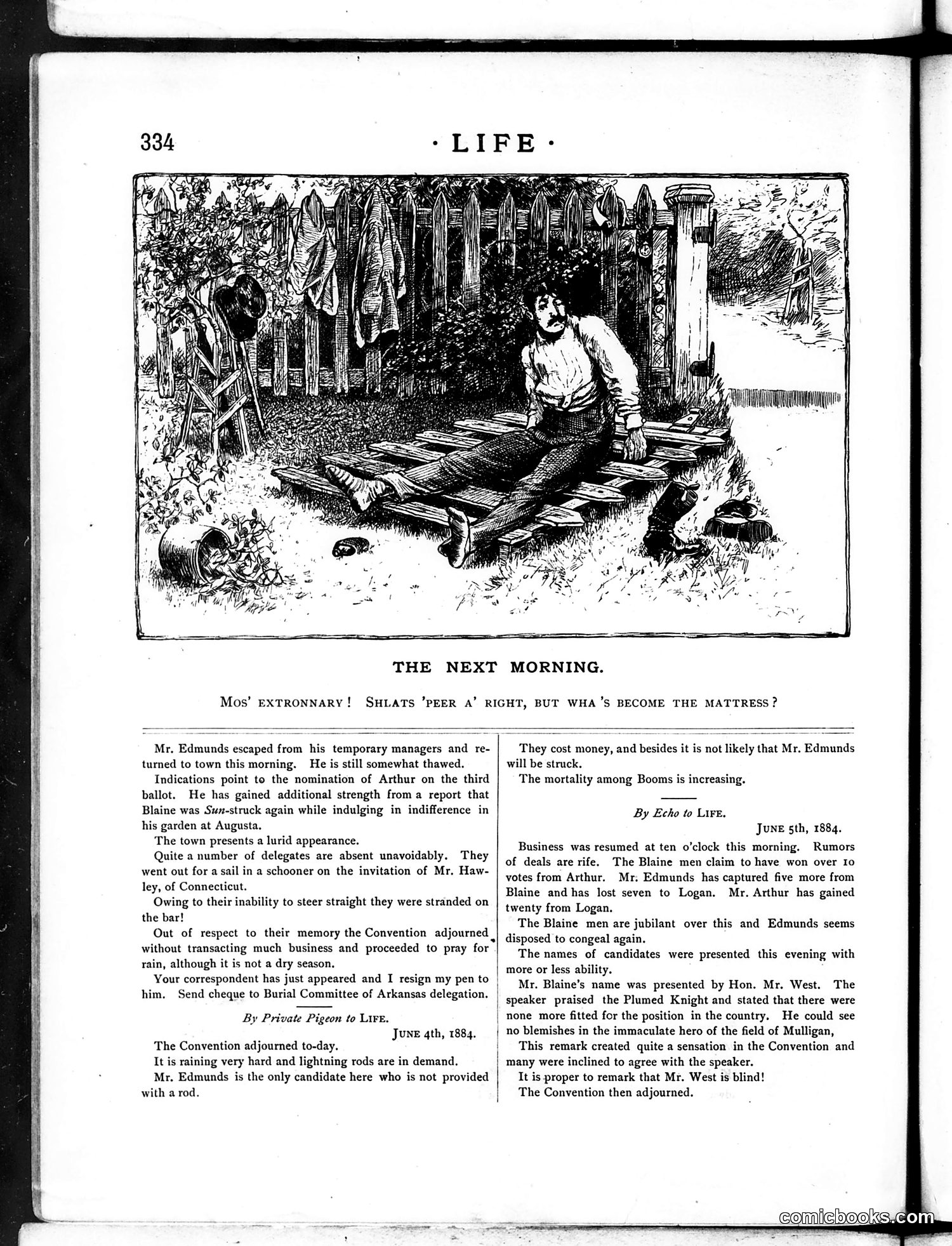
This page satirizes the chaotic 1884 Republican National Convention, covering June 4-5. The cartoon depicts a delegate asleep outdoors—the caption's dialect humor jokes about a missing mattress, mocking the disorganized proceedings. The text mocks multiple candidates: **Arthur** (gaining strength for nomination), **Blaine** (the "Plumed Knight," referenced mockingly for past scandals—"Mulligan" alludes to the Mulligan Letters corruption), and **Edmunds** and **Logan** (trading votes). The satire targets convention chaos: delegates stranded on a sandbar, prayers for rain during a wet season, lost votes constantly shifting. The final joke is cutting—Mr. West, presenting Blaine's nomination, is blind, yet praises Blaine's "immaculate" record, sarcastically suggesting the blindness is willful ignorance of Blaine's actual scandals.
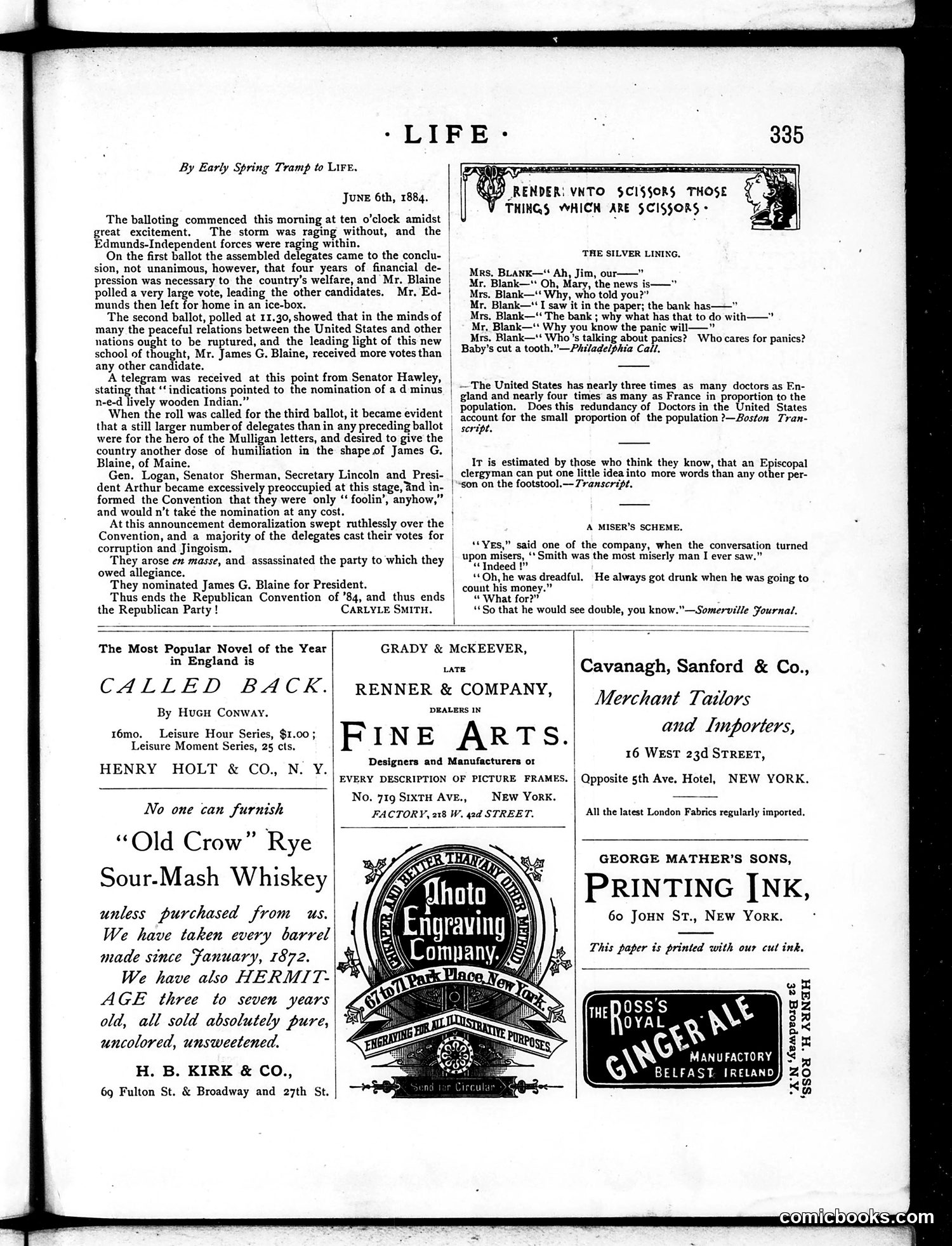
This page satirizes the 1884 Republican National Convention, which nominated James G. Blaine for president. The lead article by Carlyle Smith mocks delegates for repeatedly voting for Blaine despite—according to the author—his association with financial depression, imperialism ("jingoism"), and scandal (the "Mulligan letters" corruption case). The satire's bite: Smith describes Blaine supporters as "assassinating" the Republican Party through their choice. The piece suggests that other candidates (Logan, Sherman, Lincoln, Arthur) explicitly declined nomination, leaving only Blaine as the remaining option—further humiliating the party. The cartoon-like framing compares Blaine to a "lively wooden Indian" (Senator Hawley's dismissive phrase), suggesting he's an empty, decorative figurehead rather than a serious statesman. The remaining content consists primarily of advertisements and brief humorous items, including jokes about doctors, clergymen, and a miser.
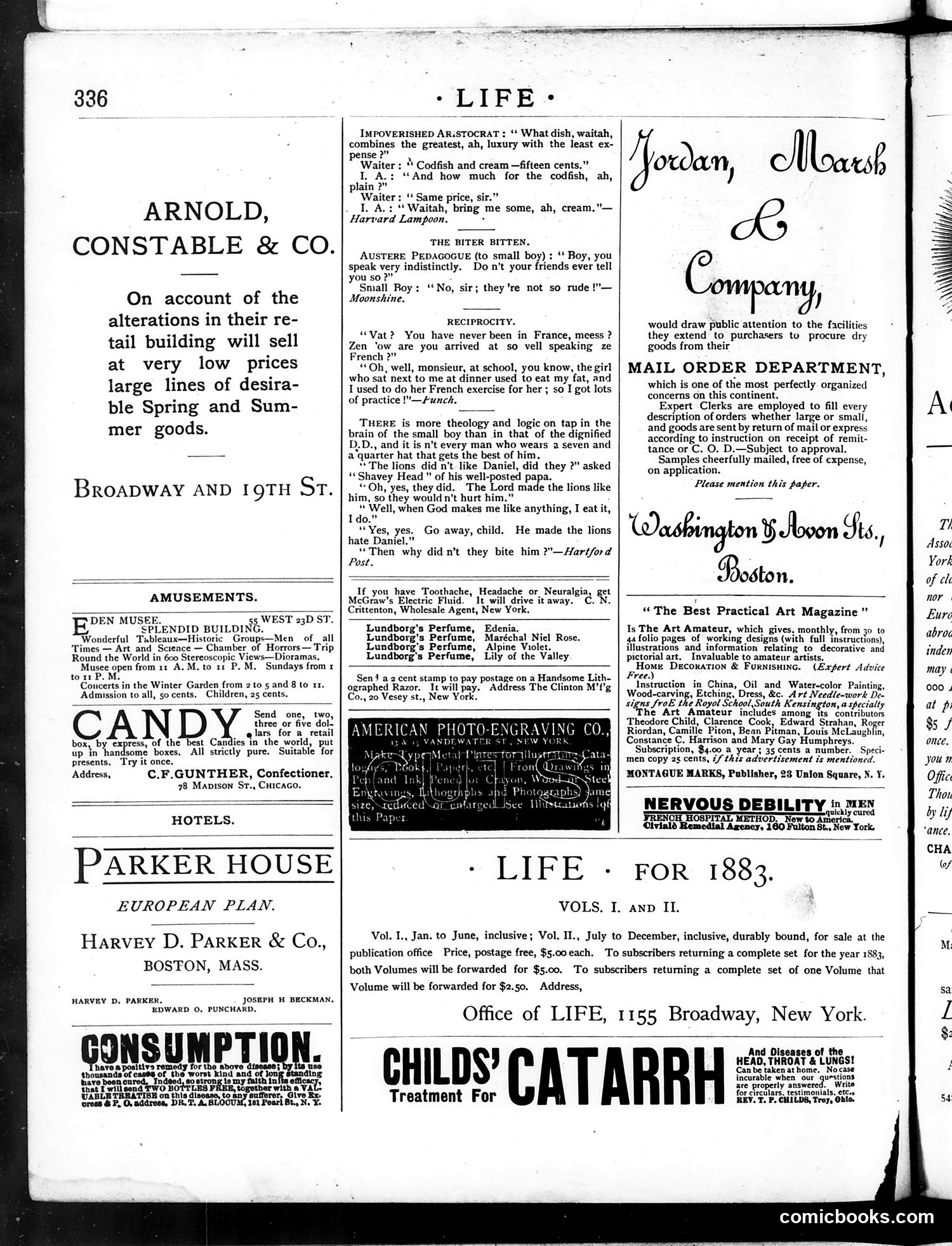
This page is primarily advertising and notices from *Life* magazine, with several short comic anecdotes interspersed. The cartoons present upper-class or educated characters in mildly humorous situations: an impoverished aristocrat trying to economize by ordering only cream (a joke about class pretension), a schoolmaster outwitted by a clever child's logic about biblical lions, and a French lesson conducted through romantic proximity. These represent typical satirical humor of the era—poking gentle fun at social pretension, authority figures, and linguistic/cultural confusion. The page is dominated by advertisements for New York businesses (Arnold, Constable & Co. department store; Parker House hotel; Eden Musee wax museum) and patent medicines typical of 1880s publications—dubious remedies for consumption and neuralgia. The masthead advertises *Life* magazine volumes for 1883. No major political satire or identifiable public figures appear on this page—it's routine period advertising and light social humor rather than pointed commentary.
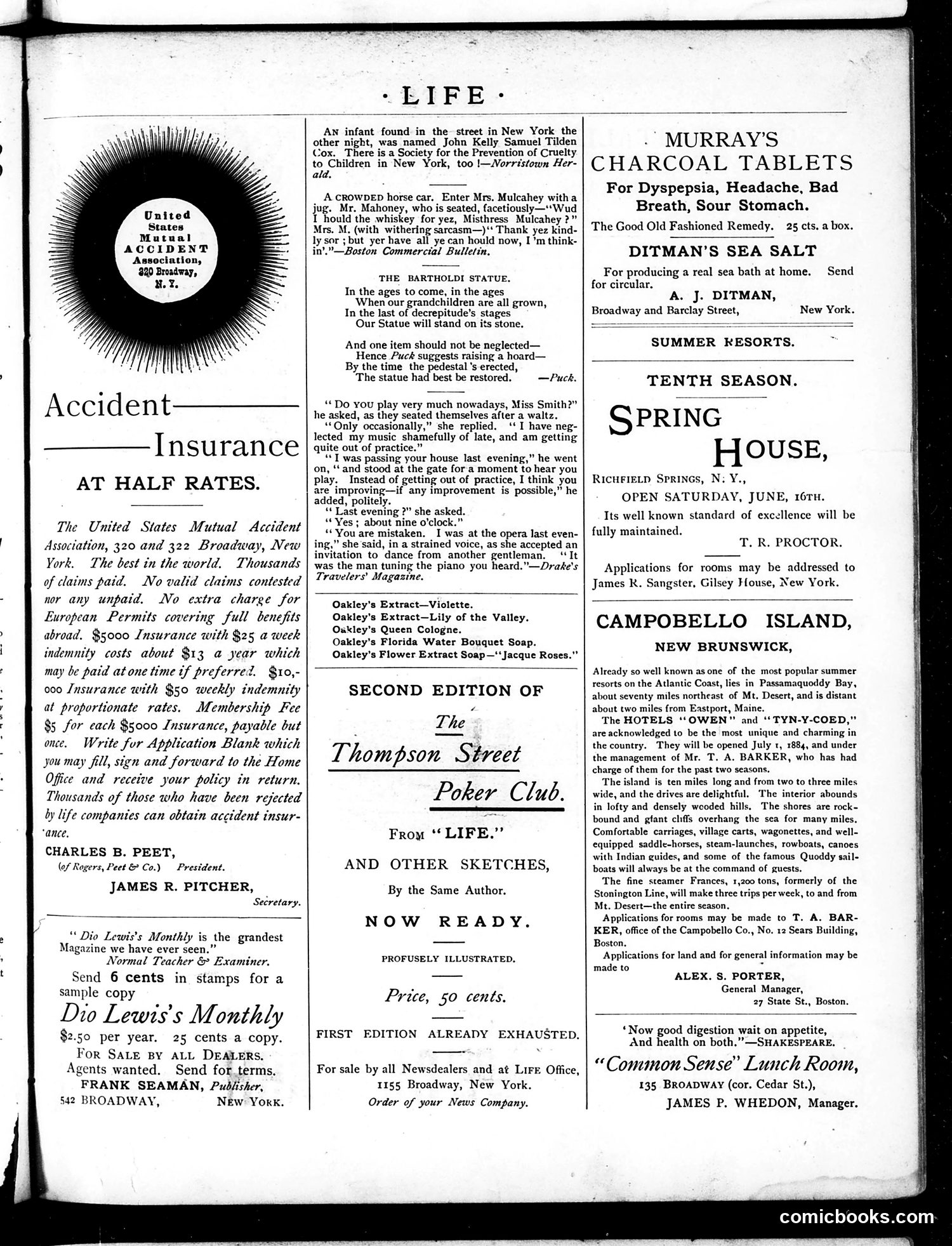
This page is primarily advertisements and humorous short anecdotal pieces rather than political satire. The main cartoonish content appears to be decorative rather than ideologically pointed. The notable items are brief jokes: one about an abandoned infant named after three politicians (John Kelly, Samuel Tilden, and Cox)—a mild dig at the public prominence of these figures. Another mocks a woman's piano playing, suggesting her suitor actually heard a professional piano tuner, not her practice. A third piece references the Bartholdi Statue (Statue of Liberty under construction), humorously suggesting funds be raised to restore it *before* it ages, since restoration will take so long. The rest comprises advertisements for patent medicines, insurance, hotels, and magazines typical of 1880s-era Life magazine. The satire is genteel and anecdotal rather than hard-hitting political commentary.
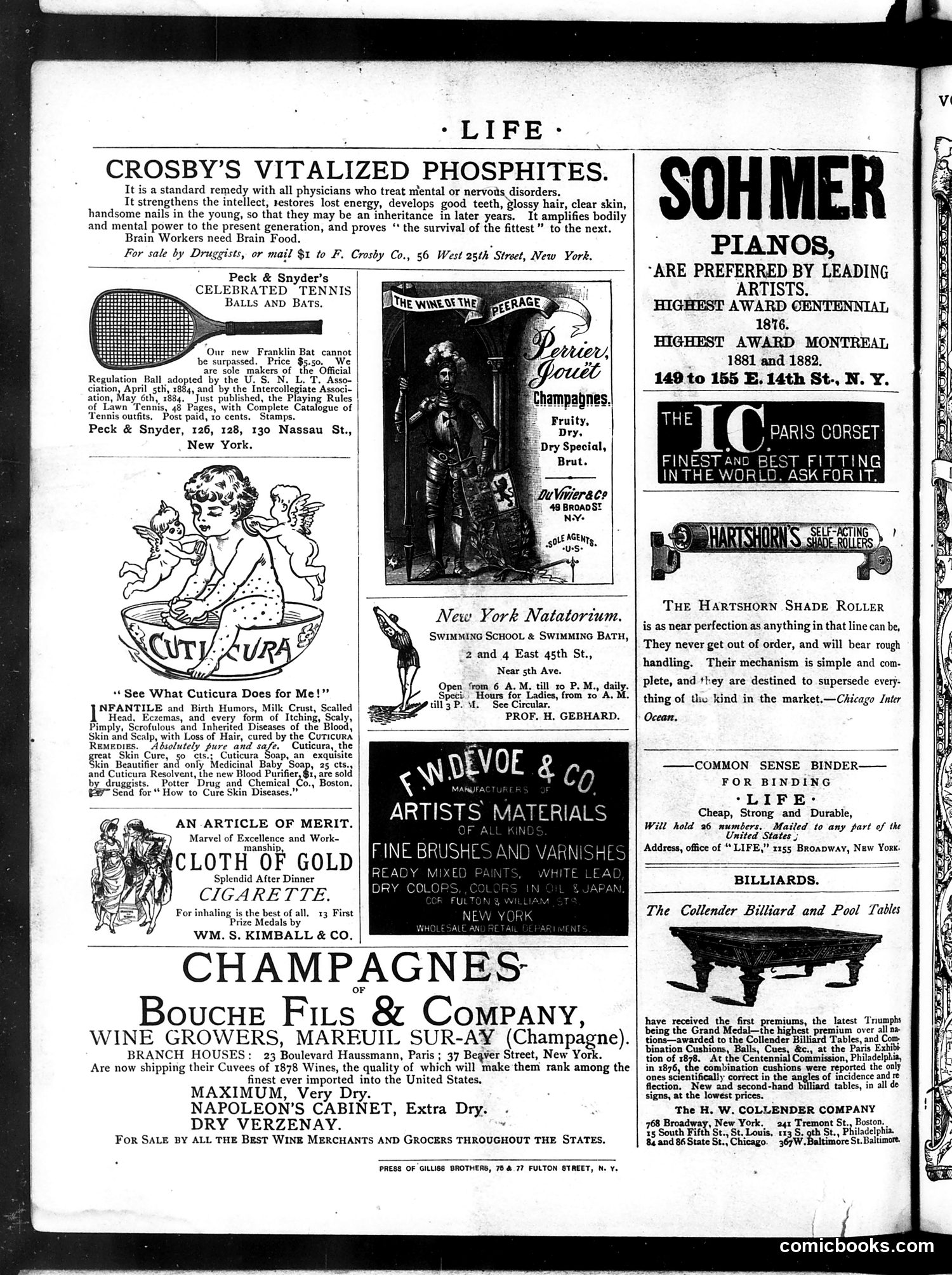
This page is **primarily advertisements**, not political satire. The content consists almost entirely of commercial promotions for late-nineteenth-century products and services. The visible cartoons appear to be **brand mascots and product illustrations** rather than editorial satire: - A cherub figure for "Cuticura" skin remedy (showing the product's medicinal benefit claim) - A "Cloth of Gold" cigarette illustration - An image associated with Perrier-Jouet champagne The satirical purpose, if any, lies in how **these advertisements claim absurdly broad health benefits**: Crosby's Phosphites promises to strengthen intellect, restore energy, develop teeth and glossy hair—essentially "survival of the fittest." Cuticura claims to cure virtually every skin condition known. This reflects the era's **patent medicine culture**, where unregulated commercial products made exaggerated medicinal claims that would be considered fraudulent today. The page documents both consumer capitalism and the absence of FDA regulation in this period.