
Life, 1884-06-12 · page 5 of 16
Life — June 12, 1884 — page 5: what you’re looking at
What you’re looking at
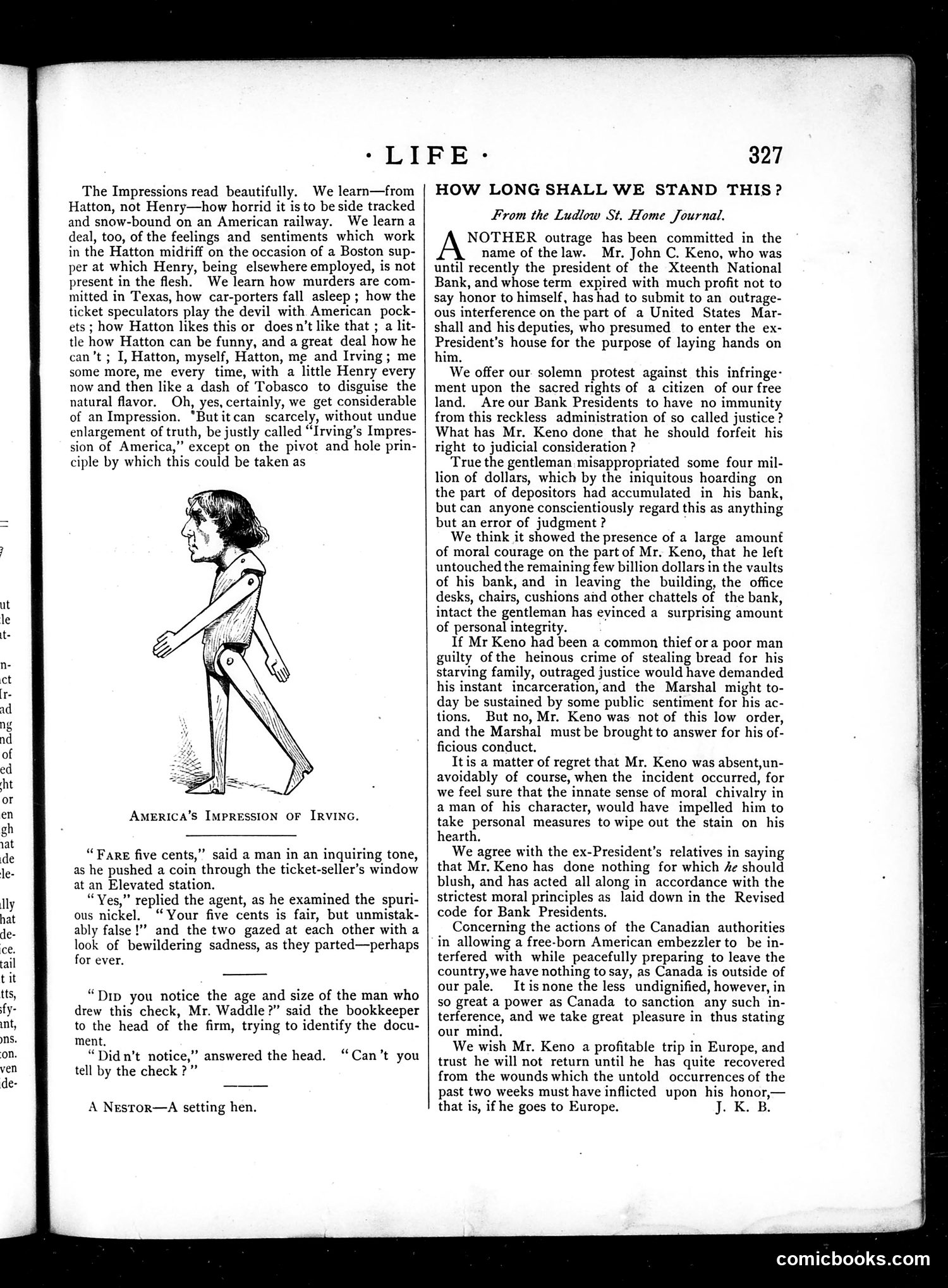
This cartoon satirizes Washington Irving, the famous American author, depicted as an exaggerated, skeletal figure in a contorted pose. The accompanying text describes Irving's impressions of America—specifically his travels on a snowy, isolated Hatton railroad journey and observations of American life and manners. The satire suggests Irving's own grotesque distortions when describing American society back to European audiences. By showing him as an absurdly twisted caricature, the cartoonist mocks how Irving's literary "impressions" of America may have been equally distorted or unflattering representations of American character to foreign readers. The visual exaggeration mirrors the supposed exaggeration in his written accounts.
📄 Transcribed text from this page (OCR, searchable)
Machine-transcribed from the original scan — historical spelling and the odd misread are preserved.
* LIFE * The Impressions read beautifully. We learn—from Hatton, not Henry—how horrid it is to be side tracked and snow-bound on an American railway. We learna deal, too, of the feelings and sentiments which work in the Hatton midfiff on the occasion of a Boston sup- per at which Henry, being elsewhere employed, is not present in the flesh. We learn how murders are com- mitted in Texas, how car-porters fall asleep ; how the ticket speculators play the devil with American pock- ets ; how Hatton likes this or doesn’t like that ; a lit- tle how Hatton can be funny, and a great deal how he can’t ; I, Hatton, myself, Hatton, me and Irving; me some more, me every time, with a little Henry every now and then like a dash of Tobasco to disguise the natural flavor. Oh, yes, certainly, we get considerable of an Impression. “Butitcan scarcely, without undue enlargement of truth, be justly called “Irving’s Impres- sion of America,” except on the pivot and hole prin- ciple by which this could be taken as AMERICA’S IMPRESSION OF IRVING. “Fare five cents,” said a man in an inquiring tone, as he pushed a coin through the ticket-seller’s window at an Elevated station. “Yes,” replied the agent, as he examined the spuri- ous nickel. ‘Your five cents is fair, but unmistak- ably false !’’ and the two gazed at each other with a look of bewildering sadness, as they parted—perhaps for ever. “Dip you notice the age and size of the man who drew this check, Mr. Waddle?” said the bookkeeper to the head of the firm, trying to identify the docu- ment. “Didn't notice,” answered the head. tell by the check ?” “Can’t you A Nestor—A setting hen. 327 HOW LONG SHALL WE STAND THIS? From the Ludlow St. Home Journal. NOTHER outrage has been committed in the name of the law. Mr. John C. Keno, who was until recently the president of the Xteenth National Bank, and whose term expired with much profit not to say honor to himself, has had to submit to an outrage- ous interference on the part of a United States Mar- shall and his deputies, who presumed to enter the ex- President's house for the purpose of laying hands on him. We offer our solemn protest against this infringe- ment upon the sacred rights of a citizen of our free land. Are our Bank Presidents to have no immunity from this reckless administration of so called justice ? What has Mr. Keno done that he should forfeit his right to judicial consideration ? True the gentleman misappropriated some four mil- lion of dollars, which by the iniquitous hoarding on the part of depositors had accumulated in his bank, but can anyone conscientiously regard this as anything but an error of judgment ? We think it showed the presence of a large amount of moral courage on the part of Mr. Keno, that he left untouched the remaining few billion dollars in the vaults of his bank, and in leaving the building, the office desks, chairs, cushions and other chattels of the bank, intact the gentleman has evinced a surprising amount of personal integrity. If Mr Keno had been a common thief ora poor man guilty ofthe heinous crime of stealing bread for his starving family, outraged justice would have demanded his instant incarceration, and the Marshal might to- day be sustained by some public sentiment for his ac- tions. But no, Mr. Keno was not of this low order, and the Marshal must be brought to answer for his of- ficious conduct. Itis a matter of regret that Mr. Keno was absent,un- avoidably of course, when the incident occurred, for we feel sure that the innate sense of moral chivalry in aman of his character, would have impelled him to take personal measures to wipe out the stain on his hearth. We agree with the ex-President’s relatives in saying that Mr. Keno has done nothing for which e should blush, and has acted all along in accordance with the strictest moral principles as laid down in the Revised code for Bank Presidents. Concerning the actions of the Canadian authorities in allowing a free-born American embezzler to be in- terfered with while peacefully preparing to leave the country,we have nothing to say, as Canada is outside of our pale. Itisnone the less undignified, however, in so great a power as Canada to sanction any such in- terference, and we take great pleasure in thus stating our mind. We wish Mr. Keno a profitable trip in Europe, and trust he will not return until he has quite recovered from the wounds which the untold occurrences of the past two weeks must have inflicted upon his honor,— that is, if he goes to Europe. J. K. B. comicbooks.com