
Life, 1884-06-12 · page 4 of 16
Life — June 12, 1884 — page 4: what you’re looking at
What you’re looking at
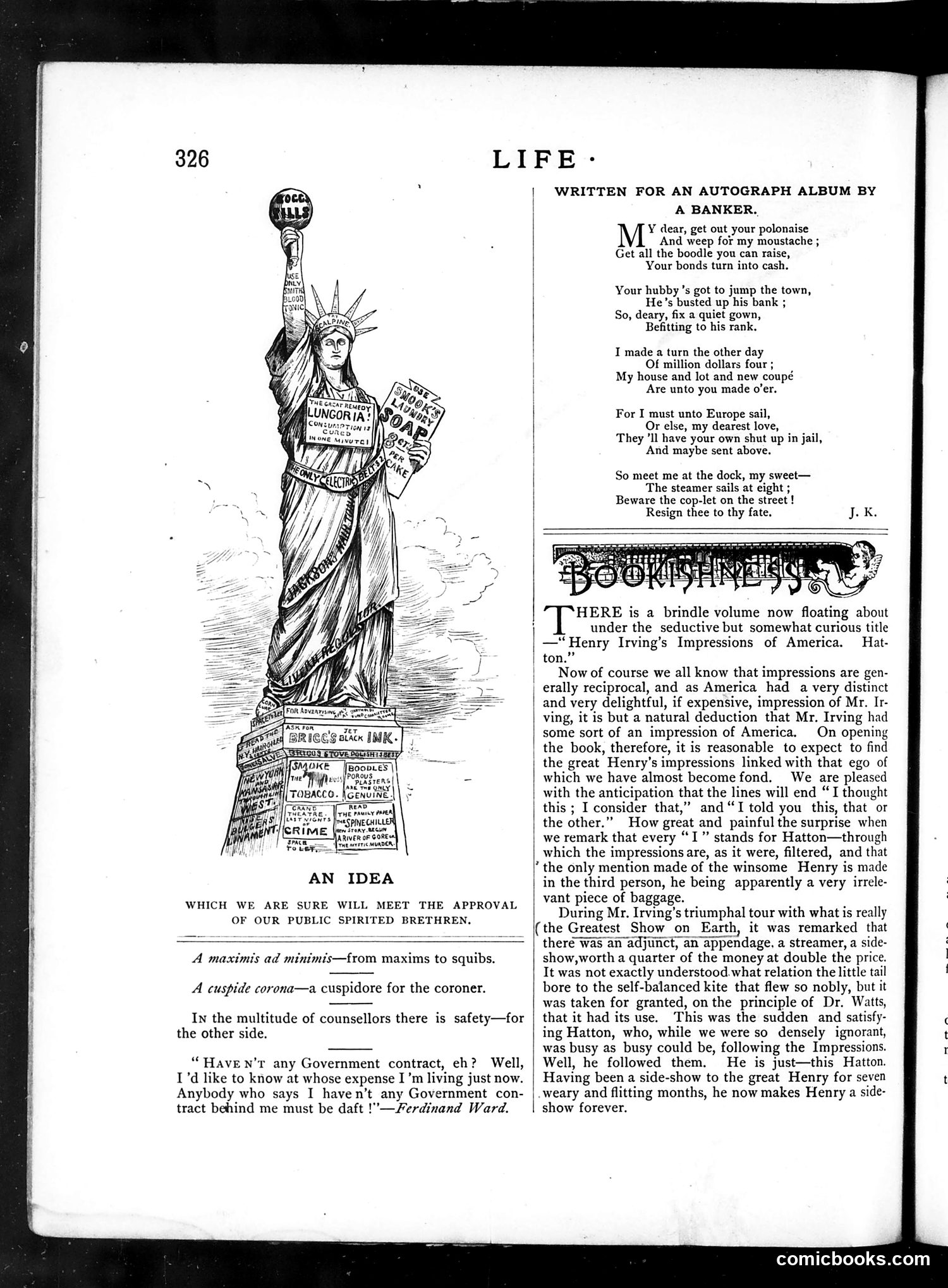
This cartoon satirizes American consumerism and commercialism by transforming the Statue of Liberty into a billboard. Lady Liberty clutches not a torch but a product advertisement, while her pedestal is plastered with advertisements for various consumer goods: ink, tobacco, soap, and other commodities. The satire targets how American capitalism has commodified the nation's most iconic symbol of freedom and democracy. Rather than representing ideals, Liberty now promotes commercial products—suggesting that by the early 20th century, American values had become inseparable from consumer culture and advertising. The accompanying text's Latin phrases ("maximus ad minimis") reinforce the joke about degrading something grand into something trivial for profit.
📄 Transcribed text from this page (OCR, searchable)
Machine-transcribed from the original scan — historical spelling and the odd misread are preserved.
LIFE: Tat can LUNGOR ie Icon [SMOKE [Boones | TOBACCO. KGenvine| | = READ rye rawiey 247e4] rae AN IDEA WHICH WE ARE SURE WILL MEET THE APPROVAL OF OUR PUBLIC SPIRITED BRETHREN, A maximis ad minimis—from maxims to squibs. A cuspide corona—a cuspidore for the coroner. In the multitude of counsellors there is safety—for the other side. “Have n’r any Government contract, eh? Well, I'd like to know at whose expense I’m living just now. Anybody who says I haven’t any Government con- tract behind me must be daft !"— Ferdinand Ward. | | WRITTEN FOR AN AUTOGRAPH ALBUM BY A BANKER. Y dear, get out your polonaise And weep for my moustache ; Get all the boodle you can raise, Your bonds turn into cash, Your hubby’s got to jump the town, He’s busted up his bank ; So, deary, fix a quiet gown, Befitting to his rank, I made a turn the other day Of million dollars four ; My house and lot and new coupé Are unto you made o’er. For I must unto Europe sail, Or else, my dearest love, They ’ll have your own shut up in jail, And maybe sent above. So meet me at the dock, my sweet— The steamer sails at eight ; Beware the cop-let on the street ! Resign thee to thy fate. HERE is a brindle volume now floating about under the seductive but somewhat curious title —‘Henry Irving’s Impressions of America. Hat- ton.” | Now of course we all know that impressions are gen- | erally reciprocal, and as America had a very distinct and very delightful, if expensive, impression of Mr. Ir- ving, it is but a natural deduction that Mr. Irving had some sort of an impression of America. On opening the book, therefore, it is reasonable to expect to find the great Henry’s impressions linked with that ego of which we have almost become fond. We are pleased with the anticipation that the lines will end “I thought this ; I consider that,” and “I told you this, that or the other.” How great and painful the surprise when | we remark that every “I” stands for Hatton—through which the impressions are, as it were, filtered, and that |’ the only mention made of the winsome Henry is made | in the third person, he being apparently a very irrele- vant piece of baggage. During Mr. Irving’s triumphal tour with what is really (the Greatest Show on Earth, it was remarked that theré was an adjunct, an appendage. a streamer, a side- show,worth a quarter of the money at double the price. It was not exactly understood.what relation the little tail bore to the self-balanced kite that flew so nobly, but it was taken for granted, on the principle of Dr. Watts, that it had its use. This was the sudden and satisfy- ing Hatton, who, while we were so densely ignorant, was busy as busy could be, following the Impressions. Well, he followed them. He is just—this Hatton. Having been a side-show to the great Henry for seven weary and flitting months, he now makes Henry a side- show forever. comicbooks.com