
A complete issue · 16 pages · 1884
Life — May 8, 1884
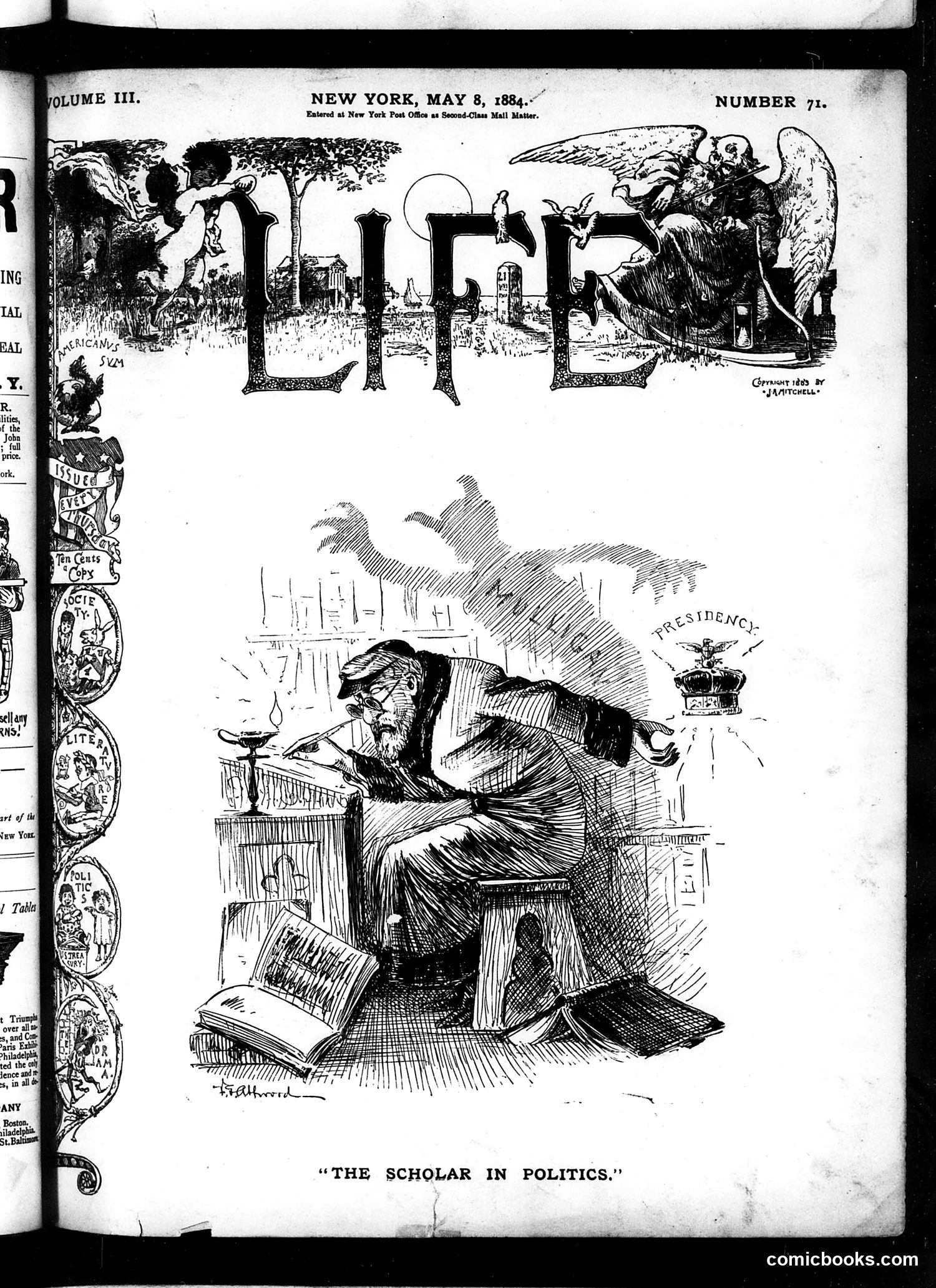
This cartoon from Life magazine (May 8, 1884) satirizes an intellectual figure engaged in political activity, likely representing a scholar or academic who has entered the political arena. The figure sits at a desk surrounded by books and papers, smoking a pipe while contemplating—suggesting someone more comfortable with abstract theory than practical governance. The "Presidency" symbol visible in the background indicates this concerns presidential politics. The satire appears to mock the notion that scholarly expertise or book-learning translates effectively to political office. The cartoon suggests tension between academic idealism and political pragmatism—implying that scholars may be ill-equipped for the rough realities of actual political power and decision-making.
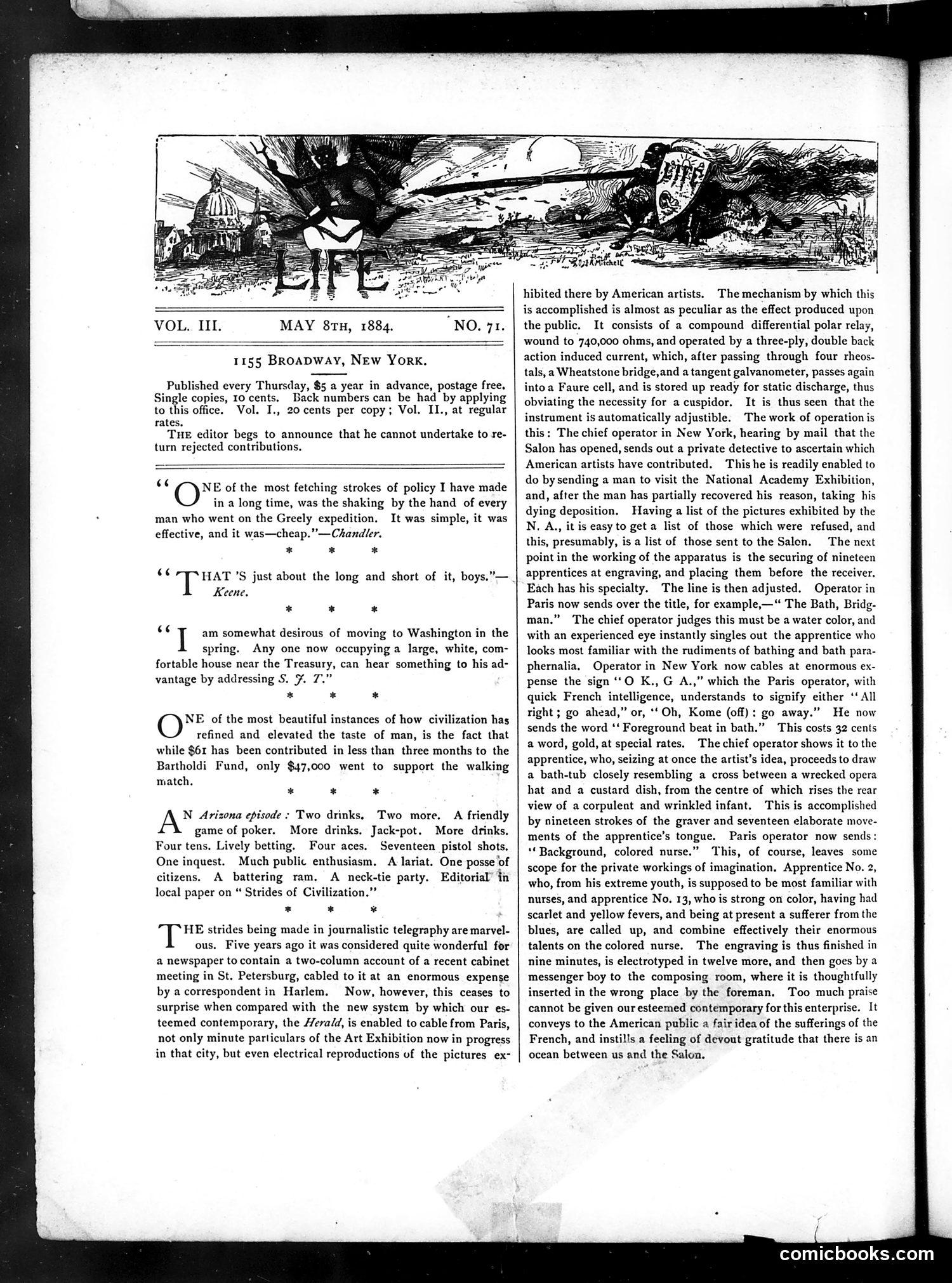
The masthead illustration depicts a winged figure (likely representing "Life" itself or artistic inspiration) swooping dramatically across a landscape. The accompanying text discusses journalistic telegraphy and an innovative system for transmitting pictures from Paris to New York via electrical reproduction—a cutting-edge technology for the era. The main satirical content consists of brief, witty editorial snippets and quotes poking fun at contemporary politics and society, including references to moving to Washington and commentary on charitable giving to the Bartholdi Fund (likely for the Statue of Liberty). The page emphasizes Life's focus as a satirical weekly: sharp social commentary wrapped in humor rather than visual political cartoons. The technological discussion reflects the magazine's interest in modern innovations and their cultural implications.
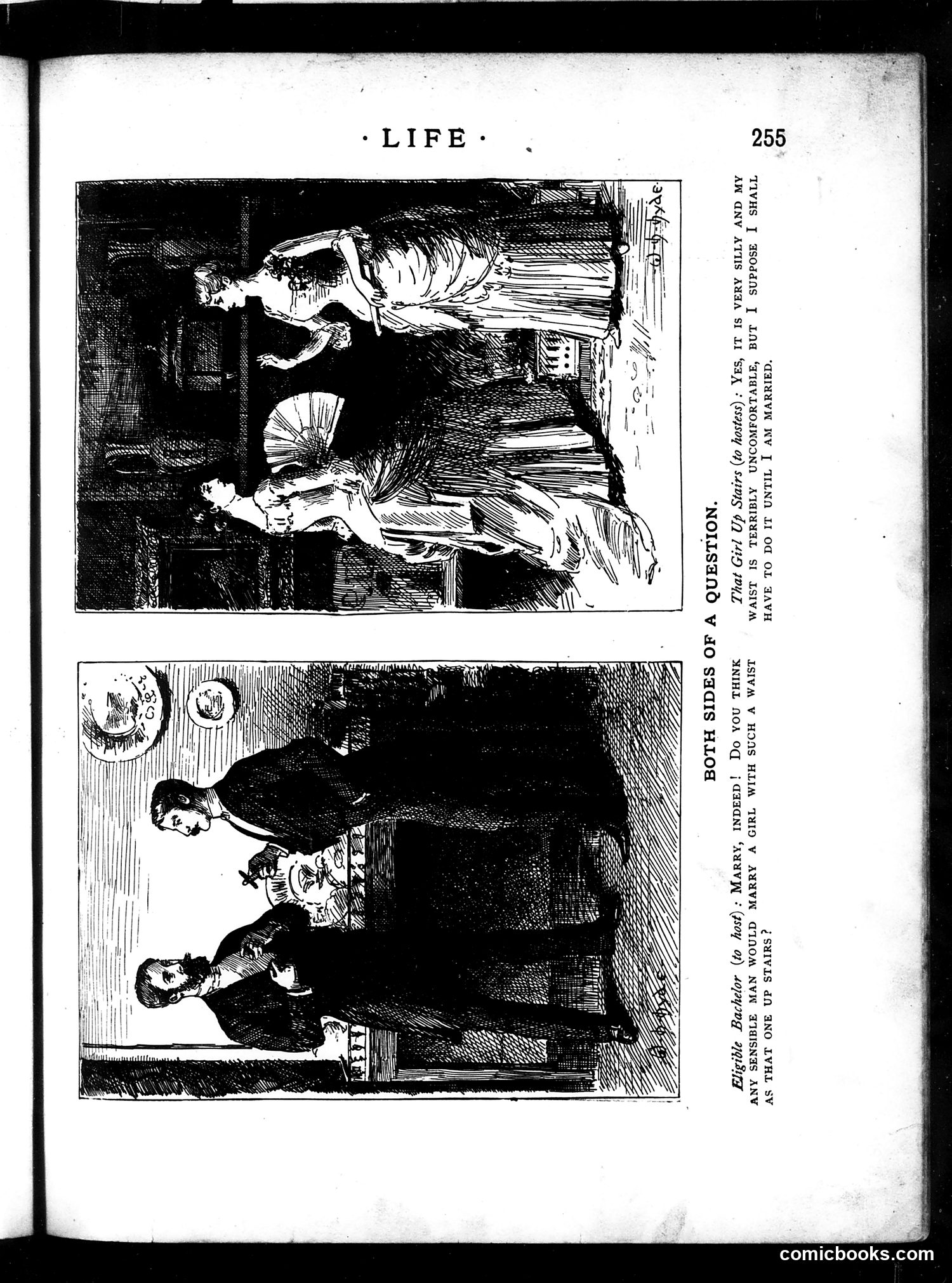
This page contains two satirical cartoon panels titled "Both Sides of a Question." The top panel depicts two women in elaborate dress with fans, appearing to be in conversation or debate. The bottom panel shows three figures in what appears to be a domestic interior setting. The caption references "Erminia Rusbacher (a lady)" and mentions "Mary, indeed! Do you think I was born without Mary a wife with her wit about her? Mary a wife with her wit about her?" **Context unclear:** Without additional historical context, the specific social or political commentary these cartoons address is difficult to determine with certainty. The phrase "both sides of a question" suggests the cartoons present contrasting perspectives on some contemporary issue, likely involving women's roles or marital relations, but the precise reference and satirical point remain unclear from the image and OCR text alone.
This page contains literary content rather than political cartoons. The main items are: 1. **"A Rain Fantasy"** - A romantic poem by F.D.S. about reminiscing over a past love, with no satirical intent. 2. **"A Wise Precaution"** - A brief joke about Imperial Dictionary proofs being inspected by boys on Fifth Avenue and 32nd Street before publication. The humor appears to be a standard pun about dictionary scrutiny rather than topical satire. 3. **"Gath's Entailed Hat"** - A book review of George Alfred Townsend's romance novel set in the Chesapeake/Delaware region circa 1825, discussing kidnapping plots and melodramatic incidents. 4. **"A Word of Justice"** - A tribute to General Hancock (appears to reference the Union general), praising his weight and character. The page lacks clear political satire or recognizable caricatures—it's primarily literary and book review content.
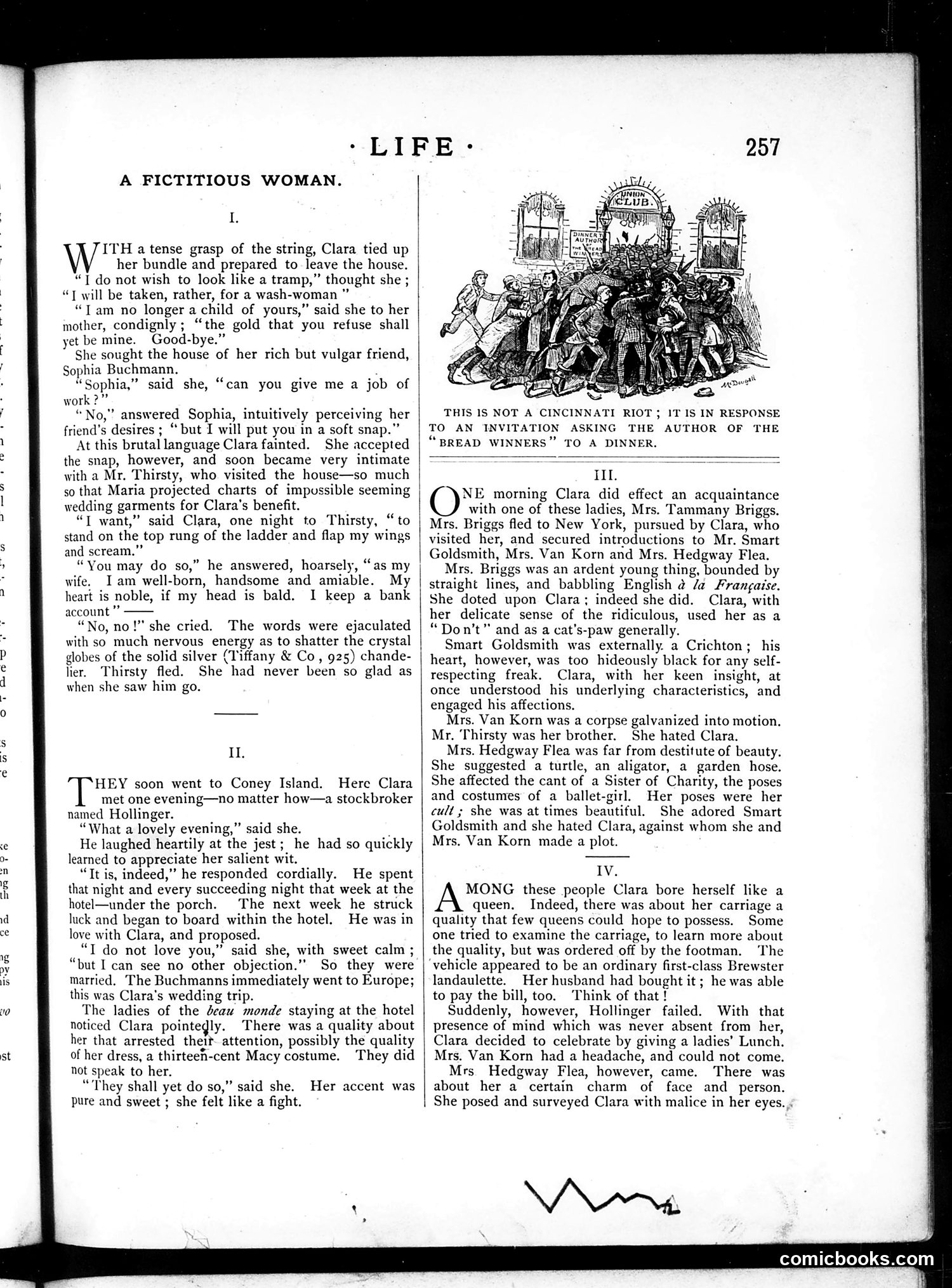
This page contains a serialized short story rather than political cartoons. The single illustration shows a street scene with well-dressed figures outside what appears to be a gentlemen's club. The caption reads: "THIS IS NOT A CINCINNATI RIOT; IT IS IN RESPONSE TO AN INVITATION ASKING THE AUTHOR OF THE 'BREAD WINNERS' TO A DINNER." This references John Hay's novel *The Bread-Winners* (1884), which satirized labor unions and working-class movements. The joke is that the crowd gathering isn't a labor riot (referencing Cincinnati's actual 1884 courthouse riots), but rather fashionable society eager to dine with the book's author. It's gentle social satire mocking both the novel's anti-labor stance and high society's pretensions.
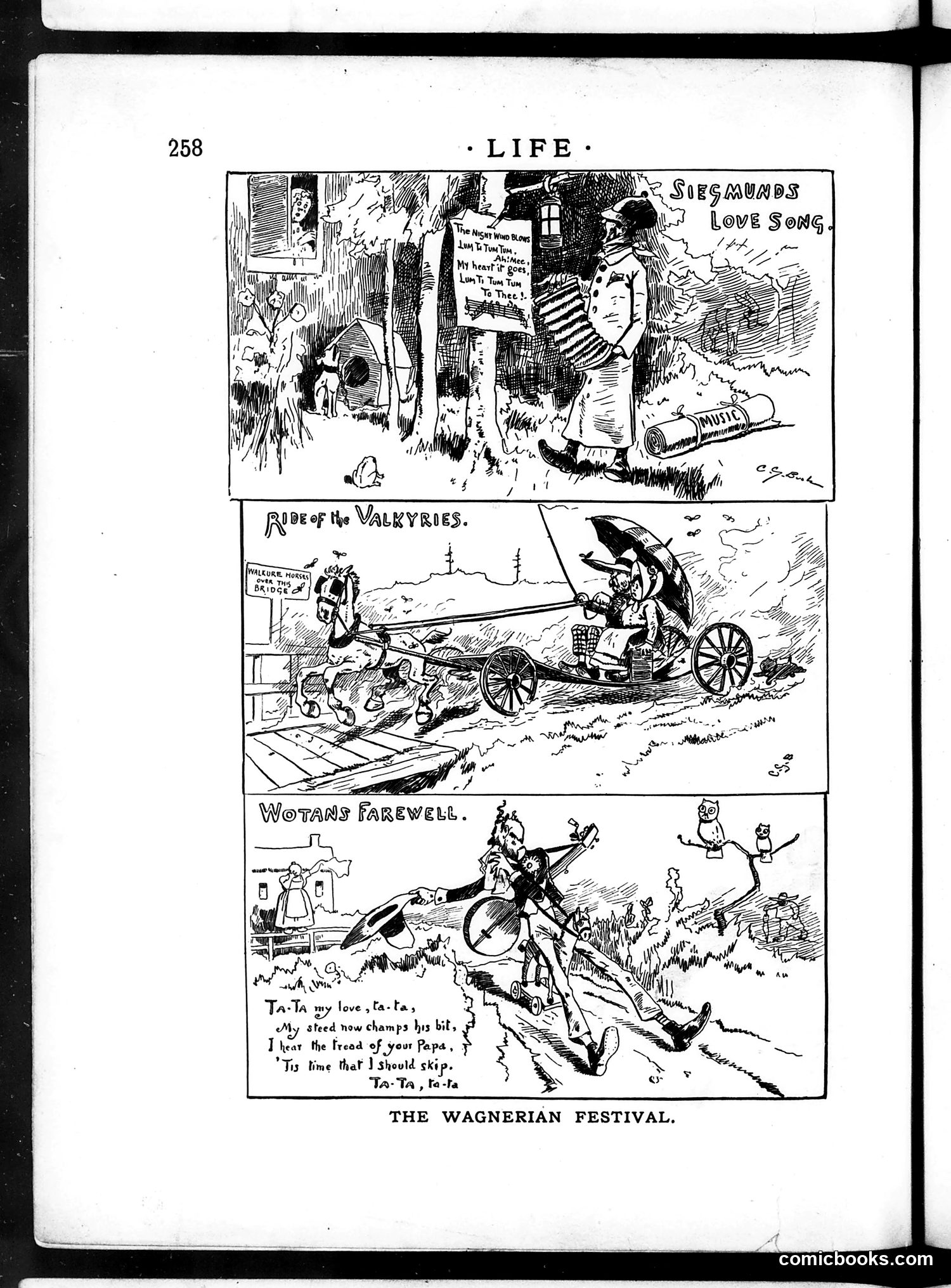
This page satirizes Wagnerian opera through three comedic panels. The top panel, "Siegmund's Love Song," shows an overly dramatic operatic scene with exaggerated German romanticism. "Ride of the Valkyries" (middle) parodies the famous Wagner composition by depicting absurd, chaotic action—women warriors on a bizarre contraption rather than horses, mocking the opera's grandiosity. "Wotan's Farewell" (bottom) continues the mockery with comic lyrics ("Ta-Ta my love, ta-ta, / My ached now champ his bit") that deliberately trivialize Wagner's serious themes through bad rhyming and slapstick humor. The satire targets Wagner's heavily dramatic, Germanic operatic style as pretentious and overwrought, using visual absurdity and doggerel verse to deflate its cultural pretensions for American audiences.
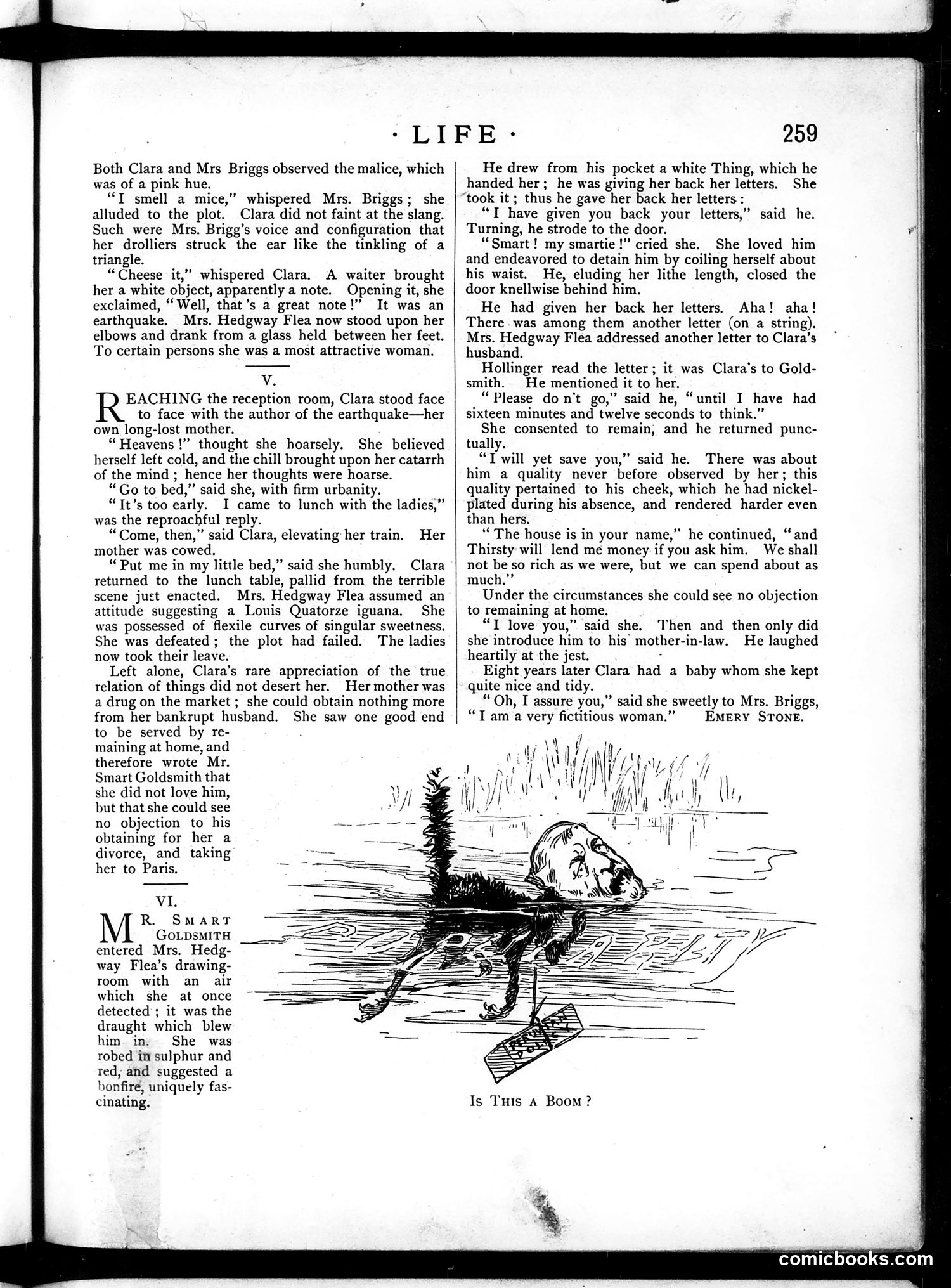
This cartoon illustrates a financial/economic collapse, likely from the late 19th century based on *Life* magazine's era. A figure lies prone in water, appearing to drown or sink, while holding what appears to be a boom (a wooden pole or beam used in sailing). The caption "Is This a Boom?" creates a dark pun: the boom—typically a sign of economic prosperity—has instead become an instrument of the figure's demise, suggesting false or unsustainable economic expansion that has catastrophically failed. The accompanying story about Clara and Mr. Goldsmith deals with personal financial ruin and social decline, reinforcing the page's theme: apparent prosperity masking underlying economic disaster.
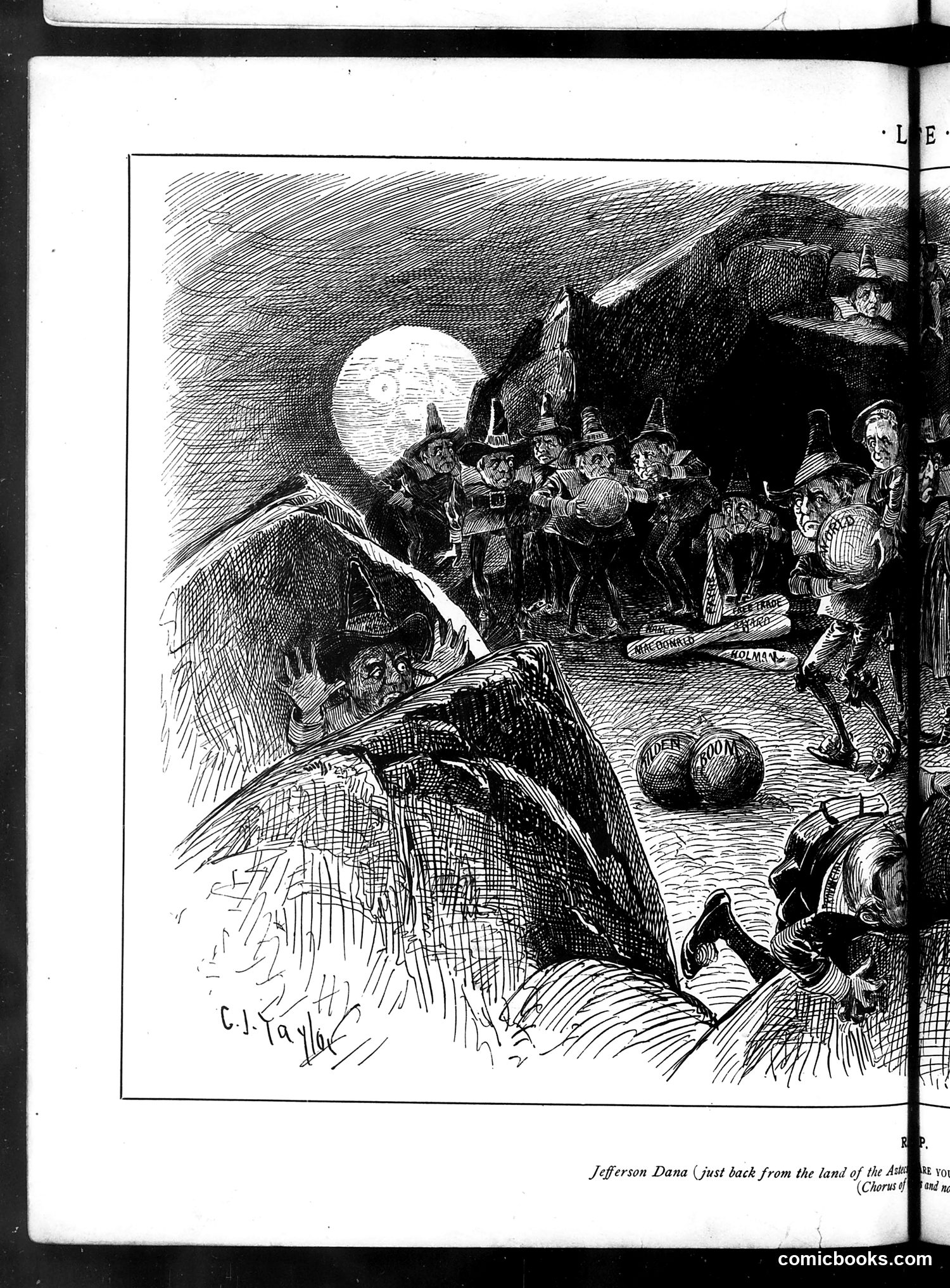
This is a political cartoon titled "Jefferson Dana (just back from the land of the Ads[?]" showing a winged angelic or allegorical figure on the left observing a nighttime scene. A full moon illuminates a gathering of men wearing what appear to be Ku Klux Klan robes and pointed hoods, standing in a circle. Two spheres labeled "MODERN" and "DOMES" (or similar) sit in the foreground. The cartoon satirizes the contrast between idealistic American values (represented by the angelic figure, likely invoking Thomas Jefferson) and the reality of KKK activity. The "land of the Ads" reference is unclear, though it may reference advertising or advertisements. The piece critiques the hypocrisy of American ideals versus racist violence, using the supernatural imagery to emphasize the otherworldly wrongness of KKK operations.
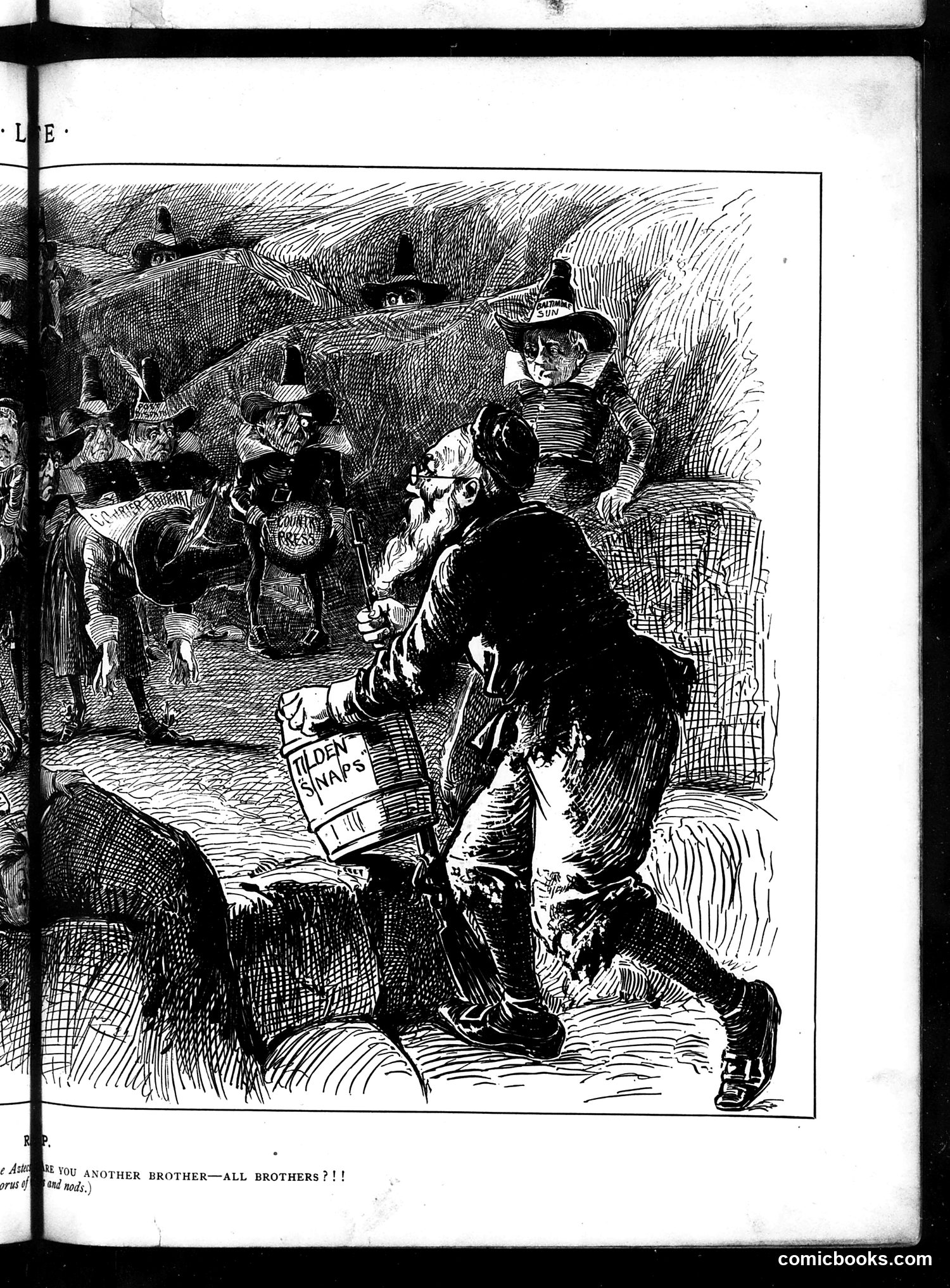
This political cartoon appears to depict a bearded figure in the foreground holding what looks like "Tilden Snaps" (visible on a container), addressing a group of soldiers or military men in the background. The caption reads "ARE YOU ANOTHER BROTHER—ALL BROTHERS?!!" The cartoon likely references **Samuel J. Tilden**, the Democratic presidential candidate, and appears to satirize themes of political unity or brotherhood among supporters, possibly during a post-Civil War context when "brother" language held particular weight regarding national reconciliation. The "Tilden Snaps" product label suggests commercial or popular support for Tilden's campaign. The questioning tone ("ARE YOU ANOTHER BROTHER?") implies skepticism about claimed solidarity or political claims. Without the publication date, the exact historical moment remains uncertain, though the military uniforms suggest post-Civil War period satire.
This page contains satirical commentary on American crime and capital punishment, circa 1880s. **"All She Could Do"** is a humorous poem by James Whitcomb Riley about a woman's conflicted courtship—she claims to abhor an old, homely suitor but her actions (swooning, silence) betray her actual attraction. The satire mocks Victorian courtship conventions and female propriety. **"Sweet Land of Liberty"** is the page's primary editorial satire, attacking America's lenient treatment of murderers. Using comparative statistics, the author argues that because America rarely executes convicted murderers (only 93 of 1,500+ convictions hanged), murder rates have exploded—three times higher than England, France, or Germany. The piece satirizes American leniency by sarcastically praising it as a "murderer's Millenium," and exposes systemic corruption: wealthy criminals hire "criminal lawyers" who bribe jurors to secure acquittals or reduced sentences. The satire targets both lenient laws and judicial corruption enabling violent crime.
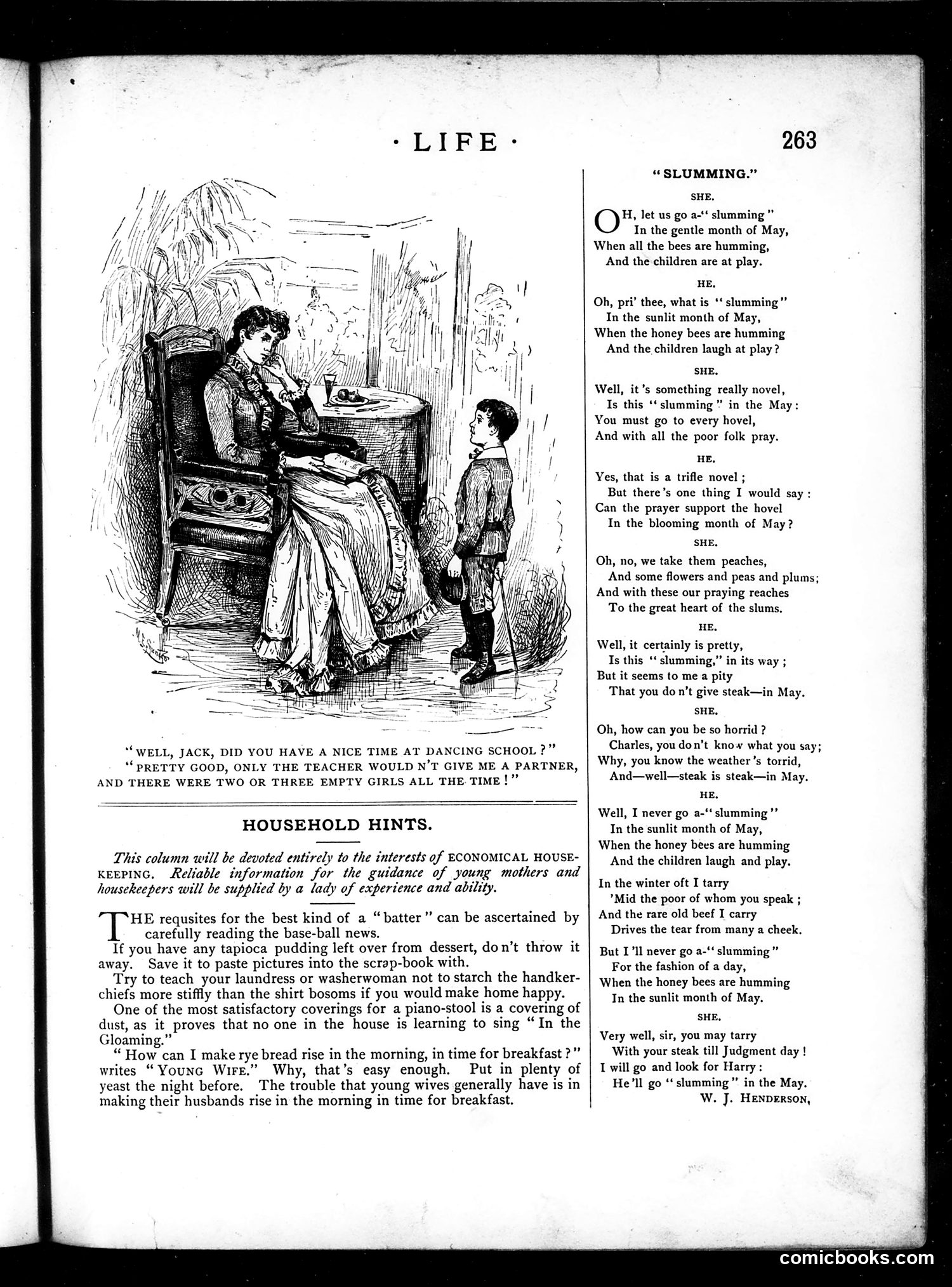
This page contains two satirical pieces mocking upper-class Victorian social practices. **The Cartoon** depicts a boy at dancing school complaining that the teacher wouldn't assign him a partner, leaving "empty girls" without dance partners—humor derived from the awkwardness of Victorian courtship rituals and gender dynamics in supervised social settings. **"Slumming"** is a dialogue poem satirizing a fashionable upper-class pastime where wealthy people would visit poor neighborhoods ("hovels" and "slums") for charity work, treating it as entertainment. The husband character ridicules his wife's approach: she wants to visit the poor in May with flowers and peaches as a trendy social activity, while he argues that *real* charity means providing substantial help (steak) in winter when the poor actually need it. The satire critiques the performative, seasonal nature of wealthy people's charitable gestures—doing good as fashion rather than genuine need. Both pieces mock Victorian social conventions and the gap between appearance and substance.
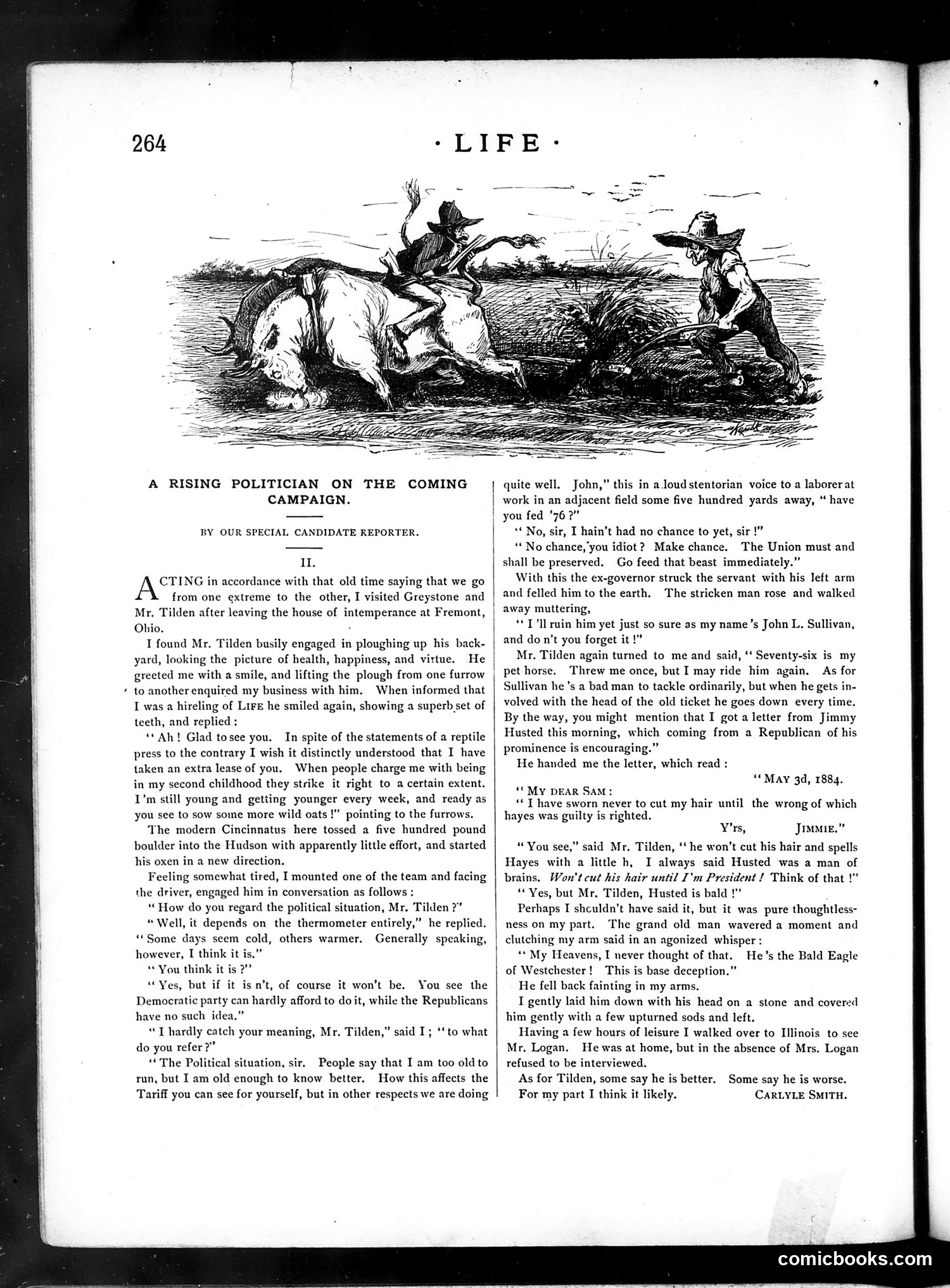
This satirical piece mocks **Samuel J. Tilden**, the 1876 Democratic presidential candidate, who apparently sought nomination again in 1884. The cartoon depicts him as an absurdly vigorous elderly man ploughing his backyard, then riding oxen while speaking nonsensical platitudes about politics and the tariff. The satire targets: 1. **Tilden's age and fitness**: Despite claims of renewed vigor ("younger every week"), he's implausibly strong yet mentally befuddled 2. **Empty political rhetoric**: His answers are evasive gibberish—politics depends on "the thermometer" 3. **The 1876 election**: References to "76" (his horse, his campaign) and Hayes's disputed presidency 4. **Republican allies**: Husted's bizarre vow never to cut his hair until Tilden becomes president—comic because Husted is already bald The punchline: Tilden faints upon learning this contradiction, suggesting his campaign rests on delusion and absurdity.
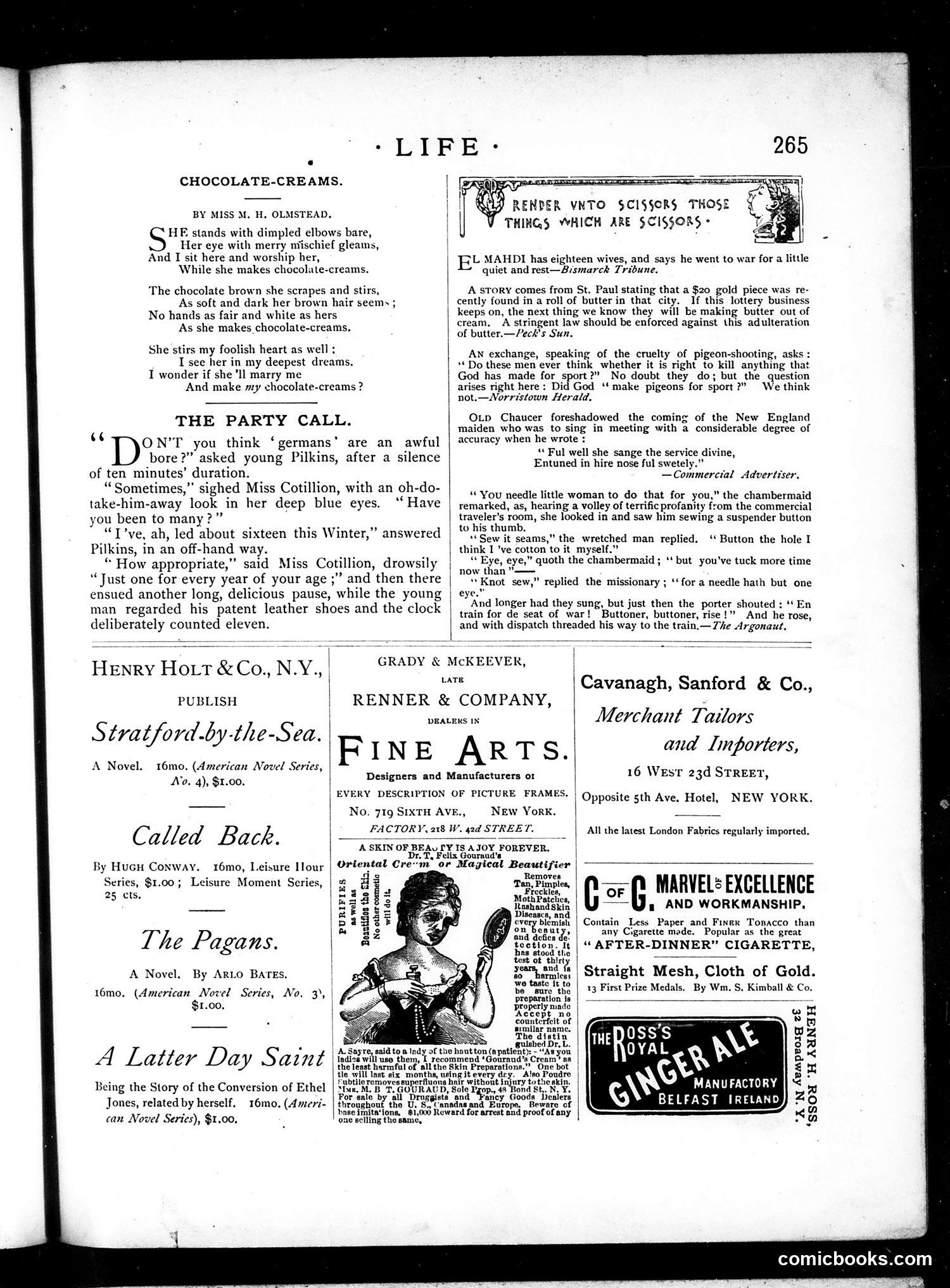
This page is primarily **literary and advertising content** rather than political satire. The main textual features include: **Poetry & Fiction:** "Chocolate-Creams" (a sentimental poem about a young man admiring a woman making candy) and "The Party Call" (a humorous dialogue between two society figures discussing the tedium of attending "Germans"—formal dance events—at length). **The Humor:** The satire is social rather than political. "The Party Call" mocks upper-class courtship rituals and the awkward silences between young people at formal gatherings, with gentle mockery of both the vapid socialite Miss Cotillion and the affected young man Pilkins. **Miscellaneous Jokes:** The page includes brief humorous quips about the Mahdi (Islamic religious figure), pigeon-shooting ethics, and butter adulteration—typical period commentary on contemporary events and social issues. **Visual Element:** A classical engraving of a woman with a hand mirror appears amid beauty product advertisements. The page is largely **advertisements for books, artwork, tailoring services, and cosmetics**, typical of Life magazine's mixed editorial-commercial format.
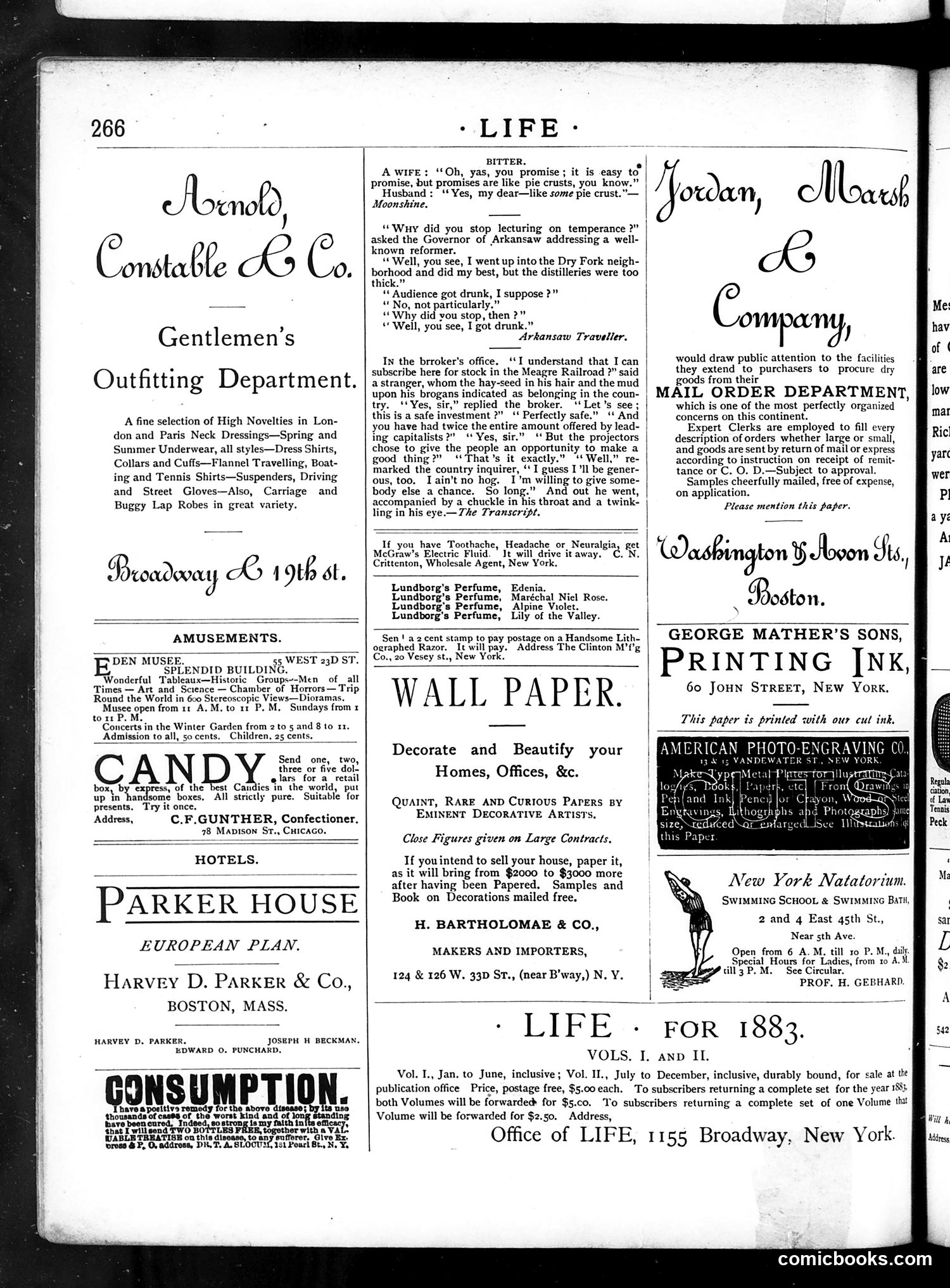
This is primarily an **advertising page** from Life magazine's 1883 volume. The page contains minimal actual editorial content—mostly commercial advertisements for hotels, clothing, confectionery, and wallpaper services. The only satirical humor appears in brief **joke snippets** scattered among ads: 1. A marital joke about "pie crust promises" (easily broken) 2. An "Arkansaw Traveller" anecdote mocking a temperance reformer who got drunk while lecturing against alcohol in a whiskey-producing region 3. A country rube foolishly investing in a dubious railroad stock, manipulated by a smooth-talking broker These jokes reflect common **19th-century satirical targets**: marriage dynamics, hypocrisy of reformers, and rural/urban stereotypes (the gullible "hay-seed" versus the slick city businessman). The page demonstrates how Life balanced serious satirical content elsewhere with commercial revenue through advertising, a typical magazine business model of the era.
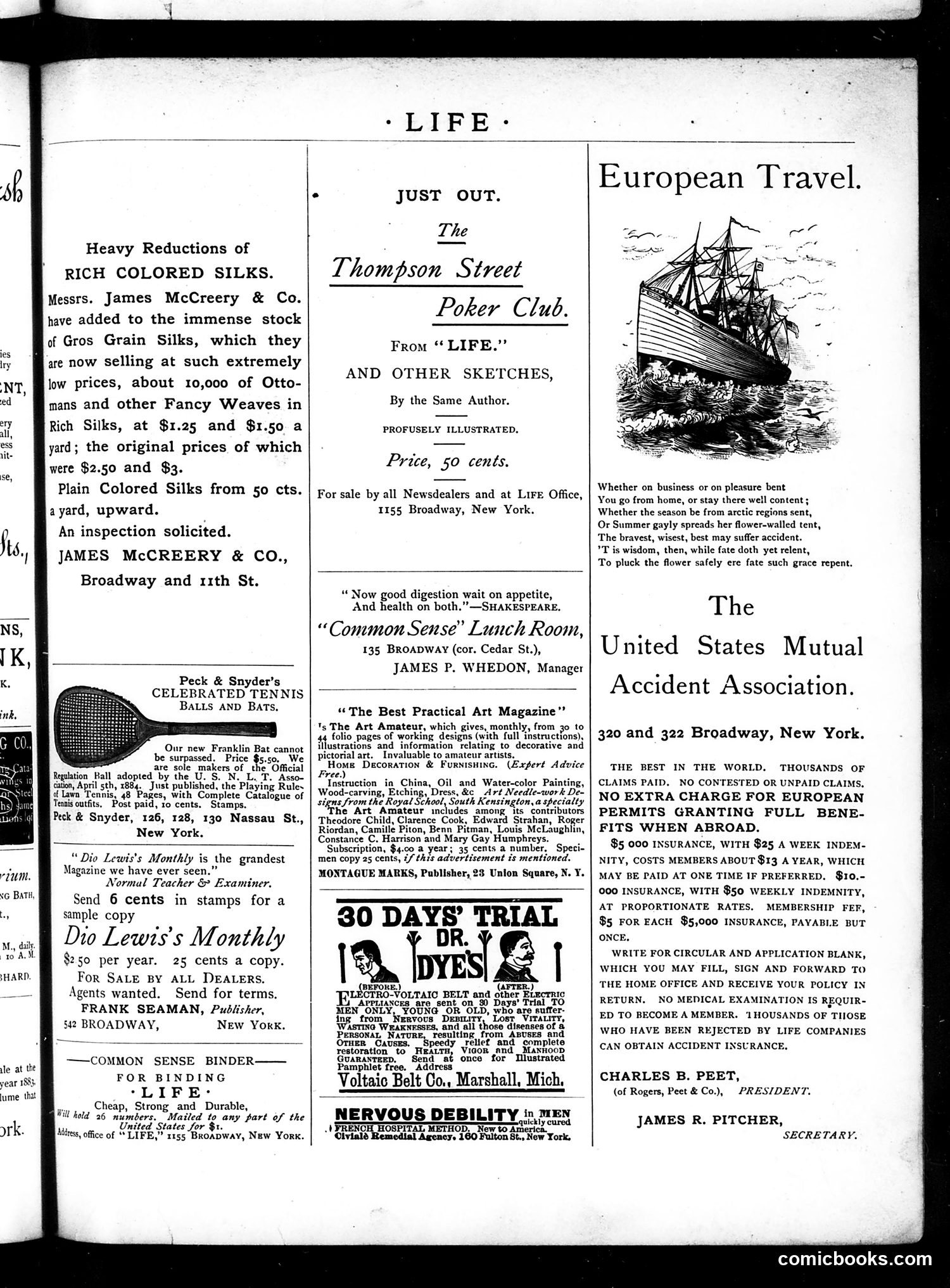
This is primarily an **advertising page** from Life magazine, circa 1884. The page contains commercial advertisements for various products and services rather than editorial cartoons or satirical content. The ads include silk retailers, sporting goods, art magazines, lunch rooms, and notably several **medical/pseudo-medical products**: a "Voltaic Belt" claiming to cure "nervous debility" and "lost vitality" in men through electrical treatment, and a "French Hospital Method" for similar conditions. These represent **19th-century quack medicine** marketed to men—exploiting anxieties about male health and sexual function with unproven electrical devices. The only editorial content is a **poem about travel safety**, emphasizing that accidents can occur anywhere, thus promoting the adjacent **United States Mutual Accident Association** insurance advertisement. The page reflects Gilded Age consumer culture and the prevalence of dubious medical claims in period publications.
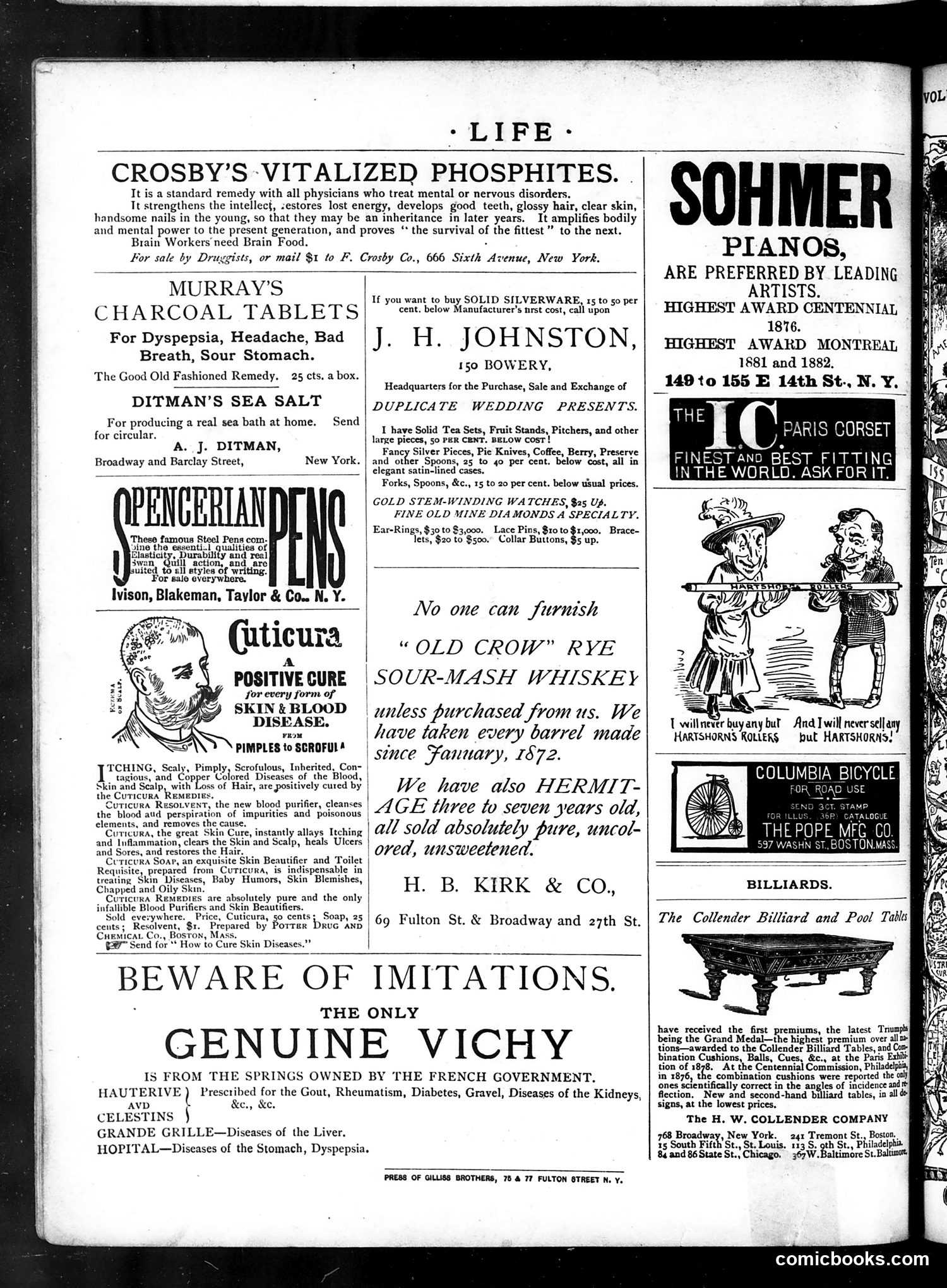
This page is primarily **advertisements with one small cartoon**. The cartoon depicts two figures in what appears to be a domestic dispute over **Hartshorn's Rollers** (window shade fixtures). One figure says "I will buy any but Hartshorn's Rollers" while the other responds "And I will never sell any but Hartshorn's." The joke is a **marital argument** presented as humorous contradiction—the husband refuses to buy them, the wife refuses to sell anything else, suggesting the product's superior quality or the wife's stubbornness (or both). It's absurdist humor playing on domestic conflict. The page itself reflects **1880s consumer culture**: patent medicines (Cuticura for skin diseases, Crosby's Phosphites for "brain food"), luxury goods (Sohmer pianos, Paris corsets), and the emerging bicycle craze. Many products make pseudoscientific health claims typical of the era before FDA regulation.