
Life, 1884-05-08 · page 10 of 16
Life — May 8, 1884 — page 10: what you’re looking at
What you’re looking at
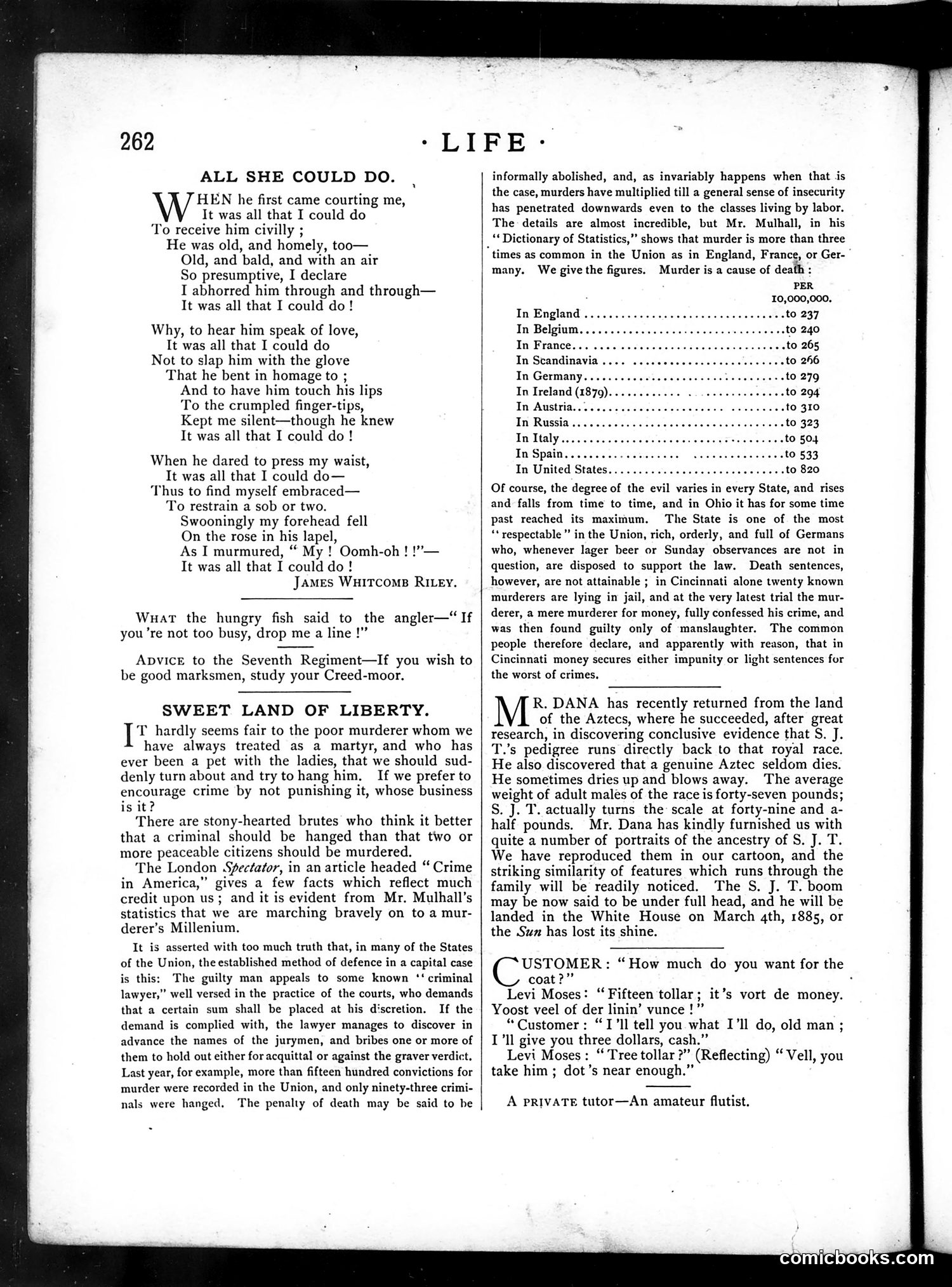
This page contains satirical commentary on American crime and capital punishment, circa 1880s. **"All She Could Do"** is a humorous poem by James Whitcomb Riley about a woman's conflicted courtship—she claims to abhor an old, homely suitor but her actions (swooning, silence) betray her actual attraction. The satire mocks Victorian courtship conventions and female propriety. **"Sweet Land of Liberty"** is the page's primary editorial satire, attacking America's lenient treatment of murderers. Using comparative statistics, the author argues that because America rarely executes convicted murderers (only 93 of 1,500+ convictions hanged), murder rates have exploded—three times higher than England, France, or Germany. The piece satirizes American leniency by sarcastically praising it as a "murderer's Millenium," and exposes systemic corruption: wealthy criminals hire "criminal lawyers" who bribe jurors to secure acquittals or reduced sentences. The satire targets both lenient laws and judicial corruption enabling violent crime.
📄 Transcribed text from this page (OCR, searchable)
Machine-transcribed from the original scan — historical spelling and the odd misread are preserved.
> LIFE: ALL SHE COULD DO. HEN he first came courting me, It was all that I could do To receive him civilly ; He was old, and homely, too— Old, and bald, and with an air So presumptive, I declare I abhorred him through and through— It was all that I could do! Why, to hear him speak of love, It was all that I could do Not to slap him with the glove That he bent in homage to ; And to have him touch his lips To the crumpled finger-tips, Kept me silent—though he knew It was all that I could do! When he dared to press my waist, It was all that I could do— Thus to find myself embraced— To restrain a sob or two. Swooningly my forehead fell On the rose in his lapel, As I murmured, “ My ! Oomh-oh ! !”"— It was all that I could do! James Wuitcoms RILEy. Wuart the hungry fish said to the angler—“ If you ’re not too busy, drop me a line !” ApvicE to the Seventh Regiment—If you wish to be good marksmen, study your Creed-moor. SWEET LAND OF LIBERTY. J" hardly seems fair to the poor murderer whom we have always treated as a martyr, and who has ever been a pet with the ladies, that we should sud- denly turn about and try tohang him. If we prefer to encourage crime by not punishing it, whose business is it? There are stony-hearted brutes who think it better that a criminal should be hanged than that two or more peaceable citizens should be murdered. The London Spectator, in an article headed “ Crime in America,” gives a few facts which reflect much credit upon us; and it is evident from Mr. Mulhall’s statistics that we are marching bravely on to a mur- derer’s Millenium. It is asserted with too much truth that, in many of the States of the Union, the established method of defence in a capital case is this: The guilty man appeals to some known *‘ criminal lawyer,” well versed in the practice of the courts, who demands that a certain sum shall be placed at his discretion. If the demand is complied with, the lawyer manages to discover in advance the names of the jurymen, and bribes one or more of them to hold out either for acquittal or against the graver verdict, Last year, for example, more than fifteen hundred convictions for murder were recorded in the Union, and only ninety-three crimi- nals were hanged, The penalty of death may be said to be informally abolished, and, as invariably happens when that is the case, murders have multiplied till a general sense of insecurity has penetrated downwards even to the classes living by labor. The details are almost incredible, but Mr. Mulhall, in his “Dictionary of Statistics,” shows that murder is more than three times as common in the Union as in England, France, or Ger- many. We give the figures. Murder is a cause of death : PER 10,000,000, In England In Belgium. In France... In Scandinavia . In Germany... In Ireland (1879) In Austria. In Russia In Italy In Spain. In United States Of course, the degree of the evil varies in every State, and rises and falls from time to time, and in Ohio it has for some time past reached its maximum. The State is one of the most “* respectable” in the Union, rich, orderly, and full of Germans who, whenever lager beer or Sunday observances are not in question, are disposed to support the law. Death sentences, however, are not attainable ; in Cincinnati alone twenty known murderers are lying in jail, and at the very latest trial the mur- derer, a mere murderer for money, fully confessed his crime, and was then found guilty only of manslaughter. The common people therefore declare, and apparently with reason, that in Cincinnati money secures either impunity or light sentences for the worst of crimes. R. DANA has recently returned from the land of the Aztecs, where he succeeded, after great research, in discovering conclusive evidence that S. J. T.’s pedigree runs directly back to that royal race. He also discovered that a genuine Aztec seldom dies. He sometimes dries up and blows away. The average weight of adult males of the race is forty-seven pounds; S. J. T. actually turns the scale at forty-nine and a- half pounds. Mr. Dana has kindly furnished us with quite a number of portraits of the ancestry of S. J. T. We have reproduced them in our cartoon, and the striking similarity of features which runs through the family will be readily noticed. The S. J. T. boom may be now said to be under full head, and he will be landed in the White House on March 4th, 1885, or the Suz has lost its shine. USTOMER: “How much do you want for the coat?” 7 Levi Moses: “Fifteen tollar; it’s vort de money. Yoost veel of der linin’ vunce !” “Customer: “I'll tell you what I’ll do, old man ; I'll give you three dollars, cash,” Levi Moses : “ Tree tollar ?” (Reflecting) “Vell, you take him ; dot’s near enough.” A PRIVATE tutor—An amateur flutist.