
Life, 1884-05-08 · page 2 of 16
Life — May 8, 1884 — page 2: what you’re looking at
What you’re looking at
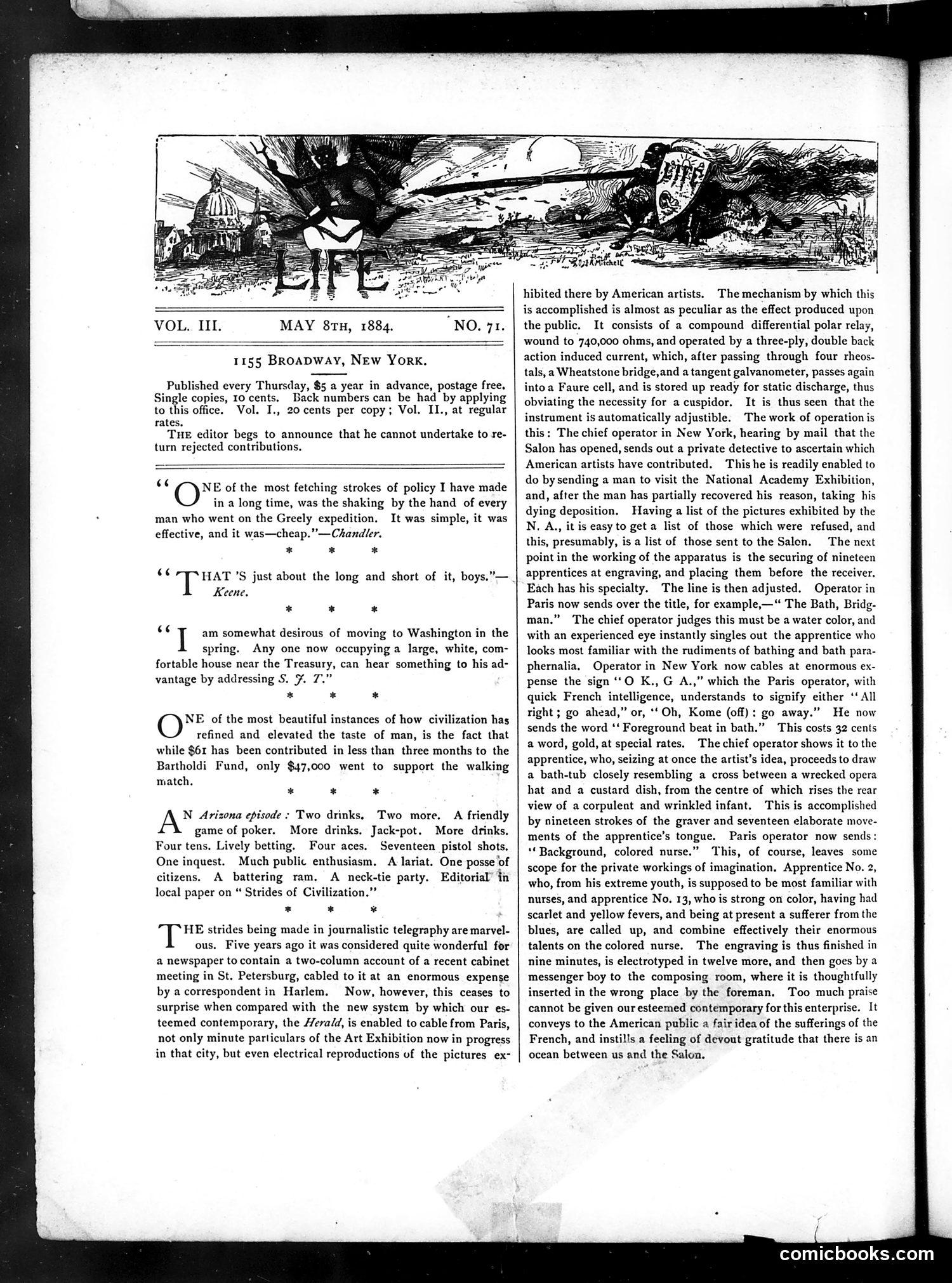
The masthead illustration depicts a winged figure (likely representing "Life" itself or artistic inspiration) swooping dramatically across a landscape. The accompanying text discusses journalistic telegraphy and an innovative system for transmitting pictures from Paris to New York via electrical reproduction—a cutting-edge technology for the era. The main satirical content consists of brief, witty editorial snippets and quotes poking fun at contemporary politics and society, including references to moving to Washington and commentary on charitable giving to the Bartholdi Fund (likely for the Statue of Liberty). The page emphasizes Life's focus as a satirical weekly: sharp social commentary wrapped in humor rather than visual political cartoons. The technological discussion reflects the magazine's interest in modern innovations and their cultural implications.
📄 Transcribed text from this page (OCR, searchable)
Machine-transcribed from the original scan — historical spelling and the odd misread are preserved.
NP! x: VOL. III. MAY 8rn, 1884. “NO. 71. 1155 BRoapway, New York. Published every Thursday, $5 a year in advance, postage free. Single copies, 10 cents. Back numbers can be had by applying to this office.. Vol. I., 20 cents per copy; Vol. II., at regular rates. THe editor begs to announce that he cannot undertake to re- turn rejected contributions. “cr NE of the most fetching strokes of policy I have made in a long time, was the shaking by the hand of every man who went on the Greely expedition. effective, and it was—cheap.”—Chandler. * * * It was simple, it was se HAT ’S just about the long and short of it, boys.”— Keene. * * * os I am somewhat desirous of moving to Washington in the spring. Any one now occupying a large, white, com- fortable house near the Treasury, can hear something to his ad- vantage by addressing S. ¥. 7.” * * * O of the most beautiful instances of how civilization has refined and elevated the taste of man, is the fact that while $61 has been contributed in less than three months to the Bartholdi Fund, only $47,000 went to support the walking match. * * * N Arizona episode ; Two drinks, Two more. A friendly game of poker. More drinks. Jack-pot. More drinks. Four tens. Lively betting. Four aces. Seventeen pistol shots, One inquest. Much public enthusiasm, A lariat. One posse of citizens. A battering ram, A neck-tie party. Editorial” in local paper on “ Strides of Civilization * * * HE strides being made in journalistic telegraphy are marvel- ous. Five years ago it was considered quite wonderful for a newspaper to contain a two-column account of a recent cabinet meeting in St. Petersburg, cabled to it at an enormous expense by a correspondent in Harlem. Now, however, this ceases to surprise when compared with the new system by which our es- teemed contemporary, the Hera/d, is enabled to cable from Paris, not only minute particulars of the Art Exhibition now in progress in that city, but even electrical reproductions of the pictures ex- hibited there by American artists. The mechanism by which this is accomplished is almost as peculiar as the effect produced upon the public. It consists of a compound differential polar relay, wound to 740,000 ohms, and operated by a three-ply, double back action induced current, which, after passing through four rheos- tals, a Wheatstone bridge,and a tangent galvanometer, passes again intoa Faure cell, and is stored up ready for static discharge, thus obviating the necessity for a cuspidor. It is thus seen that the instrument is automatically adjustible. ‘The work of operation is this: The chief operator in New York, hearing by mail that the Salon has opened, sends out a private detective to ascertain which American artists have contributed. This he is readily enabled to do by sending a man to visit the National Academy Exhibition, and, after the man has partially recovered his reason, taking his dying deposition. Having a list of the pictures exhibited by the N. A,, it is easy to get a list of those which were refused, and this, presumably, is a list of those sent to the Salon. The next point in the working of the apparatus is the securing of nineteen apprentices at engraving, and placing them before the receiver. Each has his specialty. The line is then adjusted. Operator in Paris now sends over the title, for example,—“ The Bath, Bridg- man.” The chief operator judges this must be a water color, and with an experienced eye instantly singles out the apprentice who looks most familiar with the rudiments of bathing and bath para- phernalia. Operator in New York now cables at enormous ex- pense the sign ‘‘O K., G A.,” which the Paris operator, with quick French intelligence, understands to signify either ‘All right ; go ahead,” or, ‘Oh, Kome (off): go away.” He now sends the word ‘‘ Foreground beat in bath.” This costs 32 cents a word, gold, at special rates. The chief operator shows it to the apprentice, who, seizing at once the artist’s idea, proceeds to draw a bath-tub closely resembling a cross between a wrecked opera hat and a custard dish, from the centre of which rises the rear view of a corpulent and wrinkled infant. This is accomplished by nineteen strokes of the graver and seventeen elaborate move- ments of the apprentice’s tongue. Paris operator now sends: ‘Background, colored nurse.” This, of course, leaves some scope for the private workings of imagination. Apprentice No. 2, who, from his extreme youth, is supposed to be most familiar with nurses, and apprentice No. 13, who is strong on color, having had scarlet and yellow fevers, and being at present a sufferer from the blues, are called up, and combine effectively their enormous talents on the colored nurse. The engraving is thus finished in nine minutes, is electrotyped in twelve more, and then goes by a messenger boy to the composing room, where it is thoughtfully inserted in the wrong place by the foreman. Too much praise cannot be given ouresteemed contemporary for this enterprise. It conveys to the American public a fair idea of the sufferings of the French, and instills a feeling of devout gratitude that there is an ocean between us and the Salon. comicbooks.com