
Life, 1884-05-08 · page 5 of 16
Life — May 8, 1884 — page 5: what you’re looking at
What you’re looking at
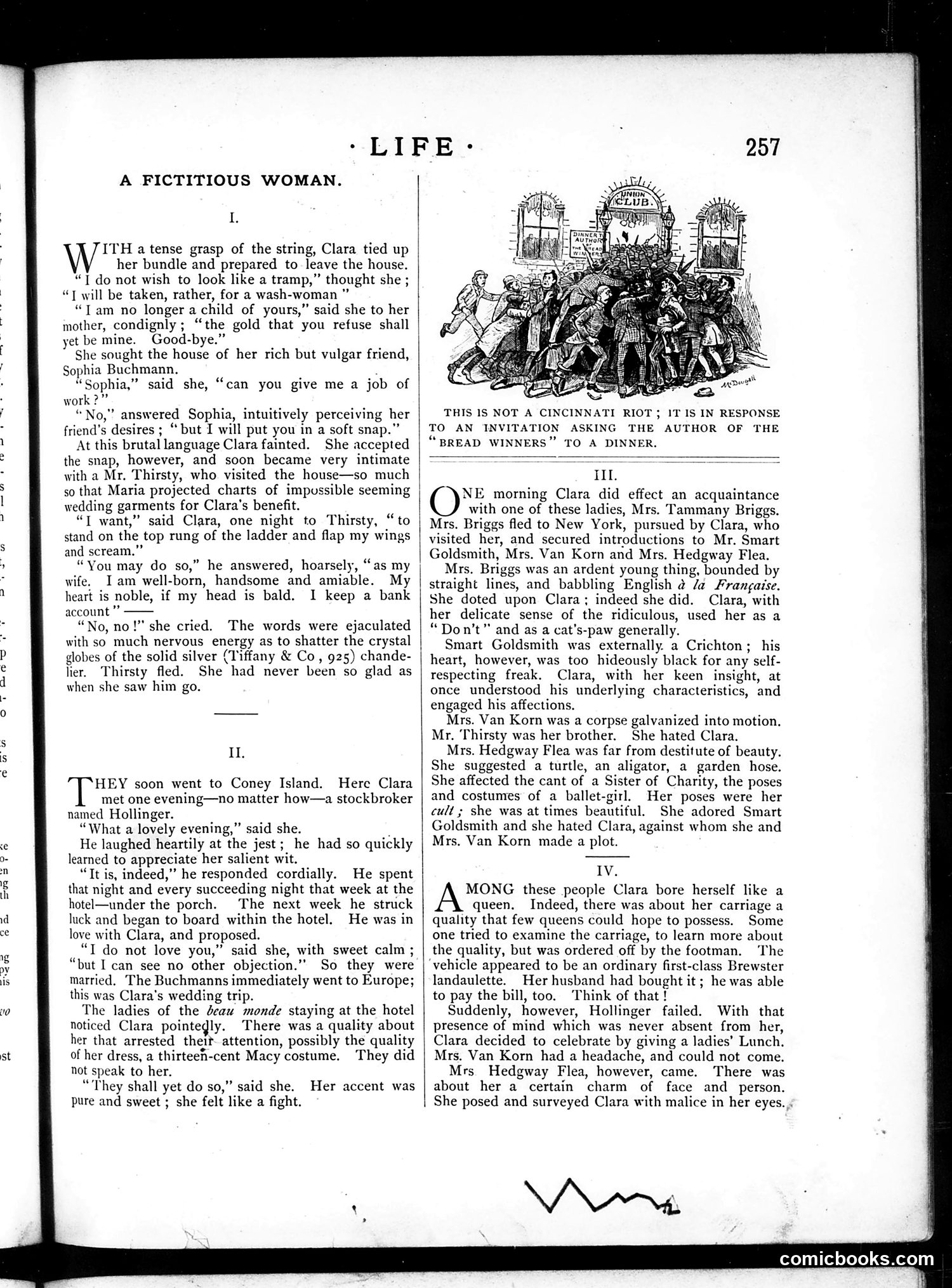
This page contains a serialized short story rather than political cartoons. The single illustration shows a street scene with well-dressed figures outside what appears to be a gentlemen's club. The caption reads: "THIS IS NOT A CINCINNATI RIOT; IT IS IN RESPONSE TO AN INVITATION ASKING THE AUTHOR OF THE 'BREAD WINNERS' TO A DINNER." This references John Hay's novel *The Bread-Winners* (1884), which satirized labor unions and working-class movements. The joke is that the crowd gathering isn't a labor riot (referencing Cincinnati's actual 1884 courthouse riots), but rather fashionable society eager to dine with the book's author. It's gentle social satire mocking both the novel's anti-labor stance and high society's pretensions.
📄 Transcribed text from this page (OCR, searchable)
Machine-transcribed from the original scan — historical spelling and the odd misread are preserved.
‘LIFE: A FICTITIOUS WOMAN. I ITH a tense grasp of the string, Clara tied up her bundle and prepared to leave the house. “T do not wish to look like a tramp,” thought she ; “J will be taken, rather, for a wash-woman ” “Tam no longer a child of yours,” said she to her mother, condignly ; “the gold that you refuse shall yet be mine. Good-bye.” She sought the house of her rich but vulgar friend, Sophia Buchmann, “Sophia,” said she, work ?” No,” answered Sophia, intuitively perceiving her friend's desires ; “ but I will put you in a soft snap.” At this brutal language Clara fainted. She accepted “can you give me a job of the snap, however, and soon became very intimate | with a Mr. Thirsty, who visited the house—so much so that Maria projected charts of impussible seeming wedding garments for Clara's benefit. “T want,” said Clara, one night to Thirsty, “to stand on the top rung of the ladder and flap my wings and scream,” “You may do so,” he answered, hoarsely, “as my wife. Iam well-born, handsome and amiable. My heart is noble, if my head is bald. I keep a bank account ”” —— “No, no!” she cried. The words were ejaculated with so much nervous energy as to shatter the crystal | globes of the solid silver (Tiffany & Co , 925) chande- lier. Thirsty fled. She had never been so glad as when she saw him go. Il. HEY soon went to Coney Island. Here Clara met one evening—no matter how—a stockbroker named Hollinger. “What a lovely evening,” said she. . He laughed heartily at the jest; he had so quickly learned to appreciate her salient wit. “Tt is, indeed,” he responded cordially. He spent that night and every succeeding night that week at the hotel—under the porch. The next week he struck luck and began to board within the hotel. He was in love with Clara, and proposed. “T do not love you,” said she, with sweet calm ; “but I can see no other objection.” So they were married. The Buchmanns immediately went to Europe; this was Clara's wedding trip. The ladies of the deau monde staying at the hotel noticed Clara pointedly. There was a quality about her that arrested their attention, possibly the quality of her dress, a thirteen-cent Macy costume. They did not speak to her. “They shall yet do so,” said she. pure and sweet ; she felt like a fight. Her accent was CN Lay a Le THIS 1S NOT A CINCINNATI RIOT; IT IS IN RESPONSE TO AN INVITATION ASKING THE AUTHOR OF THE “BREAD WINNERS” TO A DINNER. Ill. NE morning Clara did effect an acquaintance with one of these ladies, Mrs. Tammany Briggs. Mrs. Briggs fled to New York, pursued by Clara, who visited her, and secured introductions to Mr. Smart Goldsmith, Mrs. Van Korn and Mrs. Hedgway Flea. Mrs. Briggs was an ardent young thing, bounded by straight lines, and babbling English @ /a Frangaise. She doted upon Clara; indeed she did. Clara, with her delicate sense of the ridiculous, used her as a “Don’t” and as a cat’s-paw generally. Smart Goldsmith was externally. a Crichton ; his heart, however, was too hideously black for any self- respecting freak. Clara, with her keen insight, at once understood his underlying characteristics, and engaged his affections. Mrs. Van Korn was a corpse galvanized into motion, Mr. Thirsty was her brother. She hated Clara. Mrs. Hedgway Flea was far from destitute of beauty. She suggested a turtle, an aligator, a garden hose. She affected the cant of a Sister of Charity, the poses and costumes of a ballet-girl. Her poses were her cult ; she was at times beautiful. She adored Smart Goldsmith and she hated Clara, against whom she and Mrs. Van Korn made a plot. IV. MONG these people Clara bore herself like a queen. Indeed, there was about her carriage a quality that few queens could hope to possess. Some one tried to examine the carriage, to learn more about the quality, but was ordered off by the footman. The vehicle appeared to be an ordinary first-class Brewster landaulette. Her husband had bought it; he was able to pay the bill, too. ‘Think of that! Suddenly, however, Hollinger failed. With that presence of mind which was never absent from her, Clara decided to celebrate by giving a ladies’ Lunch. Mrs. Van Korn had a headache, and could not come. Mrs Hedgway Flea, however, came. There was about her a certain charm of face and_ person. She posed and surveyed Clara with malice in her eyes. « comicbooks.com