
A complete issue · 16 pages · 1884
Life — April 17, 1884
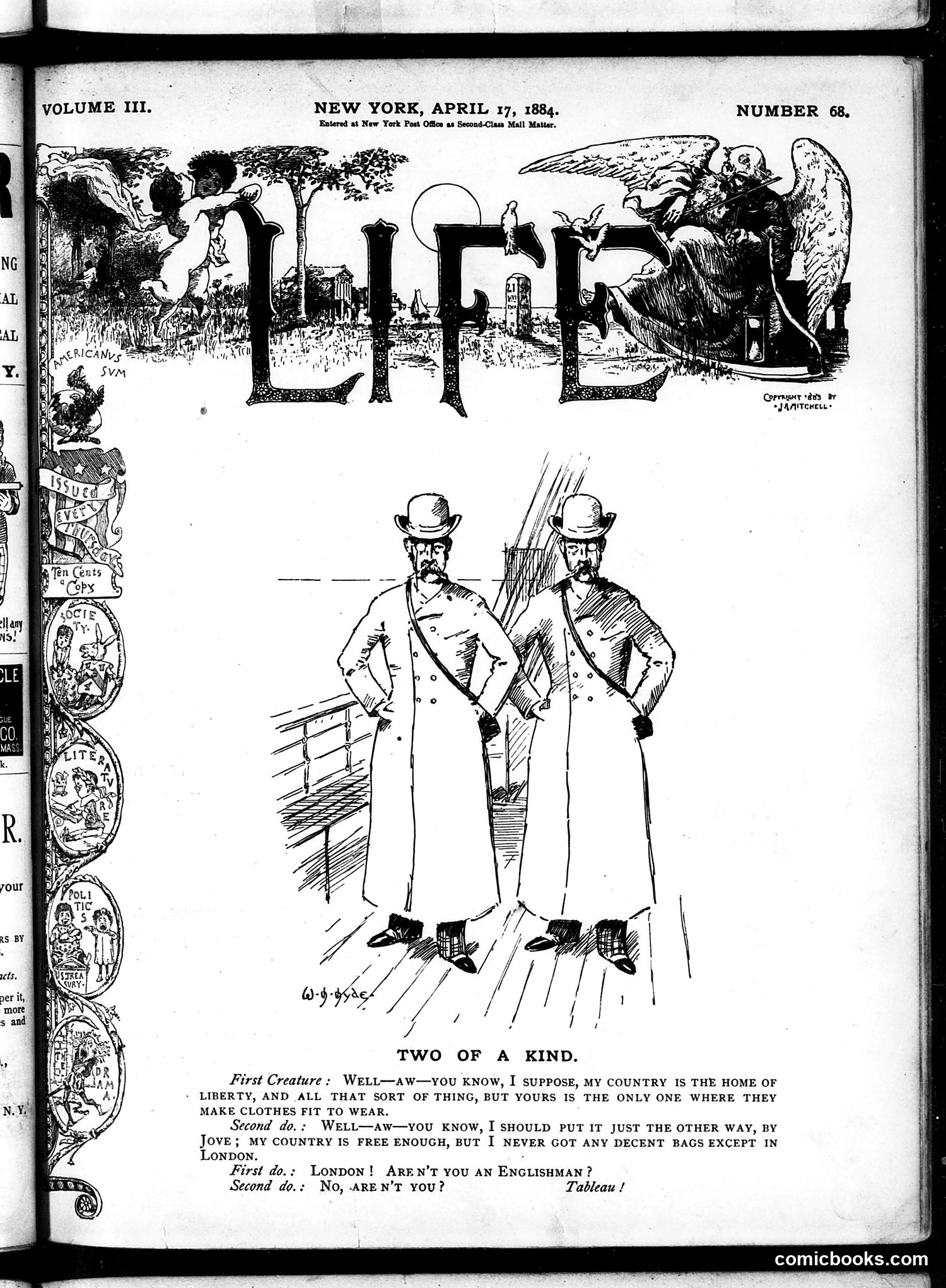
This cartoon satirizes two naval officers—depicted identically in dress uniforms with bowler hats—debating national character and liberty. The first claims his country is "the home of liberty" where citizens dress freely. The second counters that his country is also free, but never acquired "decent bags except in London." The joke plays on Victorian-era class anxieties: both nations pride themselves on freedom, yet both are apparently enslaved to British fashion standards—specifically London tailoring for men's clothing. The identical depiction emphasizes they're "two of a kind" despite their patriotic posturing. This satirizes how wealthy Western nations, despite ideological differences, share common snobbish dependence on British luxury goods and style, undercutting their claims of independence.
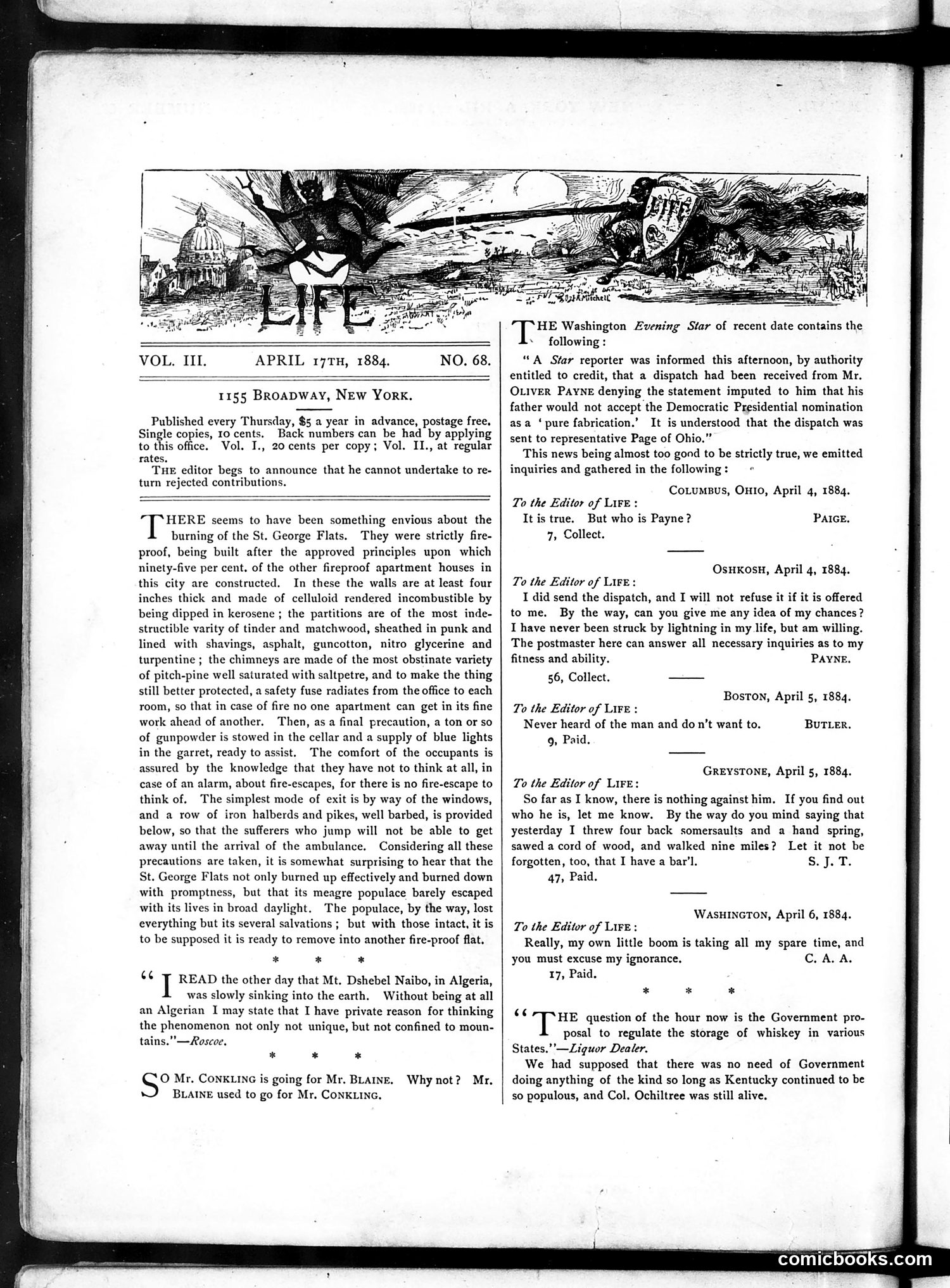
The page contains primarily **letters to the editor** and editorial commentary rather than political cartoons. The masthead shows "LIFE" with decorative imagery. Key content includes: 1. **St. George Flats fire discussion**: An extended editorial about a recent apartment fire, discussing fireproofing standards and safety measures in New York City construction. 2. **Reader letters**: Correspondence from various cities (Columbus, Oshkosh, Boston, Greystone, Washington) addressing unnamed individuals and personal matters—typical of period magazines. 3. **Political reference**: A brief note about "Mr. Conkling" and "Mr. Blaine," suggesting contemporary political figures, though the context is vague. 4. **Whiskey regulation debate**: A final item referencing Government whiskey storage policy and Kentucky distillers (Colonel Ochiitree). The page reflects 1880s urban safety concerns and political gossip rather than visual satire.
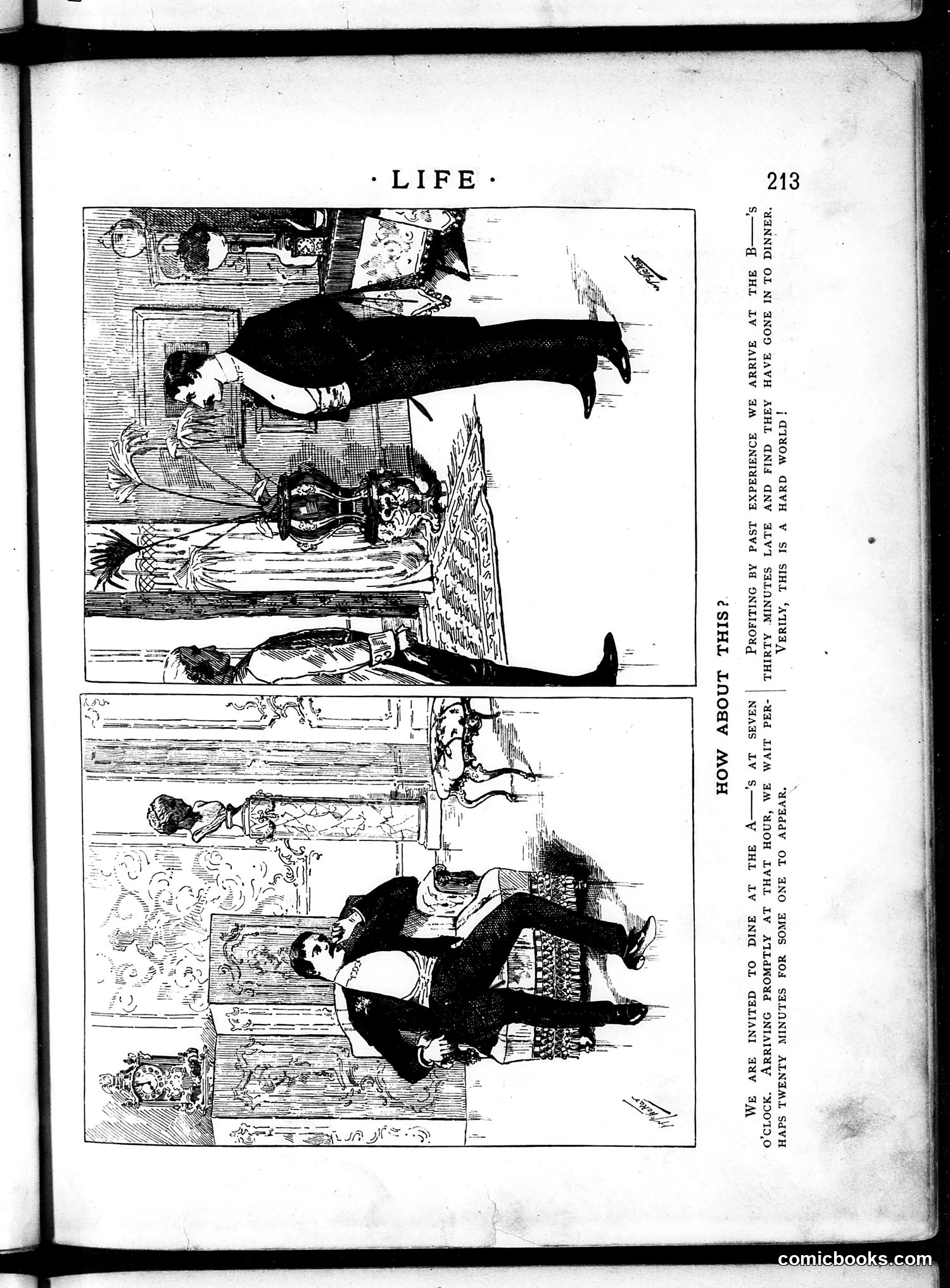
This page contains two vertically-oriented satirical illustrations about dining etiquette. The caption poses the question "How about thee?" and references arrangements for a dinner party, mentioning that "they have gone to dinners" and noting concerns about "who is a hard worker." The cartoons appear to satirize social anxieties around proper dinner conduct and seating arrangements among the upper-middle class. The figures are depicted in formal attire in domestic dining settings, suggesting social pretension or awkwardness around hospitality protocols. However, without clearer identification of specific individuals or dated historical context, the exact political or social references remain unclear. The humor seems to rely on contemporary readers' familiarity with specific social situations or personalities referenced here.
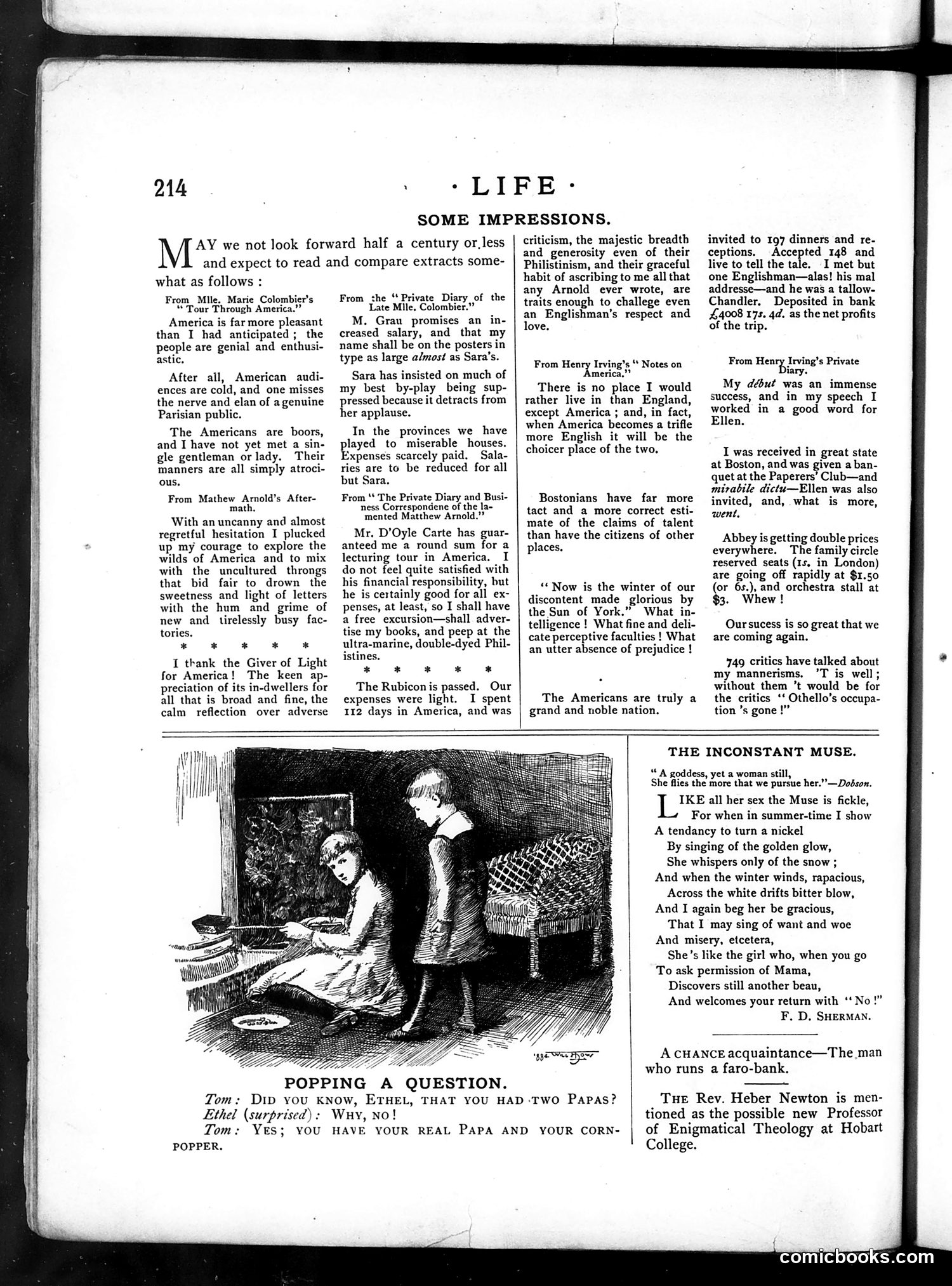
The cartoon depicts a domestic scene where a man asks his wife if she knew she had "two Papas." She responds, surprised, "Why, no!" He then reveals: "Yes; you have your real Papa and your cornpopper." This is a visual pun playing on the double meaning of "popper"—both a father figure ("papa") and the kitchen device for making popcorn shown in the scene. The humor relies on wordplay and the wife's genuine confusion before the absurd reveal. There's no apparent political content; it's simply a genteel domestic joke typical of early 20th-century *Life* magazine's humor section, relying on innocent wordplay rather than satire or social commentary.
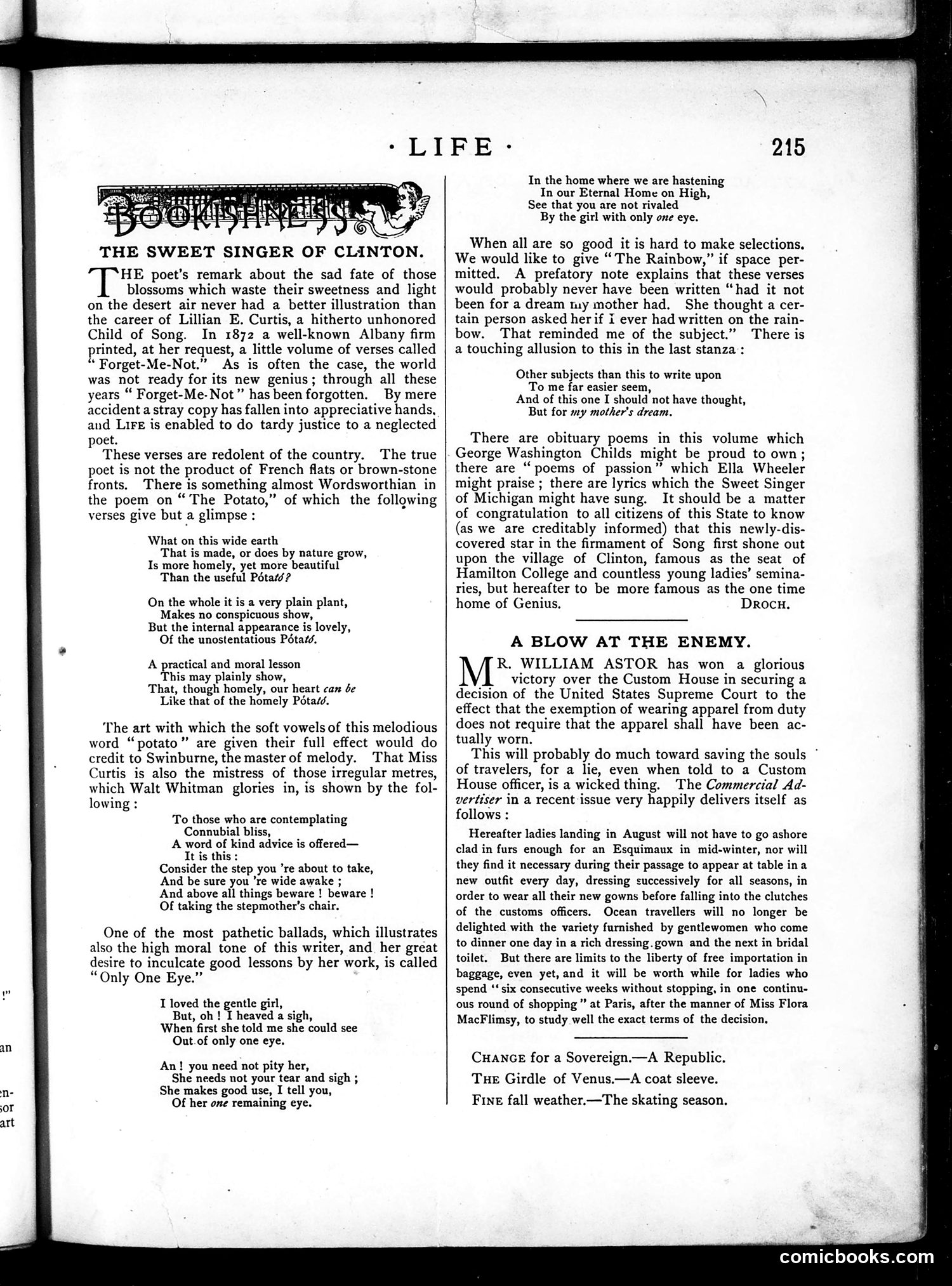
This page contains literary criticism rather than political cartoons. The main content discusses "The Sweet Singer of Clinton"—a poet named Lillian P. Curtis from Clinton, Michigan, whose work was previously neglected but is now being rediscovered. The article celebrates Curtis's verses, particularly "The Potato," and compares her style to Wordsworth. It notes that Clinton is becoming famous as the home of this "Genius" and the seat of Hamilton College. The right column includes a brief article titled "A Blow at the Enemy" regarding a U.S. Supreme Court decision about tariffs on imported clothing, with commentary on women's fashion and customs regulations. The page is primarily cultural and commercial commentary rather than political satire.
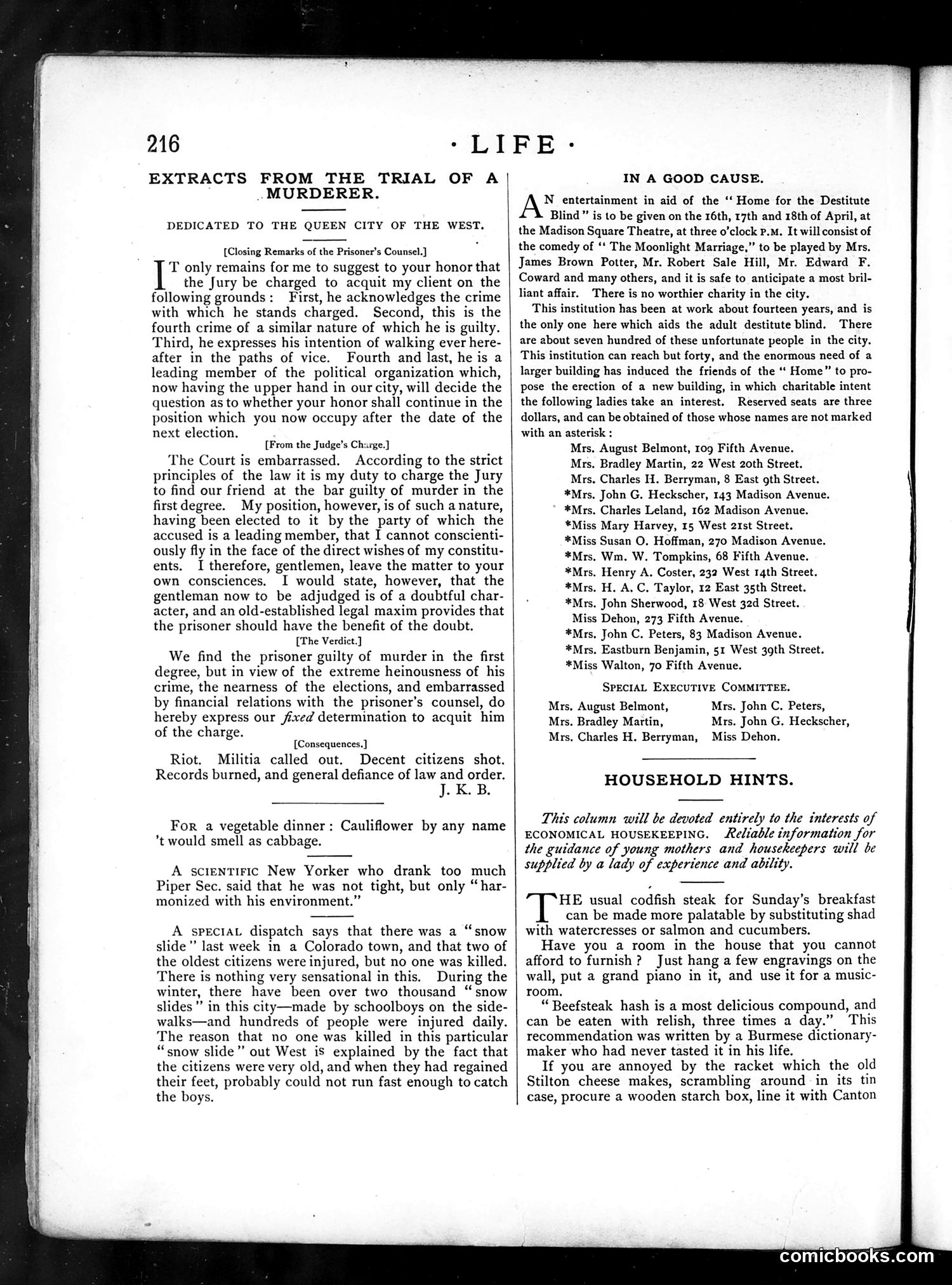
This page contains two distinct sections: **Left side:** "Extracts from the Trial of a Murderer" — a legal document dedicated to Queen City of the West (likely Cincinnati). It presents the closing remarks of a prisoner's counsel arguing for acquittal based on reasonable doubt, despite a guilty verdict in the first degree. The court ultimately expresses "grave determination to acquit him of the charge," suggesting judicial leniency toward a defendant with political connections. **Right side:** Social announcements for a charitable entertainment benefiting a "Home for the Destitute Blind," followed by "Household Hints" — domestic advice about cooking and household management. The satire appears to critique judicial favoritism and political influence in the legal system, contrasting it with charitable work for the genuinely needy.
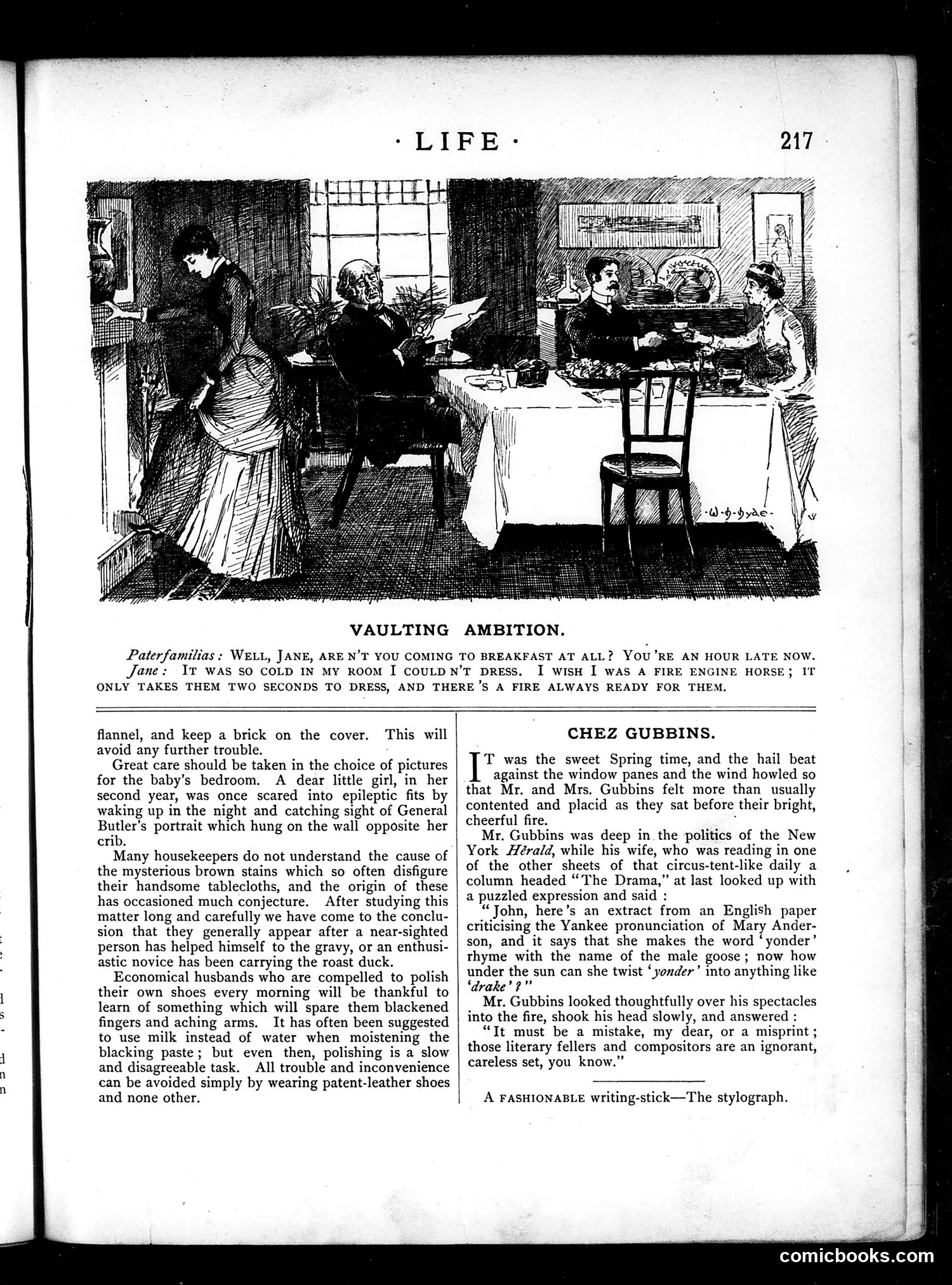
This satirical cartoon depicts a domestic scene titled "Vaulting Ambition." A young woman (Jane) arrives late to breakfast, claiming her room was so cold she couldn't dress quickly, and expressing envy of fire engine horses who can dress in seconds. The joke mocks the era's leisurely upper-class lifestyle and gendered expectations. Jane's elaborate morning routine and complaint about minor domestic discomfort contrast absurdly with her stated ambition to be as efficient as a working animal. The cartoon satirizes both the impracticality of women's fashions (requiring lengthy dressing time) and the gap between aspirational claims and actual behavior among the leisure class. The accompanying text provides household management advice, typical of Life's satirical approach to domestic life.
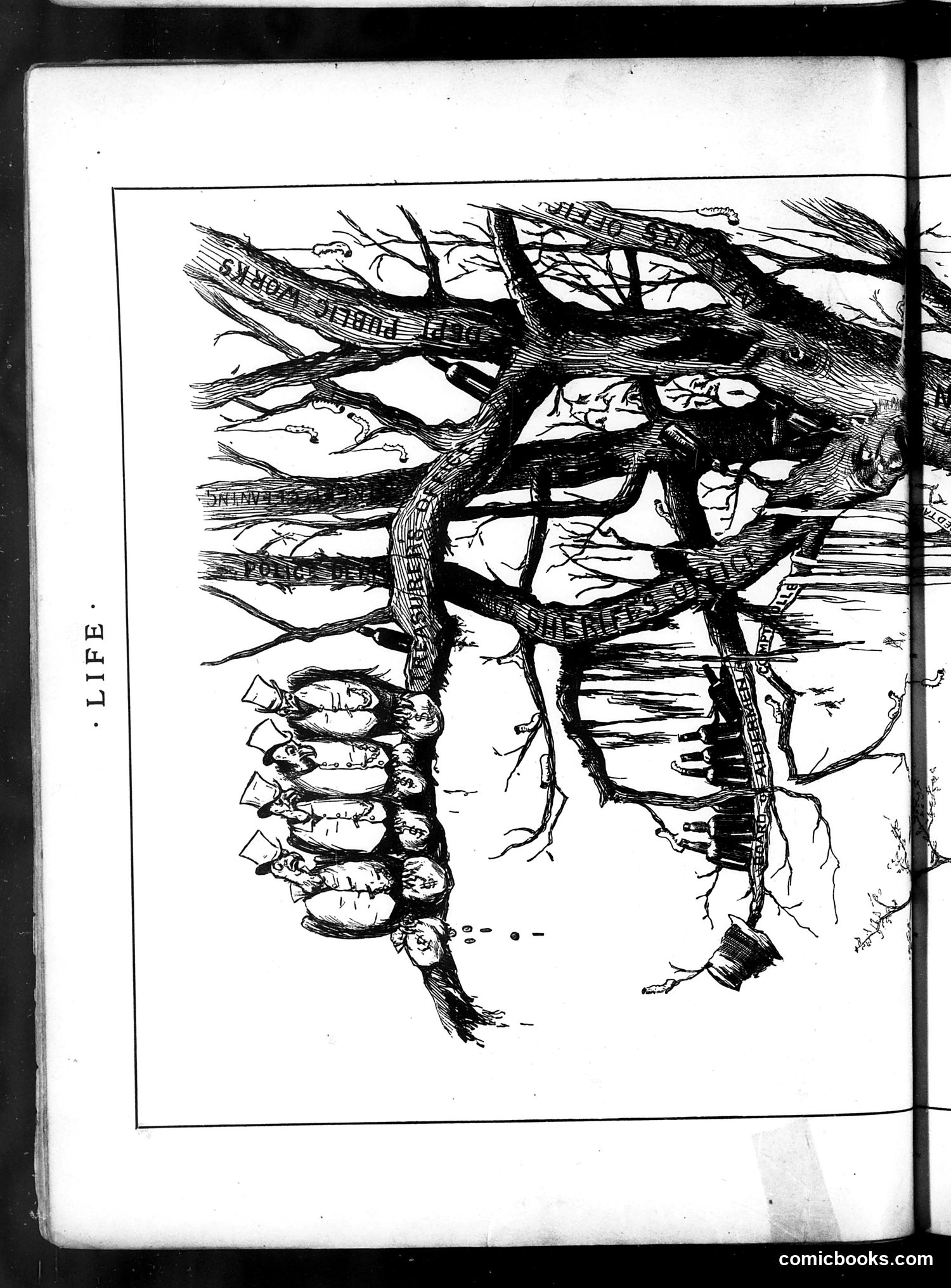
This page shows a single illustration labeled "LIFE" depicting a gnarled, bare tree with a human figure seated at its base. The tree's twisted branches appear skeletal and lifeless, rendered in heavy black ink with detailed cross-hatching. The image appears to be a memento mori or vanitas allegory—a visual meditation on mortality and life's brevity. The figure beneath the dead tree likely represents humanity confronting its own finitude. The stark, almost grotesque rendering of the tree emphasizes decay and inevitability of death. Given this appears from *Life* magazine, known for satirical and allegorical commentary, this may reference broader social anxieties about death, decline, or societal deterioration, though specific historical context is unclear without additional publication details.
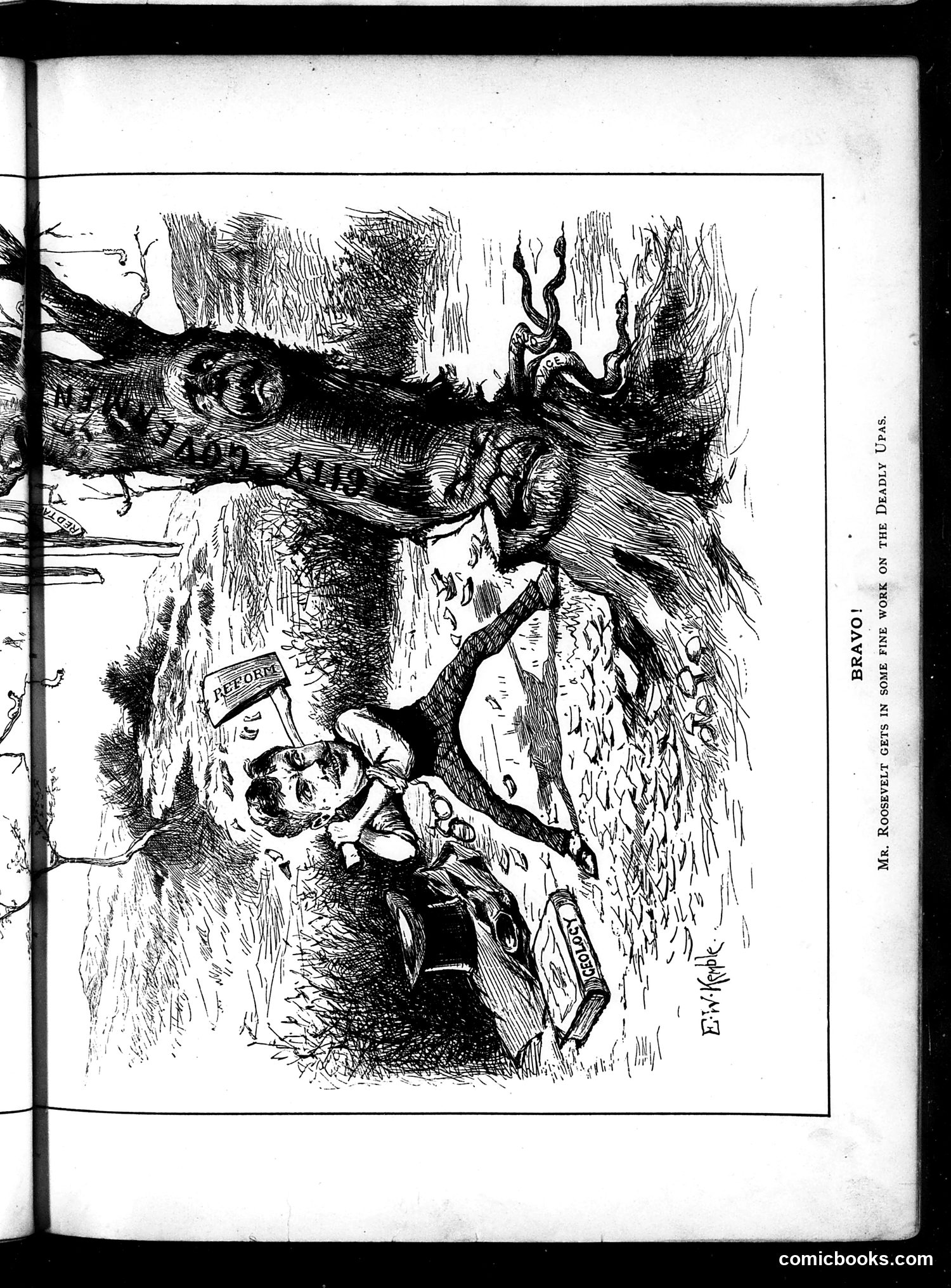
This political cartoon depicts Theodore Roosevelt as a figure being thrown or bucked off by a large, wild creature (likely representing either political opposition or an uncontrollable force). The caption reads "Mr. Roosevelt observes in some fire for on the Deadlv U.p.a." The cartoon appears to satirize Roosevelt's attempts to manage or control some dangerous or chaotic situation—the "Deadly U.p.a." likely refers to a specific political conflict or crisis of his era. The bucking motion suggests Roosevelt is losing control despite his efforts to maintain authority. The artist's signature appears to be visible at the bottom. This represents the type of satirical commentary *Life* magazine regularly offered on contemporary political figures and events during the Roosevelt administration.
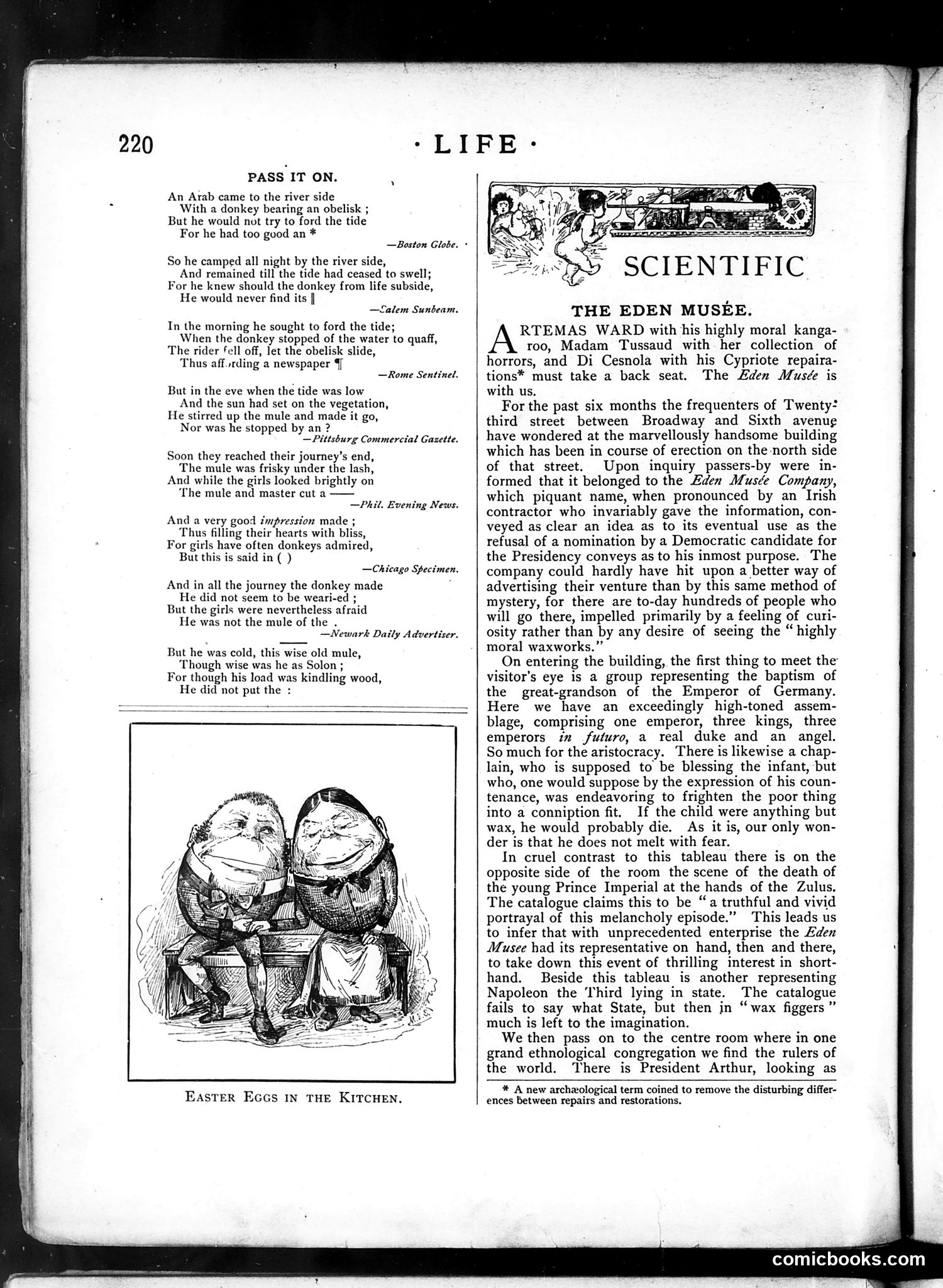
This page contains two distinct pieces. The top section, "Pass It On," is a humorous poem-chain where multiple newspapers contribute absurdist verses about an Arab, a donkey, and an obelisk attempting to cross a river. Each stanza deliberately ends with a missing word (marked by punctuation), creating wordplay based on what readers might supply—a joke format popular in period newspapers. The main article reviews the Eden Musée, a newly opened wax museum on New York's Twenty-third Street. The writer mocks its pretentiousness, describing displays of German royalty at a baptism and a tableau depicting the death of the young Prince Imperial (killed in the Zulu War). The satire criticizes the museum's sensationalism and dubious authenticity—sardonically suggesting the Eden Musée had a reporter present at the Prince's actual death to document it "in short-hand." The tone dismisses it as lurid "highly moral waxworks" designed to exploit public curiosity rather than educate.
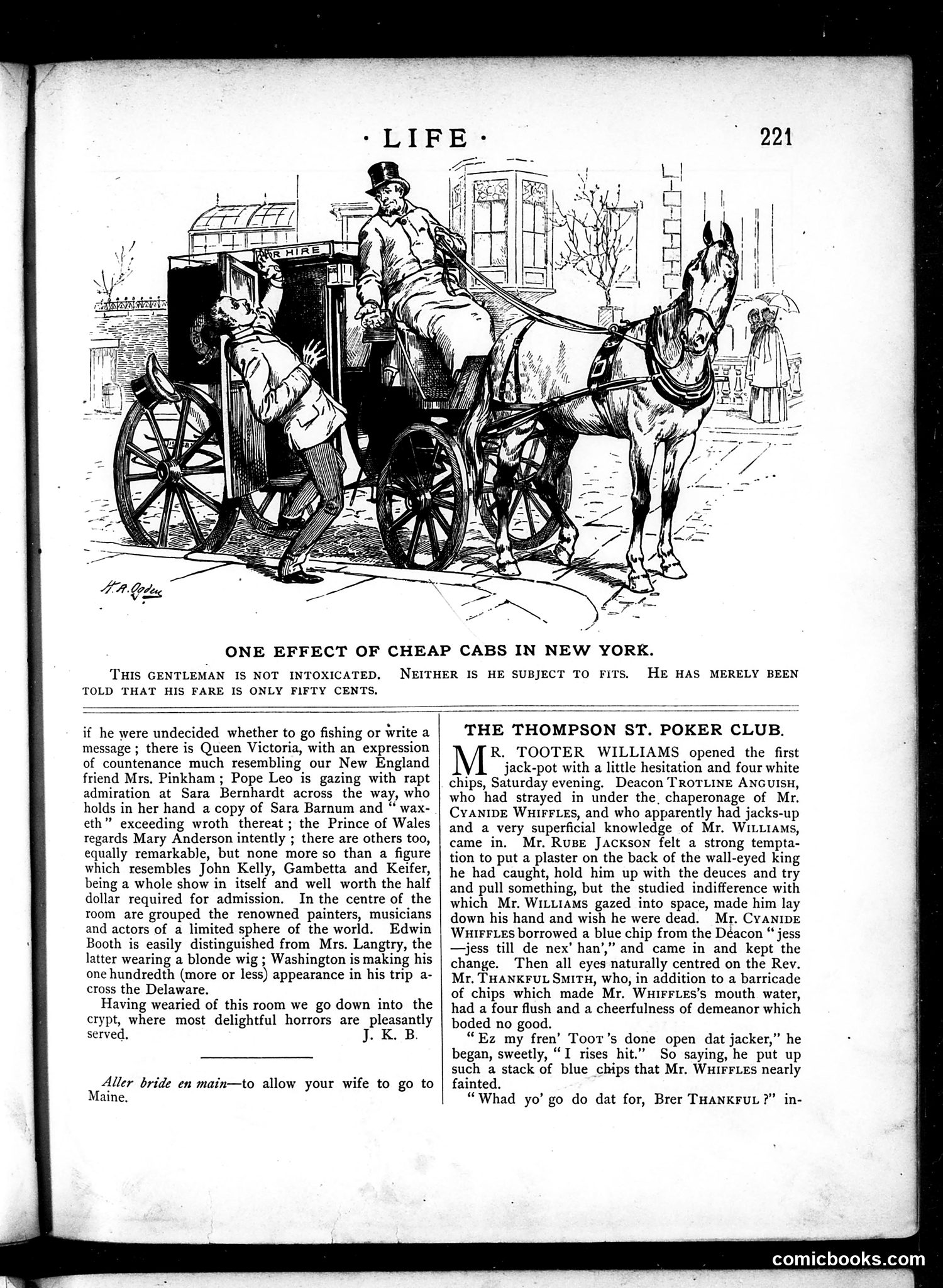
**The Cartoon:** The top illustration satirizes the effect of newly cheap cab fares in New York. A man sits atop a horse-drawn cab in an exaggerated, sprawled posture—the caption jokes that he's neither drunk nor epileptic, but has simply been shocked into this state upon learning his fare costs only fifty cents. The satire suggests that absurdly low cab prices were so surprising to New Yorkers accustomed to higher fares that the news itself was physically stunning. **The Text Below:** This appears unrelated—it's a humorous story about a poker game involving characters with comical names (Deacon Trotline Anguish, Mr. Cyanide Whiffles, Rev. Thankful Smith). The narrative mocks small-town poker play and dialect-heavy rural speech patterns common in period humor. The page demonstrates *Life* magazine's mix of satirical commentary on contemporary urban issues alongside comedic fiction.
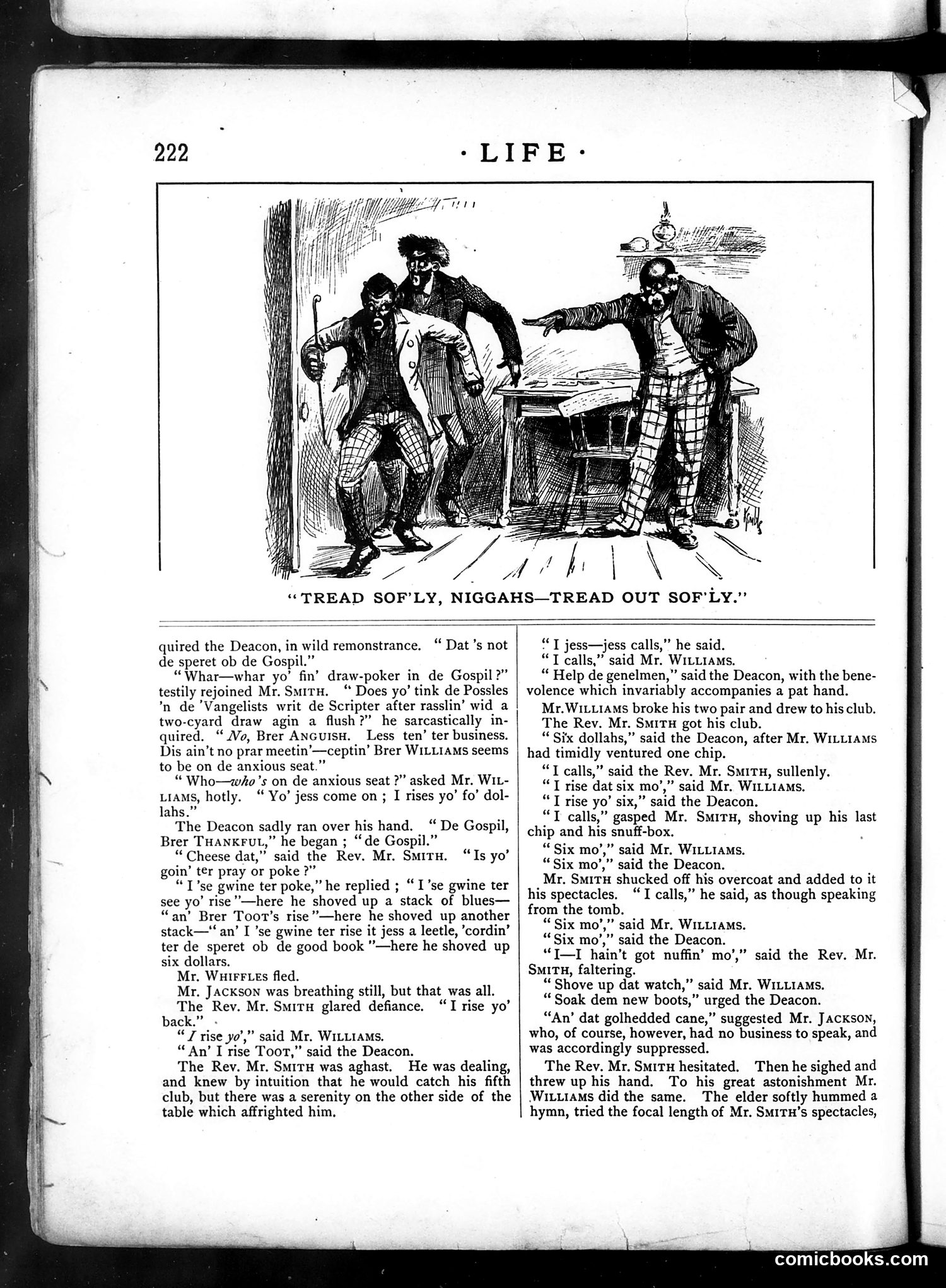
This 1880s-era Life magazine cartoon satirizes African American church leaders engaged in a high-stakes poker game, disguised as prayer meeting discourse. The sketch depicts three men—identified by dialect as Reverend Smith, Deacon Williams, and others—using religious language as cover while conducting an increasingly desperate card game. The satire works on multiple levels: it mocks both the hypocrisy of clergy gambling and employs racist caricature through exaggerated dialect ("Dat's not de speret ob de Gospil"). The humor relies on ethnic stereotyping prevalent in the era. The escalating stakes—from dollars to clothing to personal possessions—underscore the foolishness of the participants. The cartoon's title, "Tread Softly, Niggas—Tread Out So'ly," references cautionary behavior, though the full satirical intent appears directed at exposing religious hypocrisy rather than delivering social commentary beyond mockery.
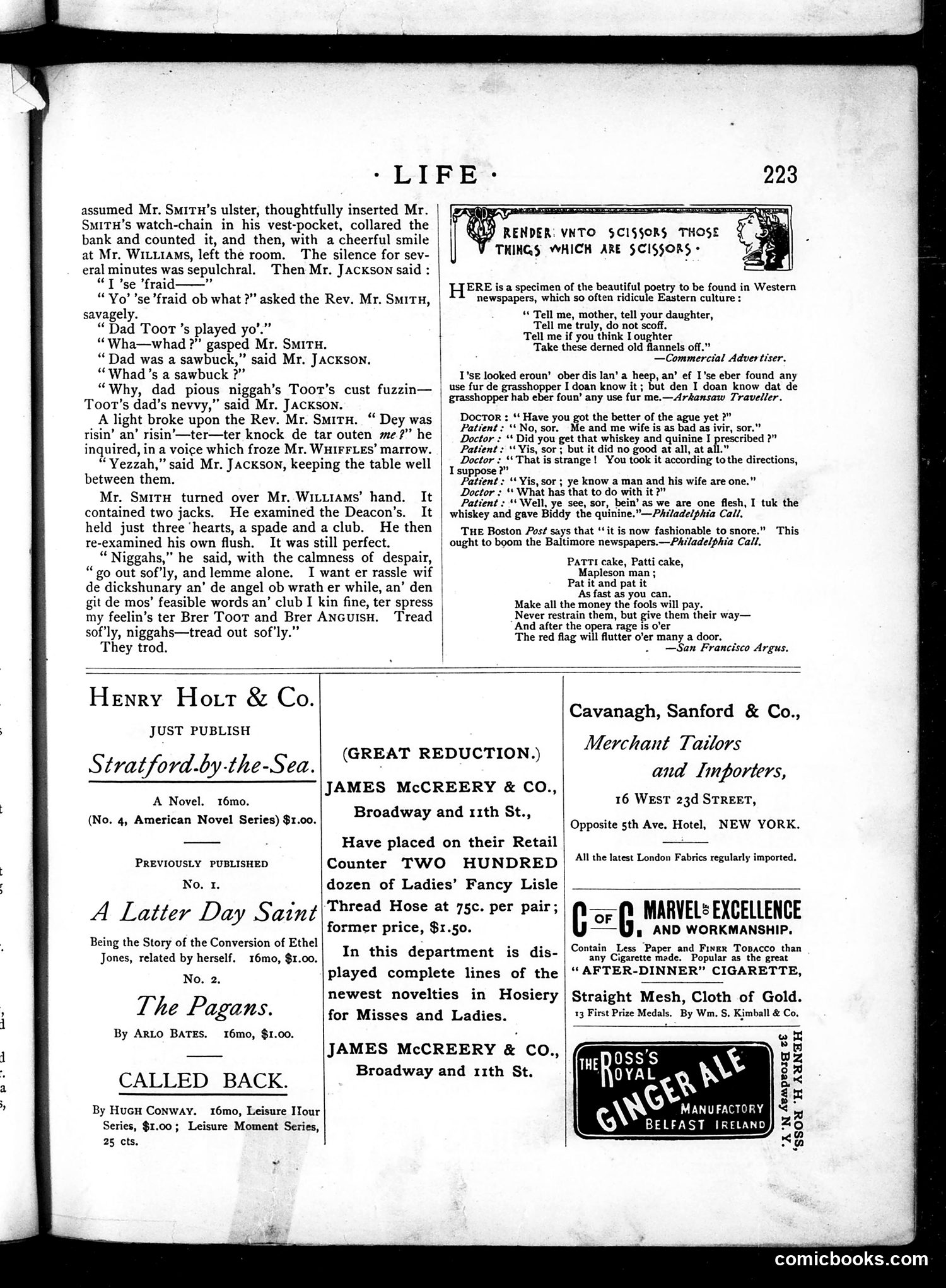
This page from *Life* magazine contains a short story excerpt (top) and advertising. The narrative depicts a card game among Black men, using heavy dialect and racial slurs characteristic of the era. The story's humor relies on a "con game" gone wrong: Mr. Smith believed he was cheating at cards but was himself deceived—his "flush" (winning hand) was beaten, and he discovers his opponent played him falsely. The punchline is his response of angry bewilderment. The dialect-heavy narrative and stereotypical characterizations reflect how *Life* (then primarily a humor and satire magazine) treated African American subjects—as objects of ridicule through exaggerated speech and stereotypes, not as actual people. This was standard in late 19th-century American periodicals. The page also includes miscellaneous humorous verse excerpts and commercial advertisements typical of such magazines.
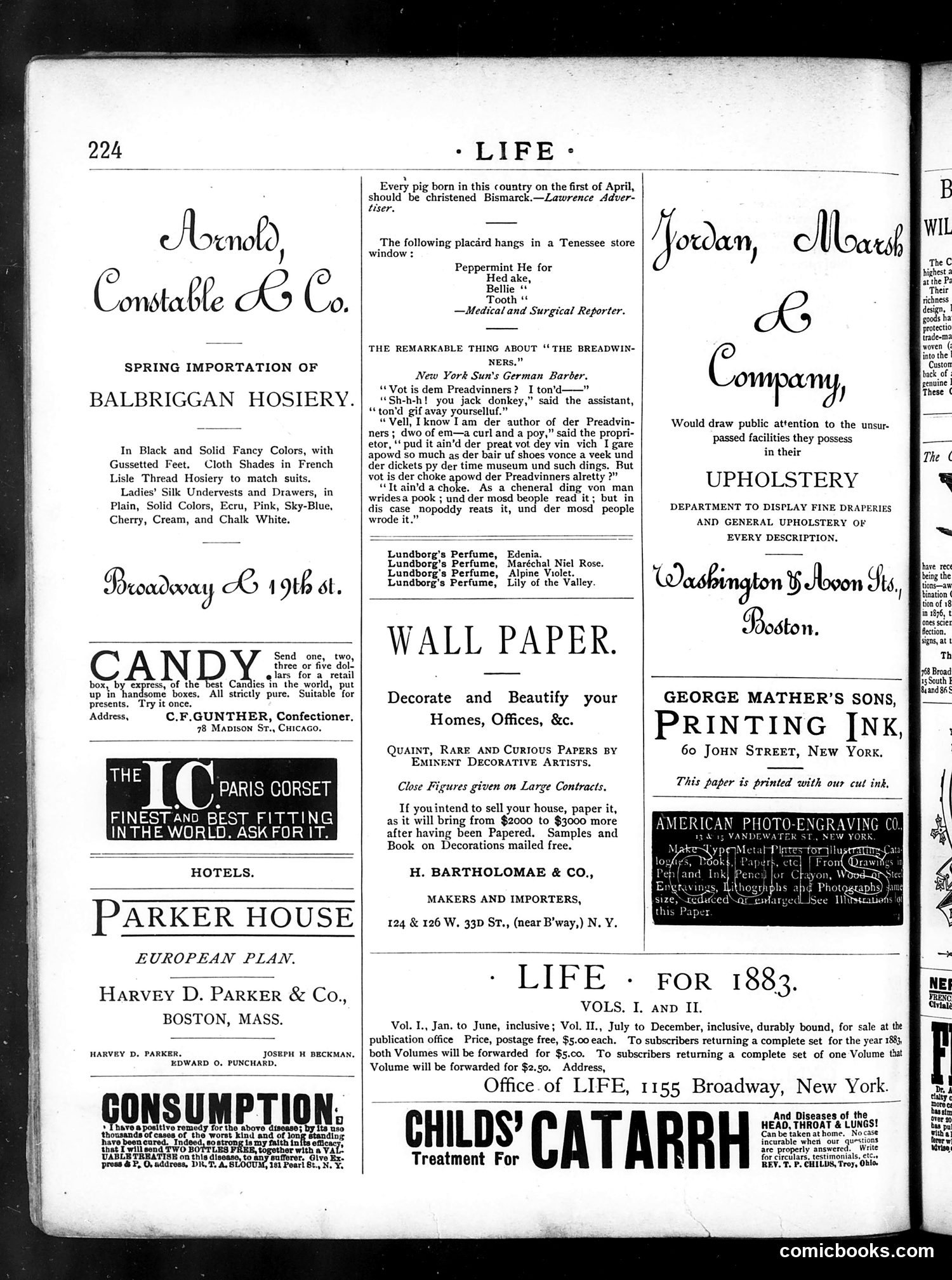
This page is primarily **advertisements and commercial notices** rather than political cartoons or satirical content. However, it contains one brief humorous item: **"The Remarkable Thing About 'The Breadwinners'"** presents a satirical dialogue between a German barber and his assistant discussing a book (likely referencing John Hay's novel "The Breadwinners," 1884). The barber claims authorship of "two of em—a curl and a poy" (a curl and a boy), making a pun equating his hairstyling work with literary creation. The joke's punchline is that while most books are widely read, nobody actually reads this one—yet the barber promoted it extensively without seeing returns. The humor relies on **ethnic dialect comedy** (exaggerated German-immigrant speech) and **meta-literary mockery** about an apparently unsuccessful contemporary novel. The rest of the page contains standard period advertisements for hosiery, candy, corsets, hotels, wallpaper, printing services, and patent medicines—typical of 1880s magazine content.
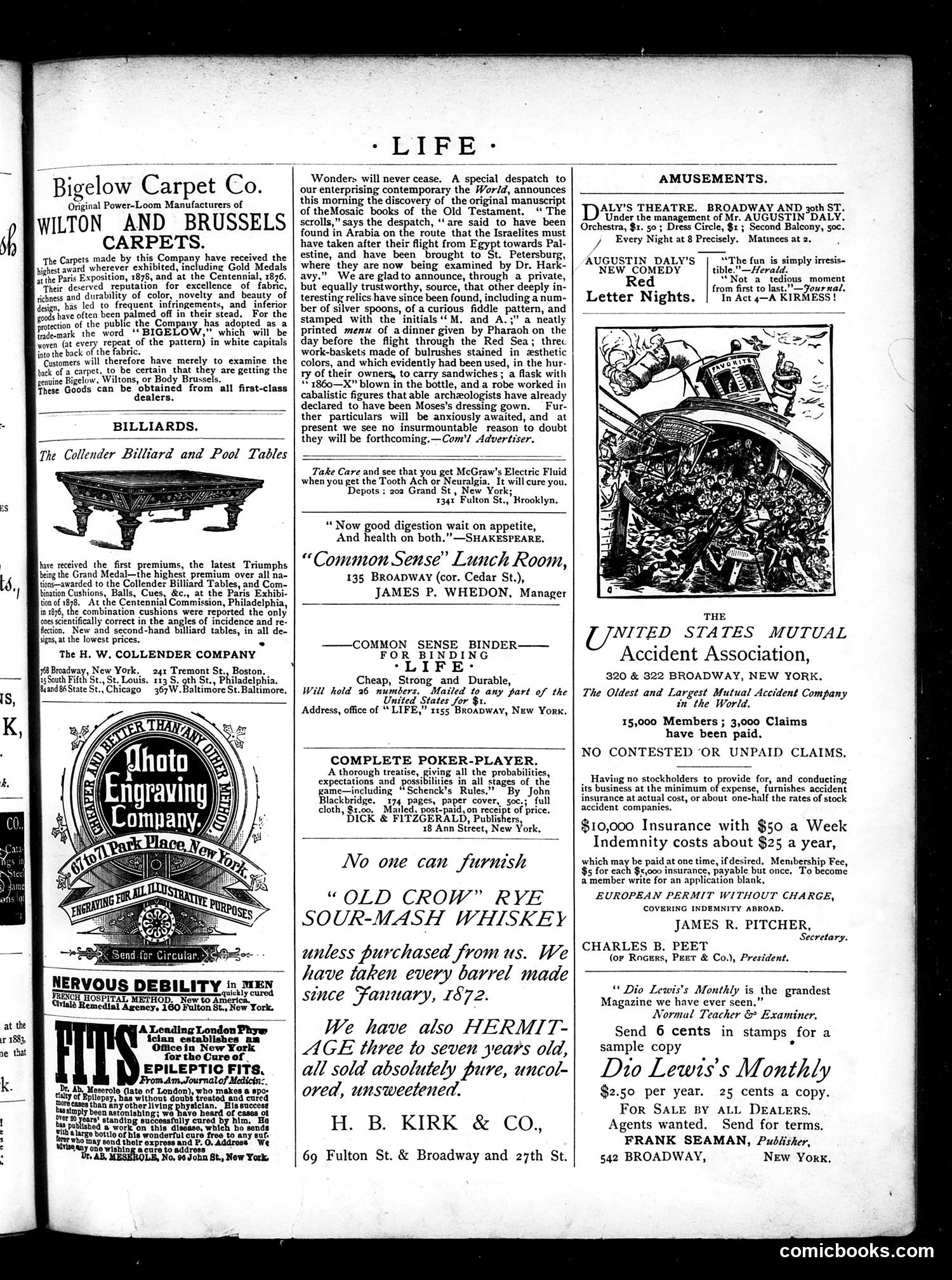
This page is primarily **advertisements** interspersed with one **satirical piece** mocking archaeological discoveries. The main satire targets contemporary sensationalism around biblical archaeology. It mockingly "announces" the discovery of Old Testament manuscripts in Arabia, supposedly being examined by scholars. The satire then ridicules this credulity by listing absurdly anachronistic "related finds": silver spoons with initials, a printed dinner menu from Pharaoh's era, aesthetic-colored work baskets, a bottle marked "1860—X" (obviously modern), and Moses's "dressing gown" decorated with cabalistic figures. The joke: credulous readers and journalists eagerly accept dubious archaeological claims without skepticism. By proposing increasingly ridiculous "discoveries," the author exposes how willing people are to believe anything presented as ancient artifact, particularly regarding biblical history. This reflects 1870s-era enthusiasm for Oriental antiquities and biblical scholarship, often mixed with hoaxes and exaggeration.
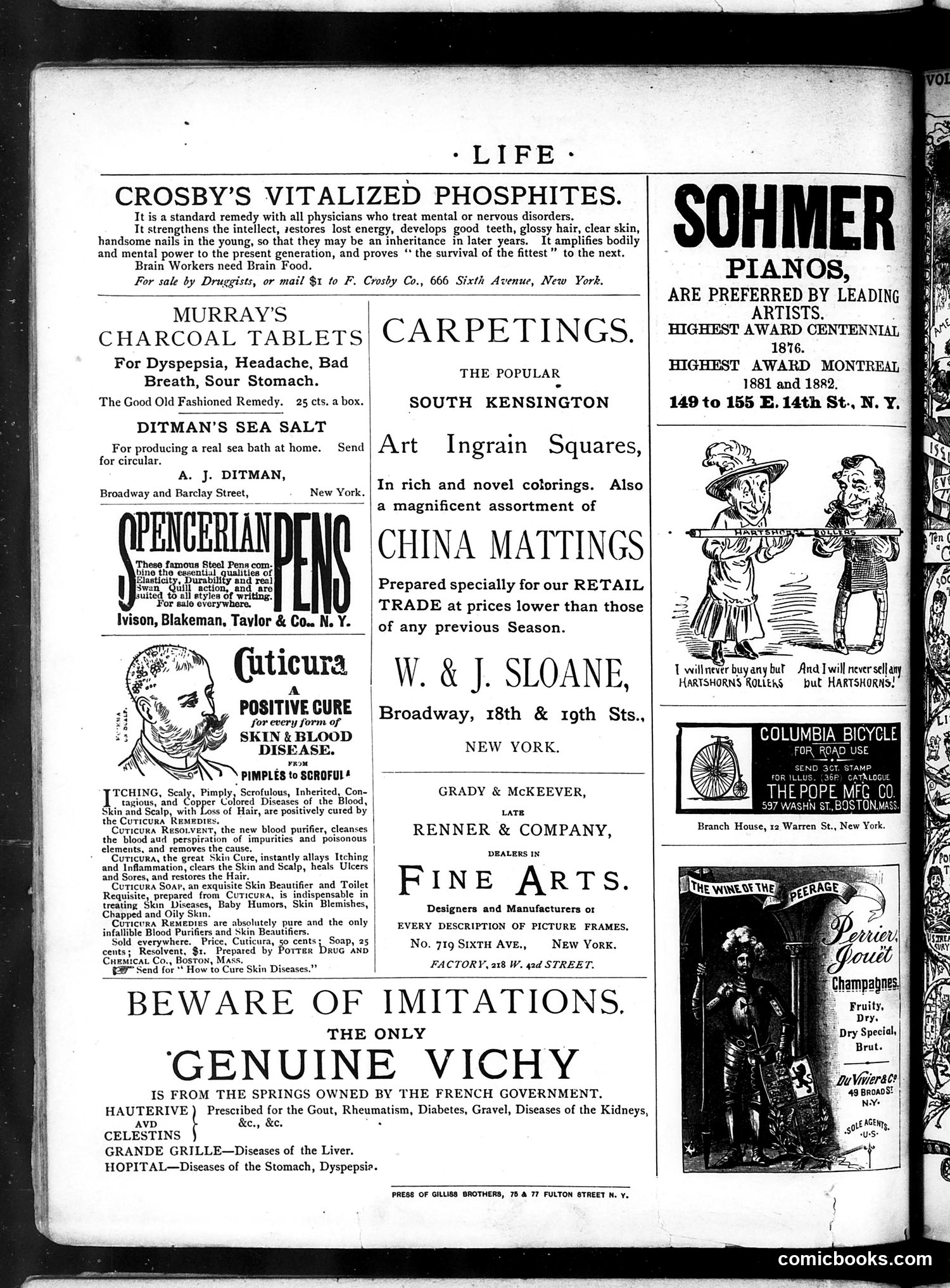
This is primarily an **advertisement page**, not a satirical cartoon page. It showcases various patent medicines and consumer goods typical of the 1880s era. The only cartoon element is a small illustration accompanying Sohmer Pianos (right side): two figures in period dress, one saying "I will never buy any but HARTSHORNS Rollers" and the other responding "And I will never sell any put HARTSHORNS!" This appears to be light product endorsement humor rather than political satire. The page otherwise consists of ads for dubious "cures"—Crosby's Phosphites (claimed to improve intellect and teeth), Cuticura (for skin diseases), Murray's Charcoal Tablets, and notably **Vichy water**, French mineral water marketed as a medical treatment for gout, rheumatism, and diabetes. These advertisements reflect late-19th-century medicine before FDA regulation, when patent medicines made extraordinary health claims without scientific backing. The page represents commercial rather than editorial content.