
Life, 1884-04-17 · page 10 of 16
Life — April 17, 1884 — page 10: what you’re looking at
What you’re looking at
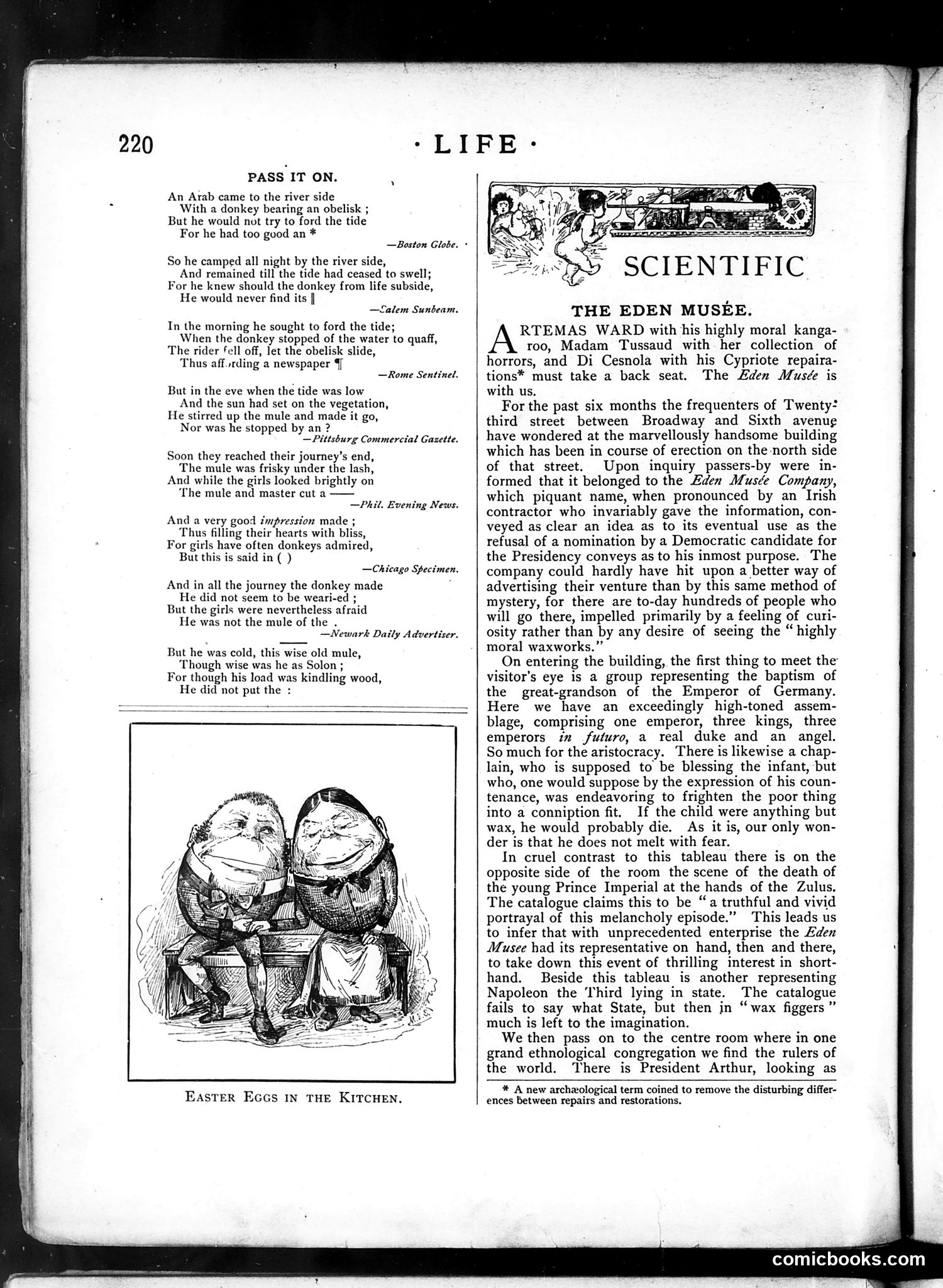
This page contains two distinct pieces. The top section, "Pass It On," is a humorous poem-chain where multiple newspapers contribute absurdist verses about an Arab, a donkey, and an obelisk attempting to cross a river. Each stanza deliberately ends with a missing word (marked by punctuation), creating wordplay based on what readers might supply—a joke format popular in period newspapers. The main article reviews the Eden Musée, a newly opened wax museum on New York's Twenty-third Street. The writer mocks its pretentiousness, describing displays of German royalty at a baptism and a tableau depicting the death of the young Prince Imperial (killed in the Zulu War). The satire criticizes the museum's sensationalism and dubious authenticity—sardonically suggesting the Eden Musée had a reporter present at the Prince's actual death to document it "in short-hand." The tone dismisses it as lurid "highly moral waxworks" designed to exploit public curiosity rather than educate.
📄 Transcribed text from this page (OCR, searchable)
Machine-transcribed from the original scan — historical spelling and the odd misread are preserved.
PASS IT ON. An Arab came to the river side With a donkey bearing an obelisk ; But he would not try to ford the tide For he had too gdod an * —Boston Globe. * So he camped all night by the river side, And remained till the tide had ceased to swell; For he knew should the donkey from life subside, He would never find its | —<Salem Sunbeam. In the morning he sought to ford the tide; When the donkey stopped of the water to quaff, The rider Fell off, let the obelisk slide, Thus aff.srding a newspaper —Rome Sentinel. But in the eve when the tide was low And the sun had set on the vegetation, He stirred up the mule and made it go, Nor was he stopped by an ? —Pittsburg Commercial Gasette. Soon they reached their journey’s end, The mule was frisky under the lash, And while the girls looked brightly on ‘The mule and master cut a —— —Phil. Evening News. And a very good impression made ; Thus filling their hearts with bliss, For girls have often donkeys admired, But this is said in ( ) —Chicago Specimen. And in all the journey the donkey made He did not seem to be weari-ed ; But the girls were nevertheless afraid He was not the mule of the . —Newark Daily Advertiser. ise old mule, ‘Though wise was he as Solon ; For though his load was kindling wood, He did not put the : But he was cold, this Easter Ecos In THE KITCHEN. THE EDEN MUSEE. RTEMAS WARD with his highly moral kanga- roo, Madam Tussaud with her collection of horrors, and Di Cesnola with his Cypriote repaira- tions* must take a back seat. The Eden Musée is with us, For the past six months the frequenters of Twenty: third street between Broadway and Sixth avenug have wondered at the marvellously handsome building which has been in course of erection on the-north side of that street. Upon inquiry passers-by were in- formed that it belonged to the Eden Musée Company, which piquant name, when pronounced by an Irish contractor who invariably gave the information, con- veyed as clear an idea as to its eventual use as the refusal of a nomination by a Democratic candidate for the Presidency conveys as to his inmost purpose. The company could hardly have hit upon a better way of advertising their venture than by this same method of mystery, for there are to-day hundreds of people who will go there, impelled primarily by a feeling of curi- osity rather than by any desire of seeing the “ highly moral waxworks.” On entering the building, the first thing to meet the visitor's eye is a group representing the baptism of the great-grandson of the Emperor of Germany. Here we have an exceedingly high-toned assem- blage, comprising one emperor, three kings, three emperors iz fuiuro, a real duke and an angel. So much for the aristocracy. There is likewise a chap- lain, who is supposed to be blessing the infant, but who, one would suppose by the expression of his coun- tenance, was endeavoring to frighten the poor thing into a conniption fit. If the child were anything but wax, he would probably die. As it is, our only won- der is that he does not melt with fear. In cruel contrast to this tableau there is on the opposite side of the room the scene of the death of the young Prince Imperial at the hands of the Zulus. The catalogue claims this to be “a truthful and vivid portrayal of this melancholy episode.” This leads us to infer that with unprecedented enterprise the Eden Musee had its representative on hand, then and there, to take down this event of thrilling interest in short- hand. Beside this tableau is another representing Napoleon the ‘Third lying in state. The catalogue fails to say what State, but then in “wax figgers ” much is left to the imagination. We then pass on to the centre room where in one grand ethnological congregation we find the rulers of the world. There is President Arthur, looking as * A new archzological term coined to remove the disturbing differ- ences between repairs and restorations. comicbooks.com