
Life, 1884-04-17 · page 5 of 16
Life — April 17, 1884 — page 5: what you’re looking at
What you’re looking at
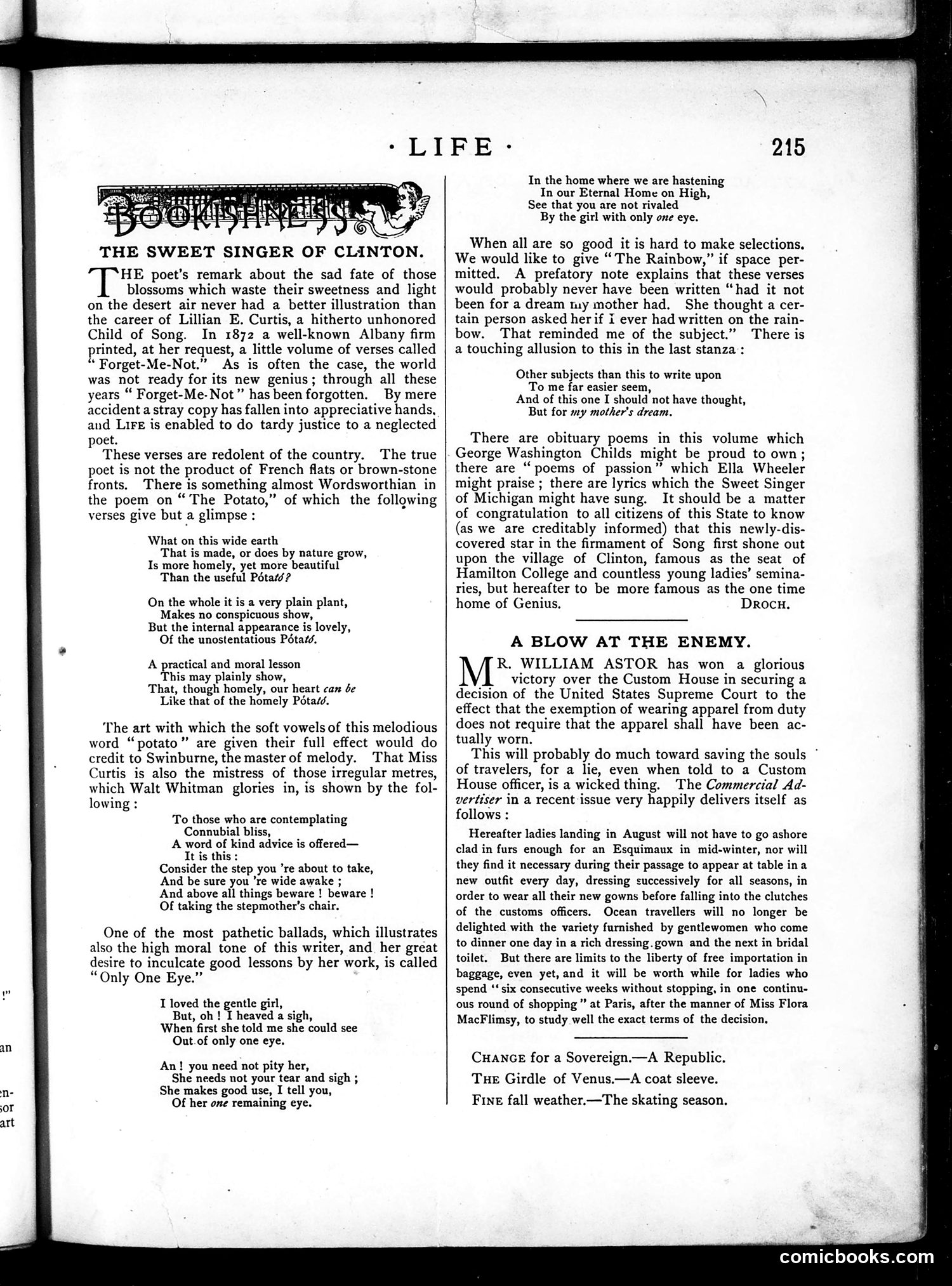
This page contains literary criticism rather than political cartoons. The main content discusses "The Sweet Singer of Clinton"—a poet named Lillian P. Curtis from Clinton, Michigan, whose work was previously neglected but is now being rediscovered. The article celebrates Curtis's verses, particularly "The Potato," and compares her style to Wordsworth. It notes that Clinton is becoming famous as the home of this "Genius" and the seat of Hamilton College. The right column includes a brief article titled "A Blow at the Enemy" regarding a U.S. Supreme Court decision about tariffs on imported clothing, with commentary on women's fashion and customs regulations. The page is primarily cultural and commercial commentary rather than political satire.
📄 Transcribed text from this page (OCR, searchable)
Machine-transcribed from the original scan — historical spelling and the odd misread are preserved.
THE SWEET SINGER OF CLINTON. HE poet’s remark about the sad fate of those blossoms which waste their sweetness and light on the desert air never had a better illustration than the career of Lillian E. Curtis, a hitherto unhonored Child of Song. In 1872 a well-known Albany firm printed, at her request, a little volume of verses called “ Forget-Me-Not.” As is often the case, the world was not ready for its new genius; through all these years “ Forget-Me-Not” has been forgotten. By mere accident a stray copy has fallen into appreciative hands, and Lire is enabled to do tardy justice to a neglected oet. These verses are redolent of the country. The true poet is not the product of French flats or brown-stone fronts. There is something almost Wordsworthian in the poem on “The Potato,” of which the following verses give but a glimpse : What on this wide earth That is made, or does by nature grow, Is more homely, yet more beautiful Than the useful Péta‘é? On the whole it is a very plain plant, Makes no conspicuous show, But the internal appearance is lovely, Of the unostentatious Pétasé. A practical and moral lesson This may plainly show, That, though homely, our heart can be Like that of the homely Péta/é. The art with which the soft vowels of this melodious word “potato” are given their full effect would do credit to Swinburne, the master of melody. That Miss Curtis is also the mistress of those irregular metres, which Walt Whitman glories in, is shown by the fol- lowing : To those who are contemplating Connubial bliss, A word of kind advice is offered— It is this : Consider the step you ’re about to take, And be sure you ’re wide awake ; And above all things beware ! beware ! Of taking the stepmother’s chair. One of the most pathetic ballads, which illustrates also the high moral tone of this writer, and her great desire to inculcate good lessons by her work, is called “Only One Eye.” I loved the gentle girl, But, oh ! f heaved a sigh, When first she told me she could see Out. of only one eye. An! you need not pity her, She needs not your tear and sigh ; She makes good use, I tell you, Of her one remaining eye. In the home where we are hastening In our Eternal Home on High, See that you are not rivaled By the girl with only one eye. When all are so good it is hard to make selections. We would like to give “The Rainbow,” if space per- mitted. A prefatory note explains that these verses would probably never have been written “had it not been for a dream my mother had. She thought a cer- tain person asked her if i ever had written on the rain- bow. That reminded me of the subject.” There is a touching allusion to this in the last stanza : Other subjects than this to write upon To me far easier seem, And of this one I should not have thought, But for my mother’s dream. There are obituary poems in this volume which George Washington Childs might be proud to own; there are “poems of passion” which Ella Wheeler might praise ; there are lyrics which the Sweet Singer of Michigan might have sung. It should be a matter of congratulation to all citizens of this State to know (as we are creditably informed) that this newly-dis- covered star in the firmament of Song first shone out upon the village of Clinton, famous as the seat of Hamilton College and countless young ladies’ semina- ries, but hereafter to be more famous as the one time home of Genius. Drocu. A BLOW AT THE ENEMY. R. WILLIAM ASTOR has won a glorious victory over the Custom House in securing a decision of the United States Supreme Court to the effect that the exemption of wearing apparel from duty does not require that the apparel shall have been ac- tually worn. This will probably do much toward saving the souls © of travelers, for a lie, even when told to a Custom House officer, is a wicked thing. The Commercial Ad- vertiser in a recent issue very happily delivers itself as follows : Hereafter ladies landing in August will not have to go ashore clad in furs enough for an Esquimaux in mid-winter, nor will they find it necessary during their passage to appear at table ina new outfit every day, dressing successively for all seasons, in order to wear all their new gowns before falling into the clutches of the customs officers. Ocean travellers will no longer be delighted with the variety furnished by gentlewomen who come to dinner one day in a rich dressing.gown and the next in bridal toilet. But there are limits to the liberty of free importation in baggage, even yet, and it will be worth while for ladies who spend “six consecutive weeks without stopping, in one continu- ous round of shopping” at Paris, after the manner of Miss Flora MacFlimsy, to study well the exact terms of the decision, CuancE for a Sovereign.—A Republic. Tue Girdle of Venus.—A coat sleeve. Fine fall weather.—The skating season. comicbooks.com