
A complete issue · 16 pages · 1884
Life — February 14, 1884
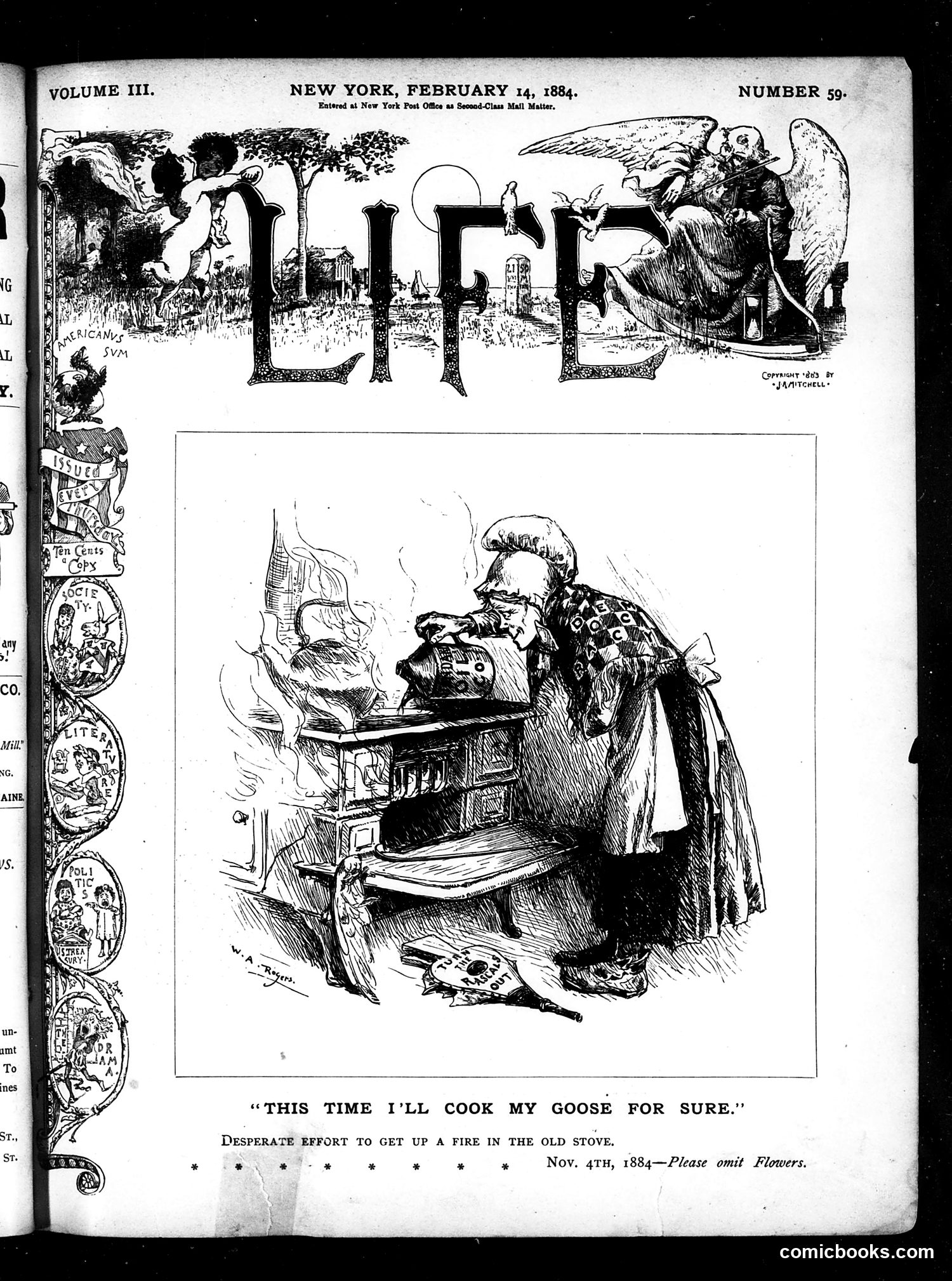
The main cartoon depicts a domestic scene titled **"This Time I'll Cook My Goose for Sure"** with a subtitle noting "Desperate Effort to Get Up a Fire in the Old Stove." The image shows an elderly woman attempting to start a fire in a wood-burning stove, struggling with the process. The humor appears to be **domestic satire** about the frustrations of 19th-century housekeeping—specifically the difficulty of lighting temperamental old stoves, a common household complaint of the era. The phrase "cook my goose" (meaning to ruin something) plays on the literal act of cooking. The cartoon likely mocks either the incompetence of household management or satirizes women's domestic struggles with outdated appliances. Without additional context from the magazine's editorial positions, the precise social commentary remains unclear.
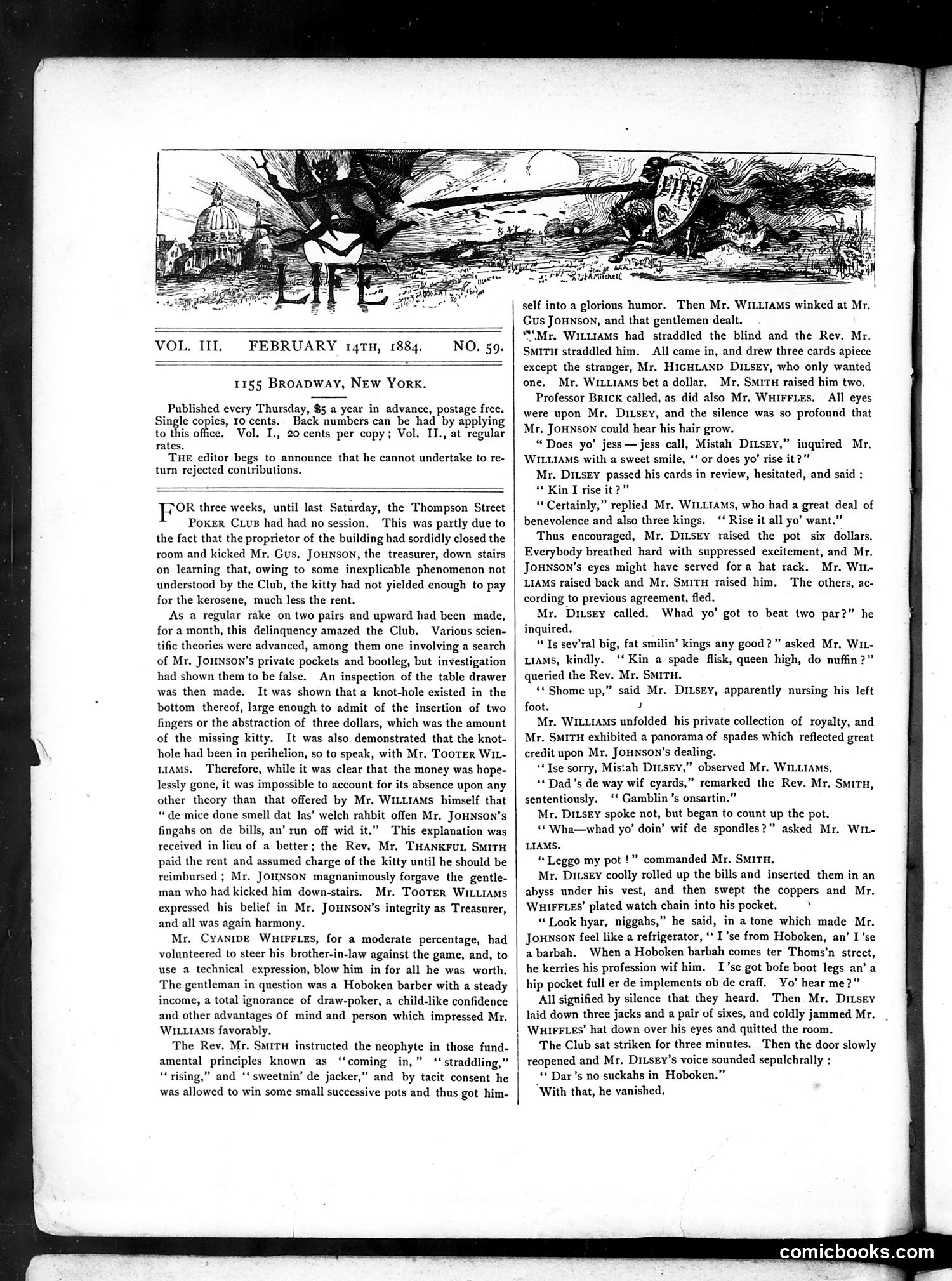
The header illustration shows Death as a skeleton sitting in a chair, overlooking a cityscape with a prominent dome (likely the Capitol). This appears to be satirizing mortality or political corruption in Washington. The main text is a humorous story about the Thompson Street Poker Club, where a missing cat and disappearing money create a mystery. The narrative involves various characters (Williams, Johnson, Dilsey, Smith, and others) solving the puzzle. The story's jokes rely on period dialect and class-based humor—particularly mocking a Black character named Dilsey and a "Hoboken barber." This is primarily **entertainment satire** rather than political commentary—poking fun at urban life, poker culture, and social pretensions of the era, though the racial caricature reflects deeply troubling 1880s attitudes.
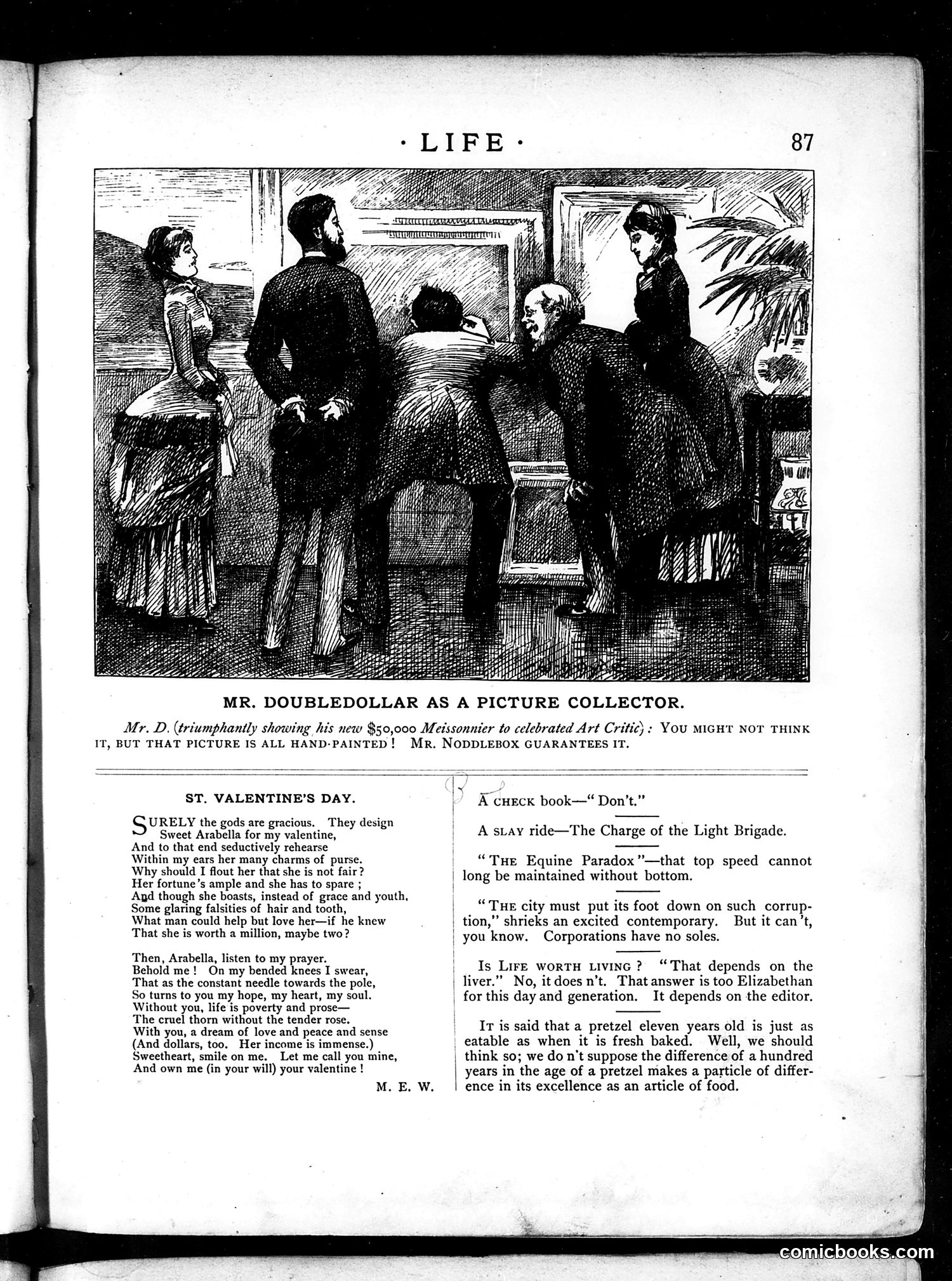
**Main Cartoon: "Mr. Doubledollar as a Picture Collector"** The cartoon depicts a wealthy collector (Mr. D., likely representing a nouveau-riche industrialist) proudly displaying what he claims is a $50,000 Meissonnier painting to a celebrated art critic. The satire mocks wealthy businessmen who accumulated fortunes during the Gilded Age, then purchased expensive artworks—often without genuine expertise or discernment. The joke is that despite Mr. Doubledollar's boastful guarantee that the painting is "hand-painted," this assurance itself reveals his ignorance about art authentication. **Lower Content:** The page includes Valentine's Day poetry and brief humorous commentary sections typical of Life's satirical format, poking fun at social conventions and current events. This reflects Progressive Era skepticism toward "rubber baron" culture and conspicuous consumption.
This page contains three separate satirical pieces rather than a single cartoon: 1. **"Happy Anglomaniac"** — A humorous anecdote mocking Americans who adopt British affectations. It describes a Jersey sportsman injuring himself while imitating English fox hunting, with the joke being that his pretension to British sporting culture literally backfires. 2. **"A Congenial Sport"** — A detailed hunting narrative appearing to satirize the chaos and incompetence of amateur hunters, emphasizing their discord and the mess they create. 3. **"Monsignor Capel"** — A commentary on a Catholic church official's lecture discussing Church doctrine regarding science and reason, likely satirizing conflicts between religious authority and scientific progress. The page is primarily text-based social satire rather than visual cartooning, typical of Life's literary humor approach from this era.
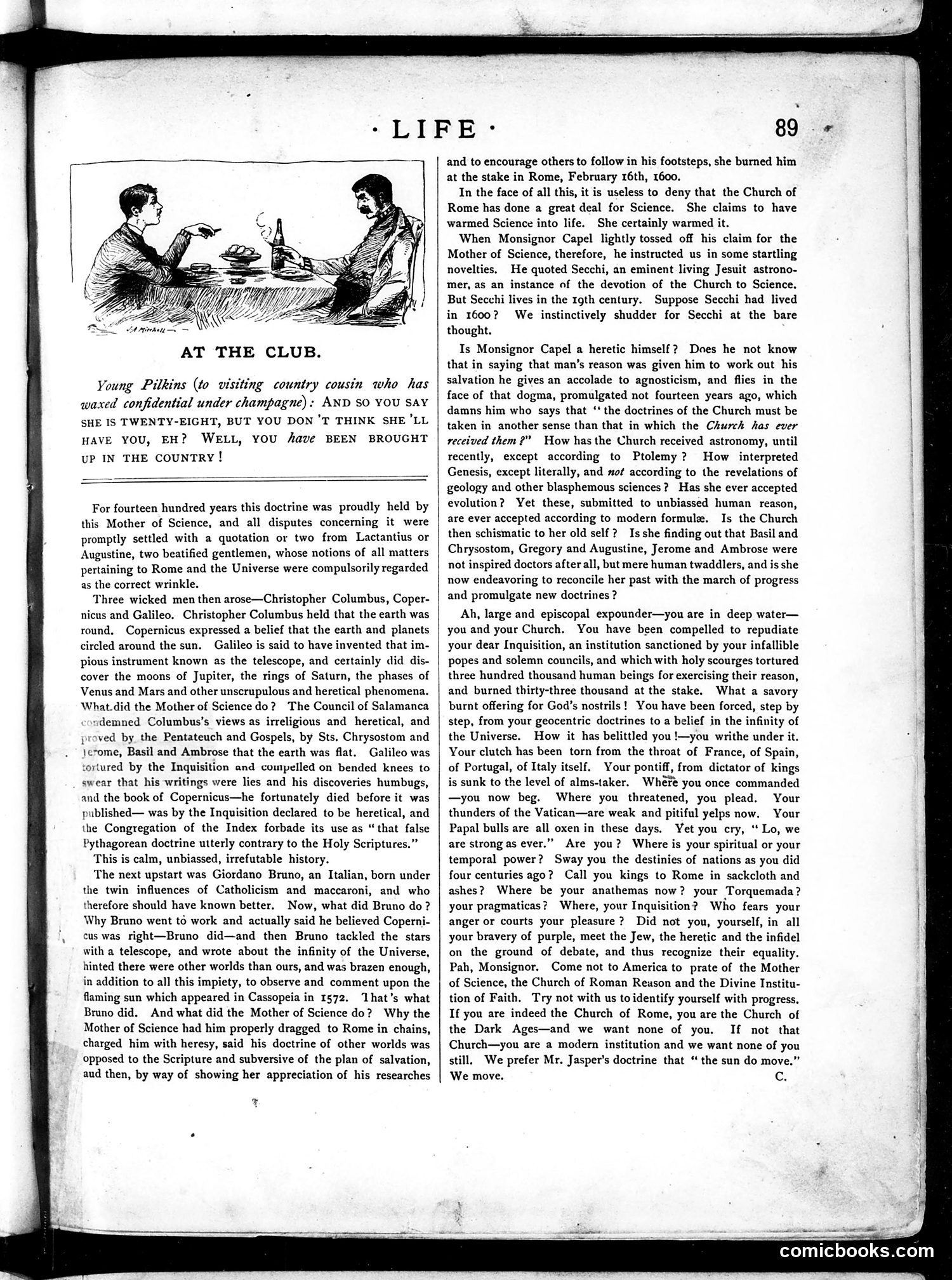
The cartoon depicts two men at a club dining together. The caption satirizes a young man's dismissal of a visiting female cousin as inexperienced ("twenty-eight, but you don't think she'll have you"). The accompanying text is a lengthy satirical attack on Monsignor Capel and the Catholic Church's stance on science. The author criticizes the Church for burning Giordano Bruno (executed 1600) and condemning Copernicus, Galileo, and other scientists for discoveries contradicting Church doctrine. The satire argues the Church claims credit for advancing science while actually suppressing it through the Inquisition. The text mocks Monsignor Capel specifically for defending the Church's historical treatment of scientists, characterizing the Church as intellectually retrograde—a "Dark Ages" institution opposing modern scientific progress.
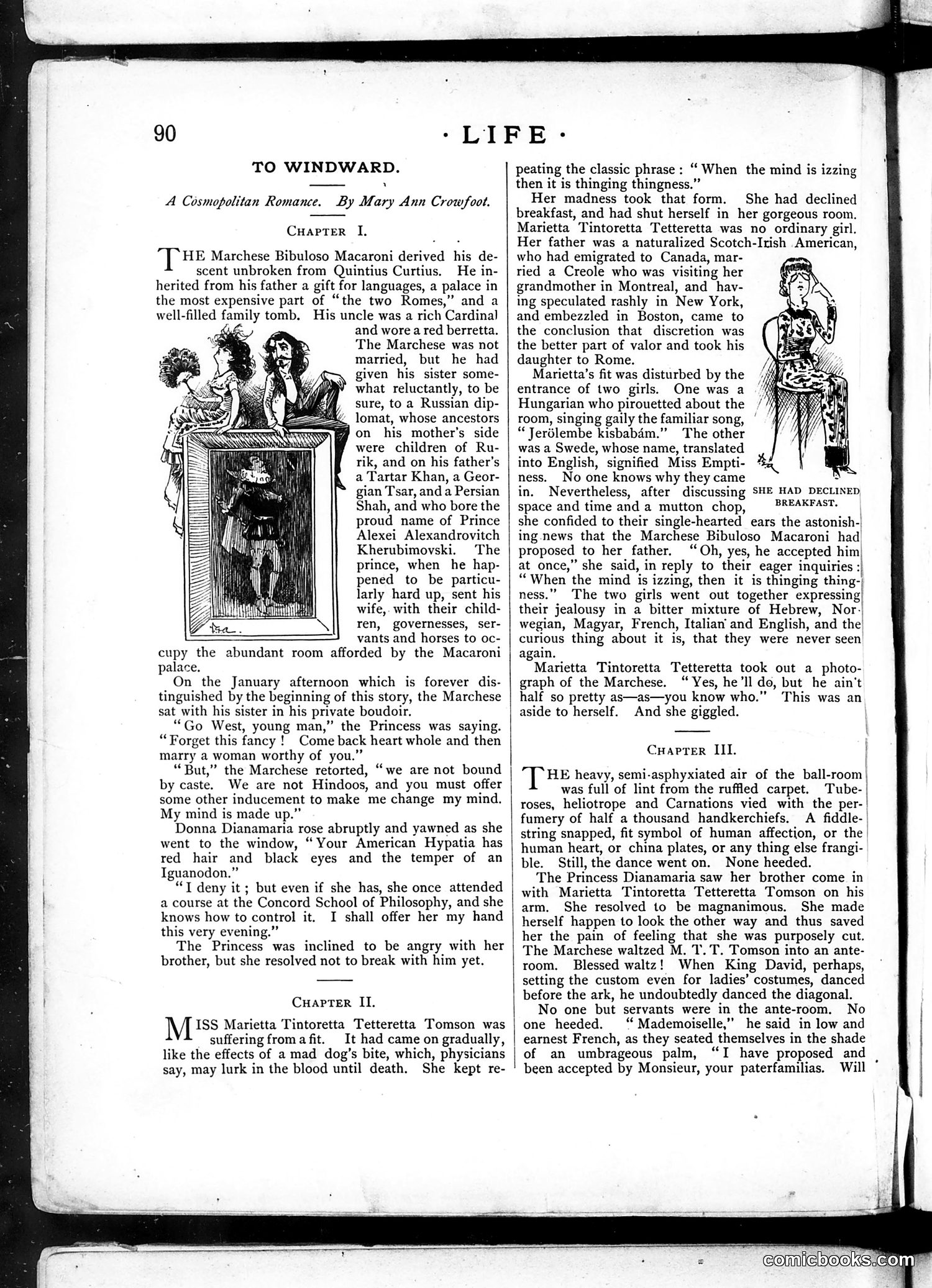
This page contains the opening of "To Windward," a serialized cosmopolitan romance by Mary Ann Crowfoot, rather than political satire or editorial cartoons. The small illustrations are decorative chapter headings showing period costume and domestic scenes typical of turn-of-the-century romantic fiction. The main illustration depicts the Marchese Babuloso Macaroni in his Italian palace—a humorous aristocratic figure whose exaggerated name suggests gentle mockery of European nobility. The story itself parodies high-society romance conventions: a Marchese with an elaborate pedigree, an American heiress protagonist suffering from "mania," and cross-cultural romantic complications. The satire targets pretentious aristocratic genealogies and the fashionable "nervous conditions" affecting wealthy American women of that era. This is entertainment content, not political commentary.
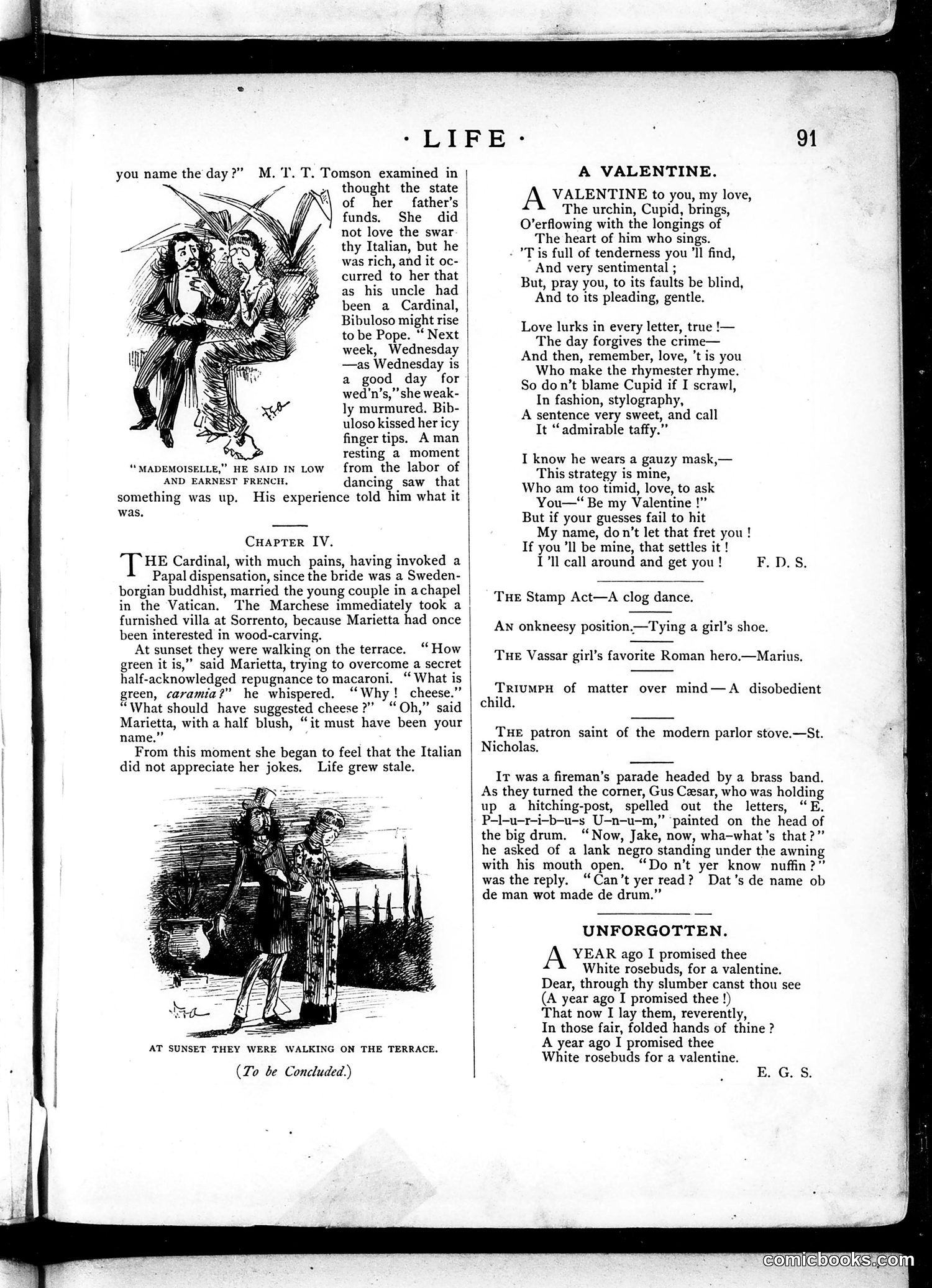
This page contains primarily literary content rather than political cartoons. The main illustrated elements are: **Two pen-and-ink sketches** accompanying Chapter IV of a serialized story about a Cardinal, a Swedish Buddhist, and a young couple named Marietta in the Vatican and Italy. The sketches show romantic scenes: one of a couple in period dress, another of figures at sunset on a terrace. The right column features **Valentine's Day poetry** and humorous definitions (the "Stamp Act" as "a clog dance," for example). These appear to be typical magazine filler—lighthearted wordplay rather than social commentary. The page reflects *Life* magazine's mix of serialized fiction, poetry, and gentle humor typical of early 20th-century American periodicals, rather than sharp political satire.
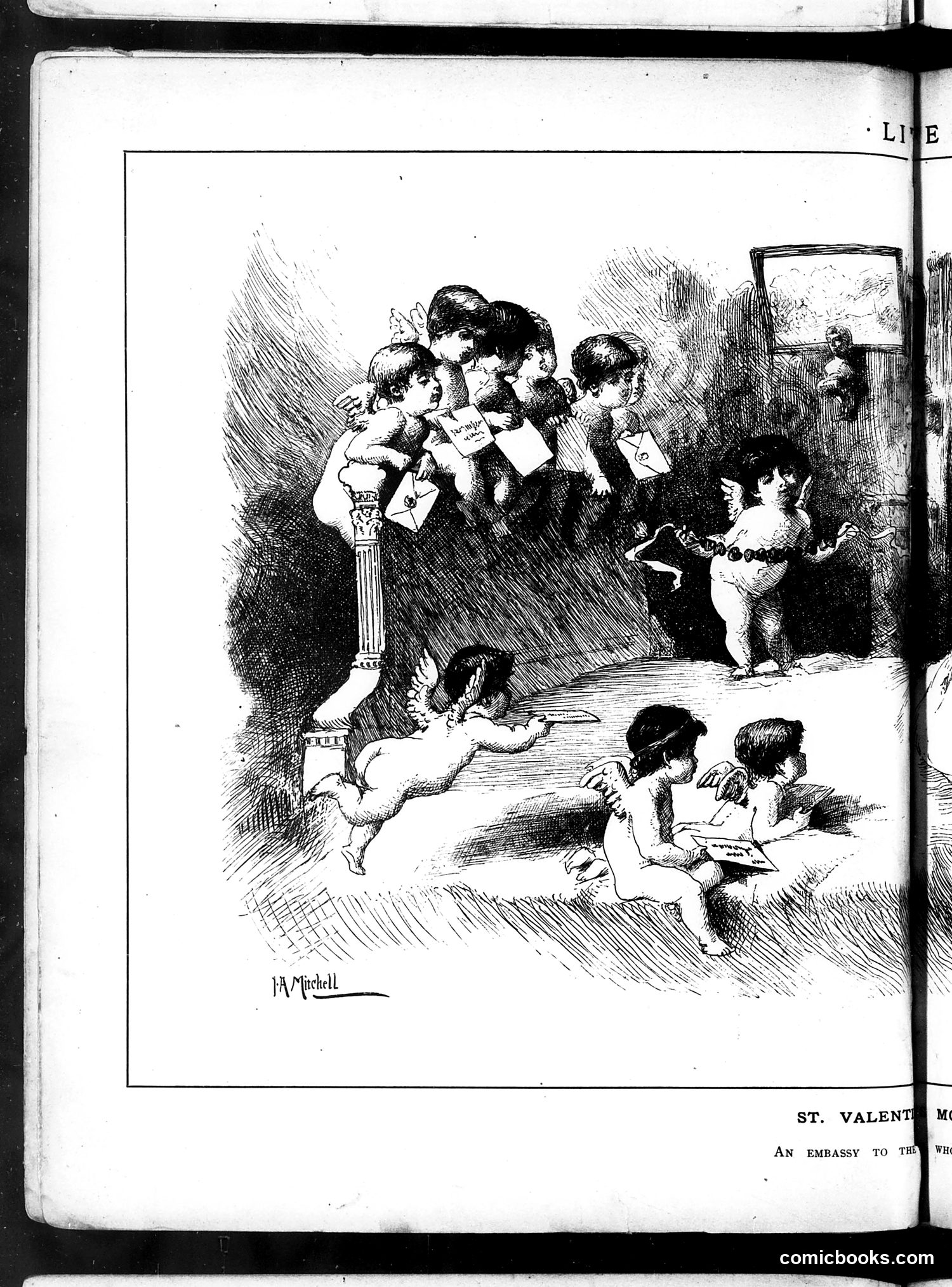
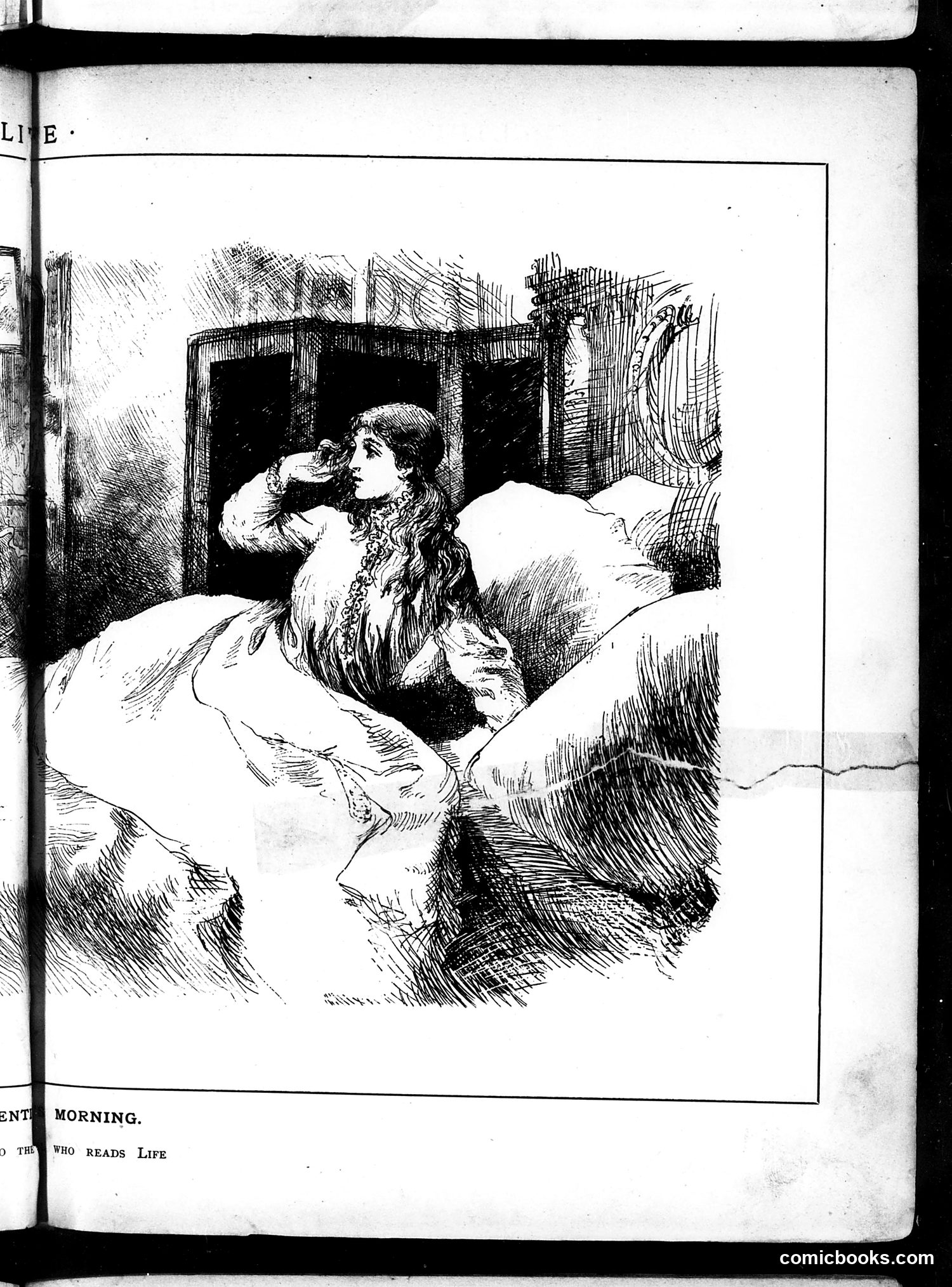
This appears to be an illustration titled "Morning" from Life magazine, with partial text reading "...who reads Life" visible at bottom. The sketch depicts a woman in bed wearing an ornate dress or negligee with long hair, gazing toward a window or mirror. The artistic style uses crosshatching typical of late 19th/early 20th-century magazine illustrations. Without more complete text or publication date, the specific satirical point remains unclear. However, the intimate bedroom setting combined with the magazine's reference suggests commentary on women's morning routines, fashion, vanity, or leisure habits—common subjects for Life's social satire. The woman's elaborate dress even in bed may be mocking affectation or idle wealth. The full caption and surrounding content would clarify the intended humor.
This page contains two main pieces of satirical content: **"Retribution"** (left): A lengthy poem mocking "bachelor Gray," a cynical, pleasure-seeking socialite devoted to yachting and bachelorhood. The narrative follows his encounter with "Daisy De Lancy St. Clair," a society beauty he initially dismisses but eventually pursues and marries. The satire targets both shallow upper-class romance and masculine hypocrisy—Gray's cynical philosophy about women ("Collectively, woman is almost divine; / Individually, thank you, not any in mine") collapses when he falls for an individual woman. **"First Aid to the Injured"** (right): Mock medical advice about female hysteria, a then-common diagnosis. The humor lies in treating hysteria as trivial (caused by mice or caterpillars) while providing absurd "treatments" like measuring waists. A footnote jokes that hysteria affects men too—specifically Democratic politicians (Tilden and Hendricks are 1876 candidates), suggesting they're laughable. The page reflects Gilded Age attitudes toward gender, marriage, and political figures.
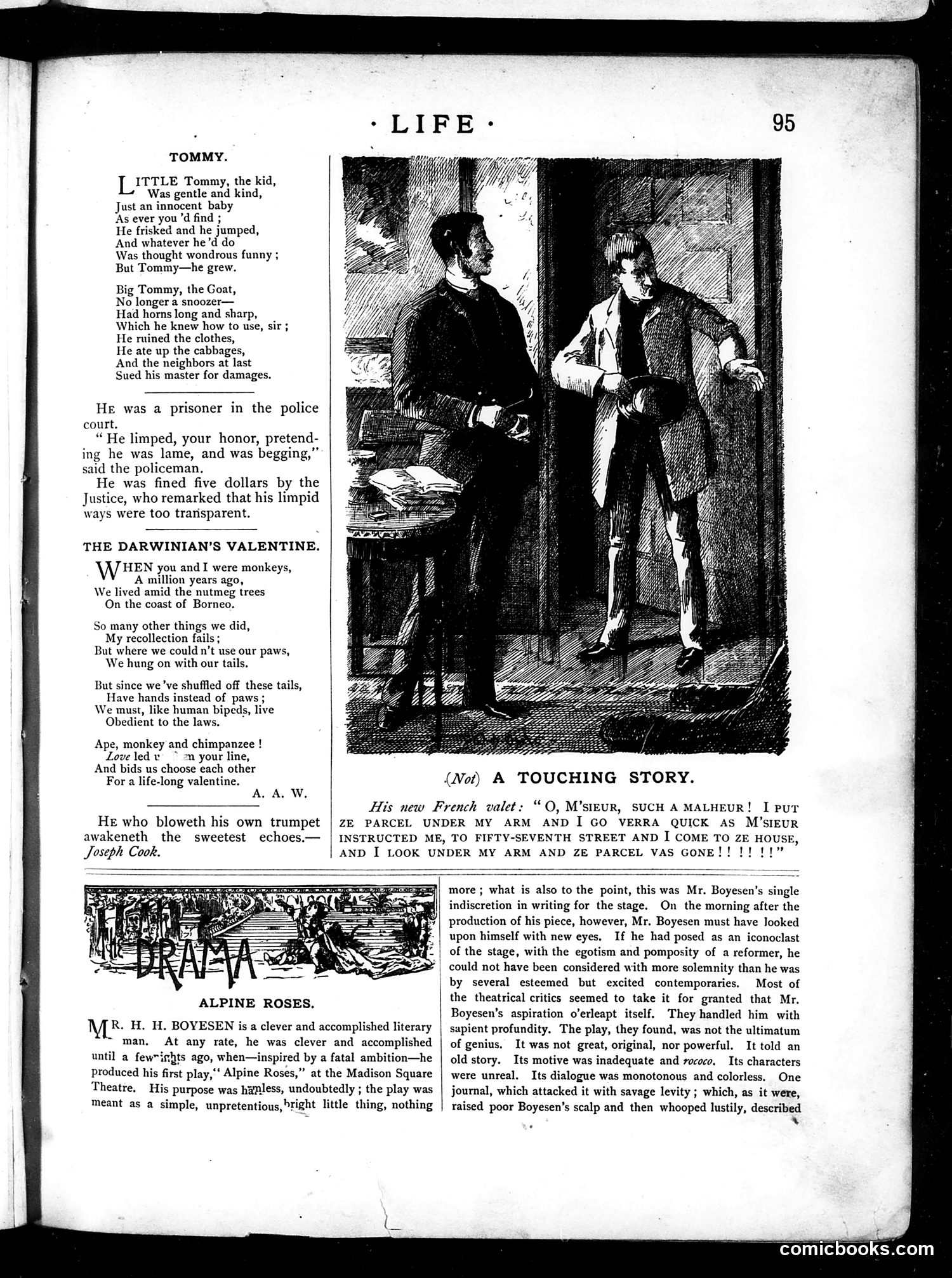
This page contains three satirical pieces typical of late 19th-century American humor: **"Tommy"** contrasts innocent childhood with destructive adulthood through a goat metaphor. Little Tommy is charming; Big Tommy the Goat becomes destructive (ruining clothes, eating cabbages), ultimately facing police court for feigned lameness. The satire mocks how cute behavior becomes criminal when the creature grows. **"The Darwinian's Valentine"** satirizes evolutionary theory (then controversial). It humorously traces human romance back to monkey ancestry, suggesting that if we evolved from apes with tails, modern humans should still "obey the laws" of nature in choosing mates—a jest at Darwinian science. **"Alpine Roses"** and **"A Touching Story"** are theater reviews. The first mocks playwright H.H. Boyesen's theatrical debut, suggesting critics savagely over-analyzed his modest play. The second presents a humorous anecdote about a French valet losing a parcel—typical comedic dialect humor of the era. The illustration appears to accompany the theater criticism section.
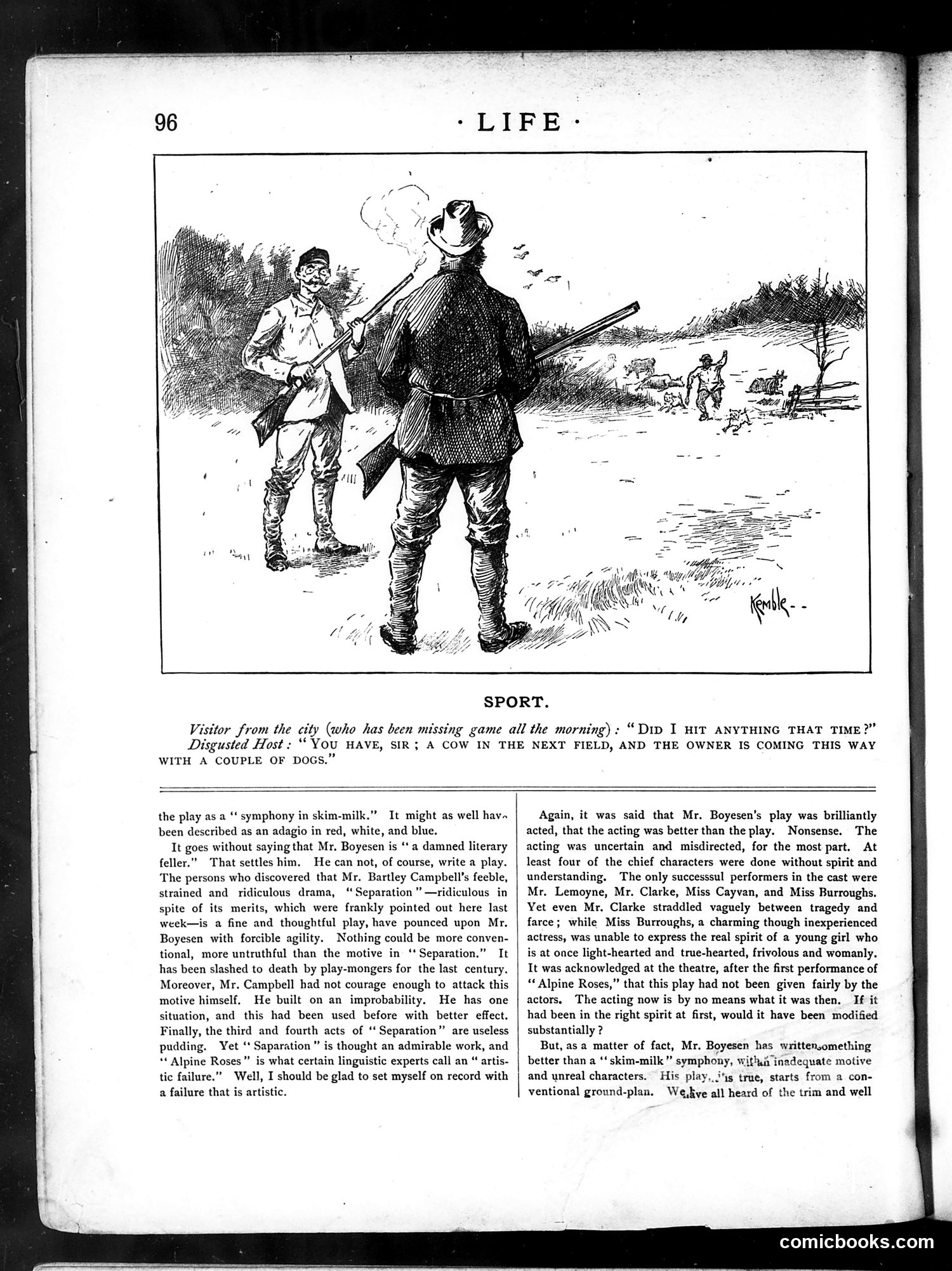
**The Cartoon ("Sport"):** This is a hunting joke depicting a city visitor who has spent the morning shooting at nothing, finally hitting *something*—a farmer's cow in the adjacent field. The "disgusted host" delivers the punchline: the angry cow's owner is approaching with dogs. **The Satire:** The humor targets incompetent urban hunters visiting the countryside. The city visitor, poorly skilled and overeager, mistakes a farm animal for game. His obliviousness to the consequences (farmer's wrath, approaching dogs) underscores the clash between city sophistication and rural realities. The joke mocks both the visitor's marksmanship and his ignorance of country life's practical dangers. **Context:** This reflects late 19th-century American leisure culture, when city dwellers traveled to rural areas for sport. The cartoon assumes readers understand hunting etiquette and the real hazard of shooting livestock—both socially embarrassing and legally problematic for the guest.
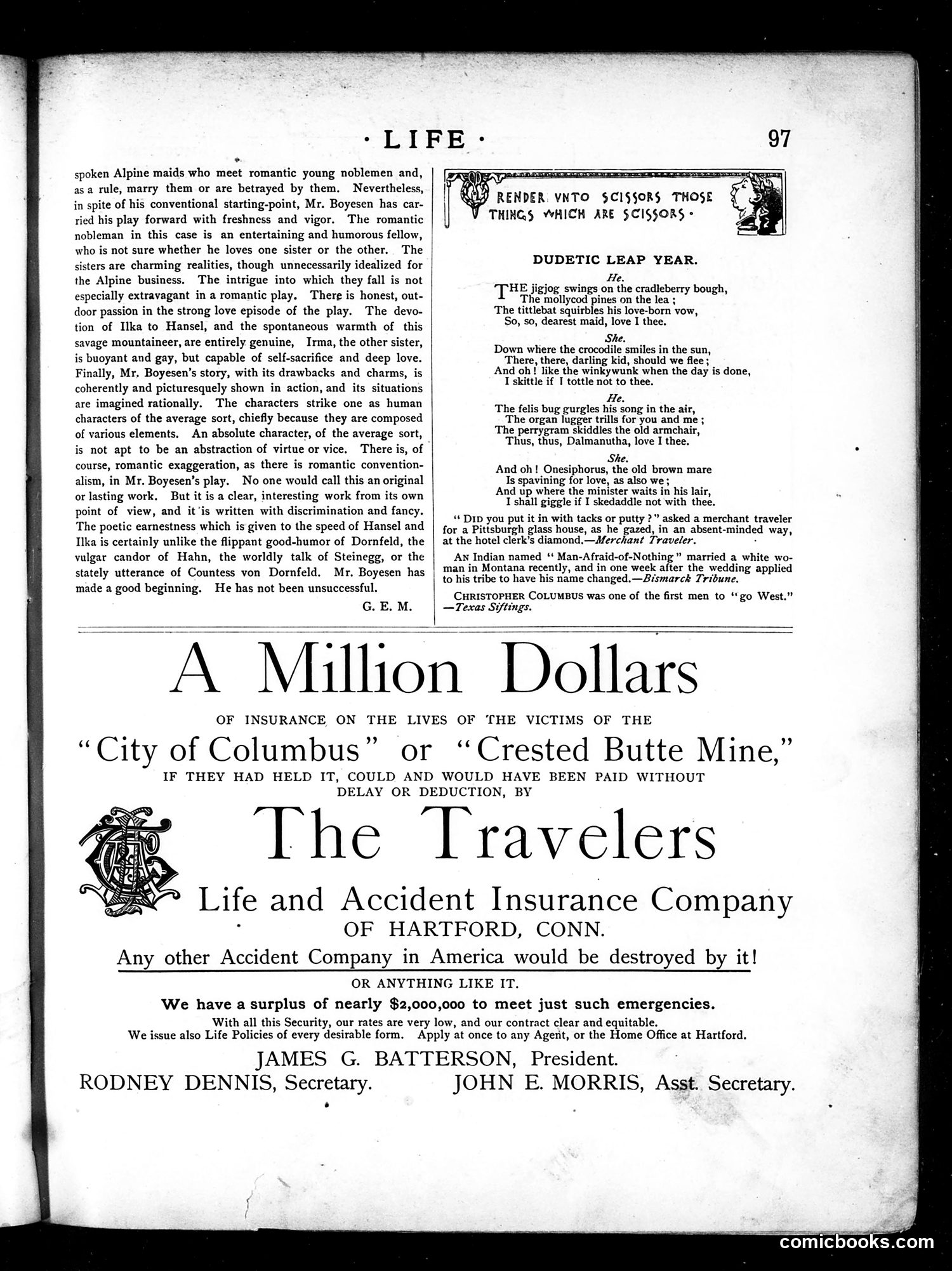
This page contains two distinct elements: **Upper section**: A theater review of Mr. Boyesen's romantic play set in the Alps, featuring two sisters and a nobleman. The critic praises its honest passion and human characters while noting it's not particularly original—competent but conventional work. **Lower section**: A series of humorous anecdotes and a major insurance advertisement. The "Dudetic Leap Year" poem appears to be nonsense verse satirizing overwrought romantic poetry (using invented words like "jigjog," "mollycod," "winkywunk"). The page's centerpiece is a provocative advertisement for The Travelers Insurance Company, referencing two major disasters—the sinking of the "City of Columbus" and the "Crested Butte Mine" catastrophe—to claim their company would have paid claims without delay, implying competitors wouldn't. The boast that "any other Accident Company in America would be destroyed by it" is aggressive marketing using real tragedies to demonstrate financial superiority and reliability. This reflects early 1900s insurance industry competition and public concern about disaster relief.
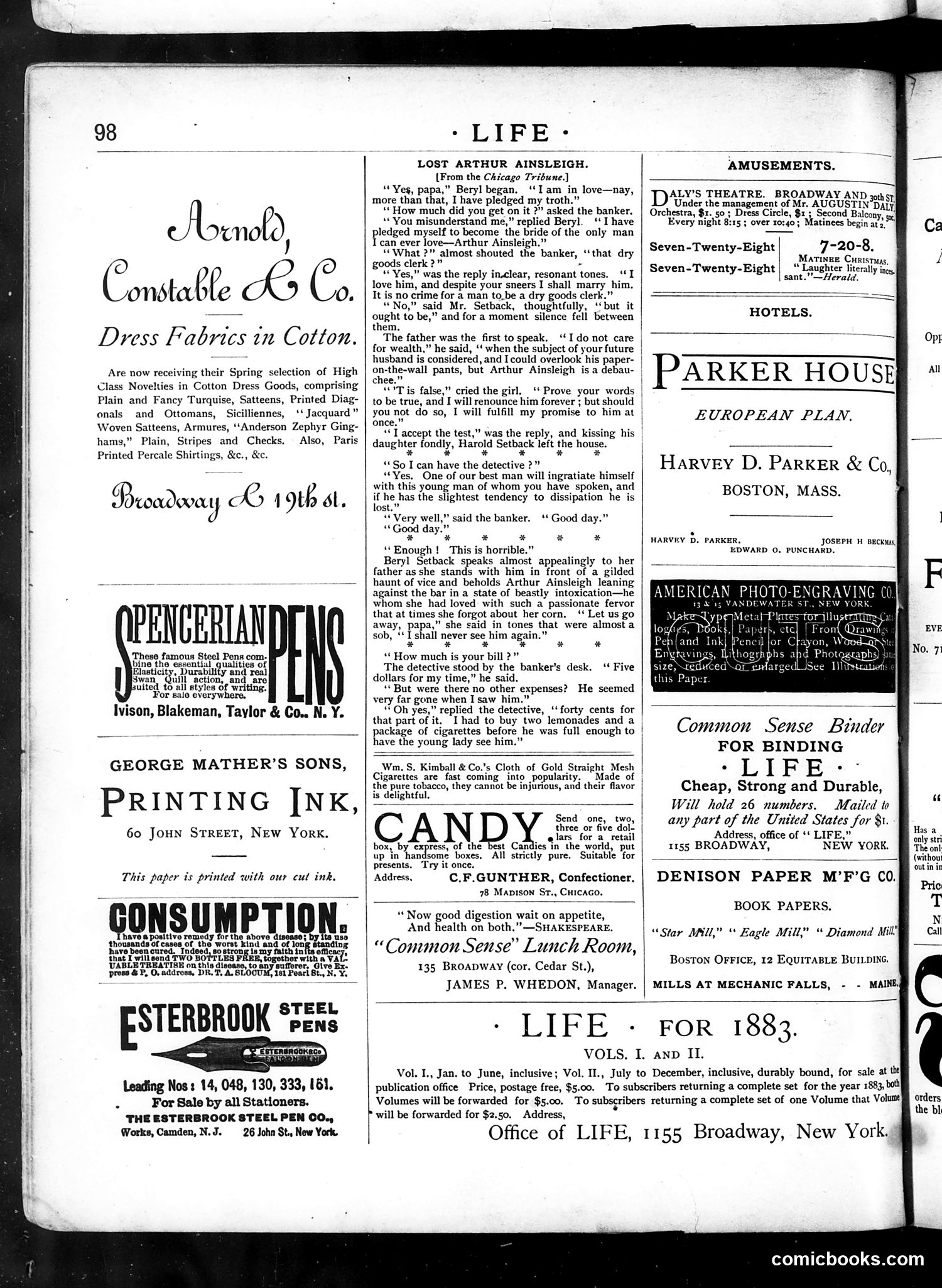
This page features a serialized story satirizing Victorian moral hypocrisy and class prejudice. A wealthy banker opposes his daughter Beryl's engagement to Arthur Ainsleigh, a dry goods clerk, deeming him beneath her station. The father hires a detective to prove Arthur is a "debauchee," hoping to destroy the relationship. The joke's twist: The detective discovers Arthur frequents a bar and gets drunk—but only *after* the detective plies him with cigarettes and alcohol to make him appear dissolute. The story exposes the detective's dishonesty and, implicitly, the banker's moral bankruptcy in manufacturing false evidence against an innocent man. The satire targets class snobbery and the corrupting influence of wealth, suggesting that the truly disreputable character is the wealthy father, not the humble clerk. The surrounding advertisements (dress fabrics, printing ink, steel pens) are unrelated commercial content typical of *Life* magazine pages.
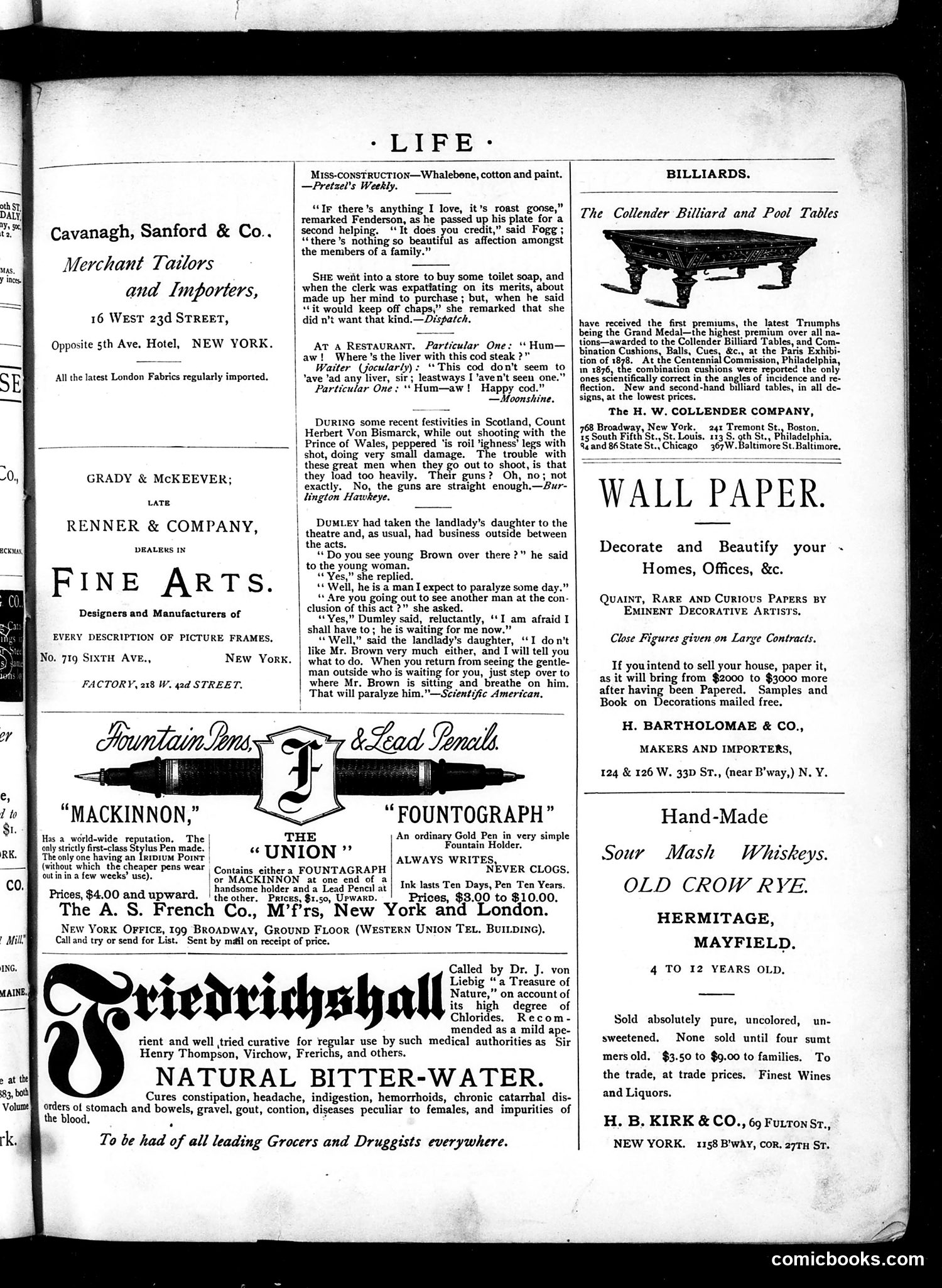
This is primarily an **advertising page** from Life magazine, featuring various commercial advertisements for merchants, artists, and patent medicines typical of the late 19th century. The page includes several **short humorous anecdotes** rather than political cartoons: - A joke about a man praising roast goose while his host interprets it as displaying family affection - A pun about toilet soap that "keeps off chaps" - A story about Count Herbert Von Bismarck accidentally shooting the Prince of Wales while hunting in Scotland - An extended anecdote about a man named Dumley attending theater with a landlady's daughter, with a punchline suggesting he should breathe on a rival to "paralyze" him These are **light social satire** mocking Victorian courtship customs, upper-class pretension, and the absurdities of polite society—standard humor for Life's educated readership. The advertisements promote fountain pens, fine art frames, tailoring, wallpaper, billiards tables, and patent medicines like Friedrichshall Natural Bitter-Water, reflecting late-1800s consumer culture.
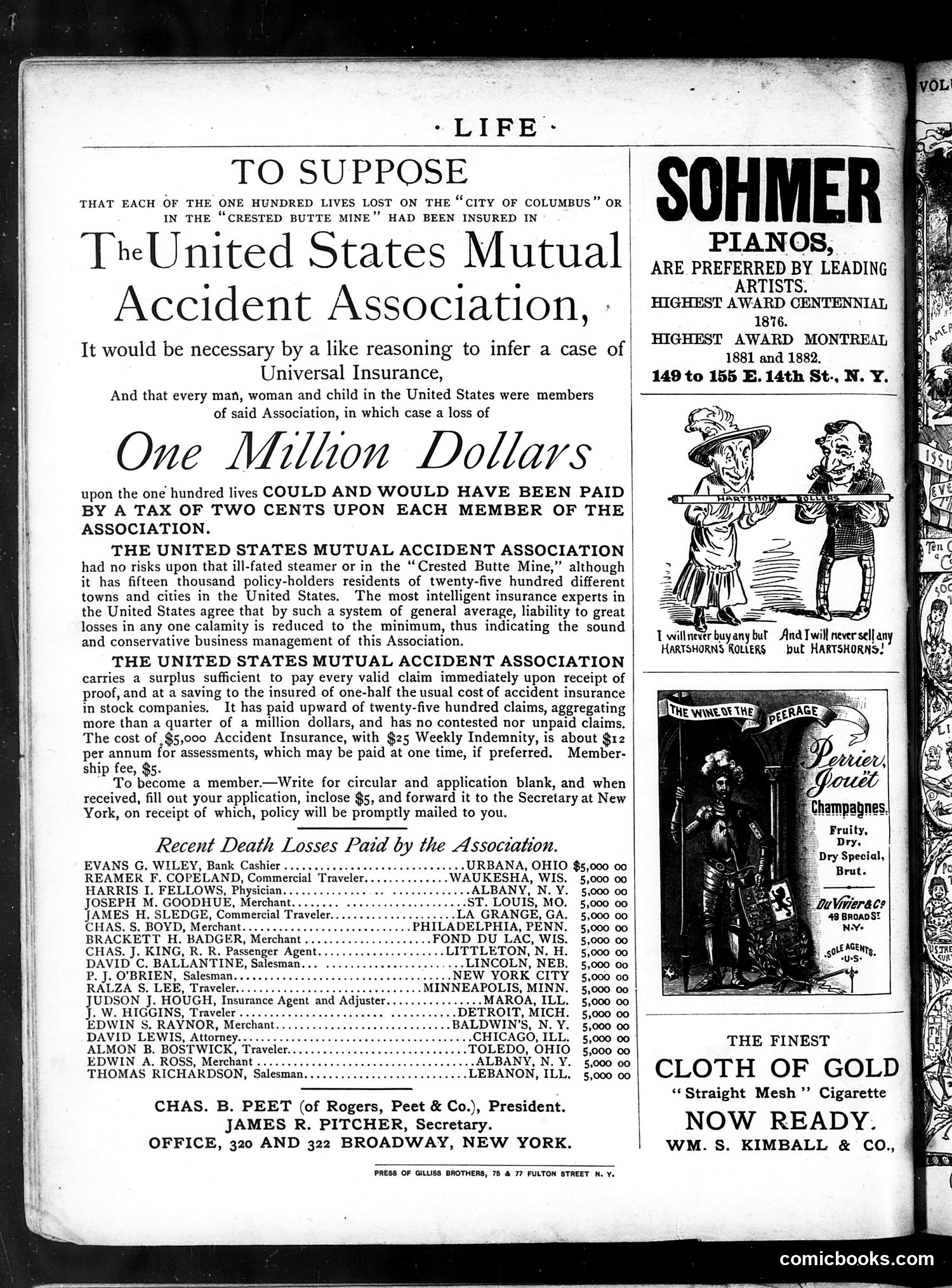
This page is primarily **advertising and corporate promotion**, not satirical content. The main feature is a lengthy advertisement for the United States Mutual Accident Association, an early insurance company. The text argues that if the ~100 lives lost in two recent disasters (the "City of Columbus" steamship and "Crested Butte Mine") had been insured through their mutual system, the cost would distribute across all members at only two cents per person—demonstrating how mutual insurance pools risk efficiently. The company then lists recent death claims it has paid out, serving as proof of legitimacy. The small cartoon shows two figures disputing over "Hartshorns Rollers" (a window shade product), illustrating consumer brand loyalty—likely a humorous ad rather than social satire. The page also contains ads for **Sohmer Pianos** and **Cloth of Gold cigarettes**. This represents typical 19th-century magazine layout: editorial/advertising content mixed together without clear distinction.