
Life, 1884-02-14 · page 6 of 16
Life — February 14, 1884 — page 6: what you’re looking at
What you’re looking at
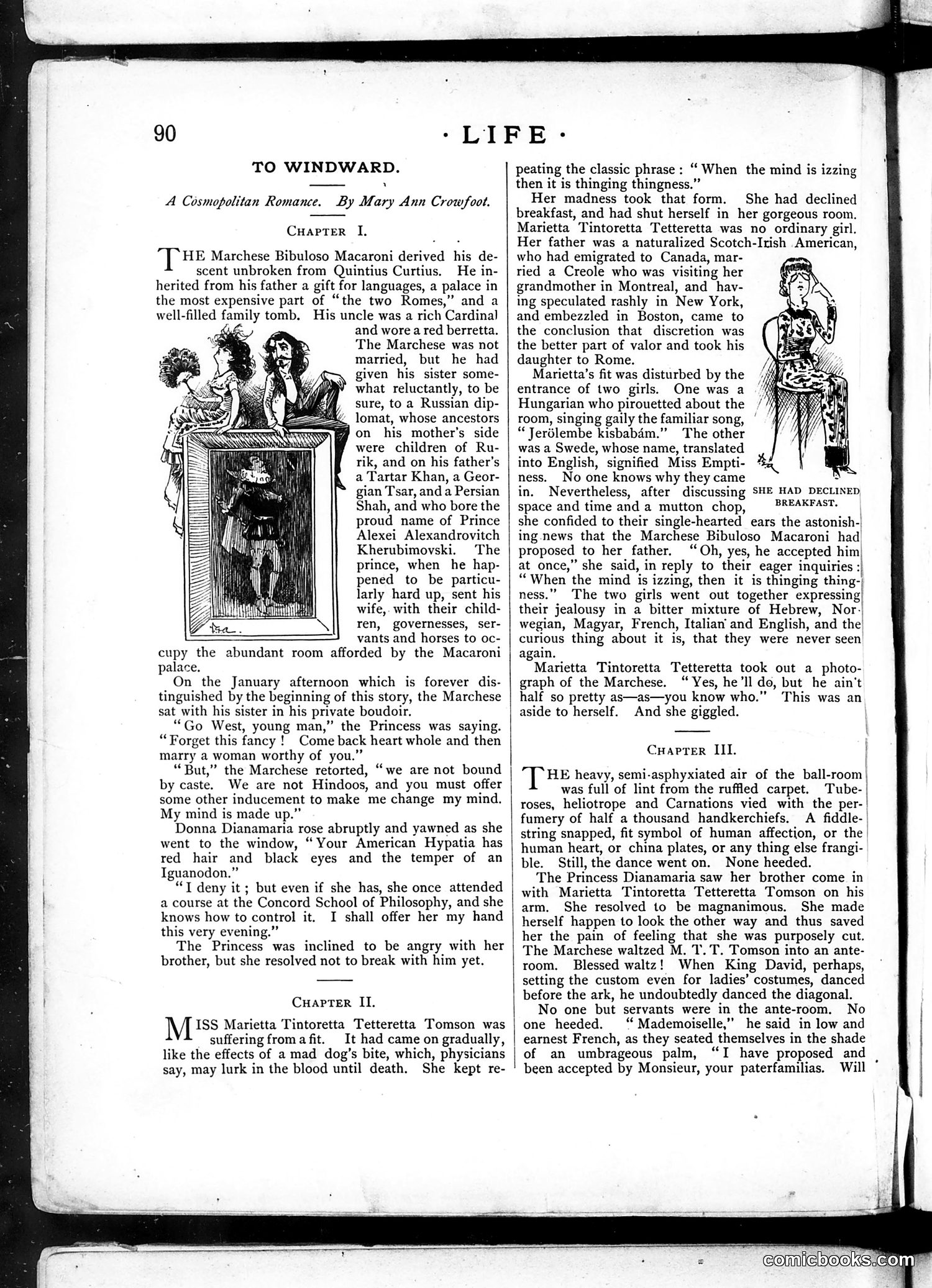
This page contains the opening of "To Windward," a serialized cosmopolitan romance by Mary Ann Crowfoot, rather than political satire or editorial cartoons. The small illustrations are decorative chapter headings showing period costume and domestic scenes typical of turn-of-the-century romantic fiction. The main illustration depicts the Marchese Babuloso Macaroni in his Italian palace—a humorous aristocratic figure whose exaggerated name suggests gentle mockery of European nobility. The story itself parodies high-society romance conventions: a Marchese with an elaborate pedigree, an American heiress protagonist suffering from "mania," and cross-cultural romantic complications. The satire targets pretentious aristocratic genealogies and the fashionable "nervous conditions" affecting wealthy American women of that era. This is entertainment content, not political commentary.
📄 Transcribed text from this page (OCR, searchable)
Machine-transcribed from the original scan — historical spelling and the odd misread are preserved.
90 TO WINDWARD. A Cosmopolitan Romance. By Mary Ann Crowfoot. CuapTerR I. HE Marchese Bibuloso Macaroni derived his de- scent unbroken from Quintius Curtius. He in- herited from his father a gift for languages, a palace in the most expensive part of “the two Romes,” and a well-filled family tomb. His uncle was a rich Cardinal fe and wore a red berretta. The Marchese was not married, but he had given his sister some- what reluctantly, to be sure, to a Russian dip- lomat, whose ancestors on his mother’s side were children of Ru- tik, and on his father’s a Tartar Khan, a Geor- gian Tsar, anda Persian Shah, and who bore the proud name of Prince Alexei Alexandrovitch Kherubimovski. The prince, when he hap- pened to be particu- larly hard up, sent his wife, with their child- ren, governesses, ser- vants and horses to oc- cupy the abundant room afforded by the Macaroni palace. On the January afternoon which is forever dis- tinguished by the beginning of this story, the Marchese sat with his sister in his private boudoir. “Go West, young man,” the Princess was saying. “Forget this fancy! Come back heart whole and then marry a woman worthy of you.” “But,” the Marchese retorted, “we are not bound by caste. We are not Hindoos, ani you must offer some other inducement to make me change my mind. My mind is made up.” Donna Dianamaria rose abruptly and yawned as she went to the window, “Your American Hypatia has red hair and black eyes and the temper of an Iguanodon.” “T deny it ; but even if she has, she once attended a course at the Concord School of Philosophy, and she knows how to control it. I shall offer her my hand this very evening.” The Princess was inclined to be angry with her brother, but she resolved not to break with him yet. CuHapter II. ISS Marietta Tintoretta Tetteretta Tomson was suffering fromafit. It had came on gradually, like the effects of a mad dog’s bite, which, physicians say, may lurk in the blood until death. She kept re- LIFE peating the classic phrase : then it is thinging thingness.” Her madness took that form. She had declined breakfast, and had shut herself in her gorgeous room. Marietta Tintoretta Tetteretta was no ordinary girl. Her father was a naturalized Scotch-Irish American, who had emigrated to Canada, mar- ried a Creole who was visiting her grandmother in Montreal, and_hav- ing speculated rashly in New York, and embezzled in Boston, came to the conclusion that discretion was the better part of valor and took his daughter to Rome. Marietta’s fit was disturbed by the entrance of two girls. One was a Hungarian who pirouetted about the room, singing gaily the familiar song, “Jerélembe kisbabam.” The other was a Swede, whose name, translated into English, signified Miss Empti- ness. No one knows why they came in. Nevertheless, after discussing SHE HAD DECLINED space and time and a mutton chop, BREAKFAST. she confided to their single-hearted ears the astonish- ing.news that the Marchese Bibuloso Macaroni had proposed to her father. “Oh, yes, he accepted him| at once,” she said, in reply to ‘their eager inquiries | ss When the mind is izzing, then it is thinging thing-| ness.” The two girls went out together expressing} their jealousy in a bitter mixture of Hebrew, Nor-| wegian, Magyar, French, Italian and English, and the curious thing about it is, that they were never seen again. Marietta Tintoretta Tetteretta took out a photo- graph of the Marchese. “Yes, he’ll do, but he ain't half so pretty as—as—you know who.” This was an aside to herself. And she giggled. “When the mind is izzing CHaprer III. | “THE heavy, semi-asphyxiated air of the ball-room| was full of lint from the ruffled carpet. Tube-| roses, heliotrope and Carnations vied with the per- fumery of half a thousand handkerchiefs. A fiddle- string snapped, fit symbol of human affection, or the human heart, or china plates, or any thing else frangi- ble. Still, the dance went on. None heeded. The Princess Dianamaria saw her brother come in with Marietta Tintoretta Tetteretta Tomson on his arm. She resolved to be magnanimous. She made herself happen to look the other way and thus saved her the pain of feeling that she was purposely cut. The Marchese waltzed M. T. T. Tomson into an ante- room. Blessed waltz! When King David, perhaps, setting the custom even for ladies’ costumes, danced before the ark, he undoubtedly danced the diagonal. No one but servants were in the ante-room. No one heeded. “ Mademoiselle,” he said in low and earnest French, as they seated themselves in the shade of an umbrageous palm, “I have proposed and _ been accepted by Monsieur, your paterfamilias. Will