
Life, 1884-02-14 · page 4 of 16
Life — February 14, 1884 — page 4: what you’re looking at
What you’re looking at
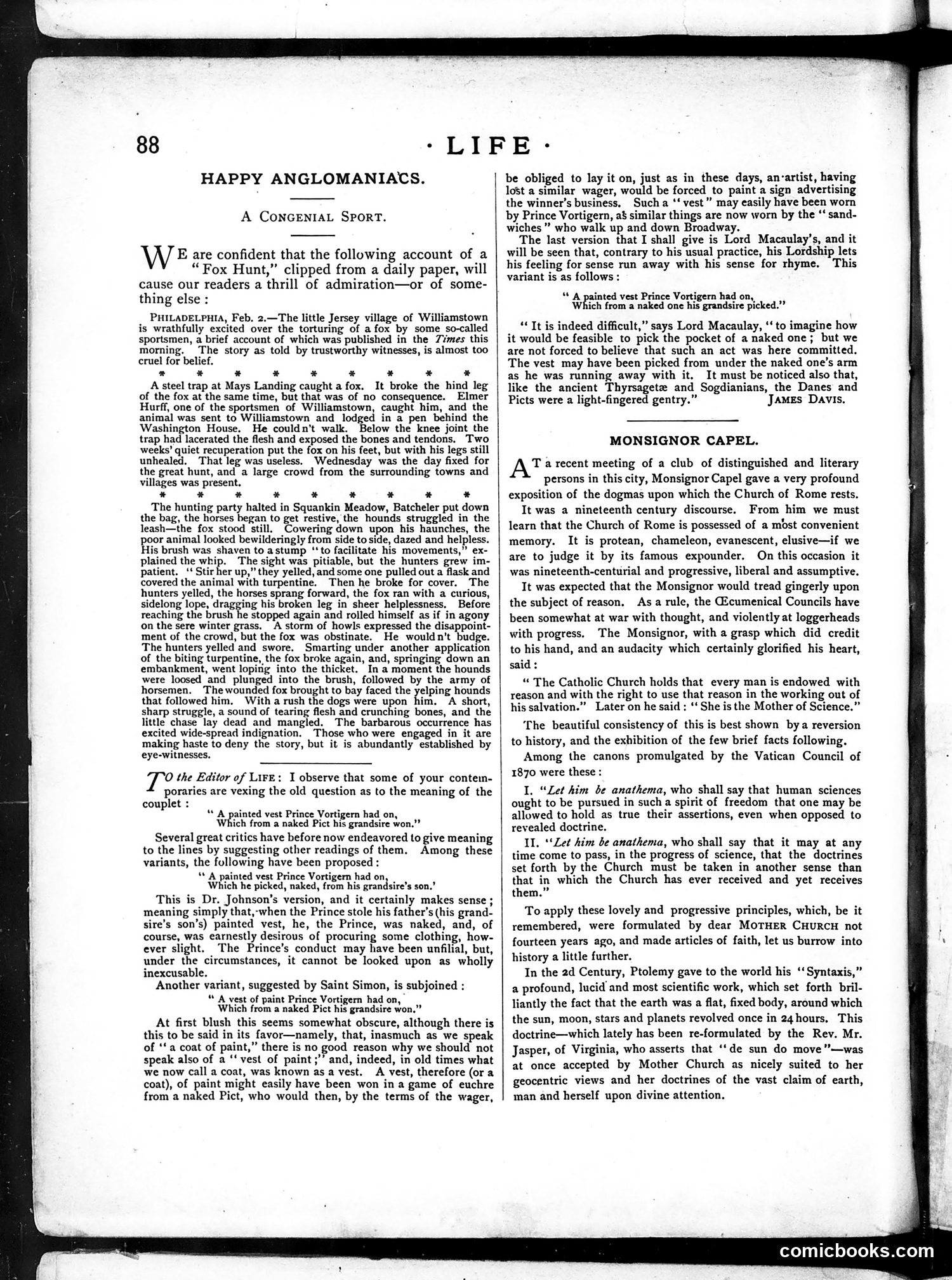
This page contains three separate satirical pieces rather than a single cartoon: 1. **"Happy Anglomaniac"** — A humorous anecdote mocking Americans who adopt British affectations. It describes a Jersey sportsman injuring himself while imitating English fox hunting, with the joke being that his pretension to British sporting culture literally backfires. 2. **"A Congenial Sport"** — A detailed hunting narrative appearing to satirize the chaos and incompetence of amateur hunters, emphasizing their discord and the mess they create. 3. **"Monsignor Capel"** — A commentary on a Catholic church official's lecture discussing Church doctrine regarding science and reason, likely satirizing conflicts between religious authority and scientific progress. The page is primarily text-based social satire rather than visual cartooning, typical of Life's literary humor approach from this era.
📄 Transcribed text from this page (OCR, searchable)
Machine-transcribed from the original scan — historical spelling and the odd misread are preserved.
*LIFE-: HAPPY ANGLOMANIACS. A COoNGENIAL Sport. W E are confident that the following account of a “Fox Hunt,” clipped from a daily paper, will cause our readers a thrill of admiration—or of some- thing else : PHILADELPHIA, Feb. 2.—The little Jersey village of Williamstown is wrathfully excited over the torturing of a fox by some so-called sportsmen, a brief account of which was published in the 7mes this morning. The story as told by trustworthy witnesses, is almost too cruel for belief. * * * * * * * * * A steel trap at Mays Landing caught a fox. It broke the hind leg of the fox at the same time, but that was of no consequence. Elmer Hurff, one of the sportsmen of Williamstown, caught him, and the animal was sent to Williamstown and lodged in a pen behind the Washington House. He couldn't walk. Below the knee joint the trap had lacerated the flesh and exposed the bones and tendons. Two weeks’ quiet recuperation put the fox on his feet, but with his legs still unhealed. That leg was useless. Wednesday was the day fixed for the great hunt, and a large crowd from the surrounding towns and villages was present. * * * * * * * * * The hunting party halted in Squankin Meadow, Batcheler put down the bag, the horses began to get restive, the hounds struggled in the leash—the fox stood still. Cowering down upon his haunches, the poor animal looked bewilderingly from side to side, dazed and helpless. His brush was shaven to astump ‘to facilitate his movements,” ex- plained the whip. The sight was pitiable, but the hunters grew im- patient. ‘‘ Stirher up,” they yelled, and some one pulled out a flask and covered the animal with turpentine. Then he broke for cover. The hunters yelled, the horses sprang forward, the fox ran with a curious, sidelong lope, dragging his broken leg in sheer helplessness. Before reaching the brush he stopped again and rolled himself as if in agony on the sere winter grass. A storm of howls expressed the disappoint- ment of the crowd, but the fox was obstinate. He wouldn't budge. The hunters yelled and swore. Smarting under another application of the biting turpentine, the fox broke again, and, springing down an embankment, went loping into the thicket. In a moment the hounds were loosed ‘and plunged into the brush, followed by the army of horsemen. The wounded fox brought to bay faced the yelping hounds that followed him. With a rush the dogs were upon him. A short, sharp struggle, a sound of tearing flesh and crunching bones, and the little chase lay dead and mangled, The barbarous occurrence has excited wide-spread indignation, Those who were engaged in it are making haste to deny the story, but it is abundantly established by eye-witnesses, Fe the Editor of LiFe: I observe that some of your contein- poraries are vexing the old question as to the meaning of the couplet : “A painted vest Prince Vortigern had on, Which from a naked Pict his grandsire won.”” Several great critics have before now endeavored to give meaning to the lines by suggesting other readings of them. Among these variants, the following have been proposed : “* A painted vest Prince Vortigern had on, Which he picked, naked, from his grandsire’s son.’ This is Dr. Johnson's version, and it certainly makes sense; meaning simply that,-when the Prince stole his father’s (his grand sire’s son’s) painted vest, he, the Prince, was naked, and, of course, was earnestly desirous of procuring some clothing, how- ever slight. The Prince’s conduct may have been unfilial, but, under the circumstances, it cannot be looked upon as wholly inexcusable. Another variant, suggested by Saint Simon, is subjoined : “A vest of paint Prince Vortigern had on, Which from a naked Pict his grandsire won,” At first blush this seems somewhat obscure, although there is this to be said in its favor—namely, that, inasmuch as we speak of ‘‘a coat of paint,” there is no good reason why we should not speak also of a ‘‘ vest of paint ;’’ and, indeed, in old times what we now call a coat, was known as a vest. A vest, therefore (or a coat), of paint might easily have been won ina game of euchre from a naked Pict, who would then, by the terms of the wager, be obliged to lay it on, just as in these days, an-artist, having lost a similar wager, would be forced to paint a sign advertising the winner's business, Such a ‘‘ vest” may easily have been worn by Prince Vortigern, a8 similar things are now worn by the “‘ sand- wiches” who walk up and down Broadway. The last version that I shall give is Lord Macaulay's, and it will be seen that, contrary to his usual practice, his Lordship lets his feeling for sense run away with his sense for rhyme. This variant is as follows: “A painted vest Prince Vortigern had on, Which from a naked one his grandsire picked.” “Tt is indeed difficult,” says Lord Macaulay, ‘‘ to imagine how it would be feasible to pick the pocket of a naked one; but we are not forced to believe that such an act was here committed. The vest may have been picked from under the naked one’s arm as he was running away with it. It must be noticed also that, like the ancient Thyrsagete and Sogdianians, the Danes and Picts were a light-fingered gentry.” James Davis. MONSIGNOR CAPEL. At a recent meeting of a club of distinguished and literary persons in this city, Monsignor Capel gave a very profound exposition of the dogmas upon which the Church of Rome rests. It was a nineteenth century discourse. From him we must learn that the Church of Rome is possessed of a most convenient memory. It is protean, chameleon, evanescent, elusive—if we are to judge it by its famous expounder. On this occasion it was nineteenth-centurial and progressive, liberal and assumptive. It was expected that the Monsignor would tread gingerly upon the subject of reason. As a rule, the GEcumenical Councils have been somewhat at war with thought, and violently at loggerheads with progress. The Monsignor, with a grasp which did credit to his hand, and an audacity which certainly glorified his heart, said : “ The Catholic Church holds that every man is endowed with reason and with the right to use that reason in the working out of his salvation.” Later on he said ; ‘‘ She is the Mother of Science.” ‘The beautiful consistency of this is best shown bya reversion to history, and the exhibition of the few brief facts following. Among the canons promulgated by the Vatican Council of 1870 were these: I. “Let him be anathema, who shall say that human sciences ought to be pursued in sucha spirit of freedom that one may be allowed to hold as true their assertions, even when opposed to revealed doctrine. Il. ‘‘Let him be anathema, who shall say that it may at any time come to pass, in the progress of science, that the doctrines set forth by the Church must be taken in another sense than that in which the Church has ever received and yet receives them.” To apply these lovely and progressive principles, which, be it remembered, were formulated by dear MOTHER CHURCH not fourteen years ago, and made articles of faith, let us burrow into history a little further. In the 2d Century, Ptolemy gave to the world his ‘‘Syntaxis,” a profound, lucid’ and most scientific work, which set forth bril- liantly the fact that the earth was a flat, fixed body, around which the sun, moon, stars and planets revolved once in 24 hours, This doctrine—which lately has been re-formulated by the Rev. Mr. Jasper, of Virginia, who asserts that ‘‘de sun do move”’—was at once accepted by Mother Church as nicely suited to her geocentric views and her doctrines of the vast claim of earth, man and herself upon divine attention. comicbooks.com