
Life, 1884-02-14 · page 5 of 16
Life — February 14, 1884 — page 5: what you’re looking at
What you’re looking at
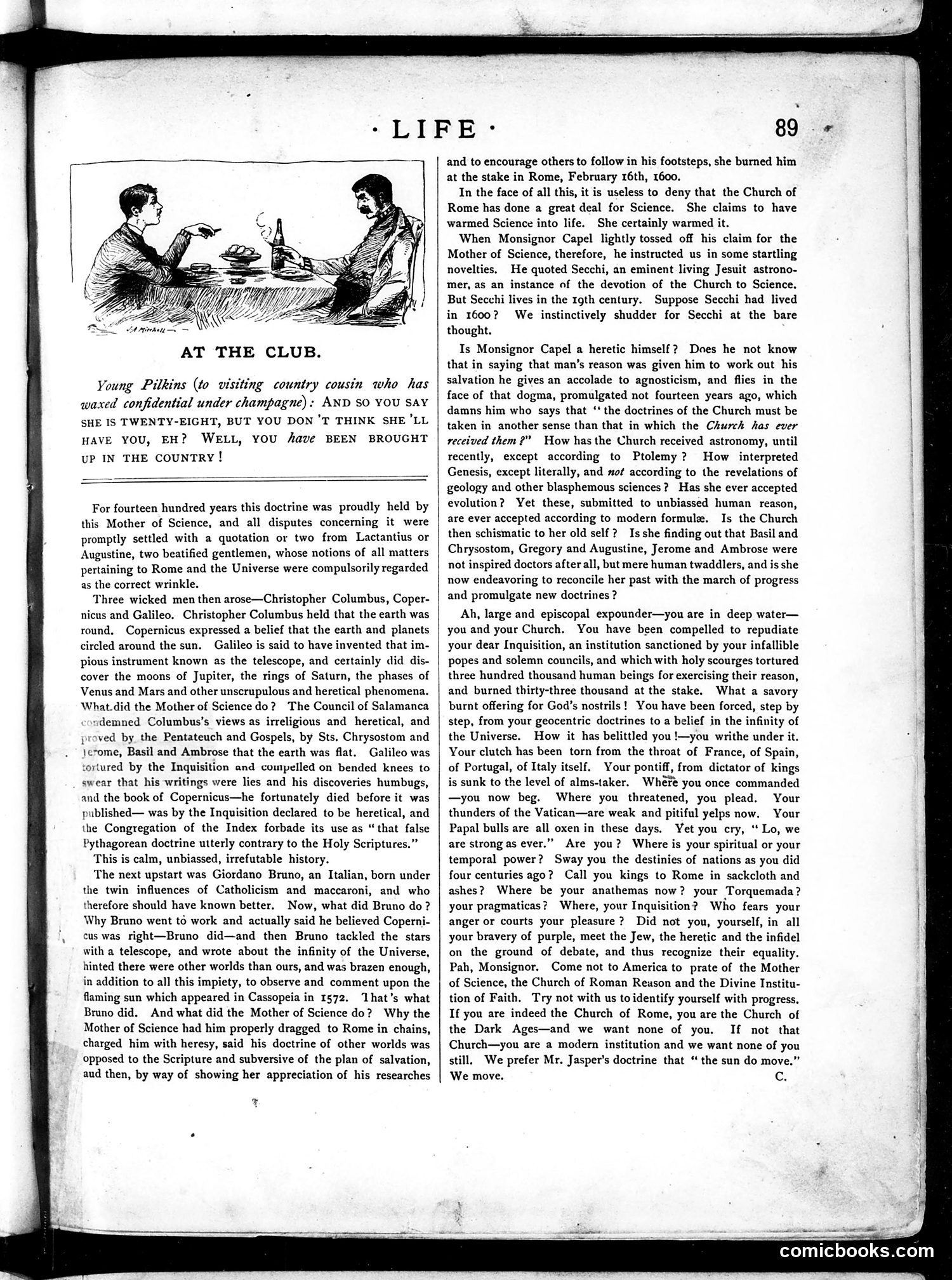
The cartoon depicts two men at a club dining together. The caption satirizes a young man's dismissal of a visiting female cousin as inexperienced ("twenty-eight, but you don't think she'll have you"). The accompanying text is a lengthy satirical attack on Monsignor Capel and the Catholic Church's stance on science. The author criticizes the Church for burning Giordano Bruno (executed 1600) and condemning Copernicus, Galileo, and other scientists for discoveries contradicting Church doctrine. The satire argues the Church claims credit for advancing science while actually suppressing it through the Inquisition. The text mocks Monsignor Capel specifically for defending the Church's historical treatment of scientists, characterizing the Church as intellectually retrograde—a "Dark Ages" institution opposing modern scientific progress.
📄 Transcribed text from this page (OCR, searchable)
Machine-transcribed from the original scan — historical spelling and the odd misread are preserved.
- LIFE: AT THE CLUB. Young Pilkins (to visiting country cousin who has waxed confidential under champagne): AND SO YOU SAY SHE IS TWENTY-EIGHT, BUT YOU DON "? THINK SHE ’LL HAVE YOU, EH? WELL, YOU have BEEN BROUGHT uP IN THE COUNTRY! For fourteen hundred years this doctrine was proudly held by this Mother of Science, and all disputes concerning it were promptly settled with a quotation or two from Lactantius or | Augustine, two beatified gentlemen, whose notions of all matters pertaining to Rome and the Universe were compulsorily regarded as the correct wrinkle. Three wicked men then arose—Christopher Columbus, Coper- nicus and Galileo. Christopher Columbus held that the earth was round. Copernicus expressed a belief that the earth and planets circled around the sun. Galileo is said to have invented that im- pious instrument known as the telescope, and certainly did dis- cover the moons of Jupiter, the rings of Saturn, the phases of Venus and Mars and other unscrupulous and heretical phenomena. What.did the Mother of Science do? The Council of Salamanca sdemned Columbus’s views as irreligious and heretical, and proved by the Pentateuch and Gospels, by Sts. Chrysostom and jerome, Basil and Ambrose that the earth was flat. Galileo was tortured by the Inquisition and compelled on bended knees to swear that his writings were lies and his discoveries humbugs, and the book of Copernicus—he fortunately died before it was published— was by the Inquisition declared to be heretical, and the Congregation of the Index forbade its use as “that false Pythagorean doctrine utterly contrary to the Holy Scriptures.” This is calm, unbiassed, irrefutable history. The next upstart was Giordano Bruno, an Italian, born under the twin influences of Catholicism and maccaroni, and who therefore should have known better. Now, what did Bruno do? Why Bruno went té work and actually said he believed Coperni- cus was right—Bruno did—and then Bruno tackled the stars with a telescope, and wrote about the infinity of the Universe, hinted there were other worlds than ours, and was brazen enough, in addition to all this impiety, to observe and comment upon the flaming sun which appeared in Cassopeia in 1572. ‘Lhat’s what Bruno did. And what did the Mother of Science do? Why the Mother of Science had him properly dragged to Rome in chains, charged him with heresy, said his doctrine of other worlds was opposed to the Scripture and subversive of the plan of salvation, aud then, by way of showing her appreciation of his researches % and to encourage others to follow in his footsteps, she burned him at the stake in Rome, February 16th, 1600. In the face of all this, it is useless to deny that the Church of Rome has done a great deal for Science. She claims to have warmed Science into life. She certainly warmed it. When Monsignor Capel lightly tossed off his claim for the Mother of Science, therefore, he instructed us in some startling novelties. He quoted Secchi, an eminent living Jesuit astrono- mer, as an instance of the devotion of the Church to Science. But Secchi lives in the rgth century. Suppose Secchi had lived in 1600? We instinctively shudder for Secchi at the bare thought. Is Monsignor Capel a heretic himself? Does he not know that in saying that man’s reason was given him to work out his salvation he gives an accolade to agnosticism, and flies in the face of that dogma, promulgated not fourteen years ago, which damns him who says that ‘‘ the doctrines of the Church must be taken in another sense than that in which the Church has ever received them ?” How has the Church received astronomy, until recently, except according to Ptolemy ? How interpreted Genesis, except literally, and mot according to the revelations of geology and other blasphemous sciences? Has she ever accepted evolution? Yet these, submitted to unbiassed human reason, are ever accepted according to modern formule. Is the Church then schismatic to her old self? Is she finding out that Basil and Chrysostom, Gregory and Augustine, Jerome and Ambrose were not inspired doctors after all, but mere human twaddlers, and is she now endeavoring to reconcile her past with the march of progress and promulgate new doctrines ? Ah, large and episcopal expounder—you are in deep water— you and your Church. You have been compelled to repudiate your dear [nquisition, an institution sanctioned by your infallible popes and solemn councils, and which with holy scourges tortured three hundred thousand human beings for exercising their reason, and burned thirty-three thousand at the stake. What a savory burnt offering for God’s nostrils! You have been forced, step by step, from your geocentric doctrines to a belief in the infinity of the Universe. How it has belittled you !—you writhe under it. Your clutch has been torn from the throat of France, of Spain, of Portugal, of Italy itself. Your pontiff, from dictator of kings is sunk to the level of alms-taker. Where you once commanded —you now beg. Where you threatened, you plead. Your thunders of the Vatican—are weak and pitiful yelps now. Your Papal bulls are all oxen in these days. Yet you cry, ‘Lo, we are strong as ever.” Are you? Where is your spiritual or your temporal power? Sway you the destinies of nations as you did four centuries ago? Call you kings to Rome in sackcloth and ashes? Where be your anathemas now? your Torquemada? your pragmaticas? Where, your Inquisition? Who fears your anger or courts your pleasure? Did not you, yourself, in all your bravery of purple, meet the Jew, the heretic and the infidel on the ground of debate, and thus recognize their equality. Pah, Monsignor. Come not to America to prate of the Mother of Science, the Church of Roman Reason and the Divine Institu- tion of Faith. Try not with us to identify yourself with progress. If you are indeed the Church of Rome, you are the Church of the Dark Ages—and we want none of you. If not that Church—you are a modern institution and we want none of you still. We prefer Mr. Jasper’s doctrine that “ the sun do move.” We move. Cc; comicbooks.com