
A complete issue · 16 pages · 1884
Life — January 17, 1884
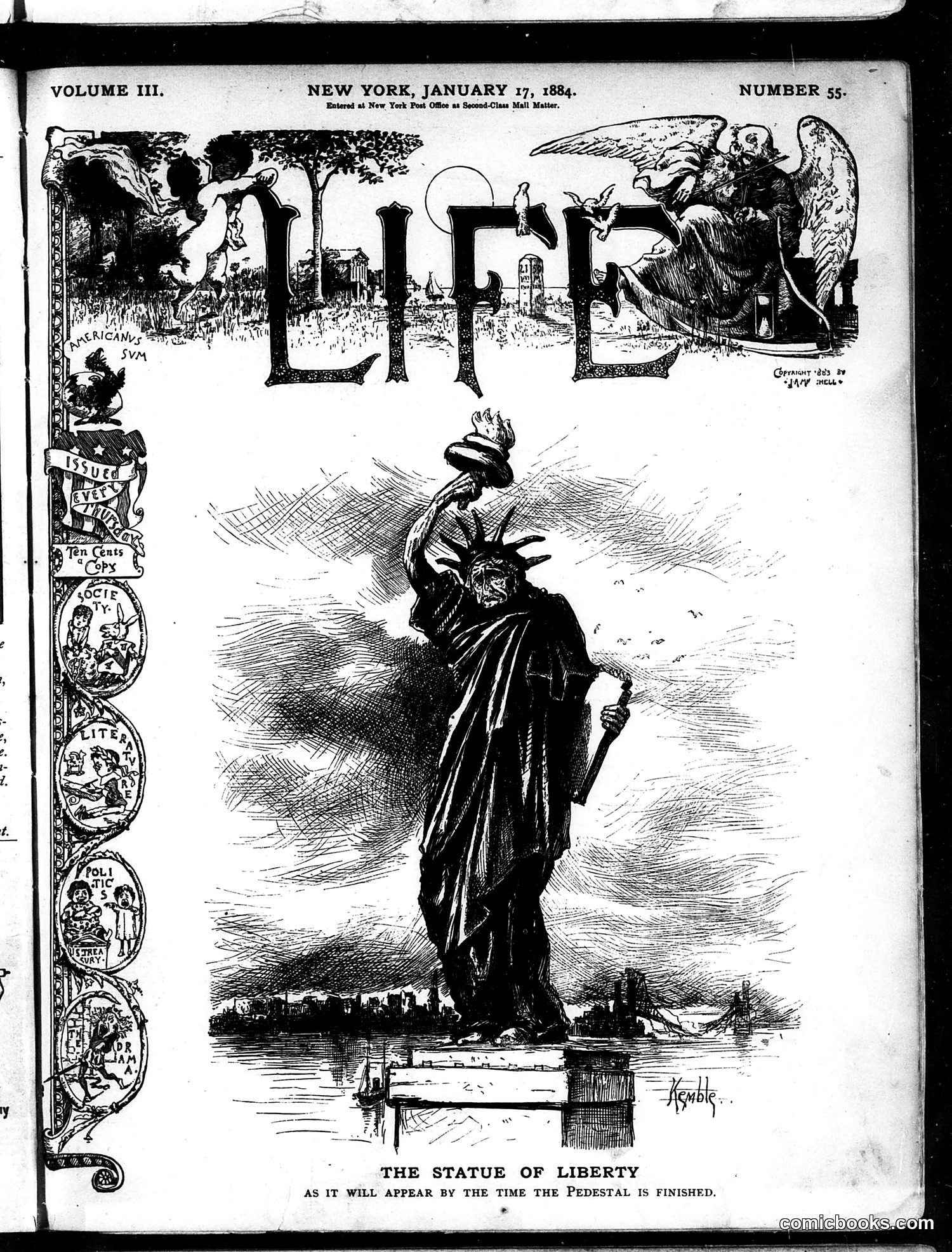
This 1884 *Life* magazine cartoon satirizes delays in completing the pedestal for the newly arrived Statue of Liberty. The figure shows Lady Liberty in tattered, worn condition—her torch arm drooping, her robe falling apart—suggesting she'll deteriorate while Americans dither over construction. The joke targets bureaucratic inefficiency and funding disputes that plagued the pedestal project. Donations had stalled, and completion seemed perpetually postponed. By depicting Liberty herself as crumbling and decrepit, the cartoonist mocks the shame of leaving France's gift incomplete, while implying American disorganization and broken promises. The skyline and harbor location confirm this references the famous monument.
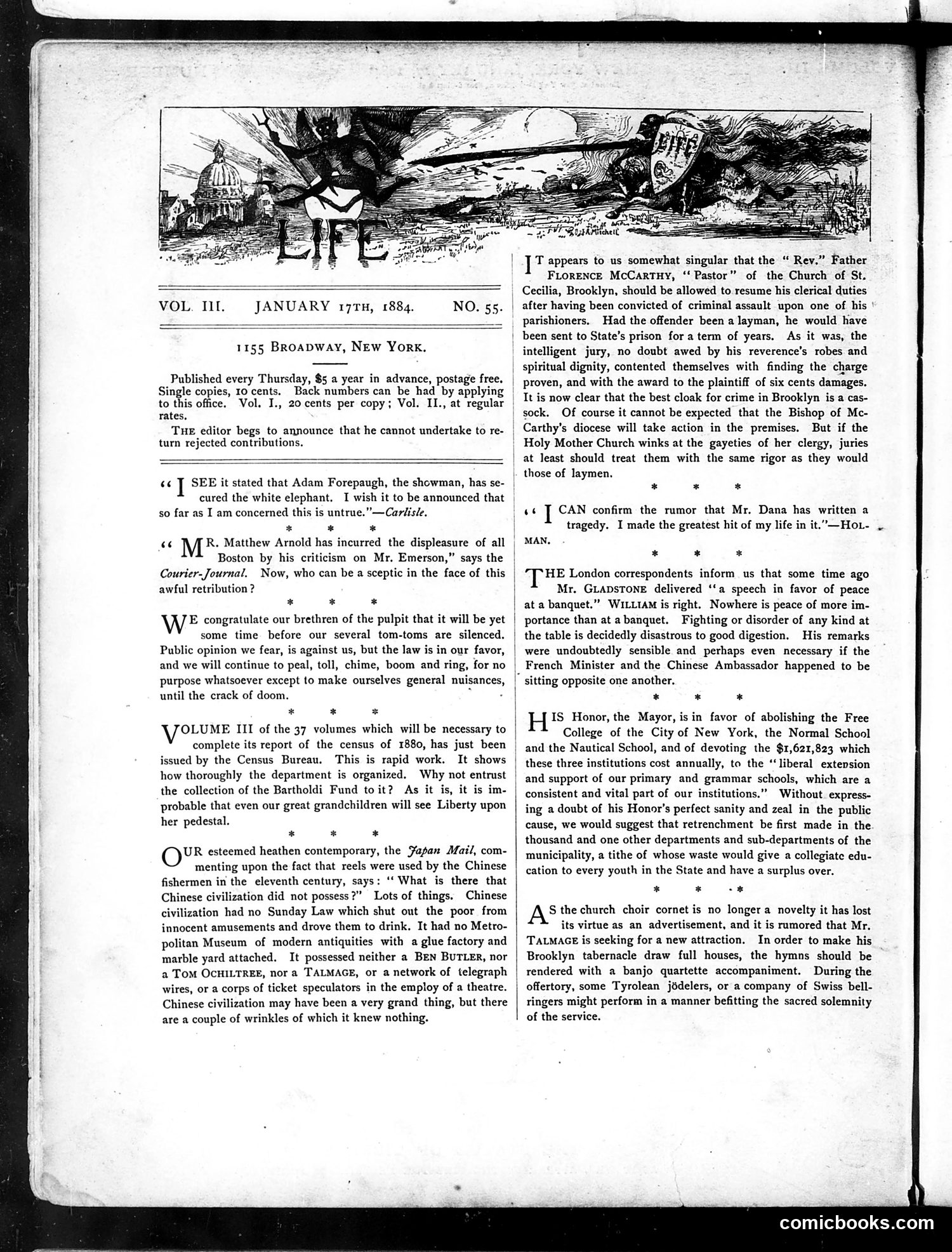
The masthead illustration depicts "Life" as a winged figure flying over a landscape with a cathedral, suggesting the magazine's role as cultural observer and satirist. The page contains editorial commentary rather than traditional political cartoons. Topics include criticism of Father Florence McCarthy of Brooklyn (accused of assault), commentary on Matthew Arnold's criticism of Emerson, and discussion of Gladstone's peace advocacy. The editors congratulate "brethren of the pulpit" on avoiding public controversies and comment on Chinese civilization's lack of modern institutions. The final item discusses whether church choirs should adopt Swiss bell-ringers or Tyrolean yodelers for accompaniment—a humorous debate about liturgical music innovation. The overall tone is satirical social commentary on religious figures, intellectual debates, and cultural questions of 1880s America.
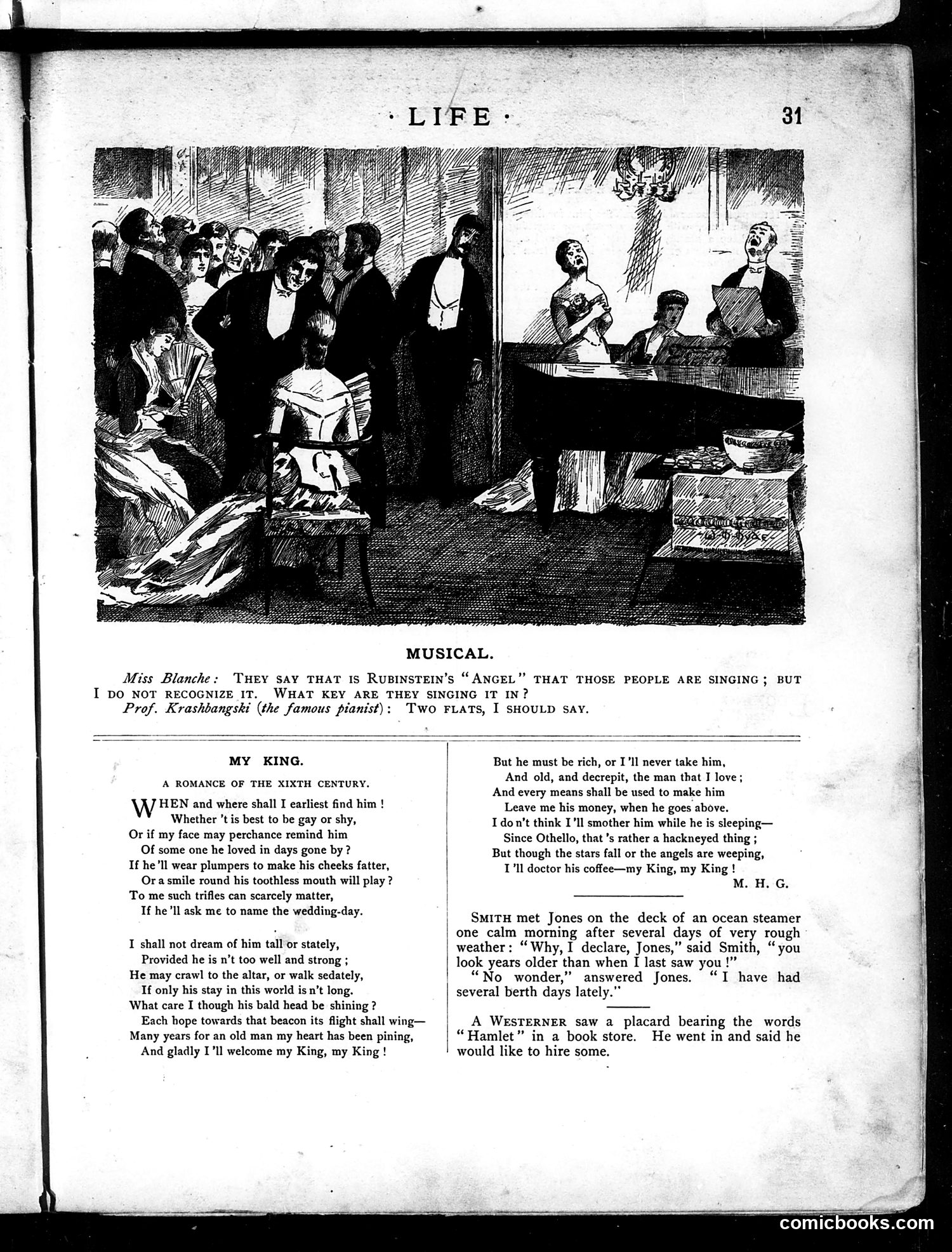
The "Musical" cartoon satirizes concert-goers' inability to recognize classical compositions. Miss Blanche cannot identify Rubinstein's "Angel," prompting Prof. Krashbangski (a caricatured foreign pianist) to sardonically suggest the piece is in "two flats"—a technical musical pun implying the audience members themselves are "flat" or dull-witted. The page also includes "My King," a romantic poem from the sixteenth century about courtship and devotion, plus three brief anecdotes: one about Jones appearing aged after rough seas, another about a Westerner attempting to hire "Hamlet" as a placard from a bookstore. The satire targets wealthy concert audiences' pretension and cultural ignorance during the Gilded Age.
This page contains no political cartoons or satirical illustrations. Instead, it presents the opening chapters of a serialized short story titled "An Idyl of Beacon Hill," set in Boston. The narrative follows Sophronia Somerset and Clarendon C. St. Faneuil's courtship and engagement. The upper portion includes a medical advice column on treating sprains, followed by brief humorous quips (aphorisms) about various occupations—dentists, auctioneers, barefoot men—typical of *Life* magazine's satirical filler content. The story itself satirizes Boston Brahmin society through genteel, mock-romantic prose and social pretension. The humor lies in the overwrought literary style and gentle mockery of upper-class Bostonians' mannerisms, not in illustrations.
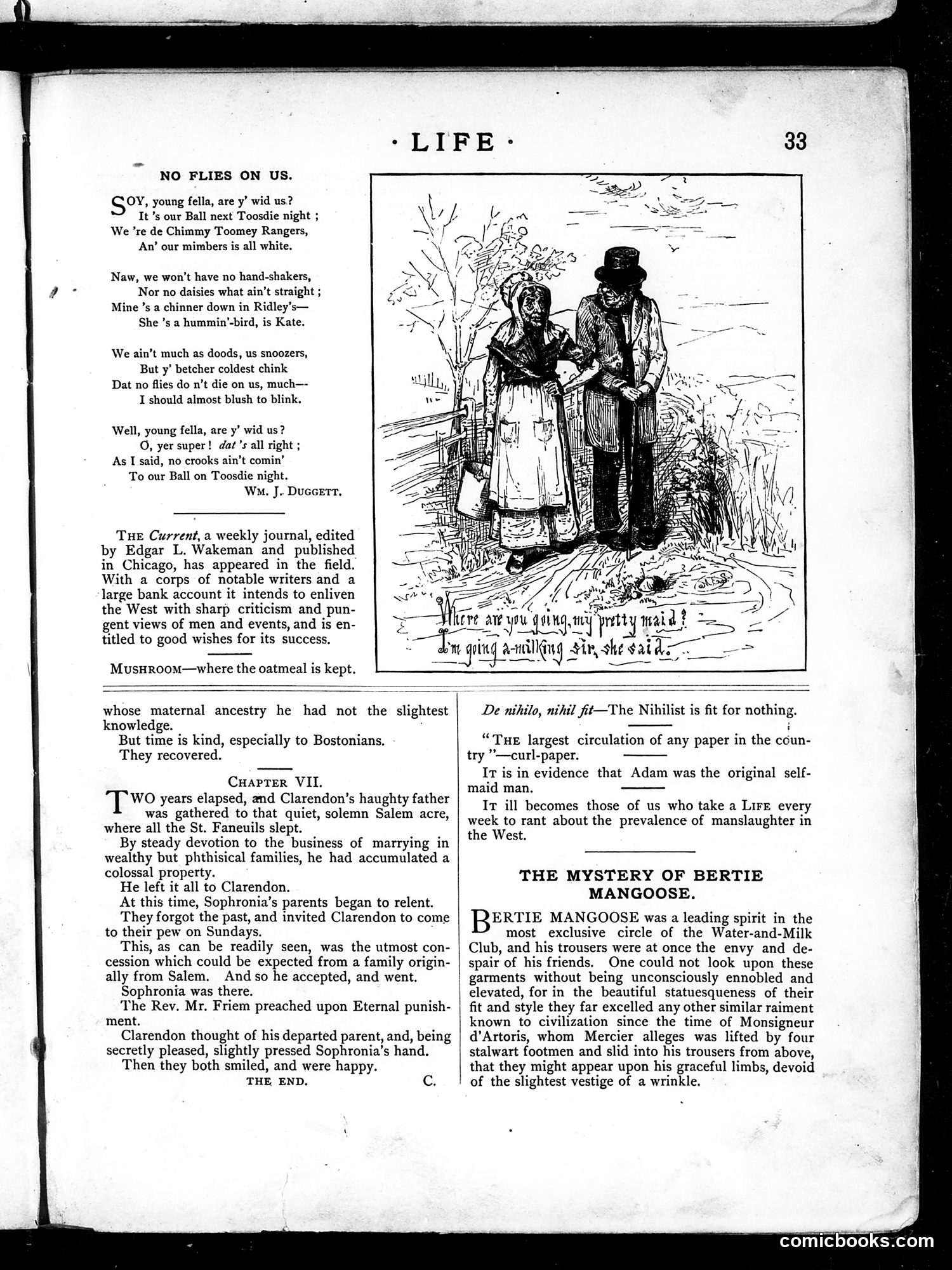
This cartoon depicts two rustic figures—a woman in a bonnet and a man in a top hat—standing outdoors. The caption reads: "Where are you going, my pretty maid? / I'm going a-milking, Sir, she said." This is a visual reference to the nursery rhyme "Where Are You Going to, My Pretty Maid?" The joke appears to play on rural/working-class courtship dynamics, with the well-dressed man ("sir") approaching a milkmaid. The surrounding poem "No Flies on Us" by W.J. Duggett emphasizes the speakers' rough, unpretentious character—they're the "Chimney Toomey Rangers" who lack refinement but possess honest directness. The satire likely mocks both rural naiveté and the pretensions of city folk attempting to court working-class women.
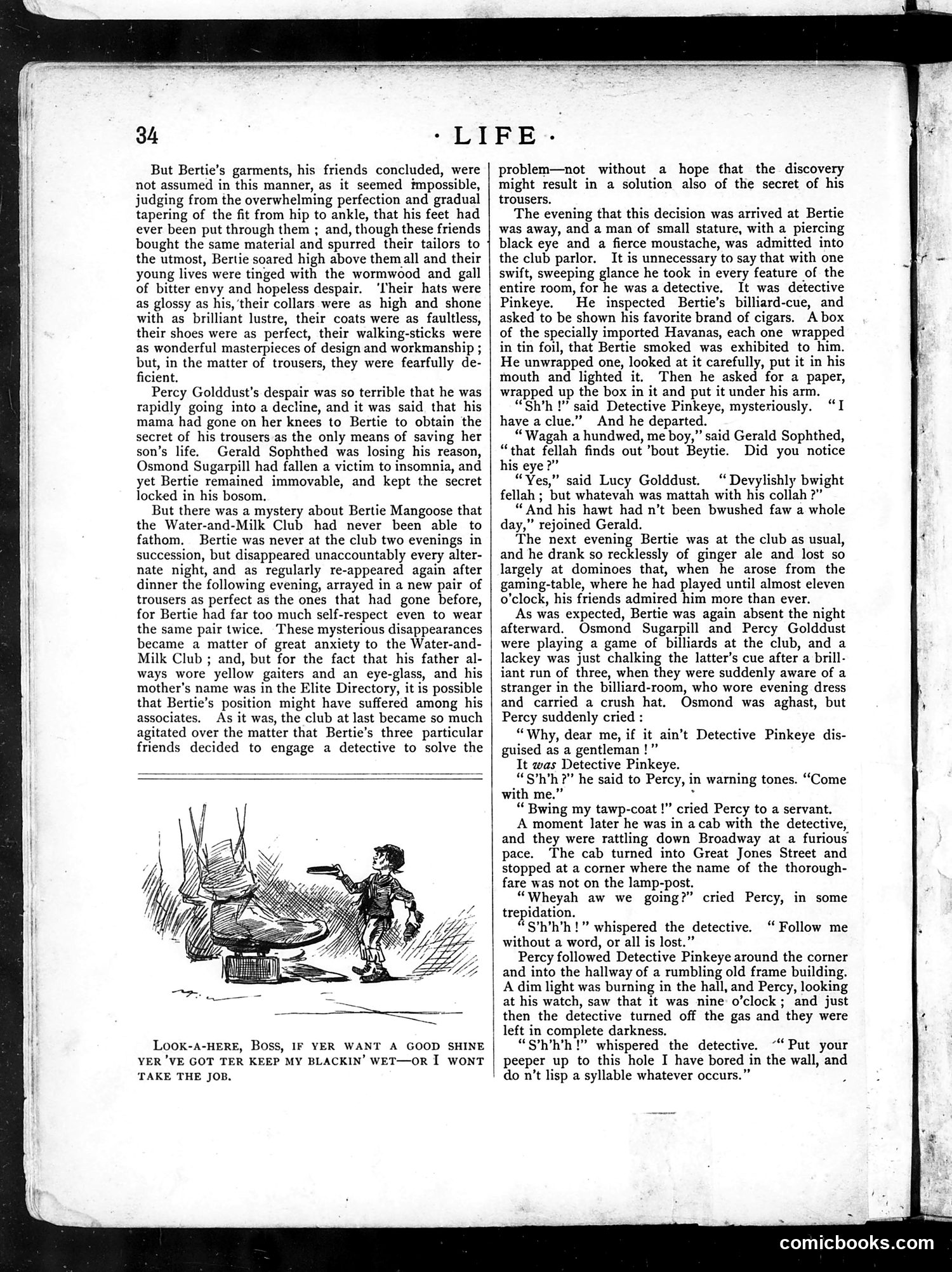
This page continues a serialized story about characters named Bertie, Percy Golddust, and Detective Pinkeye. The narrative involves Bertie's mysteriously disappearing trousers—a recurring problem that has caused social embarrassment at his exclusive club. The small illustration depicts a street-shoe-shiner's pitch, capturing working-class vernacular ("Look-a-here, Boss, if yer want a good shine..."). This contrasts with the upper-class club setting of the main story. The plot culminates with Percy summoning Detective Pinkeye to investigate Bertie's missing trousers. The story uses this absurd domestic mystery as comedic material, satirizing both Victorian gentlemen's anxieties about propriety and the period's obsession with hiring detectives for trivial matters.
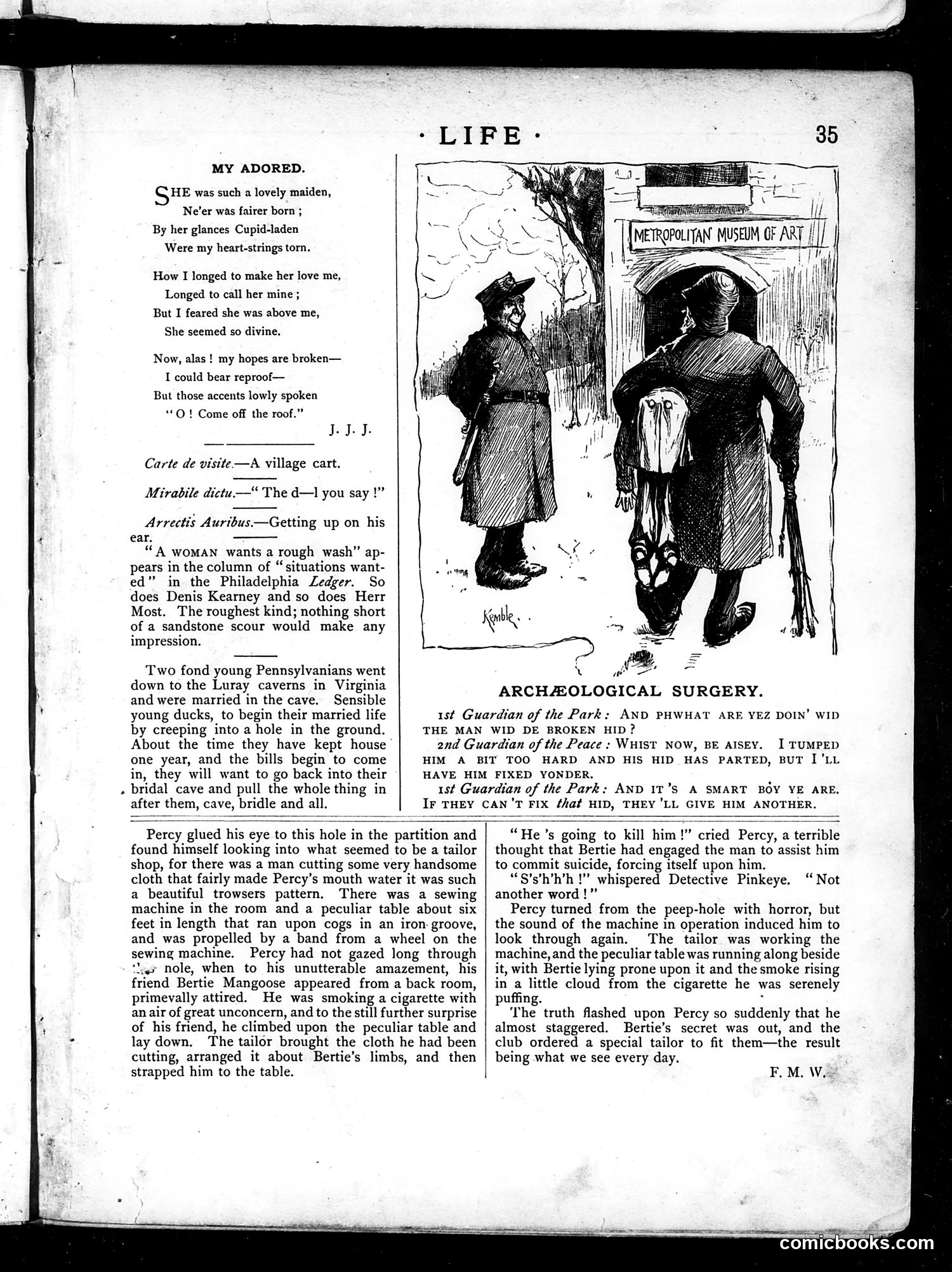
This cartoon satirizes the emerging field of orthopedic surgery, presenting it as comically crude. Two figures stand outside the Metropolitan Museum of Art—establishing an intellectual, cultured setting meant to heighten the humor. The caption stages a dialogue between two "Guardians of the Park" (likely park officials), discussing a man with a broken hip. One guardian claims they've "fixed" him, prompting the other's shocked response that they should "give him another." The joke plays on the double meaning of "fixing"—both surgical repair and the colloquial sense of rough treatment. The accompanying story below mocks early surgical techniques as primitive, comparing modern medicine unfavorably to crude folk remedies. The satire targets both medical incompetence and the pretensions of new scientific fields.
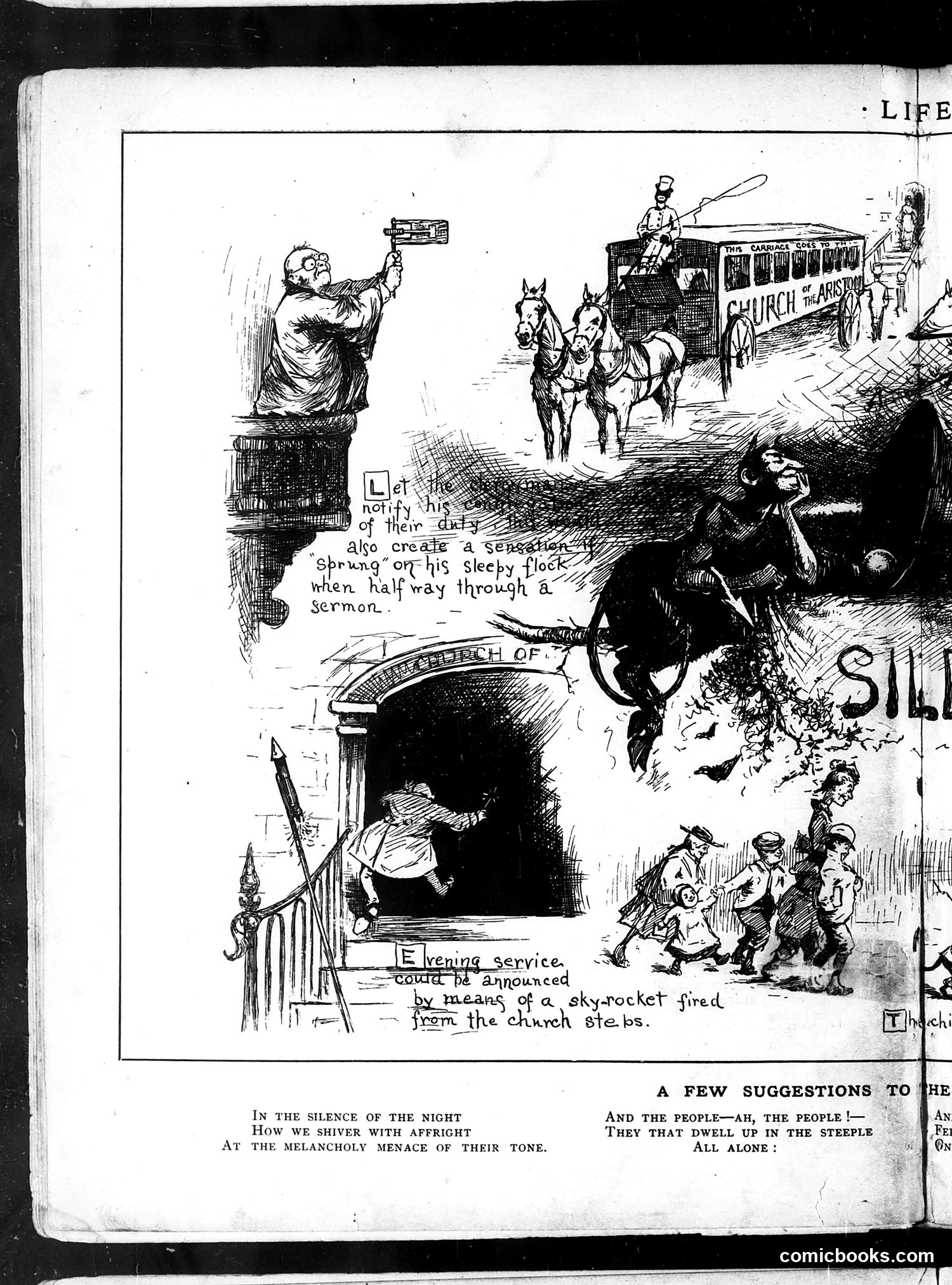
This satirical cartoon critiques **church service announcements and methods**. The main panel shows absurd ways to announce evening services: a figure on a church pillar fires a "sky-rocket" from the steeple; horse-drawn wagons advertise "Church of the Arising"; a boy uses a megaphone; children run about promoting the church. The satirical point mocks **overly aggressive or undignified advertising tactics** used by churches to announce services—suggesting they're resorting to carnival-like methods rather than relying on traditional religious authority. The caption below critiques the resulting tone: parishioners shiver "in silence of the night" at "the melancholy menace of their tone," implying these crude promotional methods undermine the solemnity churches should project. The satire targets **modernization of church communication** methods in what appears to be early 20th-century America.
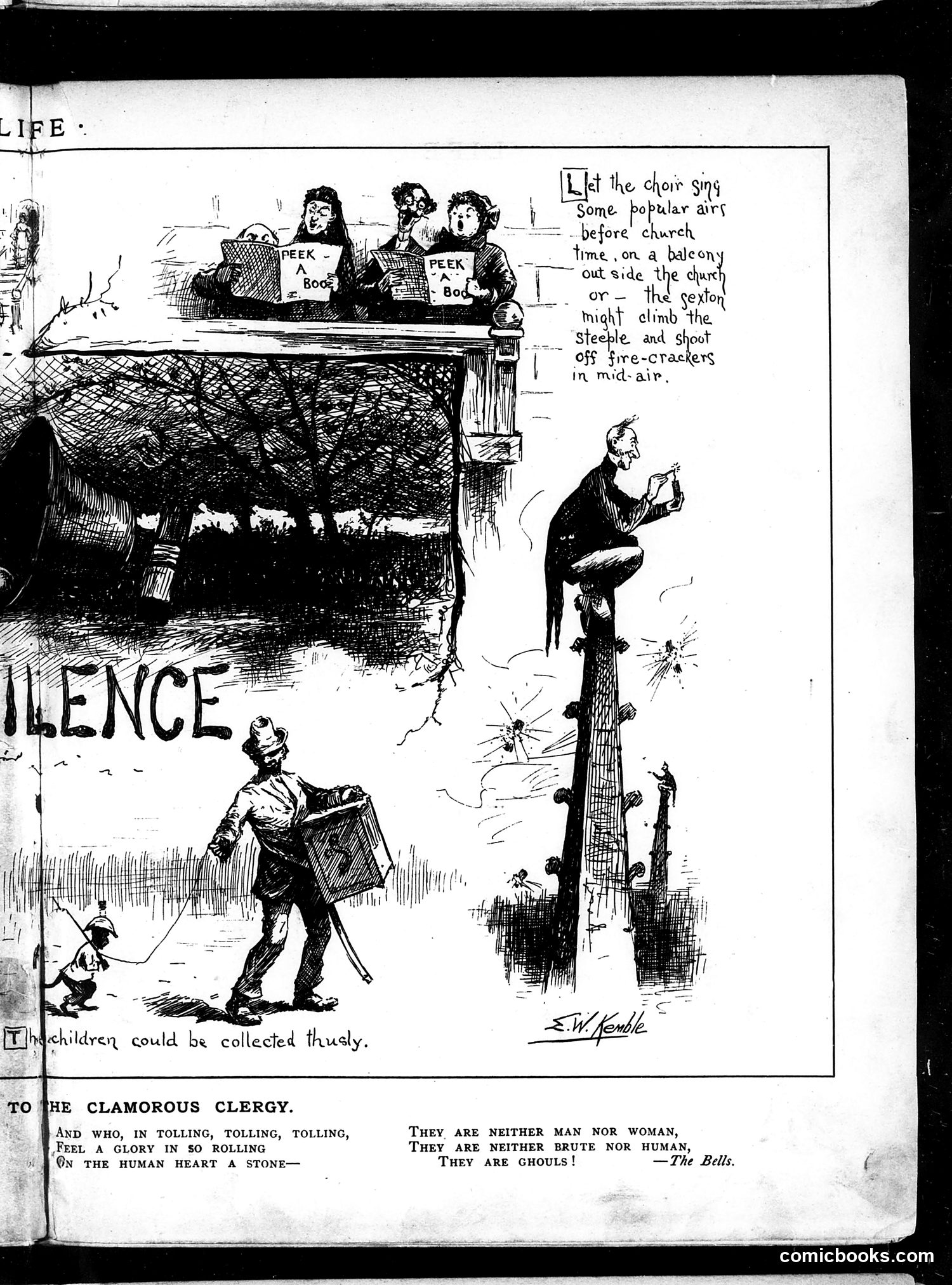
This satirical cartoon criticizes church bell-ringing practices. The top panel shows a choir on a church balcony singing "popular airs" before services while holding "Peek-a-Boo" songbooks—suggesting frivolous entertainment rather than sacred music. The accompanying text proposes an absurd alternative: letting the choir perform on the steeple, where they might "shoot off fire-crackers in mid-air" to collect children. The bottom section, titled "TO THE CLAMOROUS CLERGY," attacks bell-ringing itself as spiritually hollow, calling it merely "rolling" that produces "glory" from stone rather than genuine human virtue. The woman and child figures suggest the disturbance affects families. The satire targets 19th-century church practices perceived as noisy, undignified, or profit-driven rather than genuinely pious.
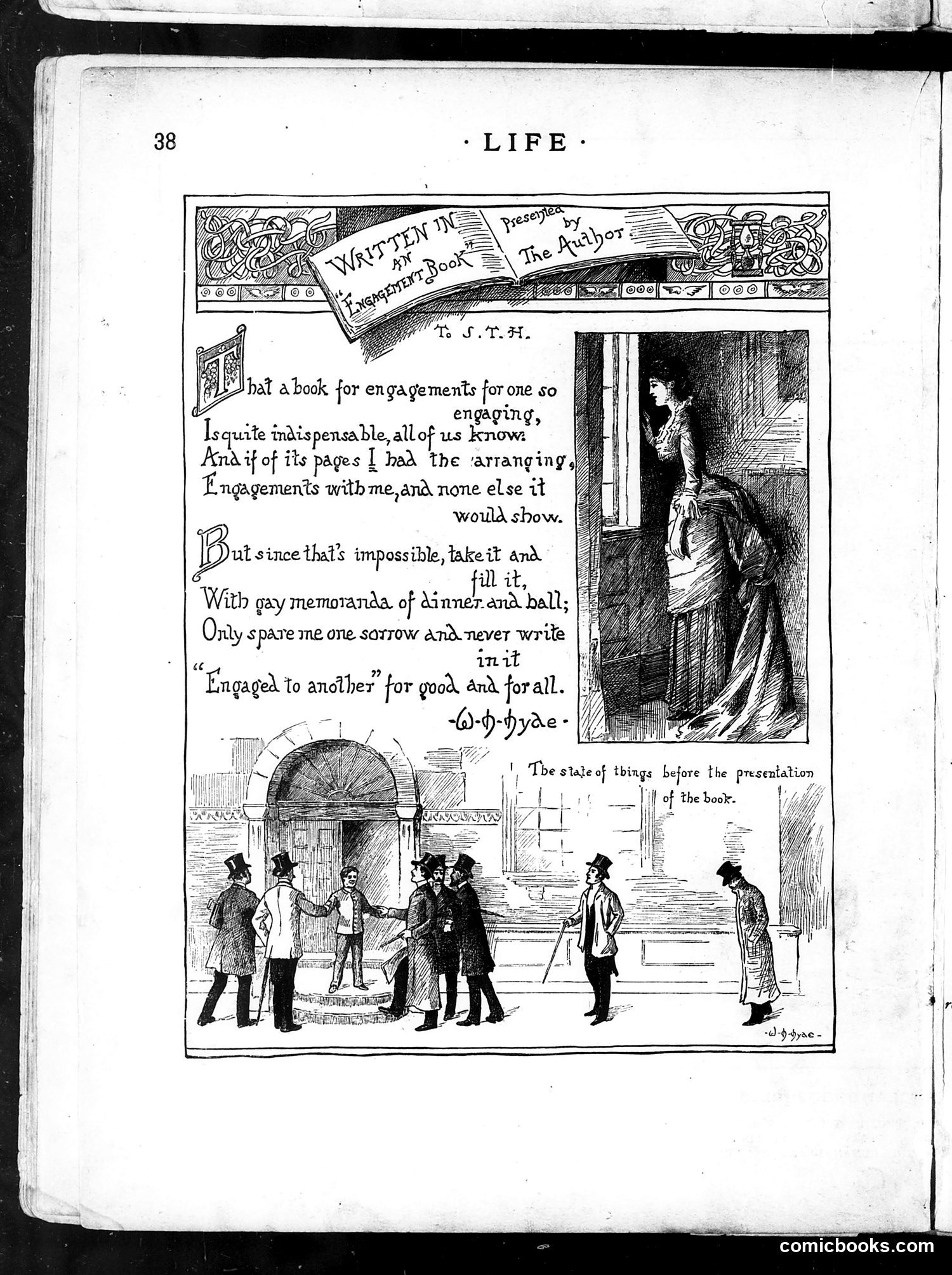
This page presents a humorous dedication poem about an **engagement book** — a social calendar where wealthy people recorded their social commitments (dinners, balls, etc.). The poem is addressed "To S.T.H." (presumably the book's recipient). The joke hinges on romantic anxiety: the author wishes the recipient would fill the book with social engagements, but asks them to never write "Engaged to another" — meaning never record a romantic engagement to someone else. It's a playful lament about unrequited affection disguised as practical advice about event planning. The accompanying illustrations show upper-class social life: a woman at a window (romantic anticipation) and gentlemen in formal dress gathered in an elegant interior space (the social scene being referenced). The satire targets the genteel pretense of Victorian/Edwardian courtship, where emotional vulnerability is masked by concerns about social calendars and formal propriety.
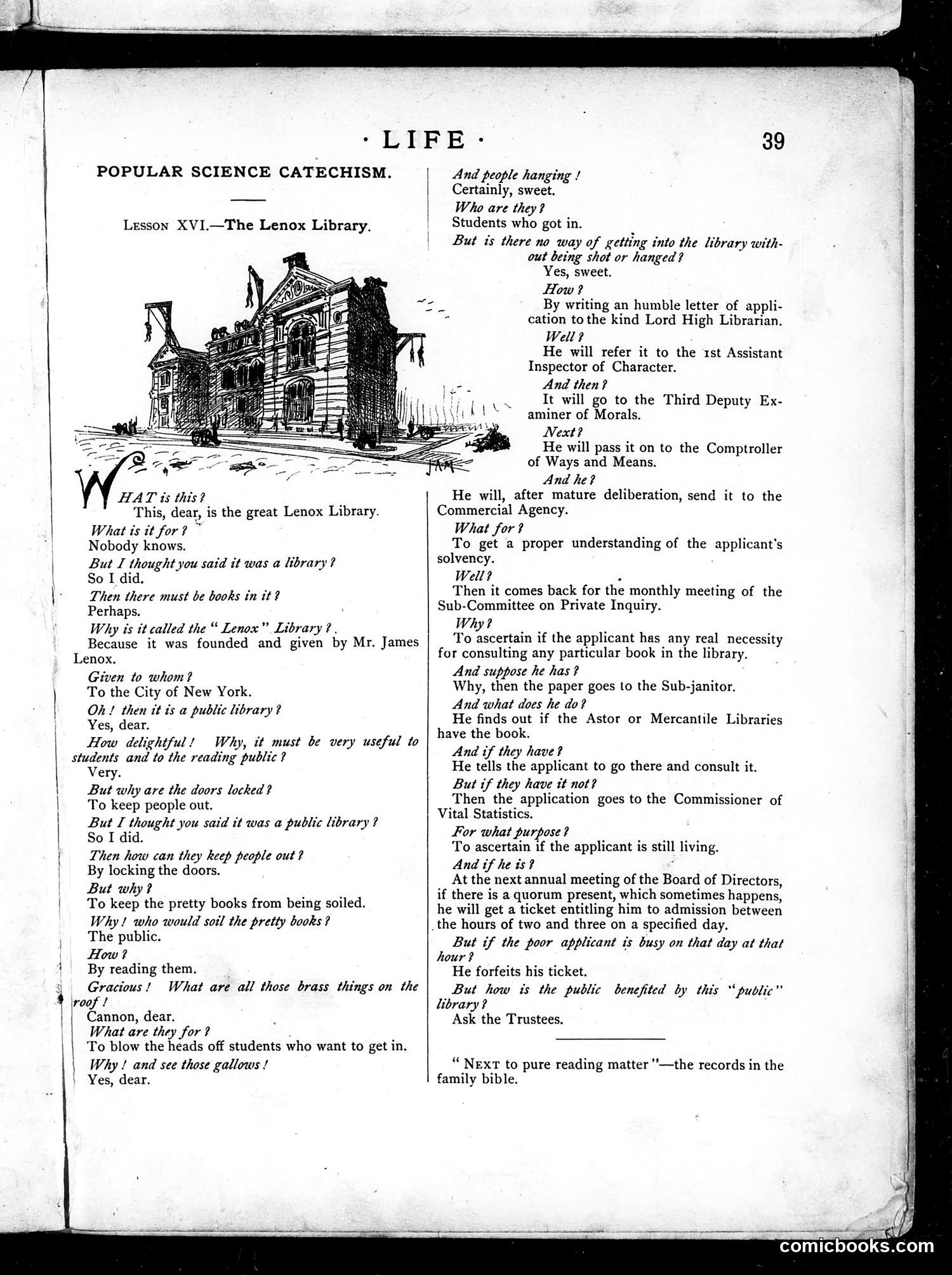
This is a satirical dialogue mocking the *inaccessibility* of the Lenox Library in New York City—a private library founded by philanthropist James Lenox and donated to the city. The joke: Though technically "public," the library functioned as practically *closed* to ordinary people. The satire uses absurdist escalation—cannons, gallows, and a Byzantine bureaucratic process—to criticize the actual gatekeeping practices that made the library useless to students and the general public it supposedly served. The cartoon illustrates the library building with exaggerated defensive features (cannons on roof, gallows). The text reveals the real barrier: a labyrinthine application process requiring approval from multiple obscure officials and commercial vetting—essentially designed to exclude common readers. The satire exposes the contradiction between the library's "public" designation and its exclusionary reality, questioning how an institution can claim to serve the public while making access nearly impossible.
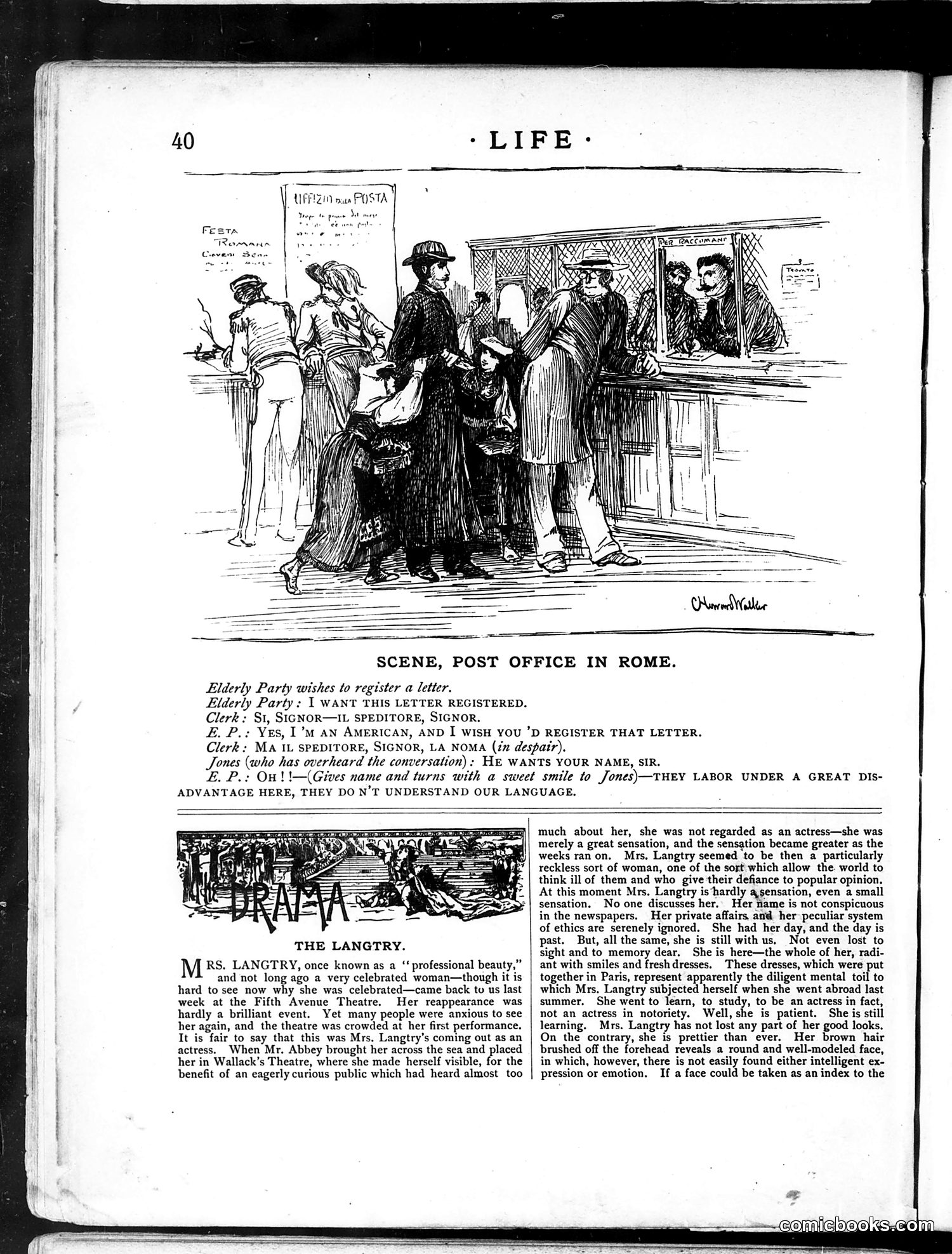
The top cartoon satirizes American tourists abroad. An elderly American tries to register a letter at a Roman post office, repeatedly insisting on "register" while the confused Italian clerk tries to explain in Italian (saying "the postman" — "il speditore"). A bystander named Jones has to translate. The joke mocks American insularity: the tourist assumes Italians simply don't understand English rather than considering he's using the wrong word or language. Below, the article discusses Mrs. Langtry, a famous British "professional beauty" and actress who recently returned to perform in New York. Life dismisses her acting talent, noting her celebrity derived from scandal and notoriety rather than skill. The magazine suggests her intellect is limited ("not easily found either intelligent expression or emotion" in her face) and that her Paris wardrobe represents shallow self-improvement. The piece reflects contemporary skepticism about beauty-based celebrity and women trading scandal for theatrical legitimacy.
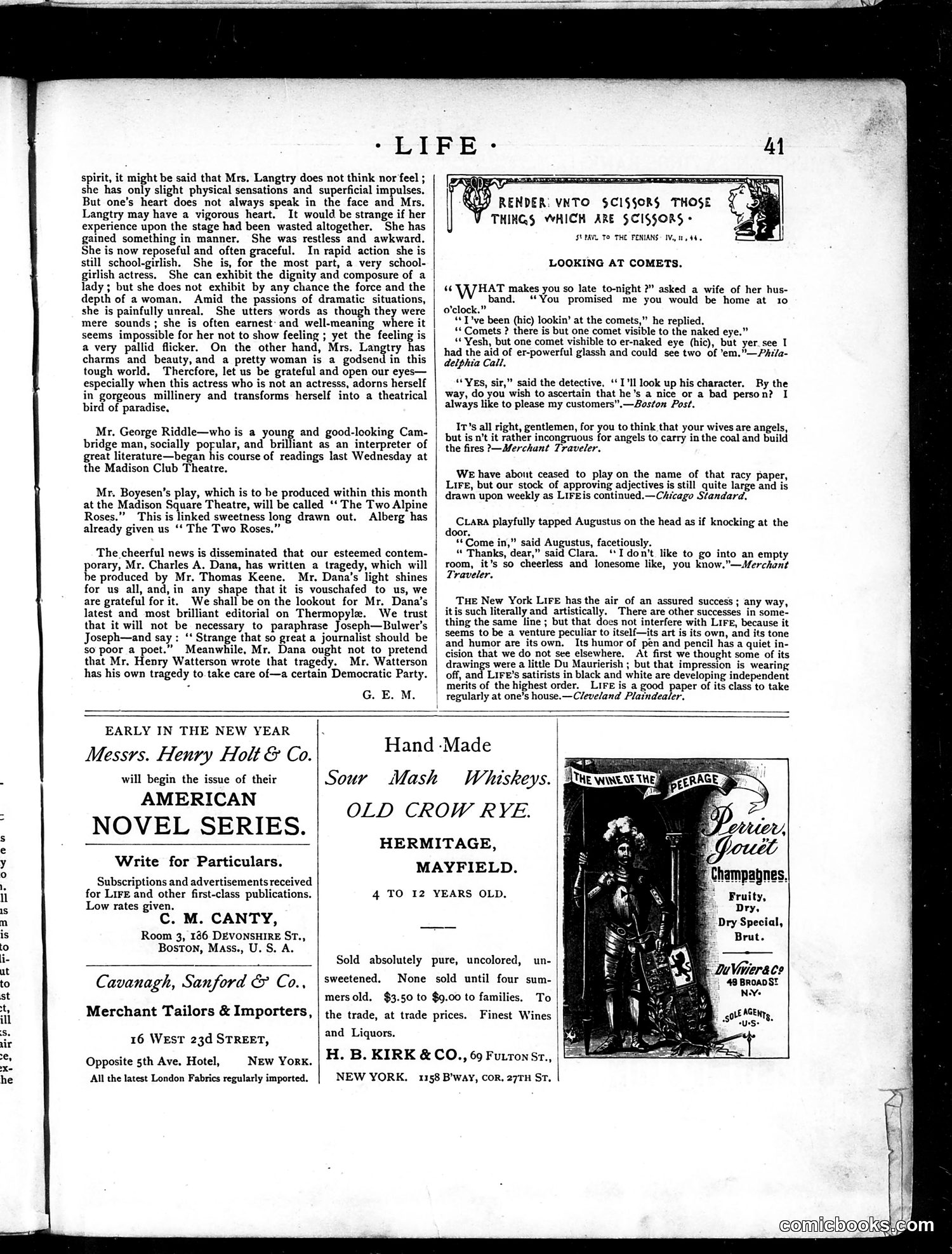
This page contains theater criticism and humorous short jokes rather than political cartoons. **Main Content:** The page features a lengthy critique of actress Lillie Langtry, concluding she's beautiful but dramatically weak—"painfully unreal" with only "pallid flicker" of genuine emotion. The author praises her charm and appearance while criticizing her acting abilities. **The Cartoon:** The small illustration at top shows a biblical pun: "Render unto scissors those things which are scissors"—a play on "Render unto Caesar." Its meaning is unclear from context alone. **Humor Section:** Several brief jokes follow, including one about a drunk man claiming to see two comets (using a magnifying glass), and jokes about wives being "angels" who must carry coal. These reflect period domesticity humor. **Advertisements:** The page also contains ads for whiskey, tailoring services, and a novel series—typical for this era's magazines. The page is primarily literary criticism and advertising with minimal political content.
This page is predominantly **advertisements** for banks, art suppliers, printing companies, and writing instruments. There are no political cartoons visible. The content consists of short **humor pieces** and jokes typical of the era: - A quip about ice cream shaped like the Bartholdi statue (the Statue of Liberty) - Jokes about gas meters, veils, and billiards - A humorous anecdote about two Black women being baptized in the James River, where one mistakes a terrapin for the angel Gabriel - A domestic comedy sketch where a clergyman's wife becomes suspicious when he mentions missing "pleasant features" of old wedding ceremonies (the joke being she thinks he means kissing the bride) These jokes reflect late-19th-century American humor—often reliant on racial stereotypes and domestic/marital comedy. There is **no significant political or social satire** on this particular page; it's a standard mixed-content issue page of advertisements interspersed with light entertainment.
This page is primarily **advertisements and filler content**, with one notable satirical piece. The main humor appears in the lengthy passage titled "THE sleeper," a mock-serious essay about churchgoers falling asleep during sermons. Written in faux-biblical language ("Peradventure he leaneth his chin upon a cane"), it humorously catalogs different sleeping positions and techniques parishioners use to hide their drowsiness—chin-propping, head-nodding, or strategic handkerchief-folding. The satire mocks both the sleepers' elaborate deceptions and their spouses' vigilant elbowing to maintain appearances of piety. The cartoon showing two figures with a pole labeled "I will never buy any but HARTSHORNS ROLLERS" and "And I will never sell any but HARTSHORNS" is an advertisement, not political satire—promoting a commercial product. The remaining content consists of product advertisements: pen nibs, billiard tables, wallpaper, candy, lunch rooms, and patent medicines. This was typical filler for *Life* magazine in this era.
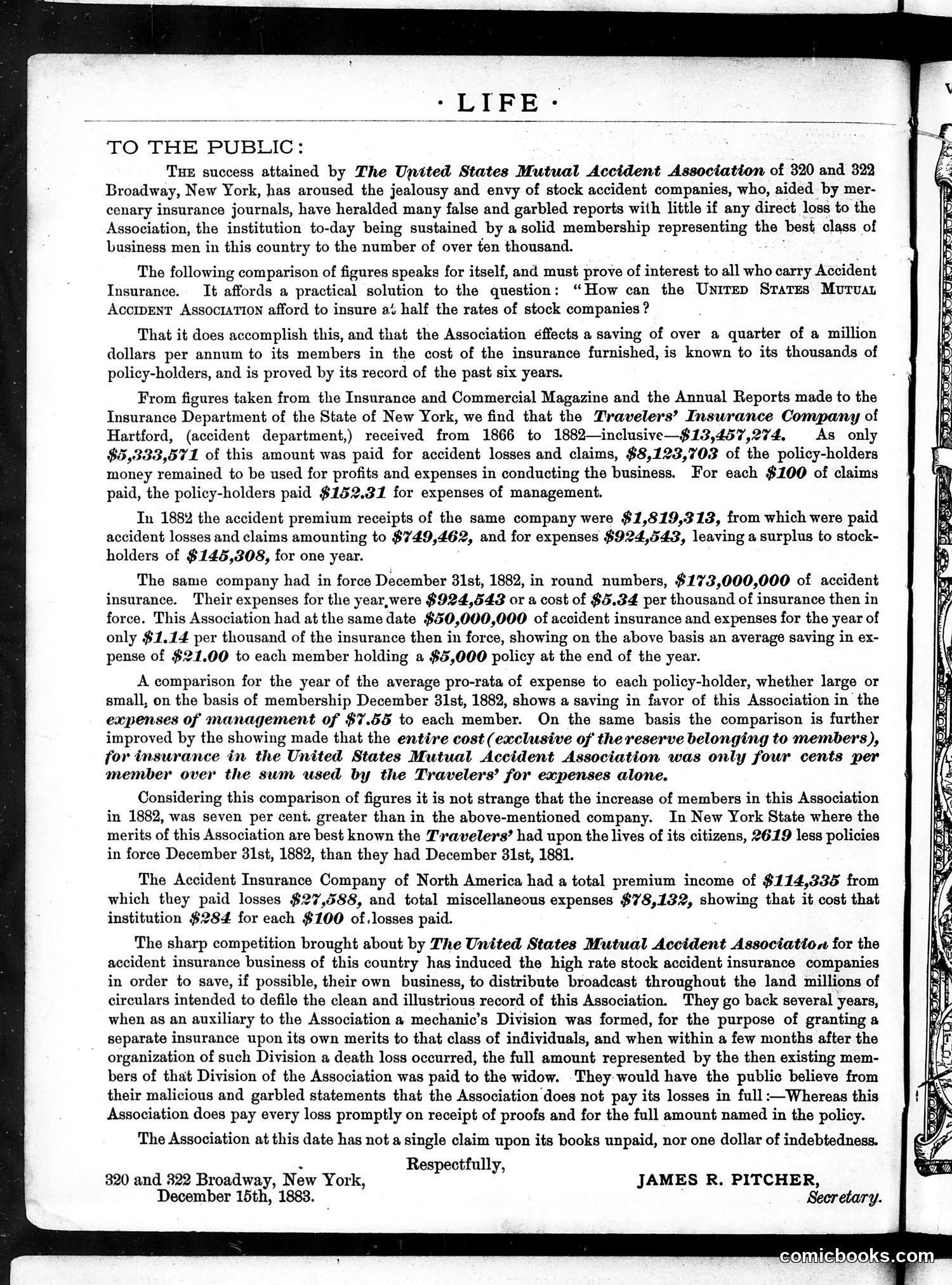
This is **not a cartoon page**—it's a lengthy advertorial letter defending the United States Mutual Accident Association against competitors. The Secretary James R. Pitcher rebuts accusations (apparently spread by rival insurance companies and their allied journals) that the mutual association is unreliable or unprofitable. Using detailed financial comparisons, he argues the USMAA offers superior value: their 1882 expenses were only $1.14 per thousand dollars of insurance versus the Travelers' Insurance Company's $5.34 per thousand. The key rhetorical move: Pitcher emphasizes the mutual structure (owned by members, not stockholders) inherently produces lower costs. He provides concrete numbers showing the USMAA saved members roughly $21 annually on $5,000 policies compared to competitors. The "jealousy and envy" language suggests stock companies spread false rumors to damage the mutual's reputation—a common 19th-century competitive tactic. The letter's publication in *Life* (a satirical magazine) lends credibility while reaching the "best class of business men" he claims as members.