
Life, 1884-01-17 · page 4 of 16
Life — January 17, 1884 — page 4: what you’re looking at
What you’re looking at
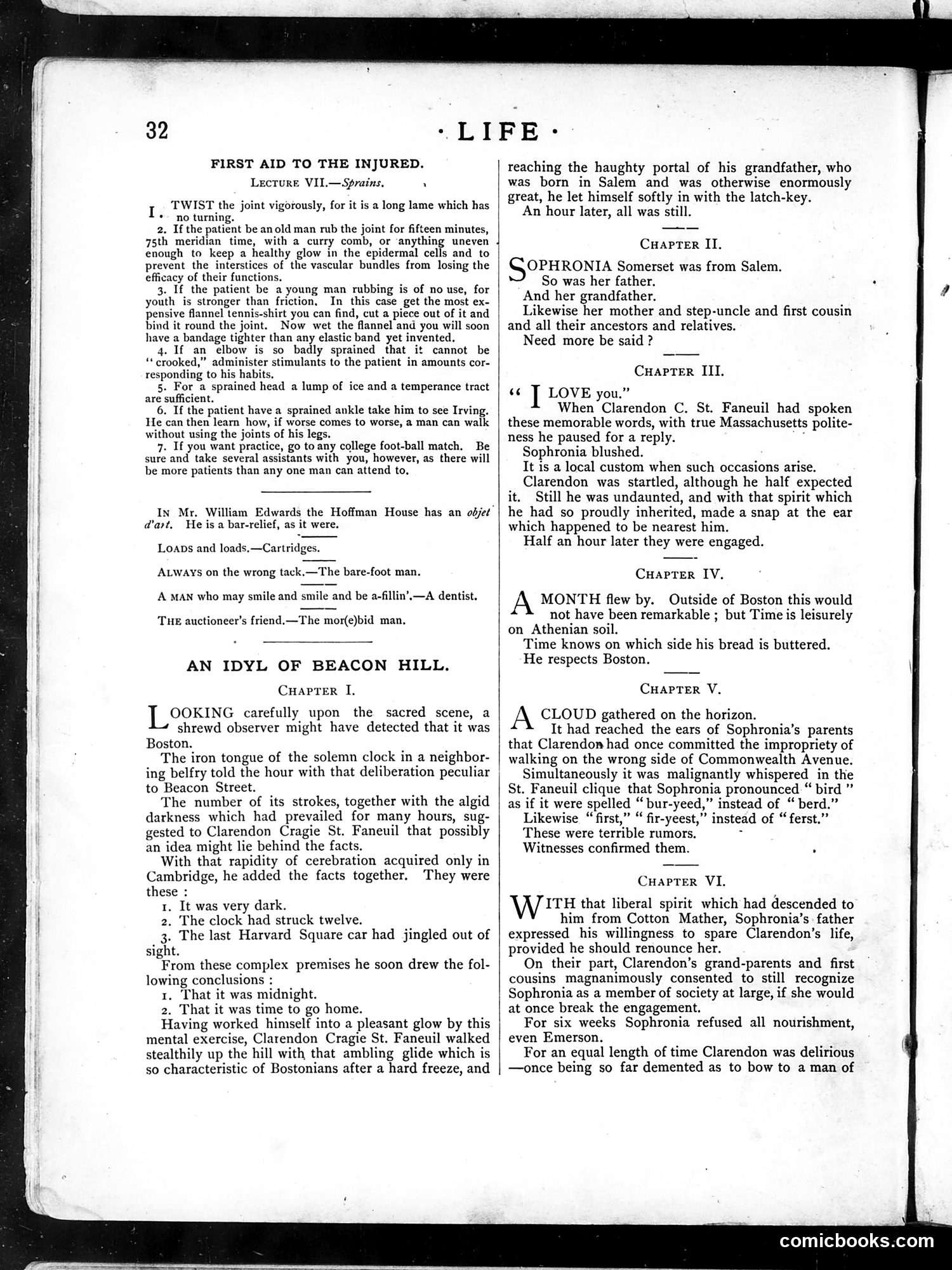
This page contains no political cartoons or satirical illustrations. Instead, it presents the opening chapters of a serialized short story titled "An Idyl of Beacon Hill," set in Boston. The narrative follows Sophronia Somerset and Clarendon C. St. Faneuil's courtship and engagement. The upper portion includes a medical advice column on treating sprains, followed by brief humorous quips (aphorisms) about various occupations—dentists, auctioneers, barefoot men—typical of *Life* magazine's satirical filler content. The story itself satirizes Boston Brahmin society through genteel, mock-romantic prose and social pretension. The humor lies in the overwrought literary style and gentle mockery of upper-class Bostonians' mannerisms, not in illustrations.
📄 Transcribed text from this page (OCR, searchable)
Machine-transcribed from the original scan — historical spelling and the odd misread are preserved.
32 FIRST AID TO THE INJURED. Lecture VII.—<Sprains, 1 |, TWIST the joint vigorously, for it is a long lame which has + no turning. 2. If the patient be anold man rub the joint for fifteen minutes, 75th meridian time, with a curry comb, or ‘anything uneven enough to keep a healthy glow in the epidermal cells and to | prevent the interstices of the vascular bundles from losing the emia of their functions. If the patient be a young man rubbing is of no use, for youth is stronger than friction, pensive flannel tenni bind it round the joint. Now wet the flannel and you will soon have a bandage tighter than any elastic band yet invented. 4. If an elbow is so badly sprained that it cannot be “crooked,” administer stimulants to the patient in amounts cor- responding to his habits, 5. For a sprained head a lump of ice and a temperance tract are sufficient. 6. If the patient have a sprained ankle take him to see Irving. He can then learn how, if worse comes to worse, a man can walk without using the joints of his legs. 7. If you want practice, go to any college foot-ball match. Be sure and take several assistants with you, however, as there will be more patients than any one man can attend to, In Mr. William Edwards the Hoffman House has an objet’ d'art, He isa bar-relief, as it were. Loans and loads.—Cartridges. Aways on the wrong tack,—The bare-foot man. A MAN who may smile and smile and be a-fillin’.—A dentist. THE auctioneer’s friend.—The mor(e)bid man, AN IDYL OF BEACON HILL. CuHaprer I. OOKING carefully upon the sacred scene, a shrewd observer might have detected that it was Boston. The iron tongue of the solemn clock in a neighbor- ing belfry told the hour with that deliberation peculiar to Beacon Street. The number of its strokes, together with the algid darkness which had prevailed for many hours, sug- gested to Clarendon Cragie St. Faneuil that possibly an idea might lie behind the facts. With that rapidity of cerebration acquired only in Cambridge, he added the facts together. They were these : 1. It was very dark. 2. The clock had struck twelve. 3. The last Harvard Square car had jingled out of sight. Si fot these complex premises he soon drew the fol- lowing conclusions : That it was midnight. 2. That it was time to go home. Having worked himself into a pleasant glow by this mental exercise, Clarendon Cragie St. Faneuil walked stealthily up the hill with that ambling glide which is so characteristic of Bostonians after a hard freeze, and In this case get the most ex- | shirt you can find, cut a piece out of it and | LIFE reaching the haughty portal of his grandfather, who was born in Salem and was otherwise enormously great, he let himself softly in with the latch-key. An hour later, all was still. Cuapter II. OPHRONIA Somerset was from Salem. So was her father. And her grandfather. Likewise her mother and step-uncle and first cousin | and all their ancestors and relatives. Need more be said ? Cuapter III. LOVE you.” When Clarendon C. St. Faneuil had spoken these memorable words, with true Massachusetts polite- ness he paused for a reply. Sophronia blushed. It is a local custom when such occasions arise. Clarendon was startled, although he half expected it. Still he was undaunted, and with that spirit which he had so proudly inherited, made a snap at the ear which happened to be nearest him. Half an hour later they were engaged. Cuaprer IV. A MONTH flew by. Outside of Boston this would not have been remarkable ; but Time is leisurely on Athenian soil. Time knows on which side his bread is buttered. He respects Boston. “cc CHAPTER V. A CLOUD gathered on the horizon. It had reached the ears of Sophronia’s parents that Clarendon had once committed the impropriety of walking on the wrong side of Commonwealth Avenue. Simultaneously it was malignantly whispered in the St. Faneuil clique that Sophronia pronounced “ bird ” as if it were spelled “ bur-yeed,” instead of “ berd.” Likewise “first,” “ fir-yeest,” instead of “ferst.” These were terrible rumors. Witnesses confirmed them. CuaptTer VI. W ITH that liberal spirit which had descended to him from Cotton Mather, Sophronia’s father expressed his willingness to spare Clarendon’s life, provided he should renounce her. On their part, Clarendon’s grand-parents and first cousins magnanimously consented to still recognize Sophronia as a member of society at large, if she would at once break the engagement. For six weeks Sophronia refused all nourishment, even Emerson. For an equal length of time Clarendon was delirious —once being so far demented as to bow to a man of comicbooks.com