
Life, 1884-01-17 · page 12 of 16
Life — January 17, 1884 — page 12: what you’re looking at
What you’re looking at
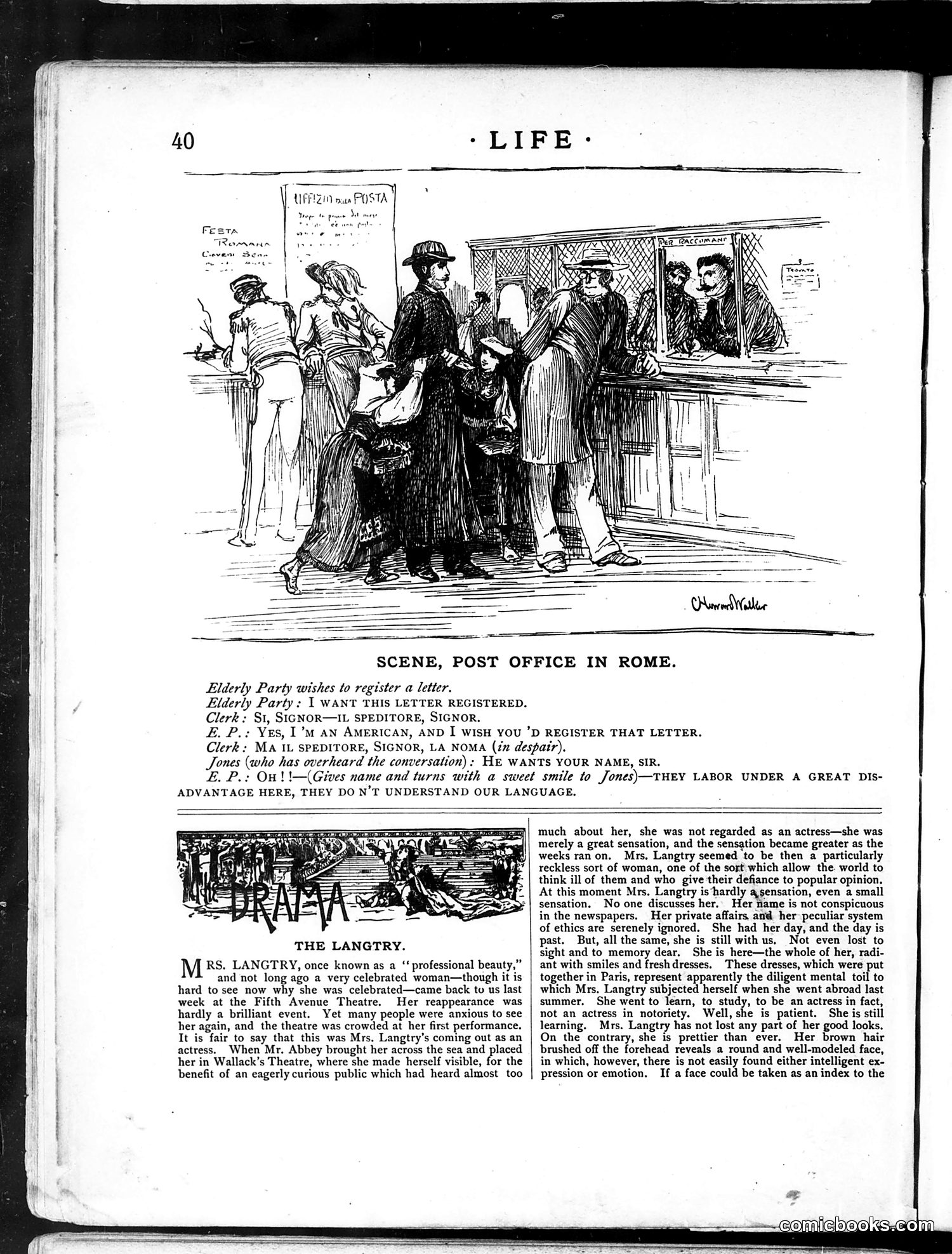
The top cartoon satirizes American tourists abroad. An elderly American tries to register a letter at a Roman post office, repeatedly insisting on "register" while the confused Italian clerk tries to explain in Italian (saying "the postman" — "il speditore"). A bystander named Jones has to translate. The joke mocks American insularity: the tourist assumes Italians simply don't understand English rather than considering he's using the wrong word or language. Below, the article discusses Mrs. Langtry, a famous British "professional beauty" and actress who recently returned to perform in New York. Life dismisses her acting talent, noting her celebrity derived from scandal and notoriety rather than skill. The magazine suggests her intellect is limited ("not easily found either intelligent expression or emotion" in her face) and that her Paris wardrobe represents shallow self-improvement. The piece reflects contemporary skepticism about beauty-based celebrity and women trading scandal for theatrical legitimacy.
📄 Transcribed text from this page (OCR, searchable)
Machine-transcribed from the original scan — historical spelling and the odd misread are preserved.
i hd SCENE, POST OFFICE IN ROME. Elderly Party wishes to register a letter. Elderly Party: | WANT THIS LETTER REGISTERED. Clerk : St, SIGNOR—IL SPEDITORE, SIGNOR. E. P.: Yes, 1’M AN AMERICAN, AND I WISH YOU ’D REGISTER THAT LETTER. Clerk; MA IL SPEDITORE, SIGNOR, LA NOMA (iz despair). Jones (who has overheard the conversation): HE WANTS YOUR NAME, SIR. E. P.: Ow! !—(Gives name and turns with a sweet smile to Jones)—THEY LABOR UNDER A GREAT DIs- ADVANTAGE HERE, THEY DO N’T UNDERSTAND OUR LANGUAGE, THE LANGTRY. RS. LANGTRY, once known as a ‘professional beauty,” and not long ago a very celebrated woman—though it is hard to see now why she was celebrated—came back to us last week at the Fifth Avenue Theatre. Her reappearance was hardly a brilliant event. Yet many people were anxious to see her again, and the theatre was crowded at her first performance. It is fair to say that this was Mrs. Langtry’s coming out as an actress. When Mr. Abbey brought her across the sea and placed her in Wallack’s Theatre, where she made herself visible, for the benefit of an eagerly curious public which had heard almost too much about her, she was not regarded as an actress—she was merely a great sensation, and the sensation became greater as the weeks ranon. Mrs. Langtry seemed to be then a particularly reckless sort of woman, one of the sort which allow the. world to think ill of them and who give their defiance to popular opinion. At this moment Mrs. Langtry is‘hardly asensation, even a small sensation. No one discusses her. Her name is not conspicuous in the newspapers. Her private affairs amd her peculiar system of ethics are serenely ignored. She had her day, and the day is past. But, all the same, she is still with us, Not even lost to sight and to memory dear. She is here—the whole of her, radi- ant with smiles and freshdresses. These dresses, which were put together in Paris, represent apparently the diligent mental toil to which Mrs. Langtry subjected herself when she went abroad last summer. She went to learn, to study, to be an actress in fact, not an actress in notoriety, Well, she is patient. She is still learning. Mrs. Langtry has not lost any part of her good looks. On the contrary, she is prettier than ever. Her brown hair brushed off the forehead reveals a round and well-modeled face, in which, however, there is not easily found either intelligent ex- pression or emotion. If a face could be taken as an index to the books?com