
Life, 1884-01-17 · page 5 of 16
Life — January 17, 1884 — page 5: what you’re looking at
What you’re looking at
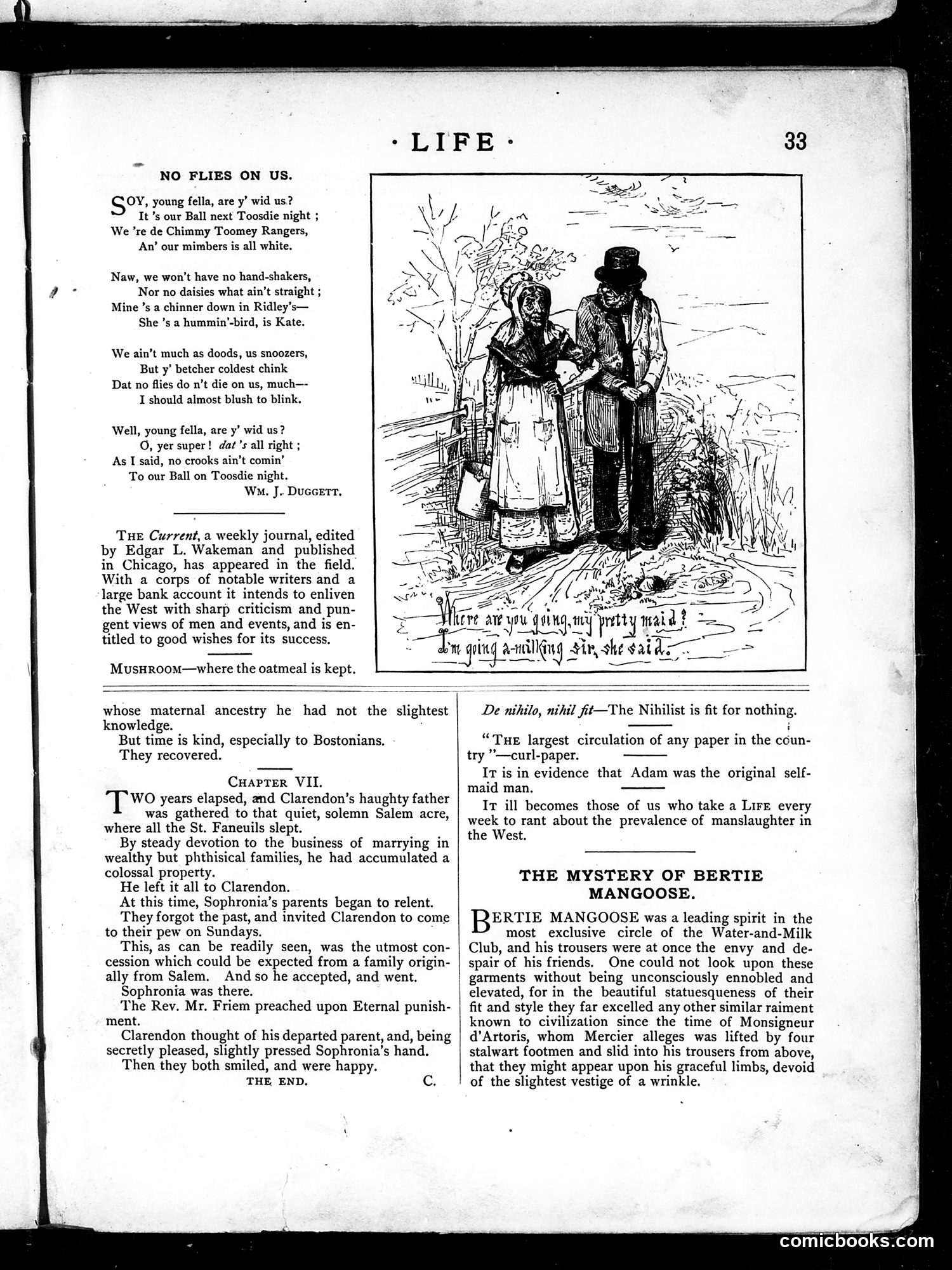
This cartoon depicts two rustic figures—a woman in a bonnet and a man in a top hat—standing outdoors. The caption reads: "Where are you going, my pretty maid? / I'm going a-milking, Sir, she said." This is a visual reference to the nursery rhyme "Where Are You Going to, My Pretty Maid?" The joke appears to play on rural/working-class courtship dynamics, with the well-dressed man ("sir") approaching a milkmaid. The surrounding poem "No Flies on Us" by W.J. Duggett emphasizes the speakers' rough, unpretentious character—they're the "Chimney Toomey Rangers" who lack refinement but possess honest directness. The satire likely mocks both rural naiveté and the pretensions of city folk attempting to court working-class women.
📄 Transcribed text from this page (OCR, searchable)
Machine-transcribed from the original scan — historical spelling and the odd misread are preserved.
NO FLIES ON US. SOY, young fella, are y’ wid us? It’s our Ball next Toosdie night ; We ’re de Chimmy Toomey Rangers, An’ our mimbers is all white. Naw, we won’t have no hand-shakers, Nor no daisies what ain’t straight ; Mine ’s a chinner down in Ridley’s— She ’s a hummin’-bird, is Kate. We ain’t much as doods, us snoozers, But y’ betcher coldest chink Dat no flies do n’t die on us, much—- I should almost blush to blink. ‘Well, young fella, are y’ wid us? G, yer super! dat’s all right ; As I said, no crooks ain’t comin’ To our Ball on Toosdie night. ‘Wo. J. Duccerr. THE Current, a weekly journal, edited by Edgar L. Wakeman and published in Chicago, has appeared in the field. With a corps of notable writers and a large bank account it intends to enliven the West with sharp criticism and pun- gent views of men and events, and is en- titled to good wishes for its success. MusHRoom—where the oatmeal is kept. 3 aN a whose maternal ancestry he had not the slightest knowledge. But time is kind, especially to Bostonians. They recovered. Cuaprer VII. Two years elapsed, and Clarendon’s haughty father was gathered to that quiet, solemn Salem acre, where all the St. Faneuils slept. By steady devotion to the business of marrying in wealthy but phthisical families, he had accumulated a colossal property. He left it all to Clarendon. At this time, Sophronia’s parents began to relent. They forgot the past, and invited Clarendon to come to their pew on Sundays. This, as can be readily seen, was the utmost con- cession which could be expected from a family origin- ally from Salem. And so he accepted, and went. Sophronia was there. The Rev. Mr. Friem preached upon Eternal punish- ment. Clarendon thought of his departed parent, and, being secretly pleased, slightly pressed Sophronia’s hand. Then they both smiled, and were happy. THE END. De nihilo, nihil fit he Nihilist is fit for more: “Tue largest circulation of any paper in the coun- try ’’"—curl-paper. Ir is in evidence that Adam was the original self- maid man. Ir ill becomes those of us who take a Lire every week to rant about the prevalence of manslaughter in the West. THE MYSTERY OF BERTIE MANGOOSE. BERTIE MANGOOSE was a leading spirit in the most exclusive circle of the Water-and-Milk Club, and his trousers were at once the envy and de- spair of his friends. One could not look upon these garments without being unconsciously ennobled and elevated, for in the beautiful statuesqueness of their fit and style they far excelled any other similar raiment known to civilization since the time of Monsigneur d’Artoris, whom Mercier alleges was lifted by four stalwart footmen and slid into his trousers from above, that they might appear upon his graceful limbs, devoid of the slightest vestige of a wrinkle. comicbooks.com