
A complete issue · 16 pages · 1884
Life — January 10, 1884
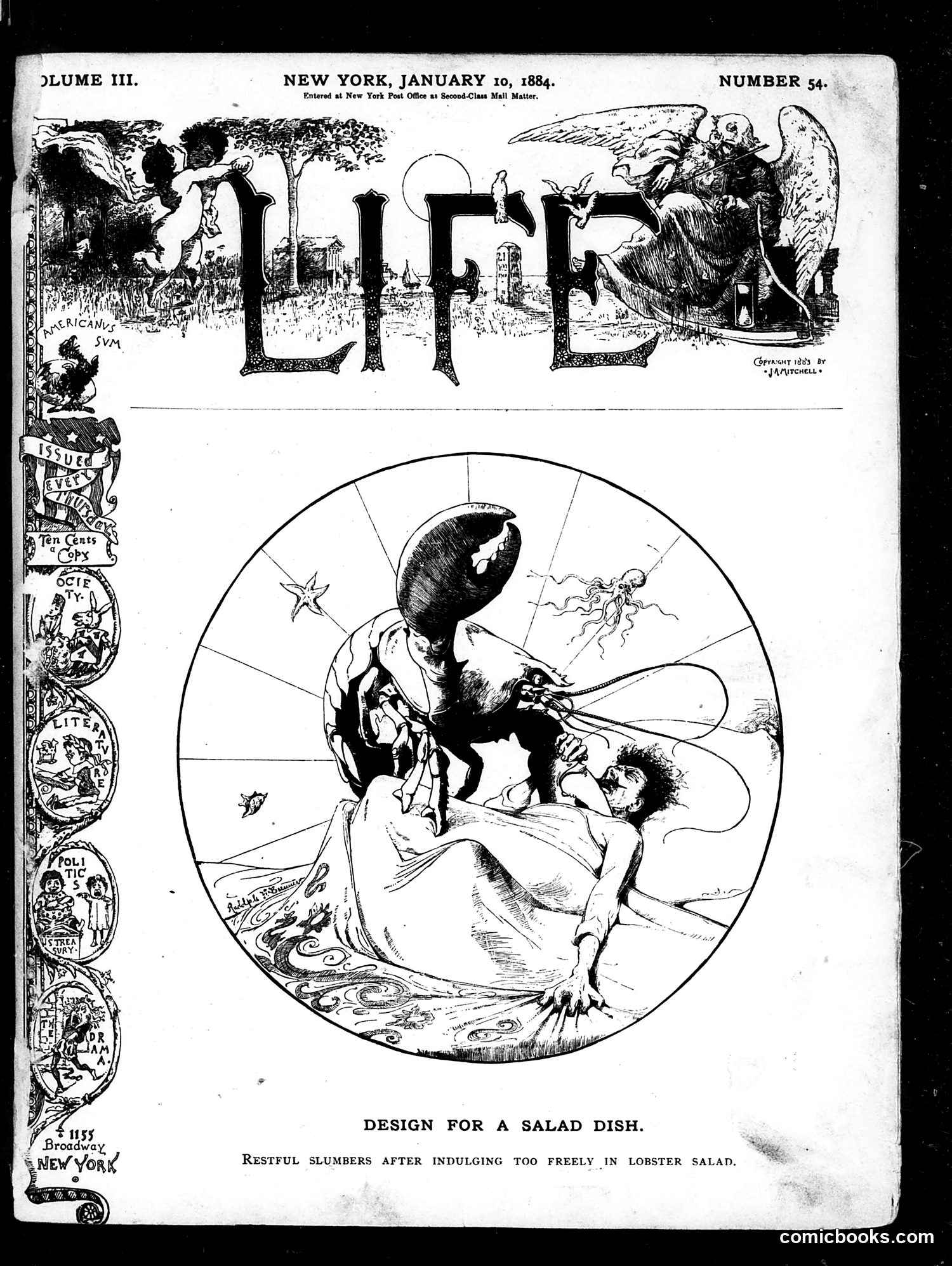
This satirical illustration depicts two figures in a circular composition labeled as "Design for a Salad Dish." The caption reads: "Restful slumbers after indulging too freely in lobster salad." The cartoon appears to be a humorous commentary on the digestive consequences of overindulgence in rich food. The two figures—seemingly well-dressed individuals or possibly caricatured social types—are shown in uncomfortable, contorted positions, suggesting they're experiencing indigestion or illness from eating too much lobster salad at what was likely a fashionable social gathering. The joke relies on 19th-century satirical conventions mocking upper-class dining excess and its consequences. This reflects Victorian-era humor about gluttony and bodily discomfort among the wealthy.
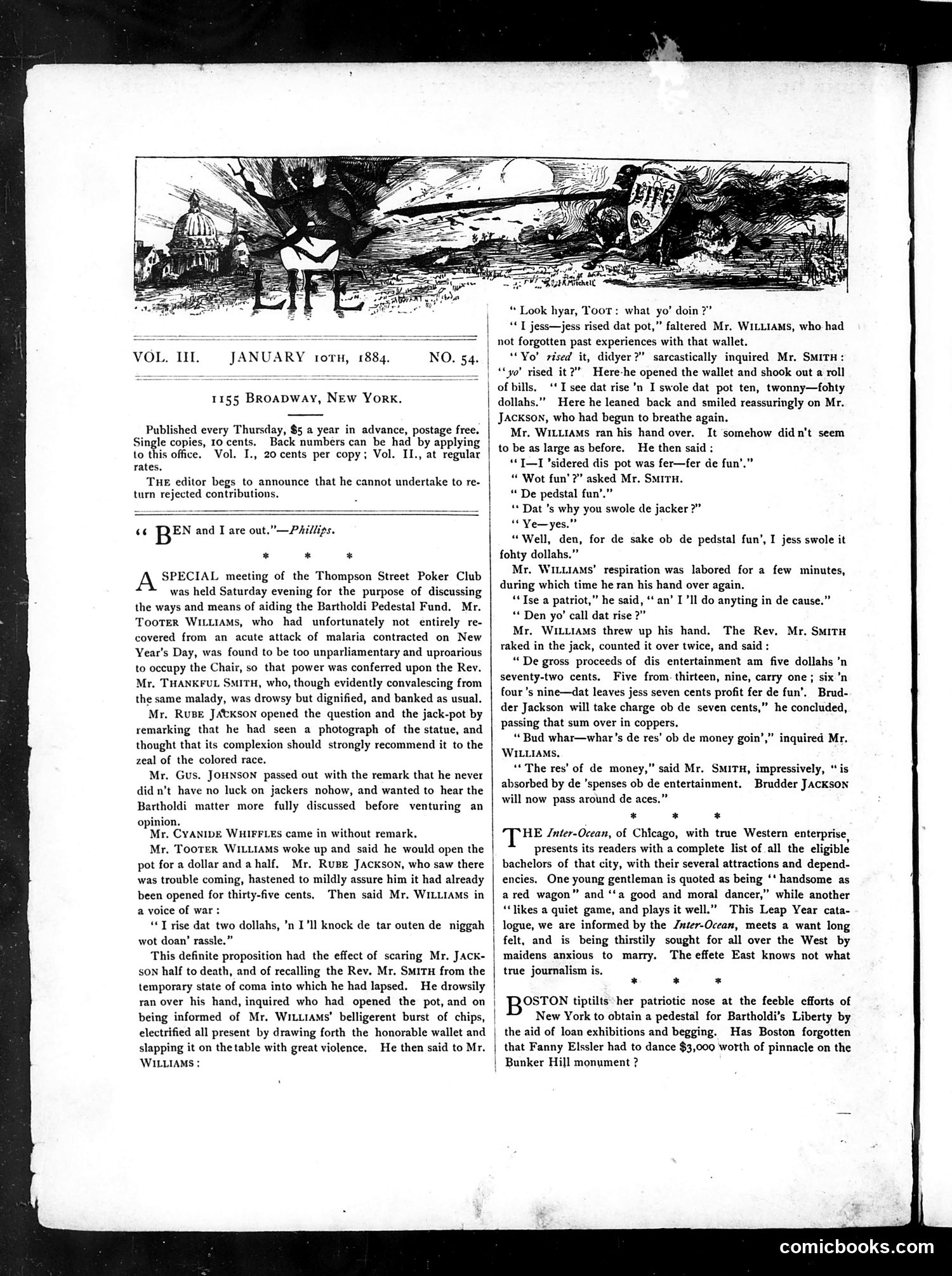
The page contains a satirical story about the Thomson Street Poker Club discussing the Berthold Pedestal Fund. The narrative mocks a character named Tooter Williams, who claims he lost money at poker but presents a worn wallet to prove his poverty. The story ridicules both Williams's excuse-making and the committee's gullible responses. The satire targets late-19th-century charitable fundraising and masculine social clubs. The humor derives from Williams's transparent dishonesty—he's clearly spent money on entertainment rather than being genuinely poor—and the other men's alternately condescending and enabling attitudes toward him. The accompanying woodcut illustration appears to show an urban landscape, likely depicting the story's setting or establishing the scene.
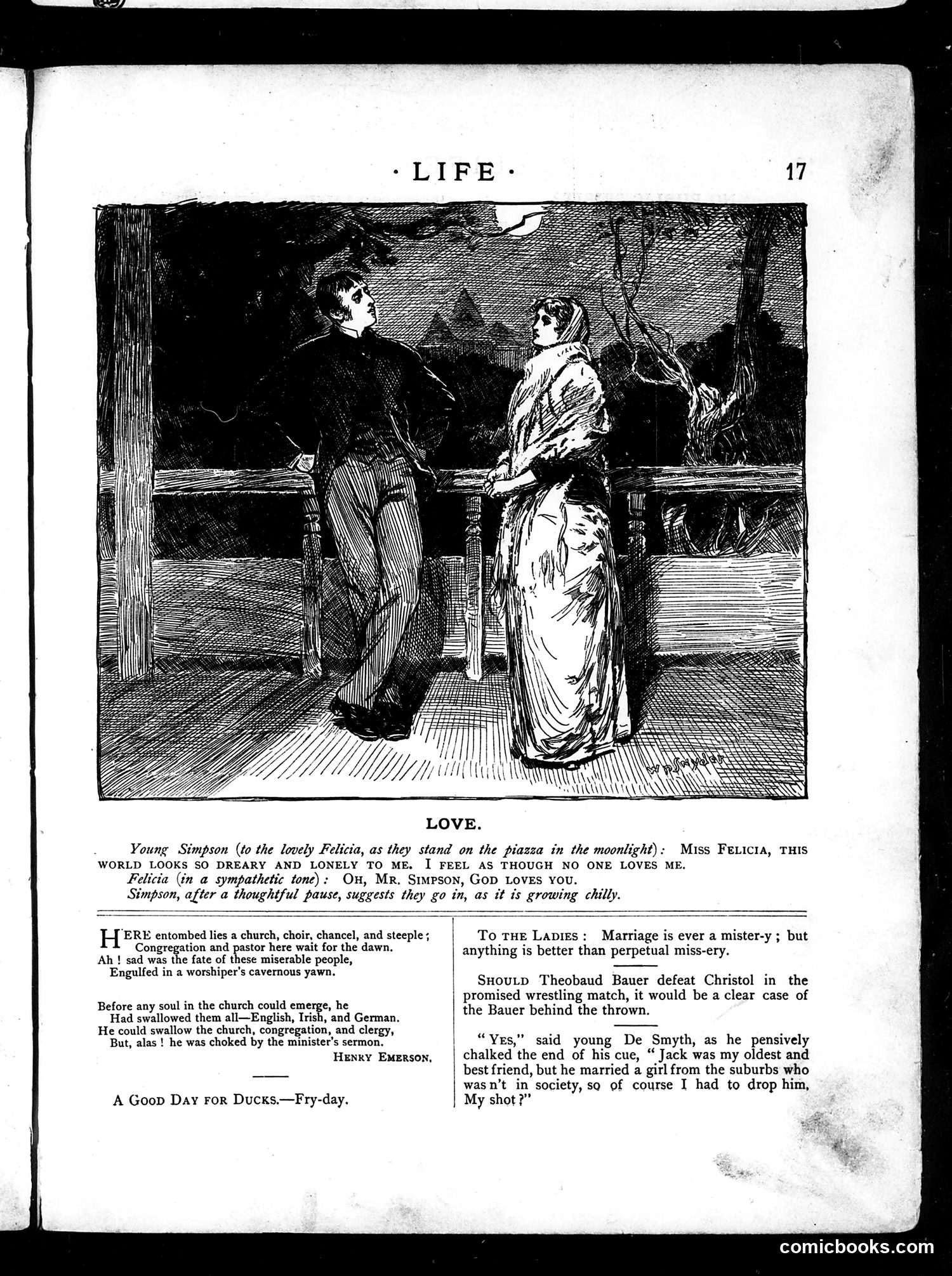
This page from *Life* magazine presents a romantic scene titled "Love," showing a young couple (identified as Simpson and Felicia) standing on a moonlit piazza. The illustration satirizes courtship conventions of the era. The accompanying text includes a Henry Emerson poem about church congregations, followed by humorous commentary on marriage. A sidebar titled "To the Ladies" jokes that "Marriage is ever a mister-y; but anything is better than perpetual miss-ery"—a pun on unmarried women ("miss"). Another anecdote mocks a man named De Smyth who married a woman "from the suburbs" despite losing his shot at a society match with his best friend Jack. The satire targets Victorian courtship rituals and social class anxieties around marriage prospects.
This page contains **no political cartoons**. Instead, it features: 1. **"No Public Spirit?"** — An editorial criticizing New Yorkers' reluctance to fund a statue pedestal through donations, despite the city's wealth. The piece contrasts this with European generosity and suggests Americans are regarded with contempt abroad for lacking civic pride. 2. **"A Kerchief"** — A sentimental poem by Clinton Scollard praising delicate fabric, decorated with embroidered roses and butterflies. 3. **"The Last of the Pie-Eaters"** — A short story by Jade-Oyle about Vallerhammer, a frontier character described as "the last of the Pie-Eaters," a vanishing tribal group of the Rocky Mountains. The page is primarily **literary and editorial content**, not visual satire.
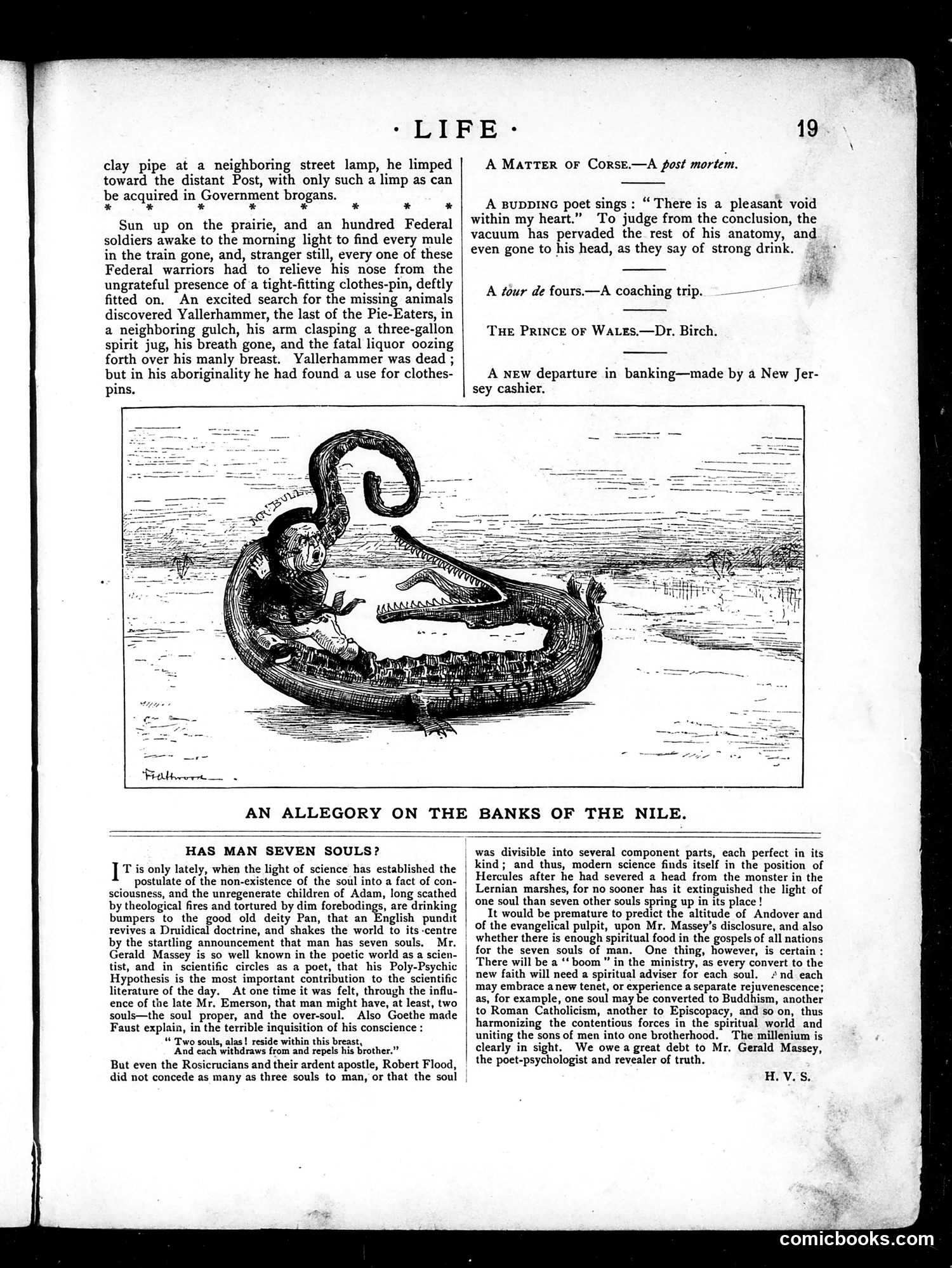
The main illustration is titled "An Allegory on the Banks of the Nile" and depicts a figure riding inside a crocodile, apparently writing or taking notes. The crocodile functions as a satirical metaphor—likely representing Egypt or colonial interests in the Nile region. The figure's precarious position (inside the dangerous animal) suggests the perilous nature of whatever enterprise or political situation is being critiqued. The accompanying text discusses whether humans possess multiple souls, referencing various philosophical and religious traditions. However, the cartoon's specific political target remains unclear without additional historical context about contemporary Egyptian or colonial affairs of the publication's era. The artwork is credited to Halford (the artist's signature visible).
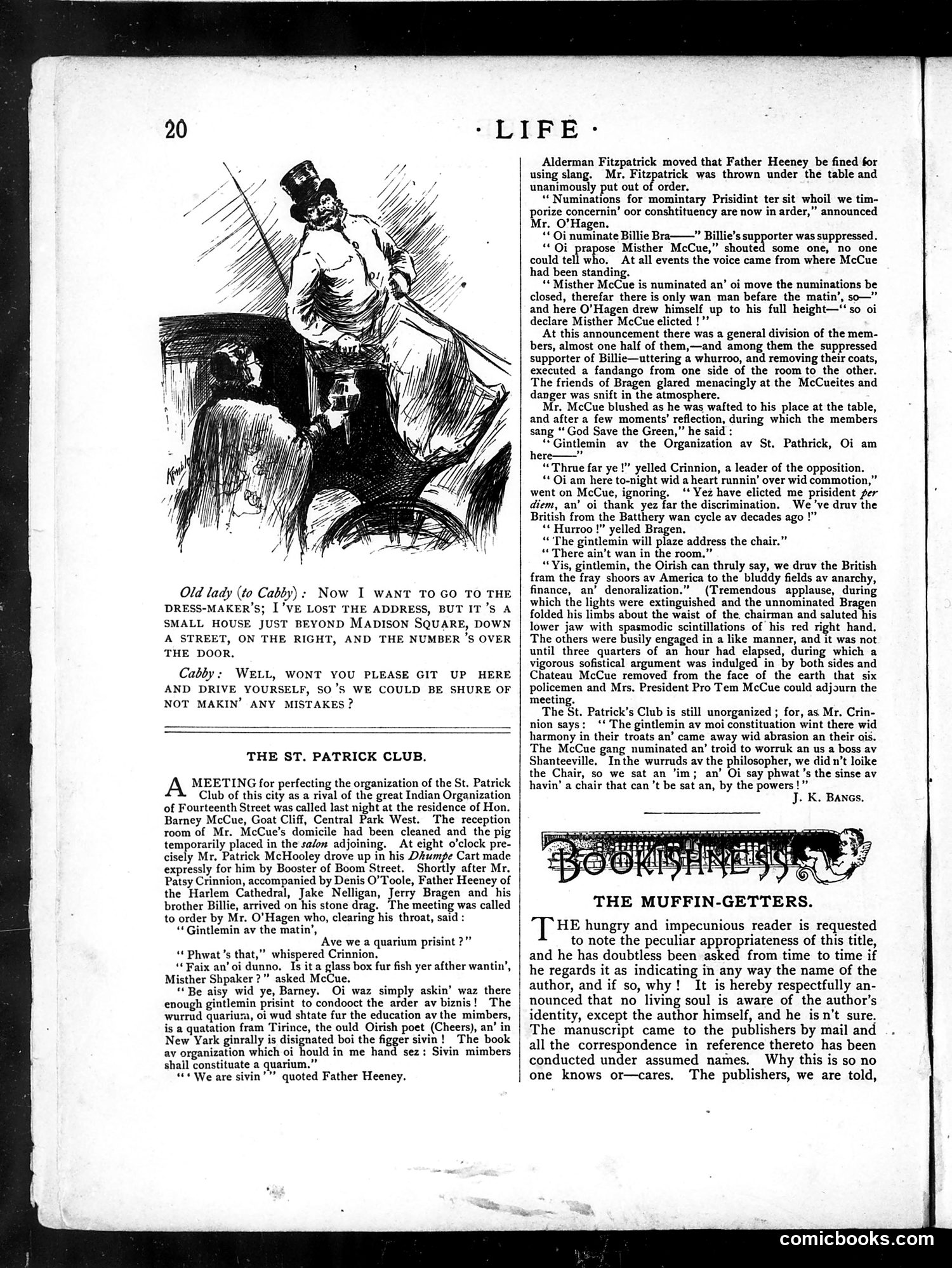
This page contains two distinct sections: **"The St. Patrick's Club" section** describes a chaotic meeting of an Irish-American organization where members attempted to elect officers. The text satirizes the disorderly proceedings, internal conflicts, and arguments that erupted—particularly highlighting disputes over nominations and competing factions unable to maintain civility. The humor targets the stereotyped image of Irish-American political organizations as tumultuous and faction-ridden, with members brawling and shouting rather than conducting business professionally. **The illustration** (top left) depicts an exaggerated caricature consistent with anti-Irish stereotypes common to 19th-century American satire—crude facial features and violent posturing. **"The Muffin-Getters"** section below appears to be an editorial note addressing reader confusion about an ongoing serial story's authorship and provenance.
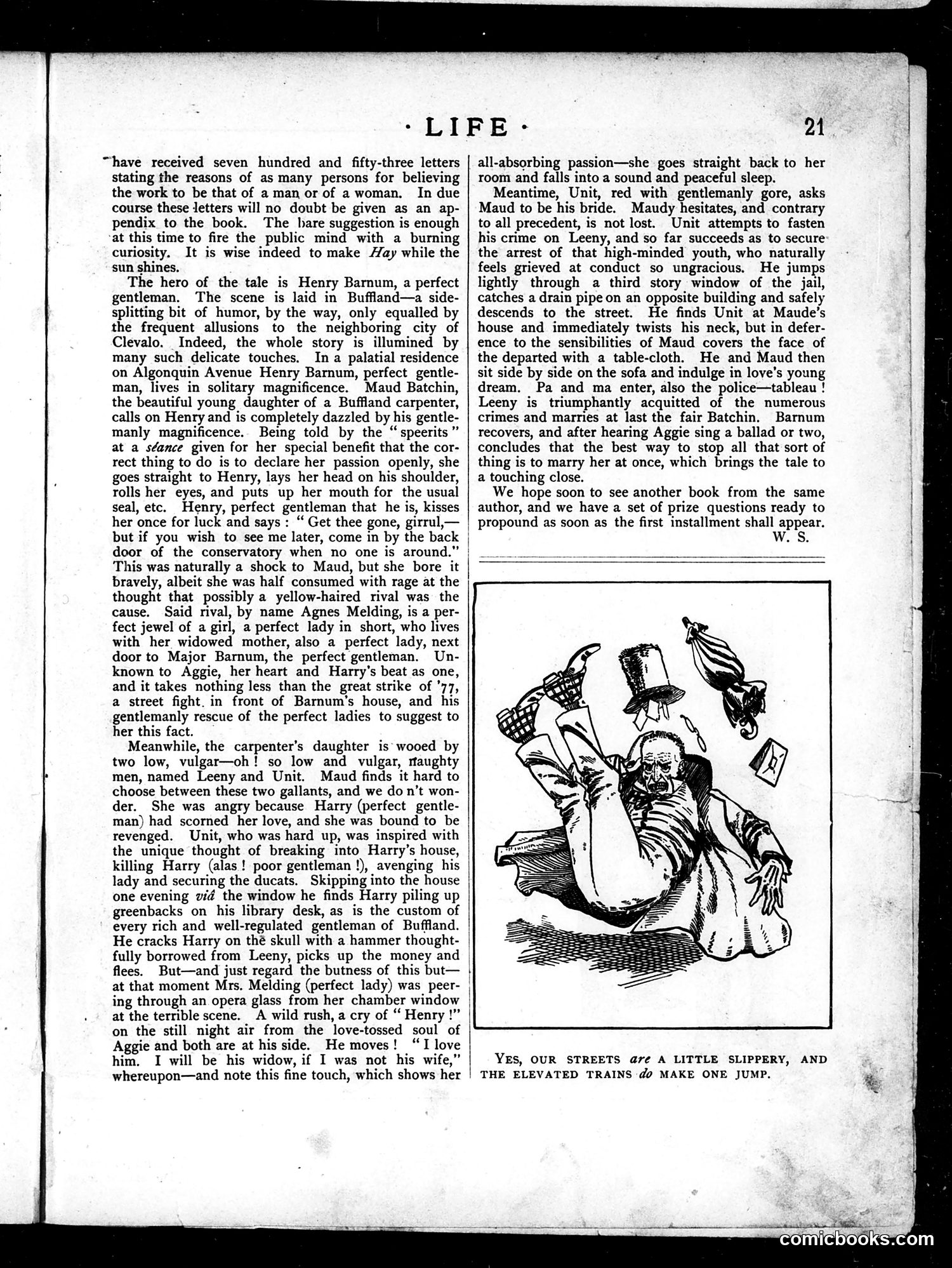
This page contains a serialized story ("Hay") rather than political satire. The narrative follows Henry Barnum, described as a "perfect gentleman," and his interactions with Maud Batchin and rivals for her affection. The single illustration shows a comedic domestic scene: a woman (likely Maud) appears startled or distressed, with various objects flying about her—suggesting physical chaos or slapstick humor. The caption below reads: "Yes, our streets *are* a little slippery, and the elevated trains *do* make one jump." This caption uses irony to comment on urban life hazards (slippery streets and elevated train vibrations), which apparently explains the woman's tumbled state. The humor derives from mundane city inconveniences rather than political commentary. This appears to be entertainment fiction rather than social satire.
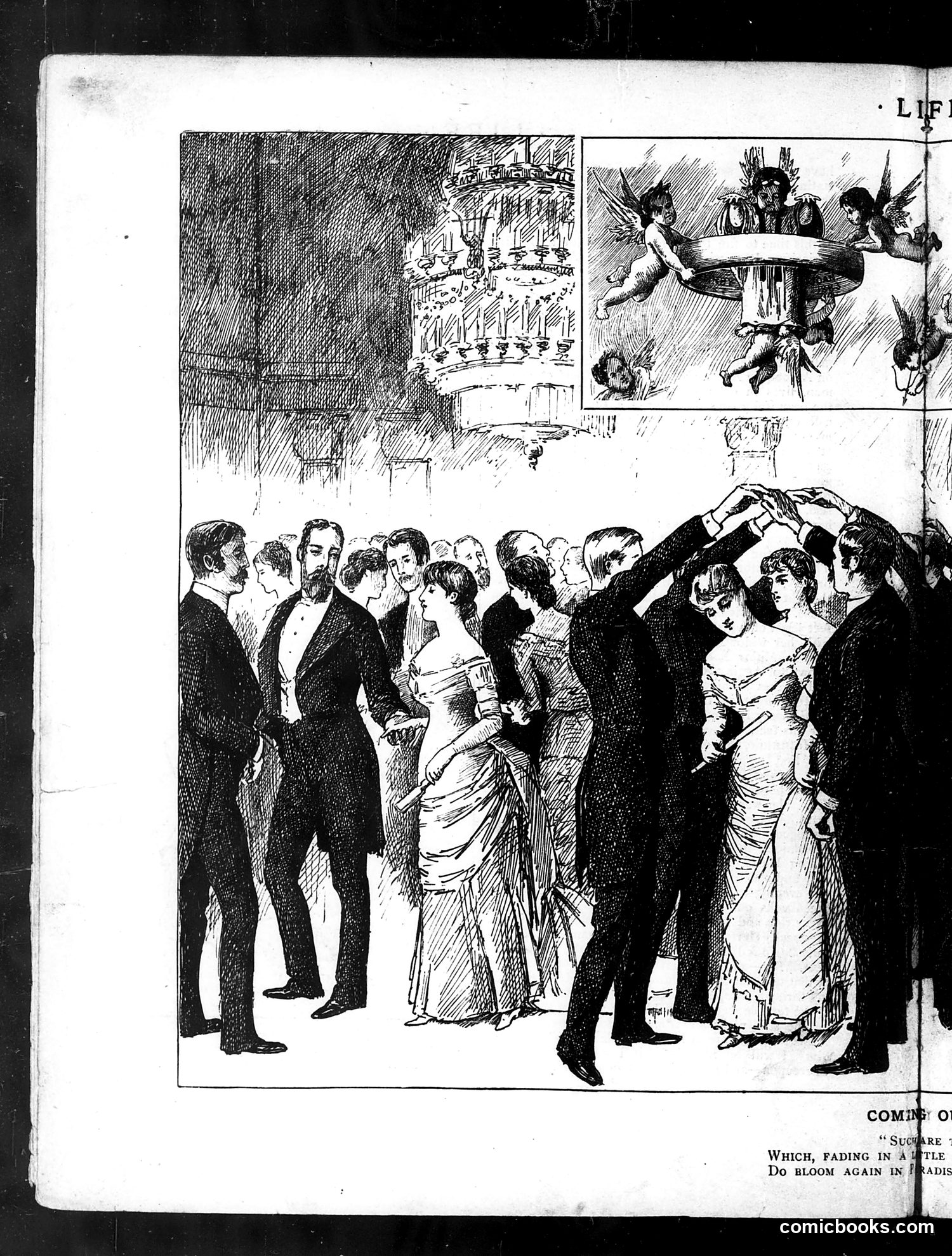
This page contains two satirical illustrations about high society and the supernatural. The lower cartoon depicts an elegant formal gathering of well-dressed men and women in what appears to be a mansion ballroom. The caption references "Séance" and mentions something "fading in a title" and "blooming again in paradise"—suggesting this scene mocks the Victorian-era obsession with spiritualism and séances. The upper inset shows cherubs or angels around a table, likely representing the "spiritual" counterpart to the earthly gathering below, satirizing how séance participants believed they communicated with the deceased through mediums. The satire targets the credulity of wealthy society figures who embraced spiritualism as entertainment and supposedly genuine contact with the afterlife—a widespread phenomenon in the late 19th/early 20th century.
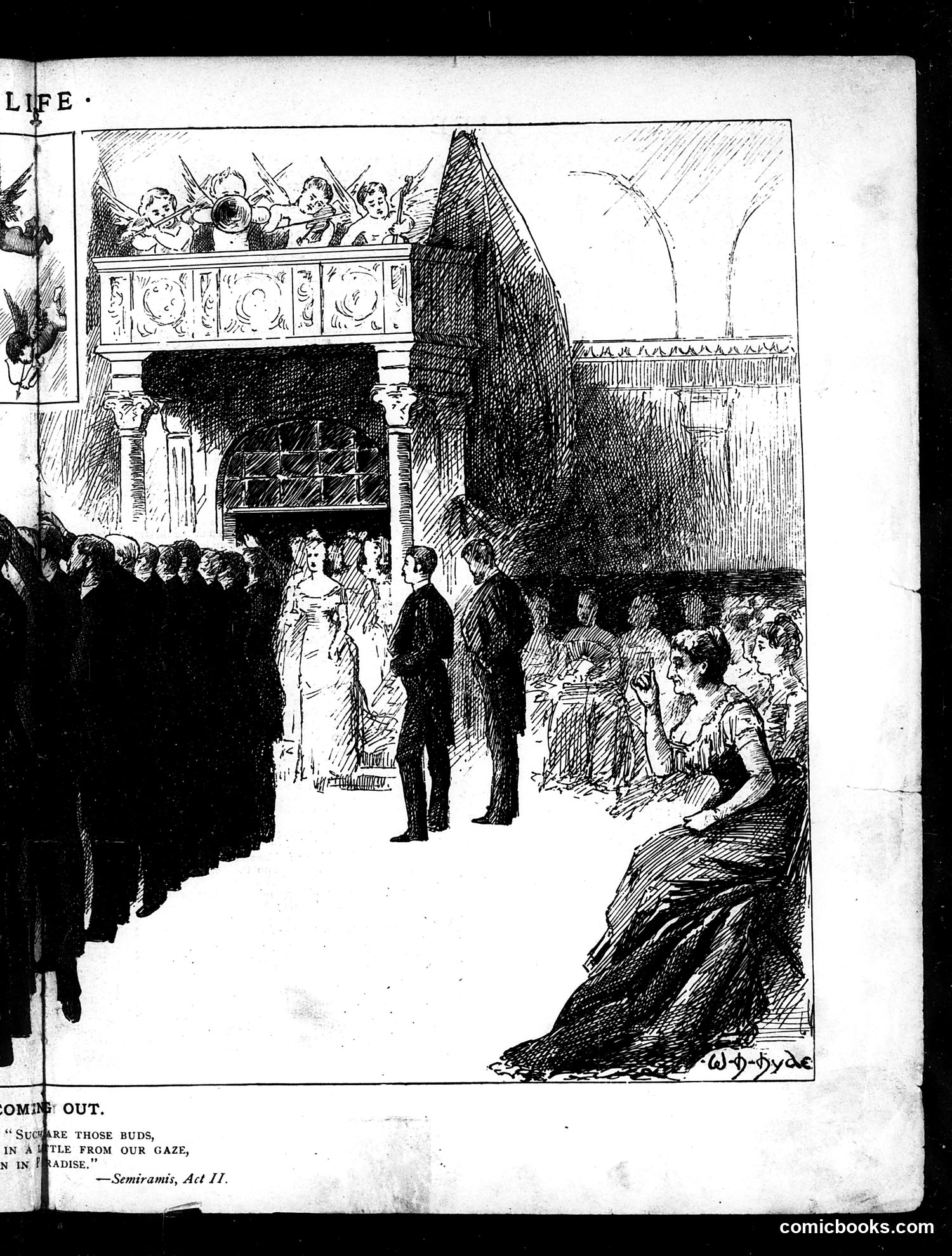
This illustration depicts a formal theatrical or social scene, likely from a Shakespeare production (the caption quotes *Semiramis, Act II*). The cartoon shows a woman in an elaborate white dress at center stage, flanked by two men in dark formal wear, while an audience fills the theater—with spectators notably crowded on the left side in silhouette. The satire appears to target either theatrical pretension or social debutante culture, where young women were formally "presented" to society. The cramped, enthusiastic audience suggests mockery of the overwrought attention given to such "coming out" events. The specific theatrical reference adds layers of commentary on performance, artifice, and society's obsession with formal social rituals.
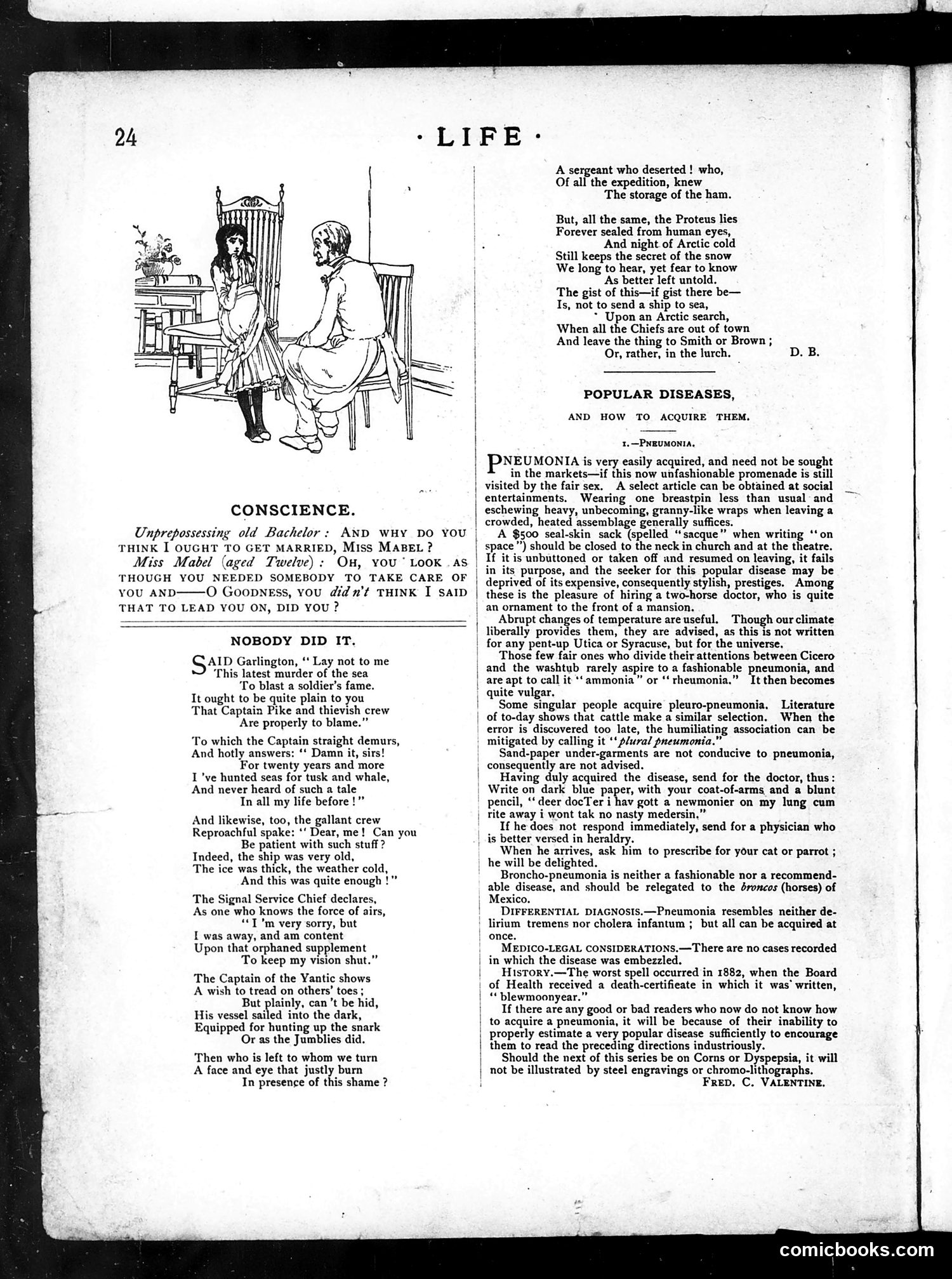
This page contains two distinct satirical pieces from 19th-century *Life* magazine: **"Conscience" cartoon** (top): A social satire showing an awkward encounter between an unprepossessing bachelor and a twelve-year-old girl (Miss Mabel). The humor derives from the child's blunt, practical response to his marriage proposal—she suggests he needs care but immediately disclaims any romantic intent, deflating his ego with devastating directness. **"Nobody Did It" poem**: A lengthy verse satirizing the Franklin Expedition or similar Arctic disaster, where responsibility for a catastrophe gets diffused among absent officials, nervous captains, and conveniently unavailable administrators. The joke is that everyone deflects blame until only "a sergeant who deserted" remains accountable—the least powerful figure. It mocks bureaucratic buck-passing. **"Popular Diseases" article**: Pseudo-medical satire ridiculing fashionable women who deliberately court pneumonia through inadequate winter clothing as a status symbol (hiring expensive doctors becomes a social display). The humor targets vanity and conspicuous consumption among the wealthy.
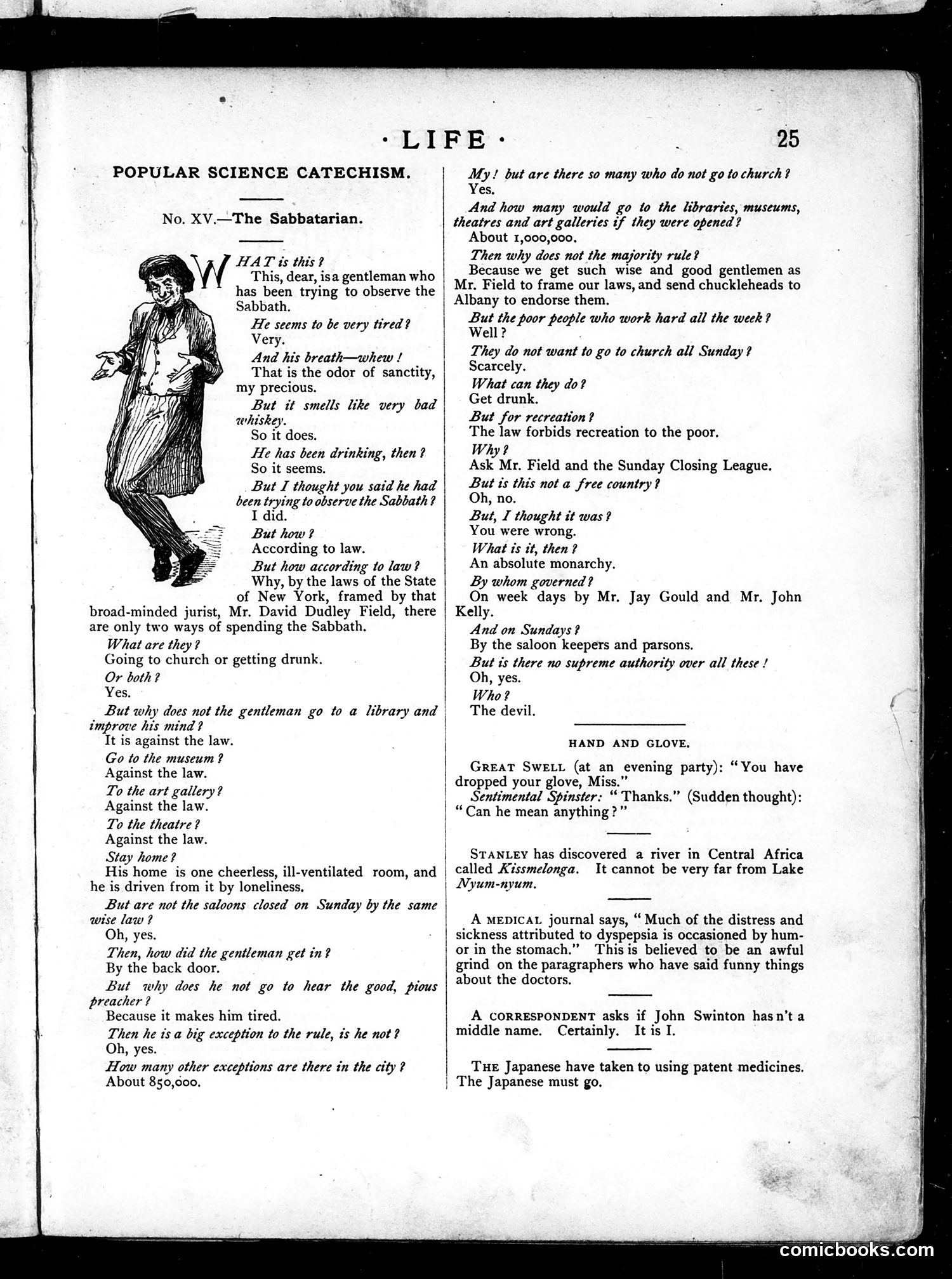
This is a scathing critique of New York's Sabbath laws, specifically those championed by jurist **David Dudley Field**. The cartoon depicts a drunk man who embodies the absurd contradiction these laws created. **The satire's point:** New York law permitted only two Sunday activities—church or getting drunk—while prohibiting libraries, museums, theaters, and art galleries. The poor, unable to afford church or improve themselves culturally, were effectively forced to saloon-drinking. **The targets:** Field and the "Sunday Closing League" (a religious reform movement) are mocked for their hypocrisy: they claimed moral authority while their laws actually *encouraged* drunkenness among working people. The closing section's dark joke—that the devil governs Sundays—suggests religious reformers have created the opposite of their stated goals. This reflects 1880s-90s tensions between Protestant moral legislation and urban working-class leisure, portraying such laws as tyrannical rather than righteous.
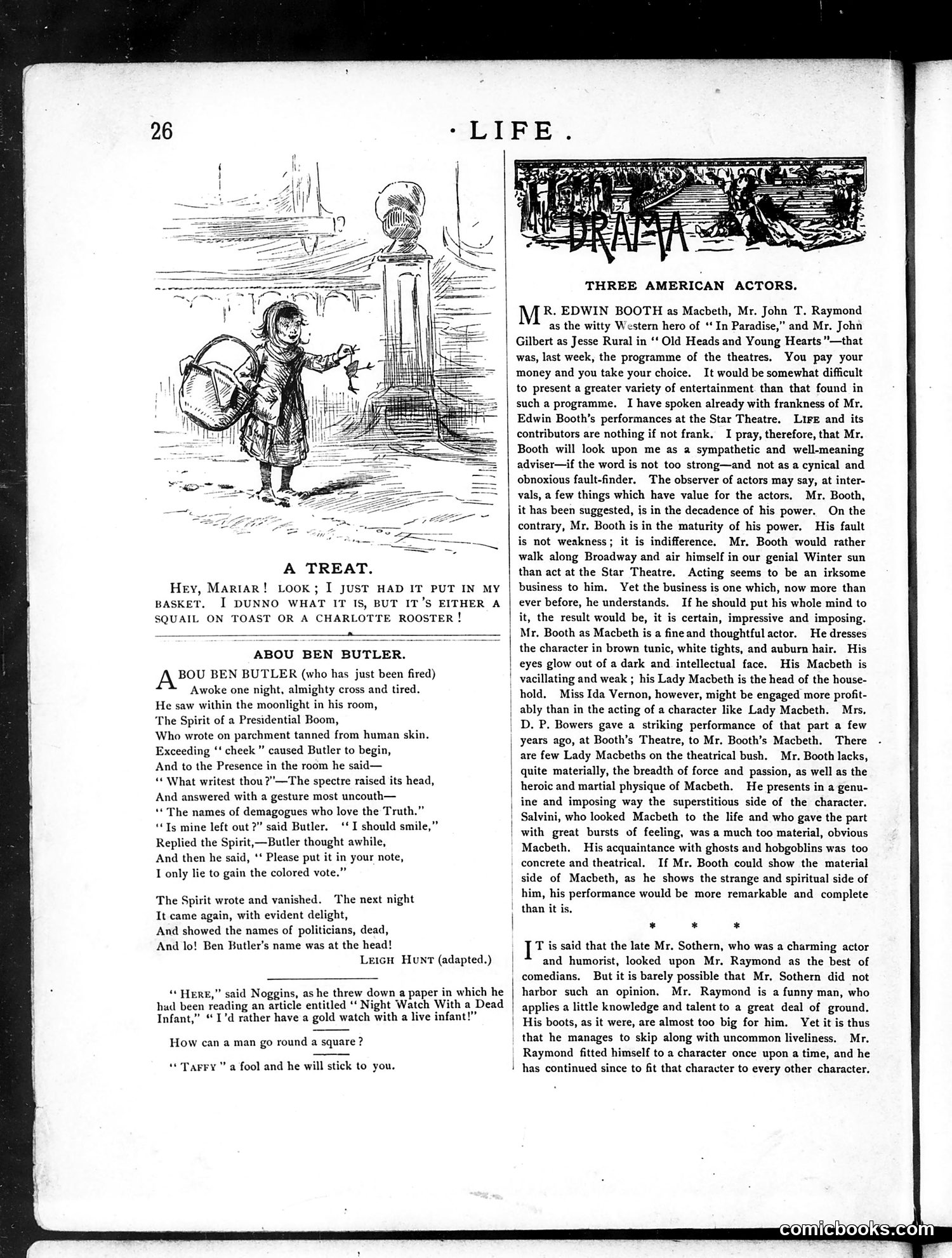
This page from *Life* magazine contains three satirical pieces: **"A Treat"** (top left): A joke about a servant who received something mysterious in a basket—either "squail on toast" or "charlotte rooster"—playing on unclear culinary terminology for humorous effect. **"Abou Ben Butler"** (left): A political satire mocking General Benjamin Butler, a controversial Union general and politician. The poem portrays him as a corrupt opportunist who cynically admits to lying "to gain the colored vote"—satirizing his opportunistic political appeals while suggesting insincerity toward Black voters. **"Three American Actors"** (right): A theater review discussing Edwin Booth's Macbeth performance. The critic argues Booth possesses talent but lacks engagement, preferring to walk Broadway rather than fully commit to acting. This is favorable-critical commentary on a celebrated actor's apparent indifference to his craft. The page mixes political mockery with cultural commentary typical of *Life*'s satirical approach.
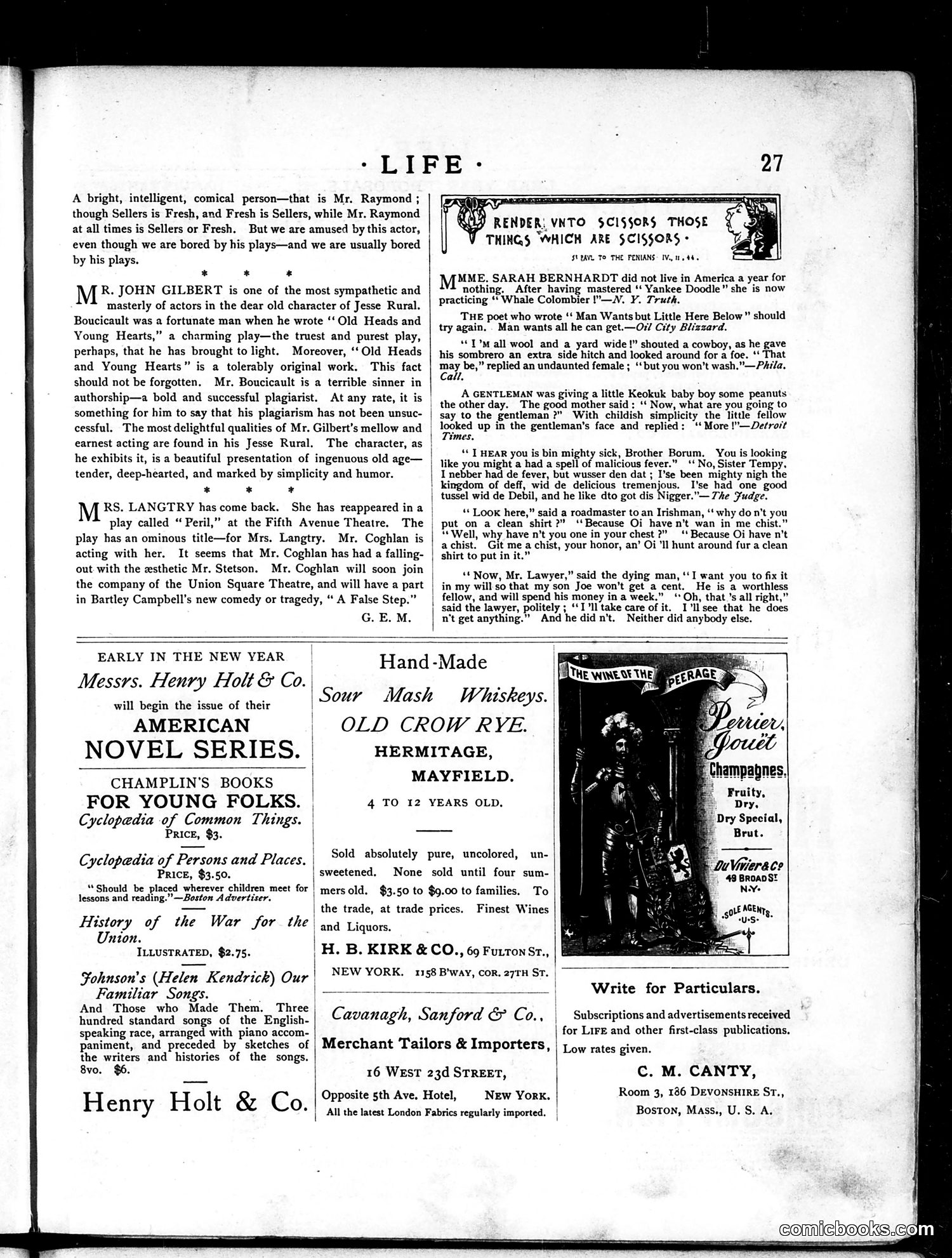
This page is primarily **theatrical criticism and humorous anecdotes**, not political cartoons. The main content reviews actors (Raymond, John Gilbert, Mrs. Langtry) performing in contemporary plays, praising their performances with specific examples. The small cartoon at top—"Render unto Scissors Those Things Which Are Scissors"—appears to be a visual pun about scissors, likely mocking pretentiousness or misapplication of effort. The bulk of the page consists of **short comedic anecdotes** targeting various groups: a Keokuk baby, an Irishman's dialect humor, racist stereotypes in depictions of Black characters ("Brother Borum," "Sister Tempy"), and a dying man's sardonic lawyer interaction. These reflect period standards of "humor" that modern readers would recognize as offensive ethnic and racial stereotyping. The lower half contains **advertisements** for books, whiskeys, and tailoring services. The satirical intent is entertainment through character sketches and theatrical commentary rather than political critique.
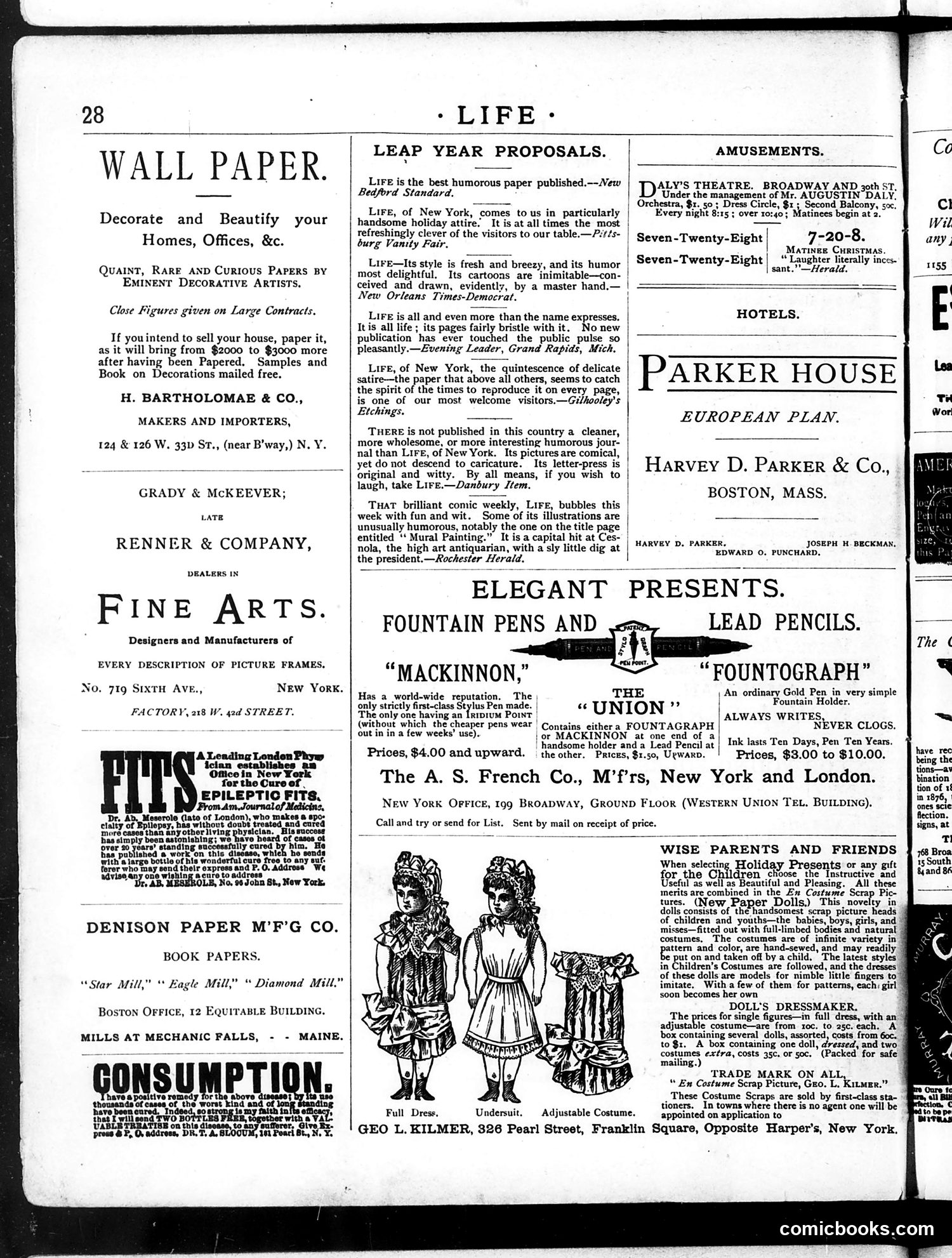
This is primarily a **commercial advertising page** from Life magazine, not a political cartoon page. The content consists almost entirely of paid advertisements for products and services typical of the late 19th century. The page includes ads for wallpaper, picture frames, medical treatments (epilepsy cure, consumption remedy), writing instruments (fountain pens, pencils), hotels, and paper mills. There is a small section titled "LEAP YEAR PROPOSALS" which contains **testimonials praising Life magazine itself**—quotes from other publications celebrating its humor, satire, and cartoons. The only reference to actual content appears to be a mention of a cartoon on the title page called "Mural Painting," described as "a capital hit at Cesnola, the high art antiquarian, with a sly little dig at the President," but this cartoon is not visible on this particular page. **In summary:** This is a advertisements-heavy page with no visible political satire or cartoons to analyze.
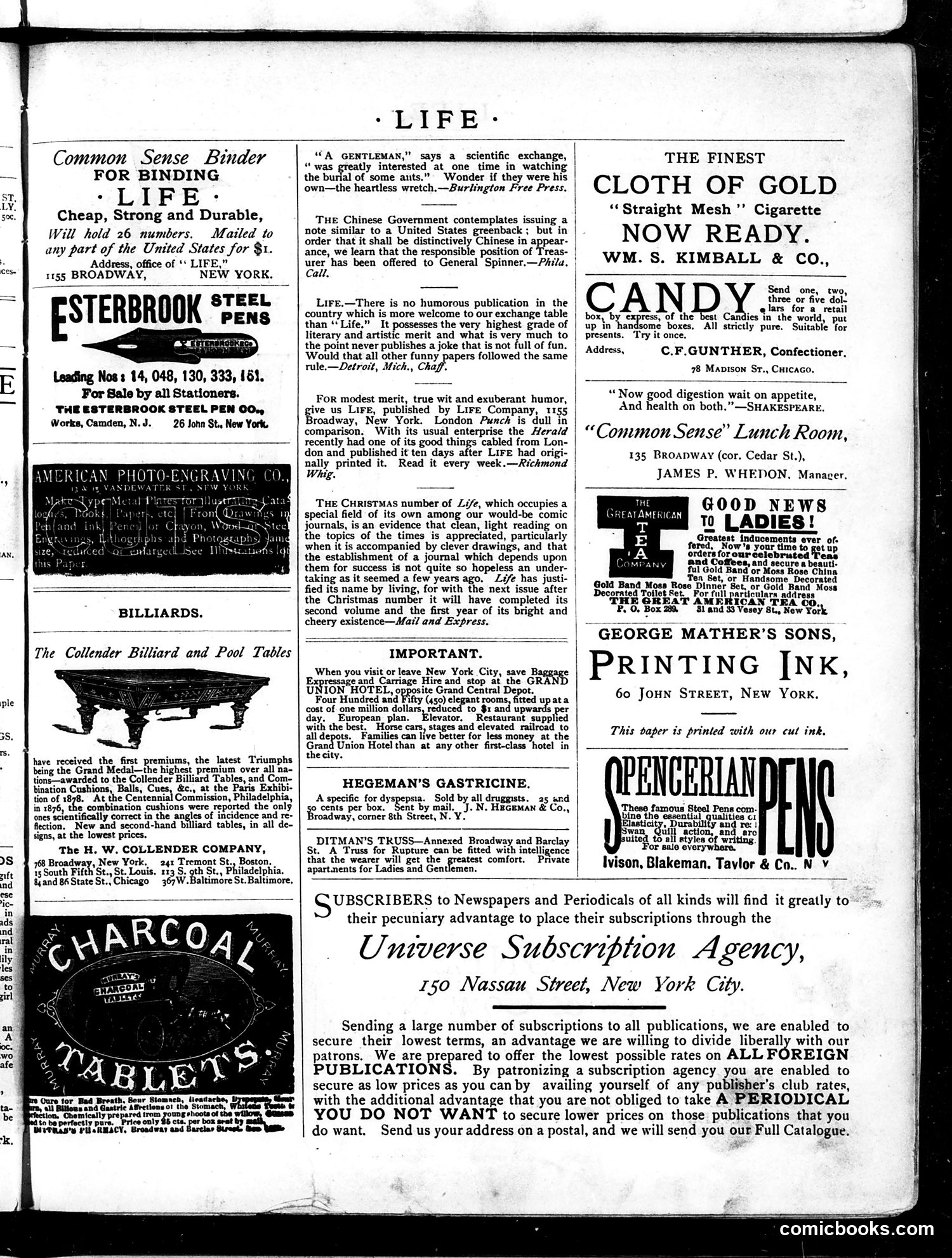
This page is primarily **advertisements and promotional puffery** rather than satirical content. The text includes self-congratulatory excerpts from other newspapers praising *Life* magazine itself—describing it as superior to rival *Punch*, clean and clever, with "modest merit" and "exuberant humor." These appear to be **testimonial ads** *Life* published about its own quality. The substantive content consists of brief satirical items: a joke mocking someone who attended "the burial of some aunts" (implying emotional distance), and a quip about the Chinese government offering the U.S. Treasurer position to someone, likely referencing General Spinner—though the specific political reference is **unclear without additional context**. The remainder is **commercial advertising**—binders, pens, billiard tables, hotels, candy, printing ink, and a subscription agency. There are **no visible political cartoons** on this page; it functions as a magazine back matter or filler page mixing self-promotion with advertisements.
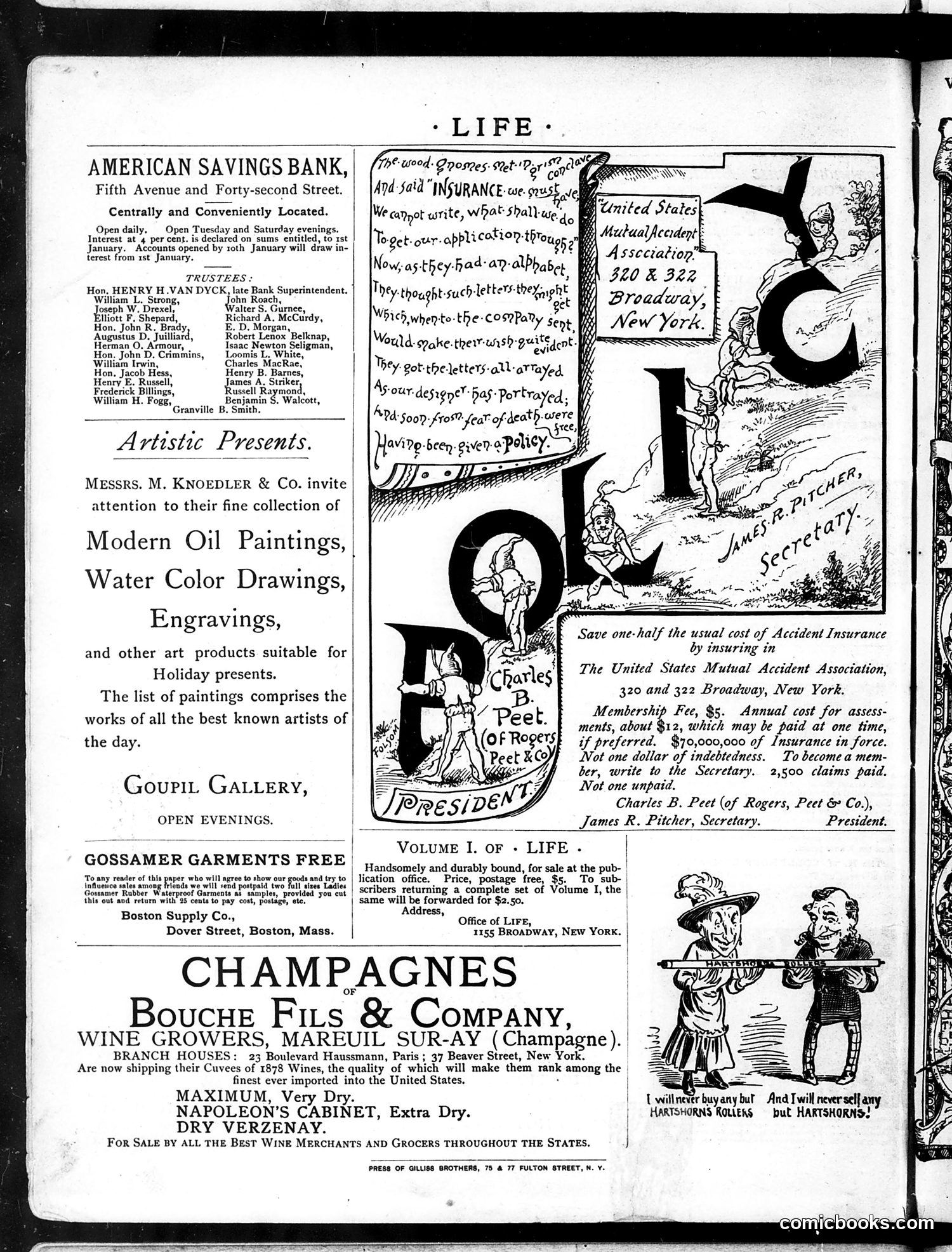
This is primarily an advertising page from *Life* magazine, with a small satirical cartoon embedded in the insurance company advertisement. The main cartoon depicts the "United States Mutual Accident Association" mascot—a figure labeled "James R. Pitcher, Secretary" alongside "Charles B. Peet...President." The cartoon illustrates the insurance company's pitch humorously: it shows figures receiving insurance letters, with text suggesting the company promises protection and efficiency ("they got the letters all arranged / As our designer has portrayed"). The satire appears gentle—poking fun at the insurance company's bureaucratic processes and formal correspondence rather than attacking it. The cartoon's central joke seems to be that the company is so well-organized and systematic that even receiving insurance paperwork becomes a comedic spectacle. The page otherwise consists of bank advertisements, art gallery notices, champagne promotions, and other commercial offerings typical of the era, with no additional political content visible.