
Life, 1884-01-10 · page 12 of 16
Life — January 10, 1884 — page 12: what you’re looking at
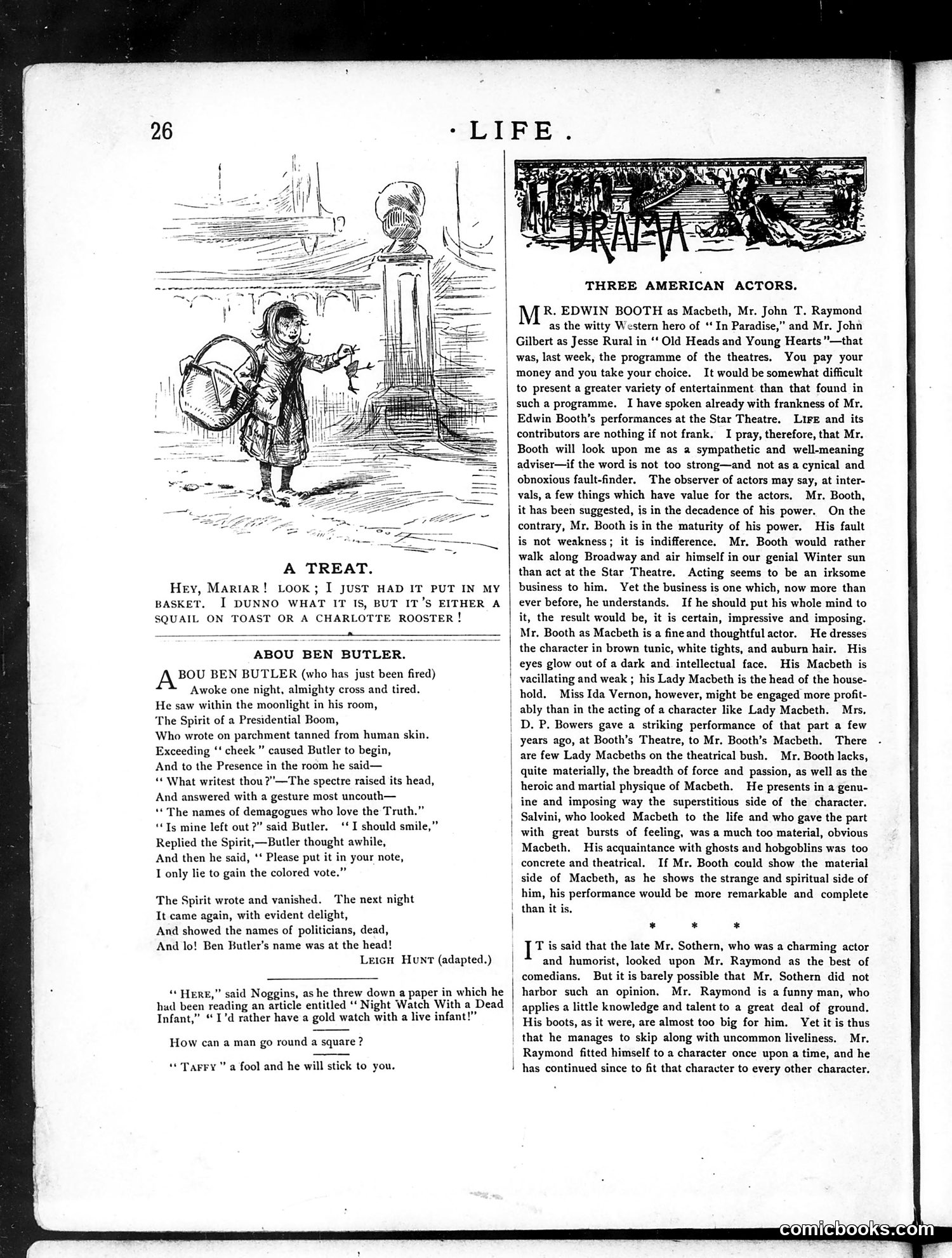
What you’re looking at
This page from *Life* magazine contains three satirical pieces: **"A Treat"** (top left): A joke about a servant who received something mysterious in a basket—either "squail on toast" or "charlotte rooster"—playing on unclear culinary terminology for humorous effect. **"Abou Ben Butler"** (left): A political satire mocking General Benjamin Butler, a controversial Union general and politician. The poem portrays him as a corrupt opportunist who cynically admits to lying "to gain the colored vote"—satirizing his opportunistic political appeals while suggesting insincerity toward Black voters. **"Three American Actors"** (right): A theater review discussing Edwin Booth's Macbeth performance. The critic argues Booth possesses talent but lacks engagement, preferring to walk Broadway rather than fully commit to acting. This is favorable-critical commentary on a celebrated actor's apparent indifference to his craft. The page mixes political mockery with cultural commentary typical of *Life*'s satirical approach.
📄 Transcribed text from this page (OCR, searchable)
Machine-transcribed from the original scan — historical spelling and the odd misread are preserved.
A TREAT. Hey, MariaR! LOOK; I JuST HAD IT PUT IN MY BASKET. I DUNNO WHAT IT IS, BUT IT’S EITHER A SQUAIL ON TOAST OR A CHARLOTTE ROOSTER ! ABOU BEN BUTLER. Aru BEN BUTLER (who has just been fired) Awoke one night, almighty cross and tired. He saw within the moonlight in his room, The Spirit of a Presidential Boom, Who wrote on parchment tanned from human skin. | eyes glow out of a dark and intellectual face. | vacillating and weak ; his Lady Macbeth is the head of the house- Exceeding ‘‘ cheek ” caused Butler to begin, And to the Presence in the room he said— «What writest thou ?”—The spectre raised its head, And answered with a gesture most uncouth— “The names of demagogues who love the Truth.” “Is mine left out ?” said Butler. ‘‘ I should smile,” Replied the Spirit,—Butler thought awhile, And then he said, ‘‘ Please put it in your note, I only lie to gain the colored vote.” The Spirit wrote and vanished. The next night It came again, with evident delight, And showed the names of politicians, dead, And lo! Ben Butler’s name was at the head! LeicH Hunt (adapted.) | had been reading an article entitled ‘‘ Night Watch With a Dead “ Here,” said Noggins, as he threw down a paper in which he | | Infant,” “I'd rather have a gold watch with a live infant!” | How can a man go round a square? ‘*Tarry ” a fool and he will stick to you. THREE AMERICAN ACTORS. R. EDWIN BOOTH as Macbeth, Mr. John T. Raymond as the witty Western hero of “In Paradise,” and Mr. John Gilbert as Jesse Rural in ‘‘ Old Heads and Young Hearts "—that was, last week, the programme of the theatres. You pay your money and you take your choice. It would be somewhat difficult to present a greater variety of entertainment. than that found in such a programme. I have spoken already with frankness of Mr. Edwin Booth’s performances at the Star Theatre. Lire and its contributors are nothing if not frank, I pray, therefore, that Mr. Booth will look upon me as a sympathetic and well-meaning adviser—if the word is not too strong—and not as a cynical and obnoxious fault-finder. The observer of actors may say, at inter- vals, a few things which have value for the actors. Mr. Booth, it has been suggested, is in the decadence of his power. On the contrary, Mr. Booth is in the maturity of his power. His fault is not weakness; it is indifference. Mr. Booth would rather walk along Broadway and air himself in our genial Winter sun than act at the Star Theatre. Acting seems to be an irksome business to him, Yet the business is one which, now more than ever before, he understands. If he should put his whole mind to it, the result would be, it is certain, impressive and imposing. Mr. Booth as Macbeth is a fineand thoughtful actor. He dresses the character in brown tunic, white tights, and auburn hair. His His Macbeth is hold. Miss Ida Vernon, however, might be engaged more profit- ably than in the acting of a character like Lady Macbeth. Mrs, D. P. Bowers gave a striking performance of that part a few years ago, at Booth’s Theatre, to Mr. Booth’s Macbeth. There are few Lady Macbeths on the theatrical bush. Mr. Booth lacks, quite materially, the breadth of force and passion, as well as the heroic and martial physique of Macbeth. He presents in a genu- ine and imposing way the superstitious side of the character. Salvini, who looked Macbeth to the life and who gave the part | with great bursts of feeling, was a much too material, obvious Macbeth. His acquaintance with ghosts and hobgoblins was too concrete and theatrical. If Mr. Booth could show the material side of Macbeth, as he shows the strange and spiritual side of him, his performance would be more remarkable and complete than it is. * * * T is said that the late Mr. Sothern, who was a charming actor and humorist, looked upon Mr. Raymond as the best of comedians. But it is barely possible that Mr, Sothern did not harbor such an opinion, Mr. Raymond is a funny man, who applies a little knowledge and talent to a great deal of ground. His boots, as it were, are almost too big for him. Yet it is thus that he manages to skip along with uncommon liveliness. Mr. Raymond fitted himself to a character once upon a time, and he has continued since to fit that character to every other character.