
Life, 1884-01-10 · page 7 of 16
Life — January 10, 1884 — page 7: what you’re looking at
What you’re looking at
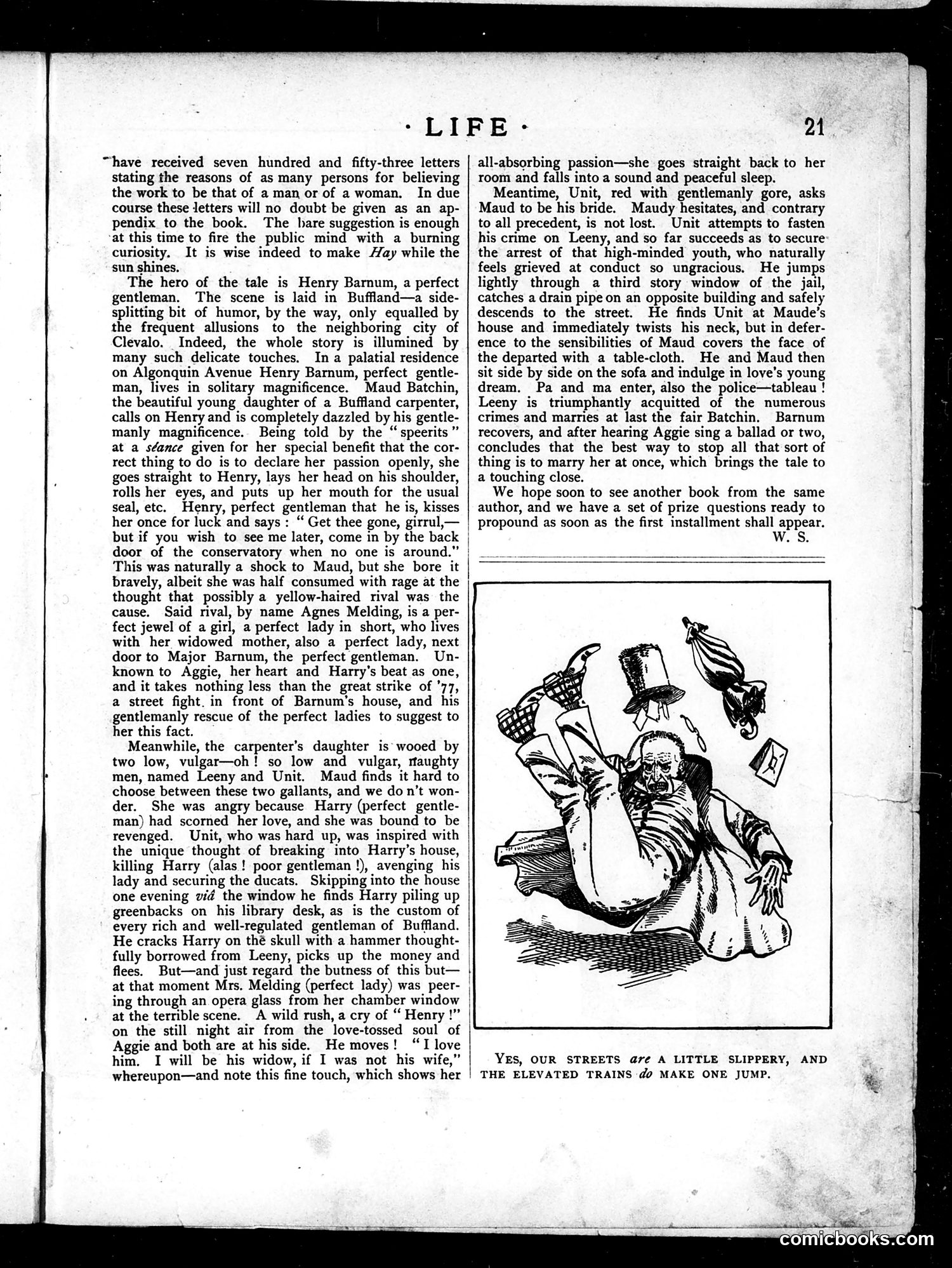
This page contains a serialized story ("Hay") rather than political satire. The narrative follows Henry Barnum, described as a "perfect gentleman," and his interactions with Maud Batchin and rivals for her affection. The single illustration shows a comedic domestic scene: a woman (likely Maud) appears startled or distressed, with various objects flying about her—suggesting physical chaos or slapstick humor. The caption below reads: "Yes, our streets *are* a little slippery, and the elevated trains *do* make one jump." This caption uses irony to comment on urban life hazards (slippery streets and elevated train vibrations), which apparently explains the woman's tumbled state. The humor derives from mundane city inconveniences rather than political commentary. This appears to be entertainment fiction rather than social satire.
📄 Transcribed text from this page (OCR, searchable)
Machine-transcribed from the original scan — historical spelling and the odd misread are preserved.
- LIFE - “have received seven hundred and fifty-three letters stating the reasons of as many persons for believing the work to be that of a man or of a woman. In due course these letters will no doubt be given as an ap- pendix to the book. The hare suggestion is enough at this time to fire the public mind with a burning curiosity. It is wise indeed to make Hay while the sun shines. The hero of the tale is Henry Barnum, a perfect gentleman. The scene is laid in Buffland—a side- splitting bit of humor, by the way, only equalled by the frequent allusions to the neighboring city of Clevalo. Indeed, the whole story is illumined by many such delicate touches. In a palatial residence on Algonquin Avenue Henry Barnum, perfect gentle- man, lives in solitary magnificence. Maud Batchin, the beautiful young daughter of a Buffland carpenter, calls on Henry and is completely dazzled by his gentle- manly magnificence. Being told by the “speerits” at a s¢ance given for her special benefit that the cor- rect thing to do is to declare her passion openly, she goes straight to Henry, lays her head on his shoulder, rolls her eyes, and puts up her mouth for the usual seal, etc. Henry, perfect gentleman that he is, kisses her once for luck and says : “ Get thee gone, girrul,— | but if you wish to see me later, come in by the back | door of the conservatory when no one is around.” | This was naturally a shock to Maud, but she bore it bravely, albeit she was half consumed with rage at the thought that possibly a yellow-haired rival was the cause. Said rival, by name Agnes Melding, is a per- fect jewel of a girl, a perfect lady in short, who lives with her widowed mother, also a perfect lady, next door to Major Barnum, the perfect gentleman. Un- known to Aggie, her heart and Harry's beat as one, and it takes nothing less than the great strike of '77, a street fight. in front of Barnum’s house, and his gentlemanly rescue of the perfect ladies to suggest to her this fact. Meanwhile, the carpenter's daughter is: wooed by two low, vulgar—oh! so low and vulgar, rtaughty men, named Leeny and Unit. Maud finds it hard to choose between these two gallants, and we do n’t won- der. She was angry because Harry (perfect gentle- man) had scorned her love, and she was bound to be revenged. Unit, who was hard up, was inspired with the unique thought of breaking into Harry’s house, killing Harry (alas! poor gentleman !), avenging his lady and securing the ducats. Skipping into the house | one evening vid the window he finds Harry piling up greenbacks on his library desk, as is the custom of every rich and well-regulated gentleman of Buffland. | He cracks Harry on thé skull with a hammer thought- | fully borrowed from Leeny, picks up the money and flees. at the terrible scene. A wild rush, a cry of “ Henry on the still night air from the love-tossed soul of | Aggie and both are at his side. He moves! “TI love him. I will be his widow, if I was not his wife,” whereupon—and note this fine touch, which shows her But—and just regard the butness of this but— | at that moment Mrs. Melding (perfect lady) was peer- | ing through an opera glass from her chamber window | vy | 21 all-absorbing passion—she goes straight back to her room and falls into a sound and peaceful sleep. Meantime, Unit, red with gentlemanly gore, asks Maud to be his bride. Maudy hesitates, and contrary to all precedent, is not lost. Unit attempts to fasten his crime on Leeny, and so far succeeds as to secure the arrest of that high-minded youth, who naturally feels grieved at conduct so ungracious. He jumps lightly through a third story window of the jail, catches a drain pipe on an opposite building and safely descends to the street. He finds Unit at Maude’s house and immediately twists his neck, but in defer- ence to the sensibilities of Maud covers the face of the departed with a table-cloth. He and Maud then sit side by side on the sofa and indulge in love's young dream. Pa and ma enter, also the police—tableau ! Leeny is triumphantly acquitted of the numerous crimes and marries at last the fair Batchin. Barnum recovers, and after hearing Aggie sing a ballad or two, concludes that the best way to stop all that sort of thing is to marry her at once, which brings the tale to a touching close. We hope soon to see another book from the same author, and we have a set of prize questions ready to propound as soon as the first installment shall appear. w. S. YEs, OUR STREETS @7v¢ A LITTLE SLIPPERY, AND THE ELEVATED TRAINS do MAKE ONE JUMP.