
A complete issue · 16 pages · 1883
Life — December 13, 1883
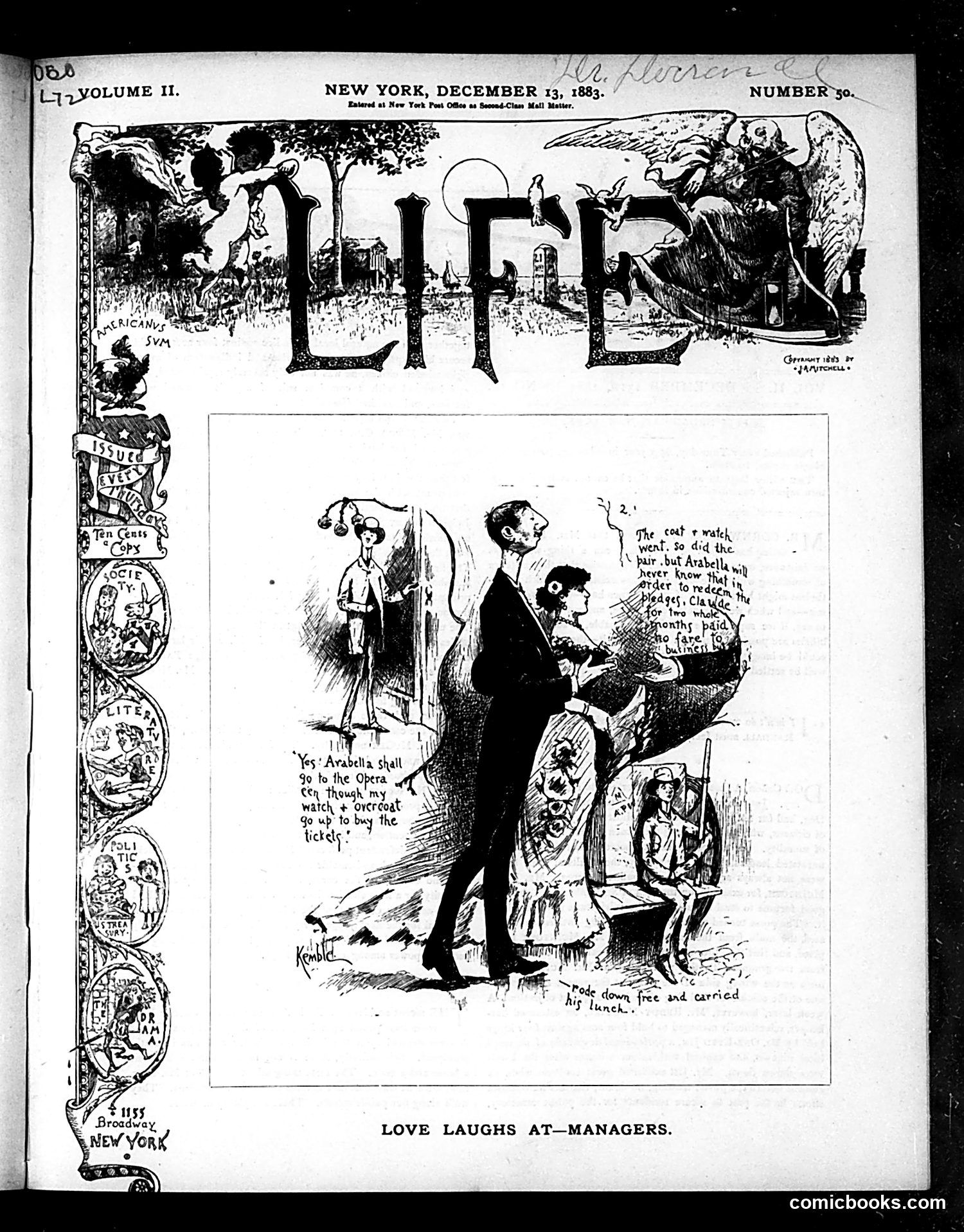
This cartoon satirizes domestic financial dynamics in the 1880s. The sketch shows a well-dressed man (likely representing a husband or suitor) and a woman discussing opera tickets and household finances. The dialogue reveals the satire's point: the man promises to take "Arabella" to the opera "even through my wallet go up to buy the tickets," while a woman responds about costs and unpaid monthly bills. A child holds what appears to be a bill or unpaid invoice. The title "Love Laughs at Managers" suggests that romantic gestures (attending expensive entertainments like opera) humorously override practical financial management and debt obligations—a commentary on how love and desire trump budgeting in household economics. The cartoon mocks both romantic excess and financial irresponsibility.
The page contains satirical commentary on Red Dog, Arizona's judicial reform efforts. The text describes how a posse, composed of citizens with competing interests in horse-raising, attempted to reform the judiciary by removing the judge. The satire criticizes the absurdity of using mob justice to fix judicial problems. It mocks Judge Bartley Smith's removal and replacement, noting that the posse's actions—though motivated by reform—undermined proper legal process. The commentary suggests that citizens with private interests cannot objectively administer justice. The piece uses Red Dog as a humorous example of frontier incompetence, implying that vigilante reform efforts, regardless of good intentions, corrupt rather than improve civic institutions. This reflects broader 1880s anxieties about frontier governance versus established legal systems.
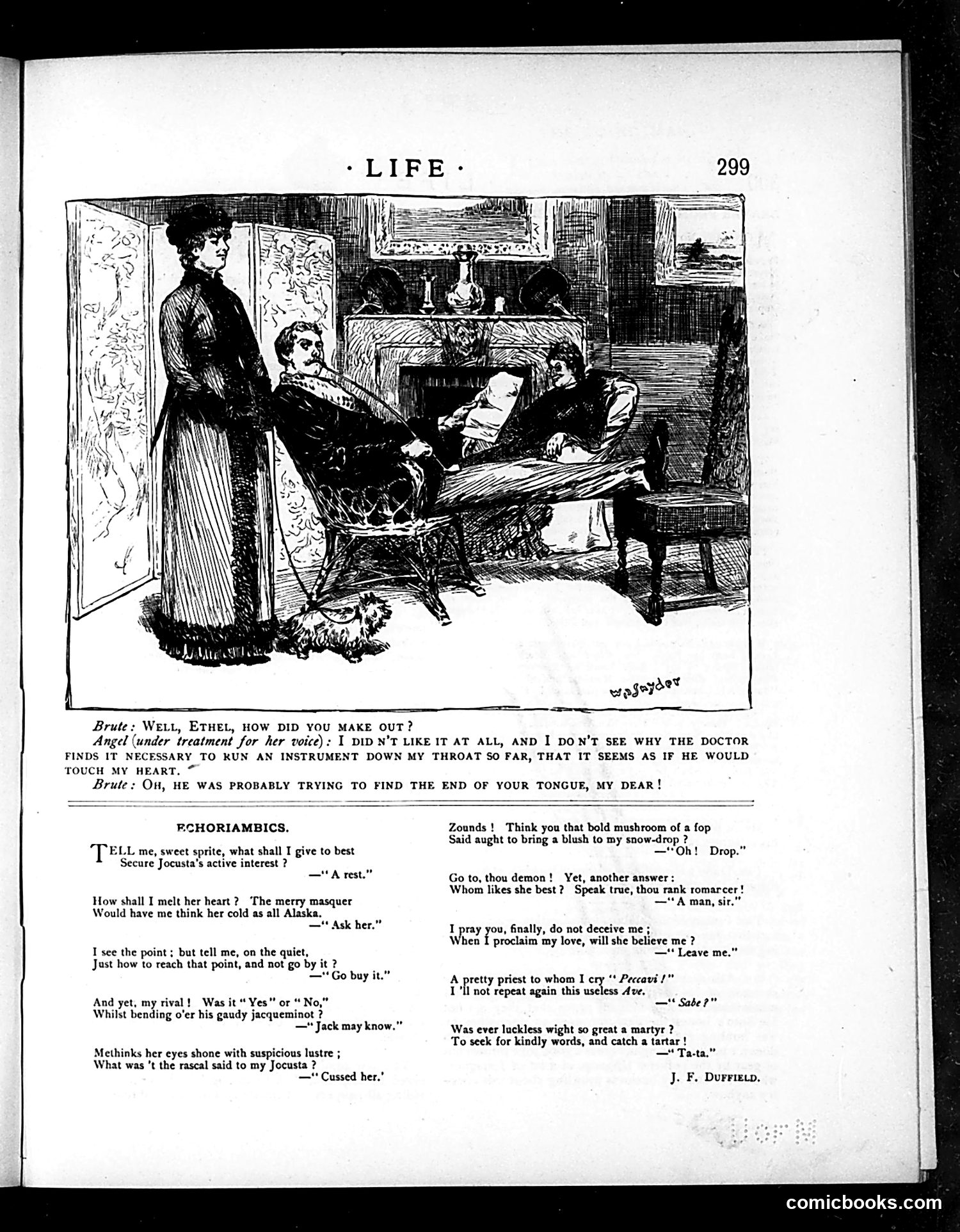
The cartoon depicts a domestic scene with a woman standing, a man in a chair reading, and another figure. The caption shows "Brute" (the man) defending himself against his wife Ethel's complaint about a doctor's throat examination being unnecessarily invasive. The humor relies on a double entendre: Brute claims the doctor was "trying to find the end of your tongue," implying Ethel talks excessively or is argumentative. This plays on a common period trope characterizing nagging wives. Below is "Echoriambics," a poetry section with romantic and cynical verses about courtship and marriage, likely by different contributors (signed J. F. Duffield). The verses mix sentimental language with satirical jabs at love and relationships. The page satirizes marriage dynamics and romantic disappointment through both visual and literary humor typical of early-20th-century Life magazine's domestic satire.
This page from *Life* magazine consists primarily of book reviews and literary commentary rather than political cartoons. The content includes: **"Leaves from the Diary of Henry Irving"** — a humorous diary entry format mocking the famous actor's self-importance and interactions with literary figures like Brahm Stoker. **Book Reviews** — Critical assessments of works including "Mrs. Gilpin's Frugalities," a novel in the "No Name Series," Edgar Fawcett's "An Ambitious Woman," Anthony Comstock's "Traps for the Young," and Bishop Pierce's poetry collection. **Brief satirical notes** — Including commentary on an Arkansas skeleton discovery claim and Massachusetts' decision to stop "skin-tanning" at Tewksbury (likely a poorhouse reference). The page functions as social and literary satire rather than visual political cartooning, using wit to critique contemporary authors, public figures, and social institutions.
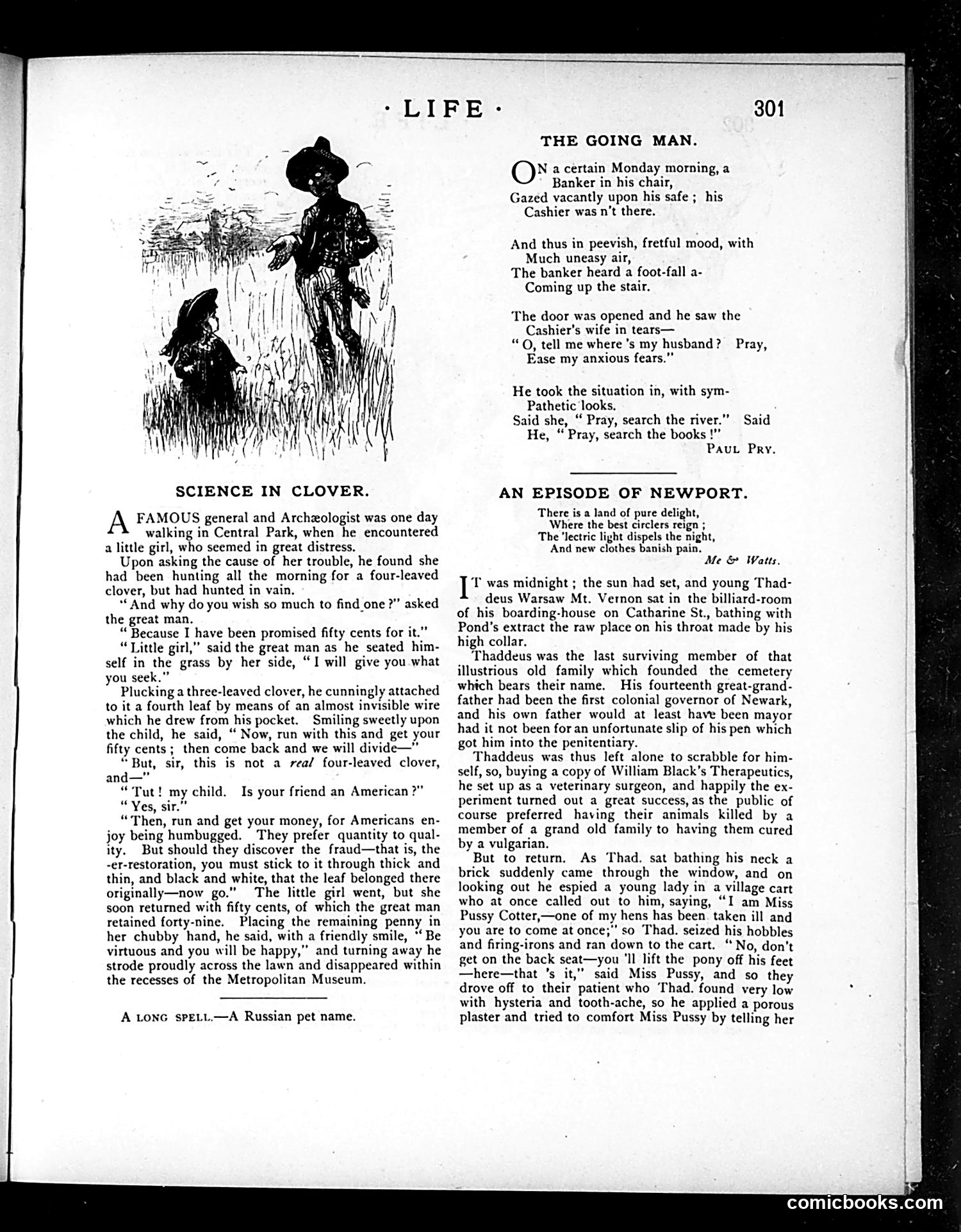
This satirical piece mocks a wealthy, pompous "famous general and Archaeologist" who encounters a poor child searching for a four-leaf clover in Central Park. The humor lies in the class contrast: when the child mentions needing fifty cents (promised as a reward), the general patronizingly offers to buy the clover himself, then lectures her about "real" four-leaf clovers while revealing his own ignorance. The satire targets upper-class pretension and condescension toward working-class people. The general's suggestion that she might be "defrauding" him with a fake clover—combined with his casual retention of "forty-nine" cents—exposes wealthy hypocrisy and dishonesty masked by intellectual authority. The title "Science in Clover" ironically comments on how the privileged invoke expertise to justify exploiting the poor.
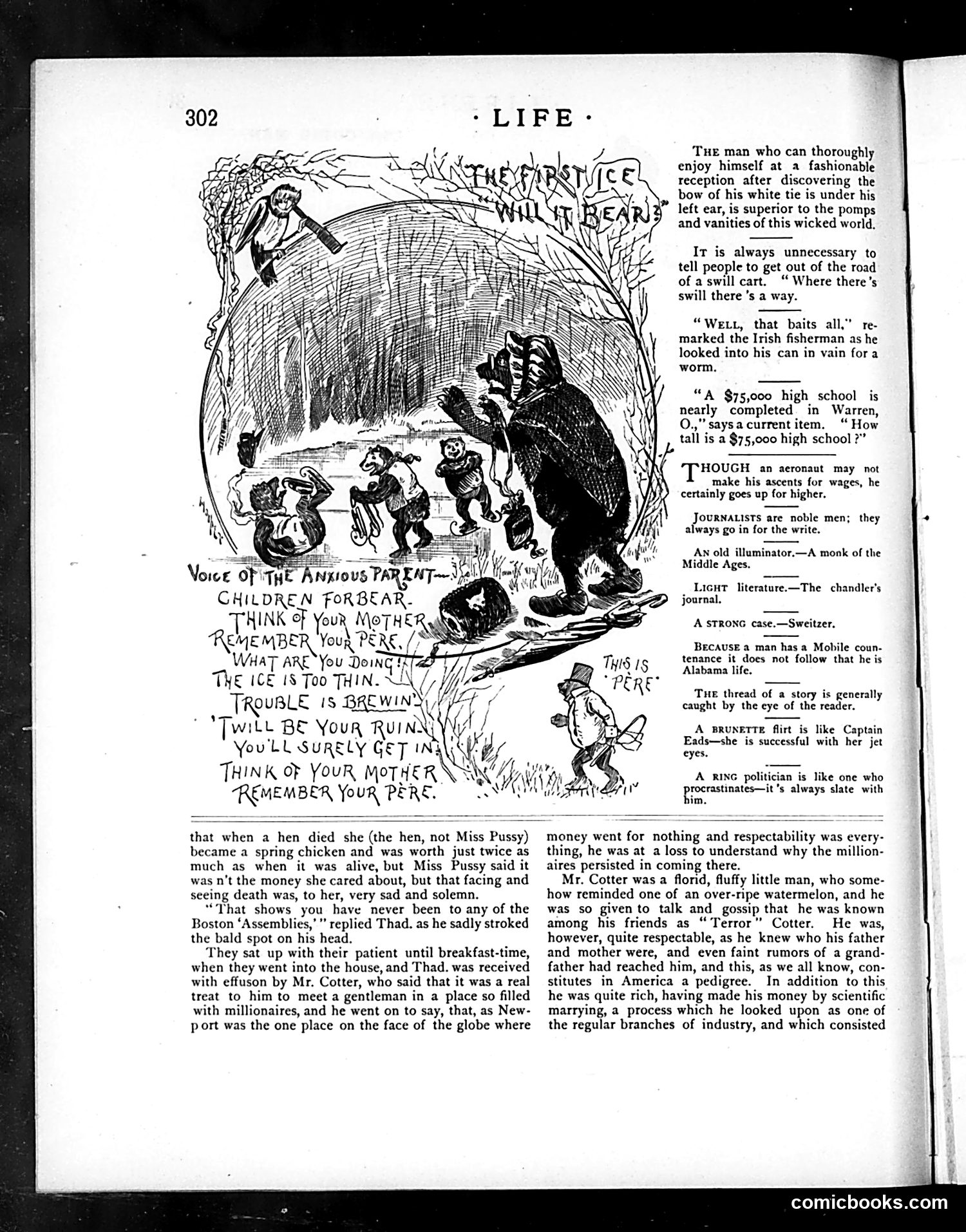
The main cartoon depicts a large bear menacing children huddled in a cave, with an "annoyed parent" warning them about danger. The text reads: "THINK OF YOUR MOTHER / REMEMBER YOUR PERC[?]... THE ICE IS TOO THIN... TROUBLE IS BREWIN'... 'TWILL BE YOUR RUIN'... SURELY GET IN... THINK OF YOUR MOTHER / REMEMBER YOUR PERC." **The bear likely represents a political threat or danger** (possibly war, economic collapse, or a foreign power), while the children represent citizens or a nation. The "annoyed parent" voice warns of various perils—thin ice, brewing trouble, financial ruin—using maternal concern as rhetorical appeal. The surrounding text contains light satirical observations about society, including quips about journalists, politicians, and fashionable society—typical of Life's general commentary style. The specific political reference remains unclear without additional historical context.
This page contains no cartoon or political satire. Instead, it presents two distinct literary sections: 1. **Left column**: A story excerpt by Roland King about wealthy characters—Mrs. De Ramm, Miss Pussy, and Thad—navigating high society. The narrative satirizes social pretension, focusing on marriage prospects and wealth among the English aristocracy. 2. **Right column**: "The Book of Books," a poem by Charles F. Lummis praising reading and literature, followed by a brief humorous exchange labeled "Amateur Flutist" about playing music too fast, resulting in family deaths from apoplexy (stroke). The page is primarily literary content rather than visual satire, typical of Life magazine's mixed format combining fiction, poetry, and humor.
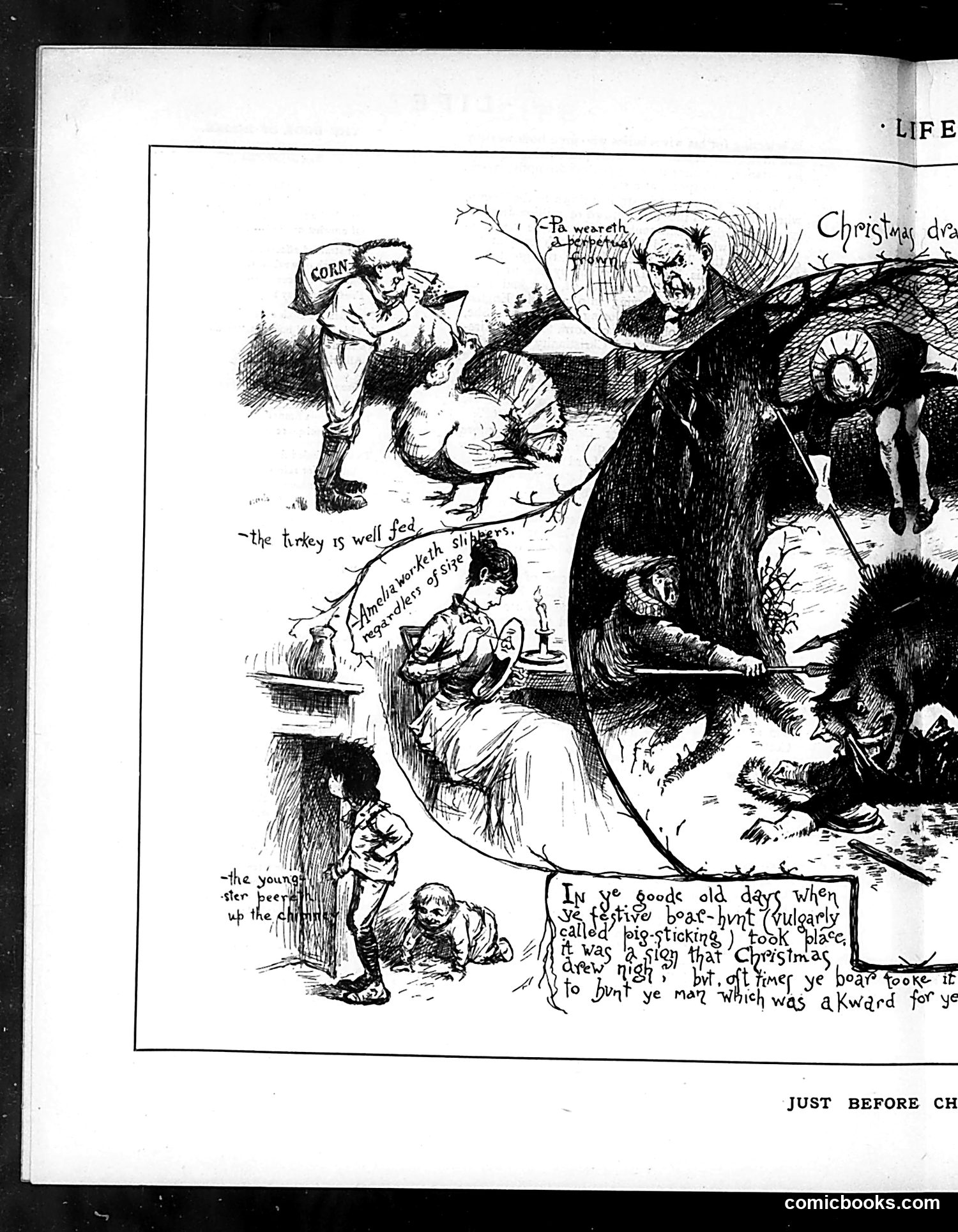
This appears to be a Christmas-themed satirical cartoon from Life magazine. The visible text references "the turkey is well fed" and mentions "Christmas dra[wing]" in the header. The cartoon depicts what seems to be a social commentary on Christmas traditions and class differences. A large, well-fed figure (possibly representing wealth or authority) is contrasted with smaller figures below, including children. One caption references "old days when ye festive boat-hunts" and "pig-sticking," suggesting nostalgia for aristocratic hunting traditions. The satire appears to critique the disconnect between wealthy Christmas celebrations and the conditions of working-class or poor families during the holiday season. The specific political figures or events referenced remain unclear from the visible text and imagery alone.
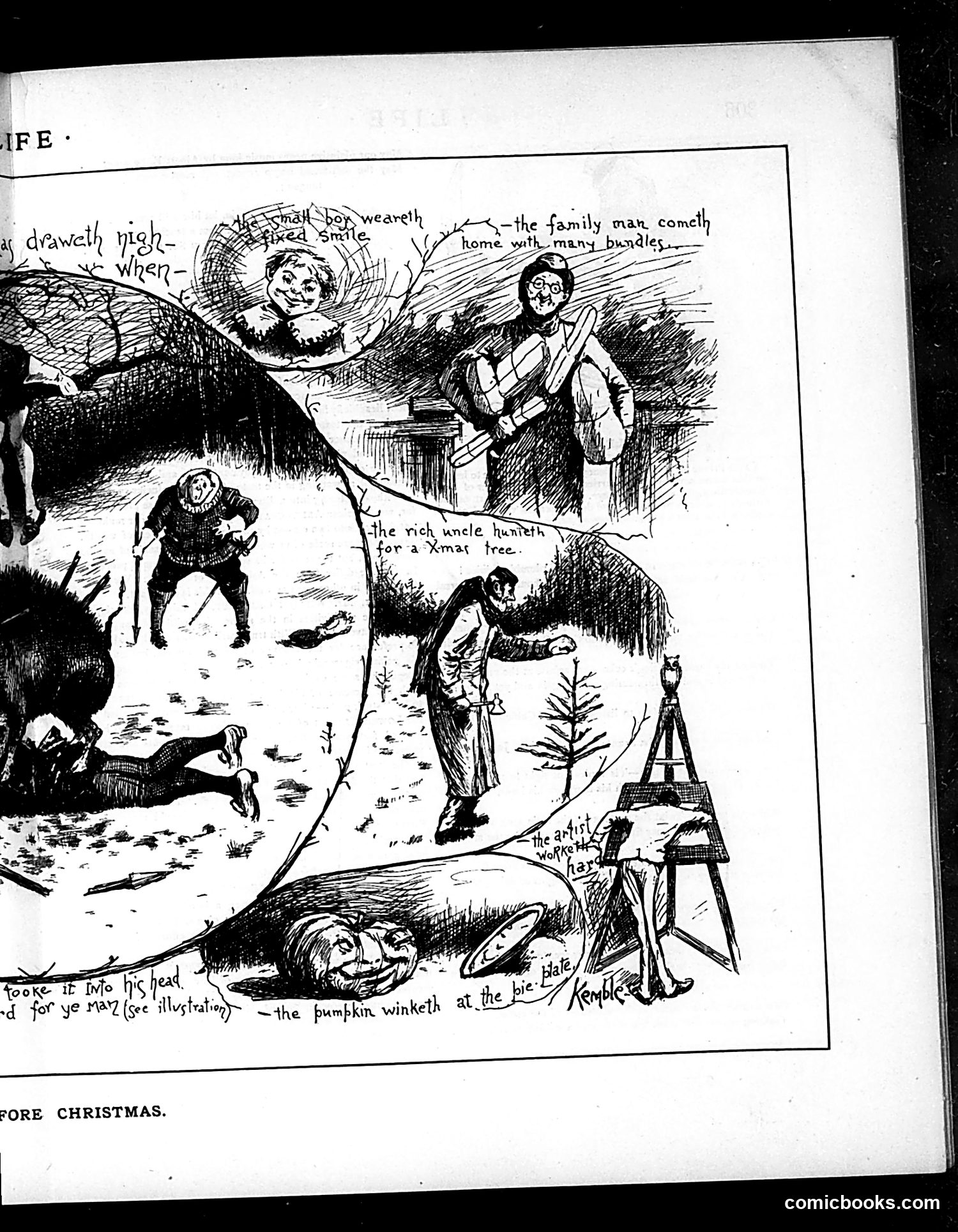
This single-panel cartoon depicts a Christmas shopping scene with class-based satire. The image shows: - **Upper panel**: A wealthy family (the "family man") returning home with "many bundles," suggesting extravagant holiday spending - **Middle section**: A "rich uncle" selecting an expensive Christmas tree - **Lower section**: Working-class figures, including someone labeled "the smith" and reference to "the pumpkin winketh at the big gate," depicting poorer people's modest circumstances The cartoon contrasts wealthy families' lavish Christmas preparations with the struggles of working-class citizens during the same holiday season. The sketchy, detailed illustration style emphasizes the social disparity. The title "Before Christmas" suggests this depicts pre-holiday economic inequality in American society.
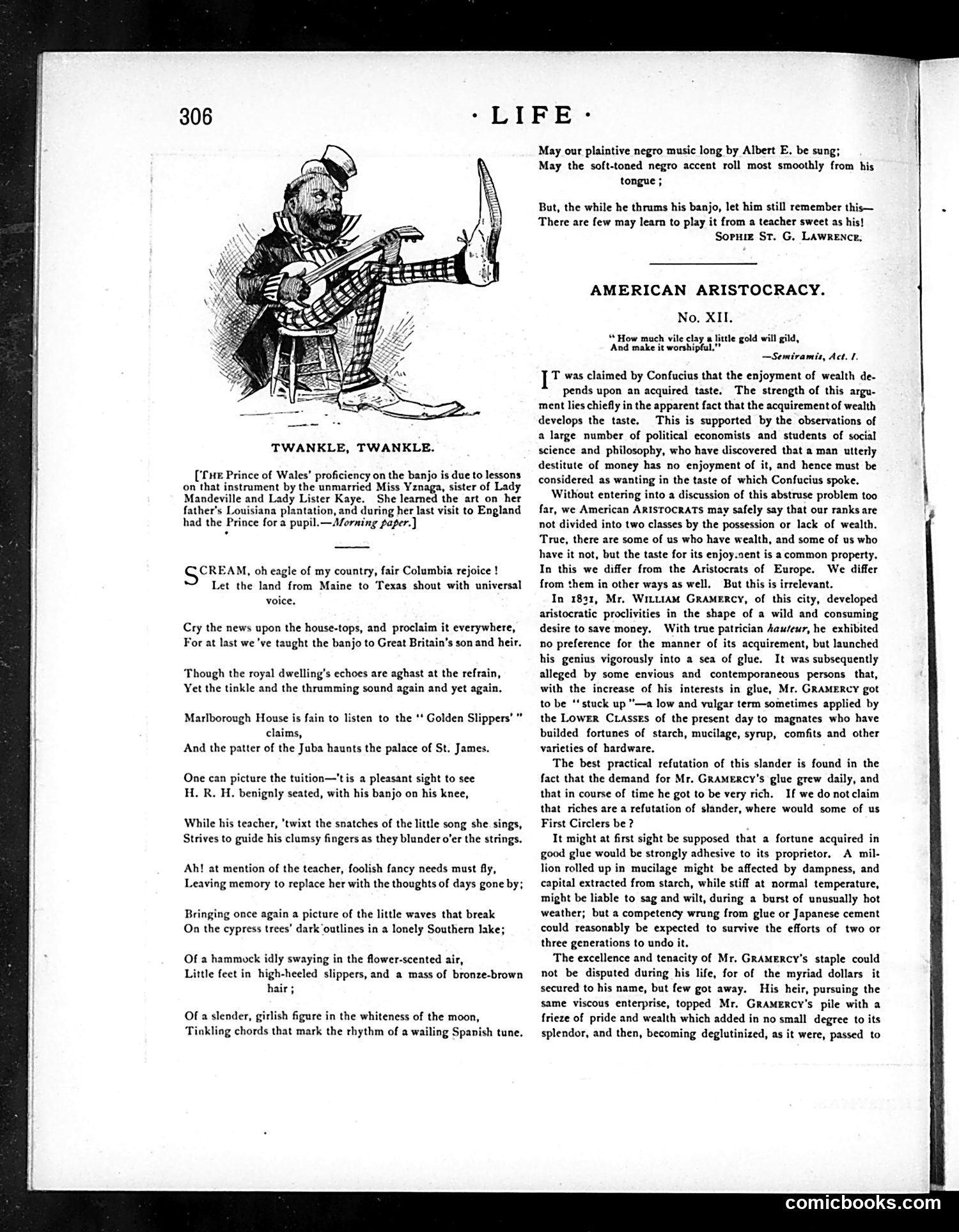
**The Cartoon:** "Twankle, Twankle" depicts a caricatured Black musician teaching banjo to the Prince of Wales. This satirizes a real 1870s-80s incident: Miss Yznaga, a Southern belle from Louisiana, taught the future King Edward VII banjo. The cartoon mocks both British royal pretension and American cultural "progress"—the joke being that America has now taught British royalty a distinctly American (and specifically African-American) instrument. **The Satire's Point:** The accompanying poem celebrates this as American cultural triumph while ironically romanticizing the South through nostalgia for plantation life. The crude caricature and the poem's celebration of "negro music" reflect the era's deeply racist attitudes, presenting Black cultural contributions as exotic entertainment rather than art. **"American Aristocracy" Section:** This separate satirical piece mocks newly wealthy American industrialists (like the fictional "Mr. Gramercy") who accumulate fortunes through undignified means (glue manufacturing) yet claim aristocratic status—poking fun at how American wealth, unlike European nobility, lacks refined origins.
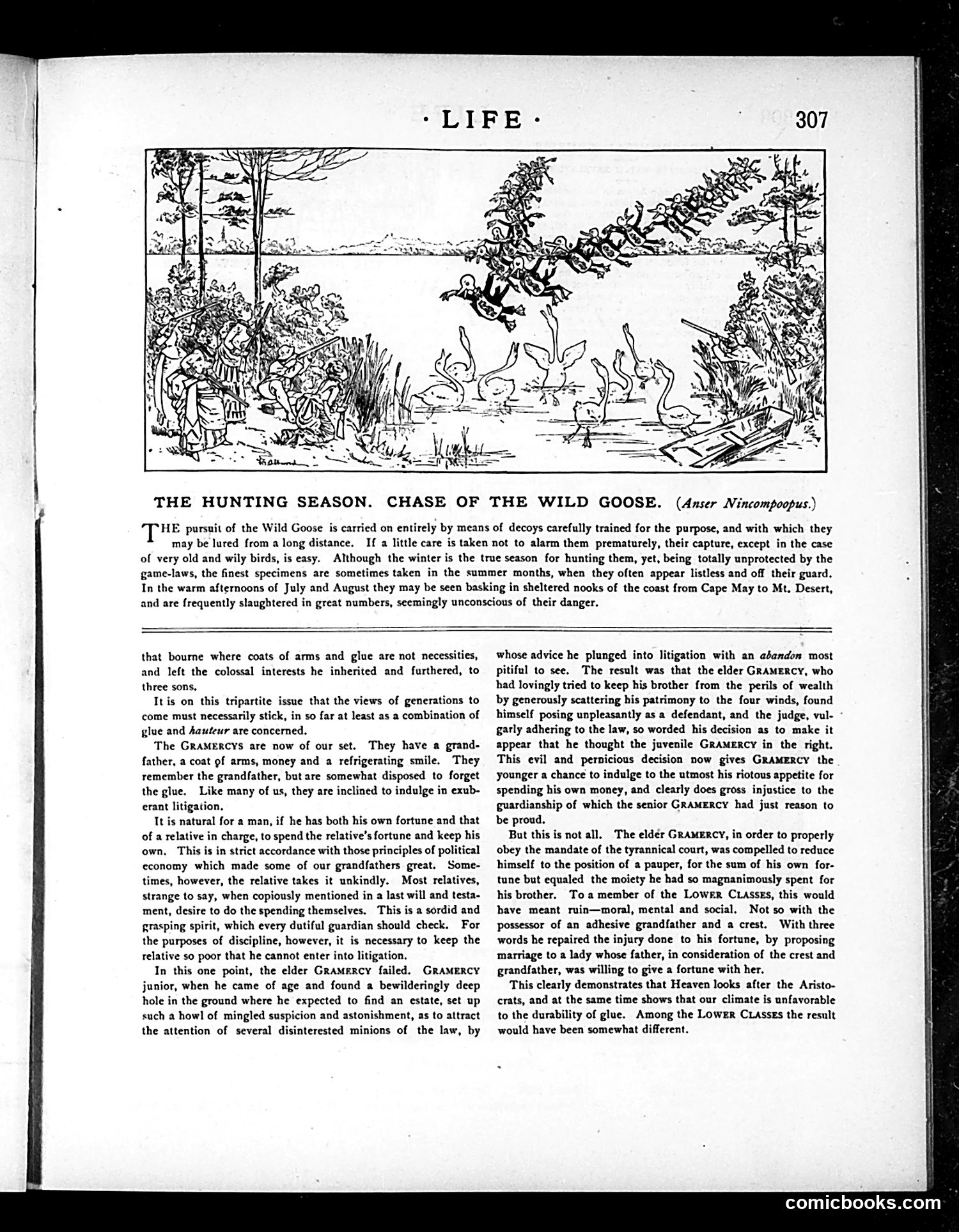
This Life magazine page contains two satirical pieces: **"The Hunting Season" (top illustration):** A naturalistic description of hunting wild geese that is actually a coded metaphor. The scientific name *Anser Nincompoopus* (the "fool goose") signals this is social satire. The geese represent gullible wealthy people who can be easily deceived and "lured" by trained decoys—likely referring to financial schemes or romantic cons targeting the naive rich. **"The Gramercy Family Story" (text below):** This satirizes inheritance disputes among the upper classes. An elder Gramercy squanders his brother's inheritance to "protect" him from wealth's corruptions, then faces lawsuit when the younger brother comes of age and discovers the depletion. A judge rules against the elder. The satire's point: wealthy aristocrats can simply marry rich to repair financial damage, whereas lower classes would face ruin—highlighting the unfair advantages of inherited status and social connections.
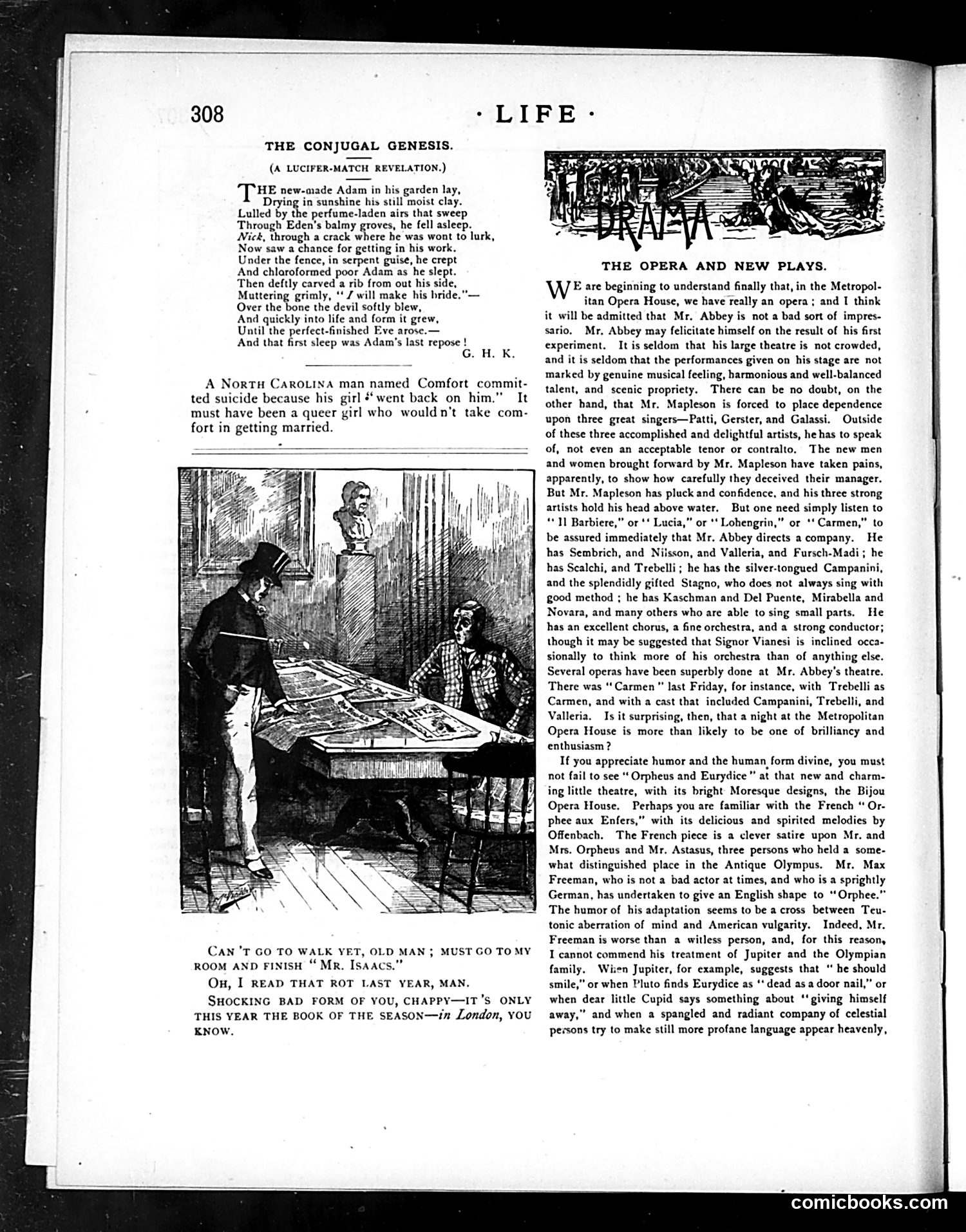
**"The Conjugal Genesis"** is a satirical poem (credited G.H.K.) retelling the Adam and Eve creation story as a "Lucifer-Match Revelation"—meaning it exposes the devil's role. The accompanying illustration shows the devil chloroforming Adam to steal his rib and create Eve. The satire's point: woman's creation was literally a deception orchestrated by Satan, making marriage itself a diabolical trick. The poem ends darkly—Adam's first sleep (unconsciousness during Eve's creation) was "his last repose," implying marriage ends male peace forever. A brief prose item jokes about a North Carolina man who committed suicide over romantic rejection, sarcastically noting he should have found "comfort in getting married." **"The Opera and New Plays"** section praises Mr. Abbey's Metropolitan Opera House management, contrasting it favorably with Mr. Mapleson's company, which relies too heavily on three star singers (Patti, Gerster, Galassi). The piece recommends seeing "Orpheus and Eurydice" at the Bijou Opera House—a French satire on classical mythology.
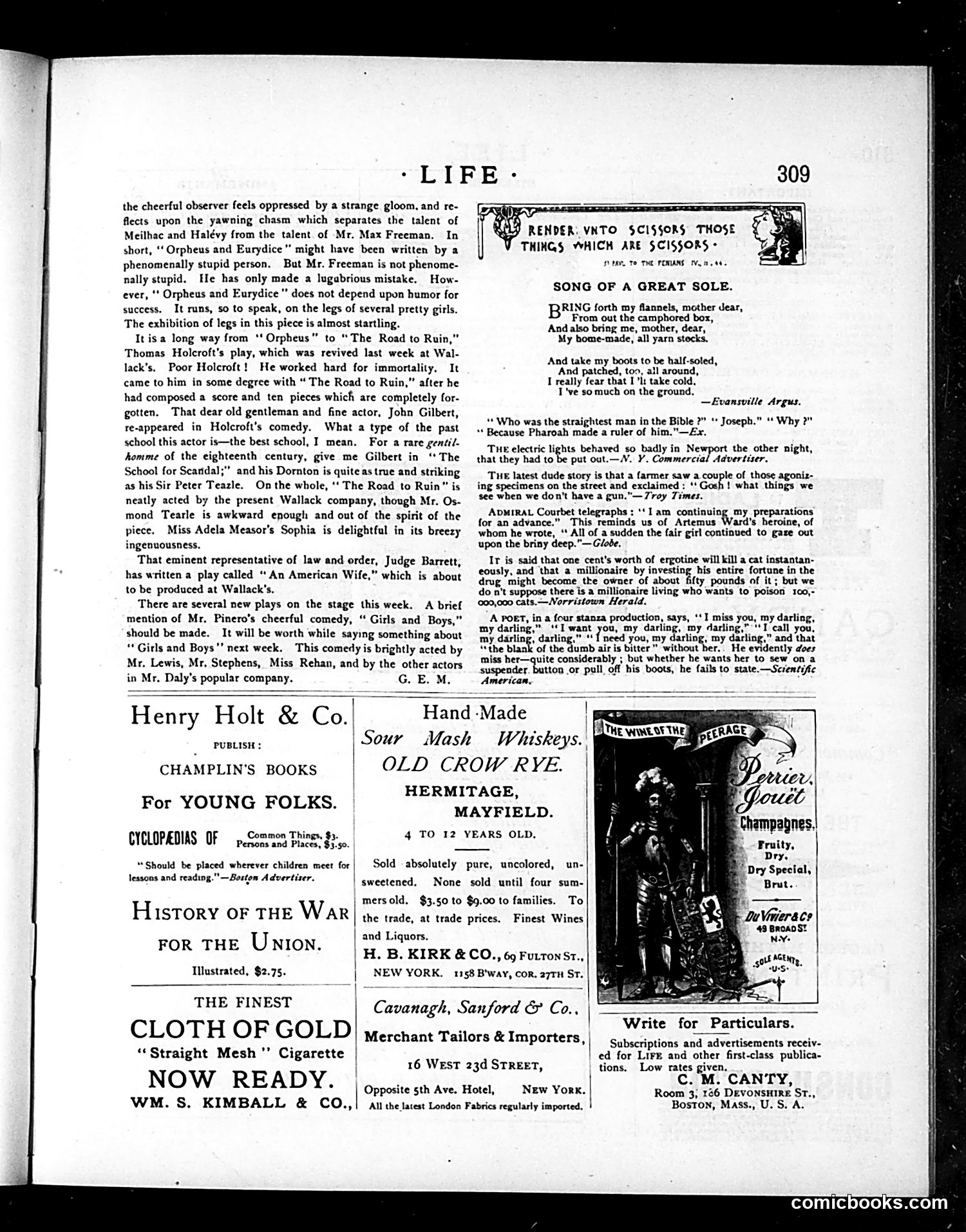
This page is primarily **theater criticism and advertisements** rather than political satire. The main content critiques recent Broadway productions: The critic reviews "Orpheus and Eurydice" (by Max Freeman), dismissing it as poorly written but noting it succeeds through "exhibition of legs" — a jab at the show's reliance on spectacle over substance. He praises John Gilbert's performance in the revival of "The Road to Ruin" as exemplifying fine 18th-century acting tradition. The small cartoon at top-right depicts a religious scene with the caption "Render unto scissors those things which are scissors," a biblical parody about scissors — likely commenting on contemporary scissor advertising or quality. The remainder comprises scattered jokes about electricity failures in Newport, absurdist humor about farmers and "dude" fashion, and wordplay about telegraph communications and poisoning cats. This is typical **late 19th-century Life magazine content**: theater gossip mixed with light humor and advertising, rather than hard political commentary.
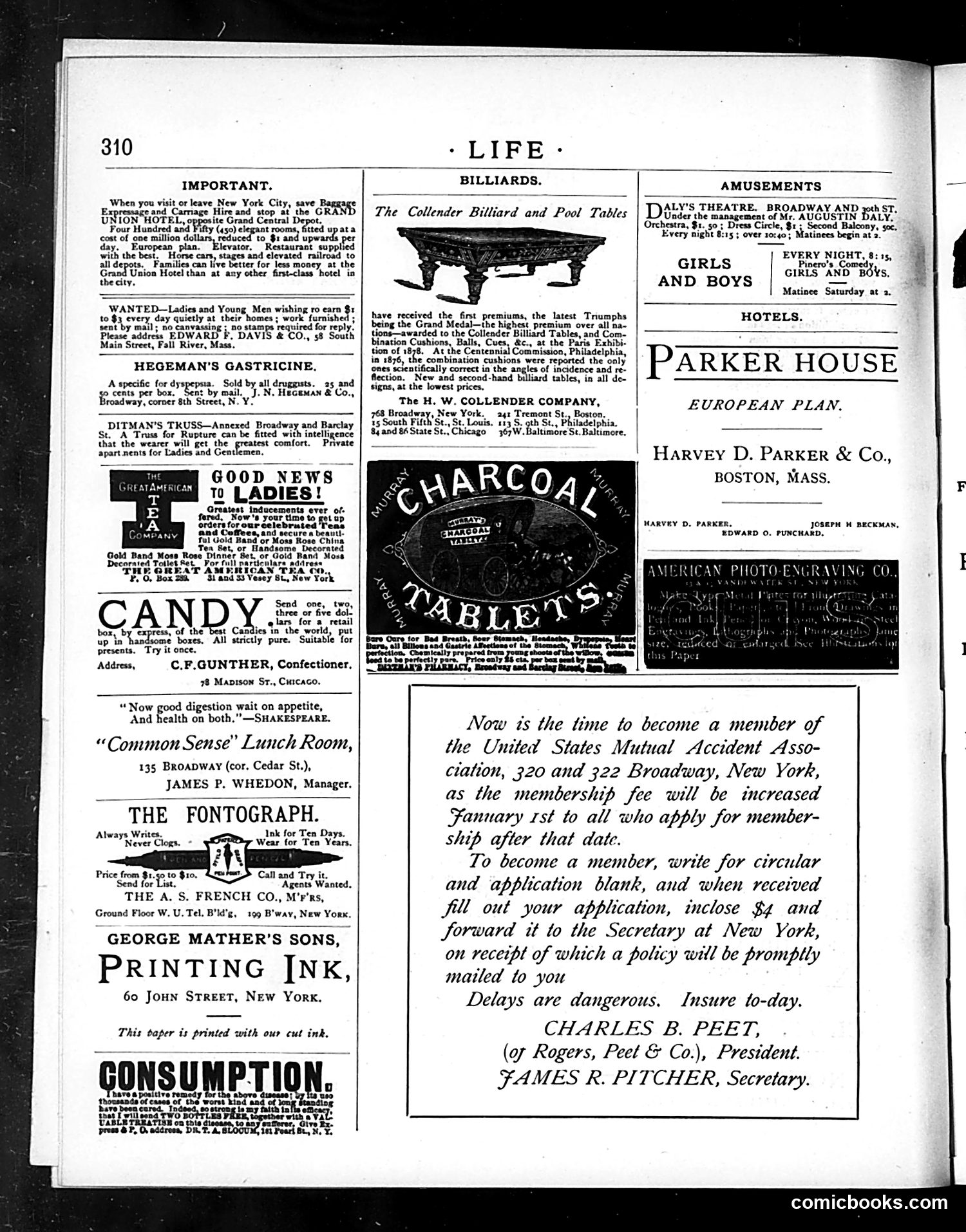
This page is predominantly **commercial advertising** rather than satirical content. It features various 19th-century product and service advertisements including: - Hotels (Grand Union Hotel, Parker House) - Patent medicines (Hegeman's Gastricine for dyspepsia, Ditman's Truss) - Food products (tea, coffee, candies) - Billiard tables by Collender - Printing ink and office supplies - Restaurant and lunch room services The only notable editorial content is a prominent boxed notice from the **United States Mutual Accident Association** urging readers to purchase accident insurance before January 1st, when membership fees will increase—presenting this as urgent and framing delay as "dangerous." The page reflects typical 19th-century magazine revenue practices: satire subsidized by dense advertising. No significant political cartoon or satirical commentary appears here.
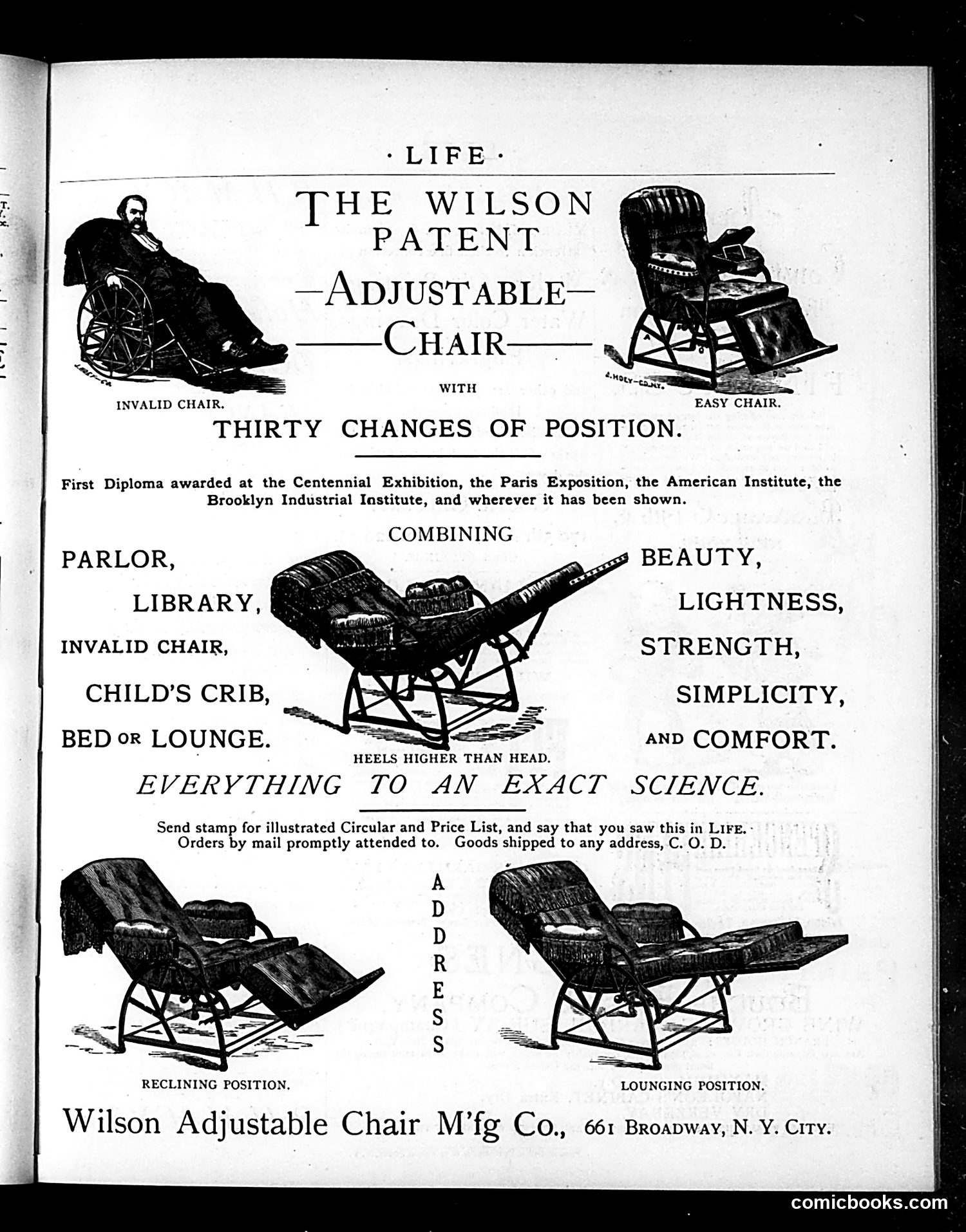
This is not a cartoon or satire—it's a **straightforward advertisement** for the Wilson Patent Adjustable Chair, appearing in Life magazine. The page showcases a furniture product marketed as a multi-purpose piece combining an invalid chair, parlor furniture, child's crib, and bed/lounge. It displays various positions (reclining, lounging, etc.) and emphasizes the chair's versatility, lightweight construction, and comfort. The ad leverages credibility by listing prestigious awards from the Centennial Exhibition, Paris Exposition, and American Institute. The copy uses period marketing language ("everything to an exact science") typical of late-19th-century product promotion. There is **no political satire or social commentary**—Life magazine contained both humorous editorial content and commercial advertisements. This page represents the latter: a manufacturer advertising an innovative adjustable furniture design to potential customers through the publication.
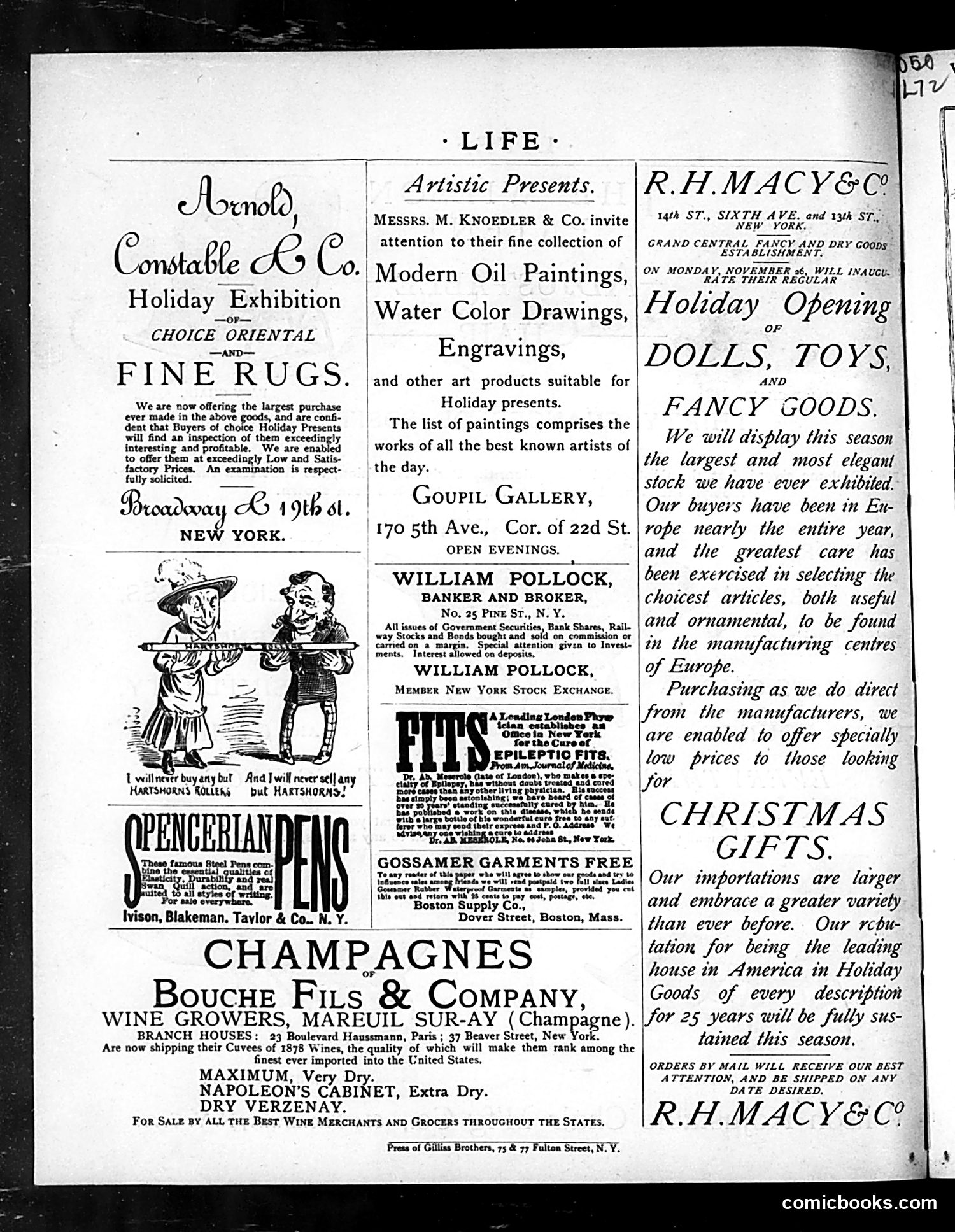
This page is primarily **advertising**, not political satire. It contains one small cartoon and numerous commercial announcements typical of a 19th-century magazine. **The Cartoon**: A single illustrated ad for Hartshorn's Rollers (window shades) shows two figures in period dress. One says "I will never buy any but Hartshorn's Rollers," while the other responds "And I will never sell any but Hartshorns!" This is straightforward product endorsement humor—a playful exchange showing both consumer and merchant loyalty to the brand. **The Advertisements**: The page showcases holiday shopping options (1870s-era): fine Oriental rugs, modern paintings, dolls and toys, champagne, banking services, and medical treatments. R.H. Macy's prominent ad announces their "Holiday Opening" with imported European goods. **For Modern Readers**: This reflects an era when magazines were heavily ad-subsidized, advertisements were integrated with editorial content, and holiday shopping focused on imported luxury goods for the wealthy. The tone is earnest rather than satirical—these are genuine commercial pitches.