
Life, 1883-12-13 · page 12 of 16
Life — December 13, 1883 — page 12: what you’re looking at
What you’re looking at
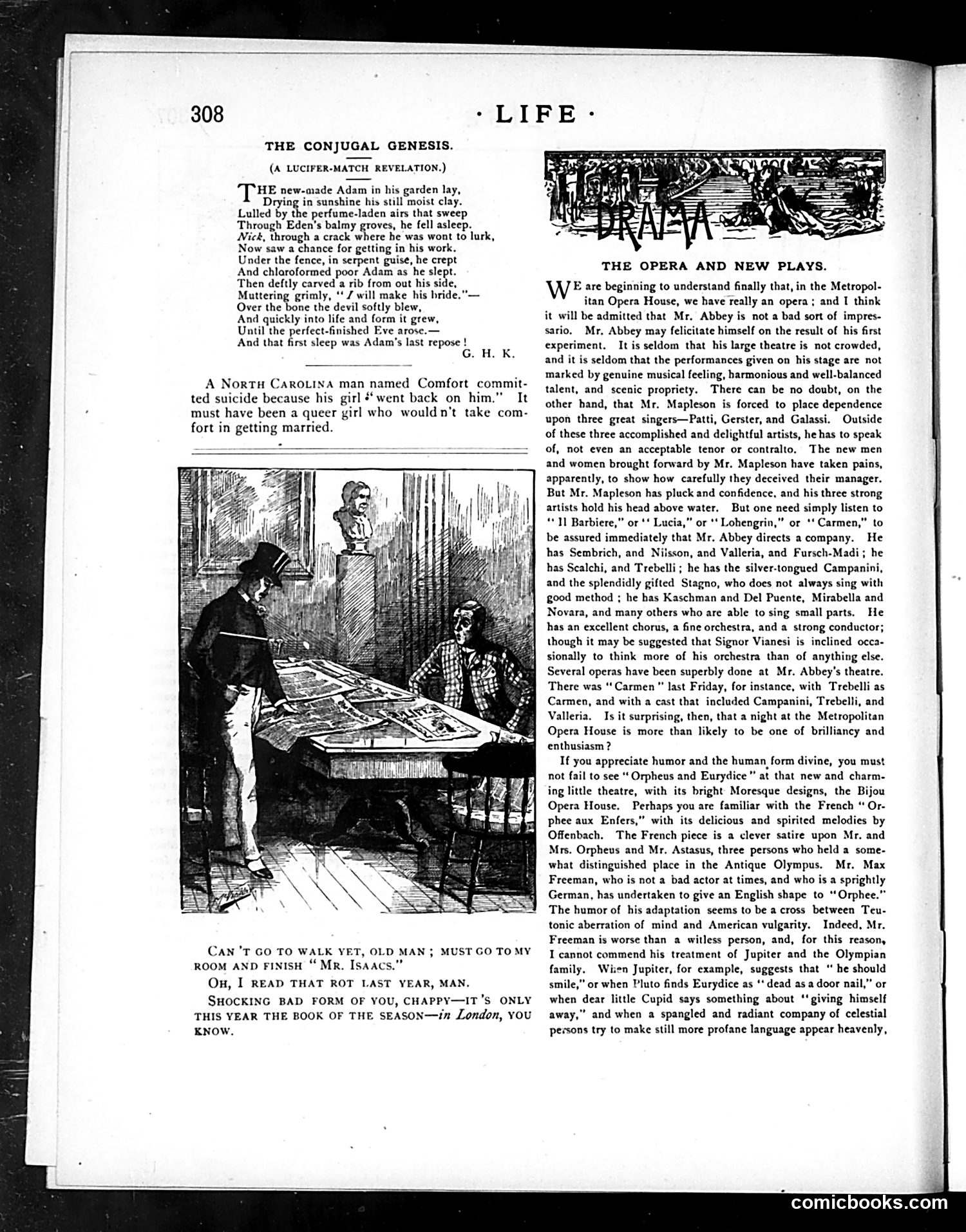
**"The Conjugal Genesis"** is a satirical poem (credited G.H.K.) retelling the Adam and Eve creation story as a "Lucifer-Match Revelation"—meaning it exposes the devil's role. The accompanying illustration shows the devil chloroforming Adam to steal his rib and create Eve. The satire's point: woman's creation was literally a deception orchestrated by Satan, making marriage itself a diabolical trick. The poem ends darkly—Adam's first sleep (unconsciousness during Eve's creation) was "his last repose," implying marriage ends male peace forever. A brief prose item jokes about a North Carolina man who committed suicide over romantic rejection, sarcastically noting he should have found "comfort in getting married." **"The Opera and New Plays"** section praises Mr. Abbey's Metropolitan Opera House management, contrasting it favorably with Mr. Mapleson's company, which relies too heavily on three star singers (Patti, Gerster, Galassi). The piece recommends seeing "Orpheus and Eurydice" at the Bijou Opera House—a French satire on classical mythology.
📄 Transcribed text from this page (OCR, searchable)
Machine-transcribed from the original scan — historical spelling and the odd misread are preserved.
THE CONJUGAL GENESIS. (A LUCIFER-MATCH REVELATION.) HE new-made Adam in his garden lay, Drying in sunshine his still moist clay. Lulled by the perfume-laden airs that sweep Through Eden's balmy groves, he fell asleep. Nick, through a crack where he was wont to lurk, Now saw a chance for getting in his work. Under the fence, in serpent guise, he crept And chlaroformed poor Adam as he slept. Then deftly carved a rib from out his side, Muttering grimly, ‘‘ / will make his bride."— Over the bone the devil softly blew, And quickly into life and form it grew, Until the perfect-finished Eve arose.— And that first sleep was Adam's last repose ! G. H. K. A NortH CaroLina man named Comfort commit- ted suicide because his girl #* went back on him.” It must have been a queer girl who wouldn't take com- fort in getting married. CAN 'T GO TO WALK YET, OLD MAN ; MUST GO TOMY ROOM AND FINISH “ MR. Isaac Ou, I READ THAT ROT LAST YEAR, MAN. SHOCKING BAD FORM OF YOU, CHAPPY—IT'S ONLY THIS YEAR THE BOOK OF THE SEASON—in London, YOU KNOW. THE OPERA AND NEW PLAYS. WE are beginning to understand finally that, in the Metropol- itan Opera House, we have really an opera ; and I think it will be admitted that Mr. Abbey is not a bad sort of impres- sario, Mr, Abbey may felicitate himself on the result of his first experiment. It is seldom that his large theatre is not crowded, and it is seldom that the performances given on his stage are not marked by genuine musical feeling, harmonious and well-balanced talent, and scenic propriety. There can be no doubt, on the other hand, that Mr. Mapleson is forced to place dependence upon three great singers—Patti, Gerster, and Galassi. Outside of these three accomplished and delightful artists, he has to speak of, not even an acceptable tenor or contralto, The new men and women brought forward by Mr. Mapleson have taken pains, apparently, to show how carefully they deceived their manager. But Mr. Mapleson has pluck and confidence, and his three strong artists hold his head above water. But one need simply listen to “Il Barbiere,” or ‘ Lucia,” or ‘ Lohengrin,” or ‘‘ Carmen,” to be assured immediately that Mr. Abbey directs a company. He has Sembrich, and Nilsson, and Valleria, and Fursch-Madi ; he has Scalchi, and Trebelli; he has the silver-tongued Campanini, and the splendidly gifted Stagno, who does not always sing with good method ; he has Kaschman and Del Puente, Mirabella and Novara, and many others who are able to sing small parts. He has an excellent chorus, a fine orchestra, and a strong conductor; though it may be suggested that Signor Vianesi is inclined occa- sionally to think more of his orchestra than of anything else. Several operas have been superbly done at Mr. Abbey’s theatre. There was ‘‘Carmen" last Friday, for instance, with Trebelli as Carmen, and with a cast that included Campanini, Trebelli, and Valleria. Is it surprising, then, that a night at the Metropolitan Opera House is more than likely to be one of brilliancy and enthusiasm ? If you appreciate humor and the human form divine, you must not fail to see * Orpheus and Eurydice” at that new and charm- ing little theatre, with its bright Moresque designs, the Bijou Opera House. Perhaps you are familiar with the French “ Or- phee aux Enfers,” with its delicious and spirited melodies by Offenbach. The French piece is a clever satire upon Mr. and Mrs. Orpheus and Mr. Astasus, three persons who held a some- what distinguished place in the Antique Olympus. Mr. Max Freeman, who is not a bad actor at times, and who is a sprightly German, has undertaken to give an English shape to “Orphee.” The humor of his adaptation seems to be a cross between Teu- tonic aberration of mind and American vulgarity. Indeed, Mr. Freeman is worse than a witless person, and, for this reasony I cannot commend his treatment of Jupiter and the Olympian family. Wien Jupiter, for example, suggests that ‘ he should smile,” or when Pluto finds Eurydice as ‘* dead as a door nail,” or when dear little Cupid says something about ‘giving himself away,” and when a spangled and radiant company of celestial pessons try to make still more profane language appear heavenly, comicbooks.com