
Life, 1883-12-13 · page 10 of 16
Life — December 13, 1883 — page 10: what you’re looking at
What you’re looking at
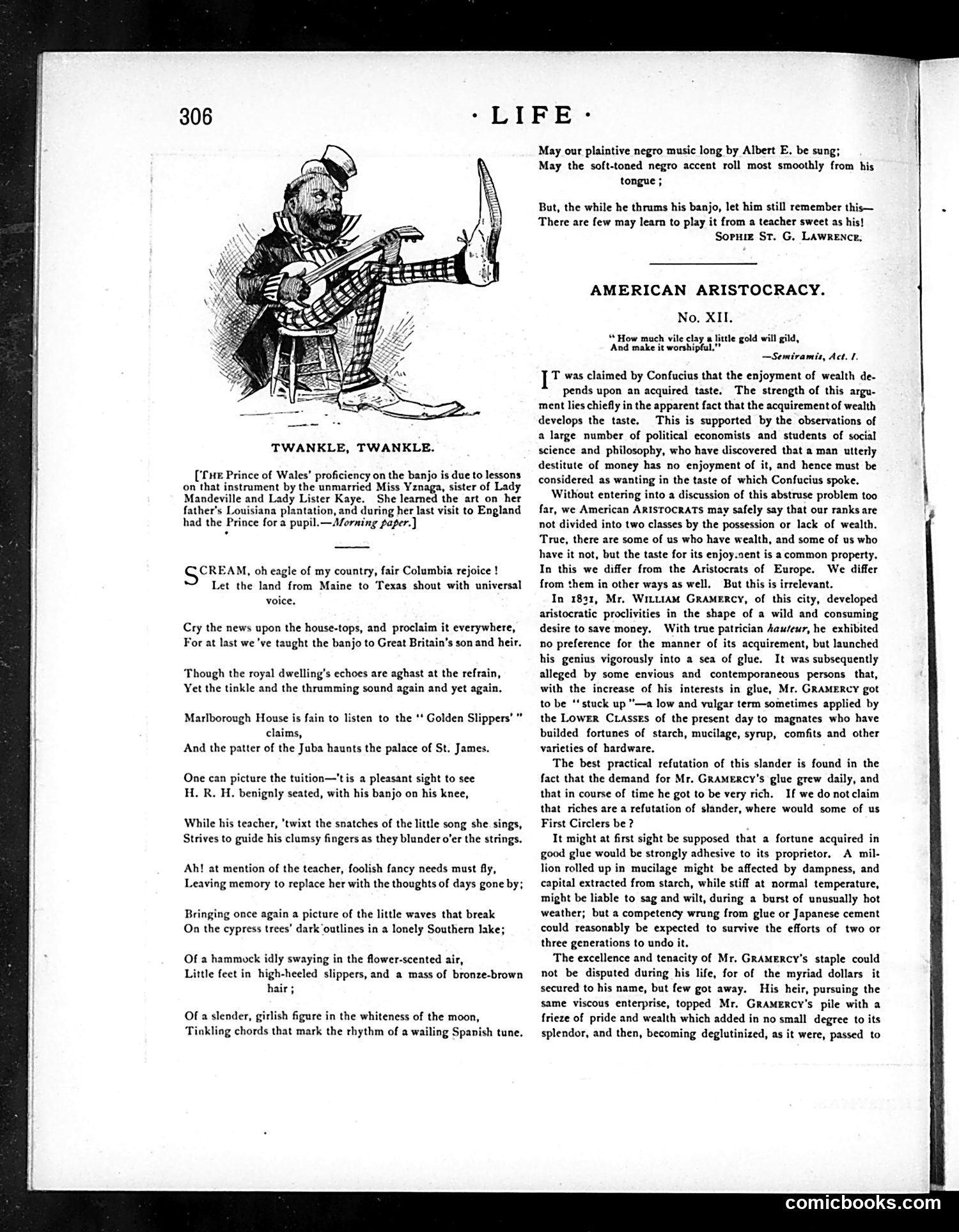
**The Cartoon:** "Twankle, Twankle" depicts a caricatured Black musician teaching banjo to the Prince of Wales. This satirizes a real 1870s-80s incident: Miss Yznaga, a Southern belle from Louisiana, taught the future King Edward VII banjo. The cartoon mocks both British royal pretension and American cultural "progress"—the joke being that America has now taught British royalty a distinctly American (and specifically African-American) instrument. **The Satire's Point:** The accompanying poem celebrates this as American cultural triumph while ironically romanticizing the South through nostalgia for plantation life. The crude caricature and the poem's celebration of "negro music" reflect the era's deeply racist attitudes, presenting Black cultural contributions as exotic entertainment rather than art. **"American Aristocracy" Section:** This separate satirical piece mocks newly wealthy American industrialists (like the fictional "Mr. Gramercy") who accumulate fortunes through undignified means (glue manufacturing) yet claim aristocratic status—poking fun at how American wealth, unlike European nobility, lacks refined origins.
📄 Transcribed text from this page (OCR, searchable)
Machine-transcribed from the original scan — historical spelling and the odd misread are preserved.
TWANKLE, TWANKLE. [Cite Prince of Wales’ proficiency on the banjo is due to lessons on that instrument by the unmarried Miss Yznaga, sister of Lady Mandeville and Lady Lister Kaye. She learned the art on her father’s Louisiana plantation, and during her last visit to England had the Prince fora pupil.—Aforning paper.) G CREAM, oh eagle of my country, fair Columbia rejoice! Let the land from Maine to Texas shout with universal voice. Cry the news upon the house-tops, and proclaim it everywhere, For at last we 've taught the banjo to Great Britain's son and heir. ‘Though the royal dwelling’s echoes are aghast at the refrain, Yet the tinkle and the thrumming sound again and yet again. Marlborough House is fain to listen to the ** Golden Slippers’ ” claims, And the patter of the Juba haunts the palace of St. James. One can picture the tuition—'tis a pleasant sight to see H. R. H. benignly seated, with his banjo on his knee, While his teacher, 'twixt the snatches of the little song she sings, Strives to guide his clumsy fingers as they blunder o'er the strings. Ah! at mention of the teacher, foolish fancy needs must fly, Leaving memory to replace her with the thoughts of days gone by; Bringing once again a picture of the little waves that break On the cypress trees’ dark outlines in a lonely Southern lake; Of a hammock idly swaying in the flower-scented air, Little feet in high-heeled slippers, and a mass of bronze-brown hair; Of a slender, girlish figure in the whiteness of the moon, Tinkling chords that mark the rhythm of a wailing Spanish tune, - LIFE: May our plaintive negro music long by Albert E. be sung; May the soft-toned negro accent roll most smoothly from his tongue ; But, the while he thrums his banjo, let him still remember this— There are few may learn to play it from a teacher sweet as his! Sorum St. G. Lawrence, AMERICAN ARISTOCRACY. No. XII. “How much vile clay a little gold will gild, And make it worshipfal.” Semiramis, Act. 1. T was claimed by Confucius that the enjoyment of wealth de- pends upon an acquired taste. The strength of this argu- ment lies chiefly in the apparent fact that the acquirement of wealth develops the taste, This is supported by the observations of a large number of political economists and students of social science and philosophy, who have discovered that a man utterly destitute of money has no enjoyment of it, and hence must be considered as wanting in the taste of which Confucius spoke. Without entering into a discussion of this abstruse problem too far, we American ARISTOCRATS may safely say that our ranks are not divided into two classes by the possession or lack of wealth. True, there are some of us who have wealth, and some of us who have it not, but the taste for its enjoy.sent is a common property. In this we differ from the Aristocrats of Europe. We differ from them in other ways as well. But this is irrelevant. In 1831, Mr. Witttam Gramercy, of this city, developed aristocratic proclivities in the shape of a wild and consuming desire to save money, With true patrician Aauleur, he exhibited no preference for the manner of its acquirement, but launched his genius vigorously into a sea of glue. It was subsequently alleged by some envious and contemporaneous persons that, with the increase of his interests in glue, Mr. GRAMERCY got to be “stuck up "—a low and vulgar term sometimes applied by the Lower Ciasses of the present day to magnates who have builded fortunes of starch, mucilage, syrup, comfits and other varieties of hardware. The best practical refutation of this slander is found in the fact that the demand for Mr. GRaMERCY’S glue grew daily, and that in course of time he got to be very rich. If we do not claim that riches are a refutation of slander, where would some of us First Circlers be ? It might at first sight be supposed that a fortune acquired in good glue would be strongly adhesive to its proprietor. A mil- lion rolled up in mucilage might be affected by dampness, and capital extracted from starch, while stiff at normal temperature, might be liable to sag and wilt, during a burst of unusually hot weather; but a competency wrung from glue or Japanese cement could reasonably be expected to survive the efforts of two or three generations to undo it. The excellence and tenacity of Mr. GRAMERCY’s staple could not be disputed during his life, for of the myriad dollars it secured to his name, but few got away. His heir, pursuing the same viscous enterprise, topped Mr. Gramercy's pile with a frieze of pride and wealth which added in no small degree to its splendor, and then, becoming deglutinized, as it were, passed to comicbooks.com