
A complete issue · 16 pages · 1883
Life — October 11, 1883
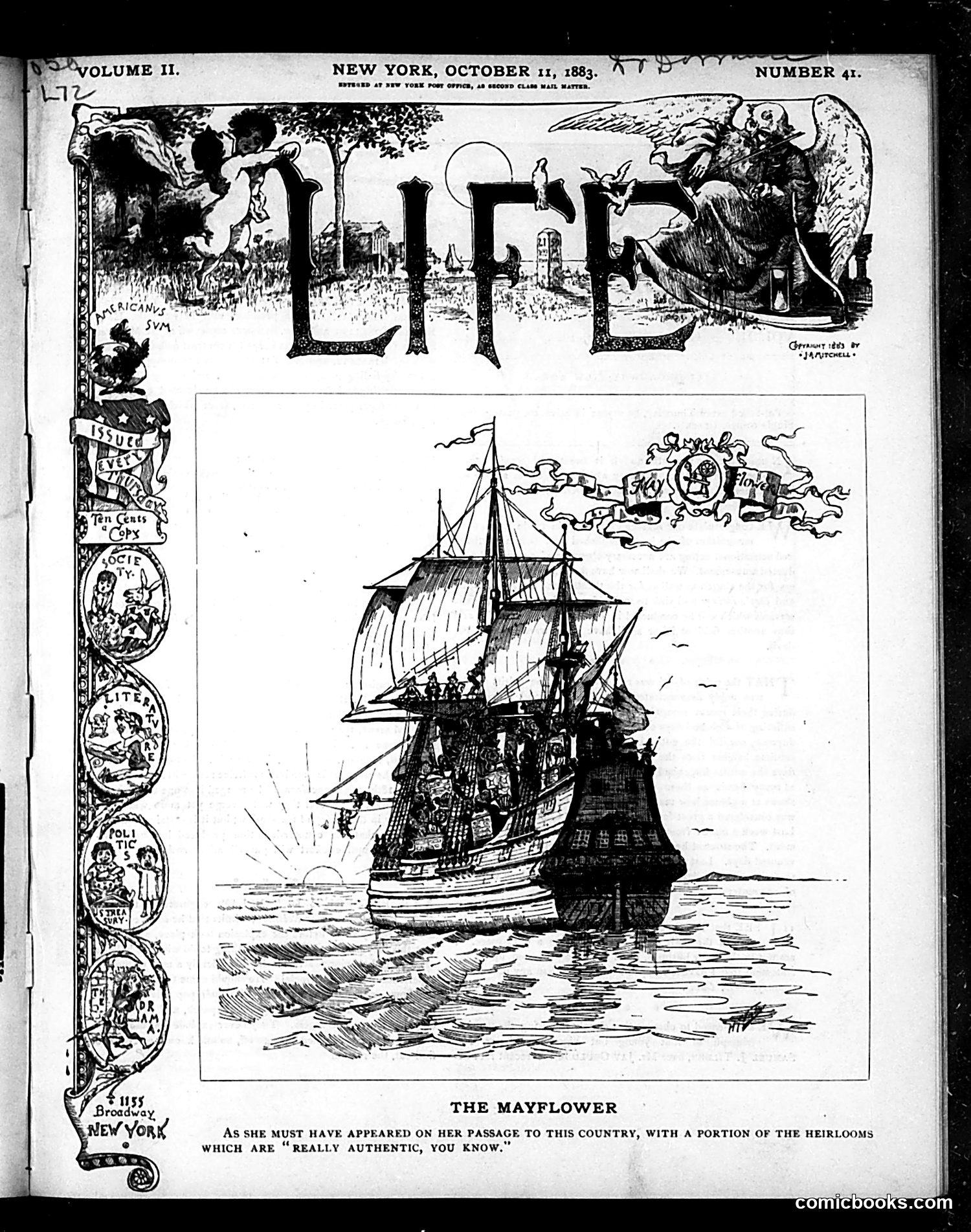
This page features "The Mayflower," a detailed engraving of the historic ship that transported Pilgrims to America in 1620. The caption notes it shows the vessel "as she must have appeared on her passage to this country, with a portion of the heirlooms which are 'really authentic, you know.'" The satire targets a contemporary obsession: Americans' collecting of supposed colonial-era artifacts and relics. The phrase "really authentic, you know" is sarcastic—suggesting wealthy collectors claimed dubious authenticity for expensive purchases. By pairing the historically significant Mayflower with the knowing wink about fake "heirlooms," the cartoonist mocks the 1880s craze for colonial memorabilia and the credulous buyers willing to pay premium prices for unverified antiques.
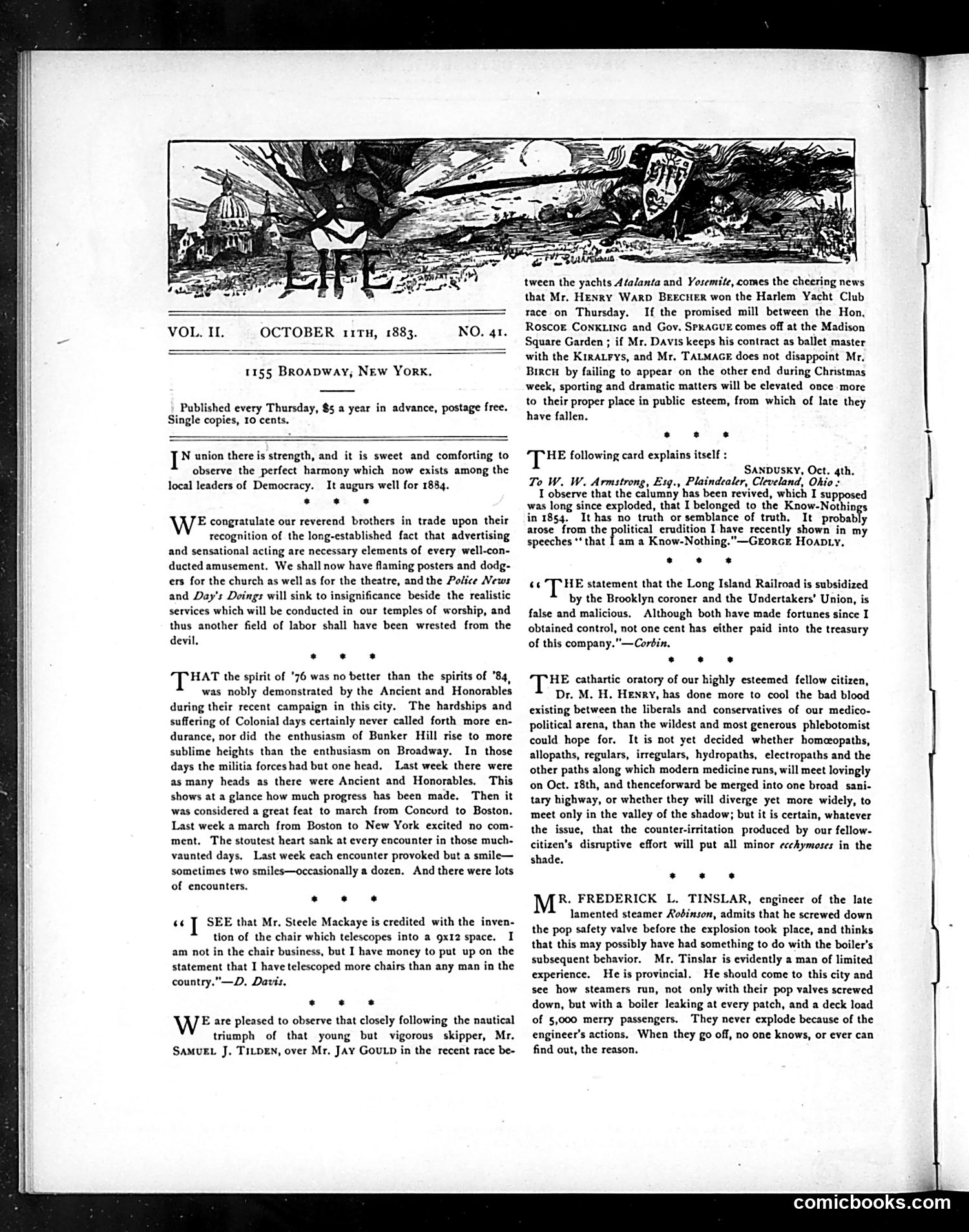
The page contains editorial commentary rather than illustrated cartoons. Key topics include: **Political Unity**: An opening section celebrates Democratic Party strength and upcoming 1884 elections. **Labor Issues**: References to advertising's role in labor struggles, mentioning the "Police News" and "Day's Doings" as realistic alternatives to other publications. **Historical Comparison**: Commentary comparing 1776's revolutionary spirit unfavorably to 1884's, citing a march from Concord to Boston as evidence of diminished enthusiasm. **Engineering Criticism**: A lengthy critique of engineer Frederick L. Tinslar regarding steamship safety, suggesting his provisional experience caused a boiler explosion killing 5,000 passengers—the writer argues Tinslar didn't understand proper valve operation. The page serves primarily as a satirical opinion publication addressing contemporary political and industrial concerns.
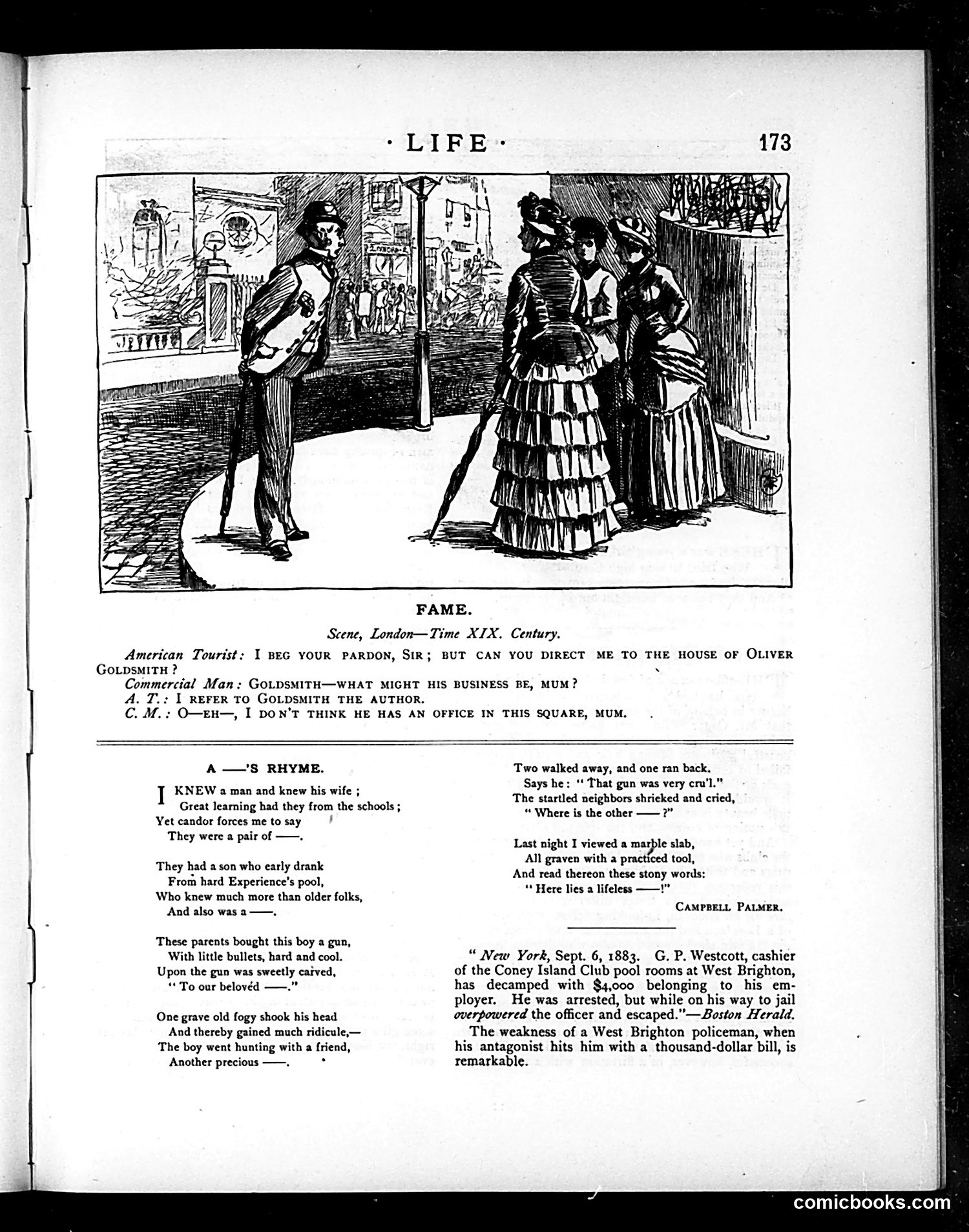
This cartoon satirizes American tourism in 19th-century London. An American tourist approaches a Commercial Man, asking directions to Oliver Goldsmith's house. The joke hinges on the Commercial Man's response: Goldsmith was a famous *author*, not a businessman with an office—he has no commercial address to direct someone to. The satire targets American tourists' ignorance of European literary culture and their tendency to seek famous figures primarily for commercial or transactional reasons. It also mocks the gap between literary fame and practical accessibility—Goldsmith's literary importance doesn't translate into a locatable office one can simply visit.
This page contains two satirical pieces about courtship and marriage, not political cartoons. **"Aphorisms by Woodchuck Pete"** offers humorous commentary on religious hypocrisy and class pretension—mocking people who selectively follow religion while ignoring its principles. **"Concerning Homely Men"** is a longer satirical essay arguing that physically unattractive men make better husbands than handsome ones. The piece names real contemporary figures—Oscar Wilde, Samuel J. Tilden, and Governor Butler—as examples of homely men of quality, contrasting them with vain, superficial handsome men. The satire suggests that women foolishly chase beauty while overlooking character, and that homely men's lack of vanity makes them more reliable partners. The essay concludes that "a thing of beauty is a joy forever"—ironically applying Keats to personality rather than appearance.
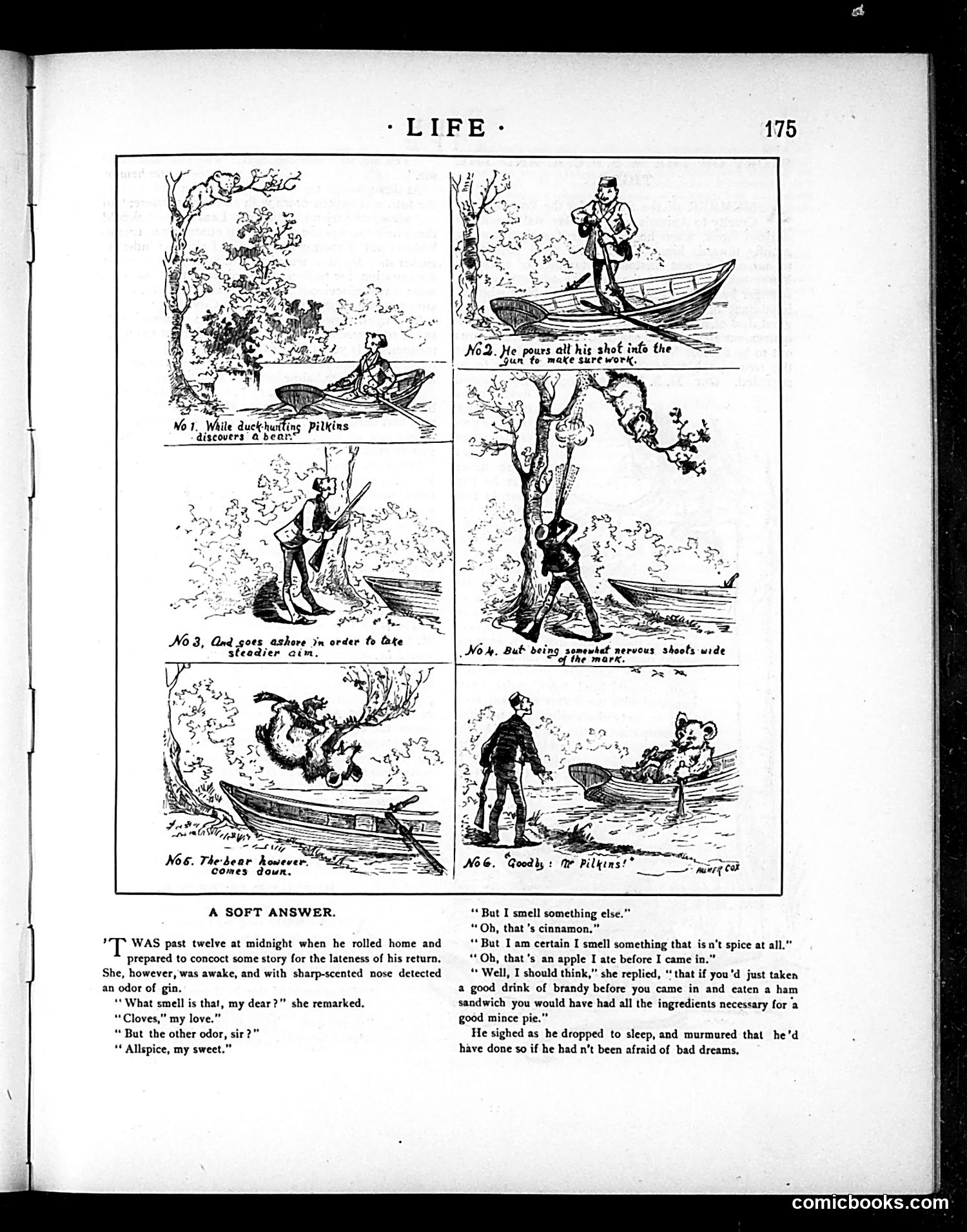
This page contains a humorous six-panel comic strip titled "While duck-hunting Pilkins discovers a bear" that depicts slapstick mishaps involving a man named Pilkins encountering a bear near a boat. The panels progress from discovery through escalating chaos, ending with Pilkins safely departed by boat. Below the comic is a prose piece, "A Soft Answer," describing a man returning home late and his wife detecting suspicious odors on him—cloves, cinnamon, and apple. His explanations (brandy, ham sandwich, mince pie) attempt to deflect her suspicion of infidelity with plausible but increasingly unconvincing alibis. The humor relies on marital tension and the husband's clumsy deceptions about his evening activities.
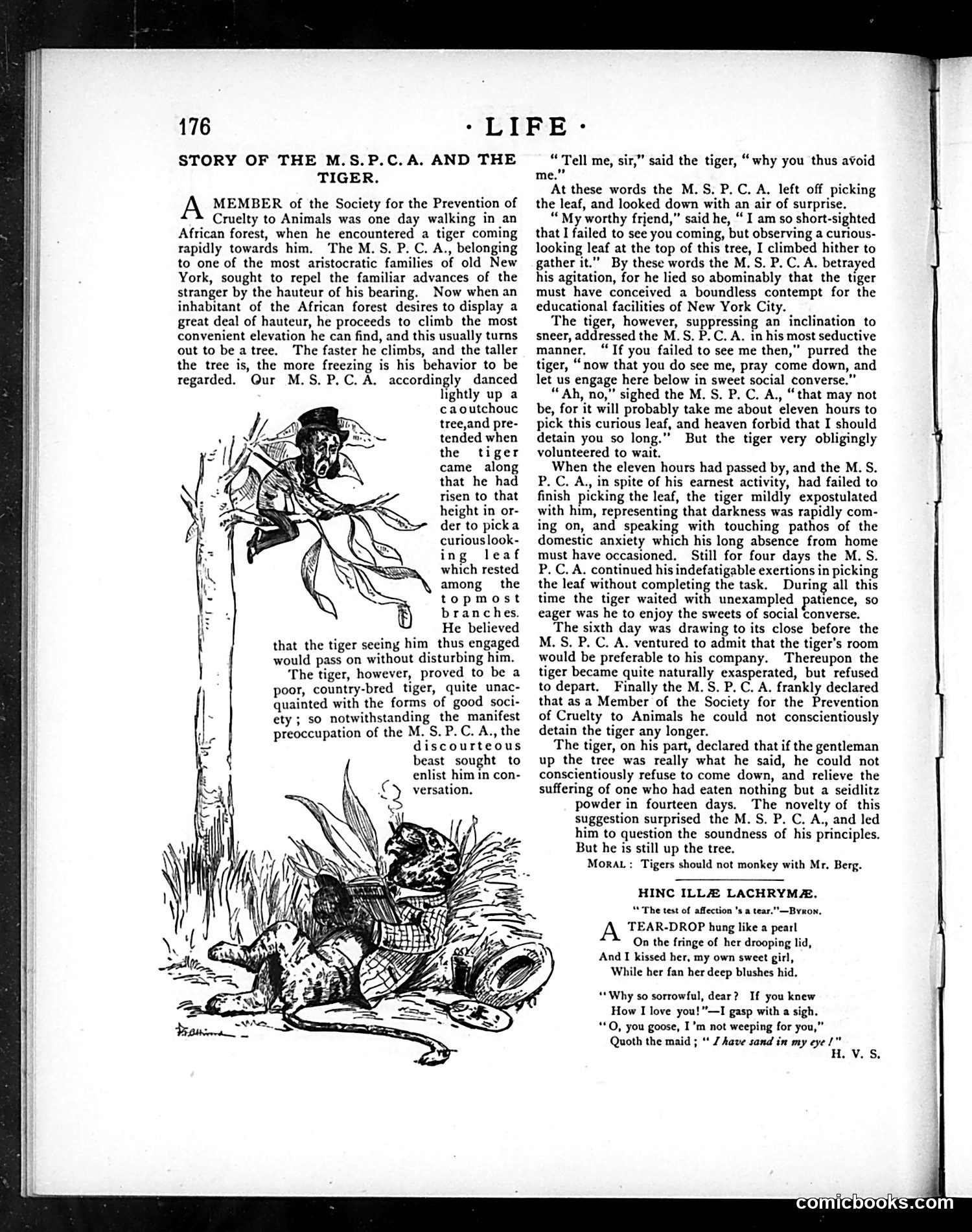
This is a satirical fable mocking the American Society for the Prevention of Cruelty to Animals (ASPCA, here called M.S.P.C.A.). The story depicts an ASPCA member in an African forest encountering a tiger. Rather than flee, the member obsessively tries to pick a leaf from a tree—ostensibly to examine it—while the tiger waits patiently for eleven days. The satire targets the ASPCA's pedantic, rule-bound approach to animal welfare. The tiger represents natural animal behavior; the ASPCA member represents misguided humanitarian intervention that prioritizes bureaucratic procedure over practical reality. The joke: the organization's genteel New York sensibilities prove absurdly useless against genuine danger. The moral warns that excessive concern for animals can become comically disconnected from common sense.
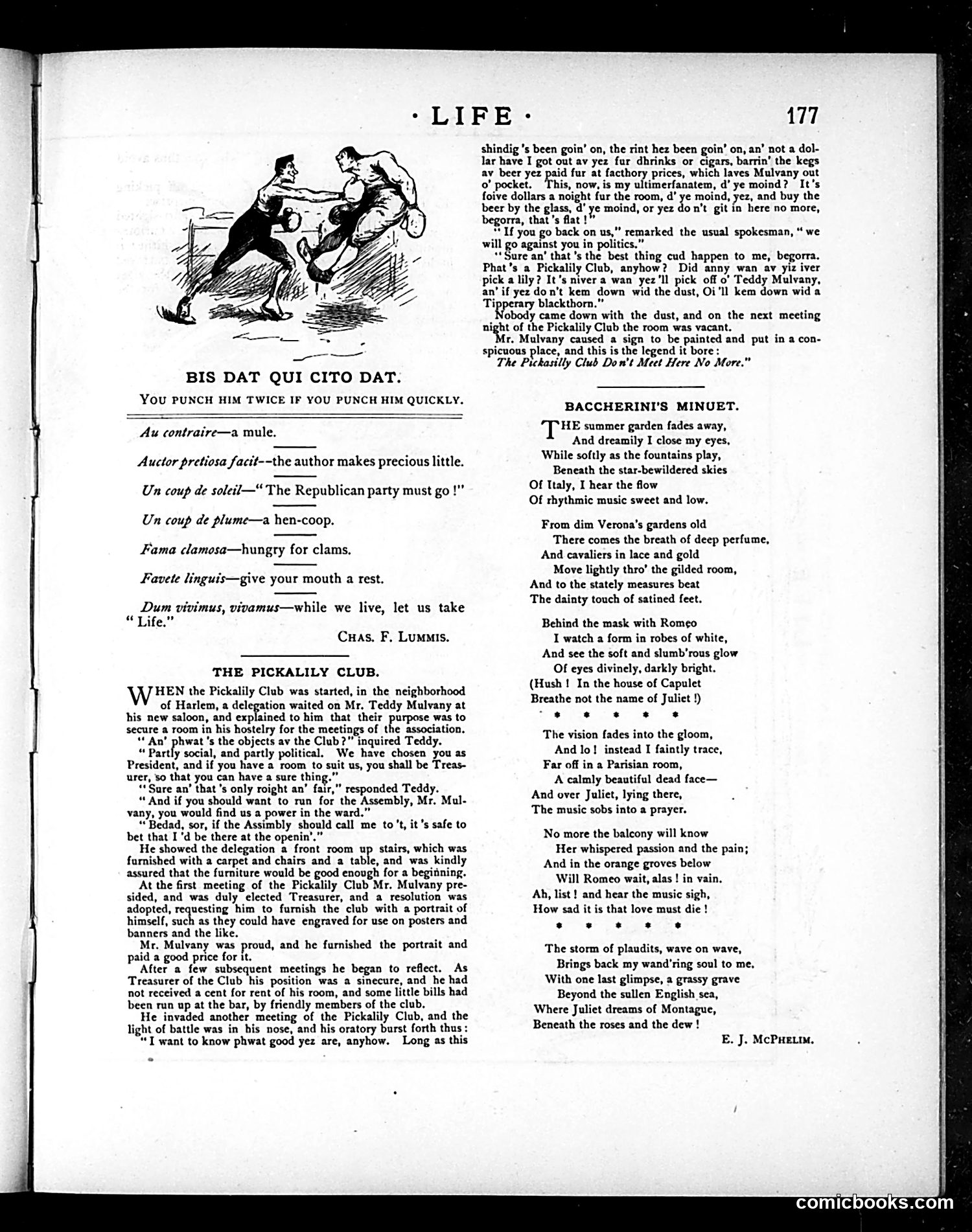
The cartoon titled "BIS DAT QUI CITO DAT" (He gives twice who gives quickly) depicts two men in a physical altercation, illustrating the Latin phrase's humorous application: "You punch him twice if you punch him quickly." Below this is "The Pickally Club," a satirical short story about a Harlem social club founded by a man named Teddy Mulvany. The narrative mocks the pretensions of the organization—members sought an elegant meeting space, adopted formal procedures, elected officers, and commissioned a portrait, yet operated from a modest rented room. The satire targets working-class social aspirations and the gap between members' ambitions and their modest means. The page also contains "Baccherini's Minuet," a romantic poem by E.J. McPhelim referencing Romeo and Juliet.
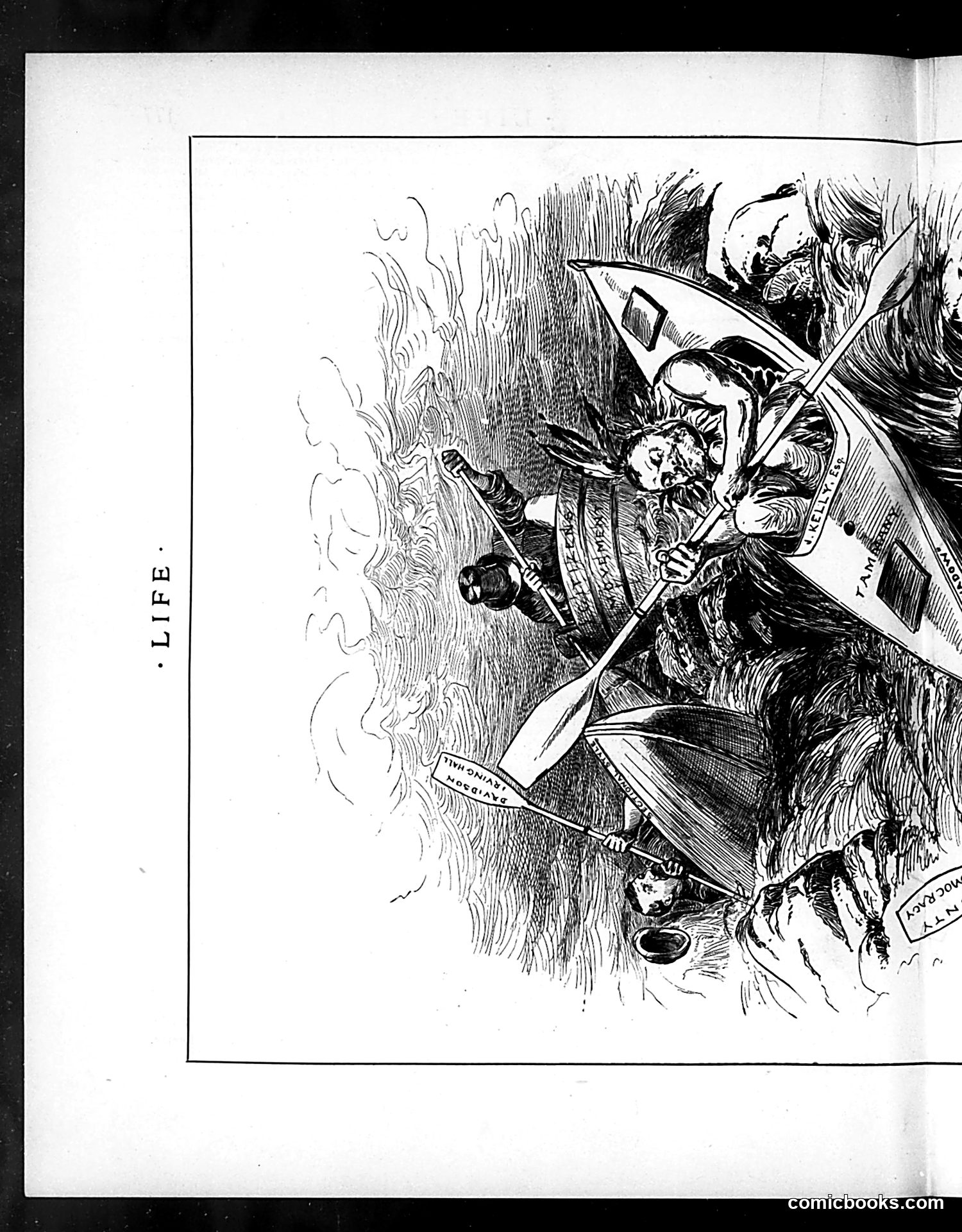
This appears to be a satirical illustration titled "LIFE" (visible on the left margin). The sketch depicts a chaotic scene with multiple figures in period dress engaged in what seems to be a violent or tumultuous confrontation. The characters carry flags and weapons, suggesting political or military conflict. The style and composition indicate this is commentary on contemporary political turmoil, likely from the late 19th or early 20th century based on the artistic technique and fashion depicted. However, without clearer visibility of specific identifying marks, faces, or accompanying article text, I cannot definitively identify which particular historical figures or events are being satirized. The overall tone suggests mockery of political chaos or civil discord, characteristic of *Life* magazine's satirical approach to social commentary.
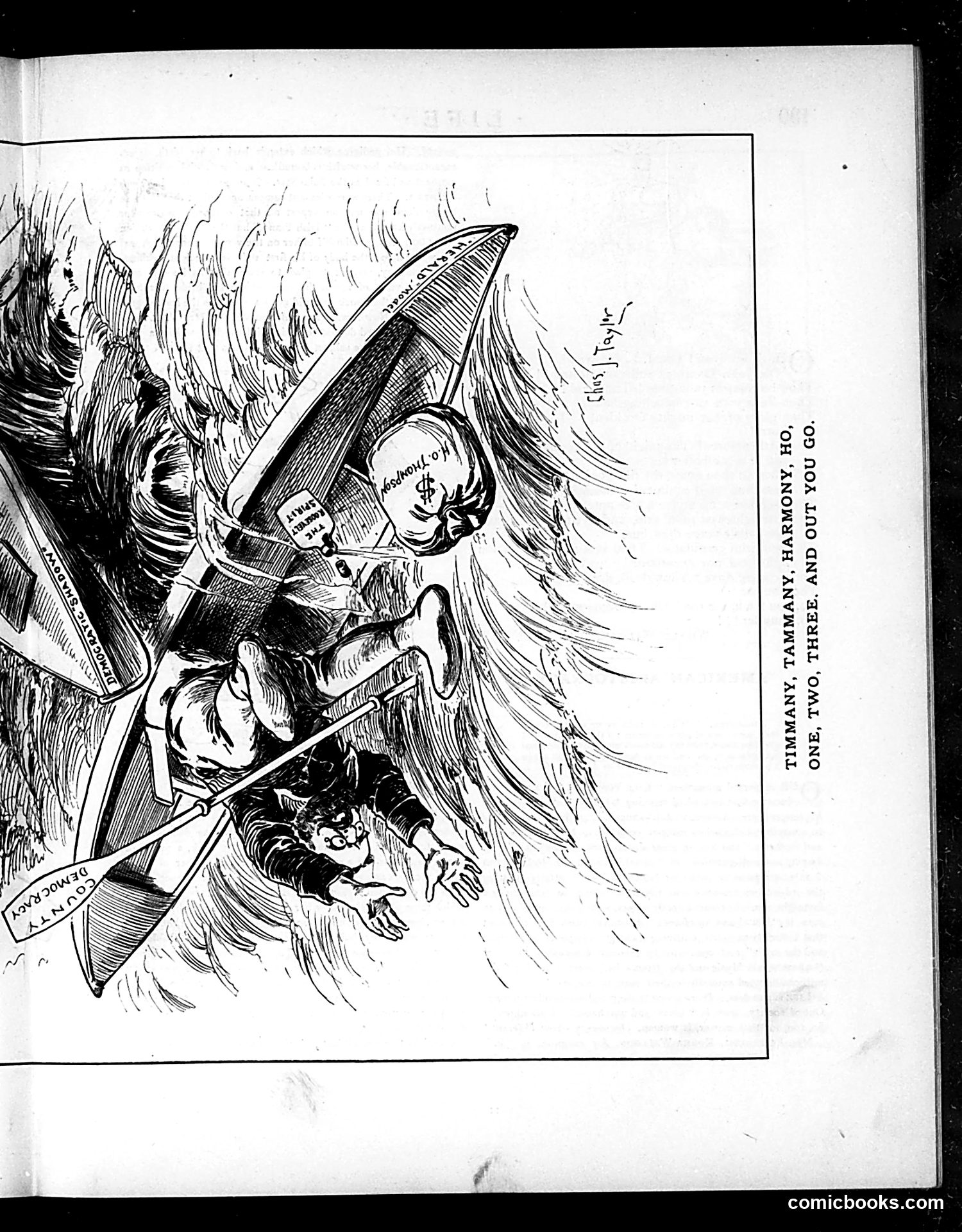
This political cartoon appears to satirize a figure wielding an axe amid flames, labeled with text referencing "TAMMANY" (likely Tammany Hall, the notorious New York Democratic political machine). The caption reads "TAMMANY TAMMANY FOR ONE, THREE, AND OUT YOU TOO." The cartoon depicts someone—possibly a political reformer or rival—attacking or destroying Tammany Hall's corrupt political structure, represented by the flames and chaos. The axe suggests violent overthrow or elimination of the organization's power. Without clearer identification of the specific figure or precise dating, the exact political context remains somewhat unclear, but this evidently comments on anti-corruption efforts or internal political conflict within New York's Democratic establishment during Tammany's era of power.
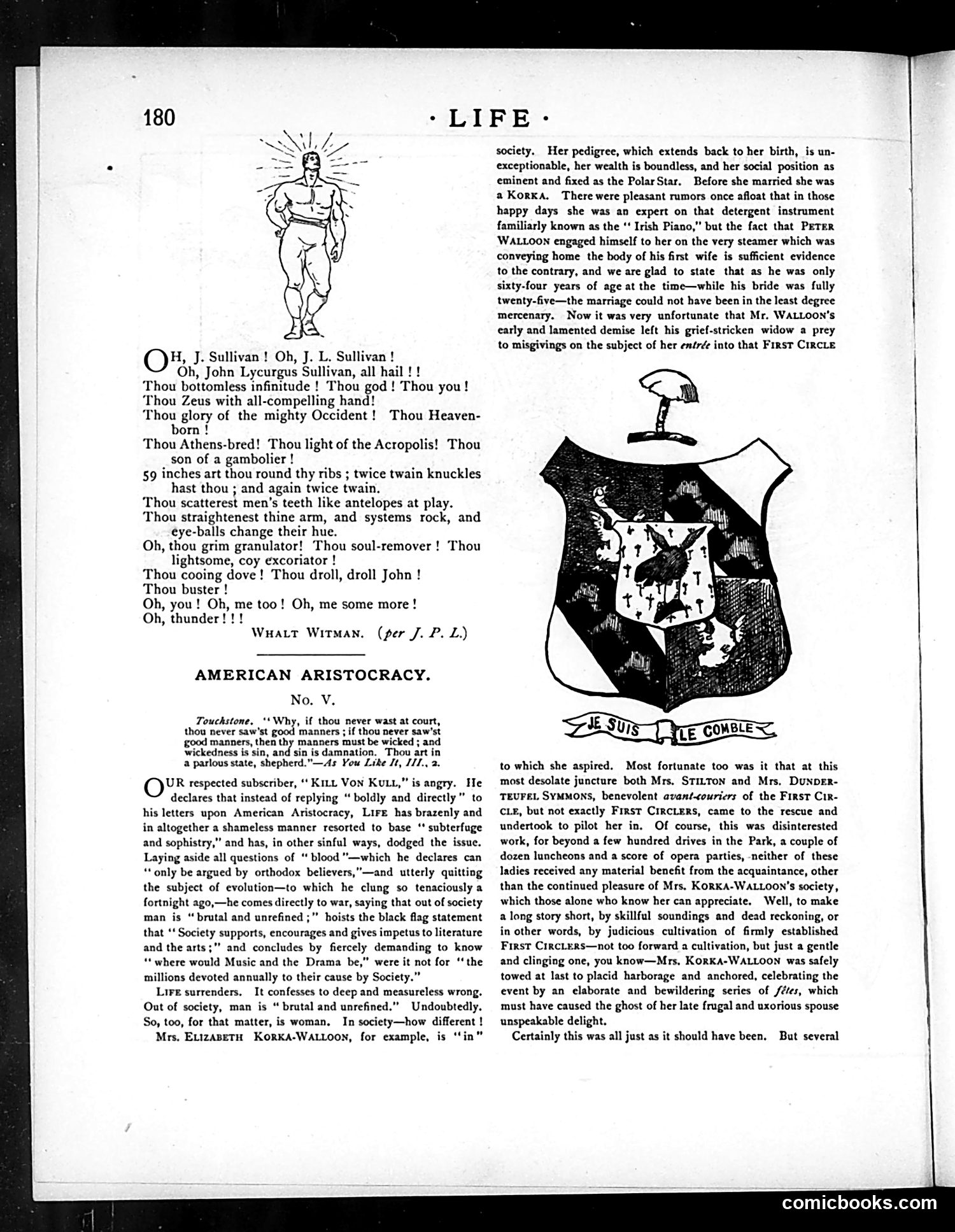
This page contains two satirical pieces from *Life* magazine: **Top: "Oh, J. Sullivan!"** — A mock-heroic poem (parodying Walt Whitman's style) celebrating **John L. Sullivan**, the famous heavyweight boxer. The exaggerated praise mocks celebrity worship and boxing mania, with absurd measurements ("59 inches round thy ribs") treating the pugilist as a god-like figure. **Bottom: "American Aristocracy, No. V"** — Social satire about class pretension. A reader ("Kill Von Kult") challenged *Life* to defend society's value; the magazine responds by mocking wealthy socialites. The main target appears to be **Mrs. Elizabeth Korka-Walloon**, a wealthy widow who married an elderly man (Peter Walloon) and gained entry to "First Circle" society through patronage by other socialites. The satire exposes the mercenary nature of high society: the women helping her advance received "no material benefit" except hundreds of carriage rides and opera parties—clearly implying hypocrisy and self-interest masquerading as benevolence.
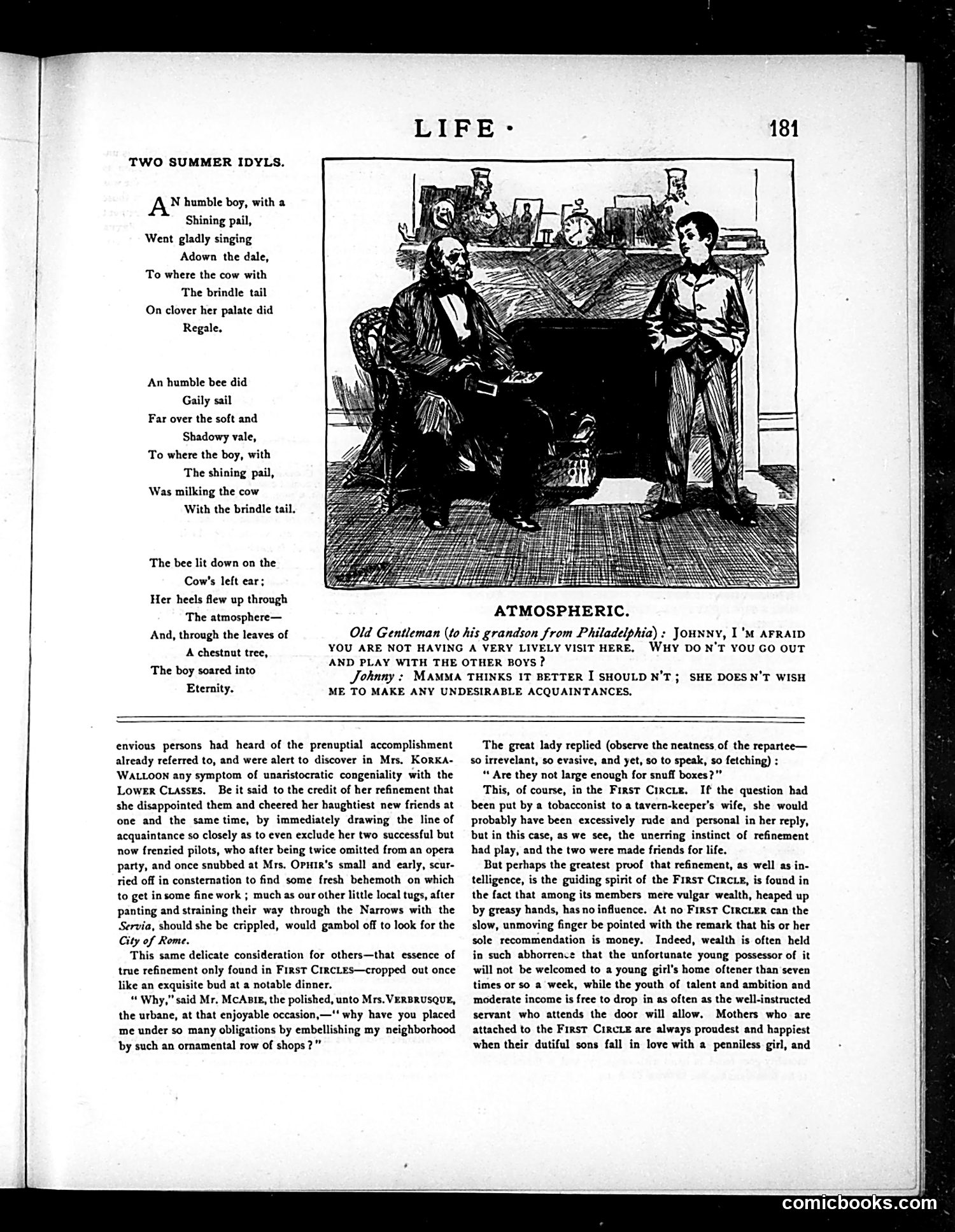
**"Two Summer Idyls"** (left column): A humorous poem about a boy milking a cow when a bee lands on the cow's ear. The startled cow kicks, sending the boy flying into the air—a slapstick joke about unexpected rural mishaps. **"Atmospheric"** (illustration and dialogue): An old gentleman asks his visiting grandson Johnny why he isn't playing with local boys. Johnny replies his mother forbids it because she doesn't want him making "undesirable acquaintances." This satirizes the snobbish class anxiety of wealthy urban families who fear their children mixing with "lower" social groups—even during leisure visits. **Lower text**: Extended satire mocking the pretensions of the wealthy "First Circle" elite. It ridicules how they maintain social barriers, exclude even successful business associates from their parties, and claim to value refinement over wealth—while simultaneously being obsessively status-conscious. The final anecdote about snuff boxes mocks their affected, evasive conversation style. The overall message: wealthy society people are hypocritical snobs.
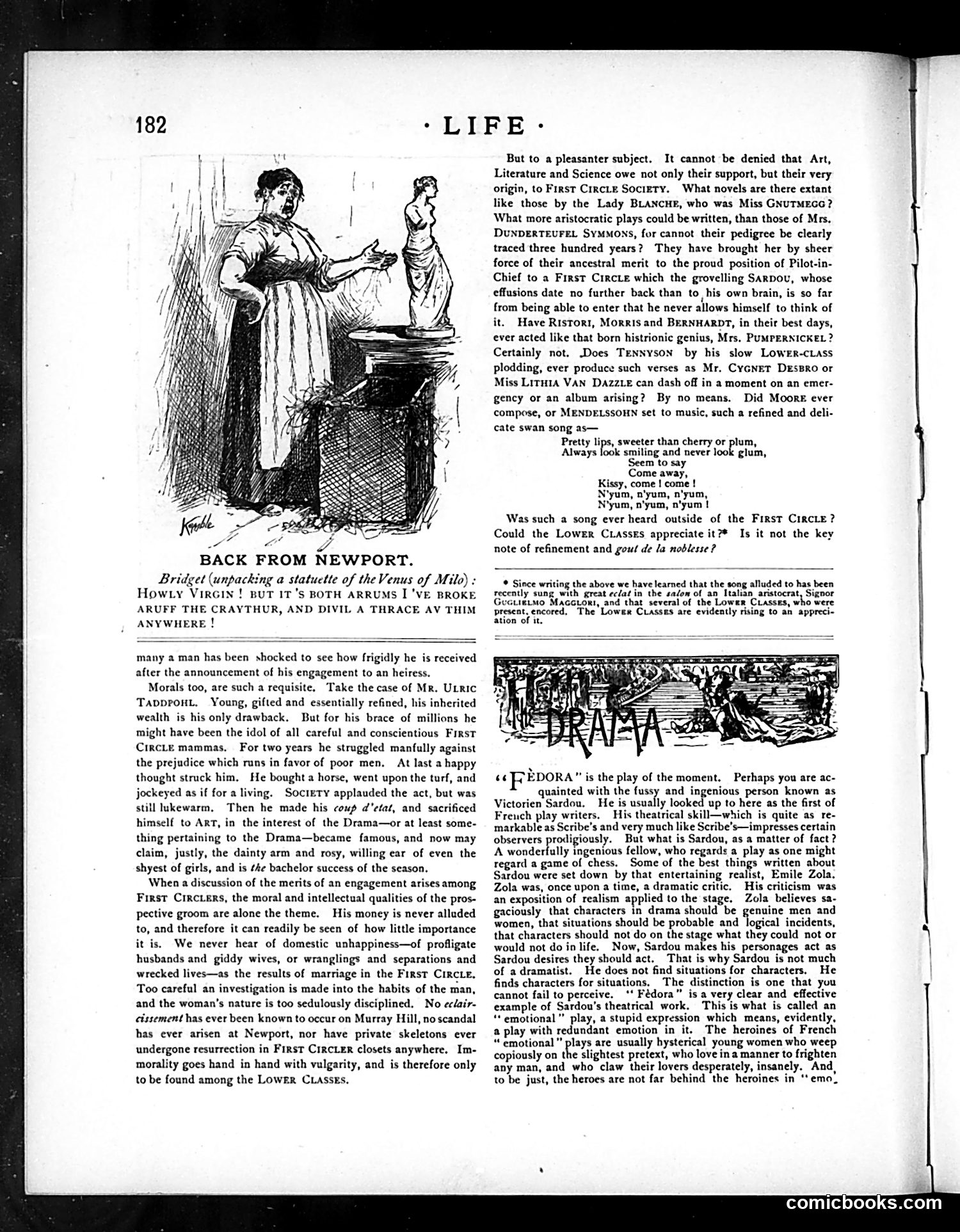
The cartoon shows **Bridget**, an Irish servant unpacking a broken Venus de Milo statue from Newport (a wealthy resort), speaking in Irish brogue—a common comedic device mocking working-class characters. The accompanying text savagely satirizes **First Circle Society**—wealthy Manhattan elites who claimed cultural superiority despite producing mediocre artists (fictional names like "Mrs. Pumpernickel," "Cygnet Desiro"). The satire's point: these aristocrats arrogantly believed themselves patrons of art and literature, yet their actual creative output was laughably inferior to genuine talents like Tennyson or Mendelssohn. The text also mocks First Circle obsession with **ancestry and wealth as moral markers**—a wealthy but morally questionable man (Ulric Taddpohl) could only gain social acceptance by pretending to sacrifice himself to Art. The satire exposes hypocrisy: First Circle society claimed to value morals and character over money, yet welcomed the wealthy while excluding the poor, and overlooked scandals among their own.
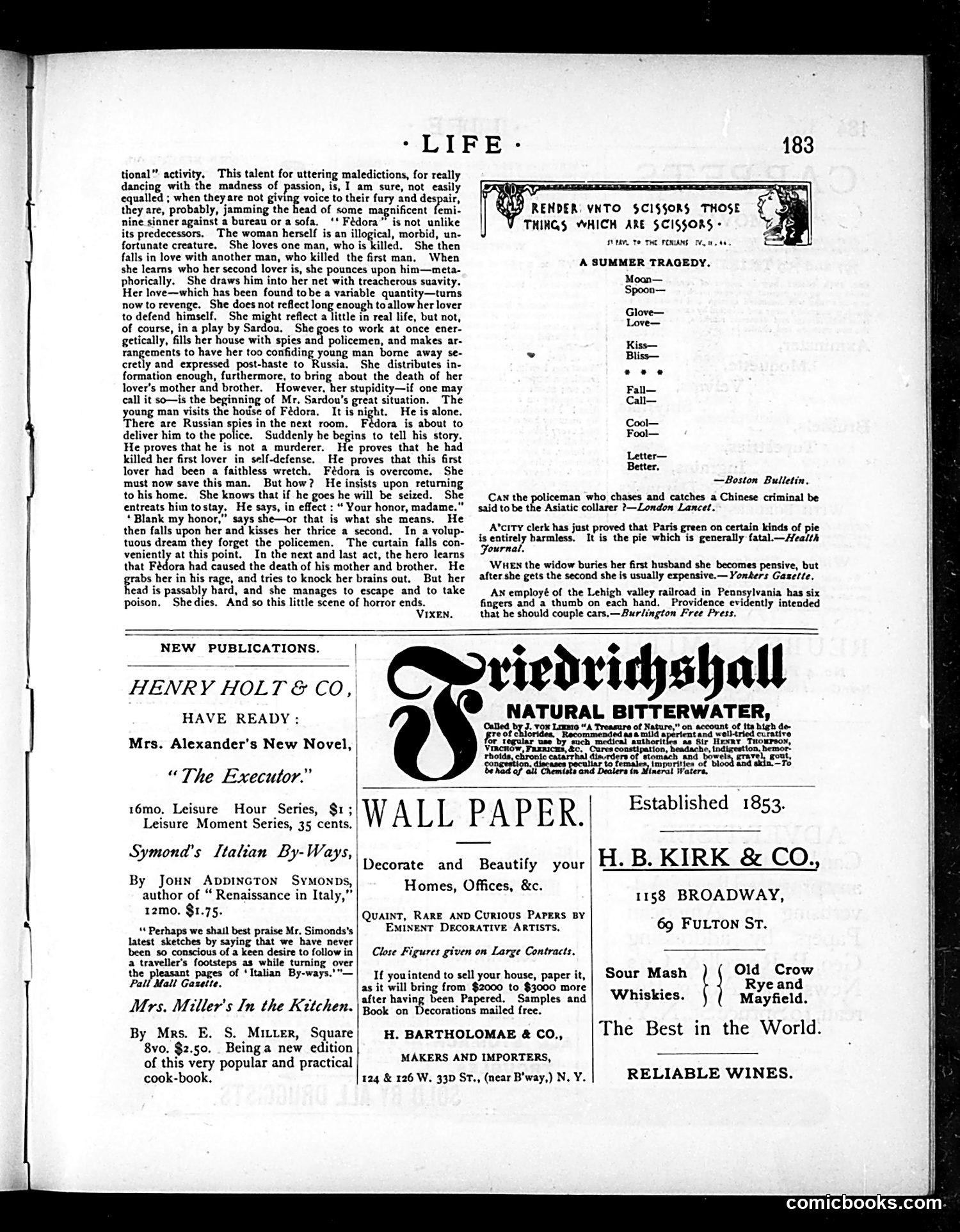
This page features a literary review of a play called "Fédora" (by Victorien Sardou, a popular 19th-century French dramatist), followed by humorous one-liners and advertisements. The main text mocks melodramatic theater conventions: an illogical female protagonist who falls in love with her first lover's murderer, then seeks revenge by having him deported to Russia. When he proves his innocence through passionate declaration, she attempts to save him—only to later discover he caused her mother and brother's deaths, leading to her suicide. The satire targets overwrought theatrical plots relying on improbable coincidences, extreme emotional swings, and moral reversals played for dramatic effect. The reviewer emphasizes the heroine's lack of reflection and the play's convenient plot mechanics ("The curtain falls conveniently"). The accompanying quips are typical "Life" humor: wordplay and social observations mocking everything from policemen to widows to railway workers—unrelated to the main review but filling space in this advertisement-heavy page.
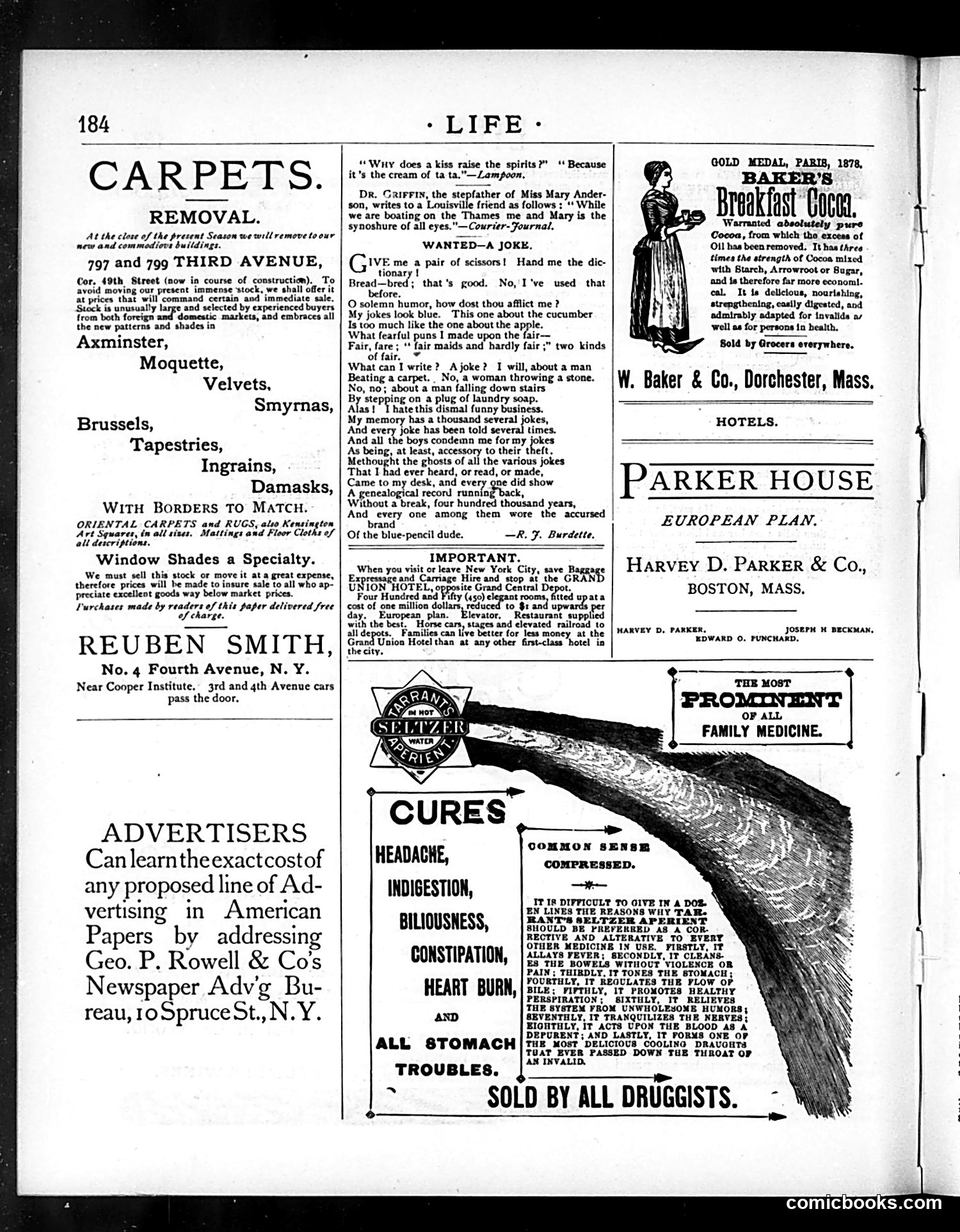
This page is primarily **advertisements and filler content** rather than political satire. The largest visual element is an advertisement for Seltzer Water, showing a bottle and claiming to cure headache, indigestion, billiousness, constipation, heart burn, and "all stomach troubles." This exemplifies 19th-century patent medicine marketing with exaggerated health claims. The "WANTED—A JOKE" section is **self-aware humor about editorial exhaustion**—a writer (credited to R.F. Burdette) laments the difficulty of creating original jokes, complaining that all his material has been previously published and scrutinized. This is an inside joke about the challenge of producing content for a humor magazine. Brief items mention Mary Anderson (an actress) and Dr. Gairrin's malapropism ("synoshure" for "cynosure"). These are trivial gossip items rather than substantive satire. The page also carries carpet removal advertisements and hotel promotions—typical commercial filler for 19th-century magazines.
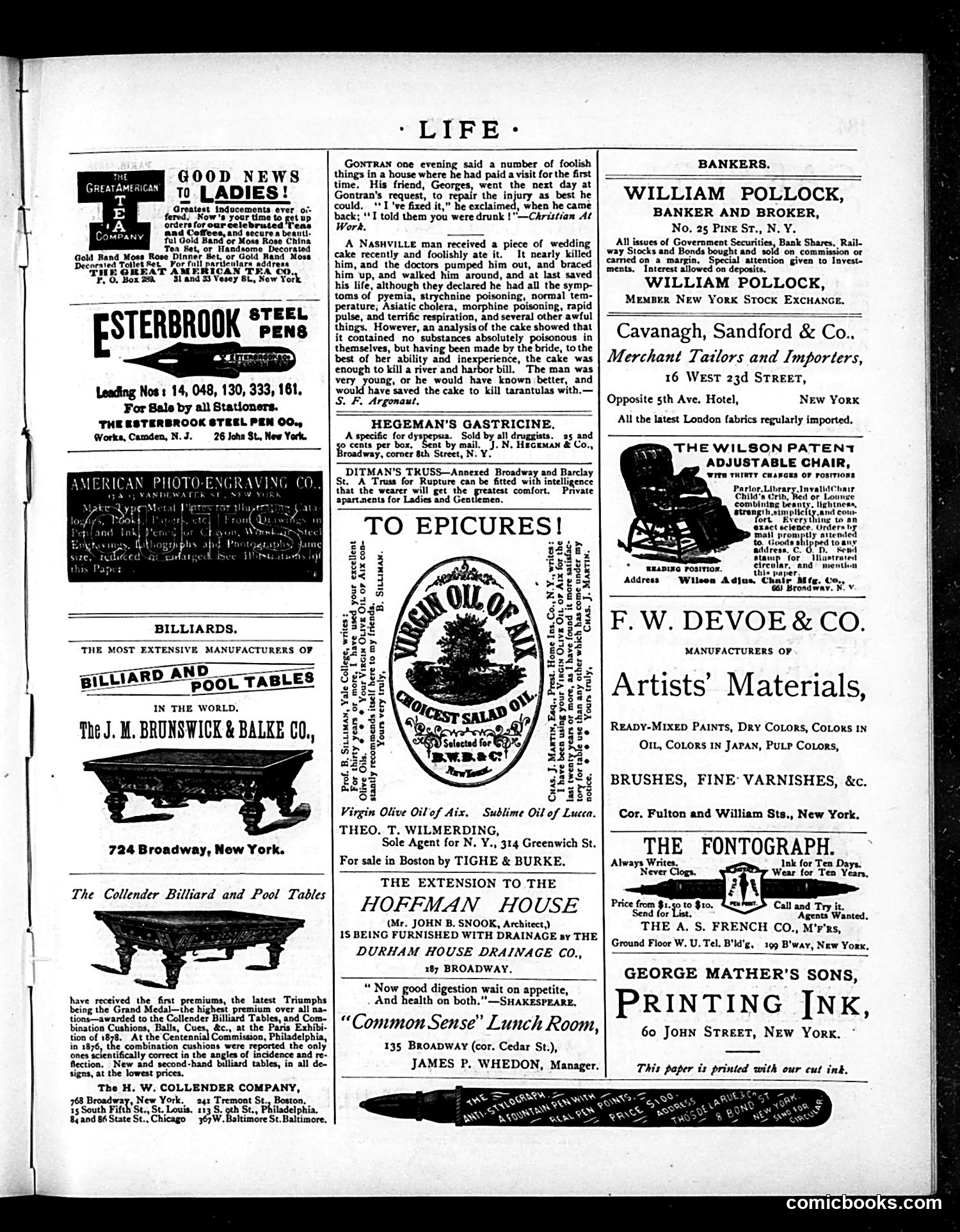
This is primarily an **advertising page** from Life magazine (a 19th-century satirical weekly), with minimal actual editorial content. The few short humor pieces serve mainly as filler among advertisements. The **satirical content** includes brief anecdotes: one mocks social embarrassment and the absurdity of blaming drunkenness on others; another jokes about a new bride's cooking being so bad her wedding cake nearly kills a guest—playing on the common era stereotype of poorly-skilled female cooks. The advertisements dominate, promoting billiard tables, fountain pens, artists' materials, printing ink, and olive oil, appealing to upper-class male consumers and ladies seeking household goods. **The satire is light and domestic** rather than political—there are no identifiable political figures or serious commentary. The humor relies on exaggeration and gentle mockery of social conventions and gender stereotypes typical of late 19th-century American humor magazines.
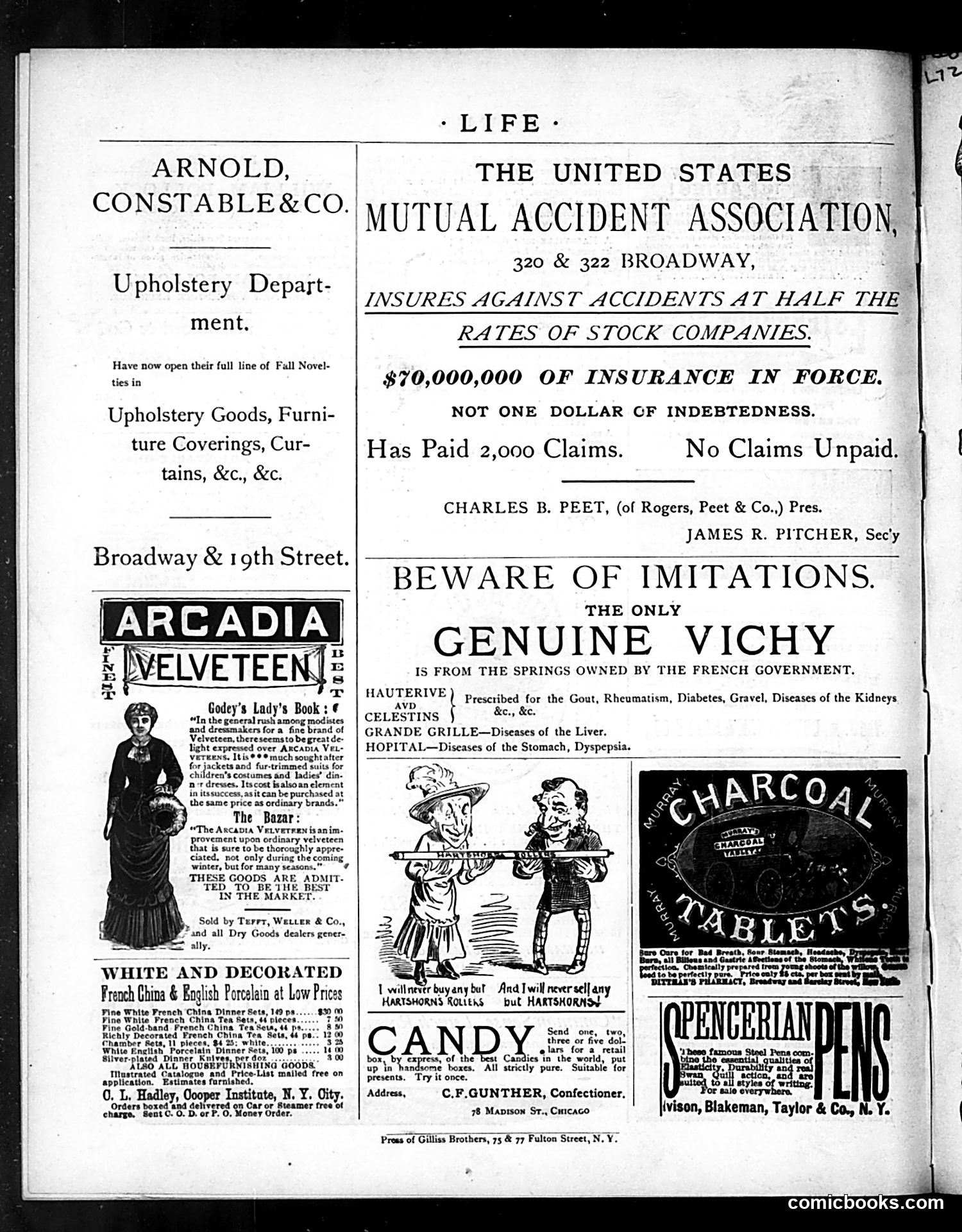
This page is primarily **advertising**, not satire or political commentary. It contains multiple product advertisements typical of a late 19th-century American magazine. The main cartoon appears in the center: two figures—apparently a woman and man in period dress—are depicted in a dispute over "Harthorns" candy, with speech bubbles indicating their conflicting claims about the product's authenticity. This likely illustrates a **common consumer concern of the era: counterfeit goods**. The accompanying text emphasizes that genuine Harthorns candy comes only from a specific confectioner (C.F. Gunther in Chicago), warning buyers against imitations. Similar authenticity warnings appear throughout the page—notably for Vichy mineral water (claimed genuine only from French government springs) and Arcadia Velveteen fabric. The cartoon's humor derives from the period's anxieties about **product fraud and brand counterfeiting**, reflecting growing consumer skepticism in an era before modern regulation and standardized labeling.