
Life, 1883-10-11 · page 12 of 16
Life — October 11, 1883 — page 12: what you’re looking at
What you’re looking at
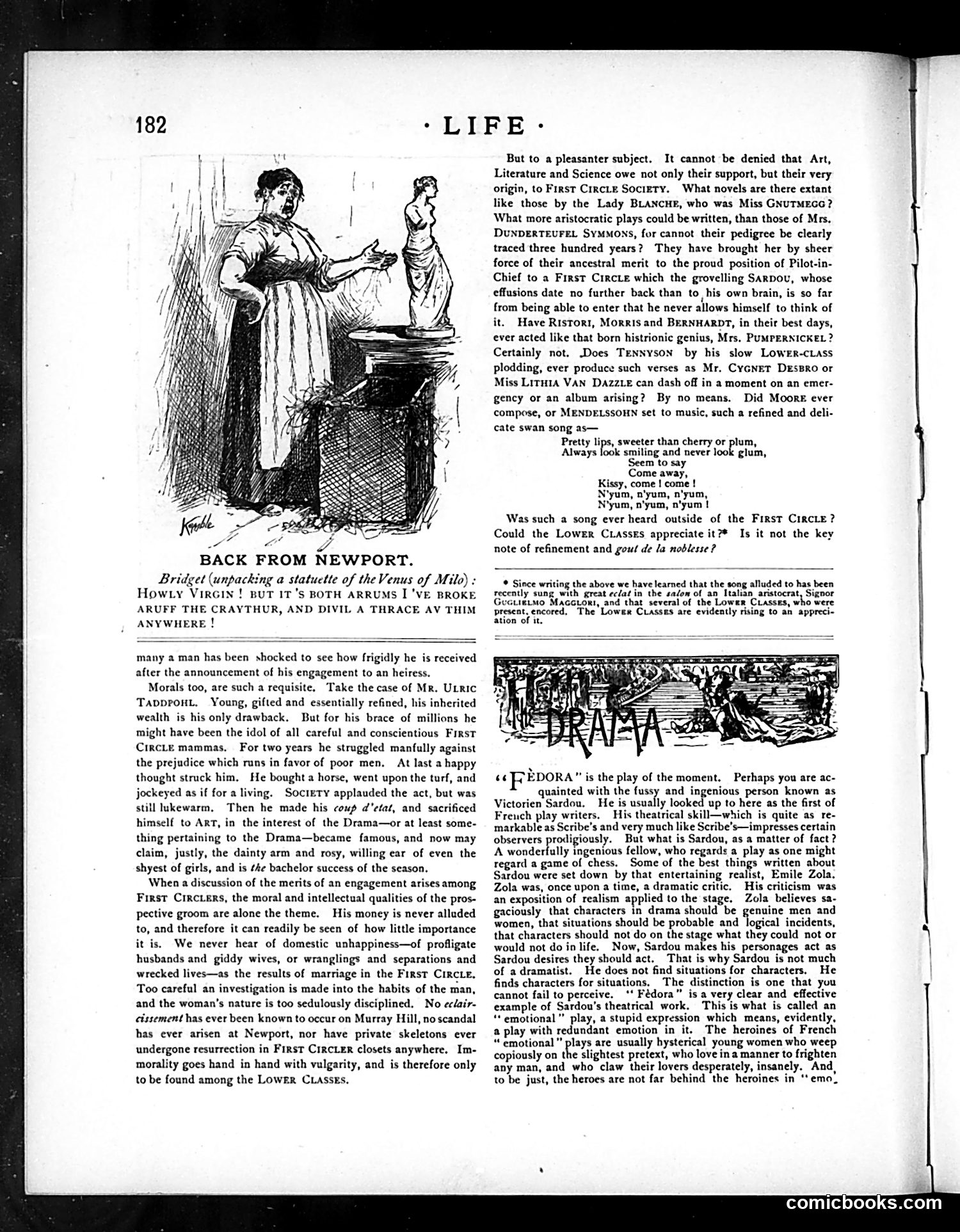
The cartoon shows **Bridget**, an Irish servant unpacking a broken Venus de Milo statue from Newport (a wealthy resort), speaking in Irish brogue—a common comedic device mocking working-class characters. The accompanying text savagely satirizes **First Circle Society**—wealthy Manhattan elites who claimed cultural superiority despite producing mediocre artists (fictional names like "Mrs. Pumpernickel," "Cygnet Desiro"). The satire's point: these aristocrats arrogantly believed themselves patrons of art and literature, yet their actual creative output was laughably inferior to genuine talents like Tennyson or Mendelssohn. The text also mocks First Circle obsession with **ancestry and wealth as moral markers**—a wealthy but morally questionable man (Ulric Taddpohl) could only gain social acceptance by pretending to sacrifice himself to Art. The satire exposes hypocrisy: First Circle society claimed to value morals and character over money, yet welcomed the wealthy while excluding the poor, and overlooked scandals among their own.
📄 Transcribed text from this page (OCR, searchable)
Machine-transcribed from the original scan — historical spelling and the odd misread are preserved.
‘SS \ Be V4 BACK FROM NEWPORT. Bridget (unpacking a statuette of the Venus of Milo) : How ty VirGin! BuT IT's BOTH ARRUMS I'VE BROKE ARUFF THE CRAYTHUR, AND DIVIL A THRACE AV THIM ANYWHERE ! ‘LIFE: But to a pleasanter subject. It cannot be denied that Art, Literature and Science owe not only their support, but their very origin, to First Crrcie Society. What novels are there extant like those by the Lady BLANCHE, who was Miss GNUTMEGG ? What more aristocratic plays could be written, than those of Mrs. DUNDERTEUFEL SYMMONS, for cannot their pedigree be clearly traced three hundred years? They have brought her by sheer force of their ancestral merit to the proud position of Pilot-in- Chief to a First Circie which the grovelling Sarpou, whose effusions date no further back than to his own brain, is so far from being able to enter that he never allows himself to think of it. Have Ristort, Morris and BERNHARDT, in their best days, ever acted like that born histrionic genius, Mrs, PUMPERNICKEL ? Certainly not. Does TENNYSON by his slow Lower-cLass plodding, ever produce such verses as Mr. CyGNET Dessro or Miss Lituta VAN Dazzze can dash off in a moment on an emer- gency or an album arising? By no means. Did Moore ever compose, or MENDELSSOHN set to music, such a refined and deli- cate swan song as— Pretty lips, sweeter than cherry or plum, Always look smiling and never look glum, Seem to say Come away, Kissy, come ! come ! N'yum, n'yum, n'yum, N'yum, n'yum, n'yum | Was such a song ever heard outside of the First C1ircre? Could the Lower Crasses appreciate it? Is it not the key note of refinement and gout de la noblesse ? * Since writing the above we have learned that the song alluded to has been recently sung with great ec/at in the sa/om of an Italian aristocrat, Signor Gvatieimo Macctont, and that several of the Lower CLasses, who were resent, encored, ‘The'Lowee Cuassis are evidently rising to ah appreci- ation of it, many a man has been shocked to see how frigidly he is received after the announcement of his engagement to an heiress. Morals too, are such a requisite, Take the case of Mr. ULric TavpronL. Young, gifted and essentially refined, his inherited wealth is his only drawback. But for his brace of millions he might have been the idol of all careful and conscientious First CircLe mammas. For two years he struggled manfully against the prejudice which rans in favor of poor men. At last a happy thought struck him. He bought a horse, went upon the turf, and jockeyed as if for a living. Society applauded the act, but was still lukewarm, Then he made his coup d'efat, and sacrificed himself to ArT, in the interest of the Drama—or at least some- thing pertaining to the Drama—became famous, and now may claim, justly, the dainty arm and rosy, willing ear of even the shyest of girls, and is ¢e bachelor success of the season. When a discussion of the merits of an engagement arises among First Crrcrers, the moral and intellectual qualities of the pros- pective groom are alone the theme. His money is never alladed to, and therefore it can readily be seen of how little importance it is. We never hear of domestic unhappiness—of profligate husbands and giddy wives, or wranglings and separations and wrecked lives—as the results of marriage in the First Circie. Too careful an investigation is made into the habits of the man, and the woman’s nature is too sedulously disciplined, No ec/air- cissement has ever been known to occur on Murray Hill, no scandal has ever arisen at Newport, nor have private skeletons ever undergone resurrection in First Crrcier closets anywhere, Im- morality goes hand in hand with vulgarity, and is therefore only to be found among the Lower CLAssEs. «¢ FPEDORA" is the play of the moment. Perhaps you are ac- quainted with the fussy and ingenious person known as Victorien Sardou. He is usually looked up to here as the first of French play writers. His theatrical skill—which is quite as re- markable as Scribe’s and very much like Scribe’s—impresses certain observers prodigiously. But what is Sardou, as a matter of fact? A wonderfully ingenious fellow, who regards a play as one might regard a game of chess. Some of the best things written about Sardou were set down by that entertaining realist, Emile Zola. Zola was, once upon a time, a dramatic critic. His criticism was an exposition of realism applied to the stage, Zola believes sa- gaciously that characters in drama should be genuine men and women, that situations should be probable and logical incidents, that characters should not do on the stage what they could not or would not do in life. Now, Sardou takes bis personages act as Sardou desires they should act. That is why Sardou is not much of adramatist. He does not find situations for characters, He finds characters for situations. The distinction is one that you cannot fail to perceive.‘ Fédora” isa very clear and effective example of Sardou’s theatrical work, This is what is called an “emotional” play, a stupid expression which means, evidently, a play with redundant emotion in it. The heroines of French “ emotional” plays are usually hysterical young women who weep copiously on the slightest pretext, who love ina manner to frighten any man, and who claw their lovers desperately, insanely. And, to be just, the heroes are not far behind the heroines in ‘temo, comicbooks.com